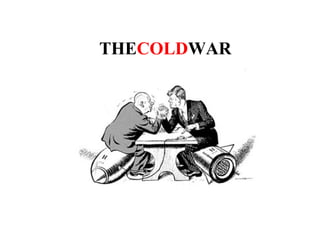
THECOLDWAR
HISTORY YEAR 9
THESTORY
The story of the Cold War is
the story of how two allies
who defeated Hitler became
competing superpowers
who took the world to the
brink of extinction.
WHYCOLD?
For more than 40 years (1945-1989) the USSR
was in conflict with the West. But that conflict
never came to open warfare.
Why? It was mainly because the existence of
nuclear weapons made hot war MAD
(mutually assured destruction).
That was why the conflict stayed a ‘cold war’;
both sides tried to undermine and destroy
each other, but not in a real war.
USA-USSR ALLIANCE
BREAKING DOWN
The USSR and the USA were separated by
a huge ideological difference. So the only
thing that held the allies together was the
need to destroy Hitler’s Nazis.
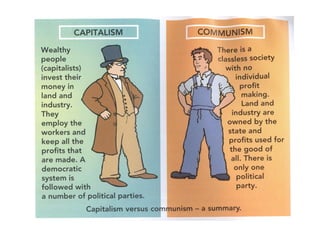
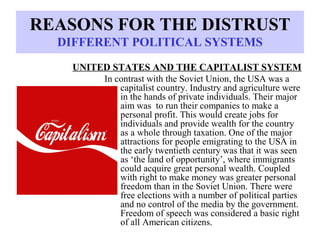
The USA was a capitalist democracy;
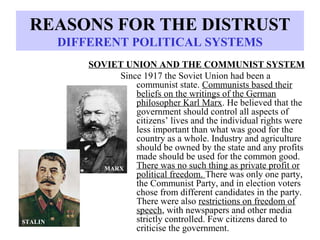
the USSR was a communist dictatorship.
Both sides believed that they held the key
to the future happiness of the human race.
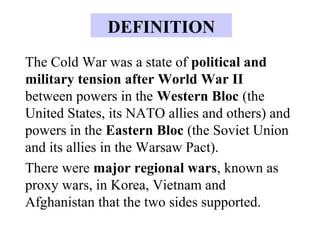
The Cold War was a state of political and
military tension after World War II
between powers in the Western Bloc (the
United States, its NATO allies and others) and
powers in the Eastern Bloc (the Soviet Union
and its allies in the Warsaw Pact).
There were major regional wars, known as
proxy wars, in Korea, Vietnam and
Afghanistan that the two sides supported.
DEFINITION
THE IRON
CURTAIN
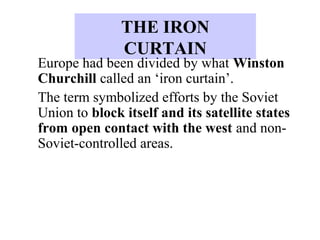
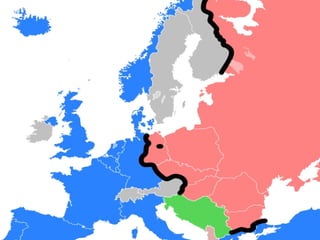
Europe had been divided by
what Winston Churchill
called an ‘iron curtain’.
The term symbolized efforts
by the Soviet Union to block
itself and its satellite states
from open contact with the
west and non-Soviet-
controlled areas.
MAJOR CRISIS
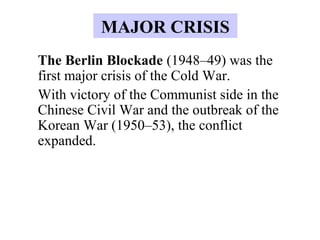
The Berlin Blockade (1948–49) was
the first major crisis of the Cold War.
With victory of the Communist side in
the Chinese Civil War and the
outbreak of the Korean War (1950–
53), the conflict expanded.
THE EASTERN BLOC
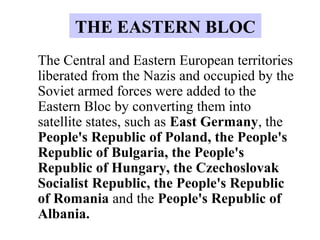
The Central and Eastern European territories
liberated from the Nazis and occupied by the
Soviet armed forces were added to the Eastern
Bloc by converting them into satellite states, such
as:
East Germany
Poland
Bulgaria
Hungary
Czechoslovakia
Romania
COLD WAR TIMELINE
1945
‘A’-Bomb dropped on Hiroshima + Nagasaki. USA ahead
in the arms race.
1947
Marshall Aid to the west of Europe. Stalin of USSR
refused it for Eastern Europe.
1948
Start of the Berlin Blockade – ended in 1949.
1949
NATO established; USSR exploded her first ‘A’-bomb;
China becomes communist.
COLD WAR TIMELINE
1950
Korean War started.
1952
USA exploded her first hydrogen bomb.
1953
Korean War ended. USSR exploded her first hydrogen
bomb. Stalin died.
1955
Warsaw Pact created. ‘Peaceful coexistence’ called for.
COLD WAR TIMELINE
1956
Hungary revolts against USSR. Suez Crisis.
1957
Sputnik launched.
1959
Cuba becomes a communist state.
1961
Military aid sent to Vietnam by USA for the first time.
Berlin Wall built.
1962
Cuban Missile Crisis.
COLD WAR TIMELINE
1963
Huge increase of American aid to Vietnam.
1965
USA openly involved in Vietnam.
1967
Six-Day War in Middle East.
1968
USSR invades Czechoslovakia.
COLD WAR TIMELINE
1973
Yom Kippur War.
1979
USSR invaded Afghanistan.
1986
Meeting in Iceland between USSR (Gorbachev) and USA
(Reagan).
1987
INF Treaty signed.

HISTORY YEAR 9 - THE COLD WAR

  • 1.
  • 2.
    THESTORY The story ofthe Cold War is the story of how two allies who defeated Hitler became competing superpowers who took the world to the brink of extinction.
  • 3.
    WHYCOLD? For more than40 years (1945-1989) the USSR was in conflict with the West. But that conflict never came to open warfare. Why? It was mainly because the existence of nuclear weapons made hot war MAD (mutually assured destruction). That was why the conflict stayed a ‘cold war’; both sides tried to undermine and destroy each other, but not in a real war.
  • 4.
    USA-USSR ALLIANCE BREAKING DOWN TheUSSR and the USA were separated by a huge ideological difference. So the only thing that held the allies together was the need to destroy Hitler’s Nazis. The USA was a capitalist democracy; the USSR was a communist dictatorship. Both sides believed that they held the key to the future happiness of the human race.
  • 5.
    The Cold Warwas a state of political and military tension after World War II between powers in the Western Bloc (the United States, its NATO allies and others) and powers in the Eastern Bloc (the Soviet Union and its allies in the Warsaw Pact). There were major regional wars, known as proxy wars, in Korea, Vietnam and Afghanistan that the two sides supported. DEFINITION
  • 6.
    THE IRON CURTAIN Europe hadbeen divided by what Winston Churchill called an ‘iron curtain’. The term symbolized efforts by the Soviet Union to block itself and its satellite states from open contact with the west and non-Soviet- controlled areas.
  • 8.
    MAJOR CRISIS The BerlinBlockade (1948–49) was the first major crisis of the Cold War. With victory of the Communist side in the Chinese Civil War and the outbreak of the Korean War (1950– 53), the conflict expanded.
  • 9.
    THE EASTERN BLOC TheCentral and Eastern European territories liberated from the Nazis and occupied by the Soviet armed forces were added to the Eastern Bloc by converting them into satellite states, such as: East Germany Poland Bulgaria Hungary Czechoslovakia Romania
  • 10.
    COLD WAR TIMELINE 1945 ‘A’-Bombdropped on Hiroshima + Nagasaki. USA ahead in the arms race. 1947 Marshall Aid to the west of Europe. Stalin of USSR refused it for Eastern Europe. 1948 Start of the Berlin Blockade – ended in 1949. 1949 NATO established; USSR exploded her first ‘A’-bomb; China becomes communist.
  • 11.
    COLD WAR TIMELINE 1950 KoreanWar started. 1952 USA exploded her first hydrogen bomb. 1953 Korean War ended. USSR exploded her first hydrogen bomb. Stalin died. 1955 Warsaw Pact created. ‘Peaceful coexistence’ called for.
  • 12.
    COLD WAR TIMELINE 1956 Hungaryrevolts against USSR. Suez Crisis. 1957 Sputnik launched. 1959 Cuba becomes a communist state. 1961 Military aid sent to Vietnam by USA for the first time. Berlin Wall built. 1962 Cuban Missile Crisis.
  • 13.
    COLD WAR TIMELINE 1963 Hugeincrease of American aid to Vietnam. 1965 USA openly involved in Vietnam. 1967 Six-Day War in Middle East. 1968 USSR invades Czechoslovakia.
  • 14.
    COLD WAR TIMELINE 1973 YomKippur War. 1979 USSR invaded Afghanistan. 1986 Meeting in Iceland between USSR (Gorbachev) and USA (Reagan). 1987 INF Treaty signed.