Project Management –
Description (1)
7/26/2017 1Arch. Dania Abdel-Aziz/ Lecture 2
Arch. Dania Abdel-Aziz
University of Jordan Year 2016/2017
2nd Summer Semester
We are going to discus Project management under those main three
headlines:
1. Description.
2. Application.
3. Implementation Procedure.
7/26/2017 Arch. Dania Abdel-Aziz/ Lecture 2 2
1. DESCRIPTION.
7/26/2017 Arch. Dania Abdel-Aziz/ Lecture 2 3
Contents
Project Management Description.
1.1. Why project management emerged?
1.2 Project Phases And The Project Life Cycle.
1.2.1. Types of dependency relationships.
1.3 Objectives of the technique.
7/26/2017 4Arch. Dania Abdel-Aziz/ Lecture 2
Why project management emerged?
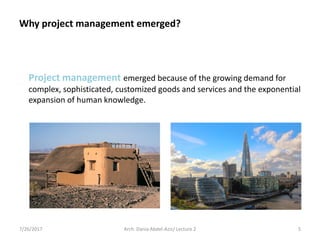
Project management emerged because of the growing demand for
complex, sophisticated, customized goods and services and the exponential
expansion of human knowledge.
7/26/2017 5Arch. Dania Abdel-Aziz/ Lecture 2
7/26/2017 Arch. Dania Abdel-Aziz/ Lecture 2 6
Because projects are unique undertakings, they
involve a degree of uncertainty.
• Organizations performing projects will usually
divide each project into several project
phases to:
• improve management control provide
for links to the ongoing operations of
the performing organization.
• Collectively, the project phases are known as
the project life cycle.
7/26/2017 7Arch. Dania Abdel-Aziz/ Lecture 2
Project Phases And The Project Life Cycle
The idea of a life cycle is a familiar one.
We all experience birth, growth, adulthood, old age and death at one time or
another.
7/26/2017 8Arch. Dania Abdel-Aziz/ Lecture 2
Most projects go through similar stages on the path from beginning to end.
• The project is born (its start-up phase).
• A manager is selected.
• The project team and initial resources are assembled.
• The work program are organized.
• The work gets under way and momentum quickly builds.
• Progress is made.
• This continues until the end is in sight.
7/26/2017 Arch. Dania Abdel-Aziz/ Lecture 2 9
Project Phases And The Project Life Cycle
The whole process or stages of growth in the life cycle of a project can be
listed as follows:
1.Initiation;
2.Planning;
3.Executing;
4.Monitoring & Controlling;
5.Closing
7/26/2017 Arch. Dania Abdel-Aziz/ Lecture 2 10
Project Phases And The Project Life Cycle
The Project Process
7/26/2017 Arch. Dania Abdel-Aziz/ Lecture 2 11
Project
set-upMajor
Project
Proposals
Project
Definition Conceptual
Design Scheme
Design Detailed
Design
Tender
Invitation &
Assessment
Manufacture
Equipment Install
Equipment
Confirm
Completion
Test &
Commission
Project
Review
Appoint Project Sponsor
Assess Project Priority
Assess Budget Implications
Est. Proj. Deliverables and Objectives
Appoint Project Leader
Approve Project Set-up
Draft Statement of Requirements (SoR)
Review & Approve SoR Identify
Resources Appoint Project
Team Produce & Maintain
Procurement Plans
Undertake Project Risk Assessment
Prepare Project Boundary Document
Develop Project Management Plan (PMP)*
Raise initial TCD-R/PERF**
Prepare Preliminary Conceptual Design**
Raise/Extend/Update initial TCD-R/PERF
Prepare Outline Conceptual Design
Define Design Constraints Prepare
Interface Requirements Spec. (IRP)
Finalise Conceptual Design
Hold Conceptual Design Review (CDR)
Clear CDR Issues
Initiate Modification Safety Case
Update PMP
Approve Proceed to Detailed Design
Raise/Extend Sub-system TCD-Rs/PERFs
Agree Classifications & Interfaces
Prepare Sub-system Scheme Design
Hold Sub-system Scheme Design Review (SDR)
Clear Sub-system SDR Issues
Update PMP
Use TCD-I/MMAC for Sub-system SD Approval
Extend TCD-Rs/PERFs
Prepare Sub-system Detailed Design Hold
Detailed Design Review (DDR)
Clear Sub-system DDR Issues
Use TCD-I/MMAC for Sub-system DD Approval
Prepare Final Documents including:
- Design Documents., Machine Compatibility
Documents., Safety Case Modification
Compile Tender Docs.***
Send out Invitations (ITTS)
Hold Clarification Meetings
Receive Tenders
Evaluate Tenders
Arrange site visits
Approve changes to Specs.
Choose preferred Company
Raise Contract Documentation
Place Contract
Hold Kick off Meeting (KOM)
Clarify Issues (Quality Plan)
Monitor Progress
Witness key Procedures
Complete Release Note
Approve Complete Package****
Approve Release Note
Pack & Dispatch Equipment
Receive Equipment
Pre-test Equipment
Install equipment
Test Equipment against Test Schedule
Commission Complete System
Confirm Technical Completion
Review Project Records Complete
Handover Documents Resolve
Reservations Obtain
Acceptance of Completed Project
Initiate Project
Undertake Design
Implement Project
Complete Project
EFDA/CSU/JOC Management
Project Leader/Project Team/EFDA/CSU
Project Team/IRP/EFDA/CSU/JDC
Project Team/Interfaces
Project Team/Interfaces/EFDA/CSU/JDC
Project Team/ICM
Project Team/ICM/EFDA/CSU
Project Team/EFDA/CSU
Project Team/CSU
Undertake Post
Project Review
Project Team/Contracts/EFDA
Project Team/Contractor/ICM
Prepare Technical Design
Ensure Machine Compatibility Prepare
Safety Case Modification
*** These will comprise:
- Technical Specification
- Drawings
- Contractual Requirements
Note: Overall Project
Management and Reporting will
be as defined in the Project
Management Plan (PMP)
**** This includes
supporting documentation
Gate 4
Gate 1 Gate 2 Gate 3
Gates (Formal Decision Points)
Gate 0
Project Justification
- Approve Project Definition
Design Approval
- Approval of
Final Documents
Readiness for
Manufacture
- Approval to
place Contract
Readiness for Operation
- Acceptance of System
Strategic and Budgetary
Approval
Undertake Tender
* This will include:
- Initial WBS, OBS and CBS
- Project Plan
- Risk and Procurement Strategies
** These will only take place here
for large projects demanding DO
effort for preliminary Conceptual
work
Characteristics of Project Phases
Each project phase is marked by completion of one or more deliverables.
• A deliverable is a tangible, verifiable work product such as:
 a feasibility study,
 a detail design,
 or a working prototype.
The deliverables, and hence the phases, are part of a generally sequential
logic designed to ensure proper definition of the product of the project.
7/26/2017 12Arch. Dania Abdel-Aziz/ Lecture 2
Phases and deliverables
7/26/2017 Arch. Dania Abdel-Aziz/ Lecture 2 13
Characteristics of Project Phases
The conclusion of a project phase is generally marked by a review of both key
deliverables and project performance to date, to:
a) Determine if the project should continue into its next phase.
b) Detect and correct errors cost effectively.
These phase-end reviews are often called phase exits, stage gates, or
kill points.
7/26/2017 14Arch. Dania Abdel-Aziz/ Lecture 2
Characteristics of Project Phases
Each project phase normally includes a set of defined deliverables designed
to establish the desired level of management control.
7/26/2017 15Arch. Dania Abdel-Aziz/ Lecture 2
Characteristics of the Project Life Cycle
Project life cycles generally define:
a) What technical work should be done in each phase.
Example: is the work of the architect part of the definition phase or part
of the execution phase.
b) Who should be involved in each phase.
Example: implementers who need to be involved with requirements and
design.
7/26/2017 Arch. Dania Abdel-Aziz/ Lecture 2 16
7/26/2017 Arch. Dania Abdel-Aziz/ Lecture 2 17
Characteristics of the Project Life Cycle
1. The project life cycle serves to define the beginning and the end of a
project.
For example, when an organization identifies an opportunity to which it would like to
respond, it will often authorize a needs assessment and/or a feasibility study to
decide if it should undertake a project.
2. The project life-cycle definition will determine whether the feasibility
study is treated as the first project phase or as a separate, standalone
project.
7/26/2017 Arch. Dania Abdel-Aziz/ Lecture 2 18
Characteristics of the Project Life Cycle
• The project life-cycle definition will also determine which transitional
actions at the beginning and the end of the project are included and which
are not.
In this manner, the project life cycle definition can be used to link the
project to the ongoing operations of the performing organization.
7/26/2017 19Arch. Dania Abdel-Aziz/ Lecture 2
Characteristics of the Project Life Cycle
 Good To Know:
• Deliverables from the preceding phase are usually approved before work
starts on the next phase.
• However a sub-sequent phase is sometimes begun prior to approval of
the previous phase deliverables when the risks involved are deemed
acceptable.
• This practice of overlapping phases is often called fast tracking.
7/26/2017 20Arch. Dania Abdel-Aziz/ Lecture 2
Characteristics of the Project Life Cycle
7/26/2017 Arch. Dania Abdel-Aziz/ Lecture 2 21
 Good To Know:
Project life-cycle descriptions may be very general or very detailed.
Highly detailed descriptions may have numerous forms, charts, and
checklists to provide structure and consistency.
Such detailed approaches are often called project management
methodologies.
Characteristics of the Project Life Cycle
Most project life-cycle descriptions share a number of common
characteristics:
a) Cost and staffing levels are low at the start, higher toward the end, and
drop rapidly as the project draws to a conclusion (Why?).
7/26/2017 22Arch. Dania Abdel-Aziz/ Lecture 2
Answer
• At the start of the project there are only a few activities going on, not all
activities can proceed, thus you have to start these activities (which need
lower staff and cost less).
• For example, you have the initiation, the mobilization, the start up (in
construction this might be excavation, levelling, foundations) then many
other activities open up as well as continuing with these activities
(columns, slabs, plastering ... etc) which all proceed in parallel and need
more staff and money.
7/26/2017 Arch. Dania Abdel-Aziz/ Lecture 2 23
Characteristics of the Project Life Cycle
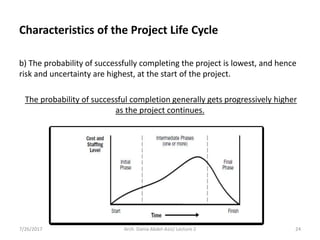
b) The probability of successfully completing the project is lowest, and hence
risk and uncertainty are highest, at the start of the project.
The probability of successful completion generally gets progressively higher
as the project continues.
7/26/2017 24Arch. Dania Abdel-Aziz/ Lecture 2
Characteristics of the Project Life Cycle
c) The ability of the stakeholders to influence the final characteristics of the
project's product and the final cost of the project is highest at the start and
gets progressively lower as the project continues (Why?).
7/26/2017 25Arch. Dania Abdel-Aziz/ Lecture 2
• At the start, the work had not yet started, or minimal work has started
(the activities mentioned in point 1 above), the stakeholders still have the
flexibility to make changes (whether it is as big as changing the whole
scope or as little as changing one of the materials used), with these
change they influence the characteristics and final cost.
• As a project progresses (and assuming we do not want to demolish works
already being carried out), change is limited as the works have progressed
and we do not want destroy existing works. the characteristics (and scope)
have already been established, and any change will have a great cost
(getting new materials, delaying works until changes are finalized, time is
money so delays will cost you.)
7/26/2017 Arch. Dania Abdel-Aziz/ Lecture 2 26
Answer
THE PROJECT MANAGEMENT TOOLS AND
PRINCIPLES PROVIDE THE MEANS FOR
7/26/2017 Arch. Dania Abdel-Aziz/ Lecture 2 27
1. Project breakdown into tasks and sub-tasks.
2. Finding interdependencies between the tasks.
3. Allocating resources, human and material and smoothing resources.
4. Estimation for total project duration and budget.
5. Monitoring more efficiently project progress.
7/26/2017 28Arch. Dania Abdel-Aziz/ Lecture 2
The project management tools and principles provide the
means for:
The project management tools and principles provide the
means for:
1. project breakdown into tasks and sub-tasks.
7/26/2017 Arch. Dania Abdel-Aziz/ Lecture 2 29
2. Finding interdependencies between the tasks.
Dependencies are the relationships among tasks which determine the order
in which activities need to be performed.
There are four (4) types of dependency relationships:
1. Finish-to-start.
2. Start-to-start.
3. Finish-to-finish.
4. Start-to-finish.
7/26/2017 Arch. Dania Abdel-Aziz/ Lecture 2 30
The project management tools and principles provide the
means for:
Types of dependencies:
1. Finish-to-start (FS) dependencies.
Predecessor must finish before Successor can start.
This is the most common type of dependency and is the default type of
dependency that Project uses.
In a finish-to-start dependency, the second task in the relationship can’t
begin until the first task finishes.
[Land must be purchased before road building can start].
7/26/2017 Arch. Dania Abdel-Aziz/ Lecture 2 31
• So, for example, if you were planning a project to make a wedding cake, you might
use a finish-to-start dependency between the “Bake cake” and “Decorate cake”
tasks.
• When the “Bake cake” task is finished, the “Decorate cake” task begins.
7/26/2017 Arch. Dania Abdel-Aziz/ Lecture 2 32
Types of dependencies:
2. Start-to-start (SS) dependencies
Predecessor must start before Successor can start.
The second task in the relationship can’t begin until after the first task in
the relationship begins.
Start-to-start dependencies don’t require that both tasks start at the
same time. They simply require that the first task has begun, in order for
the second task to begin.
[Road excavating must start before Asphalt can be laid]
7/26/2017 Arch. Dania Abdel-Aziz/ Lecture 2 33
• Going back to the wedding cake example, let’s say you had planned to make the
icing for the cake while the cake is baking in the oven.
• You can’t start making the icing until the cake has started baking, so you might use
a start-to-start dependency between the “Bake cake” and “Make icing” tasks.
7/26/2017 Arch. Dania Abdel-Aziz/ Lecture 2 34
3. Finish-to-finish (FF) dependency
Predecessor must finish before Successor can finish.
Finish-to-finish dependencies don’t require that both tasks be completed
simultaneously.
They simply require that the first task be finished, in order for the second
task to finish.
The second task can finish any time after the first task finishes.
[Laying Asphalt must be complete before line painting can be completed]
7/26/2017 Arch. Dania Abdel-Aziz/ Lecture 2 35
• In our wedding cake example, let’s say there are some finishing touches to the
decorations that you can’t finish until the cake is delivered. You can use a finish-to-
finish dependency between the “Decorate cake” and “Deliver cake” tasks.
• When the “Decorate cake” task is finished, then the “Deliver cake” task can be
completed.
7/26/2017 Arch. Dania Abdel-Aziz/ Lecture 2 36
4. Start-to-finish (SF) dependency
Predecessor must start before Successor can finish.
is a little tricky.
the second task in the relationship can’t finish until the first task starts.
However, the second task can finish any time after the first task starts.
[Road excavating must start before line painting can be completed]
7/26/2017 Arch. Dania Abdel-Aziz/ Lecture 2 37
4. Start-to-finish (SF) dependency
• Going back to our wedding cake example, let’s say you have a task for billing the
customer. It begins when the customer requests the cake, but it can’t be
completed until after the cake delivery has begun. You can use a start-to-finish
dependency between the “Deliver cake” and “Bill customer” tasks, so that when
the “Deliver cake” task has begun, it is okay for the “Bill customer” task to finish.
7/26/2017 Arch. Dania Abdel-Aziz/ Lecture 2 38
• So when you put the entire plan together, with these dependencies intact, the
plan might look something like this:
7/26/2017 Arch. Dania Abdel-Aziz/ Lecture 2 39
Exercise (1)
Write down your own examples for the four dependency types.
7/26/2017 Arch. Dania Abdel-Aziz/ Lecture 2 40
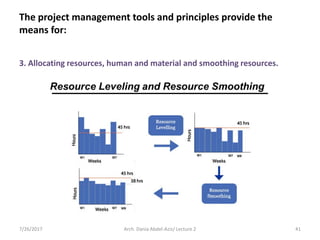
3. Allocating resources, human and material and smoothing resources.
7/26/2017 Arch. Dania Abdel-Aziz/ Lecture 2 41
The project management tools and principles provide the
means for:
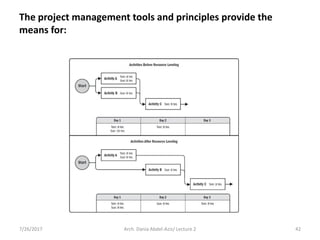
7/26/2017 Arch. Dania Abdel-Aziz/ Lecture 2 42
The project management tools and principles provide the
means for:
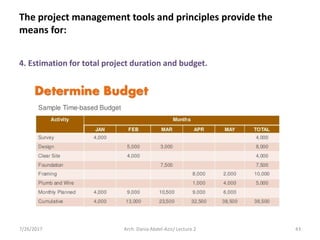
4. Estimation for total project duration and budget.
7/26/2017 Arch. Dania Abdel-Aziz/ Lecture 2 43
The project management tools and principles provide the
means for:
5. Monitoring more efficiently project progress.
7/26/2017 Arch. Dania Abdel-Aziz/ Lecture 2 44
The project management tools and principles provide the
means for:
Project management ideas are equally applicable to small as well as very
large projects (with small and large number of tasks).
• However, the formal tools used are more appropriate for rather large
projects.
7/26/2017 45Arch. Dania Abdel-Aziz/ Lecture 2
1.3. OBJECTIVES OF THE TECHNIQUE
7/26/2017 Arch. Dania Abdel-Aziz/ Lecture 2 46
1.3. Objectives of the technique
• The basic purpose for initiating a project is to accomplish some goals.
• The reason for organizing the task as a project is to focus the responsibility
and authority for the attainment of the goals on an individual (project
manager) or a small group (project team).
7/26/2017 47Arch. Dania Abdel-Aziz/ Lecture 2
Project Management is a means by which to fit the many complex pieces of
the project puzzle together, both human and technical, by use of:
1. Schedules.
2. Budgets, including resource allocation.
3. Scope (product) definition.
7/26/2017 48Arch. Dania Abdel-Aziz/ Lecture 2
1.3. Objectives of the technique
7/26/2017 Arch. Dania Abdel-Aziz/ Lecture 2 49
1. Schedules.
Gantt
Project Management fulfils two purposes:
1. Technical: Documentation techniques to communicante.
• The 'plan‘.
• Status which compares 'planned' versus 'actual' performance.
2. Human: Managerial skills to be a better 'manager' of people as well as
the project
7/26/2017 50Arch. Dania Abdel-Aziz/ Lecture 2
1.3. Objectives of the technique
References & further readings
1. Project Management, Meredith J.R. and Mantel S.J.Jr. (1995), J. Wiley & Sons.
2. Management, Batrol K.M. and Matin, D.C. (1992), McGraw-Hill.
3. Management, Concepts and Applications, Megginson L.C. (1991), Harper Collins
Publishers Inc.
4. Goal Directed Project Management by Kristoffer V. Grude, Tor Hague, Terry.
5. Gibbons (Editor), E.S. Anderson - 2nd Edition - Paperback - 196 pages, Published
1997.
7/26/2017 Arch. Dania Abdel-Aziz/ Lecture 2 51
7/26/2017 Arch. Dania Abdel-Aziz/ Lecture 2 52
Thank you 

Lecture 2. project management – Description (1)

  • 1.
    Project Management – Description(1) 7/26/2017 1Arch. Dania Abdel-Aziz/ Lecture 2 Arch. Dania Abdel-Aziz University of Jordan Year 2016/2017 2nd Summer Semester
  • 2.
    We are goingto discus Project management under those main three headlines: 1. Description. 2. Application. 3. Implementation Procedure. 7/26/2017 Arch. Dania Abdel-Aziz/ Lecture 2 2
  • 3.
    1. DESCRIPTION. 7/26/2017 Arch.Dania Abdel-Aziz/ Lecture 2 3
  • 4.
    Contents Project Management Description. 1.1.Why project management emerged? 1.2 Project Phases And The Project Life Cycle. 1.2.1. Types of dependency relationships. 1.3 Objectives of the technique. 7/26/2017 4Arch. Dania Abdel-Aziz/ Lecture 2
  • 5.
    Why project managementemerged? Project management emerged because of the growing demand for complex, sophisticated, customized goods and services and the exponential expansion of human knowledge. 7/26/2017 5Arch. Dania Abdel-Aziz/ Lecture 2
  • 6.
    7/26/2017 Arch. DaniaAbdel-Aziz/ Lecture 2 6
  • 7.
    Because projects areunique undertakings, they involve a degree of uncertainty. • Organizations performing projects will usually divide each project into several project phases to: • improve management control provide for links to the ongoing operations of the performing organization. • Collectively, the project phases are known as the project life cycle. 7/26/2017 7Arch. Dania Abdel-Aziz/ Lecture 2 Project Phases And The Project Life Cycle
  • 8.
    The idea ofa life cycle is a familiar one. We all experience birth, growth, adulthood, old age and death at one time or another. 7/26/2017 8Arch. Dania Abdel-Aziz/ Lecture 2
  • 9.
    Most projects gothrough similar stages on the path from beginning to end. • The project is born (its start-up phase). • A manager is selected. • The project team and initial resources are assembled. • The work program are organized. • The work gets under way and momentum quickly builds. • Progress is made. • This continues until the end is in sight. 7/26/2017 Arch. Dania Abdel-Aziz/ Lecture 2 9 Project Phases And The Project Life Cycle
  • 10.
    The whole processor stages of growth in the life cycle of a project can be listed as follows: 1.Initiation; 2.Planning; 3.Executing; 4.Monitoring & Controlling; 5.Closing 7/26/2017 Arch. Dania Abdel-Aziz/ Lecture 2 10 Project Phases And The Project Life Cycle
  • 11.
    The Project Process 7/26/2017Arch. Dania Abdel-Aziz/ Lecture 2 11 Project set-upMajor Project Proposals Project Definition Conceptual Design Scheme Design Detailed Design Tender Invitation & Assessment Manufacture Equipment Install Equipment Confirm Completion Test & Commission Project Review Appoint Project Sponsor Assess Project Priority Assess Budget Implications Est. Proj. Deliverables and Objectives Appoint Project Leader Approve Project Set-up Draft Statement of Requirements (SoR) Review & Approve SoR Identify Resources Appoint Project Team Produce & Maintain Procurement Plans Undertake Project Risk Assessment Prepare Project Boundary Document Develop Project Management Plan (PMP)* Raise initial TCD-R/PERF** Prepare Preliminary Conceptual Design** Raise/Extend/Update initial TCD-R/PERF Prepare Outline Conceptual Design Define Design Constraints Prepare Interface Requirements Spec. (IRP) Finalise Conceptual Design Hold Conceptual Design Review (CDR) Clear CDR Issues Initiate Modification Safety Case Update PMP Approve Proceed to Detailed Design Raise/Extend Sub-system TCD-Rs/PERFs Agree Classifications & Interfaces Prepare Sub-system Scheme Design Hold Sub-system Scheme Design Review (SDR) Clear Sub-system SDR Issues Update PMP Use TCD-I/MMAC for Sub-system SD Approval Extend TCD-Rs/PERFs Prepare Sub-system Detailed Design Hold Detailed Design Review (DDR) Clear Sub-system DDR Issues Use TCD-I/MMAC for Sub-system DD Approval Prepare Final Documents including: - Design Documents., Machine Compatibility Documents., Safety Case Modification Compile Tender Docs.*** Send out Invitations (ITTS) Hold Clarification Meetings Receive Tenders Evaluate Tenders Arrange site visits Approve changes to Specs. Choose preferred Company Raise Contract Documentation Place Contract Hold Kick off Meeting (KOM) Clarify Issues (Quality Plan) Monitor Progress Witness key Procedures Complete Release Note Approve Complete Package**** Approve Release Note Pack & Dispatch Equipment Receive Equipment Pre-test Equipment Install equipment Test Equipment against Test Schedule Commission Complete System Confirm Technical Completion Review Project Records Complete Handover Documents Resolve Reservations Obtain Acceptance of Completed Project Initiate Project Undertake Design Implement Project Complete Project EFDA/CSU/JOC Management Project Leader/Project Team/EFDA/CSU Project Team/IRP/EFDA/CSU/JDC Project Team/Interfaces Project Team/Interfaces/EFDA/CSU/JDC Project Team/ICM Project Team/ICM/EFDA/CSU Project Team/EFDA/CSU Project Team/CSU Undertake Post Project Review Project Team/Contracts/EFDA Project Team/Contractor/ICM Prepare Technical Design Ensure Machine Compatibility Prepare Safety Case Modification *** These will comprise: - Technical Specification - Drawings - Contractual Requirements Note: Overall Project Management and Reporting will be as defined in the Project Management Plan (PMP) **** This includes supporting documentation Gate 4 Gate 1 Gate 2 Gate 3 Gates (Formal Decision Points) Gate 0 Project Justification - Approve Project Definition Design Approval - Approval of Final Documents Readiness for Manufacture - Approval to place Contract Readiness for Operation - Acceptance of System Strategic and Budgetary Approval Undertake Tender * This will include: - Initial WBS, OBS and CBS - Project Plan - Risk and Procurement Strategies ** These will only take place here for large projects demanding DO effort for preliminary Conceptual work
  • 12.
    Characteristics of ProjectPhases Each project phase is marked by completion of one or more deliverables. • A deliverable is a tangible, verifiable work product such as:  a feasibility study,  a detail design,  or a working prototype. The deliverables, and hence the phases, are part of a generally sequential logic designed to ensure proper definition of the product of the project. 7/26/2017 12Arch. Dania Abdel-Aziz/ Lecture 2
  • 13.
    Phases and deliverables 7/26/2017Arch. Dania Abdel-Aziz/ Lecture 2 13
  • 14.
    Characteristics of ProjectPhases The conclusion of a project phase is generally marked by a review of both key deliverables and project performance to date, to: a) Determine if the project should continue into its next phase. b) Detect and correct errors cost effectively. These phase-end reviews are often called phase exits, stage gates, or kill points. 7/26/2017 14Arch. Dania Abdel-Aziz/ Lecture 2
  • 15.
    Characteristics of ProjectPhases Each project phase normally includes a set of defined deliverables designed to establish the desired level of management control. 7/26/2017 15Arch. Dania Abdel-Aziz/ Lecture 2
  • 16.
    Characteristics of theProject Life Cycle Project life cycles generally define: a) What technical work should be done in each phase. Example: is the work of the architect part of the definition phase or part of the execution phase. b) Who should be involved in each phase. Example: implementers who need to be involved with requirements and design. 7/26/2017 Arch. Dania Abdel-Aziz/ Lecture 2 16
  • 17.
    7/26/2017 Arch. DaniaAbdel-Aziz/ Lecture 2 17 Characteristics of the Project Life Cycle
  • 18.
    Characteristics of theProject Life Cycle 1. The project life cycle serves to define the beginning and the end of a project. For example, when an organization identifies an opportunity to which it would like to respond, it will often authorize a needs assessment and/or a feasibility study to decide if it should undertake a project. 2. The project life-cycle definition will determine whether the feasibility study is treated as the first project phase or as a separate, standalone project. 7/26/2017 Arch. Dania Abdel-Aziz/ Lecture 2 18
  • 19.
    Characteristics of theProject Life Cycle • The project life-cycle definition will also determine which transitional actions at the beginning and the end of the project are included and which are not. In this manner, the project life cycle definition can be used to link the project to the ongoing operations of the performing organization. 7/26/2017 19Arch. Dania Abdel-Aziz/ Lecture 2
  • 20.
    Characteristics of theProject Life Cycle  Good To Know: • Deliverables from the preceding phase are usually approved before work starts on the next phase. • However a sub-sequent phase is sometimes begun prior to approval of the previous phase deliverables when the risks involved are deemed acceptable. • This practice of overlapping phases is often called fast tracking. 7/26/2017 20Arch. Dania Abdel-Aziz/ Lecture 2
  • 21.
    Characteristics of theProject Life Cycle 7/26/2017 Arch. Dania Abdel-Aziz/ Lecture 2 21  Good To Know: Project life-cycle descriptions may be very general or very detailed. Highly detailed descriptions may have numerous forms, charts, and checklists to provide structure and consistency. Such detailed approaches are often called project management methodologies.
  • 22.
    Characteristics of theProject Life Cycle Most project life-cycle descriptions share a number of common characteristics: a) Cost and staffing levels are low at the start, higher toward the end, and drop rapidly as the project draws to a conclusion (Why?). 7/26/2017 22Arch. Dania Abdel-Aziz/ Lecture 2
  • 23.
    Answer • At thestart of the project there are only a few activities going on, not all activities can proceed, thus you have to start these activities (which need lower staff and cost less). • For example, you have the initiation, the mobilization, the start up (in construction this might be excavation, levelling, foundations) then many other activities open up as well as continuing with these activities (columns, slabs, plastering ... etc) which all proceed in parallel and need more staff and money. 7/26/2017 Arch. Dania Abdel-Aziz/ Lecture 2 23
  • 24.
    Characteristics of theProject Life Cycle b) The probability of successfully completing the project is lowest, and hence risk and uncertainty are highest, at the start of the project. The probability of successful completion generally gets progressively higher as the project continues. 7/26/2017 24Arch. Dania Abdel-Aziz/ Lecture 2
  • 25.
    Characteristics of theProject Life Cycle c) The ability of the stakeholders to influence the final characteristics of the project's product and the final cost of the project is highest at the start and gets progressively lower as the project continues (Why?). 7/26/2017 25Arch. Dania Abdel-Aziz/ Lecture 2
  • 26.
    • At thestart, the work had not yet started, or minimal work has started (the activities mentioned in point 1 above), the stakeholders still have the flexibility to make changes (whether it is as big as changing the whole scope or as little as changing one of the materials used), with these change they influence the characteristics and final cost. • As a project progresses (and assuming we do not want to demolish works already being carried out), change is limited as the works have progressed and we do not want destroy existing works. the characteristics (and scope) have already been established, and any change will have a great cost (getting new materials, delaying works until changes are finalized, time is money so delays will cost you.) 7/26/2017 Arch. Dania Abdel-Aziz/ Lecture 2 26 Answer
  • 27.
    THE PROJECT MANAGEMENTTOOLS AND PRINCIPLES PROVIDE THE MEANS FOR 7/26/2017 Arch. Dania Abdel-Aziz/ Lecture 2 27
  • 28.
    1. Project breakdowninto tasks and sub-tasks. 2. Finding interdependencies between the tasks. 3. Allocating resources, human and material and smoothing resources. 4. Estimation for total project duration and budget. 5. Monitoring more efficiently project progress. 7/26/2017 28Arch. Dania Abdel-Aziz/ Lecture 2 The project management tools and principles provide the means for:
  • 29.
    The project managementtools and principles provide the means for: 1. project breakdown into tasks and sub-tasks. 7/26/2017 Arch. Dania Abdel-Aziz/ Lecture 2 29
  • 30.
    2. Finding interdependenciesbetween the tasks. Dependencies are the relationships among tasks which determine the order in which activities need to be performed. There are four (4) types of dependency relationships: 1. Finish-to-start. 2. Start-to-start. 3. Finish-to-finish. 4. Start-to-finish. 7/26/2017 Arch. Dania Abdel-Aziz/ Lecture 2 30 The project management tools and principles provide the means for:
  • 31.
    Types of dependencies: 1.Finish-to-start (FS) dependencies. Predecessor must finish before Successor can start. This is the most common type of dependency and is the default type of dependency that Project uses. In a finish-to-start dependency, the second task in the relationship can’t begin until the first task finishes. [Land must be purchased before road building can start]. 7/26/2017 Arch. Dania Abdel-Aziz/ Lecture 2 31
  • 32.
    • So, forexample, if you were planning a project to make a wedding cake, you might use a finish-to-start dependency between the “Bake cake” and “Decorate cake” tasks. • When the “Bake cake” task is finished, the “Decorate cake” task begins. 7/26/2017 Arch. Dania Abdel-Aziz/ Lecture 2 32
  • 33.
    Types of dependencies: 2.Start-to-start (SS) dependencies Predecessor must start before Successor can start. The second task in the relationship can’t begin until after the first task in the relationship begins. Start-to-start dependencies don’t require that both tasks start at the same time. They simply require that the first task has begun, in order for the second task to begin. [Road excavating must start before Asphalt can be laid] 7/26/2017 Arch. Dania Abdel-Aziz/ Lecture 2 33
  • 34.
    • Going backto the wedding cake example, let’s say you had planned to make the icing for the cake while the cake is baking in the oven. • You can’t start making the icing until the cake has started baking, so you might use a start-to-start dependency between the “Bake cake” and “Make icing” tasks. 7/26/2017 Arch. Dania Abdel-Aziz/ Lecture 2 34
  • 35.
    3. Finish-to-finish (FF)dependency Predecessor must finish before Successor can finish. Finish-to-finish dependencies don’t require that both tasks be completed simultaneously. They simply require that the first task be finished, in order for the second task to finish. The second task can finish any time after the first task finishes. [Laying Asphalt must be complete before line painting can be completed] 7/26/2017 Arch. Dania Abdel-Aziz/ Lecture 2 35
  • 36.
    • In ourwedding cake example, let’s say there are some finishing touches to the decorations that you can’t finish until the cake is delivered. You can use a finish-to- finish dependency between the “Decorate cake” and “Deliver cake” tasks. • When the “Decorate cake” task is finished, then the “Deliver cake” task can be completed. 7/26/2017 Arch. Dania Abdel-Aziz/ Lecture 2 36
  • 37.
    4. Start-to-finish (SF)dependency Predecessor must start before Successor can finish. is a little tricky. the second task in the relationship can’t finish until the first task starts. However, the second task can finish any time after the first task starts. [Road excavating must start before line painting can be completed] 7/26/2017 Arch. Dania Abdel-Aziz/ Lecture 2 37
  • 38.
    4. Start-to-finish (SF)dependency • Going back to our wedding cake example, let’s say you have a task for billing the customer. It begins when the customer requests the cake, but it can’t be completed until after the cake delivery has begun. You can use a start-to-finish dependency between the “Deliver cake” and “Bill customer” tasks, so that when the “Deliver cake” task has begun, it is okay for the “Bill customer” task to finish. 7/26/2017 Arch. Dania Abdel-Aziz/ Lecture 2 38
  • 39.
    • So whenyou put the entire plan together, with these dependencies intact, the plan might look something like this: 7/26/2017 Arch. Dania Abdel-Aziz/ Lecture 2 39
  • 40.
    Exercise (1) Write downyour own examples for the four dependency types. 7/26/2017 Arch. Dania Abdel-Aziz/ Lecture 2 40
  • 41.
    3. Allocating resources,human and material and smoothing resources. 7/26/2017 Arch. Dania Abdel-Aziz/ Lecture 2 41 The project management tools and principles provide the means for:
  • 42.
    7/26/2017 Arch. DaniaAbdel-Aziz/ Lecture 2 42 The project management tools and principles provide the means for:
  • 43.
    4. Estimation fortotal project duration and budget. 7/26/2017 Arch. Dania Abdel-Aziz/ Lecture 2 43 The project management tools and principles provide the means for:
  • 44.
    5. Monitoring moreefficiently project progress. 7/26/2017 Arch. Dania Abdel-Aziz/ Lecture 2 44 The project management tools and principles provide the means for:
  • 45.
    Project management ideasare equally applicable to small as well as very large projects (with small and large number of tasks). • However, the formal tools used are more appropriate for rather large projects. 7/26/2017 45Arch. Dania Abdel-Aziz/ Lecture 2
  • 46.
    1.3. OBJECTIVES OFTHE TECHNIQUE 7/26/2017 Arch. Dania Abdel-Aziz/ Lecture 2 46
  • 47.
    1.3. Objectives ofthe technique • The basic purpose for initiating a project is to accomplish some goals. • The reason for organizing the task as a project is to focus the responsibility and authority for the attainment of the goals on an individual (project manager) or a small group (project team). 7/26/2017 47Arch. Dania Abdel-Aziz/ Lecture 2
  • 48.
    Project Management isa means by which to fit the many complex pieces of the project puzzle together, both human and technical, by use of: 1. Schedules. 2. Budgets, including resource allocation. 3. Scope (product) definition. 7/26/2017 48Arch. Dania Abdel-Aziz/ Lecture 2 1.3. Objectives of the technique
  • 49.
    7/26/2017 Arch. DaniaAbdel-Aziz/ Lecture 2 49 1. Schedules. Gantt
  • 50.
    Project Management fulfilstwo purposes: 1. Technical: Documentation techniques to communicante. • The 'plan‘. • Status which compares 'planned' versus 'actual' performance. 2. Human: Managerial skills to be a better 'manager' of people as well as the project 7/26/2017 50Arch. Dania Abdel-Aziz/ Lecture 2 1.3. Objectives of the technique
  • 51.
    References & furtherreadings 1. Project Management, Meredith J.R. and Mantel S.J.Jr. (1995), J. Wiley & Sons. 2. Management, Batrol K.M. and Matin, D.C. (1992), McGraw-Hill. 3. Management, Concepts and Applications, Megginson L.C. (1991), Harper Collins Publishers Inc. 4. Goal Directed Project Management by Kristoffer V. Grude, Tor Hague, Terry. 5. Gibbons (Editor), E.S. Anderson - 2nd Edition - Paperback - 196 pages, Published 1997. 7/26/2017 Arch. Dania Abdel-Aziz/ Lecture 2 51
  • 52.
    7/26/2017 Arch. DaniaAbdel-Aziz/ Lecture 2 52 Thank you 