Seminar Series on
Linear Algebra for Machine Learning
Part 5: Singular Value Decomposition and
Principal Component Analysis
Dr. Ceni Babaoglu
Data Science Laboratory
Ryerson University
cenibabaoglu.com
Dr. Ceni Babaoglu cenibabaoglu.com
Linear Algebra for Machine Learning: Singular Value Decomposition and Principal Component Analysis
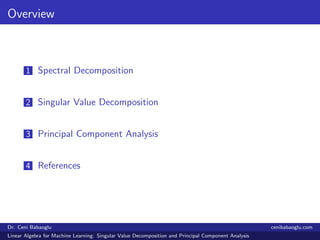
Overview
1 Spectral Decomposition
2 Singular Value Decomposition
3 Principal Component Analysis
4 References
Dr. Ceni Babaoglu cenibabaoglu.com
Linear Algebra for Machine Learning: Singular Value Decomposition and Principal Component Analysis
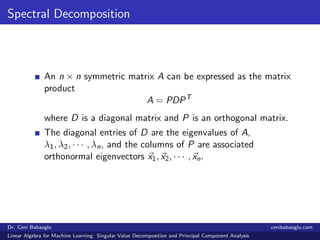
Spectral Decomposition
An n × n symmetric matrix A can be expressed as the matrix
product
A = PDPT
where D is a diagonal matrix and P is an orthogonal matrix.
The diagonal entries of D are the eigenvalues of A,
λ1, λ2, · · · , λn, and the columns of P are associated
orthonormal eigenvectors x1, x2, · · · , xn.
Dr. Ceni Babaoglu cenibabaoglu.com
Linear Algebra for Machine Learning: Singular Value Decomposition and Principal Component Analysis
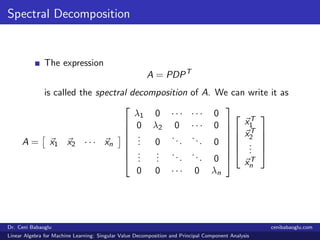
Spectral Decomposition
The expression
A = PDPT
is called the spectral decomposition of A. We can write it as
A = x1 x2 · · · xn








λ1 0 · · · · · · 0
0 λ2 0 · · · 0
... 0
...
... 0
...
...
...
... 0
0 0 · · · 0 λn













xT
1
xT
2
...
xT
n





Dr. Ceni Babaoglu cenibabaoglu.com
Linear Algebra for Machine Learning: Singular Value Decomposition and Principal Component Analysis
Spectral Decomposition
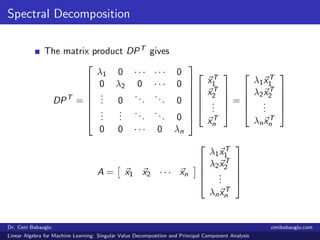
The matrix product DPT gives
DPT
=








λ1 0 · · · · · · 0
0 λ2 0 · · · 0
... 0
...
... 0
...
...
...
... 0
0 0 · · · 0 λn













xT
1
xT
2
...
xT
n





=





λ1xT
1
λ2xT
2
...
λnxT
n





A = x1 x2 · · · xn





λ1xT
1
λ2xT
2
...
λnxT
n





Dr. Ceni Babaoglu cenibabaoglu.com
Linear Algebra for Machine Learning: Singular Value Decomposition and Principal Component Analysis
Spectral Decomposition
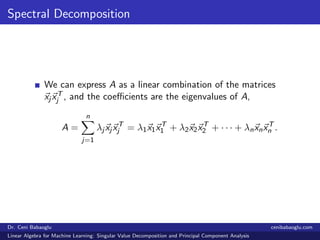
We can express A as a linear combination of the matrices
xj xT
j , and the coefficients are the eigenvalues of A,
A =
n
j=1
λj xj xT
j = λ1x1xT
1 + λ2x2xT
2 + · · · + λnxnxT
n .
Dr. Ceni Babaoglu cenibabaoglu.com
Linear Algebra for Machine Learning: Singular Value Decomposition and Principal Component Analysis
Singular Value Decomposition
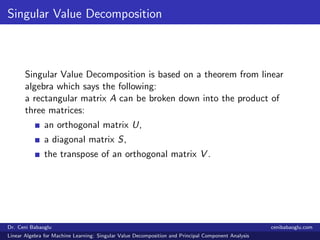
Singular Value Decomposition is based on a theorem from linear
algebra which says the following:
a rectangular matrix A can be broken down into the product of
three matrices:
an orthogonal matrix U,
a diagonal matrix S,
the transpose of an orthogonal matrix V .
Dr. Ceni Babaoglu cenibabaoglu.com
Linear Algebra for Machine Learning: Singular Value Decomposition and Principal Component Analysis
Singular Value Decomposition
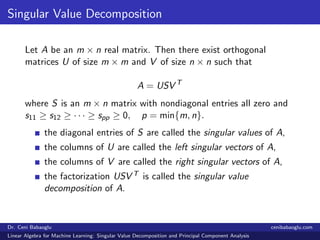
Let A be an m × n real matrix. Then there exist orthogonal
matrices U of size m × m and V of size n × n such that
A = USV T
where S is an m × n matrix with nondiagonal entries all zero and
s11 ≥ s12 ≥ · · · ≥ spp ≥ 0, p = min{m, n}.
the diagonal entries of S are called the singular values of A,
the columns of U are called the left singular vectors of A,
the columns of V are called the right singular vectors of A,
the factorization USV T is called the singular value
decomposition of A.
Dr. Ceni Babaoglu cenibabaoglu.com
Linear Algebra for Machine Learning: Singular Value Decomposition and Principal Component Analysis
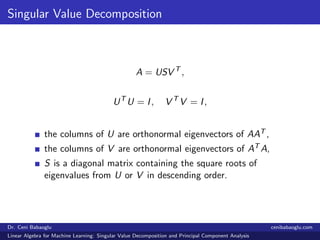
Singular Value Decomposition
A = USV T
,
UT
U = I, V T
V = I,
the columns of U are orthonormal eigenvectors of AAT ,
the columns of V are orthonormal eigenvectors of AT A,
S is a diagonal matrix containing the square roots of
eigenvalues from U or V in descending order.
Dr. Ceni Babaoglu cenibabaoglu.com
Linear Algebra for Machine Learning: Singular Value Decomposition and Principal Component Analysis
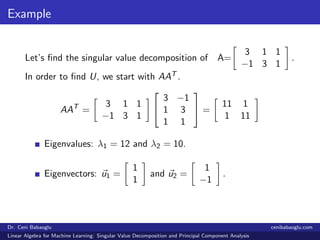
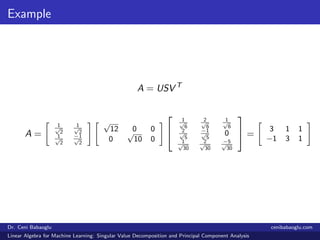
Example
Let’s find the singular value decomposition of A=
3 1 1
−1 3 1
.
In order to find U, we start with AAT .
AAT
=
3 1 1
−1 3 1


3 −1
1 3
1 1

 =
11 1
1 11
Eigenvalues: λ1 = 12 and λ2 = 10.
Eigenvectors: u1 =
1
1
and u2 =
1
−1
.
Dr. Ceni Babaoglu cenibabaoglu.com
Linear Algebra for Machine Learning: Singular Value Decomposition and Principal Component Analysis
Example
Using Gram-Schmidt Process
v1 = u1 w1 =
v1
|v1|
=
1/
√
2
1/
√
2
v2 = u2 −
(u2, v1)
(v1, v1)
v1
v2 =
1
−1
− 0
1
1
=
1
−1
− [0, 0] =
1
−1
w2 =
v2
|v2|
=
1
√
2
,
−1
√
2
U =
1/
√
2 1/
√
2
1/
√
2 −1/
√
2
Dr. Ceni Babaoglu cenibabaoglu.com
Linear Algebra for Machine Learning: Singular Value Decomposition and Principal Component Analysis
Example
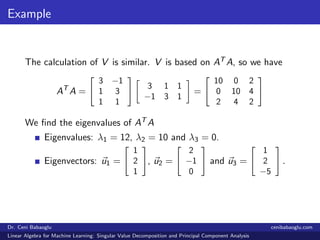
The calculation of V is similar. V is based on AT A, so we have
AT
A =
3 −1
1 3
1 1
3 1 1
−1 3 1
=
10 0 2
0 10 4
2 4 2
We find the eigenvalues of AT A
Eigenvalues: λ1 = 12, λ2 = 10 and λ3 = 0.
Eigenvectors: u1 =
1
2
1
, u2 =
2
−1
0
and u3 =
1
2
−5
.
Dr. Ceni Babaoglu cenibabaoglu.com
Linear Algebra for Machine Learning: Singular Value Decomposition and Principal Component Analysis
Example
v1 = u1, w1 =
v1
|v1|
=
1
√
6
,
2
√
6
,
1
√
6
v2 = u2 −
(u2, v1)
(v1, v1)
v1 = [2, −1, 0]
w2 =
v2
|v2|
=
2
√
5
,
−1
√
5
, 0
Dr. Ceni Babaoglu cenibabaoglu.com
Linear Algebra for Machine Learning: Singular Value Decomposition and Principal Component Analysis
Example
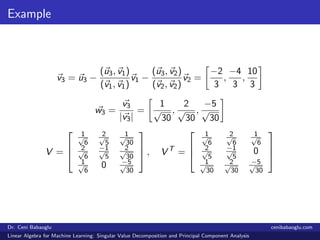
v3 = u3 −
(u3, v1)
(v1, v1)
v1 −
(u3, v2)
(v2, v2)
v2 =
−2
3
,
−4
3
,
10
3
w3 =
v3
|v3|
=
1
√
30
,
2
√
30
,
−5
√
30
V =



1√
6
2√
5
1√
30
2√
6
−1√
5
2√
30
1√
6
0 −5√
30


 , V T
=



1√
6
2√
6
1√
6
2√
5
−1√
5
0
1√
30
2√
30
−5√
30



Dr. Ceni Babaoglu cenibabaoglu.com
Linear Algebra for Machine Learning: Singular Value Decomposition and Principal Component Analysis
Example
A = USV T
A =
1√
2
1√
2
1√
2
−1√
2
√
12 0 0
0
√
10 0


1√
6
2√
6
1√
6
2√
5
−1√
5
0
1√
30
2√
30
−5√
30

 =
3 1 1
−1 3 1
Dr. Ceni Babaoglu cenibabaoglu.com
Linear Algebra for Machine Learning: Singular Value Decomposition and Principal Component Analysis
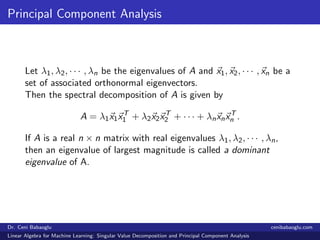
Principal Component Analysis
Let λ1, λ2, · · · , λn be the eigenvalues of A and x1, x2, · · · , xn be a
set of associated orthonormal eigenvectors.
Then the spectral decomposition of A is given by
A = λ1x1xT
1 + λ2x2xT
2 + · · · + λnxnxT
n .
If A is a real n × n matrix with real eigenvalues λ1, λ2, · · · , λn,
then an eigenvalue of largest magnitude is called a dominant
eigenvalue of A.
Dr. Ceni Babaoglu cenibabaoglu.com
Linear Algebra for Machine Learning: Singular Value Decomposition and Principal Component Analysis
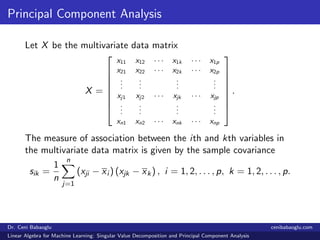
Principal Component Analysis
Let X be the multivariate data matrix
X =








x11 x12 · · · x1k · · · x1p
x21 x22 · · · x2k · · · x2p
...
...
...
...
xj1 xj2 · · · xjk · · · xjp
...
...
...
...
xn1 xn2 · · · xnk · · · xnp








.
The measure of association between the ith and kth variables in
the multivariate data matrix is given by the sample covariance
sik =
1
n
n
j=1
(xji − xi ) (xjk − xk) , i = 1, 2, . . . , p, k = 1, 2, . . . , p.
Dr. Ceni Babaoglu cenibabaoglu.com
Linear Algebra for Machine Learning: Singular Value Decomposition and Principal Component Analysis
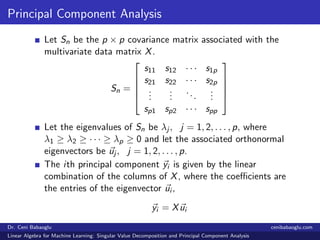
Principal Component Analysis
Let Sn be the p × p covariance matrix associated with the
multivariate data matrix X.
Sn =





s11 s12 · · · s1p
s21 s22 · · · s2p
...
...
...
...
sp1 sp2 · · · spp





Let the eigenvalues of Sn be λj , j = 1, 2, . . . , p, where
λ1 ≥ λ2 ≥ · · · ≥ λp ≥ 0 and let the associated orthonormal
eigenvectors be uj , j = 1, 2, . . . , p.
The ith principal component yi is given by the linear
combination of the columns of X, where the coefficients are
the entries of the eigenvector ui ,
yi = Xui
Dr. Ceni Babaoglu cenibabaoglu.com
Linear Algebra for Machine Learning: Singular Value Decomposition and Principal Component Analysis
Principal Component Analysis
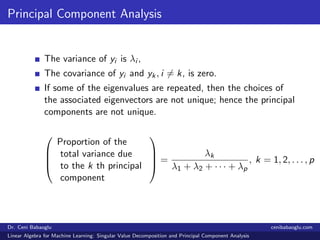
The variance of yi is λi ,
The covariance of yi and yk, i = k, is zero.
If some of the eigenvalues are repeated, then the choices of
the associated eigenvectors are not unique; hence the principal
components are not unique.




Proportion of the
total variance due
to the k th principal
component



 =
λk
λ1 + λ2 + · · · + λp
, k = 1, 2, . . . , p
Dr. Ceni Babaoglu cenibabaoglu.com
Linear Algebra for Machine Learning: Singular Value Decomposition and Principal Component Analysis
Example
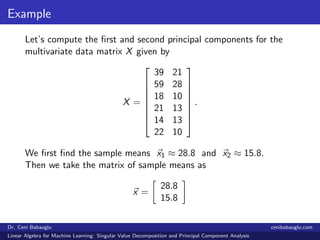
Let’s compute the first and second principal components for the
multivariate data matrix X given by
X =








39 21
59 28
18 10
21 13
14 13
22 10








.
We first find the sample means x1 ≈ 28.8 and x2 ≈ 15.8.
Then we take the matrix of sample means as
x =
28.8
15.8
Dr. Ceni Babaoglu cenibabaoglu.com
Linear Algebra for Machine Learning: Singular Value Decomposition and Principal Component Analysis
Example
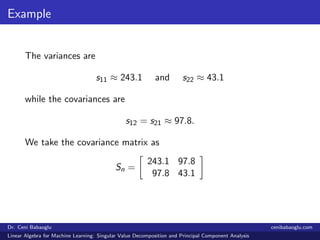
The variances are
s11 ≈ 243.1 and s22 ≈ 43.1
while the covariances are
s12 = s21 ≈ 97.8.
We take the covariance matrix as
Sn =
243.1 97.8
97.8 43.1
Dr. Ceni Babaoglu cenibabaoglu.com
Linear Algebra for Machine Learning: Singular Value Decomposition and Principal Component Analysis
Example
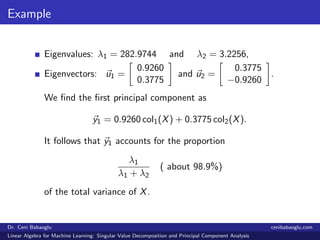
Eigenvalues: λ1 = 282.9744 and λ2 = 3.2256,
Eigenvectors: u1 =
0.9260
0.3775
and u2 =
0.3775
−0.9260
.
We find the first principal component as
y1 = 0.9260 col1(X) + 0.3775 col2(X).
It follows that y1 accounts for the proportion
λ1
λ1 + λ2
( about 98.9%)
of the total variance of X.
Dr. Ceni Babaoglu cenibabaoglu.com
Linear Algebra for Machine Learning: Singular Value Decomposition and Principal Component Analysis
Example
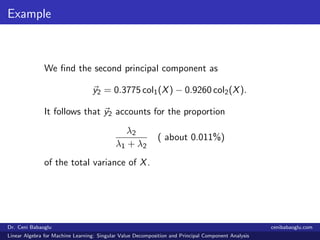
We find the second principal component as
y2 = 0.3775 col1(X) − 0.9260 col2(X).
It follows that y2 accounts for the proportion
λ2
λ1 + λ2
( about 0.011%)
of the total variance of X.
Dr. Ceni Babaoglu cenibabaoglu.com
Linear Algebra for Machine Learning: Singular Value Decomposition and Principal Component Analysis
References
Linear Algebra With Applications, 7th Edition
by Steven J. Leon.
Elementary Linear Algebra with Applications, 9th Edition
by Bernard Kolman and David Hill.
Dr. Ceni Babaoglu cenibabaoglu.com
Linear Algebra for Machine Learning: Singular Value Decomposition and Principal Component Analysis

5. Linear Algebra for Machine Learning: Singular Value Decomposition and Principal Component Analysis

  • 1.
    Seminar Series on LinearAlgebra for Machine Learning Part 5: Singular Value Decomposition and Principal Component Analysis Dr. Ceni Babaoglu Data Science Laboratory Ryerson University cenibabaoglu.com Dr. Ceni Babaoglu cenibabaoglu.com Linear Algebra for Machine Learning: Singular Value Decomposition and Principal Component Analysis
  • 2.
    Overview 1 Spectral Decomposition 2Singular Value Decomposition 3 Principal Component Analysis 4 References Dr. Ceni Babaoglu cenibabaoglu.com Linear Algebra for Machine Learning: Singular Value Decomposition and Principal Component Analysis
  • 3.
    Spectral Decomposition An n× n symmetric matrix A can be expressed as the matrix product A = PDPT where D is a diagonal matrix and P is an orthogonal matrix. The diagonal entries of D are the eigenvalues of A, λ1, λ2, · · · , λn, and the columns of P are associated orthonormal eigenvectors x1, x2, · · · , xn. Dr. Ceni Babaoglu cenibabaoglu.com Linear Algebra for Machine Learning: Singular Value Decomposition and Principal Component Analysis
  • 4.
    Spectral Decomposition The expression A= PDPT is called the spectral decomposition of A. We can write it as A = x1 x2 · · · xn         λ1 0 · · · · · · 0 0 λ2 0 · · · 0 ... 0 ... ... 0 ... ... ... ... 0 0 0 · · · 0 λn              xT 1 xT 2 ... xT n      Dr. Ceni Babaoglu cenibabaoglu.com Linear Algebra for Machine Learning: Singular Value Decomposition and Principal Component Analysis
  • 5.
    Spectral Decomposition The matrixproduct DPT gives DPT =         λ1 0 · · · · · · 0 0 λ2 0 · · · 0 ... 0 ... ... 0 ... ... ... ... 0 0 0 · · · 0 λn              xT 1 xT 2 ... xT n      =      λ1xT 1 λ2xT 2 ... λnxT n      A = x1 x2 · · · xn      λ1xT 1 λ2xT 2 ... λnxT n      Dr. Ceni Babaoglu cenibabaoglu.com Linear Algebra for Machine Learning: Singular Value Decomposition and Principal Component Analysis
  • 6.
    Spectral Decomposition We canexpress A as a linear combination of the matrices xj xT j , and the coefficients are the eigenvalues of A, A = n j=1 λj xj xT j = λ1x1xT 1 + λ2x2xT 2 + · · · + λnxnxT n . Dr. Ceni Babaoglu cenibabaoglu.com Linear Algebra for Machine Learning: Singular Value Decomposition and Principal Component Analysis
  • 7.
    Singular Value Decomposition SingularValue Decomposition is based on a theorem from linear algebra which says the following: a rectangular matrix A can be broken down into the product of three matrices: an orthogonal matrix U, a diagonal matrix S, the transpose of an orthogonal matrix V . Dr. Ceni Babaoglu cenibabaoglu.com Linear Algebra for Machine Learning: Singular Value Decomposition and Principal Component Analysis
  • 8.
    Singular Value Decomposition LetA be an m × n real matrix. Then there exist orthogonal matrices U of size m × m and V of size n × n such that A = USV T where S is an m × n matrix with nondiagonal entries all zero and s11 ≥ s12 ≥ · · · ≥ spp ≥ 0, p = min{m, n}. the diagonal entries of S are called the singular values of A, the columns of U are called the left singular vectors of A, the columns of V are called the right singular vectors of A, the factorization USV T is called the singular value decomposition of A. Dr. Ceni Babaoglu cenibabaoglu.com Linear Algebra for Machine Learning: Singular Value Decomposition and Principal Component Analysis
  • 9.
    Singular Value Decomposition A= USV T , UT U = I, V T V = I, the columns of U are orthonormal eigenvectors of AAT , the columns of V are orthonormal eigenvectors of AT A, S is a diagonal matrix containing the square roots of eigenvalues from U or V in descending order. Dr. Ceni Babaoglu cenibabaoglu.com Linear Algebra for Machine Learning: Singular Value Decomposition and Principal Component Analysis
  • 10.
    Example Let’s find thesingular value decomposition of A= 3 1 1 −1 3 1 . In order to find U, we start with AAT . AAT = 3 1 1 −1 3 1   3 −1 1 3 1 1   = 11 1 1 11 Eigenvalues: λ1 = 12 and λ2 = 10. Eigenvectors: u1 = 1 1 and u2 = 1 −1 . Dr. Ceni Babaoglu cenibabaoglu.com Linear Algebra for Machine Learning: Singular Value Decomposition and Principal Component Analysis
  • 11.
    Example Using Gram-Schmidt Process v1= u1 w1 = v1 |v1| = 1/ √ 2 1/ √ 2 v2 = u2 − (u2, v1) (v1, v1) v1 v2 = 1 −1 − 0 1 1 = 1 −1 − [0, 0] = 1 −1 w2 = v2 |v2| = 1 √ 2 , −1 √ 2 U = 1/ √ 2 1/ √ 2 1/ √ 2 −1/ √ 2 Dr. Ceni Babaoglu cenibabaoglu.com Linear Algebra for Machine Learning: Singular Value Decomposition and Principal Component Analysis
  • 12.
    Example The calculation ofV is similar. V is based on AT A, so we have AT A = 3 −1 1 3 1 1 3 1 1 −1 3 1 = 10 0 2 0 10 4 2 4 2 We find the eigenvalues of AT A Eigenvalues: λ1 = 12, λ2 = 10 and λ3 = 0. Eigenvectors: u1 = 1 2 1 , u2 = 2 −1 0 and u3 = 1 2 −5 . Dr. Ceni Babaoglu cenibabaoglu.com Linear Algebra for Machine Learning: Singular Value Decomposition and Principal Component Analysis
  • 13.
    Example v1 = u1,w1 = v1 |v1| = 1 √ 6 , 2 √ 6 , 1 √ 6 v2 = u2 − (u2, v1) (v1, v1) v1 = [2, −1, 0] w2 = v2 |v2| = 2 √ 5 , −1 √ 5 , 0 Dr. Ceni Babaoglu cenibabaoglu.com Linear Algebra for Machine Learning: Singular Value Decomposition and Principal Component Analysis
  • 14.
    Example v3 = u3− (u3, v1) (v1, v1) v1 − (u3, v2) (v2, v2) v2 = −2 3 , −4 3 , 10 3 w3 = v3 |v3| = 1 √ 30 , 2 √ 30 , −5 √ 30 V =    1√ 6 2√ 5 1√ 30 2√ 6 −1√ 5 2√ 30 1√ 6 0 −5√ 30    , V T =    1√ 6 2√ 6 1√ 6 2√ 5 −1√ 5 0 1√ 30 2√ 30 −5√ 30    Dr. Ceni Babaoglu cenibabaoglu.com Linear Algebra for Machine Learning: Singular Value Decomposition and Principal Component Analysis
  • 15.
    Example A = USVT A = 1√ 2 1√ 2 1√ 2 −1√ 2 √ 12 0 0 0 √ 10 0   1√ 6 2√ 6 1√ 6 2√ 5 −1√ 5 0 1√ 30 2√ 30 −5√ 30   = 3 1 1 −1 3 1 Dr. Ceni Babaoglu cenibabaoglu.com Linear Algebra for Machine Learning: Singular Value Decomposition and Principal Component Analysis
  • 16.
    Principal Component Analysis Letλ1, λ2, · · · , λn be the eigenvalues of A and x1, x2, · · · , xn be a set of associated orthonormal eigenvectors. Then the spectral decomposition of A is given by A = λ1x1xT 1 + λ2x2xT 2 + · · · + λnxnxT n . If A is a real n × n matrix with real eigenvalues λ1, λ2, · · · , λn, then an eigenvalue of largest magnitude is called a dominant eigenvalue of A. Dr. Ceni Babaoglu cenibabaoglu.com Linear Algebra for Machine Learning: Singular Value Decomposition and Principal Component Analysis
  • 17.
    Principal Component Analysis LetX be the multivariate data matrix X =         x11 x12 · · · x1k · · · x1p x21 x22 · · · x2k · · · x2p ... ... ... ... xj1 xj2 · · · xjk · · · xjp ... ... ... ... xn1 xn2 · · · xnk · · · xnp         . The measure of association between the ith and kth variables in the multivariate data matrix is given by the sample covariance sik = 1 n n j=1 (xji − xi ) (xjk − xk) , i = 1, 2, . . . , p, k = 1, 2, . . . , p. Dr. Ceni Babaoglu cenibabaoglu.com Linear Algebra for Machine Learning: Singular Value Decomposition and Principal Component Analysis
  • 18.
    Principal Component Analysis LetSn be the p × p covariance matrix associated with the multivariate data matrix X. Sn =      s11 s12 · · · s1p s21 s22 · · · s2p ... ... ... ... sp1 sp2 · · · spp      Let the eigenvalues of Sn be λj , j = 1, 2, . . . , p, where λ1 ≥ λ2 ≥ · · · ≥ λp ≥ 0 and let the associated orthonormal eigenvectors be uj , j = 1, 2, . . . , p. The ith principal component yi is given by the linear combination of the columns of X, where the coefficients are the entries of the eigenvector ui , yi = Xui Dr. Ceni Babaoglu cenibabaoglu.com Linear Algebra for Machine Learning: Singular Value Decomposition and Principal Component Analysis
  • 19.
    Principal Component Analysis Thevariance of yi is λi , The covariance of yi and yk, i = k, is zero. If some of the eigenvalues are repeated, then the choices of the associated eigenvectors are not unique; hence the principal components are not unique.     Proportion of the total variance due to the k th principal component     = λk λ1 + λ2 + · · · + λp , k = 1, 2, . . . , p Dr. Ceni Babaoglu cenibabaoglu.com Linear Algebra for Machine Learning: Singular Value Decomposition and Principal Component Analysis
  • 20.
    Example Let’s compute thefirst and second principal components for the multivariate data matrix X given by X =         39 21 59 28 18 10 21 13 14 13 22 10         . We first find the sample means x1 ≈ 28.8 and x2 ≈ 15.8. Then we take the matrix of sample means as x = 28.8 15.8 Dr. Ceni Babaoglu cenibabaoglu.com Linear Algebra for Machine Learning: Singular Value Decomposition and Principal Component Analysis
  • 21.
    Example The variances are s11≈ 243.1 and s22 ≈ 43.1 while the covariances are s12 = s21 ≈ 97.8. We take the covariance matrix as Sn = 243.1 97.8 97.8 43.1 Dr. Ceni Babaoglu cenibabaoglu.com Linear Algebra for Machine Learning: Singular Value Decomposition and Principal Component Analysis
  • 22.
    Example Eigenvalues: λ1 =282.9744 and λ2 = 3.2256, Eigenvectors: u1 = 0.9260 0.3775 and u2 = 0.3775 −0.9260 . We find the first principal component as y1 = 0.9260 col1(X) + 0.3775 col2(X). It follows that y1 accounts for the proportion λ1 λ1 + λ2 ( about 98.9%) of the total variance of X. Dr. Ceni Babaoglu cenibabaoglu.com Linear Algebra for Machine Learning: Singular Value Decomposition and Principal Component Analysis
  • 23.
    Example We find thesecond principal component as y2 = 0.3775 col1(X) − 0.9260 col2(X). It follows that y2 accounts for the proportion λ2 λ1 + λ2 ( about 0.011%) of the total variance of X. Dr. Ceni Babaoglu cenibabaoglu.com Linear Algebra for Machine Learning: Singular Value Decomposition and Principal Component Analysis
  • 24.
    References Linear Algebra WithApplications, 7th Edition by Steven J. Leon. Elementary Linear Algebra with Applications, 9th Edition by Bernard Kolman and David Hill. Dr. Ceni Babaoglu cenibabaoglu.com Linear Algebra for Machine Learning: Singular Value Decomposition and Principal Component Analysis