ISBN 0-321-49362-1
Chapter 4
Lexical and Syntax
Analysis
Copyright © 2007 Addison-
Wesley. All rights reserved. 1-2
Chapter 4 Topics
• Introduction
• Lexical Analysis
• The Parsing Problem
• Recursive-Descent Parsing
• Bottom-Up Parsing
Copyright © 2007 Addison-
Wesley. All rights reserved. 1-3
Introduction
• Language implementation systems must
analyze source code, regardless of the specific
implementation approach
• Nearly all syntax analysis is based on a formal
description of the syntax of the source language
(BNF)
Copyright © 2007 Addison-
Wesley. All rights reserved. 1-4
Syntax Analysis
• The syntax analysis portion of a language
processor nearly always consists of two parts:
– A low-level part called a lexical analyzer
(mathematically, a finite automaton based on a
regular grammar)
– A high-level part called a syntax analyzer, or parser
(mathematically, a push-down automaton based on a
context-free grammar, or BNF)
Copyright © 2007 Addison-
Wesley. All rights reserved. 1-5
Advantages of Using BNF to Describe
Syntax
• Provides a clear and concise syntax description
• The parser can be based directly on the BNF
• Parsers based on BNF are easy to maintain
Copyright © 2007 Addison-
Wesley. All rights reserved. 1-6
Reasons to Separate Lexical and Syntax
Analysis
• Simplicity - less complex approaches can be
used for lexical analysis; separating them
simplifies the parser
• Efficiency - separation allows optimization of the
lexical analyzer
• Portability - parts of the lexical analyzer may not
be portable, but the parser always is portable
Copyright © 2007 Addison-
Wesley. All rights reserved. 1-7
Lexical Analysis
• A lexical analyzer is a pattern matcher for
character strings
• A lexical analyzer is a “front-end” for the parser
• Identifies substrings of the source program that
belong together - lexemes
– Lexemes match a character pattern, which is
associated with a lexical category called a token
– sum is a lexeme; its token may be IDENT
Copyright © 2007 Addison-
Wesley. All rights reserved. 1-8
Lexical Analysis (continued)
• The lexical analyzer is usually a function that is called by
the parser when it needs the next token
• Three approaches to building a lexical analyzer:
– Write a formal description of the tokens and use a software tool
that constructs table-driven lexical analyzers given such a
description
– Design a state diagram that describes the tokens and write a
program that implements the state diagram
– Design a state diagram that describes the tokens and hand-
construct a table-driven implementation of the state diagram
Copyright © 2007 Addison-
Wesley. All rights reserved. 1-9
State Diagram Design
– A naïve state diagram would have a transition from
every state on every character in the source
language - such a diagram would be very large!
Copyright © 2007 Addison-
Wesley. All rights reserved. 1-10
Lexical Analysis (cont.)
• In many cases, transitions can be combined to
simplify the state diagram
– When recognizing an identifier, all uppercase and
lowercase letters are equivalent
• Use a character class that includes all letters
– When recognizing an integer literal, all digits are
equivalent - use a digit class
Copyright © 2007 Addison-
Wesley. All rights reserved. 1-11
Lexical Analysis (cont.)
• Reserved words and identifiers can be
recognized together (rather than having a part
of the diagram for each reserved word)
– Use a table lookup to determine whether a possible
identifier is in fact a reserved word
Copyright © 2007 Addison-
Wesley. All rights reserved. 1-12
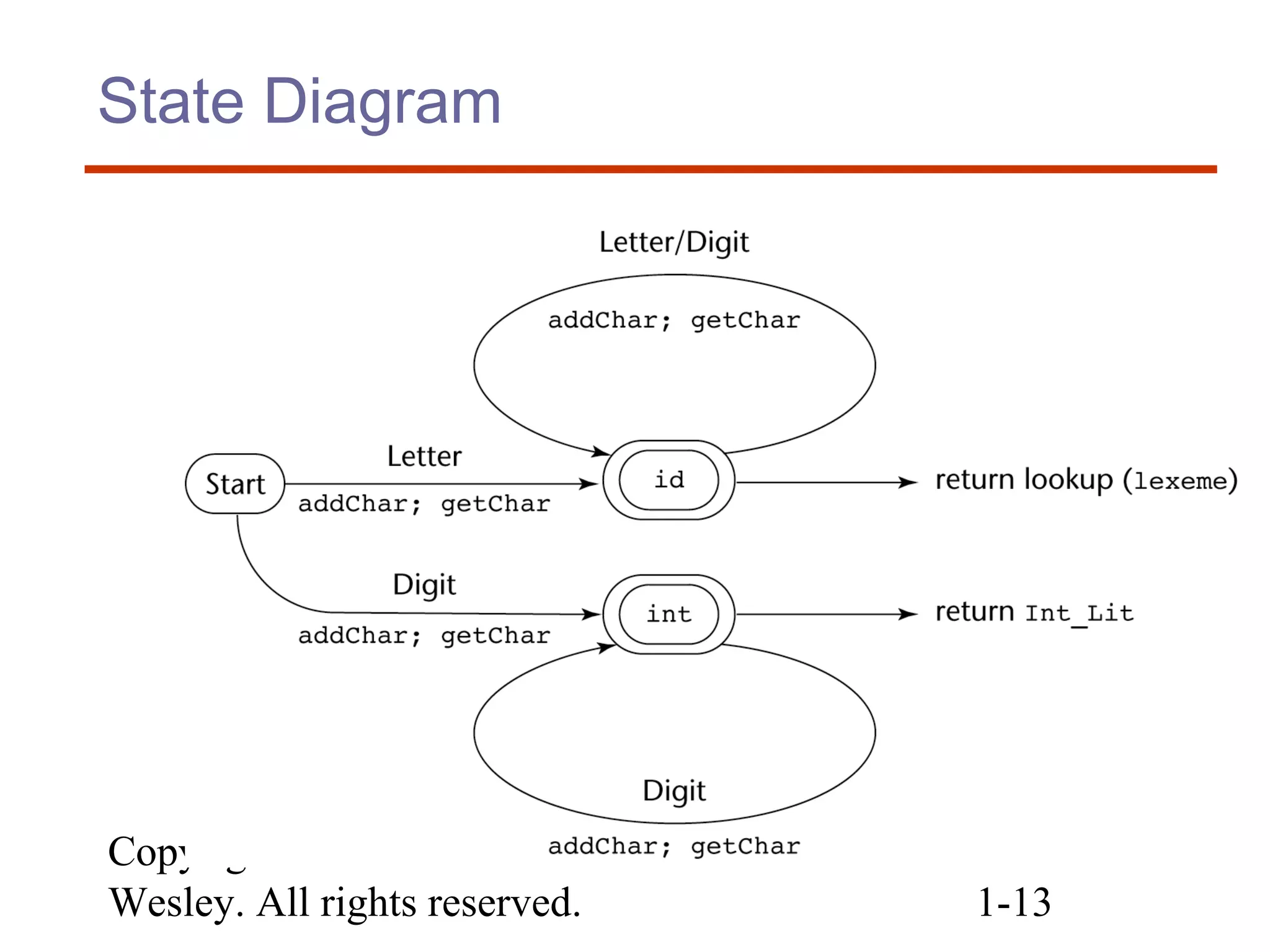
Lexical Analysis (cont.)
• Convenient utility subprograms:
– getChar - gets the next character of input, puts it in
nextChar, determines its class and puts the class in
charClass
– addChar - puts the character from nextChar into
the place the lexeme is being accumulated, lexeme
– lookup - determines whether the string in lexeme is
a reserved word (returns a code)
Copyright © 2007 Addison-
Wesley. All rights reserved. 1-13
State Diagram
Copyright © 2007 Addison-
Wesley. All rights reserved. 1-14
Lexical Analysis (cont.)
Implementation (assume initialization):
/* Global variables */
int charClass;
char lexeme [100];
char nextChar;
int lexLen;
int Letter = 0;
int DIGIT = 1;
int UNKNOWN = -1;
Copyright © 2007 Addison-
Wesley. All rights reserved. 1-15
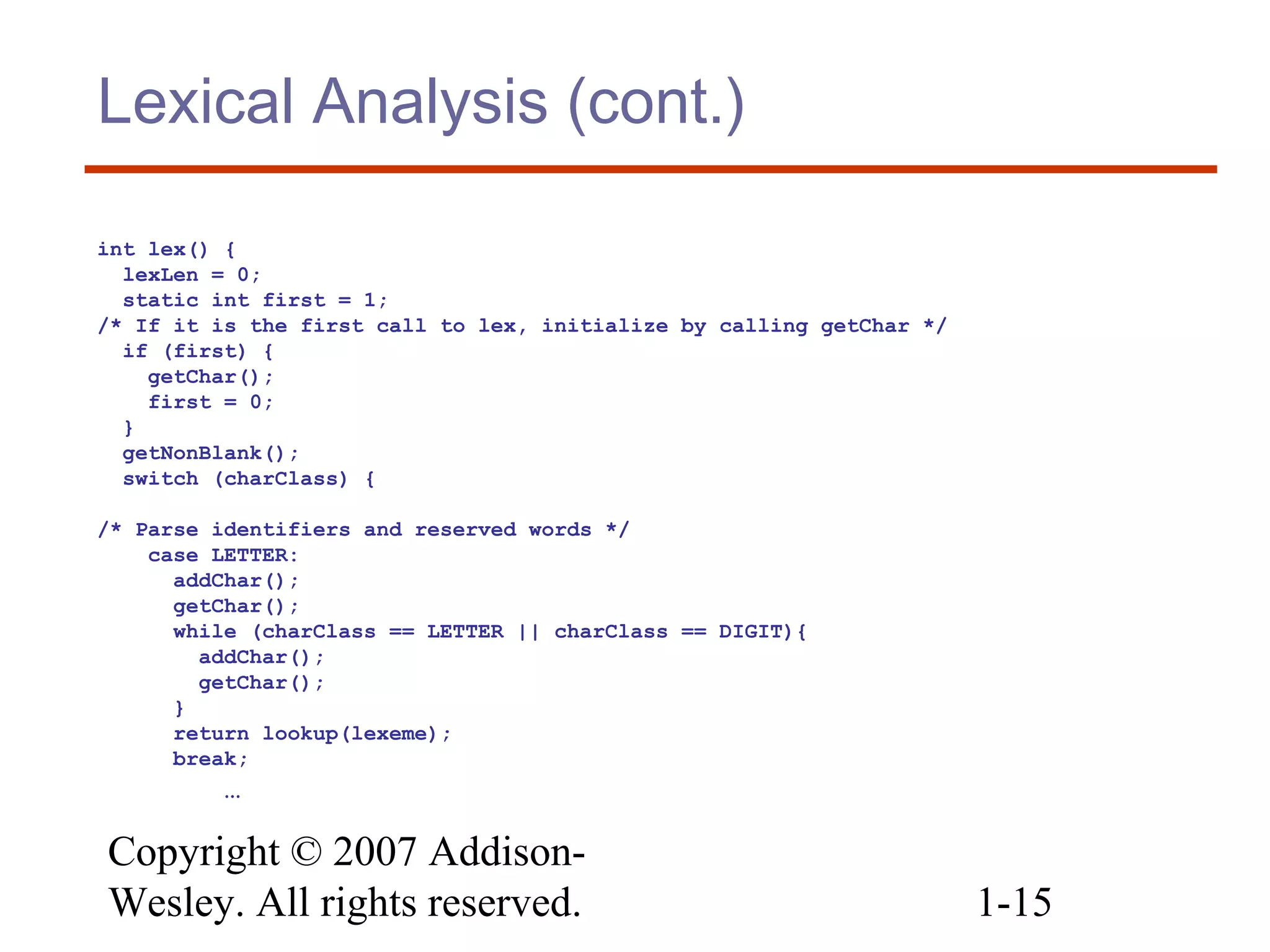
Lexical Analysis (cont.)
int lex() {
lexLen = 0;
static int first = 1;
/* If it is the first call to lex, initialize by calling getChar */
if (first) {
getChar();
first = 0;
}
getNonBlank();
switch (charClass) {
/* Parse identifiers and reserved words */
case LETTER:
addChar();
getChar();
while (charClass == LETTER || charClass == DIGIT){
addChar();
getChar();
}
return lookup(lexeme);
break;
…
Copyright © 2007 Addison-
Wesley. All rights reserved. 1-16
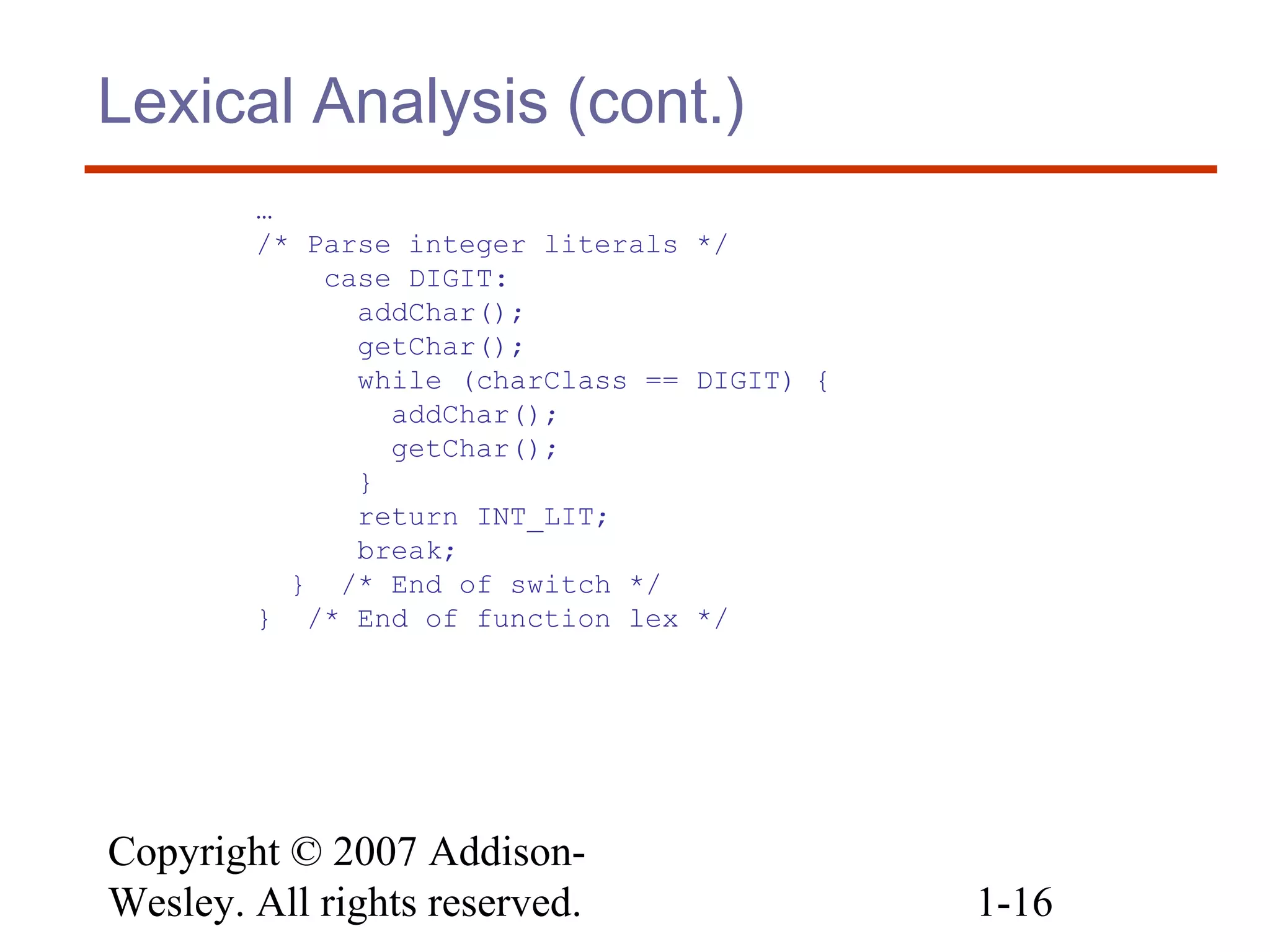
Lexical Analysis (cont.)
…
/* Parse integer literals */
case DIGIT:
addChar();
getChar();
while (charClass == DIGIT) {
addChar();
getChar();
}
return INT_LIT;
break;
} /* End of switch */
} /* End of function lex */
Copyright © 2007 Addison-
Wesley. All rights reserved. 1-17
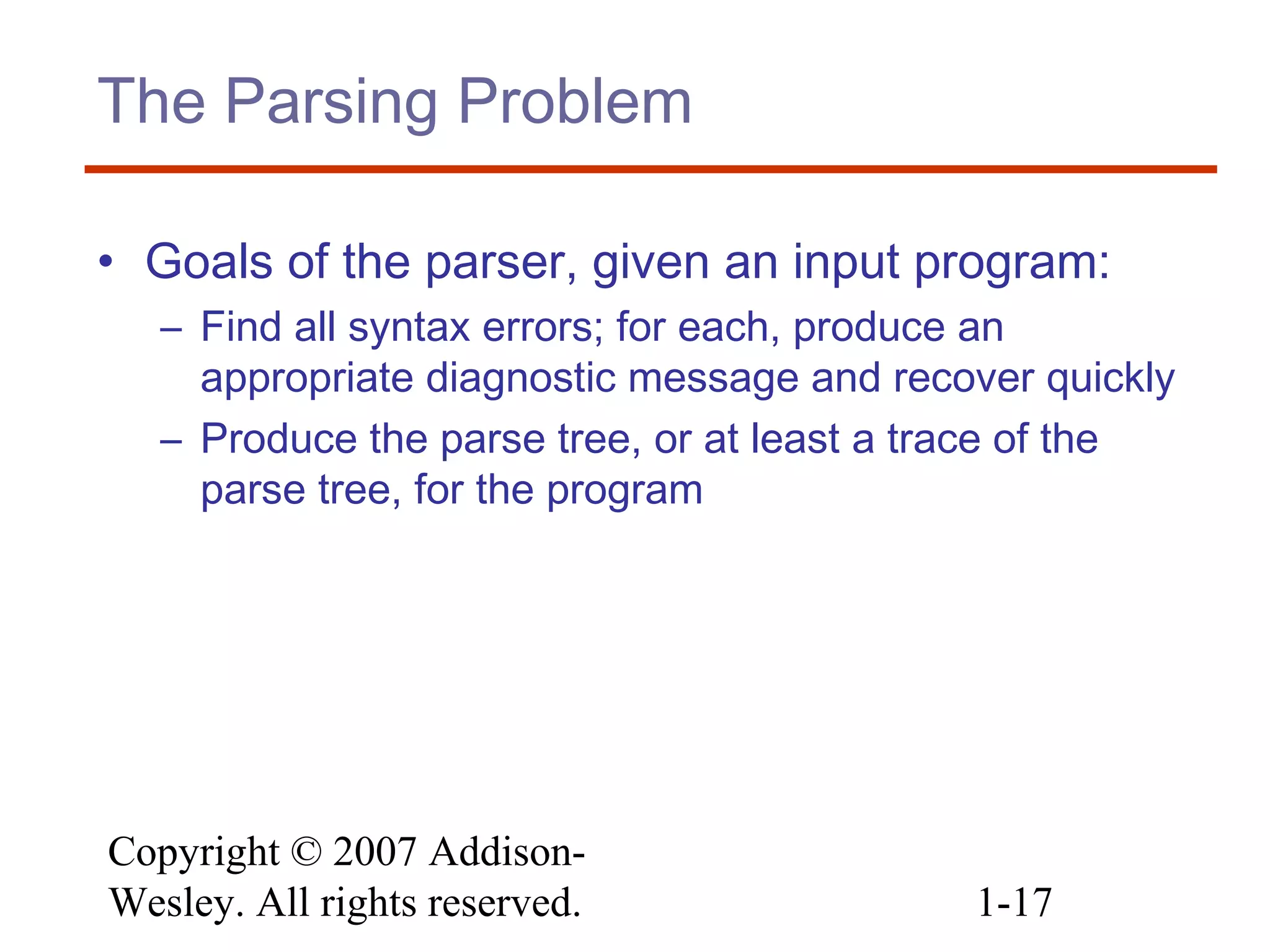
The Parsing Problem
• Goals of the parser, given an input program:
– Find all syntax errors; for each, produce an
appropriate diagnostic message and recover quickly
– Produce the parse tree, or at least a trace of the
parse tree, for the program
Copyright © 2007 Addison-
Wesley. All rights reserved. 1-18
The Parsing Problem (cont.)
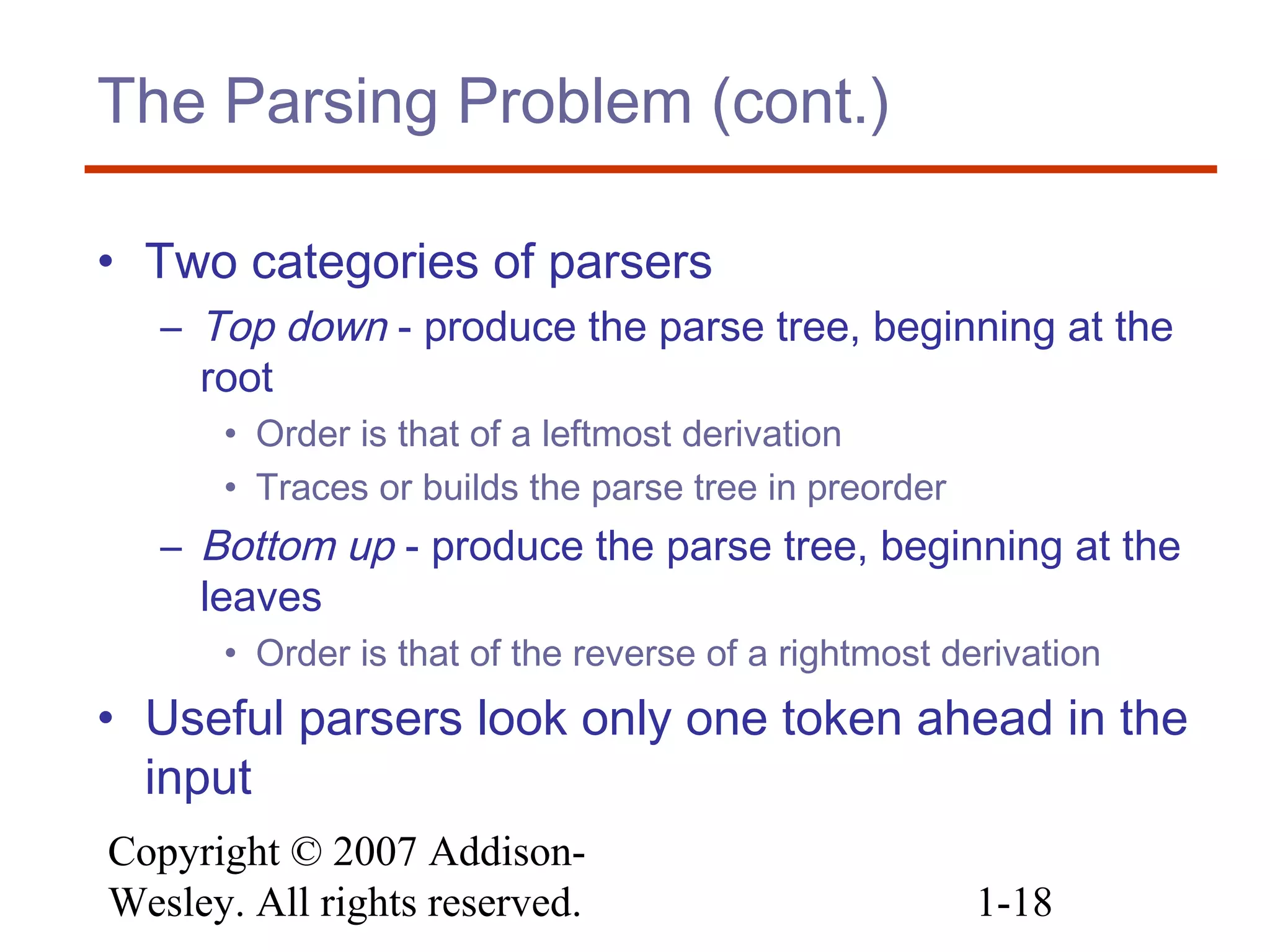
• Two categories of parsers
– Top down - produce the parse tree, beginning at the
root
• Order is that of a leftmost derivation
• Traces or builds the parse tree in preorder
– Bottom up - produce the parse tree, beginning at the
leaves
• Order is that of the reverse of a rightmost derivation
• Useful parsers look only one token ahead in the
input
Copyright © 2007 Addison-
Wesley. All rights reserved. 1-19
The Parsing Problem (cont.)
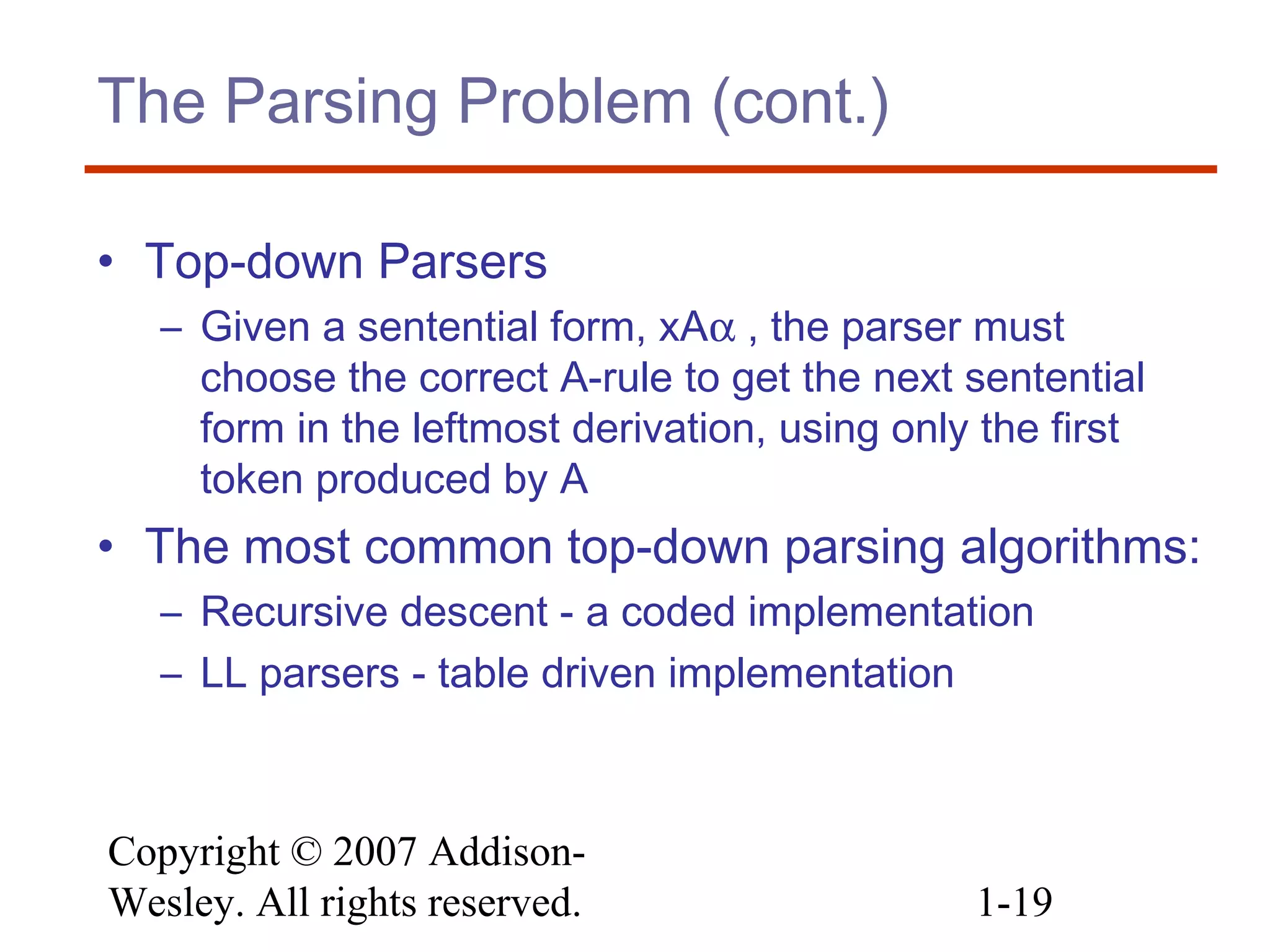
• Top-down Parsers
– Given a sentential form, xAα , the parser must
choose the correct A-rule to get the next sentential
form in the leftmost derivation, using only the first
token produced by A
• The most common top-down parsing algorithms:
– Recursive descent - a coded implementation
– LL parsers - table driven implementation
Copyright © 2007 Addison-
Wesley. All rights reserved. 1-20
The Parsing Problem (cont.)
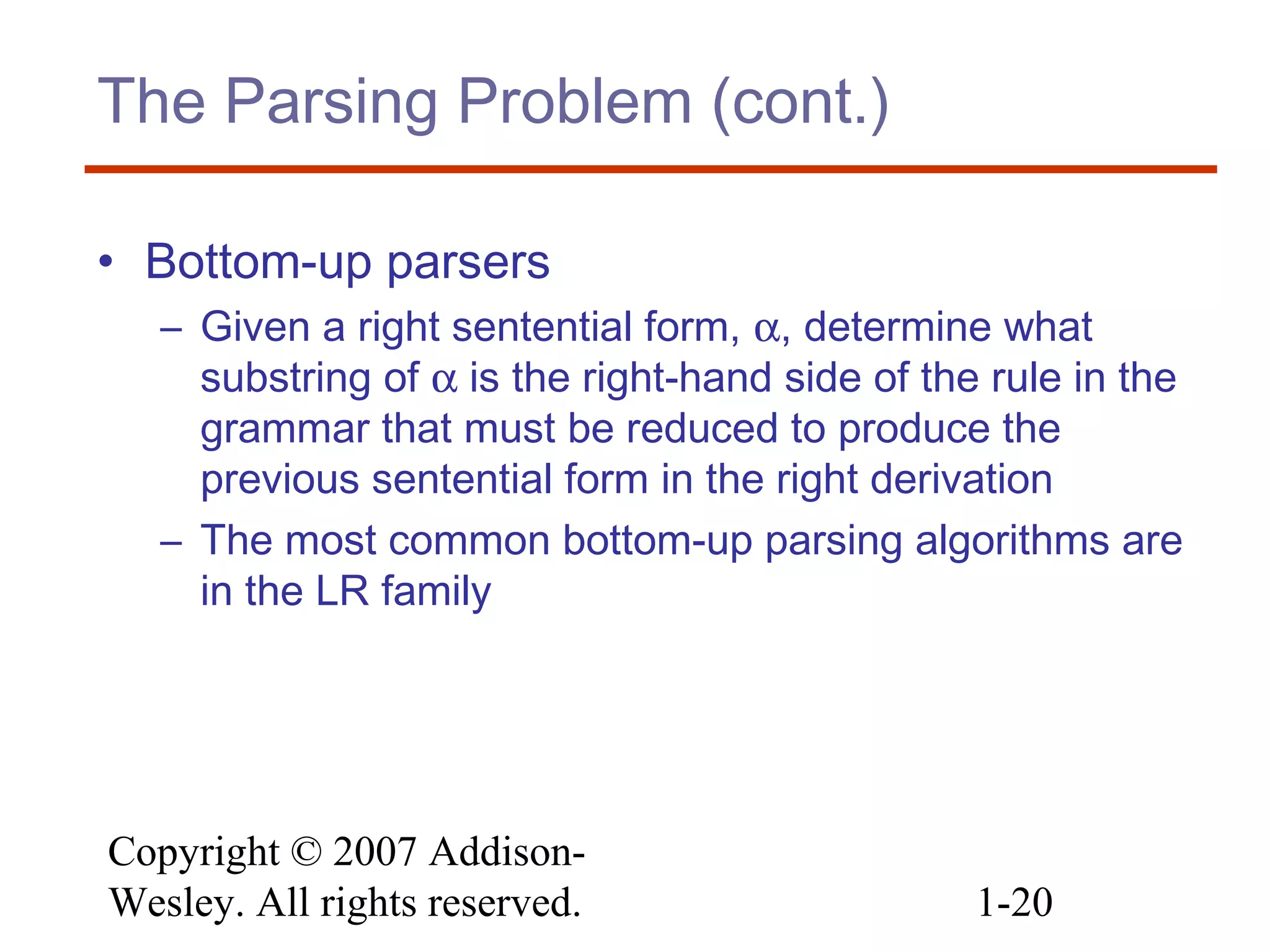
• Bottom-up parsers
– Given a right sentential form, α, determine what
substring of α is the right-hand side of the rule in the
grammar that must be reduced to produce the
previous sentential form in the right derivation
– The most common bottom-up parsing algorithms are
in the LR family
Copyright © 2007 Addison-
Wesley. All rights reserved. 1-21
The Parsing Problem (cont.)
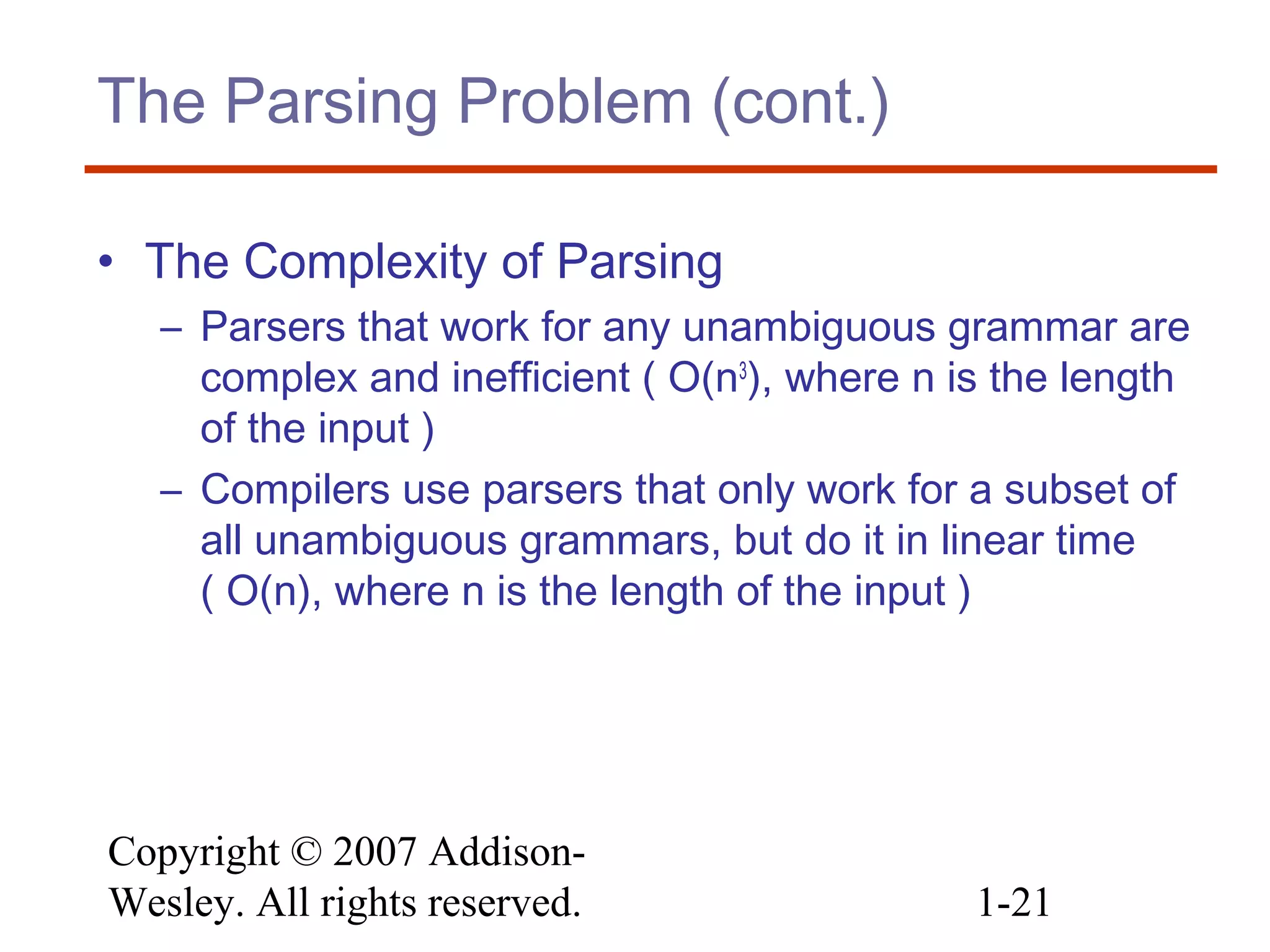
• The Complexity of Parsing
– Parsers that work for any unambiguous grammar are
complex and inefficient ( O(n3
), where n is the length
of the input )
– Compilers use parsers that only work for a subset of
all unambiguous grammars, but do it in linear time
( O(n), where n is the length of the input )
Copyright © 2007 Addison-
Wesley. All rights reserved. 1-22
Recursive-Descent Parsing
• There is a subprogram for each nonterminal in
the grammar, which can parse sentences that
can be generated by that nonterminal
• EBNF is ideally suited for being the basis for a
recursive-descent parser, because EBNF
minimizes the number of nonterminals
Copyright © 2007 Addison-
Wesley. All rights reserved. 1-23
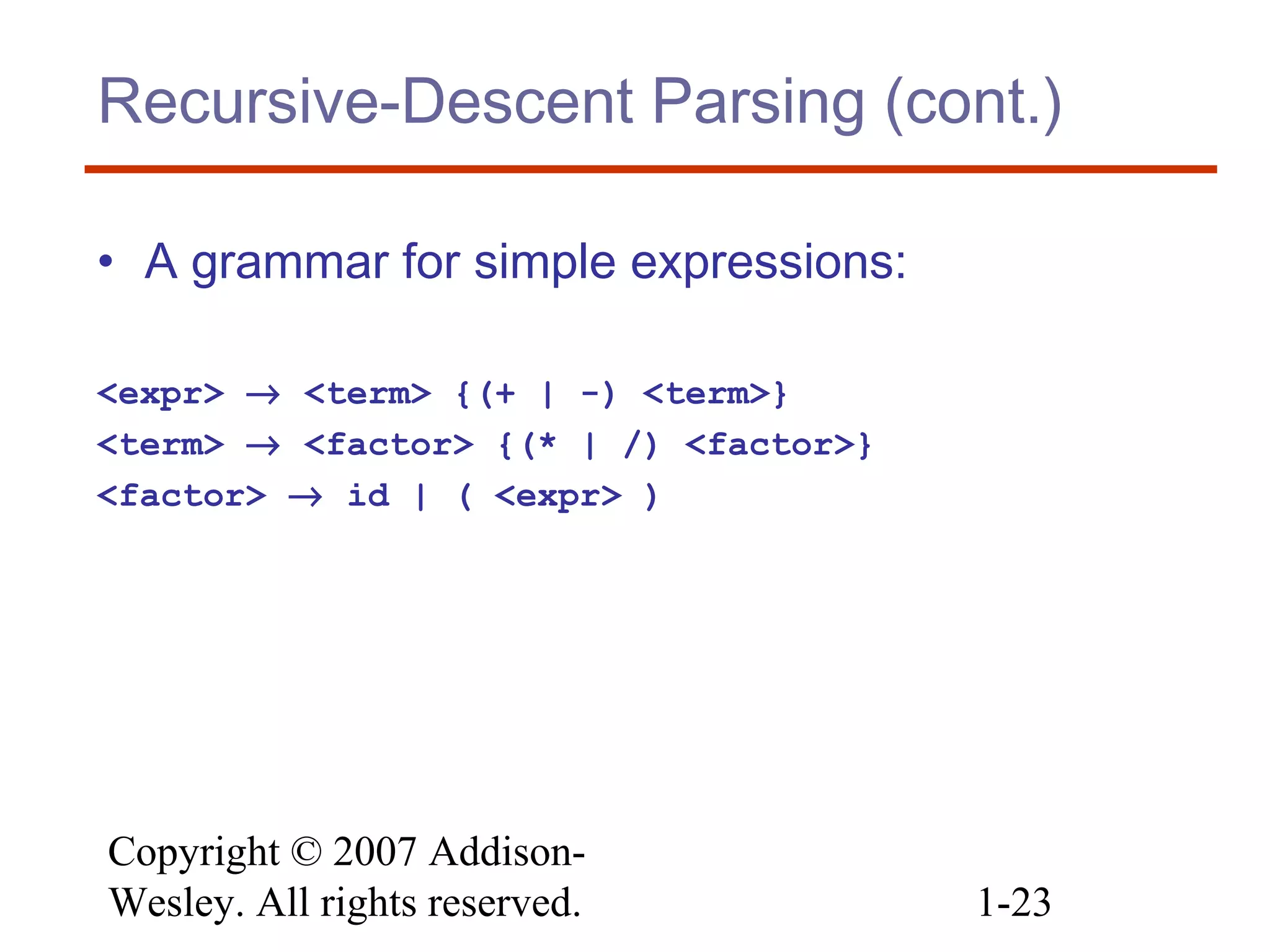
Recursive-Descent Parsing (cont.)
• A grammar for simple expressions:
<expr> → <term> {(+ | -) <term>}
<term> → <factor> {(* | /) <factor>}
<factor> → id | ( <expr> )
Copyright © 2007 Addison-
Wesley. All rights reserved. 1-24
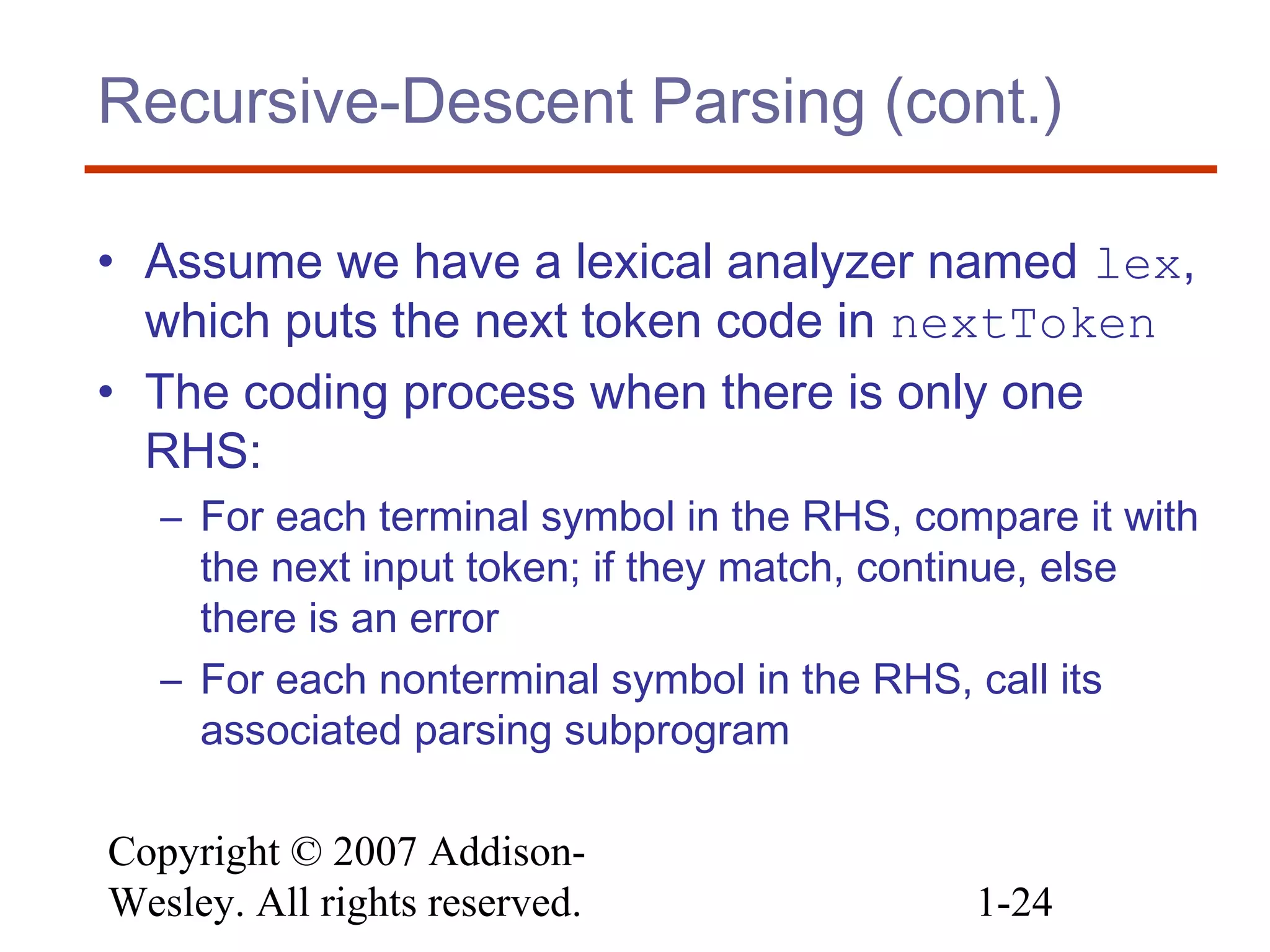
Recursive-Descent Parsing (cont.)
• Assume we have a lexical analyzer named lex,
which puts the next token code in nextToken
• The coding process when there is only one
RHS:
– For each terminal symbol in the RHS, compare it with
the next input token; if they match, continue, else
there is an error
– For each nonterminal symbol in the RHS, call its
associated parsing subprogram
Copyright © 2007 Addison-
Wesley. All rights reserved. 1-25
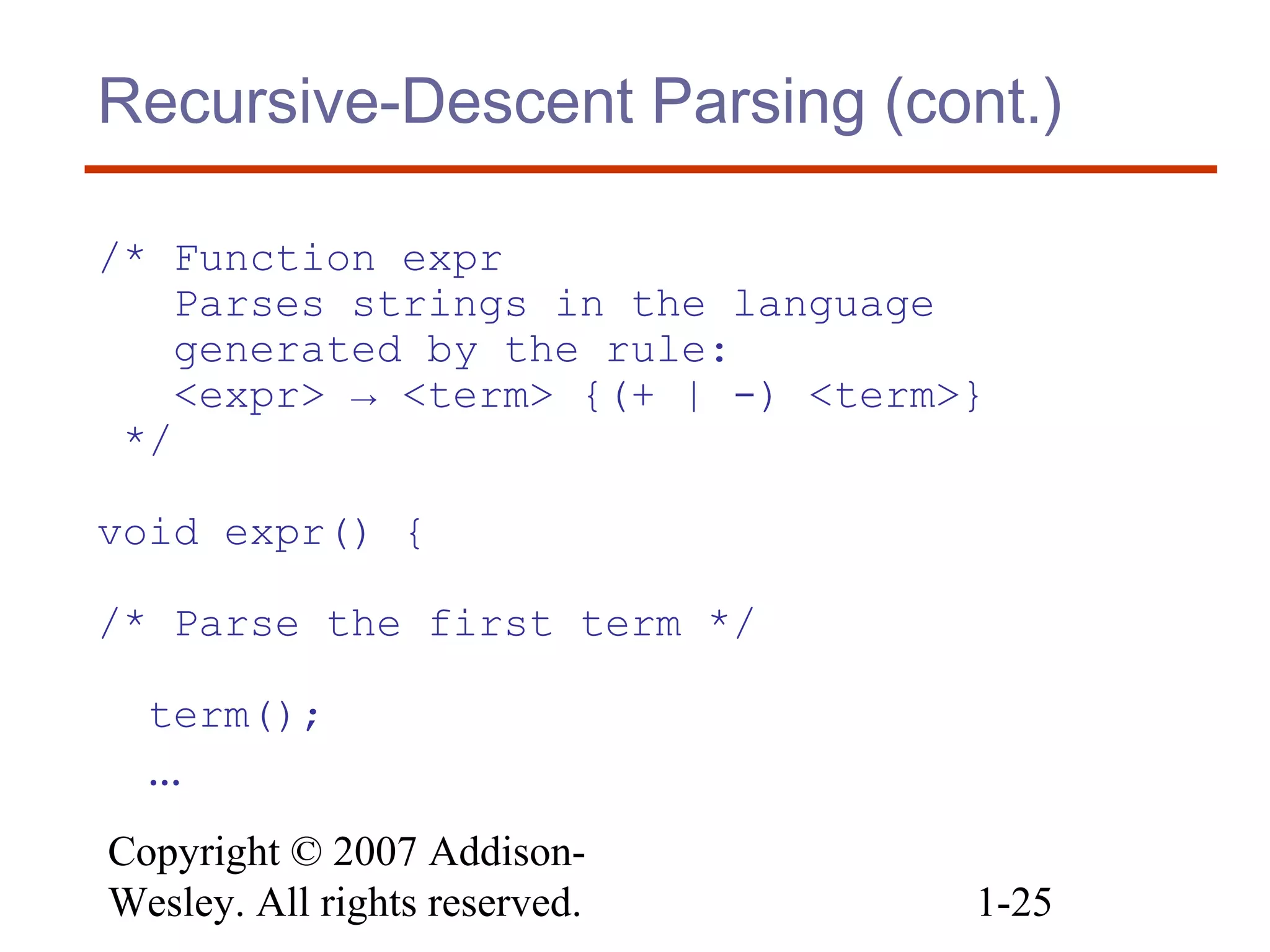
Recursive-Descent Parsing (cont.)
/* Function expr
Parses strings in the language
generated by the rule:
<expr> → <term> {(+ | -) <term>}
*/
void expr() {
/* Parse the first term */
term();
…
Copyright © 2007 Addison-
Wesley. All rights reserved. 1-26
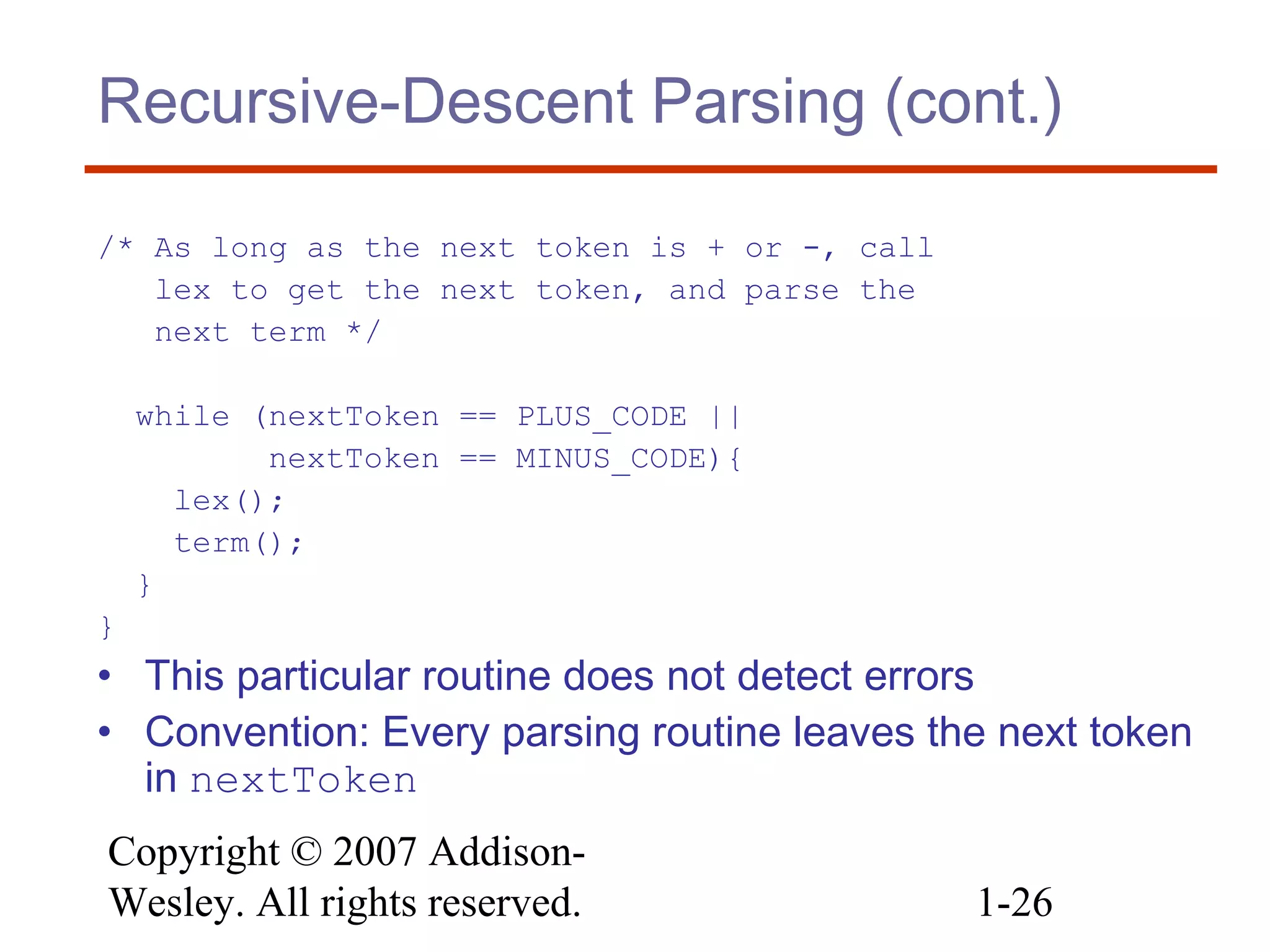
Recursive-Descent Parsing (cont.)
/* As long as the next token is + or -, call
lex to get the next token, and parse the
next term */
while (nextToken == PLUS_CODE ||
nextToken == MINUS_CODE){
lex();
term();
}
}
• This particular routine does not detect errors
• Convention: Every parsing routine leaves the next token
in nextToken
Copyright © 2007 Addison-
Wesley. All rights reserved. 1-27
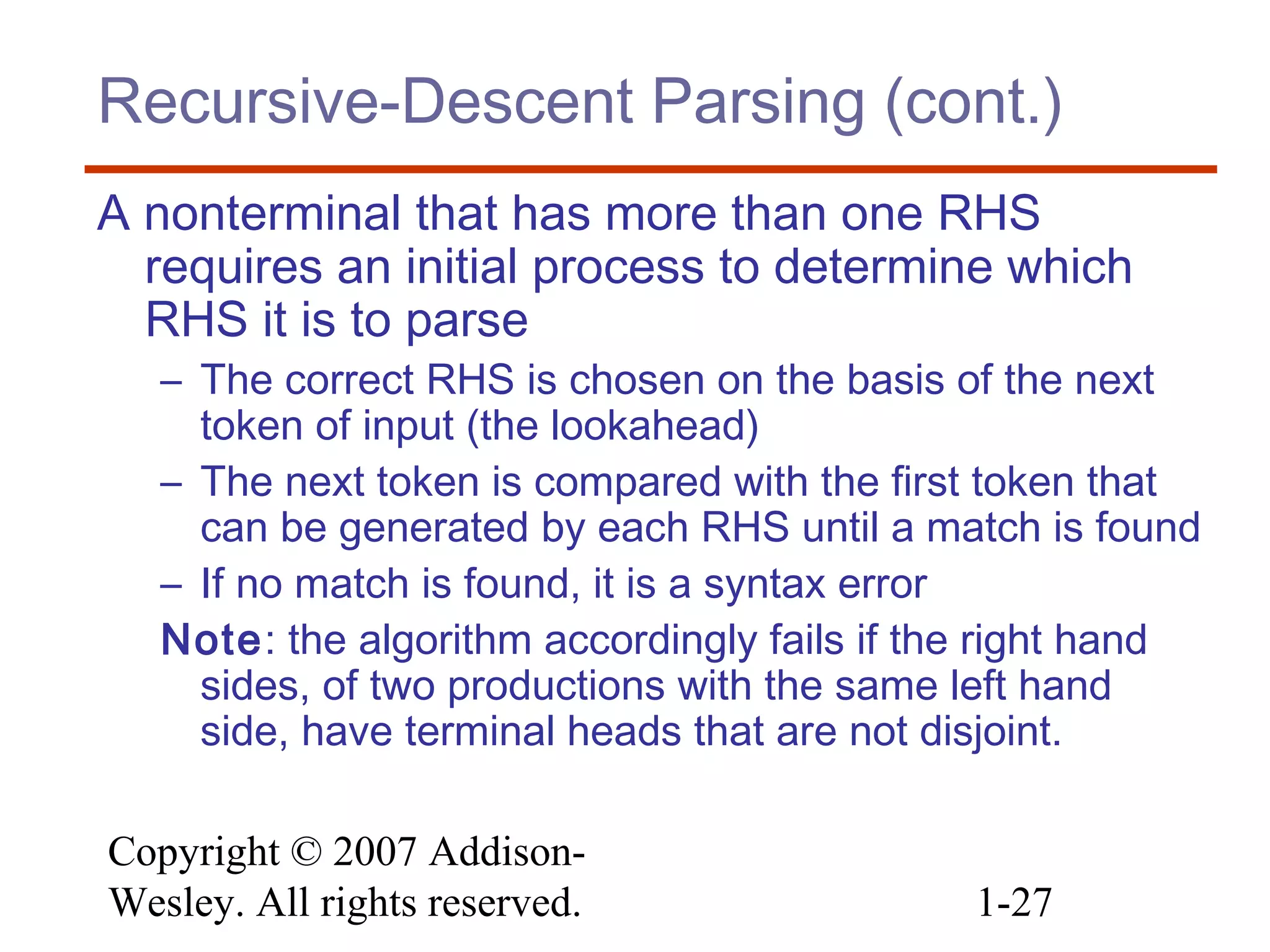
Recursive-Descent Parsing (cont.)
A nonterminal that has more than one RHS
requires an initial process to determine which
RHS it is to parse
– The correct RHS is chosen on the basis of the next
token of input (the lookahead)
– The next token is compared with the first token that
can be generated by each RHS until a match is found
– If no match is found, it is a syntax error
Note: the algorithm accordingly fails if the right hand
sides, of two productions with the same left hand
side, have terminal heads that are not disjoint.
Copyright © 2007 Addison-
Wesley. All rights reserved. 1-28
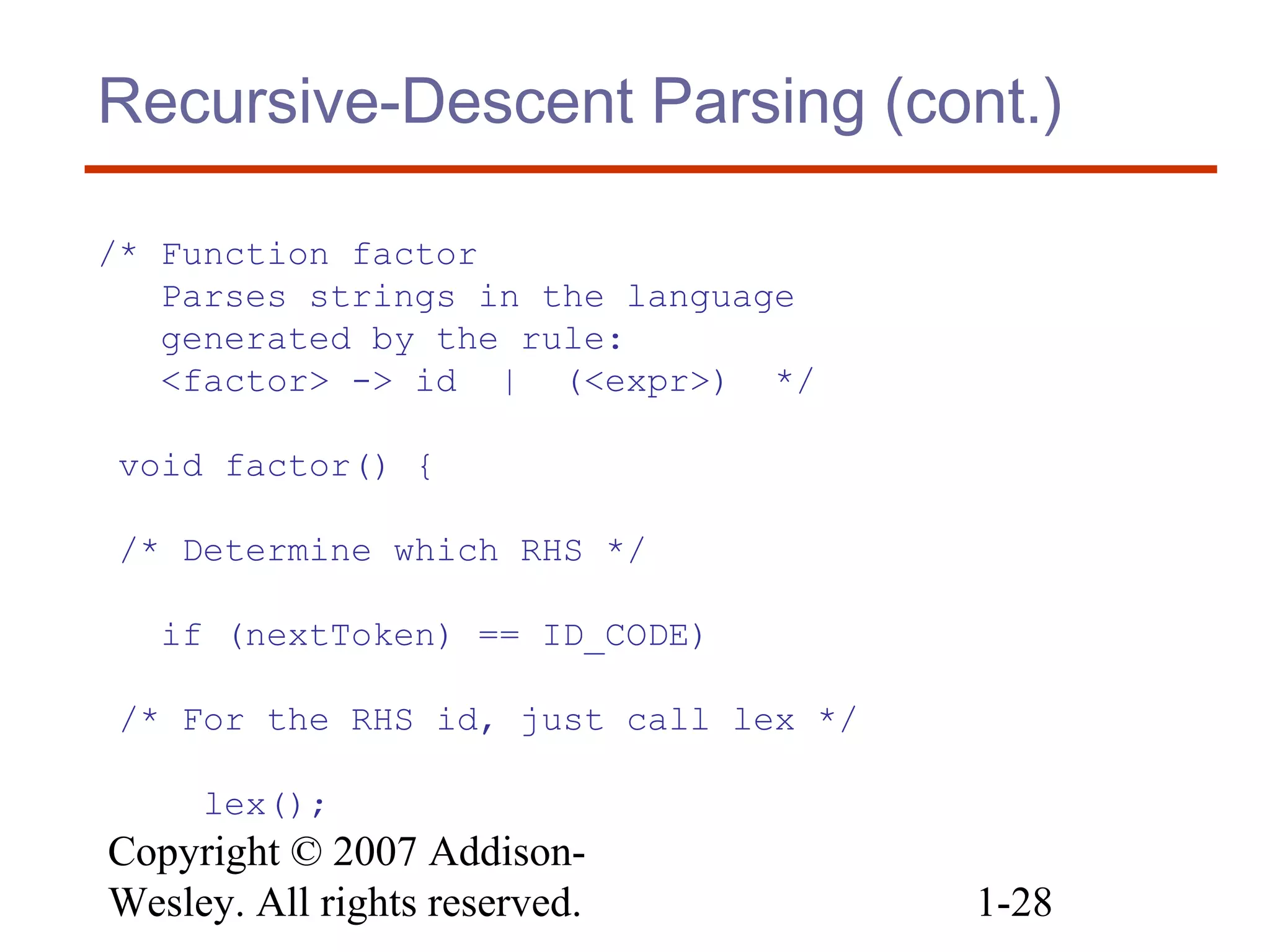
Recursive-Descent Parsing (cont.)
/* Function factor
Parses strings in the language
generated by the rule:
<factor> -> id | (<expr>) */
void factor() {
/* Determine which RHS */
if (nextToken) == ID_CODE)
/* For the RHS id, just call lex */
lex();
Copyright © 2007 Addison-
Wesley. All rights reserved. 1-29
Recursive-Descent Parsing (cont.)
/* If the RHS is (<expr>) – call lex to pass
over the left parenthesis, call expr, and
check for the right parenthesis */
else if (nextToken == LEFT_PAREN_CODE) {
lex();
expr();
if (nextToken == RIGHT_PAREN_CODE)
lex();
else
error();
} /* End of else if (nextToken == ... */
else error(); /* Neither RHS matches */
}
Copyright © 2007 Addison-
Wesley. All rights reserved. 1-30
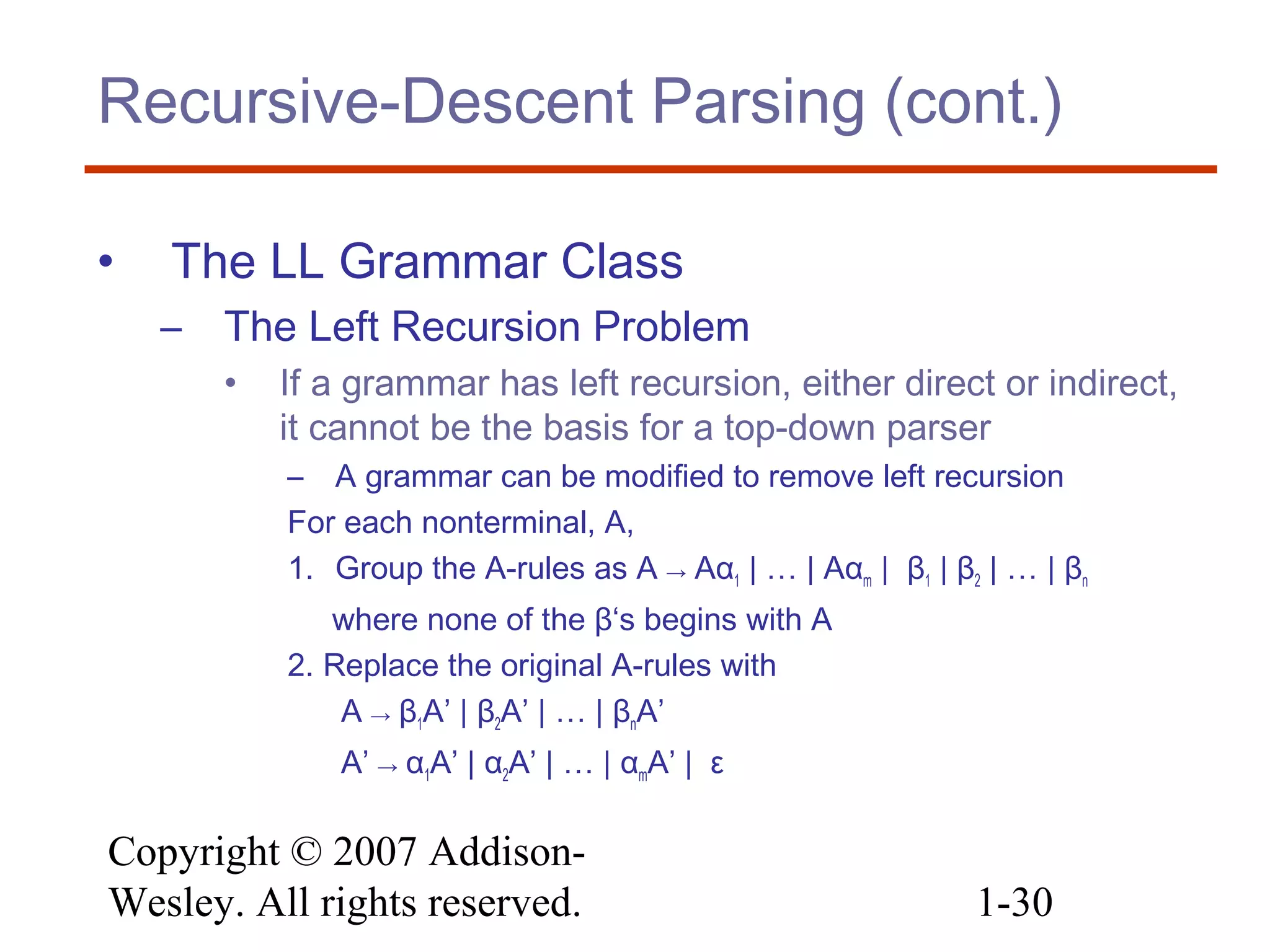
Recursive-Descent Parsing (cont.)
• The LL Grammar Class
– The Left Recursion Problem
• If a grammar has left recursion, either direct or indirect,
it cannot be the basis for a top-down parser
– A grammar can be modified to remove left recursion
For each nonterminal, A,
1. Group the A-rules as A → Aα1 | … | Aαm | β1 | β2 | … | βn
where none of the β‘s begins with A
2. Replace the original A-rules with
A → β1A’ | β2A’ | … | βnA’
A’ → α1A’ | α2A’ | … | αmA’ | ε
Copyright © 2007 Addison-
Wesley. All rights reserved. 1-31
Recursive-Descent Parsing (cont.)
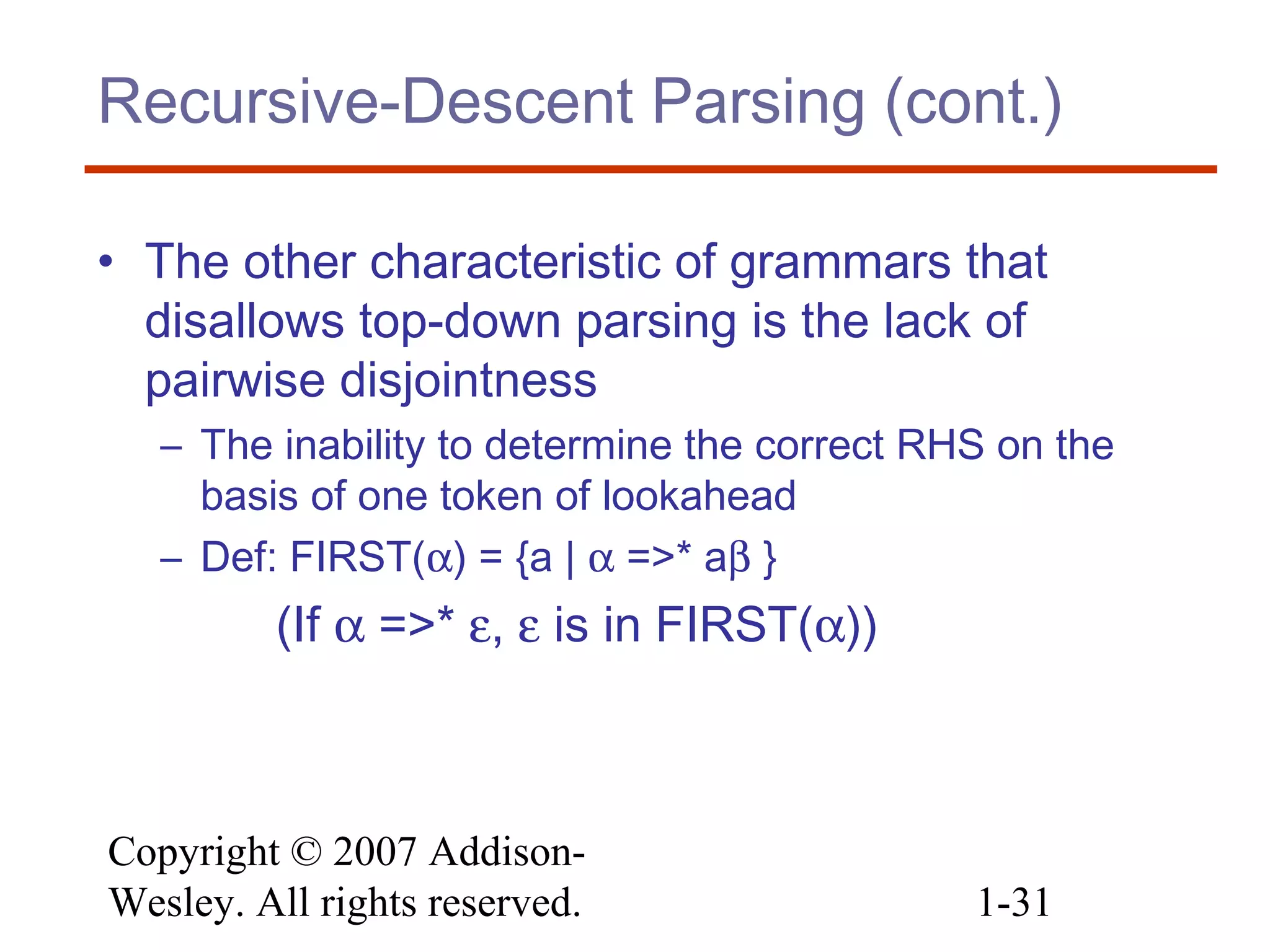
• The other characteristic of grammars that
disallows top-down parsing is the lack of
pairwise disjointness
– The inability to determine the correct RHS on the
basis of one token of lookahead
– Def: FIRST(α) = {a | α =>* aβ }
(If α =>* ε, ε is in FIRST(α))
Copyright © 2007 Addison-
Wesley. All rights reserved. 1-32
Recursive-Descent Parsing (cont.)
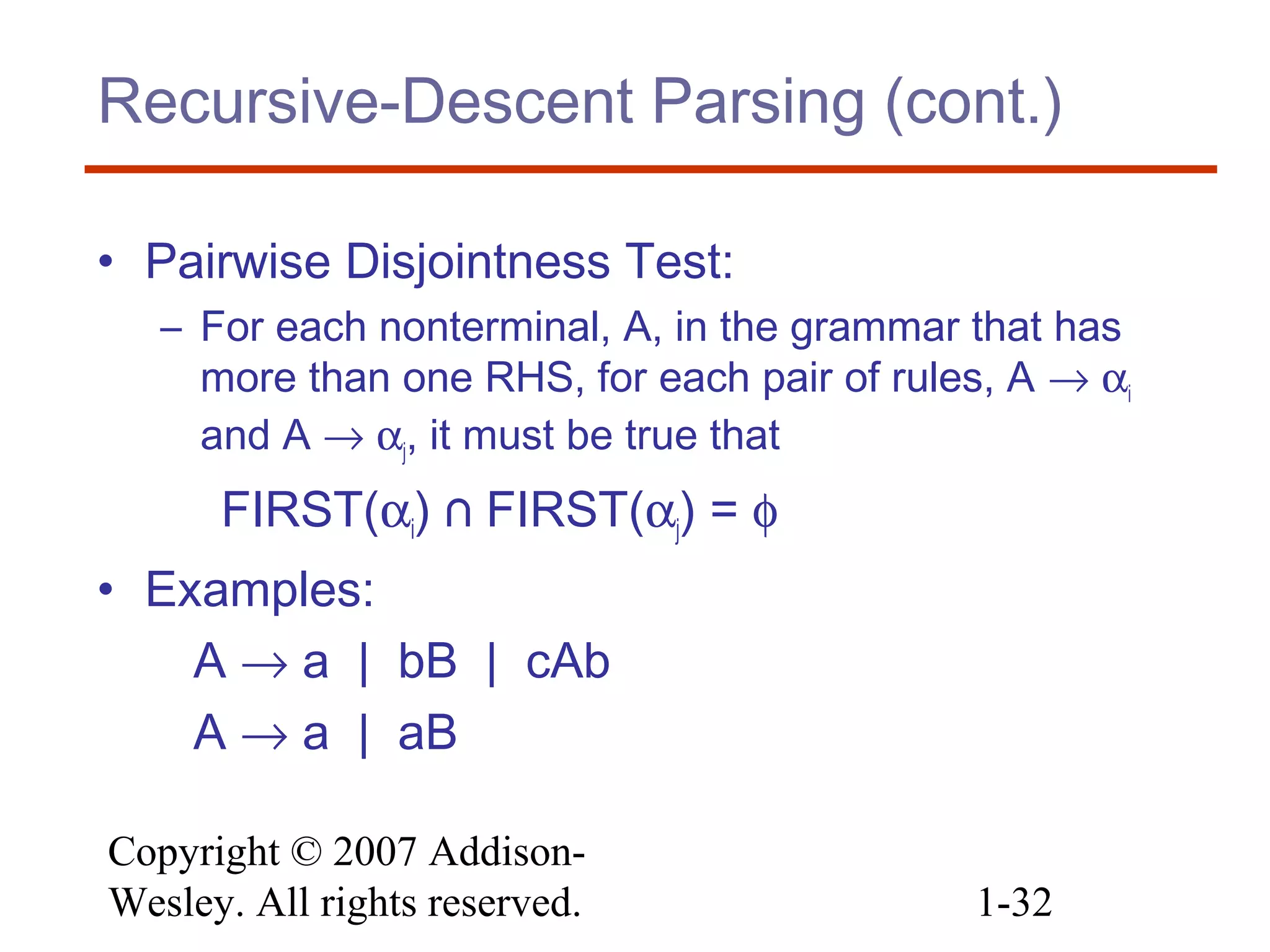
• Pairwise Disjointness Test:
– For each nonterminal, A, in the grammar that has
more than one RHS, for each pair of rules, A → αi
and A → αj, it must be true that
FIRST(αi) ⋂ FIRST(αj) = φ
• Examples:
A → a | bB | cAb
A → a | aB
Copyright © 2007 Addison-
Wesley. All rights reserved. 1-33
Bottom-up Parsing
• The parsing problem is finding the correct RHS
in a right-sentential form to reduce to get the
previous right-sentential form in the derivation
Copyright © 2007 Addison-
Wesley. All rights reserved. 1-34
Bottom-up Parsing (cont.)
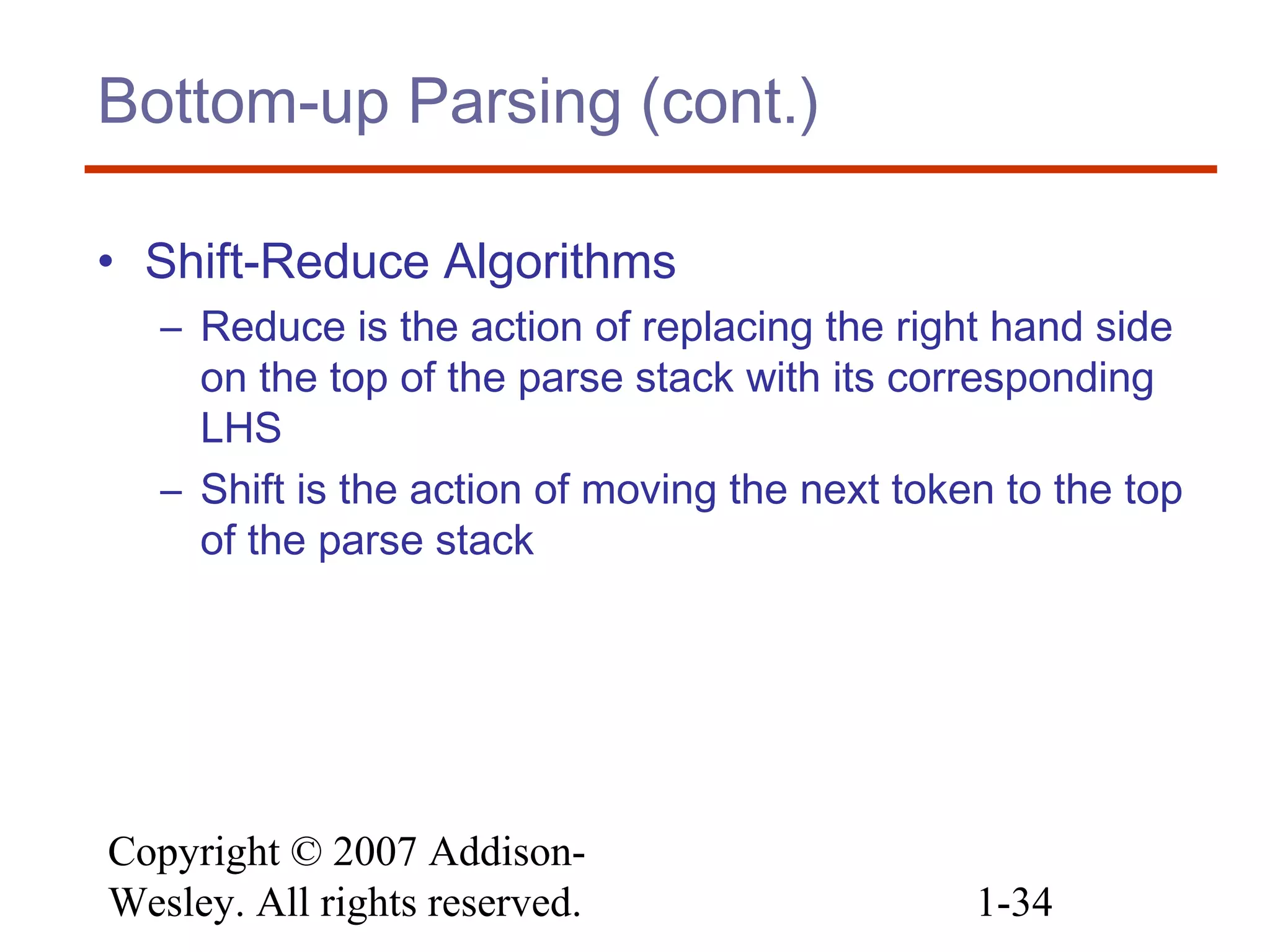
• Shift-Reduce Algorithms
– Reduce is the action of replacing the right hand side
on the top of the parse stack with its corresponding
LHS
– Shift is the action of moving the next token to the top
of the parse stack
Copyright © 2007 Addison-
Wesley. All rights reserved. 1-35
Bottom-up Parsing (cont.)
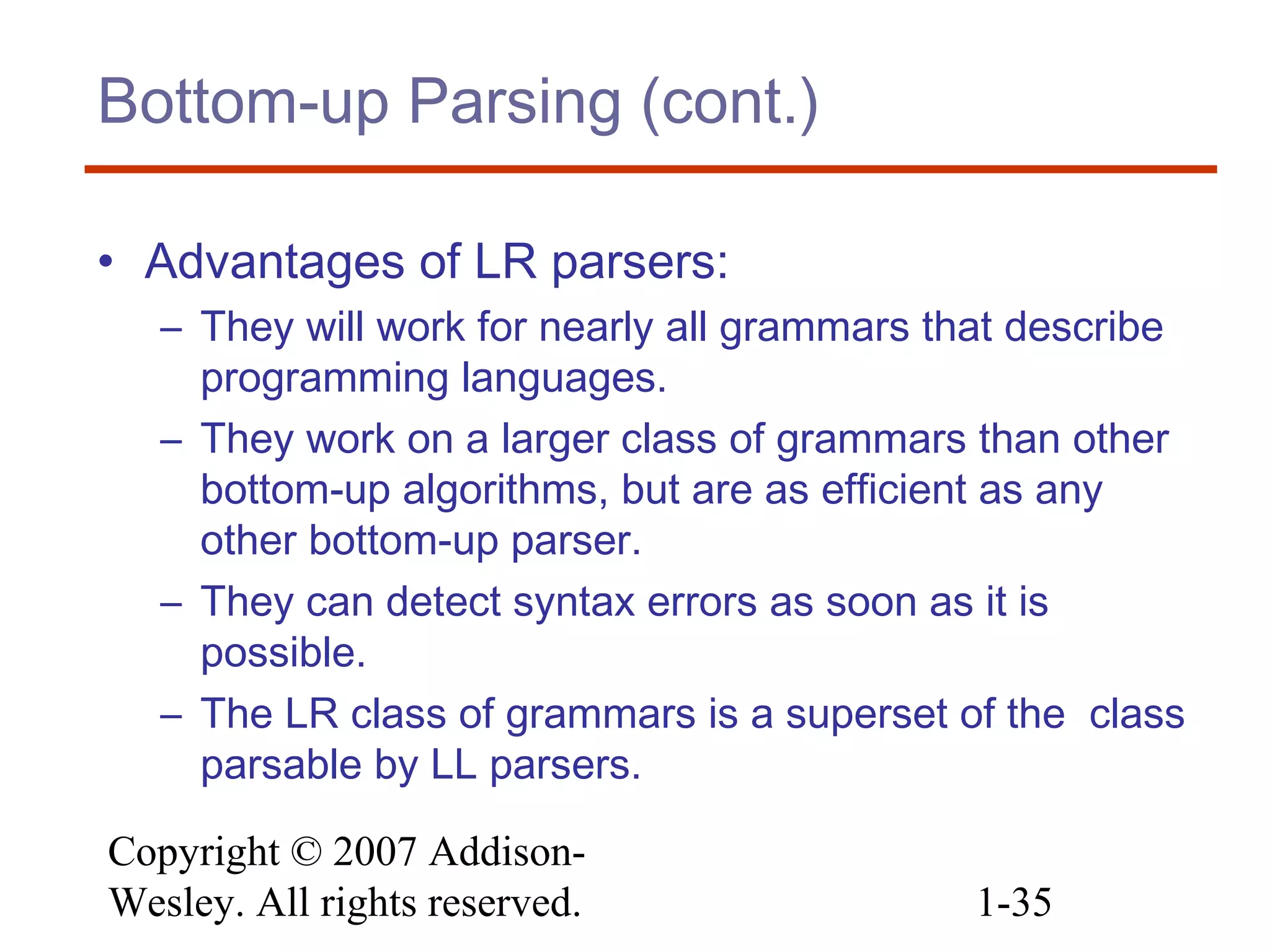
• Advantages of LR parsers:
– They will work for nearly all grammars that describe
programming languages.
– They work on a larger class of grammars than other
bottom-up algorithms, but are as efficient as any
other bottom-up parser.
– They can detect syntax errors as soon as it is
possible.
– The LR class of grammars is a superset of the class
parsable by LL parsers.
Copyright © 2007 Addison-
Wesley. All rights reserved. 1-36
Bottom-up Parsing (cont.)
• LR parsers must be constructed with a tool
• Knuth’s insight: A bottom-up parser could use
the entire history of the parse, up to the current
point, to make parsing decisions
– There were only a finite and relatively small number
of different parse situations that could have occurred,
so the history could be stored in a parser state, on
the parse stack
Copyright © 2007 Addison-
Wesley. All rights reserved. 1-37
Bottom-up Parsing (cont.)
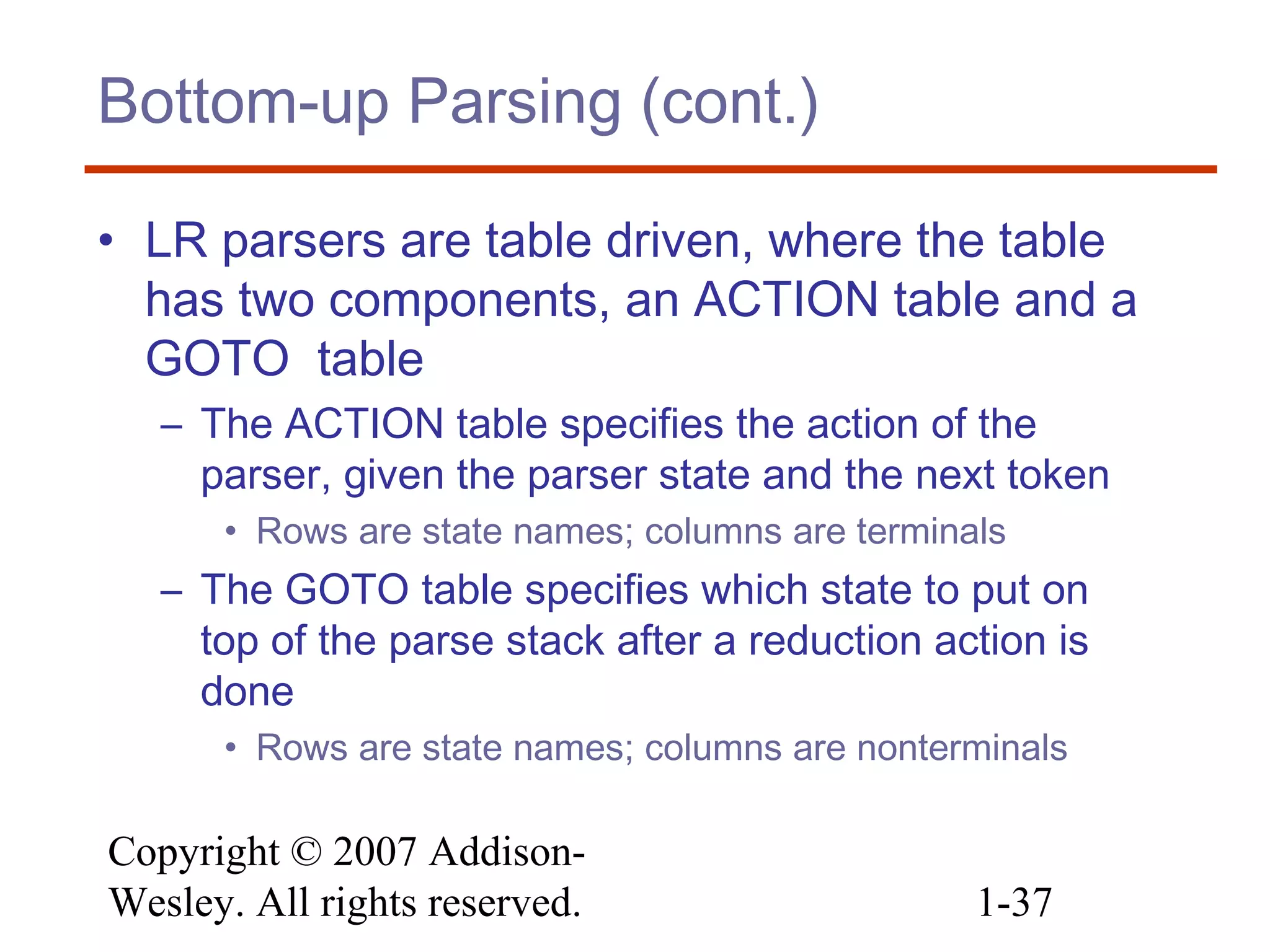
• LR parsers are table driven, where the table
has two components, an ACTION table and a
GOTO table
– The ACTION table specifies the action of the
parser, given the parser state and the next token
• Rows are state names; columns are terminals
– The GOTO table specifies which state to put on
top of the parse stack after a reduction action is
done
• Rows are state names; columns are nonterminals
Copyright © 2007 Addison-
Wesley. All rights reserved. 1-38
Bottom-up Parsing (cont.)
• Parser actions (continued):
– If ACTION[Sm, ai] = Accept, the parse is complete and
no errors were found.
– If ACTION[Sm, ai] = Error, the parser calls an error-
handling routine.
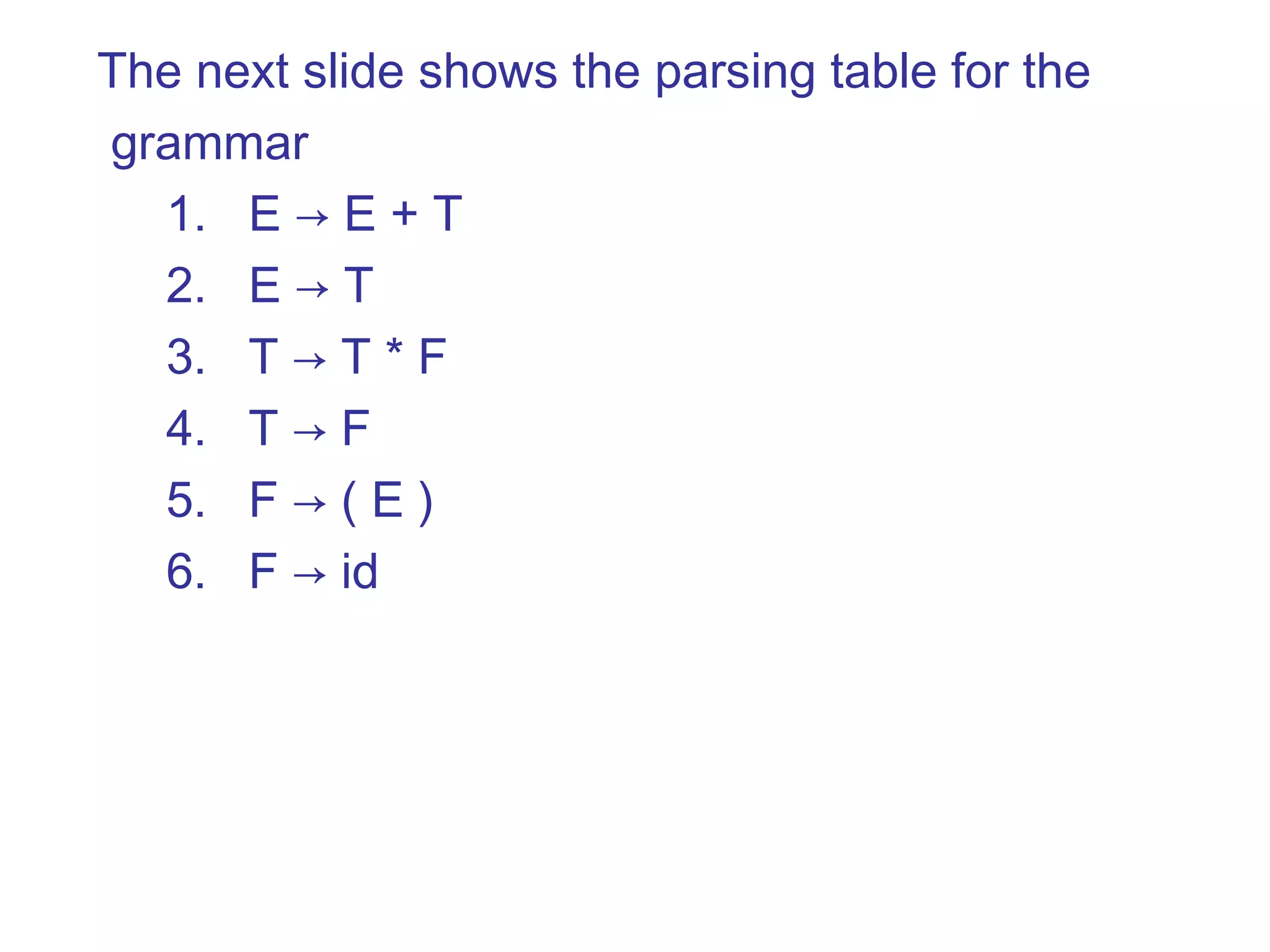
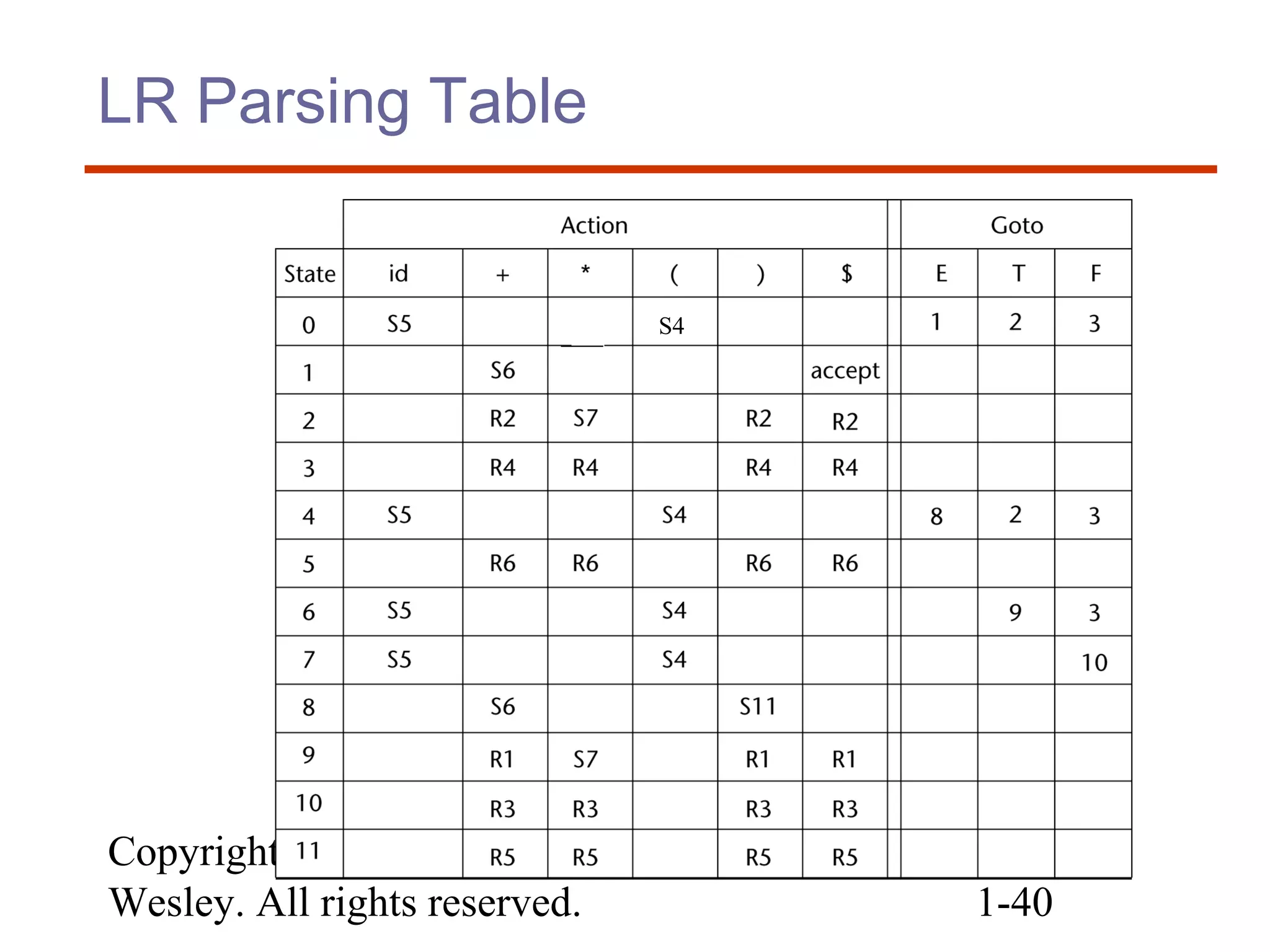
The next slide shows the parsing table for the
grammar
1. E → E + T
2. E → T
3. T → T * F
4. T → F
5. F → ( E )
6. F → id
Copyright © 2007 Addison-
Wesley. All rights reserved. 1-40
LR Parsing Table
S4
Copyright © 2007 Addison-
Wesley. All rights reserved. 1-41
Bottom-up Parsing (cont.)
• A parser table can be generated from a given
grammar with a tool, e.g., yacc
Copyright © 2007 Addison-
Wesley. All rights reserved. 1-42
Summary
• Syntax analysis is a common part of language
implementation
• A lexical analyzer is a pattern matcher that isolates
small-scale parts of a program
– Detects syntax errors
– Produces a parse tree
• A recursive-descent parser is an LL parser
– EBNF
• Parsing problem for bottom-up parsers: find the
substring of current sentential form
• The LR family of shift-reduce parsers is the most
common bottom-up parsing approach

4 lexical and syntax

  • 1.
  • 2.
    Copyright © 2007Addison- Wesley. All rights reserved. 1-2 Chapter 4 Topics • Introduction • Lexical Analysis • The Parsing Problem • Recursive-Descent Parsing • Bottom-Up Parsing
  • 3.
    Copyright © 2007Addison- Wesley. All rights reserved. 1-3 Introduction • Language implementation systems must analyze source code, regardless of the specific implementation approach • Nearly all syntax analysis is based on a formal description of the syntax of the source language (BNF)
  • 4.
    Copyright © 2007Addison- Wesley. All rights reserved. 1-4 Syntax Analysis • The syntax analysis portion of a language processor nearly always consists of two parts: – A low-level part called a lexical analyzer (mathematically, a finite automaton based on a regular grammar) – A high-level part called a syntax analyzer, or parser (mathematically, a push-down automaton based on a context-free grammar, or BNF)
  • 5.
    Copyright © 2007Addison- Wesley. All rights reserved. 1-5 Advantages of Using BNF to Describe Syntax • Provides a clear and concise syntax description • The parser can be based directly on the BNF • Parsers based on BNF are easy to maintain
  • 6.
    Copyright © 2007Addison- Wesley. All rights reserved. 1-6 Reasons to Separate Lexical and Syntax Analysis • Simplicity - less complex approaches can be used for lexical analysis; separating them simplifies the parser • Efficiency - separation allows optimization of the lexical analyzer • Portability - parts of the lexical analyzer may not be portable, but the parser always is portable
  • 7.
    Copyright © 2007Addison- Wesley. All rights reserved. 1-7 Lexical Analysis • A lexical analyzer is a pattern matcher for character strings • A lexical analyzer is a “front-end” for the parser • Identifies substrings of the source program that belong together - lexemes – Lexemes match a character pattern, which is associated with a lexical category called a token – sum is a lexeme; its token may be IDENT
  • 8.
    Copyright © 2007Addison- Wesley. All rights reserved. 1-8 Lexical Analysis (continued) • The lexical analyzer is usually a function that is called by the parser when it needs the next token • Three approaches to building a lexical analyzer: – Write a formal description of the tokens and use a software tool that constructs table-driven lexical analyzers given such a description – Design a state diagram that describes the tokens and write a program that implements the state diagram – Design a state diagram that describes the tokens and hand- construct a table-driven implementation of the state diagram
  • 9.
    Copyright © 2007Addison- Wesley. All rights reserved. 1-9 State Diagram Design – A naïve state diagram would have a transition from every state on every character in the source language - such a diagram would be very large!
  • 10.
    Copyright © 2007Addison- Wesley. All rights reserved. 1-10 Lexical Analysis (cont.) • In many cases, transitions can be combined to simplify the state diagram – When recognizing an identifier, all uppercase and lowercase letters are equivalent • Use a character class that includes all letters – When recognizing an integer literal, all digits are equivalent - use a digit class
  • 11.
    Copyright © 2007Addison- Wesley. All rights reserved. 1-11 Lexical Analysis (cont.) • Reserved words and identifiers can be recognized together (rather than having a part of the diagram for each reserved word) – Use a table lookup to determine whether a possible identifier is in fact a reserved word
  • 12.
    Copyright © 2007Addison- Wesley. All rights reserved. 1-12 Lexical Analysis (cont.) • Convenient utility subprograms: – getChar - gets the next character of input, puts it in nextChar, determines its class and puts the class in charClass – addChar - puts the character from nextChar into the place the lexeme is being accumulated, lexeme – lookup - determines whether the string in lexeme is a reserved word (returns a code)
  • 13.
    Copyright © 2007Addison- Wesley. All rights reserved. 1-13 State Diagram
  • 14.
    Copyright © 2007Addison- Wesley. All rights reserved. 1-14 Lexical Analysis (cont.) Implementation (assume initialization): /* Global variables */ int charClass; char lexeme [100]; char nextChar; int lexLen; int Letter = 0; int DIGIT = 1; int UNKNOWN = -1;
  • 15.
    Copyright © 2007Addison- Wesley. All rights reserved. 1-15 Lexical Analysis (cont.) int lex() { lexLen = 0; static int first = 1; /* If it is the first call to lex, initialize by calling getChar */ if (first) { getChar(); first = 0; } getNonBlank(); switch (charClass) { /* Parse identifiers and reserved words */ case LETTER: addChar(); getChar(); while (charClass == LETTER || charClass == DIGIT){ addChar(); getChar(); } return lookup(lexeme); break; …
  • 16.
    Copyright © 2007Addison- Wesley. All rights reserved. 1-16 Lexical Analysis (cont.) … /* Parse integer literals */ case DIGIT: addChar(); getChar(); while (charClass == DIGIT) { addChar(); getChar(); } return INT_LIT; break; } /* End of switch */ } /* End of function lex */
  • 17.
    Copyright © 2007Addison- Wesley. All rights reserved. 1-17 The Parsing Problem • Goals of the parser, given an input program: – Find all syntax errors; for each, produce an appropriate diagnostic message and recover quickly – Produce the parse tree, or at least a trace of the parse tree, for the program
  • 18.
    Copyright © 2007Addison- Wesley. All rights reserved. 1-18 The Parsing Problem (cont.) • Two categories of parsers – Top down - produce the parse tree, beginning at the root • Order is that of a leftmost derivation • Traces or builds the parse tree in preorder – Bottom up - produce the parse tree, beginning at the leaves • Order is that of the reverse of a rightmost derivation • Useful parsers look only one token ahead in the input
  • 19.
    Copyright © 2007Addison- Wesley. All rights reserved. 1-19 The Parsing Problem (cont.) • Top-down Parsers – Given a sentential form, xAα , the parser must choose the correct A-rule to get the next sentential form in the leftmost derivation, using only the first token produced by A • The most common top-down parsing algorithms: – Recursive descent - a coded implementation – LL parsers - table driven implementation
  • 20.
    Copyright © 2007Addison- Wesley. All rights reserved. 1-20 The Parsing Problem (cont.) • Bottom-up parsers – Given a right sentential form, α, determine what substring of α is the right-hand side of the rule in the grammar that must be reduced to produce the previous sentential form in the right derivation – The most common bottom-up parsing algorithms are in the LR family
  • 21.
    Copyright © 2007Addison- Wesley. All rights reserved. 1-21 The Parsing Problem (cont.) • The Complexity of Parsing – Parsers that work for any unambiguous grammar are complex and inefficient ( O(n3 ), where n is the length of the input ) – Compilers use parsers that only work for a subset of all unambiguous grammars, but do it in linear time ( O(n), where n is the length of the input )
  • 22.
    Copyright © 2007Addison- Wesley. All rights reserved. 1-22 Recursive-Descent Parsing • There is a subprogram for each nonterminal in the grammar, which can parse sentences that can be generated by that nonterminal • EBNF is ideally suited for being the basis for a recursive-descent parser, because EBNF minimizes the number of nonterminals
  • 23.
    Copyright © 2007Addison- Wesley. All rights reserved. 1-23 Recursive-Descent Parsing (cont.) • A grammar for simple expressions: <expr> → <term> {(+ | -) <term>} <term> → <factor> {(* | /) <factor>} <factor> → id | ( <expr> )
  • 24.
    Copyright © 2007Addison- Wesley. All rights reserved. 1-24 Recursive-Descent Parsing (cont.) • Assume we have a lexical analyzer named lex, which puts the next token code in nextToken • The coding process when there is only one RHS: – For each terminal symbol in the RHS, compare it with the next input token; if they match, continue, else there is an error – For each nonterminal symbol in the RHS, call its associated parsing subprogram
  • 25.
    Copyright © 2007Addison- Wesley. All rights reserved. 1-25 Recursive-Descent Parsing (cont.) /* Function expr Parses strings in the language generated by the rule: <expr> → <term> {(+ | -) <term>} */ void expr() { /* Parse the first term */ term(); …
  • 26.
    Copyright © 2007Addison- Wesley. All rights reserved. 1-26 Recursive-Descent Parsing (cont.) /* As long as the next token is + or -, call lex to get the next token, and parse the next term */ while (nextToken == PLUS_CODE || nextToken == MINUS_CODE){ lex(); term(); } } • This particular routine does not detect errors • Convention: Every parsing routine leaves the next token in nextToken
  • 27.
    Copyright © 2007Addison- Wesley. All rights reserved. 1-27 Recursive-Descent Parsing (cont.) A nonterminal that has more than one RHS requires an initial process to determine which RHS it is to parse – The correct RHS is chosen on the basis of the next token of input (the lookahead) – The next token is compared with the first token that can be generated by each RHS until a match is found – If no match is found, it is a syntax error Note: the algorithm accordingly fails if the right hand sides, of two productions with the same left hand side, have terminal heads that are not disjoint.
  • 28.
    Copyright © 2007Addison- Wesley. All rights reserved. 1-28 Recursive-Descent Parsing (cont.) /* Function factor Parses strings in the language generated by the rule: <factor> -> id | (<expr>) */ void factor() { /* Determine which RHS */ if (nextToken) == ID_CODE) /* For the RHS id, just call lex */ lex();
  • 29.
    Copyright © 2007Addison- Wesley. All rights reserved. 1-29 Recursive-Descent Parsing (cont.) /* If the RHS is (<expr>) – call lex to pass over the left parenthesis, call expr, and check for the right parenthesis */ else if (nextToken == LEFT_PAREN_CODE) { lex(); expr(); if (nextToken == RIGHT_PAREN_CODE) lex(); else error(); } /* End of else if (nextToken == ... */ else error(); /* Neither RHS matches */ }
  • 30.
    Copyright © 2007Addison- Wesley. All rights reserved. 1-30 Recursive-Descent Parsing (cont.) • The LL Grammar Class – The Left Recursion Problem • If a grammar has left recursion, either direct or indirect, it cannot be the basis for a top-down parser – A grammar can be modified to remove left recursion For each nonterminal, A, 1. Group the A-rules as A → Aα1 | … | Aαm | β1 | β2 | … | βn where none of the β‘s begins with A 2. Replace the original A-rules with A → β1A’ | β2A’ | … | βnA’ A’ → α1A’ | α2A’ | … | αmA’ | ε
  • 31.
    Copyright © 2007Addison- Wesley. All rights reserved. 1-31 Recursive-Descent Parsing (cont.) • The other characteristic of grammars that disallows top-down parsing is the lack of pairwise disjointness – The inability to determine the correct RHS on the basis of one token of lookahead – Def: FIRST(α) = {a | α =>* aβ } (If α =>* ε, ε is in FIRST(α))
  • 32.
    Copyright © 2007Addison- Wesley. All rights reserved. 1-32 Recursive-Descent Parsing (cont.) • Pairwise Disjointness Test: – For each nonterminal, A, in the grammar that has more than one RHS, for each pair of rules, A → αi and A → αj, it must be true that FIRST(αi) ⋂ FIRST(αj) = φ • Examples: A → a | bB | cAb A → a | aB
  • 33.
    Copyright © 2007Addison- Wesley. All rights reserved. 1-33 Bottom-up Parsing • The parsing problem is finding the correct RHS in a right-sentential form to reduce to get the previous right-sentential form in the derivation
  • 34.
    Copyright © 2007Addison- Wesley. All rights reserved. 1-34 Bottom-up Parsing (cont.) • Shift-Reduce Algorithms – Reduce is the action of replacing the right hand side on the top of the parse stack with its corresponding LHS – Shift is the action of moving the next token to the top of the parse stack
  • 35.
    Copyright © 2007Addison- Wesley. All rights reserved. 1-35 Bottom-up Parsing (cont.) • Advantages of LR parsers: – They will work for nearly all grammars that describe programming languages. – They work on a larger class of grammars than other bottom-up algorithms, but are as efficient as any other bottom-up parser. – They can detect syntax errors as soon as it is possible. – The LR class of grammars is a superset of the class parsable by LL parsers.
  • 36.
    Copyright © 2007Addison- Wesley. All rights reserved. 1-36 Bottom-up Parsing (cont.) • LR parsers must be constructed with a tool • Knuth’s insight: A bottom-up parser could use the entire history of the parse, up to the current point, to make parsing decisions – There were only a finite and relatively small number of different parse situations that could have occurred, so the history could be stored in a parser state, on the parse stack
  • 37.
    Copyright © 2007Addison- Wesley. All rights reserved. 1-37 Bottom-up Parsing (cont.) • LR parsers are table driven, where the table has two components, an ACTION table and a GOTO table – The ACTION table specifies the action of the parser, given the parser state and the next token • Rows are state names; columns are terminals – The GOTO table specifies which state to put on top of the parse stack after a reduction action is done • Rows are state names; columns are nonterminals
  • 38.
    Copyright © 2007Addison- Wesley. All rights reserved. 1-38 Bottom-up Parsing (cont.) • Parser actions (continued): – If ACTION[Sm, ai] = Accept, the parse is complete and no errors were found. – If ACTION[Sm, ai] = Error, the parser calls an error- handling routine.
  • 39.
    The next slideshows the parsing table for the grammar 1. E → E + T 2. E → T 3. T → T * F 4. T → F 5. F → ( E ) 6. F → id
  • 40.
    Copyright © 2007Addison- Wesley. All rights reserved. 1-40 LR Parsing Table S4
  • 41.
    Copyright © 2007Addison- Wesley. All rights reserved. 1-41 Bottom-up Parsing (cont.) • A parser table can be generated from a given grammar with a tool, e.g., yacc
  • 42.
    Copyright © 2007Addison- Wesley. All rights reserved. 1-42 Summary • Syntax analysis is a common part of language implementation • A lexical analyzer is a pattern matcher that isolates small-scale parts of a program – Detects syntax errors – Produces a parse tree • A recursive-descent parser is an LL parser – EBNF • Parsing problem for bottom-up parsers: find the substring of current sentential form • The LR family of shift-reduce parsers is the most common bottom-up parsing approach