1
Principles of Compiler Design
Sanjeev K Aggarwal
Department of Computer Science
and Engineering, IIT Kanpur
ska@iitk.ac.in
2
Motivation for doing this course
• Language processing is an important component of
programming
• A large number of systems software and application
programs require structured input
• Operating Systems (command line processing)
• Databases (Query language processing)
• Type setting systems like Latex, Nroff, Troff, Equation
editors, M4
• VLSI design and testing,
• Software quality assurance and software testing
3
• XML, html based systems, Awk, Sed, Emacs, vi ….
• Form processing, extracting information automatically
from forms
• Compilers, assemblers and linkers
• High level language to language translators
• Natural language processing
• Where ever input has a structure one can think of
language processing
• Why study compilers?
Compilers use the whole spectrum of language
processing technology
4
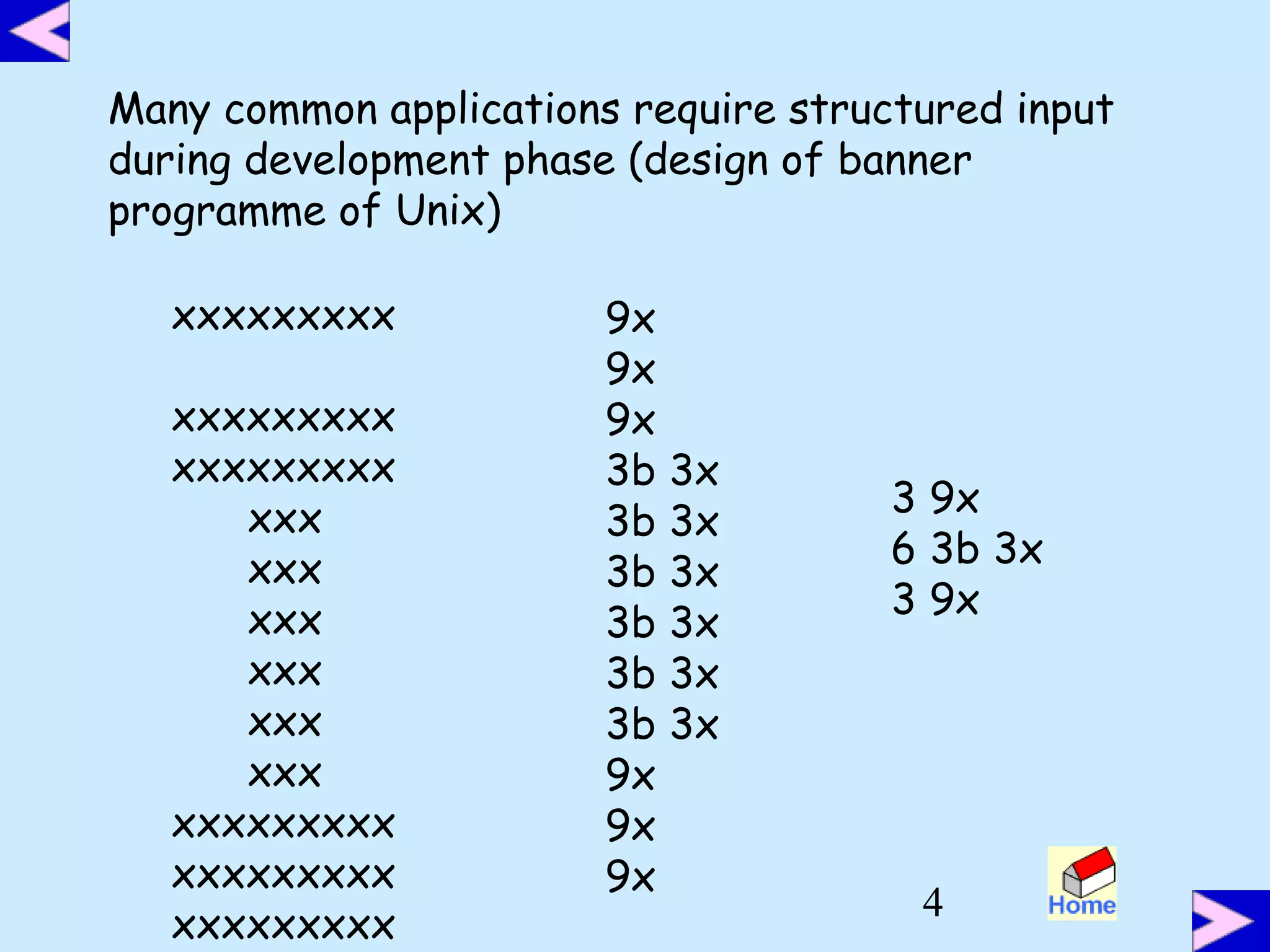
Many common applications require structured input
during development phase (design of banner
programme of Unix)
xxxxxxxxx
xxxxxxxxx
xxxxxxxxx
xxx
xxx
xxx
xxx
xxx
xxx
xxxxxxxxx
xxxxxxxxx
xxxxxxxxx
9x
9x
9x
3b 3x
3b 3x
3b 3x
3b 3x
3b 3x
3b 3x
9x
9x
9x
3 9x
6 3b 3x
3 9x
5
What will we learn in the course?
• How high level languages are implemented to generate
machine code. Complete structure of compilers and how
various parts are composed together to get a compiler
• Course has theoretical and practical components. Both are
needed in implementing programming languages. The focus
will be on practical application of the theory.
• Emphasis will be on algorithms and data structures rather
than proofs of correctness of algorithms.
• Theory of lexical analysis, parsing, type checking, runtime
system, code generation, optimization (without going too
deep into the proofs etc.)
• Techniques for developing lexical analyzers, parsers, type
checkers, run time systems, code generator, optimization.
Use of tools and specifications for developing various parts
of compilers
6
What do we expect to achieve
by the end of the course?
• Students are confident that they can
use language processing technology for
various software developments
• Students are confident that they can
design, develop, understand,
modify/enhance, and maintain compilers
for (even complex!) programming
languages
7
Organization of the course
• Approximately 40 lectures of one hour each
• One large programming project to be done in group of four students.
The project will have 4-5 parts and will be evaluated every 2-3 weeks
during the semester. It is important to start early. (25% credit)
– Copying old code is cheating. Do not Cheat.
– Late submissions will be increasingly penalized.
– Submissions must happen by noon on the due day
• Some small programming assignments and home work (10% credit)
– Do not copy. However, you are free to discuss
– Late submissions will be increasingly penalized.
– Submissions must happen by noon on the due day
• Two mid semester examinations (15% + 15% credit)
• One end semester examination (30% credit)
• Participation in the discussions in the class + class notes (5% credit)
8
Class Notes
• Groups of three students to be formed by the instructor in
round robin fashion
• Each group will be responsible for preparing notes (both
writing and editing) for two consecutive lectures
• Notes should be related to slides or a group of slides
• Notes should be added to the power point slides of the
lectures
• Slides and notes will be made available to the students
• Deadline for notes: Seven days from the second lecture
9
Required Background and self
reading
• This is a 5 unit course and, therefore, will have about 25%
more load than other professional courses. You should be
prepared for more work and long hours of programming
• Courses in data structures, computer organization, operating
systems
• Proficiency in C/C++/Java programming languages
• Knowledge of at least one assembly language, assembler,
linker & loader, symbolic debugger
• You are expected to read the complete book (except the
chapter on code optimization) on Compiler Design by Aho,
Sethi and Ullman. All the material will not be covered in the
lectures
10
Things to do immediately
• Form groups of 4 students
• Inform the instructor
– Send an email with subject line “CS335 group”
– Give roll number, name and email ids of all the group
members in the message
– Deadline Dec 31, 2004
• Give feed back through out the semester; either personally
or through email or anonymous.
PLEASE HELP ME IMPROVING THE SLIDES (both
presentation style and the material), AND THE NOTES!!
• First assignment: Write a simulator for the stack machine
described in the text book by Aho, Sethi and Ullman in
section 2.8. Submission date: Jan 10, 2005
11
Bit of History
• How are programming languages implemented? Two
major strategies:
– Interpreters (old and much less studied)
– Compilers (very well understood with
mathematical foundations)
• Some environments provide both interpreter and
compiler. Lisp, scheme etc. provide
– Interpreter for development
– Compiler for deployment
• Java
– Java compiler: Java to interpretable bytecode
– Java JIT: bytecode to executable image
12
Some early machines and
implementations
• IBM developed 704 in 1954. All programming was
done in assembly language. Cost of software
development far exceeded cost of hardware. Low
productivity.
• Speedcoding interpreter: programs ran about 10
times slower than hand written assembly code
• John Backus (in 1954): Proposed a program that
translated high level expressions into native
machine code. Skeptism all around. Most people
thought it was impossible
• Fortran I project (1954-1957): The first compiler
was released
13
Fortran I
• The first compiler had a huge impact on the programming
languages and computer science. The whole new field of compiler
design was started
• More than half the programmers were using Fortran by 1958
• The development time was cut down to half
• Led to enormous amount of theoretical work (lexical analysis,
parsing, optimization, structured programming, code generation,
error recovery etc.)
• Modern compilers preserve the basic structure of
the Fortran I compiler !!!
14
References
• Compilers: Principles, Tools and Techniques by Aho, Sethi
and Ullman
soon to be replaced by “21st
Century Compilers” by Aho,
Sethi, Ullman, and Lam
• Crafting a Compiler in C by Fischer and LeBlanc
soon to be replaced by “Crafting a Compiler” by Fischer
• Compiler Design in C by Holub
• Programming Language Pragmatics by Scott
• Engineering a Compiler by Cooper and Torczon
• Modern Compiler Implementation (in C and in Java) by Appel
• Writing Compilers and Interpreters by Mak
15
• Compiler Design by Wilhelm and Maurer
• A Retargetable Compiler: Design and Implementation by Fraser
and Hanson
• Compiler Construction by Wirth
• The Theory of Parsing, Translation and Compiling (vol 1 & 2) by
Aho and Ullman (old classic)
• Introduction to Compiler Construction with Unix by Schreiner
and Friedman
• Compiler Design and Construction: Tools and Techniques by
Pyster
• Engineering a Compiler by Anklam and Cutler
• Object Oriented Compiler Construction by Holmes
• The Compiler Design Handbook edited by Srikant and Shankar

Introduction to course

  • 1.
    1 Principles of CompilerDesign Sanjeev K Aggarwal Department of Computer Science and Engineering, IIT Kanpur ska@iitk.ac.in
  • 2.
    2 Motivation for doingthis course • Language processing is an important component of programming • A large number of systems software and application programs require structured input • Operating Systems (command line processing) • Databases (Query language processing) • Type setting systems like Latex, Nroff, Troff, Equation editors, M4 • VLSI design and testing, • Software quality assurance and software testing
  • 3.
    3 • XML, htmlbased systems, Awk, Sed, Emacs, vi …. • Form processing, extracting information automatically from forms • Compilers, assemblers and linkers • High level language to language translators • Natural language processing • Where ever input has a structure one can think of language processing • Why study compilers? Compilers use the whole spectrum of language processing technology
  • 4.
    4 Many common applicationsrequire structured input during development phase (design of banner programme of Unix) xxxxxxxxx xxxxxxxxx xxxxxxxxx xxx xxx xxx xxx xxx xxx xxxxxxxxx xxxxxxxxx xxxxxxxxx 9x 9x 9x 3b 3x 3b 3x 3b 3x 3b 3x 3b 3x 3b 3x 9x 9x 9x 3 9x 6 3b 3x 3 9x
  • 5.
    5 What will welearn in the course? • How high level languages are implemented to generate machine code. Complete structure of compilers and how various parts are composed together to get a compiler • Course has theoretical and practical components. Both are needed in implementing programming languages. The focus will be on practical application of the theory. • Emphasis will be on algorithms and data structures rather than proofs of correctness of algorithms. • Theory of lexical analysis, parsing, type checking, runtime system, code generation, optimization (without going too deep into the proofs etc.) • Techniques for developing lexical analyzers, parsers, type checkers, run time systems, code generator, optimization. Use of tools and specifications for developing various parts of compilers
  • 6.
    6 What do weexpect to achieve by the end of the course? • Students are confident that they can use language processing technology for various software developments • Students are confident that they can design, develop, understand, modify/enhance, and maintain compilers for (even complex!) programming languages
  • 7.
    7 Organization of thecourse • Approximately 40 lectures of one hour each • One large programming project to be done in group of four students. The project will have 4-5 parts and will be evaluated every 2-3 weeks during the semester. It is important to start early. (25% credit) – Copying old code is cheating. Do not Cheat. – Late submissions will be increasingly penalized. – Submissions must happen by noon on the due day • Some small programming assignments and home work (10% credit) – Do not copy. However, you are free to discuss – Late submissions will be increasingly penalized. – Submissions must happen by noon on the due day • Two mid semester examinations (15% + 15% credit) • One end semester examination (30% credit) • Participation in the discussions in the class + class notes (5% credit)
  • 8.
    8 Class Notes • Groupsof three students to be formed by the instructor in round robin fashion • Each group will be responsible for preparing notes (both writing and editing) for two consecutive lectures • Notes should be related to slides or a group of slides • Notes should be added to the power point slides of the lectures • Slides and notes will be made available to the students • Deadline for notes: Seven days from the second lecture
  • 9.
    9 Required Background andself reading • This is a 5 unit course and, therefore, will have about 25% more load than other professional courses. You should be prepared for more work and long hours of programming • Courses in data structures, computer organization, operating systems • Proficiency in C/C++/Java programming languages • Knowledge of at least one assembly language, assembler, linker & loader, symbolic debugger • You are expected to read the complete book (except the chapter on code optimization) on Compiler Design by Aho, Sethi and Ullman. All the material will not be covered in the lectures
  • 10.
    10 Things to doimmediately • Form groups of 4 students • Inform the instructor – Send an email with subject line “CS335 group” – Give roll number, name and email ids of all the group members in the message – Deadline Dec 31, 2004 • Give feed back through out the semester; either personally or through email or anonymous. PLEASE HELP ME IMPROVING THE SLIDES (both presentation style and the material), AND THE NOTES!! • First assignment: Write a simulator for the stack machine described in the text book by Aho, Sethi and Ullman in section 2.8. Submission date: Jan 10, 2005
  • 11.
    11 Bit of History •How are programming languages implemented? Two major strategies: – Interpreters (old and much less studied) – Compilers (very well understood with mathematical foundations) • Some environments provide both interpreter and compiler. Lisp, scheme etc. provide – Interpreter for development – Compiler for deployment • Java – Java compiler: Java to interpretable bytecode – Java JIT: bytecode to executable image
  • 12.
    12 Some early machinesand implementations • IBM developed 704 in 1954. All programming was done in assembly language. Cost of software development far exceeded cost of hardware. Low productivity. • Speedcoding interpreter: programs ran about 10 times slower than hand written assembly code • John Backus (in 1954): Proposed a program that translated high level expressions into native machine code. Skeptism all around. Most people thought it was impossible • Fortran I project (1954-1957): The first compiler was released
  • 13.
    13 Fortran I • Thefirst compiler had a huge impact on the programming languages and computer science. The whole new field of compiler design was started • More than half the programmers were using Fortran by 1958 • The development time was cut down to half • Led to enormous amount of theoretical work (lexical analysis, parsing, optimization, structured programming, code generation, error recovery etc.) • Modern compilers preserve the basic structure of the Fortran I compiler !!!
  • 14.
    14 References • Compilers: Principles,Tools and Techniques by Aho, Sethi and Ullman soon to be replaced by “21st Century Compilers” by Aho, Sethi, Ullman, and Lam • Crafting a Compiler in C by Fischer and LeBlanc soon to be replaced by “Crafting a Compiler” by Fischer • Compiler Design in C by Holub • Programming Language Pragmatics by Scott • Engineering a Compiler by Cooper and Torczon • Modern Compiler Implementation (in C and in Java) by Appel • Writing Compilers and Interpreters by Mak
  • 15.
    15 • Compiler Designby Wilhelm and Maurer • A Retargetable Compiler: Design and Implementation by Fraser and Hanson • Compiler Construction by Wirth • The Theory of Parsing, Translation and Compiling (vol 1 & 2) by Aho and Ullman (old classic) • Introduction to Compiler Construction with Unix by Schreiner and Friedman • Compiler Design and Construction: Tools and Techniques by Pyster • Engineering a Compiler by Anklam and Cutler • Object Oriented Compiler Construction by Holmes • The Compiler Design Handbook edited by Srikant and Shankar

Editor's Notes

  • #3 Language processing technology is very important aspect of systems programming. A large number of systems tools and quality assurance tools use this technology. Some of the important areas which use this technology are compilers, linkers, loaders, debuggers, language to language translators, command line processing, database query processing, document/form processing systems, document type setting systems, VHDL compilers for VLSI design, tools like test coverage analysis and code compliance testing, html viewers, postscript printer drivers, XML system, natural language processing etc. The list goes on and on. This is one of the core technologies in computing. In fact, wherever structured input has to be processed this technology has to be used for developing the tools.
  • #5 Let us consider banner program of Unix. This was a very popular program in pre-web days when different font sizes were not available. This program takes a text input and produces and output which reads as the input but appears on much larger canvas. Please note that it does not use larger fonts. This utility gives output on a normal high speed line printer by creating virtual large size fonts. For example letter I appears as in slide which is a 9 by 12 matrix consisting of letter Xs and blanks in appropriate positions. Designer of such utilities are actually doing a font design by defining a matrix for every letter initializing cells of this matrix to either X or blank. If multiple size ‘fonts’ have to designed then many matrices have to be initialized for each letter. There is a large scope of making an error while initializing such arrays, and repetitive work when arrays of multiple sizes have to initialed. Instead, one can write “specification” of each letter. For example specifications of letter I can be written as 1st, 2nd, and the 3rd lines consist of 9Xs, next six lines consist of 3 blanks followed by 3 Xs followed by 3 blanks, and last three lines consist of 9Xs each. This specification can be further compacted as shown on the slide. Once this specification is written then it is very easy to use a tool to convert this into an array consisting of Xs and blanks. This cleanly separate the font designer from the programmer, and reduces probability of errors in initializing arrays. This tool can be viewed as a compiler which takes these specifications and generates arrays Xs and blanks.
  • #6 In the course we intend to learn the algorithms, data structures and the techniques required to implement a full compiler. The algorithms, data structures and the techniques will be discussed in the lectures. However, actual implementation of these algorithms using the techniques will be done by working on a large laboratory project. During the course of the project students will implement a compiler for a programming language for a virtual platform like SPIM. As these will be large projects the students will work in groups of four.
  • #7 The primary objective is that at the end of the course the students must be quite comfortable with the concepts related to language processing and compiler design. They should understand the theory as well the implementation techniques. They should be able to deploy their knowledge in various fields where processing of structured data is required.
  • #8 These are the guidelines for organizing the course. However, each instructor should based on local conditions.
  • #9 These are the guidelines for organizing the course. However, each instructor should based on local conditions.
  • #10 This is specific to IIT Kanpur. Instructors should localize this information.
  • #11 So lets gear up for the course and get going immediately with small but necessary things.
  • #12 Interpreters are obsolete. Only compilers are used now.
  • #13 Some more history.
  • #14 Fortran 1 – The first compiler. It revolutionized programming. It forms the basis of even the modern compilers.
  • #15 A few references you might find useful