ISBN 0-321-49362-1
Chapter 7
Expressions and
Assignment
Statements
Copyright © 2007 Addison-
Wesley. All rights reserved. 1-2
Chapter 7 Topics
• Introduction
• Arithmetic Expressions
• Overloaded Operators
• Type Conversions
• Relational and Boolean Expressions
• Short-Circuit Evaluation
• Assignment Statements
• Mixed-Mode Assignment
Copyright © 2007 Addison-
Wesley. All rights reserved. 1-3
Introduction
• Expressions are the fundamental means of
specifying computations in a programming
language
• To understand expression evaluation, need to
be familiar with the orders of operator and
operand evaluation
• Essence of imperative languages is dominant
role of assignment statements
Copyright © 2007 Addison-
Wesley. All rights reserved. 1-4
Arithmetic Expressions
• Arithmetic evaluation was one of the motivations
for the development of the first programming
languages
• Arithmetic expressions consist of operators,
operands, parentheses, and function calls
Copyright © 2007 Addison-
Wesley. All rights reserved. 1-5
Arithmetic Expressions: Design Issues
• Design issues for arithmetic expressions
– Operator precedence rules?
– Operator associativity rules?
– Order of operand evaluation?
– Operand evaluation side effects?
– Operator overloading?
– Type mixing in expressions?
Copyright © 2007 Addison-
Wesley. All rights reserved. 1-6
Arithmetic Expressions: Operators
• A unary operator has one operand
• A binary operator has two operands
• A ternary operator has three operands
Copyright © 2007 Addison-
Wesley. All rights reserved. 1-7
Arithmetic Expressions: Operator
Precedence Rules
• The operator precedence rules for expression
evaluation define the order in which
“adjacent” operators of different precedence
levels are evaluated
• Typical precedence levels
– parentheses
– unary operators
– ** (if the language supports it)
– *, /
– +, -
Copyright © 2007 Addison-
Wesley. All rights reserved. 1-8
Arithmetic Expressions: Operator
Associativity Rule
• The operator associativity rules for expression
evaluation define the order in which adjacent operators
with the same precedence level are evaluated
• Typical associativity rules
– Left to right, except **, which is right to left
– Sometimes unary operators associate right to left (e.g., in
FORTRAN)
• APL is different; all operators have equal precedence
and all operators associate right to left
• Precedence and associativity rules can be overriden
with parentheses
Copyright © 2007 Addison-
Wesley. All rights reserved. 1-9
Ruby Expressions
• All arithmetic, relational, and assignment
operators, as well as array indexing, shifts, and
bit-wise logic operators, are implemented as
methods
- One result of this is that these operators can all
be overriden by application programs
Copyright © 2007 Addison-
Wesley. All rights reserved. 1-10
Arithmetic Expressions: Conditional
Expressions
• Conditional Expressions
– C-based languages (e.g., C, C++)
– An example:
average = (count == 0)? 0 : sum / count
– Evaluates as if written like
if (count == 0)
average = 0
else
average = sum /count
Copyright © 2007 Addison-
Wesley. All rights reserved. 1-11
Arithmetic Expressions: Operand Evaluation
Order
• Operand evaluation order
1. Variables: fetch the value from memory
2. Constants: sometimes a fetch from memory;
sometimes the constant is in the machine language
instruction
3. Parenthesized expressions: evaluate all operands
and operators first
4. The most interesting case is when an operand is a
function call
Copyright © 2007 Addison-
Wesley. All rights reserved. 1-12
Arithmetic Expressions: Potentials for Side
Effects
• Functional side effects: when a function changes a two-
way parameter or a non-local variable
• Problem with functional side effects:
– When a function referenced in an expression alters another
operand of the expression; e.g., for a parameter change:
a = 10;
/* assume that fun changes its parameter */
b = a + fun(a);
Copyright © 2007 Addison-
Wesley. All rights reserved. 1-13
Functional Side Effects
• Two possible solutions to the problem
1. Write the language definition to disallow functional
side effects
• No two-way parameters in functions
• Advantage: it works!
• Disadvantage: inflexibility of one-way parameters
Write the language definition to demand that operand
evaluation order be fixed
• Disadvantage: limits some compiler optimizations
• Java requires that operands appear to be evaluated in
left-to-right order
Copyright © 2007 Addison-
Wesley. All rights reserved. 1-14
Overloaded Operators
• Use of an operator for more than one purpose is
called operator overloading
• Some are common (e.g., + for int and float)
• Some are potential trouble (e.g., * in C and C+
+)
– Loss of compiler error detection (omission of an
operand should be a detectable error)
– Some loss of readability
– Can be avoided by introduction of new symbols (e.g.,
Pascal’s div for integer division)
Copyright © 2007 Addison-
Wesley. All rights reserved. 1-15
Overloaded Operators (continued)
• C++, Ada, Fortran 95, and C# allow user-
defined overloaded operators
• Potential problems:
– Users can define nonsense operations
– Readability may suffer, even when the operators
make sense
Copyright © 2007 Addison-
Wesley. All rights reserved. 1-16
Type Conversions
• A narrowing conversion is one that converts an
object to a type that cannot include all of the
values of the original type e.g., float to int
• A widening conversion is one in which an object
is converted to a type that can include at least
approximations to all of the values of the original
type e.g., int to float
Copyright © 2007 Addison-
Wesley. All rights reserved. 1-17
Type Conversions: Mixed Mode
• A mixed-mode expression is one that has operands of
different types
• A coercion is an implicit type conversion
• Disadvantage of coercions:
– They decrease in the type error detection ability of the compiler
• In most languages, all numeric types are coerced in
expressions, using widening conversions
• In Ada, there are virtually no coercions in expressions
Copyright © 2007 Addison-
Wesley. All rights reserved. 1-18
Explicit Type Conversions
• Called casting in C-based languages
• Examples
– C: (int)angle
– Ada: Float (Sum)
Note that Ada’s syntax is similar to that of
function calls
Copyright © 2007 Addison-
Wesley. All rights reserved. 1-19
Type Conversions: Errors in Expressions
• Causes
– Inherent limitations of arithmetic e.g.,
division by zero
– Limitations of computer arithmetic e.g.
overflow
• Often ignored by the run-time system
Copyright © 2007 Addison-
Wesley. All rights reserved. 1-20
Relational and Boolean Expressions
• Relational Expressions
– Use relational operators and operands of various
types
– Evaluate to some Boolean representation
– Operator symbols used vary somewhat among
languages (!=, /=, .NE., <>, #)
• JavaScript and PHP have two additional
relational operator, === and !==
- Similar to their cousins, == and !=, except that they do
not coerce their operands
Copyright © 2007 Addison-
Wesley. All rights reserved. 1-21
Relational and Boolean Expressions
• Boolean Expressions
– Operands are Boolean and the result is Boolean
– Example operators
FORTRAN 77 FORTRAN 90 C Ada
.AND. and && and
.OR. or || or
.NOT. not ! not
xor
Copyright © 2007 Addison-
Wesley. All rights reserved. 1-22
Relational and Boolean Expressions: No
Boolean Type in C
• C89 has no Boolean type--it uses int type with
0 for false and nonzero for true
• One odd characteristic of C’s expressions:
a < b < c is a legal expression, but the result
is not what you might expect:
– Left operator is evaluated, producing 0 or 1
– The evaluation result is then compared with the third
operand (i.e., c)
Copyright © 2007 Addison-
Wesley. All rights reserved. 1-23
Short Circuit Evaluation
• An expression in which the result is determined
without evaluating all of the operands and/or
operators
• Example: (13*a) * (b/13–1)
If a is zero, there is no need to evaluate (b/13-1)
• Problem with non-short-circuit evaluation
index = 1;
while (index <= length) && (LIST[index] != value)
index++;
– When index=length, LIST [index] will cause an
indexing problem (assuming LIST has length -1 elements)
Copyright © 2007 Addison-
Wesley. All rights reserved. 1-24
Short Circuit Evaluation (continued)
• C, C++, and Java: use short-circuit evaluation for the
usual Boolean operators (&& and ||), but also provide
bitwise Boolean operators that are not short circuit (&
and |)
• Ada: programmer can specify either (short-circuit is
specified with and then and or else)
• Short-circuit evaluation exposes the potential problem of
side effects in expressions
e.g. (a > b) || (b++ / 3)
Copyright © 2007 Addison-
Wesley. All rights reserved. 1-25
Assignment Statements
• The general syntax
<target_var> <assign_operator> <expression>
• The assignment operator
= FORTRAN, BASIC, the C-based languages
:= ALGOLs, Pascal, Ada
• = can be bad when it is overloaded for the
relational operator for equality (that’s why the C-
based languages use == as the relational
operator)
Copyright © 2007 Addison-
Wesley. All rights reserved. 1-26
Assignment Statements: Conditional
Targets
• Conditional targets (Perl)
($flag ? $total : $subtotal) = 0
Which is equivalent to
if ($flag){
$total = 0
} else {
$subtotal = 0
}
Copyright © 2007 Addison-
Wesley. All rights reserved. 1-27
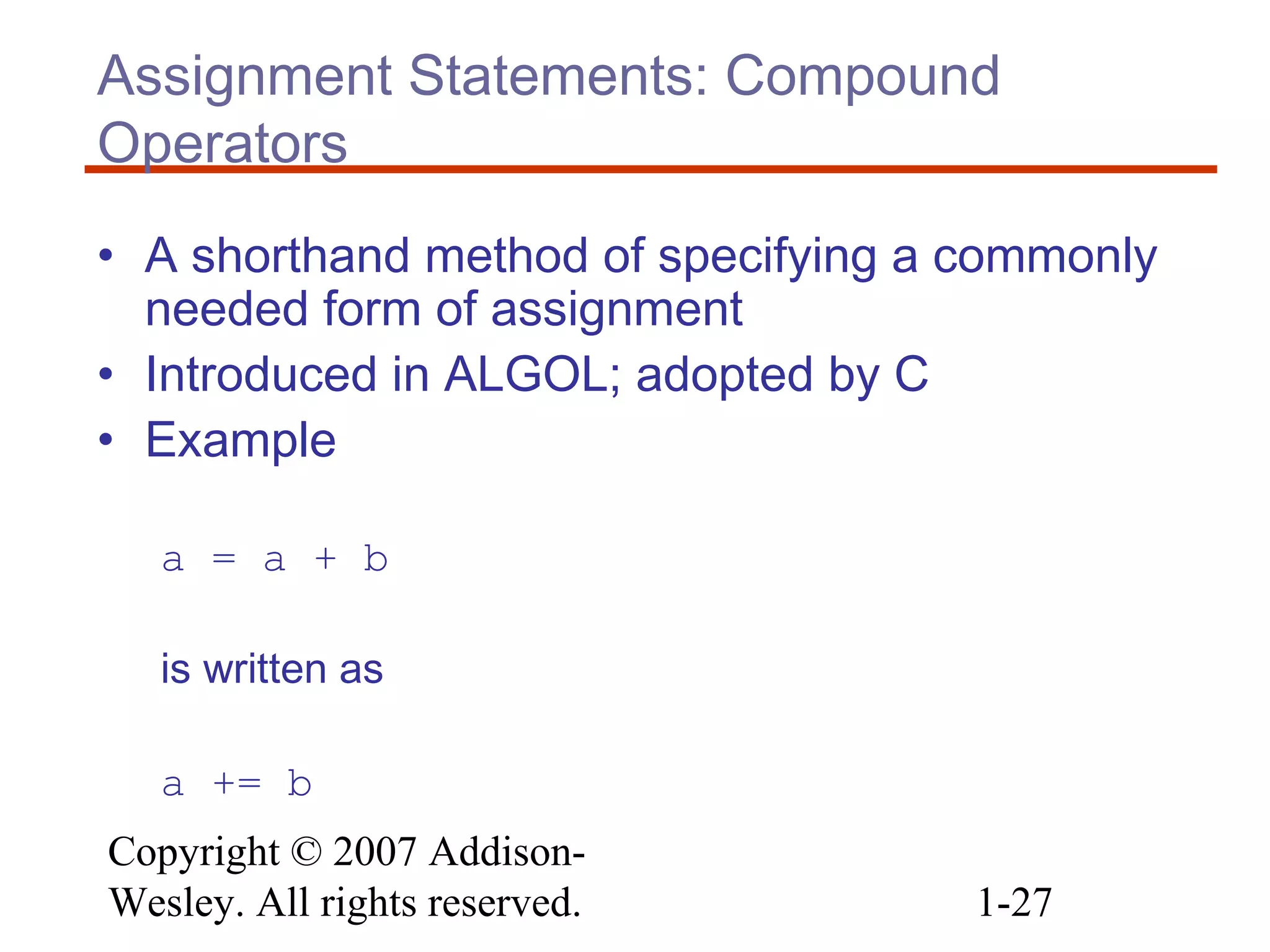
Assignment Statements: Compound
Operators
• A shorthand method of specifying a commonly
needed form of assignment
• Introduced in ALGOL; adopted by C
• Example
a = a + b
is written as
a += b
Copyright © 2007 Addison-
Wesley. All rights reserved. 1-28
Assignment Statements: Unary Assignment
Operators
• Unary assignment operators in C-based
languages combine increment and decrement
operations with assignment
• Examples
sum = ++count (count incremented, added to sum)
sum = count++ (count incremented, added to sum)
count++ (count incremented)
-count++ (count incremented then negated)
Copyright © 2007 Addison-
Wesley. All rights reserved. 1-29
Assignment as an Expression
• In C, C++, and Java, the assignment statement
produces a result and can be used as operands
• An example:
while ((ch = getchar())!= EOF){…}
ch = getchar() is carried out; the result
(assigned to ch) is used as a conditional value
for the while statement
Copyright © 2007 Addison-
Wesley. All rights reserved. 1-30
List Assignments
• Perl and Ruby support list assignments
e.g.,
($first, $second, $third) = (20, 30, 40);
Copyright © 2007 Addison-
Wesley. All rights reserved. 1-31
Mixed-Mode Assignment
• Assignment statements can also be mixed-
mode, for example
int a, b;
float c;
c = a / b;
• In Fortran, C, and C++, any numeric type
value can be assigned to any numeric type
variable
• In Java, only widening assignment coercions
are done
• In Ada, there is no assignment coercion
Copyright © 2007 Addison-
Wesley. All rights reserved. 1-32
Summary
• Expressions
• Operator precedence and associativity
• Operator overloading
• Mixed-type expressions
• Various forms of assignment

7 expressions and assignment statements

  • 1.
  • 2.
    Copyright © 2007Addison- Wesley. All rights reserved. 1-2 Chapter 7 Topics • Introduction • Arithmetic Expressions • Overloaded Operators • Type Conversions • Relational and Boolean Expressions • Short-Circuit Evaluation • Assignment Statements • Mixed-Mode Assignment
  • 3.
    Copyright © 2007Addison- Wesley. All rights reserved. 1-3 Introduction • Expressions are the fundamental means of specifying computations in a programming language • To understand expression evaluation, need to be familiar with the orders of operator and operand evaluation • Essence of imperative languages is dominant role of assignment statements
  • 4.
    Copyright © 2007Addison- Wesley. All rights reserved. 1-4 Arithmetic Expressions • Arithmetic evaluation was one of the motivations for the development of the first programming languages • Arithmetic expressions consist of operators, operands, parentheses, and function calls
  • 5.
    Copyright © 2007Addison- Wesley. All rights reserved. 1-5 Arithmetic Expressions: Design Issues • Design issues for arithmetic expressions – Operator precedence rules? – Operator associativity rules? – Order of operand evaluation? – Operand evaluation side effects? – Operator overloading? – Type mixing in expressions?
  • 6.
    Copyright © 2007Addison- Wesley. All rights reserved. 1-6 Arithmetic Expressions: Operators • A unary operator has one operand • A binary operator has two operands • A ternary operator has three operands
  • 7.
    Copyright © 2007Addison- Wesley. All rights reserved. 1-7 Arithmetic Expressions: Operator Precedence Rules • The operator precedence rules for expression evaluation define the order in which “adjacent” operators of different precedence levels are evaluated • Typical precedence levels – parentheses – unary operators – ** (if the language supports it) – *, / – +, -
  • 8.
    Copyright © 2007Addison- Wesley. All rights reserved. 1-8 Arithmetic Expressions: Operator Associativity Rule • The operator associativity rules for expression evaluation define the order in which adjacent operators with the same precedence level are evaluated • Typical associativity rules – Left to right, except **, which is right to left – Sometimes unary operators associate right to left (e.g., in FORTRAN) • APL is different; all operators have equal precedence and all operators associate right to left • Precedence and associativity rules can be overriden with parentheses
  • 9.
    Copyright © 2007Addison- Wesley. All rights reserved. 1-9 Ruby Expressions • All arithmetic, relational, and assignment operators, as well as array indexing, shifts, and bit-wise logic operators, are implemented as methods - One result of this is that these operators can all be overriden by application programs
  • 10.
    Copyright © 2007Addison- Wesley. All rights reserved. 1-10 Arithmetic Expressions: Conditional Expressions • Conditional Expressions – C-based languages (e.g., C, C++) – An example: average = (count == 0)? 0 : sum / count – Evaluates as if written like if (count == 0) average = 0 else average = sum /count
  • 11.
    Copyright © 2007Addison- Wesley. All rights reserved. 1-11 Arithmetic Expressions: Operand Evaluation Order • Operand evaluation order 1. Variables: fetch the value from memory 2. Constants: sometimes a fetch from memory; sometimes the constant is in the machine language instruction 3. Parenthesized expressions: evaluate all operands and operators first 4. The most interesting case is when an operand is a function call
  • 12.
    Copyright © 2007Addison- Wesley. All rights reserved. 1-12 Arithmetic Expressions: Potentials for Side Effects • Functional side effects: when a function changes a two- way parameter or a non-local variable • Problem with functional side effects: – When a function referenced in an expression alters another operand of the expression; e.g., for a parameter change: a = 10; /* assume that fun changes its parameter */ b = a + fun(a);
  • 13.
    Copyright © 2007Addison- Wesley. All rights reserved. 1-13 Functional Side Effects • Two possible solutions to the problem 1. Write the language definition to disallow functional side effects • No two-way parameters in functions • Advantage: it works! • Disadvantage: inflexibility of one-way parameters Write the language definition to demand that operand evaluation order be fixed • Disadvantage: limits some compiler optimizations • Java requires that operands appear to be evaluated in left-to-right order
  • 14.
    Copyright © 2007Addison- Wesley. All rights reserved. 1-14 Overloaded Operators • Use of an operator for more than one purpose is called operator overloading • Some are common (e.g., + for int and float) • Some are potential trouble (e.g., * in C and C+ +) – Loss of compiler error detection (omission of an operand should be a detectable error) – Some loss of readability – Can be avoided by introduction of new symbols (e.g., Pascal’s div for integer division)
  • 15.
    Copyright © 2007Addison- Wesley. All rights reserved. 1-15 Overloaded Operators (continued) • C++, Ada, Fortran 95, and C# allow user- defined overloaded operators • Potential problems: – Users can define nonsense operations – Readability may suffer, even when the operators make sense
  • 16.
    Copyright © 2007Addison- Wesley. All rights reserved. 1-16 Type Conversions • A narrowing conversion is one that converts an object to a type that cannot include all of the values of the original type e.g., float to int • A widening conversion is one in which an object is converted to a type that can include at least approximations to all of the values of the original type e.g., int to float
  • 17.
    Copyright © 2007Addison- Wesley. All rights reserved. 1-17 Type Conversions: Mixed Mode • A mixed-mode expression is one that has operands of different types • A coercion is an implicit type conversion • Disadvantage of coercions: – They decrease in the type error detection ability of the compiler • In most languages, all numeric types are coerced in expressions, using widening conversions • In Ada, there are virtually no coercions in expressions
  • 18.
    Copyright © 2007Addison- Wesley. All rights reserved. 1-18 Explicit Type Conversions • Called casting in C-based languages • Examples – C: (int)angle – Ada: Float (Sum) Note that Ada’s syntax is similar to that of function calls
  • 19.
    Copyright © 2007Addison- Wesley. All rights reserved. 1-19 Type Conversions: Errors in Expressions • Causes – Inherent limitations of arithmetic e.g., division by zero – Limitations of computer arithmetic e.g. overflow • Often ignored by the run-time system
  • 20.
    Copyright © 2007Addison- Wesley. All rights reserved. 1-20 Relational and Boolean Expressions • Relational Expressions – Use relational operators and operands of various types – Evaluate to some Boolean representation – Operator symbols used vary somewhat among languages (!=, /=, .NE., <>, #) • JavaScript and PHP have two additional relational operator, === and !== - Similar to their cousins, == and !=, except that they do not coerce their operands
  • 21.
    Copyright © 2007Addison- Wesley. All rights reserved. 1-21 Relational and Boolean Expressions • Boolean Expressions – Operands are Boolean and the result is Boolean – Example operators FORTRAN 77 FORTRAN 90 C Ada .AND. and && and .OR. or || or .NOT. not ! not xor
  • 22.
    Copyright © 2007Addison- Wesley. All rights reserved. 1-22 Relational and Boolean Expressions: No Boolean Type in C • C89 has no Boolean type--it uses int type with 0 for false and nonzero for true • One odd characteristic of C’s expressions: a < b < c is a legal expression, but the result is not what you might expect: – Left operator is evaluated, producing 0 or 1 – The evaluation result is then compared with the third operand (i.e., c)
  • 23.
    Copyright © 2007Addison- Wesley. All rights reserved. 1-23 Short Circuit Evaluation • An expression in which the result is determined without evaluating all of the operands and/or operators • Example: (13*a) * (b/13–1) If a is zero, there is no need to evaluate (b/13-1) • Problem with non-short-circuit evaluation index = 1; while (index <= length) && (LIST[index] != value) index++; – When index=length, LIST [index] will cause an indexing problem (assuming LIST has length -1 elements)
  • 24.
    Copyright © 2007Addison- Wesley. All rights reserved. 1-24 Short Circuit Evaluation (continued) • C, C++, and Java: use short-circuit evaluation for the usual Boolean operators (&& and ||), but also provide bitwise Boolean operators that are not short circuit (& and |) • Ada: programmer can specify either (short-circuit is specified with and then and or else) • Short-circuit evaluation exposes the potential problem of side effects in expressions e.g. (a > b) || (b++ / 3)
  • 25.
    Copyright © 2007Addison- Wesley. All rights reserved. 1-25 Assignment Statements • The general syntax <target_var> <assign_operator> <expression> • The assignment operator = FORTRAN, BASIC, the C-based languages := ALGOLs, Pascal, Ada • = can be bad when it is overloaded for the relational operator for equality (that’s why the C- based languages use == as the relational operator)
  • 26.
    Copyright © 2007Addison- Wesley. All rights reserved. 1-26 Assignment Statements: Conditional Targets • Conditional targets (Perl) ($flag ? $total : $subtotal) = 0 Which is equivalent to if ($flag){ $total = 0 } else { $subtotal = 0 }
  • 27.
    Copyright © 2007Addison- Wesley. All rights reserved. 1-27 Assignment Statements: Compound Operators • A shorthand method of specifying a commonly needed form of assignment • Introduced in ALGOL; adopted by C • Example a = a + b is written as a += b
  • 28.
    Copyright © 2007Addison- Wesley. All rights reserved. 1-28 Assignment Statements: Unary Assignment Operators • Unary assignment operators in C-based languages combine increment and decrement operations with assignment • Examples sum = ++count (count incremented, added to sum) sum = count++ (count incremented, added to sum) count++ (count incremented) -count++ (count incremented then negated)
  • 29.
    Copyright © 2007Addison- Wesley. All rights reserved. 1-29 Assignment as an Expression • In C, C++, and Java, the assignment statement produces a result and can be used as operands • An example: while ((ch = getchar())!= EOF){…} ch = getchar() is carried out; the result (assigned to ch) is used as a conditional value for the while statement
  • 30.
    Copyright © 2007Addison- Wesley. All rights reserved. 1-30 List Assignments • Perl and Ruby support list assignments e.g., ($first, $second, $third) = (20, 30, 40);
  • 31.
    Copyright © 2007Addison- Wesley. All rights reserved. 1-31 Mixed-Mode Assignment • Assignment statements can also be mixed- mode, for example int a, b; float c; c = a / b; • In Fortran, C, and C++, any numeric type value can be assigned to any numeric type variable • In Java, only widening assignment coercions are done • In Ada, there is no assignment coercion
  • 32.
    Copyright © 2007Addison- Wesley. All rights reserved. 1-32 Summary • Expressions • Operator precedence and associativity • Operator overloading • Mixed-type expressions • Various forms of assignment

Editor's Notes

  • #3 &amp;lt;number&amp;gt;