Syntactic Analysis
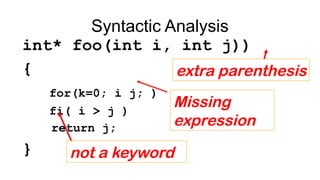
int* foo(int i, int j))
{
for(k=0; i j; )
fi( i > j )
return j;
}
extra parenthesis
Missing
expression
not a keyword
Syntactic Analysis
int* foo(int i, int j)
{
for(k=0; i < j; j++ )
if( i < j-2 )
sum = sum+i
return sum;
}
undeclared var
return type
mismatch
undeclared var
return type
mismatch
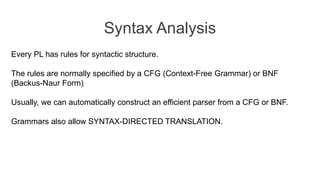
Syntax Analysis
Every PL has rules for syntactic structure.
The rules are normally specified by a CFG (Context-Free Grammar) or BNF
(Backus-Naur Form)
Usually, we can automatically construct an efficient parser from a CFG or BNF.
Grammars also allow SYNTAX-DIRECTED TRANSLATION.
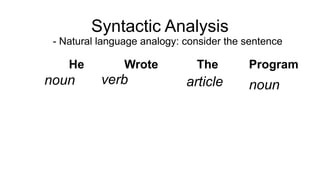
- Natural language analogy: consider the sentence
He Wrote The Program
Syntactic Analysis
noun verb article noun
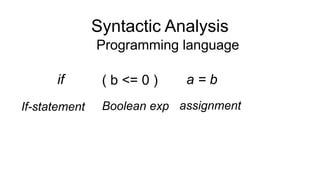
Programming language
Syntactic Analysis
if ( b <= 0 ) a = b
Boolean exp assignment
If-statement
Context-Free Grammars
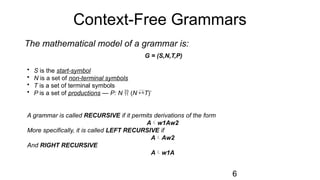
The mathematical model of a grammar is:
G = (S,N,T,P)
• S is the start-symbol
• N is a set of non-terminal symbols
• T is a set of terminal symbols
• P is a set of productions — P: N  (N T)*
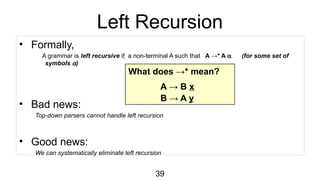
A grammar is called RECURSIVE if it permits derivations of the form
Aw1Aw2
More specifically, it is called LEFT RECURSIVE if
AAw2
And RIGHT RECURSIVE
Aw1A
6
Context-Free Grammars
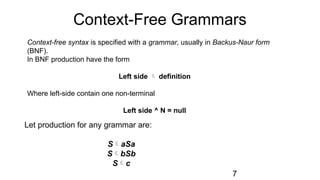
Context-free syntax is specified with a grammar, usually in Backus-Naur form
(BNF).
In BNF production have the form
Left side  definition
Where left-side contain one non-terminal
Left side ^ N = null
Let production for any grammar are:
SaSa
SbSb
Sc
7
Context-Free Grammars
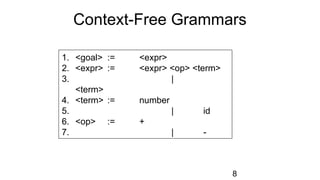
1. <goal> := <expr>
2. <expr> := <expr> <op> <term>
3. |
<term>
4. <term> := number
5. | id
6. <op> := +
7. | -
8
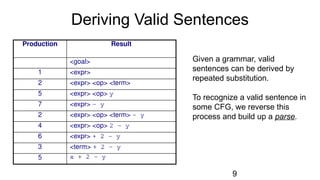
Deriving Valid Sentences
Production Result
<goal>
1 <expr>
2 <expr> <op> <term>
5 <expr> <op> y
7 <expr> - y
2 <expr> <op> <term> - y
4 <expr> <op> 2 - y
6 <expr> + 2 - y
3 <term> + 2 - y
5 x + 2 - y
Given a grammar, valid
sentences can be derived by
repeated substitution.
To recognize a valid sentence in
some CFG, we reverse this
process and build up a parse.
9
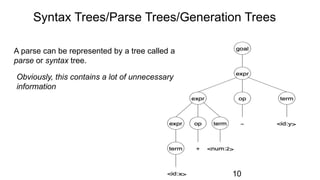
Syntax Trees/Parse Trees/Generation Trees
A parse can be represented by a tree called a
parse or syntax tree.
Obviously, this contains a lot of unnecessary
information
10
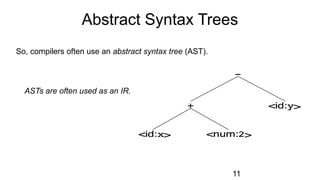
Abstract Syntax Trees
So, compilers often use an abstract syntax tree (AST).
ASTs are often used as an IR.
11
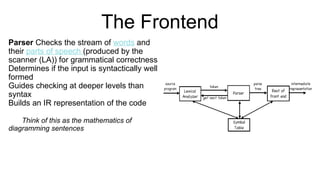
The Frontend
Parser Checks the stream of words and
their parts of speech (produced by the
scanner (LA)) for grammatical correctness
Determines if the input is syntactically well
formed
Guides checking at deeper levels than
syntax
Builds an IR representation of the code
Think of this as the mathematics of
diagramming sentences
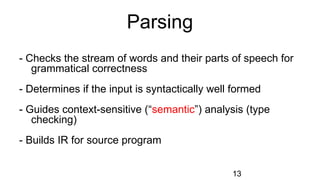
Parsing
13
- Checks the stream of words and their parts of speech for
grammatical correctness
- Determines if the input is syntactically well formed
- Guides context-sensitive (“semantic”) analysis (type
checking)
- Builds IR for source program
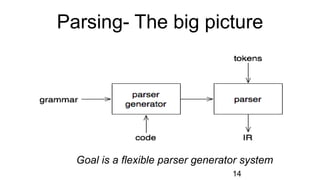
Parsing- The big picture
14
Goal is a flexible parser generator system
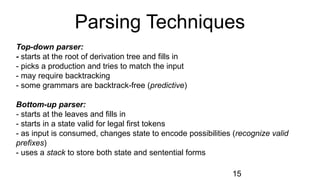
Parsing Techniques
15
Top-down parser:
- starts at the root of derivation tree and fills in
- picks a production and tries to match the input
- may require backtracking
- some grammars are backtrack-free (predictive)
Bottom-up parser:
- starts at the leaves and fills in
- starts in a state valid for legal first tokens
- as input is consumed, changes state to encode possibilities (recognize valid
prefixes)
- uses a stack to store both state and sentential forms
Derivations
The Two Derivations for x – 2 * y
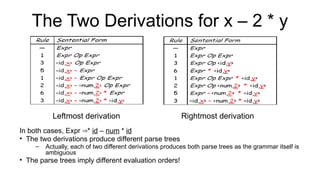
In both cases, Expr *
⇒ id – num * id
• The two derivations produce different parse trees
– Actually, each of two different derivations produces both parse trees as the grammar itself is
ambiguous
• The parse trees imply different evaluation orders!
Leftmost derivation Rightmost derivation
Derivations and Parse Trees
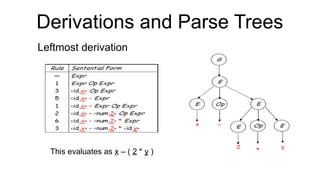
Leftmost derivation
This evaluates as x – ( 2 * y )
Derivations and Parse Trees
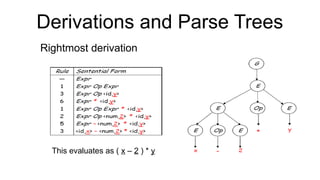
Rightmost derivation
This evaluates as ( x – 2 ) * y
Ambiguity
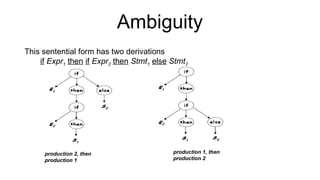
This sentential form has two derivations
if Expr1 then if Expr2 then Stmt1 else Stmt2
production 2, then
production 1
production 1, then
production 2
Ambiguity
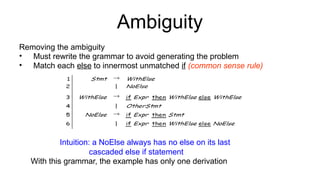
Removing the ambiguity
• Must rewrite the grammar to avoid generating the problem
• Match each else to innermost unmatched if (common sense rule)
Intuition: a NoElse always has no else on its last
cascaded else if statement
With this grammar, the example has only one derivation
Ambiguity
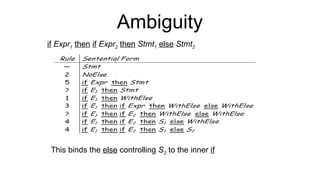
if Expr1 then if Expr2 then Stmt1 else Stmt2
This binds the else controlling S2 to the inner if
23
Exercises
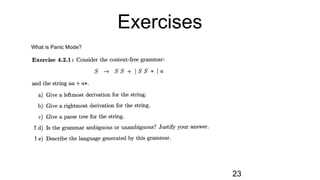
What is Panic Mode?
Role of a Parser
24
•- Not all sequences of tokens are program.
-Parser must distinguish between valid and invalid
sequences of tokens.
- An expressive way to describe the syntax.
• - An acceptor mechanism that determines if input
token stream satisfies the syntax.
-Parsing is the process of discovering a derivation
for some sentence
-Mathematical model of syntax – a grammar G.
-Algortihm for testing membership in L(G).
Study of Parsing
26
Two Approaches
27
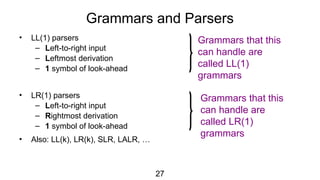
Grammars and Parsers
• LL(1) parsers
– Left-to-right input
– Leftmost derivation
– 1 symbol of look-ahead
• LR(1) parsers
– Left-to-right input
– Rightmost derivation
– 1 symbol of look-ahead
• Also: LL(k), LR(k), SLR, LALR, …
Grammars that this
can handle are
called LL(1)
grammars
Grammars that this
can handle are
called LR(1)
grammars
Parsing Restriction
• In a compiler’s parser, we don’t have long-distance
vision. We are usually limited to just one-symbol of
lookahead. The lookahead symbol is the next symbol
coming up in the input.
• Another restruction to parsing would be to implement
backtracking.
28
Top Down Predictive Parsing
• A predictive parser is characterized by its ability to
choose the production to apply solely on the basis of
the next input symbol and the current nonterminal
being processed.
• To enable this, the grammar must take a particular
form. We call such a grammar LL(1).
• The first "L" means we scan the input from left to right;
the second "L" means we create a leftmost derivation;
and the 1 means one input symbol of lookahead.
29
30
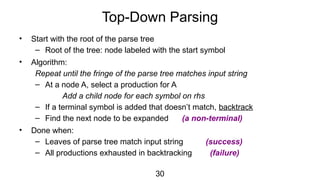
Top-Down Parsing
• Start with the root of the parse tree
– Root of the tree: node labeled with the start symbol
• Algorithm:
Repeat until the fringe of the parse tree matches input string
– At a node A, select a production for A
Add a child node for each symbol on rhs
– If a terminal symbol is added that doesn’t match, backtrack
– Find the next node to be expanded (a non-terminal)
• Done when:
– Leaves of parse tree match input string (success)
– All productions exhausted in backtracking (failure)
Recursive Descent
• The first technique for implementing a predictive
parser is called recursive-descent.
• A recursive-descent parser consists of several small
functions, one for each nonterminal in the grammar.
• As we parse a sentence, we call the functions that
correspond to the left side nonterminal of the
productions we are applying. If these productions are
recursive, end up calling the functions recursively.
31
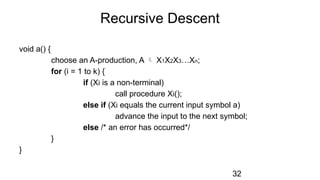
void a() {
choose an A-production, A  X1X2X3…Xn;
for (i = 1 to k) {
if (Xi is a non-terminal)
call procedure Xi();
else if (Xi equals the current input symbol a)
advance the input to the next symbol;
else /* an error has occurred*/
}
}
Recursive Descent
32
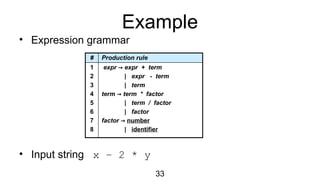
33
Example
• Expression grammar
• Input string x – 2 * y
# Production rule
1
2
3
4
5
6
7
8
expr → expr + term
| expr - term
| term
term → term * factor
| term / factor
| factor
factor → number
| identifier
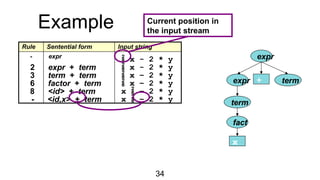
34
Example
Rule Sentential form Input string
- expr expr
expr
x
+
term
fact
term
2 expr + term  x - 2 * y
3 term + term  x – 2 * y
6 factor + term  x – 2 * y
8 <id> + term x  – 2 * y
- <id,x> + term x  – 2 * y
 x - 2 * y
Current position in
the input stream
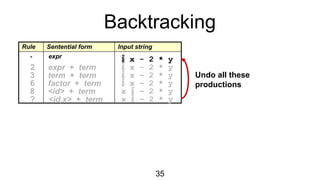
35
Backtracking
Rule Sentential form Input string
- expr
2 expr + term  x - 2 * y
3 term + term  x – 2 * y
6 factor + term  x – 2 * y
8 <id> + term x  – 2 * y
? <id,x> + term x  – 2 * y
 x - 2 * y
Undo all these
productions
36
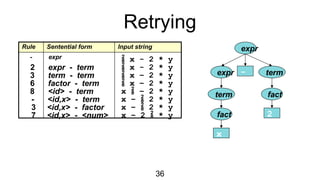
Retrying
Rule Sentential form Input string
- expr
expr
expr
x
-
term
fact
term
2 expr - term  x - 2 * y
3 term - term  x – 2 * y
6 factor - term  x – 2 * y
8 <id> - term x  – 2 * y
- <id,x> - term x –  2 * y
 x - 2 * y
3 <id,x> - factor x –  2 * y
7 <id,x> - <num> x – 2  * y
fact
2
37
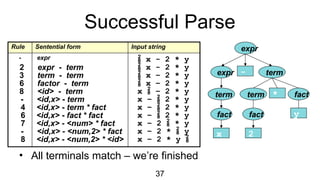
Successful Parse
• All terminals match – we’re finished
Rule Sentential form Input string
- expr
expr
expr
x
-
term
fact
term
2 expr - term  x - 2 * y
3 term - term  x – 2 * y
6 factor - term  x – 2 * y
8 <id> - term x  – 2 * y
- <id,x> - term x –  2 * y
 x - 2 * y
4 <id,x> - term * fact x –  2 * y
6 <id,x> - fact * fact x –  2 * y
2
7 <id,x> - <num> * fact x – 2  * y
fact
- <id,x> - <num,2> * fact x – 2 *  y
8 <id,x> - <num,2> * <id> x – 2 * y 
term * fact
y
38
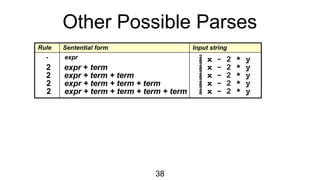
Other Possible Parses
Rule Sentential form Input string
- expr
2 expr + term  x - 2 * y
2 expr + term + term  x – 2 * y
2 expr + term + term + term  x – 2 * y
2 expr + term + term + term + term  x – 2 * y
 x - 2 * y
39
Left Recursion
• Formally,
A grammar is left recursive if  a non-terminal A such that A →* A a (for some set of
symbols a)
• Bad news:
Top-down parsers cannot handle left recursion
• Good news:
We can systematically eliminate left recursion
What does →* mean?
A → B x
B → A y
40
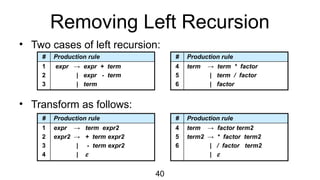
Removing Left Recursion
• Two cases of left recursion:
• Transform as follows:
# Production rule
1
2
3
expr → expr + term
| expr - term
| term
# Production rule
4
5
6
term → term * factor
| term / factor
| factor
# Production rule
1
2
3
4
expr → term expr2
expr2 → + term expr2
| - term expr2
| e
# Production rule
4
5
6
term → factor term2
term2 → * factor term2
| / factor term2
| e
41
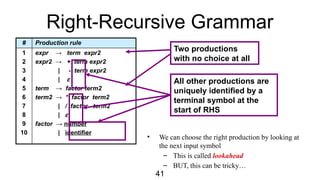
Right-Recursive Grammar
• We can choose the right production by looking at
the next input symbol
– This is called lookahead
– BUT, this can be tricky…
# Production rule
1
2
3
4
5
6
7
8
9
10
expr → term expr2
expr2 → + term expr2
| - term expr2
| e
term → factor term2
term2 → * factor term2
| / factor term2
| e
factor → number
| identifier
Two productions
with no choice at all
All other productions are
uniquely identified by a
terminal symbol at the
start of RHS
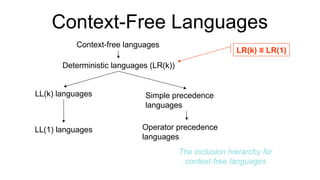
Context-Free Languages
The inclusion hierarchy for
context-free languages
Context-free languages
Deterministic languages (LR(k))
LL(k) languages Simple precedence
languages
LL(1) languages Operator precedence
languages
LR(k) ≡ LR(1)
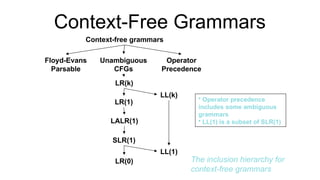
Context-Free Grammars
• Operator precedence
includes some ambiguous
grammars
• LL(1) is a subset of SLR(1)
The inclusion hierarchy for
context-free grammars
Context-free grammars
Floyd-Evans
Parsable
Unambiguous
CFGs
Operator
Precedence
LR(k)
LR(1)
LALR(1)
SLR(1)
LR(0)
LL(1)
LL(k)
Beyond Syntax
• There is a level of correctness that is deeper than grammar
fie(a,b,c,d)
int a, b, c, d;
{ … }
fee() {
int f[3],g[0],
h, i, j, k;
char *p;
fie(h,i,“ab”,j, k);
k = f * i + j;
h = g[17];
printf(“<%s,%s>.n”,
p,q);
p = 10;
}
What is wrong with this program?
(let me count the ways …)
Semantics
• There is a level of correctness that is deeper than grammar
fie(a,b,c,d)
int a, b, c, d;
{ … }
fee() {
int f[3],g[0],
h, i, j, k;
char *p;
fie(h,i,“ab”,j, k);
k = f * i + j;
h = g[17];
printf(“<%s,%s>.n”,
p,q);
p = 10;
}
What is wrong with this program?
(let me count the ways …)
• declared g[0], used g[17]
• wrong number of args to fie()
• “ab” is not an int
• wrong dimension on use of f
• undeclared variable q
• 10 is not a character string
All of these are “deeper than
syntax”
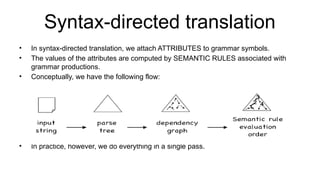
Syntax-directed translation
• In syntax-directed translation, we attach ATTRIBUTES to grammar symbols.
• The values of the attributes are computed by SEMANTIC RULES associated with
grammar productions.
• Conceptually, we have the following flow:
• In practice, however, we do everything in a single pass.
Syntax-directed translation
• There are two ways to represent the semantic rules we associate with
grammar symbols.
– SYNTAX-DIRECTED DEFINITIONS (SDDs) do not specify the order in which
semantic actions should be executed
– TRANSLATION SCHEMES explicitly specify the ordering of the semantic
actions.
• SDDs are higher level; translation schemes are closer to
• an implementation
Syntax-directed definitions
• The SYNTAX-DIRECTED DEFINITION (SDD) is a generalization of
the context-free grammar.
• Each grammar symbol in the CFG is given a set of ATTRIBUTES.
• Attributes can be any type (string, number, memory loc, etc)
• SYNTHESIZED attributes are computed from the values of the
CHILDREN of a node in the parse tree.
• INHERITED attributes are computed from the attributes of the
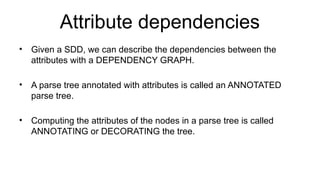
parents and/or siblings of a node in the parse tree.
Attribute dependencies
• Given a SDD, we can describe the dependencies between the
attributes with a DEPENDENCY GRAPH.
• A parse tree annotated with attributes is called an ANNOTATED
parse tree.
• Computing the attributes of the nodes in a parse tree is called
ANNOTATING or DECORATING the tree.
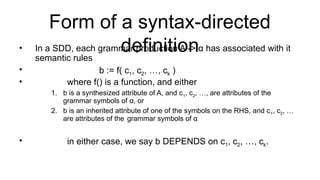
Form of a syntax-directed
definition
• In a SDD, each grammar production A -> α has associated with it
semantic rules
• b := f( c1, c2, …, ck )
• where f() is a function, and either
1. b is a synthesized attribute of A, and c1, c2, …, are attributes of the
grammar symbols of α, or
2. b is an inherited attribute of one of the symbols on the RHS, and c1, c2, …
are attributes of the grammar symbols of α
• in either case, we say b DEPENDS on c1, c2, …, ck.
Semantic rules
• Usually we actually write the semantic rules with expressions
instead of functions.
• If the rule has a SIDE EFFECT, e.g. updating the symbol table, we
write the rule as a procedure call.
• When a SDD has no side effects, we call it an ATTRIBUTE
GRAMMAR.
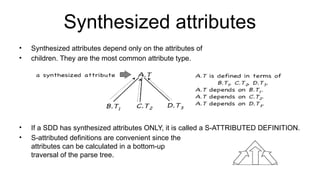
Synthesized attributes
• Synthesized attributes depend only on the attributes of
• children. They are the most common attribute type.
• If a SDD has synthesized attributes ONLY, it is called a S-ATTRIBUTED DEFINITION.
• S-attributed definitions are convenient since the
attributes can be calculated in a bottom-up
traversal of the parse tree.
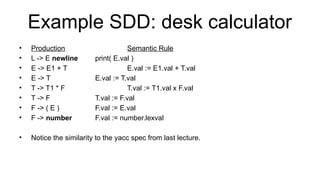
Example SDD: desk calculator
• Production Semantic Rule
• L -> E newline print( E.val )
• E -> E1 + T E.val := E1.val + T.val
• E -> T E.val := T.val
• T -> T1 * F T.val := T1.val x F.val
• T -> F T.val := F.val
• F -> ( E ) F.val := E.val
• F -> number F.val := number.lexval
• Notice the similarity to the yacc spec from last lecture.
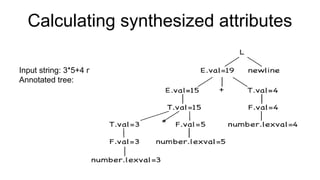
Calculating synthesized attributes
Input string: 3*5+4 newline
Annotated tree:
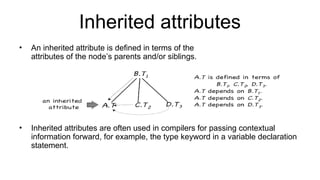
Inherited attributes
• An inherited attribute is defined in terms of the
attributes of the node’s parents and/or siblings.
• Inherited attributes are often used in compilers for passing contextual
information forward, for example, the type keyword in a variable declaration
statement.
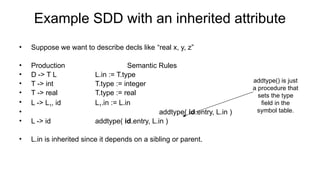
Example SDD with an inherited attribute
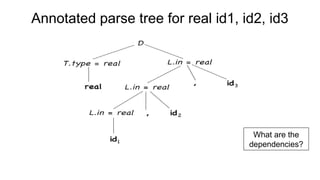
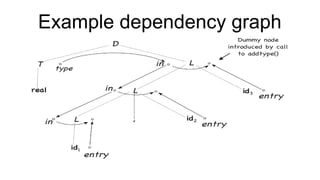
• Suppose we want to describe decls like “real x, y, z”
• Production Semantic Rules
• D -> T L L.in := T.type
• T -> int T.type := integer
• T -> real T.type := real
• L -> L1, id L1.in := L.in
• addtype( id.entry, L.in )
• L -> id addtype( id.entry, L.in )
• L.in is inherited since it depends on a sibling or parent.
addtype() is just
a procedure that
sets the type
field in the
symbol table.
Annotated parse tree for real id1, id2, id3
What are the
dependencies?
Dependency graphs
• If an attribute b depends on attribute c, then attribute b has to be
evaluated AFTER c.
• DEPENDENCY GRAPHS visualize these requirements.
– Each attribute is a node
– We add edges from the node for attribute c to the node for attribute b, if
b depends on c.
– For procedure calls, we introduce a dummy synthesized attribute that
depends on the parameters of the procedure calls.
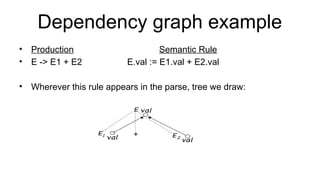
Dependency graph example
• Production Semantic Rule
• E -> E1 + E2 E.val := E1.val + E2.val
• Wherever this rule appears in the parse, tree we draw:
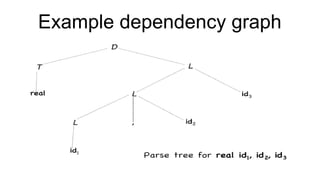
Example dependency graph
Finding a valid evaluation order
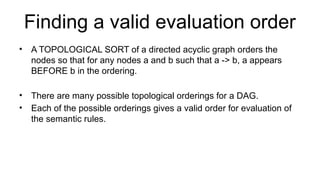
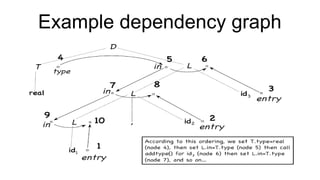
• A TOPOLOGICAL SORT of a directed acyclic graph orders the
nodes so that for any nodes a and b such that a -> b, a appears
BEFORE b in the ordering.
• There are many possible topological orderings for a DAG.
• Each of the possible orderings gives a valid order for evaluation of
the semantic rules.
Example dependency graph

Syntactic Analysis in Compiler Construction

  • 1.
    Syntactic Analysis int* foo(inti, int j)) { for(k=0; i j; ) fi( i > j ) return j; } extra parenthesis Missing expression not a keyword
  • 2.
    Syntactic Analysis int* foo(inti, int j) { for(k=0; i < j; j++ ) if( i < j-2 ) sum = sum+i return sum; } undeclared var return type mismatch undeclared var return type mismatch
  • 3.
    Syntax Analysis Every PLhas rules for syntactic structure. The rules are normally specified by a CFG (Context-Free Grammar) or BNF (Backus-Naur Form) Usually, we can automatically construct an efficient parser from a CFG or BNF. Grammars also allow SYNTAX-DIRECTED TRANSLATION.
  • 4.
    - Natural languageanalogy: consider the sentence He Wrote The Program Syntactic Analysis noun verb article noun
  • 5.
    Programming language Syntactic Analysis if( b <= 0 ) a = b Boolean exp assignment If-statement
  • 6.
    Context-Free Grammars The mathematicalmodel of a grammar is: G = (S,N,T,P) • S is the start-symbol • N is a set of non-terminal symbols • T is a set of terminal symbols • P is a set of productions — P: N  (N T)* A grammar is called RECURSIVE if it permits derivations of the form Aw1Aw2 More specifically, it is called LEFT RECURSIVE if AAw2 And RIGHT RECURSIVE Aw1A 6
  • 7.
    Context-Free Grammars Context-free syntaxis specified with a grammar, usually in Backus-Naur form (BNF). In BNF production have the form Left side  definition Where left-side contain one non-terminal Left side ^ N = null Let production for any grammar are: SaSa SbSb Sc 7
  • 8.
    Context-Free Grammars 1. <goal>:= <expr> 2. <expr> := <expr> <op> <term> 3. | <term> 4. <term> := number 5. | id 6. <op> := + 7. | - 8
  • 9.
    Deriving Valid Sentences ProductionResult <goal> 1 <expr> 2 <expr> <op> <term> 5 <expr> <op> y 7 <expr> - y 2 <expr> <op> <term> - y 4 <expr> <op> 2 - y 6 <expr> + 2 - y 3 <term> + 2 - y 5 x + 2 - y Given a grammar, valid sentences can be derived by repeated substitution. To recognize a valid sentence in some CFG, we reverse this process and build up a parse. 9
  • 10.
    Syntax Trees/Parse Trees/GenerationTrees A parse can be represented by a tree called a parse or syntax tree. Obviously, this contains a lot of unnecessary information 10
  • 11.
    Abstract Syntax Trees So,compilers often use an abstract syntax tree (AST). ASTs are often used as an IR. 11
  • 12.
    The Frontend Parser Checksthe stream of words and their parts of speech (produced by the scanner (LA)) for grammatical correctness Determines if the input is syntactically well formed Guides checking at deeper levels than syntax Builds an IR representation of the code Think of this as the mathematics of diagramming sentences
  • 13.
    Parsing 13 - Checks thestream of words and their parts of speech for grammatical correctness - Determines if the input is syntactically well formed - Guides context-sensitive (“semantic”) analysis (type checking) - Builds IR for source program
  • 14.
    Parsing- The bigpicture 14 Goal is a flexible parser generator system
  • 15.
    Parsing Techniques 15 Top-down parser: -starts at the root of derivation tree and fills in - picks a production and tries to match the input - may require backtracking - some grammars are backtrack-free (predictive) Bottom-up parser: - starts at the leaves and fills in - starts in a state valid for legal first tokens - as input is consumed, changes state to encode possibilities (recognize valid prefixes) - uses a stack to store both state and sentential forms
  • 16.
  • 17.
    The Two Derivationsfor x – 2 * y In both cases, Expr * ⇒ id – num * id • The two derivations produce different parse trees – Actually, each of two different derivations produces both parse trees as the grammar itself is ambiguous • The parse trees imply different evaluation orders! Leftmost derivation Rightmost derivation
  • 18.
    Derivations and ParseTrees Leftmost derivation This evaluates as x – ( 2 * y )
  • 19.
    Derivations and ParseTrees Rightmost derivation This evaluates as ( x – 2 ) * y
  • 20.
    Ambiguity This sentential formhas two derivations if Expr1 then if Expr2 then Stmt1 else Stmt2 production 2, then production 1 production 1, then production 2
  • 21.
    Ambiguity Removing the ambiguity •Must rewrite the grammar to avoid generating the problem • Match each else to innermost unmatched if (common sense rule) Intuition: a NoElse always has no else on its last cascaded else if statement With this grammar, the example has only one derivation
  • 22.
    Ambiguity if Expr1 thenif Expr2 then Stmt1 else Stmt2 This binds the else controlling S2 to the inner if
  • 23.
  • 24.
    Role of aParser 24 •- Not all sequences of tokens are program. -Parser must distinguish between valid and invalid sequences of tokens. - An expressive way to describe the syntax. • - An acceptor mechanism that determines if input token stream satisfies the syntax.
  • 25.
    -Parsing is theprocess of discovering a derivation for some sentence -Mathematical model of syntax – a grammar G. -Algortihm for testing membership in L(G). Study of Parsing
  • 26.
  • 27.
    27 Grammars and Parsers •LL(1) parsers – Left-to-right input – Leftmost derivation – 1 symbol of look-ahead • LR(1) parsers – Left-to-right input – Rightmost derivation – 1 symbol of look-ahead • Also: LL(k), LR(k), SLR, LALR, … Grammars that this can handle are called LL(1) grammars Grammars that this can handle are called LR(1) grammars
  • 28.
    Parsing Restriction • Ina compiler’s parser, we don’t have long-distance vision. We are usually limited to just one-symbol of lookahead. The lookahead symbol is the next symbol coming up in the input. • Another restruction to parsing would be to implement backtracking. 28
  • 29.
    Top Down PredictiveParsing • A predictive parser is characterized by its ability to choose the production to apply solely on the basis of the next input symbol and the current nonterminal being processed. • To enable this, the grammar must take a particular form. We call such a grammar LL(1). • The first "L" means we scan the input from left to right; the second "L" means we create a leftmost derivation; and the 1 means one input symbol of lookahead. 29
  • 30.
    30 Top-Down Parsing • Startwith the root of the parse tree – Root of the tree: node labeled with the start symbol • Algorithm: Repeat until the fringe of the parse tree matches input string – At a node A, select a production for A Add a child node for each symbol on rhs – If a terminal symbol is added that doesn’t match, backtrack – Find the next node to be expanded (a non-terminal) • Done when: – Leaves of parse tree match input string (success) – All productions exhausted in backtracking (failure)
  • 31.
    Recursive Descent • Thefirst technique for implementing a predictive parser is called recursive-descent. • A recursive-descent parser consists of several small functions, one for each nonterminal in the grammar. • As we parse a sentence, we call the functions that correspond to the left side nonterminal of the productions we are applying. If these productions are recursive, end up calling the functions recursively. 31
  • 32.
    void a() { choosean A-production, A  X1X2X3…Xn; for (i = 1 to k) { if (Xi is a non-terminal) call procedure Xi(); else if (Xi equals the current input symbol a) advance the input to the next symbol; else /* an error has occurred*/ } } Recursive Descent 32
  • 33.
    33 Example • Expression grammar •Input string x – 2 * y # Production rule 1 2 3 4 5 6 7 8 expr → expr + term | expr - term | term term → term * factor | term / factor | factor factor → number | identifier
  • 34.
    34 Example Rule Sentential formInput string - expr expr expr x + term fact term 2 expr + term  x - 2 * y 3 term + term  x – 2 * y 6 factor + term  x – 2 * y 8 <id> + term x  – 2 * y - <id,x> + term x  – 2 * y  x - 2 * y Current position in the input stream
  • 35.
    35 Backtracking Rule Sentential formInput string - expr 2 expr + term  x - 2 * y 3 term + term  x – 2 * y 6 factor + term  x – 2 * y 8 <id> + term x  – 2 * y ? <id,x> + term x  – 2 * y  x - 2 * y Undo all these productions
  • 36.
    36 Retrying Rule Sentential formInput string - expr expr expr x - term fact term 2 expr - term  x - 2 * y 3 term - term  x – 2 * y 6 factor - term  x – 2 * y 8 <id> - term x  – 2 * y - <id,x> - term x –  2 * y  x - 2 * y 3 <id,x> - factor x –  2 * y 7 <id,x> - <num> x – 2  * y fact 2
  • 37.
    37 Successful Parse • Allterminals match – we’re finished Rule Sentential form Input string - expr expr expr x - term fact term 2 expr - term  x - 2 * y 3 term - term  x – 2 * y 6 factor - term  x – 2 * y 8 <id> - term x  – 2 * y - <id,x> - term x –  2 * y  x - 2 * y 4 <id,x> - term * fact x –  2 * y 6 <id,x> - fact * fact x –  2 * y 2 7 <id,x> - <num> * fact x – 2  * y fact - <id,x> - <num,2> * fact x – 2 *  y 8 <id,x> - <num,2> * <id> x – 2 * y  term * fact y
  • 38.
    38 Other Possible Parses RuleSentential form Input string - expr 2 expr + term  x - 2 * y 2 expr + term + term  x – 2 * y 2 expr + term + term + term  x – 2 * y 2 expr + term + term + term + term  x – 2 * y  x - 2 * y
  • 39.
    39 Left Recursion • Formally, Agrammar is left recursive if  a non-terminal A such that A →* A a (for some set of symbols a) • Bad news: Top-down parsers cannot handle left recursion • Good news: We can systematically eliminate left recursion What does →* mean? A → B x B → A y
  • 40.
    40 Removing Left Recursion •Two cases of left recursion: • Transform as follows: # Production rule 1 2 3 expr → expr + term | expr - term | term # Production rule 4 5 6 term → term * factor | term / factor | factor # Production rule 1 2 3 4 expr → term expr2 expr2 → + term expr2 | - term expr2 | e # Production rule 4 5 6 term → factor term2 term2 → * factor term2 | / factor term2 | e
  • 41.
    41 Right-Recursive Grammar • Wecan choose the right production by looking at the next input symbol – This is called lookahead – BUT, this can be tricky… # Production rule 1 2 3 4 5 6 7 8 9 10 expr → term expr2 expr2 → + term expr2 | - term expr2 | e term → factor term2 term2 → * factor term2 | / factor term2 | e factor → number | identifier Two productions with no choice at all All other productions are uniquely identified by a terminal symbol at the start of RHS
  • 42.
    Context-Free Languages The inclusionhierarchy for context-free languages Context-free languages Deterministic languages (LR(k)) LL(k) languages Simple precedence languages LL(1) languages Operator precedence languages LR(k) ≡ LR(1)
  • 43.
    Context-Free Grammars • Operatorprecedence includes some ambiguous grammars • LL(1) is a subset of SLR(1) The inclusion hierarchy for context-free grammars Context-free grammars Floyd-Evans Parsable Unambiguous CFGs Operator Precedence LR(k) LR(1) LALR(1) SLR(1) LR(0) LL(1) LL(k)
  • 44.
    Beyond Syntax • Thereis a level of correctness that is deeper than grammar fie(a,b,c,d) int a, b, c, d; { … } fee() { int f[3],g[0], h, i, j, k; char *p; fie(h,i,“ab”,j, k); k = f * i + j; h = g[17]; printf(“<%s,%s>.n”, p,q); p = 10; } What is wrong with this program? (let me count the ways …)
  • 45.
    Semantics • There isa level of correctness that is deeper than grammar fie(a,b,c,d) int a, b, c, d; { … } fee() { int f[3],g[0], h, i, j, k; char *p; fie(h,i,“ab”,j, k); k = f * i + j; h = g[17]; printf(“<%s,%s>.n”, p,q); p = 10; } What is wrong with this program? (let me count the ways …) • declared g[0], used g[17] • wrong number of args to fie() • “ab” is not an int • wrong dimension on use of f • undeclared variable q • 10 is not a character string All of these are “deeper than syntax”
  • 46.
    Syntax-directed translation • Insyntax-directed translation, we attach ATTRIBUTES to grammar symbols. • The values of the attributes are computed by SEMANTIC RULES associated with grammar productions. • Conceptually, we have the following flow: • In practice, however, we do everything in a single pass.
  • 47.
    Syntax-directed translation • Thereare two ways to represent the semantic rules we associate with grammar symbols. – SYNTAX-DIRECTED DEFINITIONS (SDDs) do not specify the order in which semantic actions should be executed – TRANSLATION SCHEMES explicitly specify the ordering of the semantic actions. • SDDs are higher level; translation schemes are closer to • an implementation
  • 48.
    Syntax-directed definitions • TheSYNTAX-DIRECTED DEFINITION (SDD) is a generalization of the context-free grammar. • Each grammar symbol in the CFG is given a set of ATTRIBUTES. • Attributes can be any type (string, number, memory loc, etc) • SYNTHESIZED attributes are computed from the values of the CHILDREN of a node in the parse tree. • INHERITED attributes are computed from the attributes of the parents and/or siblings of a node in the parse tree.
  • 49.
    Attribute dependencies • Givena SDD, we can describe the dependencies between the attributes with a DEPENDENCY GRAPH. • A parse tree annotated with attributes is called an ANNOTATED parse tree. • Computing the attributes of the nodes in a parse tree is called ANNOTATING or DECORATING the tree.
  • 50.
    Form of asyntax-directed definition • In a SDD, each grammar production A -> α has associated with it semantic rules • b := f( c1, c2, …, ck ) • where f() is a function, and either 1. b is a synthesized attribute of A, and c1, c2, …, are attributes of the grammar symbols of α, or 2. b is an inherited attribute of one of the symbols on the RHS, and c1, c2, … are attributes of the grammar symbols of α • in either case, we say b DEPENDS on c1, c2, …, ck.
  • 51.
    Semantic rules • Usuallywe actually write the semantic rules with expressions instead of functions. • If the rule has a SIDE EFFECT, e.g. updating the symbol table, we write the rule as a procedure call. • When a SDD has no side effects, we call it an ATTRIBUTE GRAMMAR.
  • 52.
    Synthesized attributes • Synthesizedattributes depend only on the attributes of • children. They are the most common attribute type. • If a SDD has synthesized attributes ONLY, it is called a S-ATTRIBUTED DEFINITION. • S-attributed definitions are convenient since the attributes can be calculated in a bottom-up traversal of the parse tree.
  • 53.
    Example SDD: deskcalculator • Production Semantic Rule • L -> E newline print( E.val ) • E -> E1 + T E.val := E1.val + T.val • E -> T E.val := T.val • T -> T1 * F T.val := T1.val x F.val • T -> F T.val := F.val • F -> ( E ) F.val := E.val • F -> number F.val := number.lexval • Notice the similarity to the yacc spec from last lecture.
  • 54.
    Calculating synthesized attributes Inputstring: 3*5+4 newline Annotated tree:
  • 55.
    Inherited attributes • Aninherited attribute is defined in terms of the attributes of the node’s parents and/or siblings. • Inherited attributes are often used in compilers for passing contextual information forward, for example, the type keyword in a variable declaration statement.
  • 56.
    Example SDD withan inherited attribute • Suppose we want to describe decls like “real x, y, z” • Production Semantic Rules • D -> T L L.in := T.type • T -> int T.type := integer • T -> real T.type := real • L -> L1, id L1.in := L.in • addtype( id.entry, L.in ) • L -> id addtype( id.entry, L.in ) • L.in is inherited since it depends on a sibling or parent. addtype() is just a procedure that sets the type field in the symbol table.
  • 57.
    Annotated parse treefor real id1, id2, id3 What are the dependencies?
  • 58.
    Dependency graphs • Ifan attribute b depends on attribute c, then attribute b has to be evaluated AFTER c. • DEPENDENCY GRAPHS visualize these requirements. – Each attribute is a node – We add edges from the node for attribute c to the node for attribute b, if b depends on c. – For procedure calls, we introduce a dummy synthesized attribute that depends on the parameters of the procedure calls.
  • 59.
    Dependency graph example •Production Semantic Rule • E -> E1 + E2 E.val := E1.val + E2.val • Wherever this rule appears in the parse, tree we draw:
  • 60.
  • 61.
  • 62.
    Finding a validevaluation order • A TOPOLOGICAL SORT of a directed acyclic graph orders the nodes so that for any nodes a and b such that a -> b, a appears BEFORE b in the ordering. • There are many possible topological orderings for a DAG. • Each of the possible orderings gives a valid order for evaluation of the semantic rules.
  • 63.

Editor's Notes

  • #6 Called “context-free” because rules for non-terminals can be written without regard for the context in which they appear.
  • #7 Called “context-free” because rules for non-terminals can be written without regard for the context in which they appear.
  • #8 Called “context-free” because rules for non-terminals can be written without regard for the context in which they appear.