TCP/IP Protocol
Mukesh N. Tekwani
Mumbai, India
mukeshtekwani@outlook.com
2
Objectives
 Connection-oriented and connectionless
services
 The TCP/IP layers
 Differences between OSI and TCP/IP models
November 9, 2019
Mukesh N. Tekwani
(mukeshtekwani@outlook.com)
3
Connection-Oriented Services
 Connection-oriented service modelled after
the telephone system
 To talk to someone, pick up a phone, dial the
number, talk and disconnect
 Similarly, in a network, the service user will
 Establish a connection
 Use the connection
 Release the connection
 The sender, receiver and the network may
conduct a negotiation about data transfer speed,
maximum message size, etc
November 9, 2019
Mukesh N. Tekwani
(mukeshtekwani@outlook.com)
4
Connection-Oriented Services
 Connection-oriented service is used when
reliability is important
 E.g., for file transfer, we want that all bits arrive
correctly and in the order they were sent
November 9, 2019
Mukesh N. Tekwani
(mukeshtekwani@outlook.com)
5
Connectionless Services
 Connectionless service modelled after the
postal system
 Each message (letter) carries the full destination
address
 Each message is routed through the system
independent of all others
 If two messages are sent to the same destination,
normally the first one to be sent should arrive first.
But it is possible that the second message arrives
first
November 9, 2019
Mukesh N. Tekwani
(mukeshtekwani@outlook.com)
6
TCP/IP Protocol Suite
 TCP / IP – Transmission Control Protocol /
Internet Protocol
 Developed prior to the OSI model
 Layers of TCP/IP do not match exactly with
those in the OSI model
 Used in the Internet
 Ability to connect multiple networks in a
seamless way was one of the major design
goals which led to development of TCP / IP
November 9, 2019
Mukesh N. Tekwani
(mukeshtekwani@outlook.com)
7
TCP/IP Protocol Suite
 TCP / IP – refers to a collection of data
communication protocols
 This name TCP/IP is misleading because
TCP and IP are only two of the many
protocols that compose the suite
 TCP / IP has its origins in the work done by
the US Department of Defense.
November 9, 2019
Mukesh N. Tekwani
(mukeshtekwani@outlook.com)
8
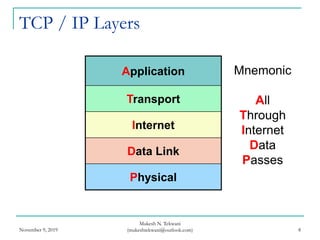
TCP / IP Layers
Application
Transport
Internet
Data Link
Physical
Mnemonic
All
Through
Internet
Data
Passes
November 9, 2019
Mukesh N. Tekwani
(mukeshtekwani@outlook.com)
9
TCP / IP Suite
 The TCP / IP suite does not define any
specific protocols at the data link and
physical layers
November 9, 2019
Mukesh N. Tekwani
(mukeshtekwani@outlook.com)
10
Application Layer
 The Application layer is equivalent to the
combined OSI Session, Presentation, and
Application layers
Application Layer = SPA
 All the functions handled by these 3 layers in
the OSI model are handled by the Application
layer in TCP / IP model
November 9, 2019
Mukesh N. Tekwani
(mukeshtekwani@outlook.com)
11
Application Layer
 This layer contains all the higher-level
protocols
 FTP – File Transfer Protocol – basic file transfer
between hosts (computers)
 SMTP – Simple Mail Transfer Protocol (for
email)
 HTTP – Hyper Text Transfer Protocol (for web
browsing)
 Data unit created at this layer is called a
message
November 9, 2019
Mukesh N. Tekwani
(mukeshtekwani@outlook.com)
12
Encapsulation of Data
 TCP/IP protocol suite encapsulates data units
at various layers of the model
 At the Application layer, the data unit created
is called a message.
 The Transport layer adds a header to form
either a segment with TCP.
 The Network (or Internet) layer adds another
header to form a datagram
November 9, 2019
Mukesh N. Tekwani
(mukeshtekwani@outlook.com)
13
Encapsulation of Data
 Datagram – A self-contained message unit
which contains sufficient information to allow
it to be routed from the source to the
destination
 The protocol used at the data link layer
encapsulates the datagram into a frame and
this is transmitted across the transmission
medium.
November 9, 2019
Mukesh N. Tekwani
(mukeshtekwani@outlook.com)
14
Transport Layer - UDP
 This layer is represented by two protocols –
TCP and UDP
 TCP – Transmission Control Protocol
 UDP – User Datagram Protocol
 UDP is simpler but is used when reliability
and security are less important than size and
speed – such as speech, video
 Since security and reliability are essential for
most applications, TCP is used more often
November 9, 2019
Mukesh N. Tekwani
(mukeshtekwani@outlook.com)
15
Transport Layer - TCP
 TCP is a reliable connection-oriented protocol
 Allows error-free transmission
 Incoming byte stream is fragmented into a
number of shorter messages and these are
passed on to the next layer
 At the receiving end the TCP reassembles
the messages into an output stream
 TCP also handles flow control – to control
data transfer rate
November 9, 2019
Mukesh N. Tekwani
(mukeshtekwani@outlook.com)
16
Transport Layer - TCP
 A connection must be established between
the sender and the receiver before
transmission begins
 TCP creates a circuit between sender and
receiver for the duration of the transmission
 TCP begins each transmission by alerting the
receiver that segments are on their way
(connection establishment).
 Each transmission is ended with connection
termination
November 9, 2019
Mukesh N. Tekwani
(mukeshtekwani@outlook.com)
17
Transport Layer - TCP
 Each segment created by TCP includes
 A sequencing number for re-ordering after receipt.
 An acknowledgement ID number
 Source address
 Destination address
 Checksum – for error detection
 Data
 And other fields
November 9, 2019
Mukesh N. Tekwani
(mukeshtekwani@outlook.com)
18
Internetwork or Network Layer
 Also referred to as Network Layer or Internetwork
Layer
 Internetwork Protocol (IP) is an unreliable and
connectionless protocol
 It offers a best–effort delivery service
 No error checking
 IP does its best to get a transmission through to its
destination but with no guarantees
 Noise can cause bit errors during transmission
 Datagrams maybe discarded due to timeout errors
 Example of best-effort delivery service is: post-office
November 9, 2019
Mukesh N. Tekwani
(mukeshtekwani@outlook.com)
19
Internetwork or Network Layer
 IP transports data in packets called datagrams
 Each datagram is transported separately
 Datagrams can be of variable lengths (upto 64 KB)
 Datagrams may travel along different routes and may
arrive out of sequence
 IP does not keep track of the routes
 IP does not have the facility to reorder datagrams
once they arrive
 A datagram contains a header and data
 The header contains a number of fields including
source and destination address
November 9, 2019
Mukesh N. Tekwani
(mukeshtekwani@outlook.com)
20
Comparison of OSI and TCP/IP Models
 The OSI model makes a clear distinction
between services, interfaces and protocols
 Each layer performs some service for the layer
above it
 A layer’s interface tells the processes above it
how to access it. It specifies what the parameters
are and what results to expect (somewhat like a
function declaration)
 The protocols used in a layer are used to get the
job done.
November 9, 2019
Mukesh N. Tekwani
(mukeshtekwani@outlook.com)
21
Comparison of OSI and TCP/IP Models
 The OSI model has 7 layers while the TCP/
IP model has 5 layers
 Both have network, transport, and application
layers, but the other layers are different
 OSI model supports both connectionless and
connection-oriented communication
 TCP/IP supports only connectionless
communication
November 9, 2019
Mukesh N. Tekwani
(mukeshtekwani@outlook.com)
22
References
 “Computer Networks”,
 Tanenbaum A (PHI)
 “Data Communications and Networking”,
 Forouzan B (TMH)
 “Local Area Networks”,
 Keiser (TMH)
November 9, 2019
Mukesh N. Tekwani
(mukeshtekwani@outlook.com)
23November 9, 2019
Mukesh N. Tekwani
(mukeshtekwani@outlook.com)

TCP-IP Reference Model

  • 1.
    TCP/IP Protocol Mukesh N.Tekwani Mumbai, India mukeshtekwani@outlook.com
  • 2.
    2 Objectives  Connection-oriented andconnectionless services  The TCP/IP layers  Differences between OSI and TCP/IP models November 9, 2019 Mukesh N. Tekwani (mukeshtekwani@outlook.com)
  • 3.
    3 Connection-Oriented Services  Connection-orientedservice modelled after the telephone system  To talk to someone, pick up a phone, dial the number, talk and disconnect  Similarly, in a network, the service user will  Establish a connection  Use the connection  Release the connection  The sender, receiver and the network may conduct a negotiation about data transfer speed, maximum message size, etc November 9, 2019 Mukesh N. Tekwani (mukeshtekwani@outlook.com)
  • 4.
    4 Connection-Oriented Services  Connection-orientedservice is used when reliability is important  E.g., for file transfer, we want that all bits arrive correctly and in the order they were sent November 9, 2019 Mukesh N. Tekwani (mukeshtekwani@outlook.com)
  • 5.
    5 Connectionless Services  Connectionlessservice modelled after the postal system  Each message (letter) carries the full destination address  Each message is routed through the system independent of all others  If two messages are sent to the same destination, normally the first one to be sent should arrive first. But it is possible that the second message arrives first November 9, 2019 Mukesh N. Tekwani (mukeshtekwani@outlook.com)
  • 6.
    6 TCP/IP Protocol Suite TCP / IP – Transmission Control Protocol / Internet Protocol  Developed prior to the OSI model  Layers of TCP/IP do not match exactly with those in the OSI model  Used in the Internet  Ability to connect multiple networks in a seamless way was one of the major design goals which led to development of TCP / IP November 9, 2019 Mukesh N. Tekwani (mukeshtekwani@outlook.com)
  • 7.
    7 TCP/IP Protocol Suite TCP / IP – refers to a collection of data communication protocols  This name TCP/IP is misleading because TCP and IP are only two of the many protocols that compose the suite  TCP / IP has its origins in the work done by the US Department of Defense. November 9, 2019 Mukesh N. Tekwani (mukeshtekwani@outlook.com)
  • 8.
    8 TCP / IPLayers Application Transport Internet Data Link Physical Mnemonic All Through Internet Data Passes November 9, 2019 Mukesh N. Tekwani (mukeshtekwani@outlook.com)
  • 9.
    9 TCP / IPSuite  The TCP / IP suite does not define any specific protocols at the data link and physical layers November 9, 2019 Mukesh N. Tekwani (mukeshtekwani@outlook.com)
  • 10.
    10 Application Layer  TheApplication layer is equivalent to the combined OSI Session, Presentation, and Application layers Application Layer = SPA  All the functions handled by these 3 layers in the OSI model are handled by the Application layer in TCP / IP model November 9, 2019 Mukesh N. Tekwani (mukeshtekwani@outlook.com)
  • 11.
    11 Application Layer  Thislayer contains all the higher-level protocols  FTP – File Transfer Protocol – basic file transfer between hosts (computers)  SMTP – Simple Mail Transfer Protocol (for email)  HTTP – Hyper Text Transfer Protocol (for web browsing)  Data unit created at this layer is called a message November 9, 2019 Mukesh N. Tekwani (mukeshtekwani@outlook.com)
  • 12.
    12 Encapsulation of Data TCP/IP protocol suite encapsulates data units at various layers of the model  At the Application layer, the data unit created is called a message.  The Transport layer adds a header to form either a segment with TCP.  The Network (or Internet) layer adds another header to form a datagram November 9, 2019 Mukesh N. Tekwani (mukeshtekwani@outlook.com)
  • 13.
    13 Encapsulation of Data Datagram – A self-contained message unit which contains sufficient information to allow it to be routed from the source to the destination  The protocol used at the data link layer encapsulates the datagram into a frame and this is transmitted across the transmission medium. November 9, 2019 Mukesh N. Tekwani (mukeshtekwani@outlook.com)
  • 14.
    14 Transport Layer -UDP  This layer is represented by two protocols – TCP and UDP  TCP – Transmission Control Protocol  UDP – User Datagram Protocol  UDP is simpler but is used when reliability and security are less important than size and speed – such as speech, video  Since security and reliability are essential for most applications, TCP is used more often November 9, 2019 Mukesh N. Tekwani (mukeshtekwani@outlook.com)
  • 15.
    15 Transport Layer -TCP  TCP is a reliable connection-oriented protocol  Allows error-free transmission  Incoming byte stream is fragmented into a number of shorter messages and these are passed on to the next layer  At the receiving end the TCP reassembles the messages into an output stream  TCP also handles flow control – to control data transfer rate November 9, 2019 Mukesh N. Tekwani (mukeshtekwani@outlook.com)
  • 16.
    16 Transport Layer -TCP  A connection must be established between the sender and the receiver before transmission begins  TCP creates a circuit between sender and receiver for the duration of the transmission  TCP begins each transmission by alerting the receiver that segments are on their way (connection establishment).  Each transmission is ended with connection termination November 9, 2019 Mukesh N. Tekwani (mukeshtekwani@outlook.com)
  • 17.
    17 Transport Layer -TCP  Each segment created by TCP includes  A sequencing number for re-ordering after receipt.  An acknowledgement ID number  Source address  Destination address  Checksum – for error detection  Data  And other fields November 9, 2019 Mukesh N. Tekwani (mukeshtekwani@outlook.com)
  • 18.
    18 Internetwork or NetworkLayer  Also referred to as Network Layer or Internetwork Layer  Internetwork Protocol (IP) is an unreliable and connectionless protocol  It offers a best–effort delivery service  No error checking  IP does its best to get a transmission through to its destination but with no guarantees  Noise can cause bit errors during transmission  Datagrams maybe discarded due to timeout errors  Example of best-effort delivery service is: post-office November 9, 2019 Mukesh N. Tekwani (mukeshtekwani@outlook.com)
  • 19.
    19 Internetwork or NetworkLayer  IP transports data in packets called datagrams  Each datagram is transported separately  Datagrams can be of variable lengths (upto 64 KB)  Datagrams may travel along different routes and may arrive out of sequence  IP does not keep track of the routes  IP does not have the facility to reorder datagrams once they arrive  A datagram contains a header and data  The header contains a number of fields including source and destination address November 9, 2019 Mukesh N. Tekwani (mukeshtekwani@outlook.com)
  • 20.
    20 Comparison of OSIand TCP/IP Models  The OSI model makes a clear distinction between services, interfaces and protocols  Each layer performs some service for the layer above it  A layer’s interface tells the processes above it how to access it. It specifies what the parameters are and what results to expect (somewhat like a function declaration)  The protocols used in a layer are used to get the job done. November 9, 2019 Mukesh N. Tekwani (mukeshtekwani@outlook.com)
  • 21.
    21 Comparison of OSIand TCP/IP Models  The OSI model has 7 layers while the TCP/ IP model has 5 layers  Both have network, transport, and application layers, but the other layers are different  OSI model supports both connectionless and connection-oriented communication  TCP/IP supports only connectionless communication November 9, 2019 Mukesh N. Tekwani (mukeshtekwani@outlook.com)
  • 22.
    22 References  “Computer Networks”, Tanenbaum A (PHI)  “Data Communications and Networking”,  Forouzan B (TMH)  “Local Area Networks”,  Keiser (TMH) November 9, 2019 Mukesh N. Tekwani (mukeshtekwani@outlook.com)
  • 23.
    23November 9, 2019 MukeshN. Tekwani (mukeshtekwani@outlook.com)