HYPERTENSIVE
DISORDERS OF
PREGNANCY
DEFINITION
•In pregnancy, the blood pressure is considered
to be raised if:
•The blood pressure is 140/90 mmHg or more
•The systolic blood pressure has increased by
30mmHg
•The diastolic blood pressure has increased by
15mmHg
MAGNITUDE AND IMPORTANCE
•Hypertension is the most common medical
problem encountered during pregnancy,
complicating up to 5% of pregnancies.
•Hypertensive disorders in pregnancy may cause
maternal and fetal morbidity and remain an
important cause of maternal deaths around the
world.
CLASSIFICATION OF HYPERTENSIVE
DISEASES OF THE PREGNANCY
1. Gestational hypertension (PIH)
2. Pre-eclampsia
3. Eclampsia
4. Pre-eclampsia superimposed on chronic
hypertension
5. Chronic hypertension
1. GESTATIONAL HYPERTENSION (PIH)
• Diagnosis made when the blood pressure reaches
140/90mmHg or greater for the first time during pregnancy
but in whom proteinuria has not developed.
• Gestational hypertension is called transient hypertension if
pre-eclampsia doesn’t develop and the blood pressure
returns to normal by 12 weeks postpartum.
• Gestation hypertension is termed as chronic if blood
pressure elevation persists beyond 12 weeks postpartum.
Diagnostic criteria for Gestational
hypertension
•No protenuria
•BP returns to normal <12wks postpartum
•Final diagnosis made only postpartum
2. PRE-ECLAMPSIA
• Hypertension associated with protenuria and oedema occurring
primarily in Nulliparous after 20th week’s gestation and most
frequently near term.
• It is a specific syndrome of reduced organ perfusion secondary
to vasospasm and endothelial activation.
• Protenuria is an important sign of pre-eclampsia and that the
diagnosis is questionable in its absence. (significant protenuria
is defined by urine protein of 0.3g/24 hrs)
Protenuria defined by excretion of 300mg protein in 24 hrs or
persistence 30mg/dl (1+ dipstick in random urine sample).
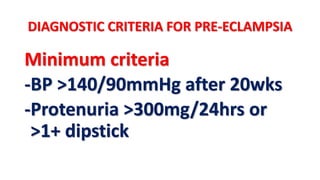
DIAGNOSTIC CRITERIA FOR PRE-ECLAMPSIA
Minimum criteria
-BP >140/90mmHg after 20wks
-Protenuria >300mg/24hrs or
>1+ dipstick
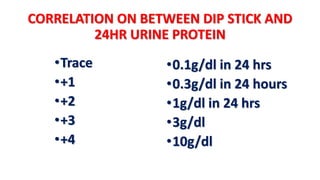
CORRELATION ON BETWEEN DIP STICK AND
24HR URINE PROTEIN
•Trace
•+1
•+2
•+3
•+4
•0.1g/dl in 24 hrs
•0.3g/dl in 24 hours
•1g/dl in 24 hrs
•3g/dl
•10g/dl
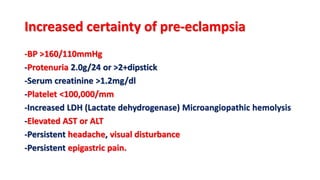
Increased certainty of pre-eclampsia
-BP >160/110mmHg
-Protenuria 2.0g/24 or >2+dipstick
-Serum creatinine >1.2mg/dl
-Platelet <100,000/mm
-Increased LDH (Lactate dehydrogenase) Microangiopathic hemolysis
-Elevated AST or ALT
-Persistent headache, visual disturbance
-Persistent epigastric pain.
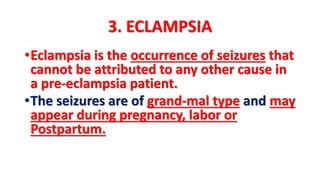
3. ECLAMPSIA
•Eclampsia is the occurrence of seizures that
cannot be attributed to any other cause in
a pre-eclampsia patient.
•The seizures are of grand-mal type and may
appear during pregnancy, labor or
Postpartum.
Diagnostic criteria for Eclampsia
•seizures that can not be attributed to any
other cause in a pt with pre eclampsia.
• Pre-eclamptic patients may fit in the
absence of protenuria because protenuria
usually develops later in the course of the
disease.
4. CHRONIC HYPERTENSION
• Hypertension that is present before conception, before 20wks
gestation or that persists beyond 12wks postpartum.
• The diagnosis of chronic hypertension is suggested by;
1. Hypertension (140/90mmHg ) antecedent to pregnancy.
2. Hypertension detected before 20wks unless there is GTD’s.
3. Persistent hypertension long after delivery.
5. PRE-ECLAMPSIA SUPERIMPOSED ON
CHRONIC HYPERTENSION.
Patient prognosis (both mother and the fetus)
is grave than in either of the conditions.
•All chronic hypertensive disorders regardless of
their cause predispose to the development of
superimposed pre-eclampsia or eclampsia.
Diagnosis of superimposed eclampsia
• Criteria for superimposed preeclampsia are:-
 worsening Hypertension above average values before
20wks (30mmHg systolic, 15mmHg diastolic)
Non-dependant oedema
New onset protenuria of more than 300mg in 24hrs (+1 dip
stick) in hypertensive women with no protenuria or a
sudden increase in protenuria or BP a woman with
hypertension
1. PRE-ECLAMPSIA
Old names
•EPH gestosis
•Toxemia of pregnancy
pathophysiology
•The exact pathophysiologic mechanism is not clearly
understood
 Disorder of endothelial function with generalised
vasospasm.
Abnormal placental development or
placental damage from diffuse
microthrombosis may be central to the
development of this disorder.
Uteroplacental ischemia is postulated to predispose
to the production and release of biochemical
mediators that enter the maternal circulation, causing
widespread endothelial dysfunction and generalized
arteriolar constriction and vasospasm.
 Lipid peroxidation products and ROS
 Cytokines. TNF alpha and IL-6
Placental syncytiotrophoblast micrivilous membrane
(STBM)
•ROS, Cytokines, and STBM)= endothelial
dysfunction seen in pre-eclampsia.
•Vasoactive substances = causing generalized
vasoconstriction and consequent systemic
hypertension
•Thromboxane a2
•vasopressin
Maternal risk factors for preeclampsia
1. First pregnancy
2. New partner/paternity
3. Age younger than 18 years or older than 35 years
4. History of preeclampsia
5. Family history of preeclampsia in a first-degree
relative
6. Black race
7. Multiple pregnancy
8. polyhydromnious
Medical risk factors for preeclampsia
• Chronic hypertension
• Secondary causes of chronic hypertension such as
hypercortisolism, hyperaldosteronism, pheochromocytoma, or
renal artery stenosis
• Preexisting diabetes (type 1 or type 2), especially with
microvascular disease
• Renal disease
• Systemic lupus erythematosus
• Obesity
• Thrombophilia
Placental/fetal risk factors for
preeclampsia
•Multiple gestations
•Hydrops fetalis
•Gestational trophoblastic disease (GTD)
•Triploidy
CLASSIFICATION OF PE.
A.MILD PREECLAMPSIA
B.SEVERE PREECLAMPSIA
MILD PREECLAMPSIA
•BP 140/90 to <160/110mmHg.
•Protenuria <2g/24hrs
•Normal deep tendon reflex
•Pretibial edema nil/present
SEVERE PREECLAMPSIA
• systolic BP>160mmHg or diastolic 110mmHg on 2different occasions 6hrs
apart
• protenuria >2g/24hrs or 2-4+dipstick.
• Serum creatinine >1.2mg/dl
• Oliguria <500ml/24hrs
• Cerebral or visual disturbance
• Epigastric pain
• Elevated liver enzymes
• Platelets <100,000/m3
• Retinal haemorrhage, exudates or pappiloedema
• Pulmonary edema.
PATHOLOGY SEEN IN PE.
PE is a multisystem disease i.e. no
system is spared in PE
CNS
• Petechial haemorrhage or gross intercranial haemorrhage.
• Fibrinoid necrosis
• Thrombosis of arterioles
• Microinfacts
• Retinal haemorrhage and infarcts are less common
• cerebral oedema
The lesions are widely distributed throughout the brain where the
cortex is much more affected
EYES
•Serous retinal
detachments and
cortical blindness
PULMONARY SYSTERM
•Pulmonary edema may be due to:
•Protenuria or endothelial leakage
•Fluid admin
•Decreased plasma colloidal osmotic
pressure
•use of colloids to replace the volume
•Aspiration
CARDIOVASCULAR
•Volume expansion doesn’t occur as in
normal pregnancy
•Plasma volume is reduced etc.
LIVER
•Periportal hemorrhagic necrosis
•Hepatic rupture
•Sub capsular haematoma
•HELLP syndrome
•Hepatic infarction
KIDNEYS
•Glomerulosclerosis -swelling of the
glomerular capillary endothelium that
causes decreased glomerular perfusion and
GFR
•Leakage of proteins through the glomeruli
leading to proteinuria.
•Lesions are totally reversible after 6wks
BLOOD
•DIC
•Low fibrinogen
•HELLP syndrome diagnosis based on
Schistocytes on peripheral blood smears, Lactic
dehydrogenase >600U/l, total bilirubin of
>1.2mg/dl, AST>70/ul and platelet counts of
<100,000/mm.
CLINICAL FINDINGS
•HTN most important feature
•Protenuria last to develop due to
glomeruloendotheliosis
•Oedema
Management of mild pre-eclampsia
MATERNAL
• Bed rest
• Antihypertensives
• Daily urine protein
• BP monitoring and antihypertensives
• Pt education on danger signs
• LFT, Uric acid, Electrolytes, serum proteins weekly
• Coagulation studies
FETAL
•Evaluated twice a wk by USS
•Biophysical profile
•FMC
SEVERE CASES
•Prevent the occurrence of seizures by using
magnesium sulphate
•Control BP
•Decision to deliver depends on GA and
fetal/maternal conditions.
•Accelerate lung maturity by steroids
INDICATIONS OF DELIVERY IN SEVERE
CASES
• BP consistently higher than
100mmHg diastolic in 24hrs
period or confirmed higher
than 110mmHg
• Raising serum creatinine
• Persistent or severe headache
• Epigastric pain
• Abnormal liver function test
• Thrombocytopenia
• HELLP
• Pulmonary edema
• Eclampsia
• Abnormal fetal heart
findings
• SGA or IUGR
2. ECLAMPSIA
Physical signs:
• Eclamptic seizure
• The patient may have 1 or more seizures.
• Seizures generally last 60-75 seconds.
• The patient's face initially may become distorted, with protrusion of
the eyes.
• The patient may begin foaming at the mouth.
• Respiration ceases for the duration of the seizure.
• The seizure may be divided into 2 phases:
• Phase 1 lasts 15-20 seconds and begins with facial
twitching. The body becomes rigid, leading to
generalized muscular contractions.
• Phase 2 lasts approximately 60 seconds. It starts in the
jaw, moves to the muscles of the face and eyelids, and
then spreads throughout the body. The muscles begin
alternating between contracting and relaxing in rapid
sequence.
•A coma or a period of unconsciousness
follows phase 2.
•Unconsciousness lasts for a variable period.
•Following the coma phase, the patient may
regain some consciousness.
•The patient may become combative and very
agitated.
Principles of management
Stabilise mother and then deliver foetus
Treat and prevent fits
Treat blood pressure
Attention to fluid balance
Be aware of and prevent complications
TREATMENT
•Control seizures with magnesium sulphate
•Control BP
•Delivery; The mode of delivery should be
based on obstetric indications, with the
understanding that vaginal delivery is
preferable from a maternal standpoint
Magnesium sulphate
The anticonvulsant of choice
Given in two phases
Loading dose
Maintenance dose
Fitting or unconscious
Call for help
Recovery position
Open and maintain airway
iv access and give magnesium sulphate
Loading dose is given IV and IM
4g given IV slow over 10-15minutes
AND
10g IM (diluent 2% Lignocaine)
Give 5g to each buttock
Maintenance dose
IV route
4g of 20% MgSO4 in 500ml ml normal Saline IV infusion at
rate of 1g/hour
OR
IM route
After loading dose continue with 5 g IM (2.5mg in each
buttock) every 4 hours to until 24 hours after birth or 24
hours after last convulsion
Magnesium caution!
Do not give the next dose of magnesium if
Absent knee jerk
Urine output less than 100 mls in last 4 hours
Respiratory rate less than 16 breaths per minute
If respiratory rate less than 16 breaths / minute stop
magnesium and give calcium gluconate 1 g iv over 10
minutes
Blood pressure
 Uncontrolled blood pressure leads to intracranial haemorrhage and
death
 Monitor
 Treat if BP diastolic >110 mm Hg or systolic >160 mmHg
 Nifedipine, hydralazine, labetalol according to local protocol
 Nifedipine 10 – 20mg sublingual to maintain BP
 Hydralazine 10 – 20mg iv until diastolic is below 100
Delivery
Assess pregnancy and assess cervix
Vaginal delivery or CS?
Vaginal if no maternal or fetal distress, no
obstetric contraindication and cervix favourable
CS if repeated fits, fetal distress or unfavourable
cervix
After delivery
Monitor until diuresis occurs
Remember (pre-)eclampsia get worse or first fit
can occur in post partum period
Continue magnesium for 24 hours after delivery
or after last fit – no need to “tail off”

Pih

  • 1.
  • 2.
    DEFINITION •In pregnancy, theblood pressure is considered to be raised if: •The blood pressure is 140/90 mmHg or more •The systolic blood pressure has increased by 30mmHg •The diastolic blood pressure has increased by 15mmHg
  • 3.
    MAGNITUDE AND IMPORTANCE •Hypertensionis the most common medical problem encountered during pregnancy, complicating up to 5% of pregnancies. •Hypertensive disorders in pregnancy may cause maternal and fetal morbidity and remain an important cause of maternal deaths around the world.
  • 5.
    CLASSIFICATION OF HYPERTENSIVE DISEASESOF THE PREGNANCY 1. Gestational hypertension (PIH) 2. Pre-eclampsia 3. Eclampsia 4. Pre-eclampsia superimposed on chronic hypertension 5. Chronic hypertension
  • 6.
    1. GESTATIONAL HYPERTENSION(PIH) • Diagnosis made when the blood pressure reaches 140/90mmHg or greater for the first time during pregnancy but in whom proteinuria has not developed. • Gestational hypertension is called transient hypertension if pre-eclampsia doesn’t develop and the blood pressure returns to normal by 12 weeks postpartum. • Gestation hypertension is termed as chronic if blood pressure elevation persists beyond 12 weeks postpartum.
  • 7.
    Diagnostic criteria forGestational hypertension •No protenuria •BP returns to normal <12wks postpartum •Final diagnosis made only postpartum
  • 8.
    2. PRE-ECLAMPSIA • Hypertensionassociated with protenuria and oedema occurring primarily in Nulliparous after 20th week’s gestation and most frequently near term. • It is a specific syndrome of reduced organ perfusion secondary to vasospasm and endothelial activation. • Protenuria is an important sign of pre-eclampsia and that the diagnosis is questionable in its absence. (significant protenuria is defined by urine protein of 0.3g/24 hrs) Protenuria defined by excretion of 300mg protein in 24 hrs or persistence 30mg/dl (1+ dipstick in random urine sample).
  • 9.
    DIAGNOSTIC CRITERIA FORPRE-ECLAMPSIA Minimum criteria -BP >140/90mmHg after 20wks -Protenuria >300mg/24hrs or >1+ dipstick
  • 10.
    CORRELATION ON BETWEENDIP STICK AND 24HR URINE PROTEIN •Trace •+1 •+2 •+3 •+4 •0.1g/dl in 24 hrs •0.3g/dl in 24 hours •1g/dl in 24 hrs •3g/dl •10g/dl
  • 11.
    Increased certainty ofpre-eclampsia -BP >160/110mmHg -Protenuria 2.0g/24 or >2+dipstick -Serum creatinine >1.2mg/dl -Platelet <100,000/mm -Increased LDH (Lactate dehydrogenase) Microangiopathic hemolysis -Elevated AST or ALT -Persistent headache, visual disturbance -Persistent epigastric pain.
  • 12.
    3. ECLAMPSIA •Eclampsia isthe occurrence of seizures that cannot be attributed to any other cause in a pre-eclampsia patient. •The seizures are of grand-mal type and may appear during pregnancy, labor or Postpartum.
  • 13.
    Diagnostic criteria forEclampsia •seizures that can not be attributed to any other cause in a pt with pre eclampsia. • Pre-eclamptic patients may fit in the absence of protenuria because protenuria usually develops later in the course of the disease.
  • 14.
    4. CHRONIC HYPERTENSION •Hypertension that is present before conception, before 20wks gestation or that persists beyond 12wks postpartum. • The diagnosis of chronic hypertension is suggested by; 1. Hypertension (140/90mmHg ) antecedent to pregnancy. 2. Hypertension detected before 20wks unless there is GTD’s. 3. Persistent hypertension long after delivery.
  • 15.
    5. PRE-ECLAMPSIA SUPERIMPOSEDON CHRONIC HYPERTENSION. Patient prognosis (both mother and the fetus) is grave than in either of the conditions. •All chronic hypertensive disorders regardless of their cause predispose to the development of superimposed pre-eclampsia or eclampsia.
  • 16.
    Diagnosis of superimposedeclampsia • Criteria for superimposed preeclampsia are:-  worsening Hypertension above average values before 20wks (30mmHg systolic, 15mmHg diastolic) Non-dependant oedema New onset protenuria of more than 300mg in 24hrs (+1 dip stick) in hypertensive women with no protenuria or a sudden increase in protenuria or BP a woman with hypertension
  • 17.
    1. PRE-ECLAMPSIA Old names •EPHgestosis •Toxemia of pregnancy
  • 18.
    pathophysiology •The exact pathophysiologicmechanism is not clearly understood  Disorder of endothelial function with generalised vasospasm. Abnormal placental development or placental damage from diffuse microthrombosis may be central to the development of this disorder.
  • 19.
    Uteroplacental ischemia ispostulated to predispose to the production and release of biochemical mediators that enter the maternal circulation, causing widespread endothelial dysfunction and generalized arteriolar constriction and vasospasm.  Lipid peroxidation products and ROS  Cytokines. TNF alpha and IL-6 Placental syncytiotrophoblast micrivilous membrane (STBM)
  • 20.
    •ROS, Cytokines, andSTBM)= endothelial dysfunction seen in pre-eclampsia. •Vasoactive substances = causing generalized vasoconstriction and consequent systemic hypertension •Thromboxane a2 •vasopressin
  • 21.
    Maternal risk factorsfor preeclampsia 1. First pregnancy 2. New partner/paternity 3. Age younger than 18 years or older than 35 years 4. History of preeclampsia 5. Family history of preeclampsia in a first-degree relative 6. Black race 7. Multiple pregnancy 8. polyhydromnious
  • 22.
    Medical risk factorsfor preeclampsia • Chronic hypertension • Secondary causes of chronic hypertension such as hypercortisolism, hyperaldosteronism, pheochromocytoma, or renal artery stenosis • Preexisting diabetes (type 1 or type 2), especially with microvascular disease • Renal disease • Systemic lupus erythematosus • Obesity • Thrombophilia
  • 23.
    Placental/fetal risk factorsfor preeclampsia •Multiple gestations •Hydrops fetalis •Gestational trophoblastic disease (GTD) •Triploidy
  • 24.
    CLASSIFICATION OF PE. A.MILDPREECLAMPSIA B.SEVERE PREECLAMPSIA
  • 25.
    MILD PREECLAMPSIA •BP 140/90to <160/110mmHg. •Protenuria <2g/24hrs •Normal deep tendon reflex •Pretibial edema nil/present
  • 26.
    SEVERE PREECLAMPSIA • systolicBP>160mmHg or diastolic 110mmHg on 2different occasions 6hrs apart • protenuria >2g/24hrs or 2-4+dipstick. • Serum creatinine >1.2mg/dl • Oliguria <500ml/24hrs • Cerebral or visual disturbance • Epigastric pain • Elevated liver enzymes • Platelets <100,000/m3 • Retinal haemorrhage, exudates or pappiloedema • Pulmonary edema.
  • 27.
    PATHOLOGY SEEN INPE. PE is a multisystem disease i.e. no system is spared in PE
  • 28.
    CNS • Petechial haemorrhageor gross intercranial haemorrhage. • Fibrinoid necrosis • Thrombosis of arterioles • Microinfacts • Retinal haemorrhage and infarcts are less common • cerebral oedema The lesions are widely distributed throughout the brain where the cortex is much more affected
  • 29.
  • 30.
    PULMONARY SYSTERM •Pulmonary edemamay be due to: •Protenuria or endothelial leakage •Fluid admin •Decreased plasma colloidal osmotic pressure •use of colloids to replace the volume •Aspiration
  • 31.
    CARDIOVASCULAR •Volume expansion doesn’toccur as in normal pregnancy •Plasma volume is reduced etc.
  • 32.
    LIVER •Periportal hemorrhagic necrosis •Hepaticrupture •Sub capsular haematoma •HELLP syndrome •Hepatic infarction
  • 33.
    KIDNEYS •Glomerulosclerosis -swelling ofthe glomerular capillary endothelium that causes decreased glomerular perfusion and GFR •Leakage of proteins through the glomeruli leading to proteinuria. •Lesions are totally reversible after 6wks
  • 34.
    BLOOD •DIC •Low fibrinogen •HELLP syndromediagnosis based on Schistocytes on peripheral blood smears, Lactic dehydrogenase >600U/l, total bilirubin of >1.2mg/dl, AST>70/ul and platelet counts of <100,000/mm.
  • 35.
    CLINICAL FINDINGS •HTN mostimportant feature •Protenuria last to develop due to glomeruloendotheliosis •Oedema
  • 36.
    Management of mildpre-eclampsia MATERNAL • Bed rest • Antihypertensives • Daily urine protein • BP monitoring and antihypertensives • Pt education on danger signs • LFT, Uric acid, Electrolytes, serum proteins weekly • Coagulation studies
  • 37.
    FETAL •Evaluated twice awk by USS •Biophysical profile •FMC
  • 38.
    SEVERE CASES •Prevent theoccurrence of seizures by using magnesium sulphate •Control BP •Decision to deliver depends on GA and fetal/maternal conditions. •Accelerate lung maturity by steroids
  • 39.
    INDICATIONS OF DELIVERYIN SEVERE CASES • BP consistently higher than 100mmHg diastolic in 24hrs period or confirmed higher than 110mmHg • Raising serum creatinine • Persistent or severe headache • Epigastric pain • Abnormal liver function test • Thrombocytopenia • HELLP • Pulmonary edema • Eclampsia • Abnormal fetal heart findings • SGA or IUGR
  • 40.
    2. ECLAMPSIA Physical signs: •Eclamptic seizure • The patient may have 1 or more seizures. • Seizures generally last 60-75 seconds. • The patient's face initially may become distorted, with protrusion of the eyes. • The patient may begin foaming at the mouth. • Respiration ceases for the duration of the seizure.
  • 41.
    • The seizuremay be divided into 2 phases: • Phase 1 lasts 15-20 seconds and begins with facial twitching. The body becomes rigid, leading to generalized muscular contractions. • Phase 2 lasts approximately 60 seconds. It starts in the jaw, moves to the muscles of the face and eyelids, and then spreads throughout the body. The muscles begin alternating between contracting and relaxing in rapid sequence.
  • 42.
    •A coma ora period of unconsciousness follows phase 2. •Unconsciousness lasts for a variable period. •Following the coma phase, the patient may regain some consciousness. •The patient may become combative and very agitated.
  • 43.
    Principles of management Stabilisemother and then deliver foetus Treat and prevent fits Treat blood pressure Attention to fluid balance Be aware of and prevent complications
  • 44.
    TREATMENT •Control seizures withmagnesium sulphate •Control BP •Delivery; The mode of delivery should be based on obstetric indications, with the understanding that vaginal delivery is preferable from a maternal standpoint
  • 45.
    Magnesium sulphate The anticonvulsantof choice Given in two phases Loading dose Maintenance dose
  • 46.
    Fitting or unconscious Callfor help Recovery position Open and maintain airway iv access and give magnesium sulphate
  • 47.
    Loading dose isgiven IV and IM 4g given IV slow over 10-15minutes AND 10g IM (diluent 2% Lignocaine) Give 5g to each buttock
  • 48.
    Maintenance dose IV route 4gof 20% MgSO4 in 500ml ml normal Saline IV infusion at rate of 1g/hour OR IM route After loading dose continue with 5 g IM (2.5mg in each buttock) every 4 hours to until 24 hours after birth or 24 hours after last convulsion
  • 49.
    Magnesium caution! Do notgive the next dose of magnesium if Absent knee jerk Urine output less than 100 mls in last 4 hours Respiratory rate less than 16 breaths per minute If respiratory rate less than 16 breaths / minute stop magnesium and give calcium gluconate 1 g iv over 10 minutes
  • 50.
    Blood pressure  Uncontrolledblood pressure leads to intracranial haemorrhage and death  Monitor  Treat if BP diastolic >110 mm Hg or systolic >160 mmHg  Nifedipine, hydralazine, labetalol according to local protocol  Nifedipine 10 – 20mg sublingual to maintain BP  Hydralazine 10 – 20mg iv until diastolic is below 100
  • 51.
    Delivery Assess pregnancy andassess cervix Vaginal delivery or CS? Vaginal if no maternal or fetal distress, no obstetric contraindication and cervix favourable CS if repeated fits, fetal distress or unfavourable cervix
  • 52.
    After delivery Monitor untildiuresis occurs Remember (pre-)eclampsia get worse or first fit can occur in post partum period Continue magnesium for 24 hours after delivery or after last fit – no need to “tail off”

Editor's Notes

  • #46 Deep IM injection, IM route attractive for use in BEOC.
  • #49 IV route is not promoted, because of difficulty of regulating drips using gravity dependent sets. Shortage of midwives in many resource poor settings exacerbates this problem. More over complications tend to be observed more with the infusion.