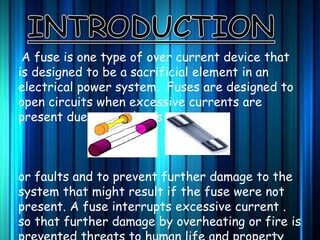
A fuse is one type of over current device that
is designed to be a sacrificial element in an
electrical power system. Fuses are designed to
open circuits when excessive currents are
present due to overloads
or faults and to prevent further damage to the
system that might result if the fuse were not
present. A fuse interrupts excessive current .
so that further damage by overheating or fire is
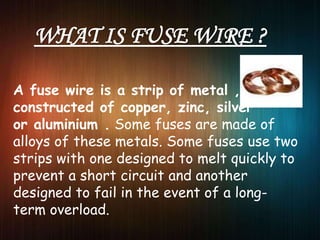
A fuse wire is a strip of metal ,
constructed of copper, zinc, silver
or aluminium . Some fuses are made of
alloys of these metals. Some fuses use two
strips with one designed to melt quickly to
prevent a short circuit and another
designed to fail in the event of a long-
term overload.
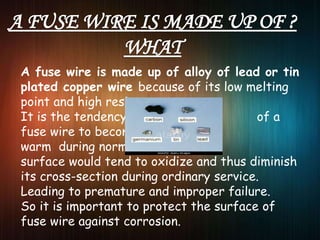
A fuse wire is made up of alloy of lead or tin
plated copper wire because of its low melting
point and high resistance .
It is the tendency of a
fuse wire to become slightly
warm during normal use, its
surface would tend to oxidize and thus diminish
its cross-section during ordinary service.
Leading to premature and improper failure.
So it is important to protect the surface of
fuse wire against corrosion.
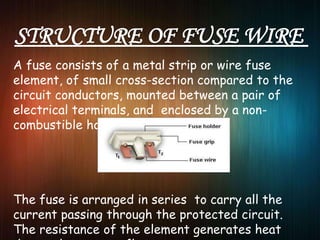
A fuse consists of a metal strip or wire fuse
element, of small cross-section compared to the
circuit conductors, mounted between a pair of
electrical terminals, and enclosed by a non-
combustible housing
The fuse is arranged in series to carry all the
current passing through the protected circuit.
The resistance of the element generates heat
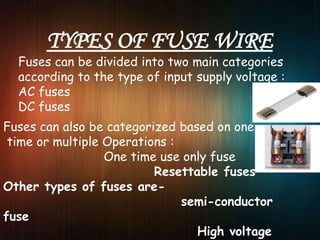
Fuses can be divided into two main categories
according to the type of input supply voltage :
AC fuses
DC fuses
Fuses can also be categorized based on one
time or multiple Operations :
One time use only fuse
Resettable fuses
Other types of fuses are-
semi-conductor
fuse
High voltage
There is a little difference between AC and DC
Fuses used in the AC and DC Systems.
In a DC system, when the metallic wire Melts
because of the heat generated by the over current,
then Arc is produced and it is very difficult to
extinct this arc because of DC constant value. So in
order to minimize the fuse arcing, DC fuse are little
bigger than an AC fuse which increase the distance
between the electrodes to reduce the arc in the
Fuse. On the other hand, i.e. in the AC system,
voltage with 60Hz or 50Hz frequency changes it
amplitude from zero to 60 times every second, so
arc can be extinct easily as compared to DC.
One time use fuses contain a metallic wire,
which burns out, when an over current, over
load or mismatched load connect event occur,
user has to manually replace these fuses,
switch fuses are cheap and widely used in
almost all the electronics and electrical
systems.
A polymeric positive temperature
coefficient device commonly known as
a resettable fuse is a passive electronic
component used to protect against over
The primary reason for using a fuse is not to
protect the device per se, but to prevent fire or
other events from happening if the device
malfunctions. A fuse rated at a particular current
is a bit of a misnomer. Notice that it takes time
for something to heat and melt and if the rate of
heating is proportional to the current, you can
sustain a much higher current through fuse as
long as you shorten the current's duration in time.
. A fuse is a "current limiting device".
Finally, when picking the fuse you want something
that will disrupt the circuit when it's obviously
beyond the designed operating current that takes
the mentioned variables into consideration and
definitely doesn't disrupt the circuit when it's
operating as designed. The way a traditional single
use fuse works is by using a small piece of wire
who's resistance is such that the wire will heat
and melt at a predetermined current. It is
designed to be a cheap, expendable "weakest-link"
which upon failure will open the circuit preventing
further damage or fire risk.
from the above slides we came to
know many things about the fuse
wires.
They help in short circuit
protection.
They are regarded as Environmental
friendly technology.
They are very essential in electrical
THANK YOU

Physics ppt on fuse

  • 3.
    A fuse isone type of over current device that is designed to be a sacrificial element in an electrical power system. Fuses are designed to open circuits when excessive currents are present due to overloads or faults and to prevent further damage to the system that might result if the fuse were not present. A fuse interrupts excessive current . so that further damage by overheating or fire is
  • 4.
    A fuse wireis a strip of metal , constructed of copper, zinc, silver or aluminium . Some fuses are made of alloys of these metals. Some fuses use two strips with one designed to melt quickly to prevent a short circuit and another designed to fail in the event of a long- term overload.
  • 5.
    A fuse wireis made up of alloy of lead or tin plated copper wire because of its low melting point and high resistance . It is the tendency of a fuse wire to become slightly warm during normal use, its surface would tend to oxidize and thus diminish its cross-section during ordinary service. Leading to premature and improper failure. So it is important to protect the surface of fuse wire against corrosion.
  • 6.
    A fuse consistsof a metal strip or wire fuse element, of small cross-section compared to the circuit conductors, mounted between a pair of electrical terminals, and enclosed by a non- combustible housing The fuse is arranged in series to carry all the current passing through the protected circuit. The resistance of the element generates heat
  • 7.
    Fuses can bedivided into two main categories according to the type of input supply voltage : AC fuses DC fuses Fuses can also be categorized based on one time or multiple Operations : One time use only fuse Resettable fuses Other types of fuses are- semi-conductor fuse High voltage
  • 8.
    There is alittle difference between AC and DC Fuses used in the AC and DC Systems. In a DC system, when the metallic wire Melts because of the heat generated by the over current, then Arc is produced and it is very difficult to extinct this arc because of DC constant value. So in order to minimize the fuse arcing, DC fuse are little bigger than an AC fuse which increase the distance between the electrodes to reduce the arc in the Fuse. On the other hand, i.e. in the AC system, voltage with 60Hz or 50Hz frequency changes it amplitude from zero to 60 times every second, so arc can be extinct easily as compared to DC.
  • 9.
    One time usefuses contain a metallic wire, which burns out, when an over current, over load or mismatched load connect event occur, user has to manually replace these fuses, switch fuses are cheap and widely used in almost all the electronics and electrical systems. A polymeric positive temperature coefficient device commonly known as a resettable fuse is a passive electronic component used to protect against over
  • 11.
    The primary reasonfor using a fuse is not to protect the device per se, but to prevent fire or other events from happening if the device malfunctions. A fuse rated at a particular current is a bit of a misnomer. Notice that it takes time for something to heat and melt and if the rate of heating is proportional to the current, you can sustain a much higher current through fuse as long as you shorten the current's duration in time. . A fuse is a "current limiting device".
  • 12.
    Finally, when pickingthe fuse you want something that will disrupt the circuit when it's obviously beyond the designed operating current that takes the mentioned variables into consideration and definitely doesn't disrupt the circuit when it's operating as designed. The way a traditional single use fuse works is by using a small piece of wire who's resistance is such that the wire will heat and melt at a predetermined current. It is designed to be a cheap, expendable "weakest-link" which upon failure will open the circuit preventing further damage or fire risk.
  • 13.
    from the aboveslides we came to know many things about the fuse wires. They help in short circuit protection. They are regarded as Environmental friendly technology. They are very essential in electrical
  • 15.