Comparison of existing CNI
plugins for Kubernetes
Adam Hamsik
adam.hamsik@lablabs.io
Labyrinth Labs
Rock-solid infrastructure and DevOps
● Building rock-solid and secure foundations for all your digital operations. Our
mission is to let you focus on your business without ever needing to worry
about technical issues again.
● Making you ready for growing traffic, safe against new security vulnerabilities
and data-loss.
2
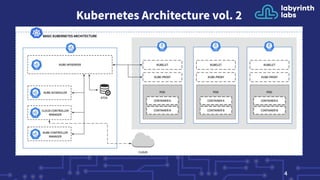
Kubernetes Architecture
● Master acts as the control plane for Kubernetes. Kubernetes master is
responsible for maintaining the desired state for cluster. The “master” refers to
a collection of processes managing and is responsible at a minimum for running
scheduler, cluster controller, API Server.
● Nodes acts as the “worker” of Kubernetes cluster. The nodes in a cluster are the
machines (VMs, physical servers, etc) that run your applications and cloud
workflows. The Kubernetes master controls each node.
3
Kubernetes Architecture vol. 2
4
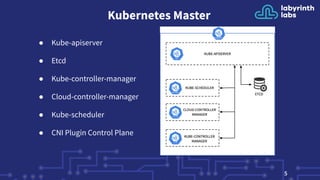
Kubernetes Master
● Kube-apiserver
● Etcd
● Kube-controller-manager
● Cloud-controller-manager
● Kube-scheduler
● CNI Plugin Control Plane
5
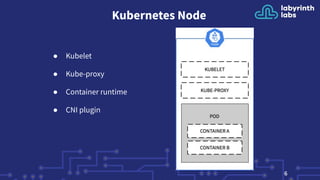
Kubernetes Node
● Kubelet
● Kube-proxy
● Container runtime
● CNI plugin
6
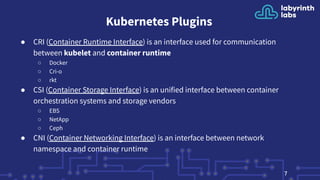
Kubernetes Plugins
● CRI (Container Runtime Interface) is an interface used for communication
between kubelet and container runtime
○ Docker
○ Cri-o
○ rkt
● CSI (Container Storage Interface) is an unified interface between container
orchestration systems and storage vendors
○ EBS
○ NetApp
○ Ceph
● CNI (Container Networking Interface) is an interface between network
namespace and container runtime
7
What is a CNI Plugin ?
● Simplest interface between container runtime and network
implementation
● Originated at CoreOS as part of Rkt Container runtime
● CNCF project
● Repository: https://github.com/containernetworking/cni
● Specification: the API between runtimes and network plugins
8
Kubernetes CNI Requirements
● pods on a node can communicate with all pods on all nodes without NAT
● agents on a node (e.g. system daemons, kubelet) can communicate with all
pods on that node
● pods in the host network of a node can communicate with all pods on all nodes
without NAT
● containers within a Pod share their network namespaces
○ You can access other container services through localhost
9
Kubernetes CNI Implementation
● Containers in a pod exists within network namespace and share same IP -
○ this setup allow for intrapod communication over localhost
● Pod are given cluster unique IP for the duration of its lifecycle
● Services are given a persistent cluster unique IP that spans Pods lifecycle
● External connectivity is generally handled by an infrastructure (default GWs)
10
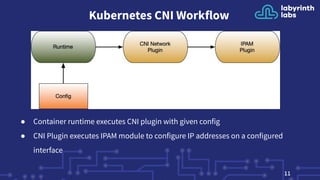
Kubernetes CNI Workflow
● Container runtime executes CNI plugin with given config
● CNI Plugin executes IPAM module to configure IP addresses on a configured
interface
11
Demo Time vol.1
● Show
● CNI Plugin executes IPAM module to configure IP addresses on a configured
interface
12
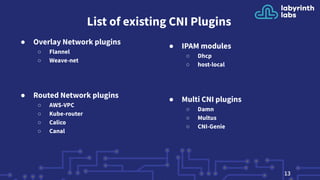
List of existing CNI Plugins
● Overlay Network plugins
○ Flannel
○ Weave-net
● Routed Network plugins
○ AWS-VPC
○ Kube-router
○ Calico
○ Canal
● IPAM modules
○ Dhcp
○ host-local
● Multi CNI plugins
○ Damn
○ Multus
○ CNI-Genie
13
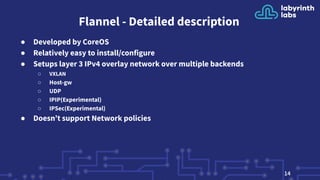
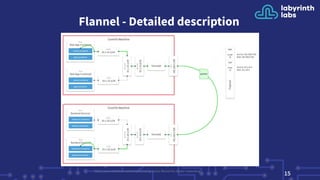
Flannel - Detailed description
● Developed by CoreOS
● Relatively easy to install/configure
● Setups layer 3 IPv4 overlay network over multiple backends
○ VXLAN
○ Host-gw
○ UDP
○ IPIP(Experimental)
○ IPSec(Experimental)
● Doesn’t support Network policies
14
Flannel - Detailed description
15
https://www.slideshare.net/lorispack/using-coreos-flannel-for-docker-networking
Calico - Detailed description
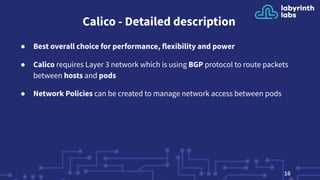
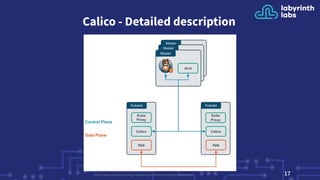
● Best overall choice for performance, flexibility and power
● Calico requires Layer 3 network which is using BGP protocol to route packets
between hosts and pods
● Network Policies can be created to manage network access between pods
16
Calico - Detailed description
17https://www.docker.com/blog/networking-in-docker-enterprise-edition-2-0/
Kube-router - Detailed description
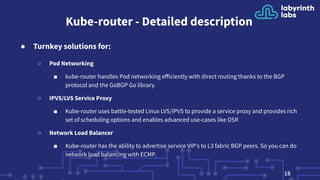
● Turnkey solutions for:
○ Pod Networking
■ kube-router handles Pod networking efficiently with direct routing thanks to the BGP
protocol and the GoBGP Go library.
○ IPVS/LVS Service Proxy
■ Kube-router uses battle-tested Linux LVS/IPVS to provide a service proxy and provides rich
set of scheduling options and enables advanced use-cases like DSR
○ Network Load Balancer
■ Kube-router has the ability to advertise service VIP's to L3 fabric BGP peers. So you can do
network load balancing with ECMP.
18
AWS VPC CNI - Detailed description
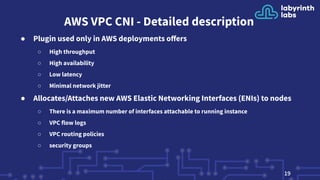
● Plugin used only in AWS deployments offers
○ High throughput
○ High availability
○ Low latency
○ Minimal network jitter
● Allocates/Attaches new AWS Elastic Networking Interfaces (ENIs) to nodes
○ There is a maximum number of interfaces attachable to running instance
○ VPC flow logs
○ VPC routing policies
○ security groups
19
Questions ?
adam.hamsik@lablabs.io
www.lablabs.io
20
More information
● http://events17.linuxfoundation.org/sites/events/files/slides/Container%20Net
working%20Deep%20Dive.pdf
● https://thenewstack.io/hackers-guide-kubernetes-networking/
● https://www.cncf.io/wp-content/uploads/2017/11/Introduction-to-CNI-2.pdf
● https://itnext.io/benchmark-results-of-kubernetes-network-plugins-cni-over-1
0gbit-s-network-36475925a560
● https://www.altoros.com/blog/kubernetes-networking-writing-your-own-simpl
e-cni-plug-in-with-bash/
21

4. CNCF kubernetes Comparison of-existing-cni-plugins-for-kubernetes

  • 1.
    Comparison of existingCNI plugins for Kubernetes Adam Hamsik adam.hamsik@lablabs.io
  • 2.
    Labyrinth Labs Rock-solid infrastructureand DevOps ● Building rock-solid and secure foundations for all your digital operations. Our mission is to let you focus on your business without ever needing to worry about technical issues again. ● Making you ready for growing traffic, safe against new security vulnerabilities and data-loss. 2
  • 3.
    Kubernetes Architecture ● Masteracts as the control plane for Kubernetes. Kubernetes master is responsible for maintaining the desired state for cluster. The “master” refers to a collection of processes managing and is responsible at a minimum for running scheduler, cluster controller, API Server. ● Nodes acts as the “worker” of Kubernetes cluster. The nodes in a cluster are the machines (VMs, physical servers, etc) that run your applications and cloud workflows. The Kubernetes master controls each node. 3
  • 4.
  • 5.
    Kubernetes Master ● Kube-apiserver ●Etcd ● Kube-controller-manager ● Cloud-controller-manager ● Kube-scheduler ● CNI Plugin Control Plane 5
  • 6.
    Kubernetes Node ● Kubelet ●Kube-proxy ● Container runtime ● CNI plugin 6
  • 7.
    Kubernetes Plugins ● CRI(Container Runtime Interface) is an interface used for communication between kubelet and container runtime ○ Docker ○ Cri-o ○ rkt ● CSI (Container Storage Interface) is an unified interface between container orchestration systems and storage vendors ○ EBS ○ NetApp ○ Ceph ● CNI (Container Networking Interface) is an interface between network namespace and container runtime 7
  • 8.
    What is aCNI Plugin ? ● Simplest interface between container runtime and network implementation ● Originated at CoreOS as part of Rkt Container runtime ● CNCF project ● Repository: https://github.com/containernetworking/cni ● Specification: the API between runtimes and network plugins 8
  • 9.
    Kubernetes CNI Requirements ●pods on a node can communicate with all pods on all nodes without NAT ● agents on a node (e.g. system daemons, kubelet) can communicate with all pods on that node ● pods in the host network of a node can communicate with all pods on all nodes without NAT ● containers within a Pod share their network namespaces ○ You can access other container services through localhost 9
  • 10.
    Kubernetes CNI Implementation ●Containers in a pod exists within network namespace and share same IP - ○ this setup allow for intrapod communication over localhost ● Pod are given cluster unique IP for the duration of its lifecycle ● Services are given a persistent cluster unique IP that spans Pods lifecycle ● External connectivity is generally handled by an infrastructure (default GWs) 10
  • 11.
    Kubernetes CNI Workflow ●Container runtime executes CNI plugin with given config ● CNI Plugin executes IPAM module to configure IP addresses on a configured interface 11
  • 12.
    Demo Time vol.1 ●Show ● CNI Plugin executes IPAM module to configure IP addresses on a configured interface 12
  • 13.
    List of existingCNI Plugins ● Overlay Network plugins ○ Flannel ○ Weave-net ● Routed Network plugins ○ AWS-VPC ○ Kube-router ○ Calico ○ Canal ● IPAM modules ○ Dhcp ○ host-local ● Multi CNI plugins ○ Damn ○ Multus ○ CNI-Genie 13
  • 14.
    Flannel - Detaileddescription ● Developed by CoreOS ● Relatively easy to install/configure ● Setups layer 3 IPv4 overlay network over multiple backends ○ VXLAN ○ Host-gw ○ UDP ○ IPIP(Experimental) ○ IPSec(Experimental) ● Doesn’t support Network policies 14
  • 15.
    Flannel - Detaileddescription 15 https://www.slideshare.net/lorispack/using-coreos-flannel-for-docker-networking
  • 16.
    Calico - Detaileddescription ● Best overall choice for performance, flexibility and power ● Calico requires Layer 3 network which is using BGP protocol to route packets between hosts and pods ● Network Policies can be created to manage network access between pods 16
  • 17.
    Calico - Detaileddescription 17https://www.docker.com/blog/networking-in-docker-enterprise-edition-2-0/
  • 18.
    Kube-router - Detaileddescription ● Turnkey solutions for: ○ Pod Networking ■ kube-router handles Pod networking efficiently with direct routing thanks to the BGP protocol and the GoBGP Go library. ○ IPVS/LVS Service Proxy ■ Kube-router uses battle-tested Linux LVS/IPVS to provide a service proxy and provides rich set of scheduling options and enables advanced use-cases like DSR ○ Network Load Balancer ■ Kube-router has the ability to advertise service VIP's to L3 fabric BGP peers. So you can do network load balancing with ECMP. 18
  • 19.
    AWS VPC CNI- Detailed description ● Plugin used only in AWS deployments offers ○ High throughput ○ High availability ○ Low latency ○ Minimal network jitter ● Allocates/Attaches new AWS Elastic Networking Interfaces (ENIs) to nodes ○ There is a maximum number of interfaces attachable to running instance ○ VPC flow logs ○ VPC routing policies ○ security groups 19
  • 20.
  • 21.
    More information ● http://events17.linuxfoundation.org/sites/events/files/slides/Container%20Net working%20Deep%20Dive.pdf ●https://thenewstack.io/hackers-guide-kubernetes-networking/ ● https://www.cncf.io/wp-content/uploads/2017/11/Introduction-to-CNI-2.pdf ● https://itnext.io/benchmark-results-of-kubernetes-network-plugins-cni-over-1 0gbit-s-network-36475925a560 ● https://www.altoros.com/blog/kubernetes-networking-writing-your-own-simpl e-cni-plug-in-with-bash/ 21