Practical CNI
Tuesday, June 20
Lorenzo Fontana - @fntlnz
DevOps @ Kiratech
Docker Captain - Docker Maintainer
https://fntlnz.wtf
Introduction to the project and how to get hands dirty with it
A brief introduction
- A runtime independent platform for container networking
- Part of CNCF (well, since May 2017) ¹
- An effort held by multiple entities: CoreOS, Red Hat
OpenShift, Apache Mesos, Cloud Foundry, Kubernetes,
Kurma and rkt.
- Designed around a minimal specification
¹ https://www.cncf.io/blog/2017/05/23/cncf-hosts-container-networking-interface-cni/
The SPEC¹ - and its purpose
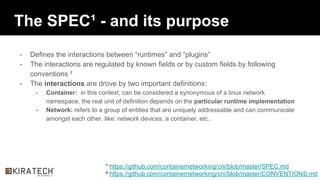
- Defines the interactions between “runtimes” and “plugins”
- The interactions are regulated by known fields or by custom fields by following
conventions ²
- The interactions are drove by two important definitions:
- Container: in this context, can be considered a synonymous of a linux network
namespace, the real unit of definition depends on the particular runtime implementation
- Network: refers to a group of entities that are uniquely addressable and can communicate
amongst each other, like: network devices, a container, etc..
¹ https://github.com/containernetworking/cni/blob/master/SPEC.md
² https://github.com/containernetworking/cni/blob/master/CONVENTIONS.md
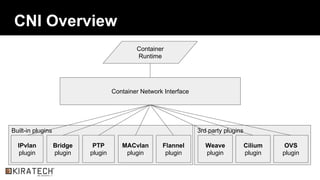
Wait, Plugins ?
- Plugins are executables invoked by the container runtime
- Plugins are responsible for:
- IPAM
- Connecting VETH Pairs
- Adding necessary network components, like bridges
https://github.com/containernetworking/plugins/
3rd party pluginsBuilt-in plugins
CNI Overview
Container
Runtime
Container Network Interface
IPvlan
plugin
Bridge
plugin
PTP
plugin
MACvlan
plugin
Weave
plugin
Cilium
plugin
OVS
plugin
Flannel
plugin
The “ptp” Plugin
{
"name": "mynet",
"type": "ptp",
"ipam": {
"type": "host-local",
"subnet": "10.1.1.0/24"
},
"dns": {
"nameservers": [ "10.1.1.1", "8.8.8.8" ]
}
}
ns0 s1
tap0 tap1
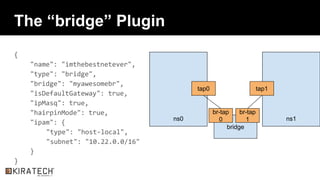
The “bridge” Plugin
{
"name": "imthebestnetever",
"type": "bridge",
"bridge": "myawesomebr",
"isDefaultGateway": true,
"ipMasq": true,
"hairpinMode": true,
"ipam": {
"type": "host-local",
"subnet": "10.22.0.0/16"
}
}
ns0 ns1
tap0 tap1
bridge
br-tap
0
br-tap
1
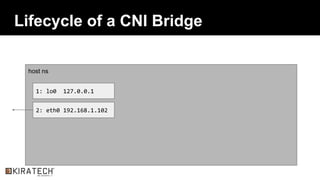
Lifecycle of a CNI Bridge
host ns
2: eth0 192.168.1.102
1: lo0 127.0.0.1
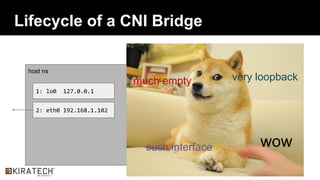
Lifecycle of a CNI Bridge
host ns
2: eth0 192.168.1.102
1: lo0 127.0.0.1
wow
much empty
such interface
very loopback
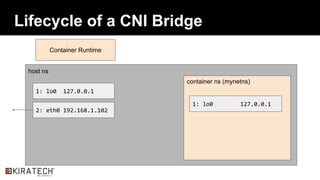
Lifecycle of a CNI Bridge
host ns
container ns (mynetns)
1: lo0 127.0.0.1
2: eth0 192.168.1.102
1: lo0 127.0.0.1
Container Runtime
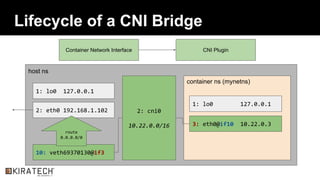
Lifecycle of a CNI Bridge
host ns
container ns (mynetns)
3: eth0@if10 10.22.0.3
1: lo0 127.0.0.1
2: eth0 192.168.1.102
10: veth69370130@if3
2: cni0
10.22.0.0/16
1: lo0 127.0.0.1
route
0.0.0.0/0
Container Network Interface CNI Plugin
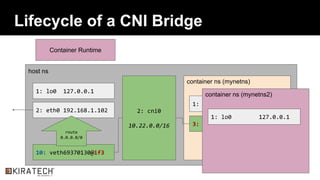
Lifecycle of a CNI Bridge
host ns
container ns (mynetns)
3: eth0@if10 10.22.0.3
1: lo0 127.0.0.1
2: eth0 192.168.1.102
10: veth69370130@if3
2: cni0
10.22.0.0/16
1: lo0 127.0.0.1
route
0.0.0.0/0
Container Runtime
container ns (mynetns2)
1: lo0 127.0.0.1
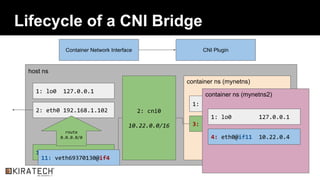
Lifecycle of a CNI Bridge
host ns
container ns (mynetns)
3: eth0@if10 10.22.0.3
1: lo0 127.0.0.1
2: eth0 192.168.1.102
10: veth69370130@if3
2: cni0
10.22.0.0/16
1: lo0 127.0.0.1
route
0.0.0.0/0
container ns (mynetns2)
4: eth0@if11 10.22.0.4
1: lo0 127.0.0.1
11: veth69370130@if4
Container Network Interface CNI Plugin
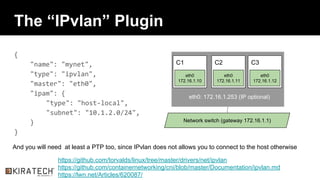
The “IPvlan” Plugin
{
"name": "mynet",
"type": "ipvlan",
"master": "eth0",
"ipam": {
"type": "host-local",
"subnet": "10.1.2.0/24",
}
}
And you will need at least a PTP too, since IPvlan does not allows you to connect to the host otherwise
Network switch (gateway 172.16.1.1)
eth0: 172.16.1.253 (IP optional)
C1
eth0
172.16.1.10
C3C2
eth0
172.16.1.11
eth0
172.16.1.12
https://github.com/torvalds/linux/tree/master/drivers/net/ipvlan
https://github.com/containernetworking/cni/blob/master/Documentation/ipvlan.md
https://lwn.net/Articles/620087/
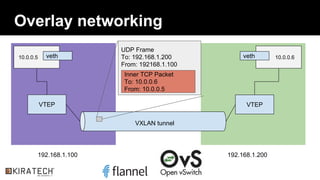
Overlay networking
VXLAN tunnel
veth veth
VTEP VTEP
10.0.0.5 10.0.0.6
192.168.1.100 192.168.1.200
UDP Frame
To: 192.168.1.200
From: 192168.1.100
Inner TCP Packet
To: 10.0.0.6
From: 10.0.0.5
OVN
- L2/L3 network virtualization for Open vSwitch
- Integrated with Container Orchestrators ¹
- Integrated with hypervisors (KVM, XEN, Hyper-V)
- Integrated with OpenStack
- Integrated DHCP
- Integrated QoS
- Trunking
- Scalable
- Multiple overlay technologies (Geneve, STT and VXLAN)
- Means hybrid networks between infrastructures (hybrid / cloud) and different
virtualization technologies (OS Level: containers and Full: Virtual machines)
¹ https://github.com/openvswitch/ovn-kubernetes
http://openvswitch.org/support/dist-docs/ovn-architecture.7.html
Thank you!
Find me on
https://fntlnz.wtf
https://github.com/fntlnz
https://twitter.com/fntlnz
http://www.kiratech.it/china
lo@linux.com

Practical CNI

  • 1.
    Practical CNI Tuesday, June20 Lorenzo Fontana - @fntlnz DevOps @ Kiratech Docker Captain - Docker Maintainer https://fntlnz.wtf Introduction to the project and how to get hands dirty with it
  • 2.
    A brief introduction -A runtime independent platform for container networking - Part of CNCF (well, since May 2017) ¹ - An effort held by multiple entities: CoreOS, Red Hat OpenShift, Apache Mesos, Cloud Foundry, Kubernetes, Kurma and rkt. - Designed around a minimal specification ¹ https://www.cncf.io/blog/2017/05/23/cncf-hosts-container-networking-interface-cni/
  • 3.
    The SPEC¹ -and its purpose - Defines the interactions between “runtimes” and “plugins” - The interactions are regulated by known fields or by custom fields by following conventions ² - The interactions are drove by two important definitions: - Container: in this context, can be considered a synonymous of a linux network namespace, the real unit of definition depends on the particular runtime implementation - Network: refers to a group of entities that are uniquely addressable and can communicate amongst each other, like: network devices, a container, etc.. ¹ https://github.com/containernetworking/cni/blob/master/SPEC.md ² https://github.com/containernetworking/cni/blob/master/CONVENTIONS.md
  • 4.
    Wait, Plugins ? -Plugins are executables invoked by the container runtime - Plugins are responsible for: - IPAM - Connecting VETH Pairs - Adding necessary network components, like bridges https://github.com/containernetworking/plugins/
  • 5.
    3rd party pluginsBuilt-inplugins CNI Overview Container Runtime Container Network Interface IPvlan plugin Bridge plugin PTP plugin MACvlan plugin Weave plugin Cilium plugin OVS plugin Flannel plugin
  • 6.
    The “ptp” Plugin { "name":"mynet", "type": "ptp", "ipam": { "type": "host-local", "subnet": "10.1.1.0/24" }, "dns": { "nameservers": [ "10.1.1.1", "8.8.8.8" ] } } ns0 s1 tap0 tap1
  • 7.
    The “bridge” Plugin { "name":"imthebestnetever", "type": "bridge", "bridge": "myawesomebr", "isDefaultGateway": true, "ipMasq": true, "hairpinMode": true, "ipam": { "type": "host-local", "subnet": "10.22.0.0/16" } } ns0 ns1 tap0 tap1 bridge br-tap 0 br-tap 1
  • 8.
    Lifecycle of aCNI Bridge host ns 2: eth0 192.168.1.102 1: lo0 127.0.0.1
  • 9.
    Lifecycle of aCNI Bridge host ns 2: eth0 192.168.1.102 1: lo0 127.0.0.1 wow much empty such interface very loopback
  • 10.
    Lifecycle of aCNI Bridge host ns container ns (mynetns) 1: lo0 127.0.0.1 2: eth0 192.168.1.102 1: lo0 127.0.0.1 Container Runtime
  • 11.
    Lifecycle of aCNI Bridge host ns container ns (mynetns) 3: eth0@if10 10.22.0.3 1: lo0 127.0.0.1 2: eth0 192.168.1.102 10: veth69370130@if3 2: cni0 10.22.0.0/16 1: lo0 127.0.0.1 route 0.0.0.0/0 Container Network Interface CNI Plugin
  • 12.
    Lifecycle of aCNI Bridge host ns container ns (mynetns) 3: eth0@if10 10.22.0.3 1: lo0 127.0.0.1 2: eth0 192.168.1.102 10: veth69370130@if3 2: cni0 10.22.0.0/16 1: lo0 127.0.0.1 route 0.0.0.0/0 Container Runtime container ns (mynetns2) 1: lo0 127.0.0.1
  • 13.
    Lifecycle of aCNI Bridge host ns container ns (mynetns) 3: eth0@if10 10.22.0.3 1: lo0 127.0.0.1 2: eth0 192.168.1.102 10: veth69370130@if3 2: cni0 10.22.0.0/16 1: lo0 127.0.0.1 route 0.0.0.0/0 container ns (mynetns2) 4: eth0@if11 10.22.0.4 1: lo0 127.0.0.1 11: veth69370130@if4 Container Network Interface CNI Plugin
  • 14.
    The “IPvlan” Plugin { "name":"mynet", "type": "ipvlan", "master": "eth0", "ipam": { "type": "host-local", "subnet": "10.1.2.0/24", } } And you will need at least a PTP too, since IPvlan does not allows you to connect to the host otherwise Network switch (gateway 172.16.1.1) eth0: 172.16.1.253 (IP optional) C1 eth0 172.16.1.10 C3C2 eth0 172.16.1.11 eth0 172.16.1.12 https://github.com/torvalds/linux/tree/master/drivers/net/ipvlan https://github.com/containernetworking/cni/blob/master/Documentation/ipvlan.md https://lwn.net/Articles/620087/
  • 15.
    Overlay networking VXLAN tunnel vethveth VTEP VTEP 10.0.0.5 10.0.0.6 192.168.1.100 192.168.1.200 UDP Frame To: 192.168.1.200 From: 192168.1.100 Inner TCP Packet To: 10.0.0.6 From: 10.0.0.5
  • 16.
    OVN - L2/L3 networkvirtualization for Open vSwitch - Integrated with Container Orchestrators ¹ - Integrated with hypervisors (KVM, XEN, Hyper-V) - Integrated with OpenStack - Integrated DHCP - Integrated QoS - Trunking - Scalable - Multiple overlay technologies (Geneve, STT and VXLAN) - Means hybrid networks between infrastructures (hybrid / cloud) and different virtualization technologies (OS Level: containers and Full: Virtual machines) ¹ https://github.com/openvswitch/ovn-kubernetes http://openvswitch.org/support/dist-docs/ovn-architecture.7.html
  • 17.
    Thank you! Find meon https://fntlnz.wtf https://github.com/fntlnz https://twitter.com/fntlnz http://www.kiratech.it/china lo@linux.com