Evolution of the
Container Network Interface
(CNI)
Casey Callendrello
CoreOS
Who am I?
github.com/squeed
@squeed
CNI maintainer
Rkt developer
The CNI
How it started
How it’s grown
New developments
What’s next
What is CNI?
A standard way to connect your containers to your network.
“Your network”
AWS? GCE? Bare Metal?
BGP? OSPF? OpenFlow? “API”?
Overlay networks?
Flat layer 2 space?
Specialized hardware?
What is CNI?
An API for networking vendors to implement.
A small library for runtimes to consume.
Contain the complexity
What is CNI?
A living, active open-source project with:
- 5 maintainers
- 60 contributors at 10+ companies
- 10+ plugin vendors
- 6+ runtimes
How did it start?
How did it start?
● Rkt is a daemonless container runtime
● No complicated data model or online DB
● Principle throughout rkt is “clean integration
points”
How did it start?
Need for a simple way to “bring this namespace
online”
● Handling namespaces in golang is painful
● Let’s initialize the network in a separate
process
● And define an interface
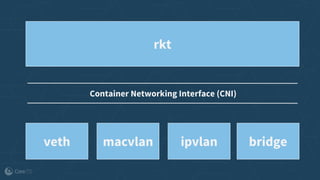
rkt
veth macvlan ipvlan bridge
Container Networking Interface (CNI)
Adoption & Growth
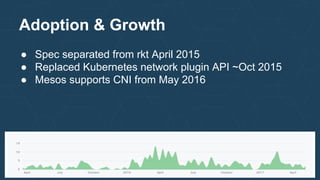
● Spec separated from rkt April 2015
● Replaced Kubernetes network plugin API ~Oct 2015
● Mesos supports CNI from May 2016
Who uses it? - Vendors
● Canonical Kubernetes
● Tectonic by CoreOS
● Redhat Openshift
● “Kubenet” plugin
Science!
Technical introduction
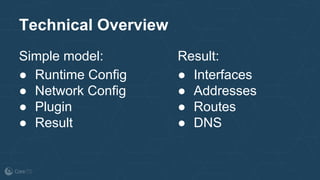
Technical Overview
Simple model:
● Runtime Config
● Network Config
● Plugin
● Result
Result:
● Interfaces
● Addresses
● Routes
● DNS
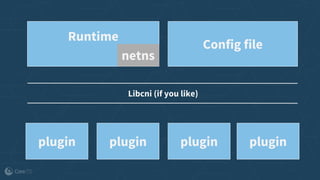
Runtime
plugin plugin plugin plugin
Libcni (if you like)
Config file
netns
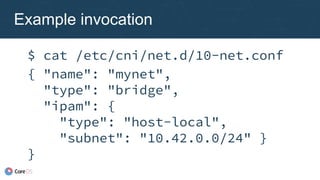
Example invocation
$ cat /etc/cni/net.d/10-net.conf
{ "name": "mynet",
"type": "bridge",
"ipam": {
"type": "host-local",
"subnet": "10.42.0.0/24" }
}
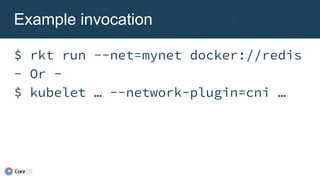
$ rkt run --net=mynet docker://redis
- Or -
$ kubelet … --network-plugin=cni …
Example invocation
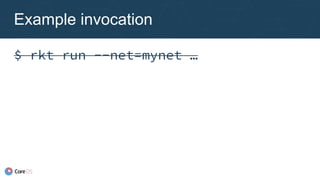
$ rkt run --net=mynet …
Example invocation
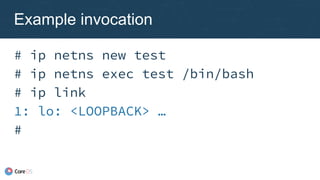
# ip netns new test
# ip netns exec test /bin/bash
# ip link
1: lo: <LOOPBACK> …
#
Example invocation
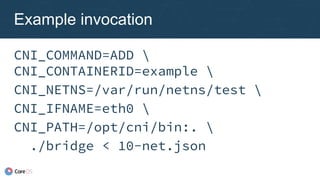
CNI_COMMAND=ADD 
CNI_CONTAINERID=example 
CNI_NETNS=/var/run/netns/test 
CNI_IFNAME=eth0 
CNI_PATH=/opt/cni/bin:. 
./bridge < 10-net.json
Example invocation
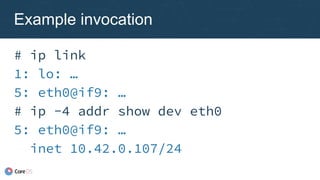
# ip link
1: lo: …
5: eth0@if9: …
# ip -4 addr show dev eth0
5: eth0@if9: …
inet 10.42.0.107/24
Example invocation
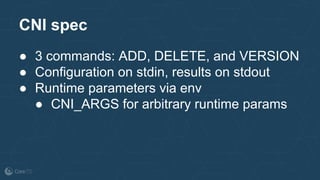
● 3 commands: ADD, DELETE, and VERSION
● Configuration on stdin, results on stdout
● Runtime parameters via env
● CNI_ARGS for arbitrary runtime params
CNI spec
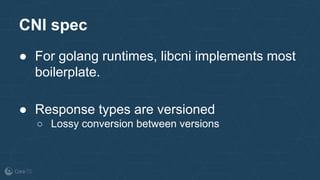
● For golang runtimes, libcni implements most
boilerplate.
● Response types are versioned
○ Lossy conversion between versions
CNI spec
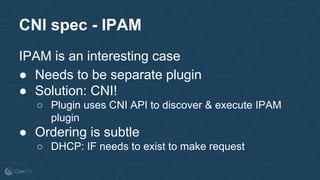
IPAM is an interesting case
● Needs to be separate plugin
● Solution: CNI!
○ Plugin uses CNI API to discover & execute IPAM
plugin
● Ordering is subtle
○ DHCP: IF needs to exist to make request
CNI spec - IPAM
Use cases & Plugins
Basic:
Bridge, veth
Muxing:
Macvlan, ipvlan
Overlay networks:
Flannel, Calico, Weave
What plugins exist?
IPAM:
Host-local, dhcp,
Infoblox
What plugins exist?
Cilium: BPF-based networking
● No more iptables & conntrack!
● I want to give Mellanox all my money
SR-IOV: PCI sub-devices
● I am doing HFT and want to give Intel even
more of my money
Common CNI setups
Bridge + port forwarding
● “I’ll use the host IP for everything”
● Pods not otherwise reachable
Common CNI setups
Macvlan + DHCP
● “I already have an expensive network”
● “And an expensive network admin”
● Watch those CAM tables!
Each pod directly connected to network
Common CNI setups
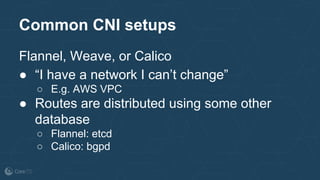
Flannel, Weave, or Calico
● “I have a network I can’t change”
○ E.g. AWS VPC
● Routes are distributed using some other
database
○ Flannel: etcd
○ Calico: bgpd
What’s new with CNI?
Spec version v0.3
Awesome logo (Thanks, LF!)
What’s new in v0.3
● Type enhancements
● Plugin chaining
● Capability arguments
Type enhancements in v0.3
New result type adds:
● Multiple IPs
● Interfaces
○ Including host-side interface
ConfigLists / Plugin Chaining
IPAM separated some common behavior.
Add post-creation plugins too!
Plugin chaining
Motivating examples: anything that tweaks an
existing interface or IP
● Port forwarding
● Sysctl tuning
● Traffic shaping
● SLAAC?
Plugin chaining
New configuration
format
● Just a list of
configuration blocks
● Runtime chains
previous result
{ "name": "dbnet",
"plugins": [
{ "type": "bridge",
"ipam": {
"type": "host-local",
"subnet": "10.1.0.0/16" }
},
{ "type": "tuning",
"sysctl": {
"net.core.somaxconn":
"500" }
}
]
}
Chained plugins
Existing:
● Tuning
● Iptables-based port forwarding
Future:
● Bridge (for virtual machines, etc.)
Capability arguments
The problem:
I want to forward ports dynamically.
( curl http://127.0.0.1:8080 )
Capability arguments
The problem
● CNI_ARGS too freeform
● Don’t want to put rewrite logic in the runtime
● Don’t know which plugin does the forwarding
○ Remember Cilium?
Capability arguments
Need a way to pass in
● Dynamic (run-time)
● Structured
● Plugin-agnostic (sort of) configuration
To one or more plugins in a chain.
Capability Arguments
Don’t want
● Templating language
● Complicated runtime
● JSON in an environment variable
Capability arguments
Solution:
● Spec defines “capabilities”
● Plugins declare support
● Libcni patches arguments into config
○ Yes, it’s JSON manipulation, but it’s standardized
Capability arguments
{
"type": "portmap-iptables",
"capabilities": {"portMappings": true},
}
Becomes:
{ "type": "portmap-iptables",
"runtimeConfig": {
"portMappings": [
{"hostPort": 80, "containerPort": 8080}
]},
}
Capability arguments
● Writing specs requires careful thought
● We all need to work together
● Many people contributed to the v0.3 upgrade
○ Esp. Kubernetes and Mesos devs
Putting it all together
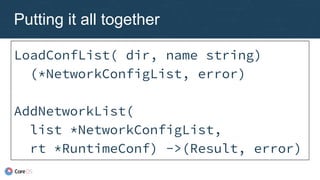
LoadConfList( dir, name string)
(*NetworkConfigList, error)
AddNetworkList(
list *NetworkConfigList,
rt *RuntimeConf) ->(Result, error)
What’s Next?
New plugins!
I want YOU to write new plugins
● Firewalld integration
● Traffic shaping
○ Oh, and this is a new capability
● Better tuning
○ Some of you have some hard-learned TCP hacks
IPv6
Spec as written now makes v6 easy.
CNI-maintained plugins need some small
tweaks.
A philosophical question: Is SLAAC an IPAM
plugin?
Virtual machines
Spec does not actually require namespaces
Hyper and Intel working on this
Plugin chaining makes this a lot easier
CNCF
CNI (probably) going under the CNCF
Voting is underway now.
No real change, just formal recognition.
Splitting spec and code
Right now, all code under a single repository.
That was a mistake.
CNI-maintained plugins
In summary
In summary
CNI is a living, breathing project.
We’re entirely dependent on the community.
We want you to participate.
Participation
Write new plugins! It’s easy!
Document your use cases
File bugs, fix bugs
Join us in IRC (or slack…)
Cni-dev mailing list.
Monthly community sync.
CoreOS is running the world’s containers
We’re hiring (in Berlin!): careers@coreos.com
sales@coreos.com
90+ Projects on GitHub, 1,000+ Contributors
coreos.com
Support plans, training and more
OPEN SOURCE ENTERPRISE
casey.callendrello@coreos.com
@squeed
github.com/squeed
QUESTIONS?
Thanks!
We’re hiring: coreos.com/careers
Slack & IRC
More events: coreos.com/community
LONGER CHAT?
Bonus slides
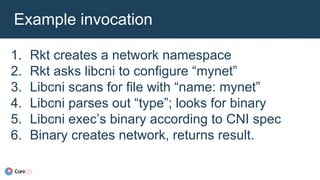
1. Rkt creates a network namespace
2. Rkt asks libcni to configure “mynet”
3. Libcni scans for file with “name: mynet”
4. Libcni parses out “type”; looks for binary
5. Libcni exec’s binary according to CNI spec
6. Binary creates network, returns result.
Example invocation

OSDC 2017 | The evolution of the Container Network Interface by Casey Callendrello

  • 1.
    Evolution of the ContainerNetwork Interface (CNI) Casey Callendrello CoreOS
  • 2.
  • 3.
    The CNI How itstarted How it’s grown New developments What’s next
  • 4.
    What is CNI? Astandard way to connect your containers to your network.
  • 5.
    “Your network” AWS? GCE?Bare Metal? BGP? OSPF? OpenFlow? “API”? Overlay networks? Flat layer 2 space? Specialized hardware?
  • 6.
    What is CNI? AnAPI for networking vendors to implement. A small library for runtimes to consume. Contain the complexity
  • 7.
    What is CNI? Aliving, active open-source project with: - 5 maintainers - 60 contributors at 10+ companies - 10+ plugin vendors - 6+ runtimes
  • 8.
    How did itstart?
  • 9.
    How did itstart? ● Rkt is a daemonless container runtime ● No complicated data model or online DB ● Principle throughout rkt is “clean integration points”
  • 10.
    How did itstart? Need for a simple way to “bring this namespace online” ● Handling namespaces in golang is painful ● Let’s initialize the network in a separate process ● And define an interface
  • 11.
    rkt veth macvlan ipvlanbridge Container Networking Interface (CNI)
  • 12.
    Adoption & Growth ●Spec separated from rkt April 2015 ● Replaced Kubernetes network plugin API ~Oct 2015 ● Mesos supports CNI from May 2016
  • 13.
    Who uses it?- Vendors ● Canonical Kubernetes ● Tectonic by CoreOS ● Redhat Openshift ● “Kubenet” plugin
  • 14.
  • 15.
  • 16.
    Technical Overview Simple model: ●Runtime Config ● Network Config ● Plugin ● Result Result: ● Interfaces ● Addresses ● Routes ● DNS
  • 17.
    Runtime plugin plugin pluginplugin Libcni (if you like) Config file netns
  • 18.
    Example invocation $ cat/etc/cni/net.d/10-net.conf { "name": "mynet", "type": "bridge", "ipam": { "type": "host-local", "subnet": "10.42.0.0/24" } }
  • 19.
    $ rkt run--net=mynet docker://redis - Or - $ kubelet … --network-plugin=cni … Example invocation
  • 20.
    $ rkt run--net=mynet … Example invocation
  • 21.
    # ip netnsnew test # ip netns exec test /bin/bash # ip link 1: lo: <LOOPBACK> … # Example invocation
  • 22.
    CNI_COMMAND=ADD CNI_CONTAINERID=example CNI_NETNS=/var/run/netns/test CNI_IFNAME=eth0 CNI_PATH=/opt/cni/bin:. ./bridge < 10-net.json Example invocation
  • 23.
    # ip link 1:lo: … 5: eth0@if9: … # ip -4 addr show dev eth0 5: eth0@if9: … inet 10.42.0.107/24 Example invocation
  • 24.
    ● 3 commands:ADD, DELETE, and VERSION ● Configuration on stdin, results on stdout ● Runtime parameters via env ● CNI_ARGS for arbitrary runtime params CNI spec
  • 25.
    ● For golangruntimes, libcni implements most boilerplate. ● Response types are versioned ○ Lossy conversion between versions CNI spec
  • 26.
    IPAM is aninteresting case ● Needs to be separate plugin ● Solution: CNI! ○ Plugin uses CNI API to discover & execute IPAM plugin ● Ordering is subtle ○ DHCP: IF needs to exist to make request CNI spec - IPAM
  • 27.
    Use cases &Plugins
  • 28.
    Basic: Bridge, veth Muxing: Macvlan, ipvlan Overlaynetworks: Flannel, Calico, Weave What plugins exist? IPAM: Host-local, dhcp, Infoblox
  • 29.
    What plugins exist? Cilium:BPF-based networking ● No more iptables & conntrack! ● I want to give Mellanox all my money SR-IOV: PCI sub-devices ● I am doing HFT and want to give Intel even more of my money
  • 30.
    Common CNI setups Bridge+ port forwarding ● “I’ll use the host IP for everything” ● Pods not otherwise reachable
  • 31.
    Common CNI setups Macvlan+ DHCP ● “I already have an expensive network” ● “And an expensive network admin” ● Watch those CAM tables! Each pod directly connected to network
  • 32.
    Common CNI setups Flannel,Weave, or Calico ● “I have a network I can’t change” ○ E.g. AWS VPC ● Routes are distributed using some other database ○ Flannel: etcd ○ Calico: bgpd
  • 33.
    What’s new withCNI? Spec version v0.3
  • 34.
  • 35.
    What’s new inv0.3 ● Type enhancements ● Plugin chaining ● Capability arguments
  • 36.
    Type enhancements inv0.3 New result type adds: ● Multiple IPs ● Interfaces ○ Including host-side interface
  • 37.
    ConfigLists / PluginChaining IPAM separated some common behavior. Add post-creation plugins too!
  • 38.
    Plugin chaining Motivating examples:anything that tweaks an existing interface or IP ● Port forwarding ● Sysctl tuning ● Traffic shaping ● SLAAC?
  • 39.
    Plugin chaining New configuration format ●Just a list of configuration blocks ● Runtime chains previous result { "name": "dbnet", "plugins": [ { "type": "bridge", "ipam": { "type": "host-local", "subnet": "10.1.0.0/16" } }, { "type": "tuning", "sysctl": { "net.core.somaxconn": "500" } } ] }
  • 40.
    Chained plugins Existing: ● Tuning ●Iptables-based port forwarding Future: ● Bridge (for virtual machines, etc.)
  • 41.
    Capability arguments The problem: Iwant to forward ports dynamically. ( curl http://127.0.0.1:8080 )
  • 42.
    Capability arguments The problem ●CNI_ARGS too freeform ● Don’t want to put rewrite logic in the runtime ● Don’t know which plugin does the forwarding ○ Remember Cilium?
  • 43.
    Capability arguments Need away to pass in ● Dynamic (run-time) ● Structured ● Plugin-agnostic (sort of) configuration To one or more plugins in a chain.
  • 44.
    Capability Arguments Don’t want ●Templating language ● Complicated runtime ● JSON in an environment variable
  • 45.
    Capability arguments Solution: ● Specdefines “capabilities” ● Plugins declare support ● Libcni patches arguments into config ○ Yes, it’s JSON manipulation, but it’s standardized
  • 46.
    Capability arguments { "type": "portmap-iptables", "capabilities":{"portMappings": true}, } Becomes: { "type": "portmap-iptables", "runtimeConfig": { "portMappings": [ {"hostPort": 80, "containerPort": 8080} ]}, }
  • 47.
    Capability arguments ● Writingspecs requires careful thought ● We all need to work together ● Many people contributed to the v0.3 upgrade ○ Esp. Kubernetes and Mesos devs
  • 48.
    Putting it alltogether LoadConfList( dir, name string) (*NetworkConfigList, error) AddNetworkList( list *NetworkConfigList, rt *RuntimeConf) ->(Result, error)
  • 49.
  • 50.
    New plugins! I wantYOU to write new plugins ● Firewalld integration ● Traffic shaping ○ Oh, and this is a new capability ● Better tuning ○ Some of you have some hard-learned TCP hacks
  • 51.
    IPv6 Spec as writtennow makes v6 easy. CNI-maintained plugins need some small tweaks. A philosophical question: Is SLAAC an IPAM plugin?
  • 52.
    Virtual machines Spec doesnot actually require namespaces Hyper and Intel working on this Plugin chaining makes this a lot easier
  • 53.
    CNCF CNI (probably) goingunder the CNCF Voting is underway now. No real change, just formal recognition.
  • 54.
    Splitting spec andcode Right now, all code under a single repository. That was a mistake. CNI-maintained plugins
  • 55.
  • 56.
    In summary CNI isa living, breathing project. We’re entirely dependent on the community. We want you to participate.
  • 57.
    Participation Write new plugins!It’s easy! Document your use cases File bugs, fix bugs Join us in IRC (or slack…) Cni-dev mailing list. Monthly community sync.
  • 58.
    CoreOS is runningthe world’s containers We’re hiring (in Berlin!): careers@coreos.com sales@coreos.com 90+ Projects on GitHub, 1,000+ Contributors coreos.com Support plans, training and more OPEN SOURCE ENTERPRISE
  • 59.
  • 60.
  • 61.
    1. Rkt createsa network namespace 2. Rkt asks libcni to configure “mynet” 3. Libcni scans for file with “name: mynet” 4. Libcni parses out “type”; looks for binary 5. Libcni exec’s binary according to CNI spec 6. Binary creates network, returns result. Example invocation