OpenWrt wireless
sean
Doc version
● V1 2018-05-18
– Wireless config & tools
● V2 2018-05-24
– 802.11
Wireless config
● UCI
– https://openwrt.org/docs/guide-user/network/wifi/basic
– config 'wifi-device'
● Hwmode: 11b, 11g, and 11a
● Htmode: HT20, HT40-, HT40+, HT40, NONE or VHT20, VHT40, VHT80,
VHT160
– config 'wifi-iface'
● Mode: ap, sta, adhoc, wds, monitor, mesh
● Encryption: none, wep, psk, psk2, wep+shared, wep+open, wep+mixed
● WPA Modes??
● WPA Enterprise (Access Point)??
– 80_Y6399_3_IPQ40X8_QSDK_SETUP_AND_USER_GUIDE.pdf
● 6.3 Wireless section
Wireless tools
● 80-Y8052-1_AP 10.4 CLI USER GUIDE.pdf
●
Turn on wifi
● /etc/config/wireless
– Uci set wireless.wifi0.disabled=0
– Uci commit
– Wifi reload
Linux Wireless
● https://wireless.wiki.kernel.org/en/users
● https://wireless.wiki.kernel.org/en/developers/do
cumentation/api-list
● configuration management for wireless devices
– Cfg80211: Kernel side
● https://wireless.wiki.kernel.org/en/developers/documenta
tion/cfg80211
– Nl80211: User-space side, Netlink-based user-
space protocol
● https://wireless.wiki.kernel.org/en/developers/documenta
tion/nl80211
–
MLME 管理物理层 MAC 状态机
● MLME Stands for Media Access Control (MAC)
Sublayer Management Entity
– managed in hardware
● FullMAC a type of wireless card
– managed in software
● SoftMAC a type of WNIC
– mac80211 A driver API for SoftMAC wireless cards.
● https://wireless.wiki.kernel.org/en/developers/documentation/mac80211
● Cfg80211: Works together with FullMAC-drivers and
also with mac80211-based drivers.
mac80211
● https://wireless.wiki.kernel.org/en/developers/d
ocumentation/mac80211
● https://wireless.wiki.kernel.org/_media/en/devel
opers/documentation/mac80211.pdf
● https://wireless.wiki.kernel.org/en/developers
/documentation/mac80211/api
● https://www.kernel.org/doc/html/latest/driver-
api/80211/
feeds/wlan_open/mac80211/
● Makefile
– KernelPackage/cfg80211
● Linux wireless LAN (802.11) configuration API
– KernelPackage/mac80211
● Linux 802.11 Wireless Networking Stack
– KernelPackage/ath9k
● QCA 802.11n PCI wireless cards support
– KernelPackage/ath10k
● QCA 802.11ac wireless cards support
– KernelPackage/wil6210
● QCA 802.11ad wireless cards support
modes
● https://wireless.wiki.kernel.org/en/users/docum
entation/modes
● AccessPoint (AP) infrastructure mode
● Station infrastructure mode
● Monitor mode
● Ad-Hoc (IBSS) mode
● Wireless Distribution System (WDS)
● Mesh
hostapd
● https://wireless.wiki.kernel.org/en/users/docum
entation/hostapd
●
Qualcomm
Atheros driver
● device types
– wifiN device
● radio layer or ATH/HAL layer
– athN device.
● protocol, or 802.11 layer
● WLAN driver models
– Direct Attach (DA)
● WLAN driver runs on the host platform
● interfaces
● with the WLAN hardware through the host bus interface (that is, PCI, PCIe, AHB, and so on)
● AR928x, AR938x, AR939x, AR958x, AR959x, AR934x,
● AR935x, QCA953x, QCA955x and IPQ4019.
– Offload (OL)
● WLAN driver component runs on the target
● thin interface layer
● software is added on both the host and target for the host-target communications
● QCA988x, QCA989x, QCA9990 and IPQ4019.
iwconfig
● Command on protocol layer
– ifconfig
– iwconfig
● iwconfig athN channel opchannel
– ifconfig athN down before issuing the channel change
– ifconfig athN up after making the channel change
● enc and key
– set and manage WEP keys
● Essid
– up to 32 characters in length and can contain spaces(must be quoted
when including spaces)
iwpriv
● It is recommended to use the radio layer (wifiN) parameters over
the protocol layer (athN) parameters when duplication exists.
● Association/ACL parameters
– addmac
– delmac
– getmac
– iwpriv athN maccmd cmd
● 0 Disable ACL checking
● 1 Only allow association with MAC addresses on the list
● 2 Deny association with any MAC address on the list
● 3 Flush the current ACL list
● 4 Suspend current ACL policies. Re-enable with a 1 or 2 command.
iwpriv
● Beacon configuration parameters
– countryie
– hide_ssid
● Channel width parameters
– Mode
● Physical layer parameters
– setCountryID
iwlist
● iwlist ath0 scan
● iwlist ath0 channel
Test case
● Change ssid
● Change enc and key
test-ap-change-ssid.sh
SUFFIX="$1" 
uci batch <<EOF
set wireless.@wifi-iface[0].ssid="0penWrt 2G ${SUFFIX}"
set wireless.@wifi-iface[1].ssid="0penWrt 5G ${SUFFIX}"
EOF
uci commit
uci show wireless
./test-ap-change-ssid.sh 0001
./test-ap-change-ssid.sh 0002
./test-ap-change-ssid.sh 0003
./test-ap-change-ssid.sh 0004
test-ap-enc-key.sh
ENC="$1"; KEY=$2; 
uci batch <<EOF
set wireless.@wifi-iface[0].encryption=${ENC}
set wireless.@wifi-iface[0].key=${KEY}
set wireless.@wifi-iface[1].encryption=${ENC}
set wireless.@wifi-iface[1].key=${KEY}
EOF
uci commit
uci show wireless
./test-ap-enc-key.sh psk2 11111111
./test-ap-enc-key.sh psk 11111111
./test-ap-enc-key.sh psk2-mixed 11111111
./test-ap-enc-key.sh psk-mixed 11111111
encryption
psk-mixed,psk-mixed+aes,psk-
mixed+ccmp ,psk-mixed+tkip,psk-
mixed+tkip+aes,psk-mixed+tkip+ccmp
psk2,psk2+ccmp,psk2+aes,psk,psk+ccmp,psk+ase,
psk2+tkip+ccmp,psk2+tkip+aes,psk+tkip+ccmp,psk
+tkip+aes
psk2+tkip,psk+tkip
在IEEE 802.11i 规格书中,CCMP为default mode
TKIP was deprecated by the IEEE in January 2009
这些配置无效:psk2+ccmp-256,psk2+gcmp,psk2+gcmp-
256,wapi-psk
test-ap-hide-ssid.sh
HIDE="$1" 
uci batch <<EOF
set wireless.@wifi-iface[0].hidden=${HIDE}
set wireless.@wifi-iface[1].hidden=${HIDE}
EOF
uci commit
uci show wireless
./test-ap-hide-ssid.sh 0
./test-ap-hide-ssid.sh 1
test-network-reload.sh
● wifi reload
● /etc/init.d/network reload
test-ap-add-guest.sh
NETWORKID="guest$1";FIREWALLZONE="guestzone$1";REGIN=$1; 
uci batch <<EOF
set network.${NETWORKID}=interface
set network.${NETWORKID}.ifname=${NETWORKID}
set network.${NETWORKID}.proto=static
set network.${NETWORKID}.ipaddr=192.168.1${REGIN}.1
set network.${NETWORKID}.netmask=255.255.255.0
set network.${NETWORKID}.ip6assign='60'
set wireless.@wifi-iface[${REGIN}].device='wifi0'
set wireless.@wifi-iface[${REGIN}].network=${NETWORKID}
set wireless.@wifi-iface[${REGIN}].ssid=${NETWORKID}
set wireless.@wifi-iface[${REGIN}].mode='ap'
set wireless.@wifi-iface[${REGIN}].hidden='0'
set wireless.@wifi-iface[${REGIN}].encryption='psk2'
set wireless.@wifi-iface[${REGIN}].key='12345678'
set dhcp.${NETWORKID}=dhcp
set dhcp.${NETWORKID}.interface=${NETWORKID}
set dhcp.${NETWORKID}.start=100
set dhcp.${NETWORKID}.leasetime=12h
set dhcp.${NETWORKID}.limit=150
set dhcp.${NETWORKID}.dhcpv6=server
set dhcp.${NETWORKID}.ra=server
set firewall.${FIREWALLZONE}=zone
set firewall.${FIREWALLZONE}.name=${FIREWALLZONE}
set firewall.${FIREWALLZONE}.network=${NETWORKID}
set firewall.${FIREWALLZONE}.forward=REJECT
set firewall.${FIREWALLZONE}.output=ACCEPT
set firewall.${FIREWALLZONE}.input=REJECT
set firewall.${FIREWALLZONE}_fwd=forwarding
set firewall.${FIREWALLZONE}_fwd.src=${FIREWALLZONE}
set firewall.${FIREWALLZONE}_fwd.dest=wan
set firewall.${FIREWALLZONE}_dhcp=rule
set firewall.${FIREWALLZONE}_dhcp.name=${FIREWALLZONE}_DHCP
set firewall.${FIREWALLZONE}_dhcp.src=${FIREWALLZONE}
set firewall.${FIREWALLZONE}_dhcp.target=ACCEPT
set firewall.${FIREWALLZONE}_dhcp.proto=udp
set firewall.${FIREWALLZONE}_dhcp.dest_port=67-68
set firewall.${FIREWALLZONE}_dns=rule
set firewall.${FIREWALLZONE}_dns.name=${FIREWALLZONE}_DNS
set firewall.${FIREWALLZONE}_dns.src=${FIREWALLZONE}
set firewall.${FIREWALLZONE}_dns.target=ACCEPT
set firewall.${FIREWALLZONE}_dns.proto='tcp udp'
set firewall.${FIREWALLZONE}_dns.dest_port=53
EOF
uci commit
uci show network.${NETWORKID}
802.11 standards 1/2
● Lowercase add new clause to 802.11
● Uppercase standalone specifications
● 802.11 1997 first standart
● 802.11a 1999 second PHY standard
● 802.11b 1999 third PHY standard
● 802.11g 2003 PHY
● family (c–f, h, j) are service amendments
– 802.11h make 802.11a compatible with European
– 802.11i improvements to security at link layer
– 802.11j enhancements to 802.11a to conform Japan
802.11 standards 2/2
● 802.11n high throughput 100Mbps
– can use either the 2.4 GHz or the 5 GHz band
– MIMO
● 802.11p for use in automobiles
● 802.11r roaming
● 802.11s mesh networking technology
● 802.11T test and measurement specification
● 802.11u interworking
802.11 network PHY standards
● https://en.wikipedia.org/wiki/IEEE_802.11
Radio Spectrum
● The Key Resource
● FCC(Federal Communications Commission)
/US
● ERO(European Radiocommunications Office)
● ITU(International Telecommunications Union)
ISM Bands
● ISM(Industrial Scientific Medical) Free License
● https://baike.baidu.com/item/ISM%E9%A2%
91%E6%AE%B5/2114556
● 802.11b and 802.11g 2.4GHz
● 802.11a 5GHz
● 802.11ac 5GHz
● 802.11n either 2.4 GHz or 5 GHz band
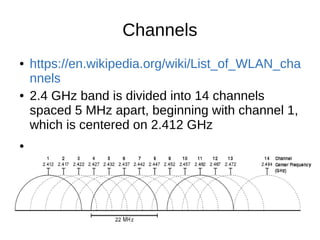
Channels
● https://en.wikipedia.org/wiki/List_of_WLAN_cha
nnels
● 2.4 GHz band is divided into 14 channels
spaced 5 MHz apart, beginning with channel 1,
which is centered on 2.412 GHz
●
PHY Rate
● 802.11 a Up to 54Mbps
● 802.11b 5.5Mbps 11Mbps
● 802.11g Up to 54Mbps
● 802.11n Up to 600Mbps
● 802.11ac Up to 6.9Gbps
Why Wireless?
● Advantage
– *Mobility
– Roam freely
– Flexibility
● Range up to a few miles
●
Reduces the need for construction of old buildings
● DisAdvantage
– Unauthorized use
– Traffic injection
– Traffic analysis
AP
● access points are bridges between the
wireless world and the wired world.
● The so called hot spot
● Act much like old shared ethernet hubs
Type of networks
● IBSS(Independent basic service set)
– Ad hoc BSSs or ad hoc networks
● Infrastructure BSS
– Defined by distance from the AP
● ESS(extended service set)
– All Aps in an ESS are given the same SSID
– Highest level abstraction supported by 802.11 network
● Multi-BSS
– Virtual Aps
– VLAN
Types of Access Points
● For the home: residential gateways
● For the office: enterprise access points
● For the large office: wireless switches
residential gateways
● DHCP server
– plug-and-play configuration easier.
● routable IP address / NAT
● WAN interface
– modem, a serial port, or even DSL.
● default internal IP address.
● do not have sophisticated radios.
enterprise access points
● several access points working in concert
● Upgradeability
● Security
– AES acceleration in hardware,
– support multiple security standards simultanously.
● multiple virtual radio networks
● Transmission power
● Multiple SSIDs
wireless switches
● load-balance clients between Aps
● monitor radio activity centrally
● extend the existing network more easily.
Topology Examples
● The Monolithic Single-Subnet Network
● "E.T. Phone Home" or "Island Paradise"
● Dynamic VLAN Assignment
● Virtual Access Points
Challenges for the MAC
● RF Link Quality
– Positive acknowledgment of data transmissions
– Atomic operations: all or nothing
● 802.11 allows stations to lock out contention
● not interrupted by other stations
– multirate
The Hidden Node Problem
● Wireless transceivers are generally half-duplex
● Request to Send (RTS) and Clear to Send
(CTS) signals to clear out an area
Frame Body
● higher-layer payload
● maximum payload of 2,304 bytes
cipher
● stream cipher
– WEP
– TKIP
● block cipher
– Advanced Encryption Standard (AES)
– CCMP
Wi-Fi Protected Access (WPA)
● WPA version 1 is based on the third draft of
802.11i (from mid-2003)
● WPA version 2 is the final standardized version
of 802.11i from mid-2004.
● designed to bring TKIP to the market more
quickly
● slight modification of a subset of 802.11i
● TKIP is the default cipher, rather than CCMP.
802.11i
● Temporal Key Integrity Protocol (TKIP)
– bolster security to the greatest extent possible on
pre-802.11i hardware
● Counter Mode with CBC-MAC Protocol (CCMP)
Robust Security Network (RSN)
● 802.11i Key Hierarchy
– Pairwise key: protect traffic between a station and
the AP it is currently serving
– Group keys: protect broadcast or multicast traffic
from an AP to its associated clients.
Security Definition and Analysis
● Integrity
– Has somebody improperly changed the data?
● Secrecy
– Has the data been improperly disclosed?
– relatively easy eavesdropping
– lack of strong user authentication
● Availability
– Can I read my data when I want to?
– Denial of Service (DoS) / lack of frame authentication
authentication
● Your credentials, please
● transparent proxy
– custom portal page for authentication purposes.
– cannot be used to derive keys for link-layer security
protocols.
encryption
● Only authorized users with the keys to access the data
● data is not tampered with inflight.
● encryption protocols
– Static WEP
– 802.1X-based dynamic WEP
– Temporal Key Integrity Protocol (TKIP)
● TKIP is should not be considered a long-term solution.
– Counter Mode CBC-MAC Protocol (CCMP)
– Network-layer encryption
● IPsec, SSL, or SSH.
rogue access points
● Secrecy and integrity of the whole network
Network integrity
● traffic injection
● WPA
– allow each frame to be authenticated
Access Control
● Station authentication
● Association
● Link layer
● Network-or transport-layer
authentication protocols
● WEP shared key authentication
● MAC address filtering
● WPA preshared key (WPA-PSK or WPA Personal)
● 802.1X-based protocols
– extended authentication methods that runs over EAP.
– WPA Enterprise.
● Network-layer authentication
– VPN

Openwrt wireless

  • 1.
  • 2.
    Doc version ● V12018-05-18 – Wireless config & tools ● V2 2018-05-24 – 802.11
  • 3.
    Wireless config ● UCI –https://openwrt.org/docs/guide-user/network/wifi/basic – config 'wifi-device' ● Hwmode: 11b, 11g, and 11a ● Htmode: HT20, HT40-, HT40+, HT40, NONE or VHT20, VHT40, VHT80, VHT160 – config 'wifi-iface' ● Mode: ap, sta, adhoc, wds, monitor, mesh ● Encryption: none, wep, psk, psk2, wep+shared, wep+open, wep+mixed ● WPA Modes?? ● WPA Enterprise (Access Point)?? – 80_Y6399_3_IPQ40X8_QSDK_SETUP_AND_USER_GUIDE.pdf ● 6.3 Wireless section
  • 4.
    Wireless tools ● 80-Y8052-1_AP10.4 CLI USER GUIDE.pdf ●
  • 5.
    Turn on wifi ●/etc/config/wireless – Uci set wireless.wifi0.disabled=0 – Uci commit – Wifi reload
  • 6.
    Linux Wireless ● https://wireless.wiki.kernel.org/en/users ●https://wireless.wiki.kernel.org/en/developers/do cumentation/api-list ● configuration management for wireless devices – Cfg80211: Kernel side ● https://wireless.wiki.kernel.org/en/developers/documenta tion/cfg80211 – Nl80211: User-space side, Netlink-based user- space protocol ● https://wireless.wiki.kernel.org/en/developers/documenta tion/nl80211 –
  • 7.
    MLME 管理物理层 MAC状态机 ● MLME Stands for Media Access Control (MAC) Sublayer Management Entity – managed in hardware ● FullMAC a type of wireless card – managed in software ● SoftMAC a type of WNIC – mac80211 A driver API for SoftMAC wireless cards. ● https://wireless.wiki.kernel.org/en/developers/documentation/mac80211 ● Cfg80211: Works together with FullMAC-drivers and also with mac80211-based drivers.
  • 8.
    mac80211 ● https://wireless.wiki.kernel.org/en/developers/d ocumentation/mac80211 ● https://wireless.wiki.kernel.org/_media/en/devel opers/documentation/mac80211.pdf ●https://wireless.wiki.kernel.org/en/developers /documentation/mac80211/api ● https://www.kernel.org/doc/html/latest/driver- api/80211/
  • 9.
    feeds/wlan_open/mac80211/ ● Makefile – KernelPackage/cfg80211 ●Linux wireless LAN (802.11) configuration API – KernelPackage/mac80211 ● Linux 802.11 Wireless Networking Stack – KernelPackage/ath9k ● QCA 802.11n PCI wireless cards support – KernelPackage/ath10k ● QCA 802.11ac wireless cards support – KernelPackage/wil6210 ● QCA 802.11ad wireless cards support
  • 10.
    modes ● https://wireless.wiki.kernel.org/en/users/docum entation/modes ● AccessPoint(AP) infrastructure mode ● Station infrastructure mode ● Monitor mode ● Ad-Hoc (IBSS) mode ● Wireless Distribution System (WDS) ● Mesh
  • 11.
  • 12.
    Qualcomm Atheros driver ● devicetypes – wifiN device ● radio layer or ATH/HAL layer – athN device. ● protocol, or 802.11 layer ● WLAN driver models – Direct Attach (DA) ● WLAN driver runs on the host platform ● interfaces ● with the WLAN hardware through the host bus interface (that is, PCI, PCIe, AHB, and so on) ● AR928x, AR938x, AR939x, AR958x, AR959x, AR934x, ● AR935x, QCA953x, QCA955x and IPQ4019. – Offload (OL) ● WLAN driver component runs on the target ● thin interface layer ● software is added on both the host and target for the host-target communications ● QCA988x, QCA989x, QCA9990 and IPQ4019.
  • 13.
    iwconfig ● Command onprotocol layer – ifconfig – iwconfig ● iwconfig athN channel opchannel – ifconfig athN down before issuing the channel change – ifconfig athN up after making the channel change ● enc and key – set and manage WEP keys ● Essid – up to 32 characters in length and can contain spaces(must be quoted when including spaces)
  • 14.
    iwpriv ● It isrecommended to use the radio layer (wifiN) parameters over the protocol layer (athN) parameters when duplication exists. ● Association/ACL parameters – addmac – delmac – getmac – iwpriv athN maccmd cmd ● 0 Disable ACL checking ● 1 Only allow association with MAC addresses on the list ● 2 Deny association with any MAC address on the list ● 3 Flush the current ACL list ● 4 Suspend current ACL policies. Re-enable with a 1 or 2 command.
  • 15.
    iwpriv ● Beacon configurationparameters – countryie – hide_ssid ● Channel width parameters – Mode ● Physical layer parameters – setCountryID
  • 16.
    iwlist ● iwlist ath0scan ● iwlist ath0 channel
  • 17.
    Test case ● Changessid ● Change enc and key
  • 18.
    test-ap-change-ssid.sh SUFFIX="$1" uci batch<<EOF set wireless.@wifi-iface[0].ssid="0penWrt 2G ${SUFFIX}" set wireless.@wifi-iface[1].ssid="0penWrt 5G ${SUFFIX}" EOF uci commit uci show wireless ./test-ap-change-ssid.sh 0001 ./test-ap-change-ssid.sh 0002 ./test-ap-change-ssid.sh 0003 ./test-ap-change-ssid.sh 0004
  • 19.
    test-ap-enc-key.sh ENC="$1"; KEY=$2; ucibatch <<EOF set wireless.@wifi-iface[0].encryption=${ENC} set wireless.@wifi-iface[0].key=${KEY} set wireless.@wifi-iface[1].encryption=${ENC} set wireless.@wifi-iface[1].key=${KEY} EOF uci commit uci show wireless ./test-ap-enc-key.sh psk2 11111111 ./test-ap-enc-key.sh psk 11111111 ./test-ap-enc-key.sh psk2-mixed 11111111 ./test-ap-enc-key.sh psk-mixed 11111111
  • 20.
  • 21.
    test-ap-hide-ssid.sh HIDE="$1" uci batch<<EOF set wireless.@wifi-iface[0].hidden=${HIDE} set wireless.@wifi-iface[1].hidden=${HIDE} EOF uci commit uci show wireless ./test-ap-hide-ssid.sh 0 ./test-ap-hide-ssid.sh 1
  • 22.
  • 23.
    test-ap-add-guest.sh NETWORKID="guest$1";FIREWALLZONE="guestzone$1";REGIN=$1; uci batch<<EOF set network.${NETWORKID}=interface set network.${NETWORKID}.ifname=${NETWORKID} set network.${NETWORKID}.proto=static set network.${NETWORKID}.ipaddr=192.168.1${REGIN}.1 set network.${NETWORKID}.netmask=255.255.255.0 set network.${NETWORKID}.ip6assign='60' set wireless.@wifi-iface[${REGIN}].device='wifi0' set wireless.@wifi-iface[${REGIN}].network=${NETWORKID} set wireless.@wifi-iface[${REGIN}].ssid=${NETWORKID} set wireless.@wifi-iface[${REGIN}].mode='ap' set wireless.@wifi-iface[${REGIN}].hidden='0' set wireless.@wifi-iface[${REGIN}].encryption='psk2' set wireless.@wifi-iface[${REGIN}].key='12345678' set dhcp.${NETWORKID}=dhcp set dhcp.${NETWORKID}.interface=${NETWORKID} set dhcp.${NETWORKID}.start=100 set dhcp.${NETWORKID}.leasetime=12h set dhcp.${NETWORKID}.limit=150 set dhcp.${NETWORKID}.dhcpv6=server set dhcp.${NETWORKID}.ra=server set firewall.${FIREWALLZONE}=zone set firewall.${FIREWALLZONE}.name=${FIREWALLZONE} set firewall.${FIREWALLZONE}.network=${NETWORKID} set firewall.${FIREWALLZONE}.forward=REJECT set firewall.${FIREWALLZONE}.output=ACCEPT set firewall.${FIREWALLZONE}.input=REJECT set firewall.${FIREWALLZONE}_fwd=forwarding set firewall.${FIREWALLZONE}_fwd.src=${FIREWALLZONE} set firewall.${FIREWALLZONE}_fwd.dest=wan set firewall.${FIREWALLZONE}_dhcp=rule set firewall.${FIREWALLZONE}_dhcp.name=${FIREWALLZONE}_DHCP set firewall.${FIREWALLZONE}_dhcp.src=${FIREWALLZONE} set firewall.${FIREWALLZONE}_dhcp.target=ACCEPT set firewall.${FIREWALLZONE}_dhcp.proto=udp set firewall.${FIREWALLZONE}_dhcp.dest_port=67-68 set firewall.${FIREWALLZONE}_dns=rule set firewall.${FIREWALLZONE}_dns.name=${FIREWALLZONE}_DNS set firewall.${FIREWALLZONE}_dns.src=${FIREWALLZONE} set firewall.${FIREWALLZONE}_dns.target=ACCEPT set firewall.${FIREWALLZONE}_dns.proto='tcp udp' set firewall.${FIREWALLZONE}_dns.dest_port=53 EOF uci commit uci show network.${NETWORKID}
  • 24.
    802.11 standards 1/2 ●Lowercase add new clause to 802.11 ● Uppercase standalone specifications ● 802.11 1997 first standart ● 802.11a 1999 second PHY standard ● 802.11b 1999 third PHY standard ● 802.11g 2003 PHY ● family (c–f, h, j) are service amendments – 802.11h make 802.11a compatible with European – 802.11i improvements to security at link layer – 802.11j enhancements to 802.11a to conform Japan
  • 25.
    802.11 standards 2/2 ●802.11n high throughput 100Mbps – can use either the 2.4 GHz or the 5 GHz band – MIMO ● 802.11p for use in automobiles ● 802.11r roaming ● 802.11s mesh networking technology ● 802.11T test and measurement specification ● 802.11u interworking
  • 26.
    802.11 network PHYstandards ● https://en.wikipedia.org/wiki/IEEE_802.11
  • 27.
    Radio Spectrum ● TheKey Resource ● FCC(Federal Communications Commission) /US ● ERO(European Radiocommunications Office) ● ITU(International Telecommunications Union)
  • 28.
    ISM Bands ● ISM(IndustrialScientific Medical) Free License ● https://baike.baidu.com/item/ISM%E9%A2% 91%E6%AE%B5/2114556 ● 802.11b and 802.11g 2.4GHz ● 802.11a 5GHz ● 802.11ac 5GHz ● 802.11n either 2.4 GHz or 5 GHz band
  • 29.
    Channels ● https://en.wikipedia.org/wiki/List_of_WLAN_cha nnels ● 2.4GHz band is divided into 14 channels spaced 5 MHz apart, beginning with channel 1, which is centered on 2.412 GHz ●
  • 31.
    PHY Rate ● 802.11a Up to 54Mbps ● 802.11b 5.5Mbps 11Mbps ● 802.11g Up to 54Mbps ● 802.11n Up to 600Mbps ● 802.11ac Up to 6.9Gbps
  • 32.
    Why Wireless? ● Advantage –*Mobility – Roam freely – Flexibility ● Range up to a few miles ● Reduces the need for construction of old buildings ● DisAdvantage – Unauthorized use – Traffic injection – Traffic analysis
  • 33.
    AP ● access pointsare bridges between the wireless world and the wired world. ● The so called hot spot ● Act much like old shared ethernet hubs
  • 34.
    Type of networks ●IBSS(Independent basic service set) – Ad hoc BSSs or ad hoc networks ● Infrastructure BSS – Defined by distance from the AP ● ESS(extended service set) – All Aps in an ESS are given the same SSID – Highest level abstraction supported by 802.11 network ● Multi-BSS – Virtual Aps – VLAN
  • 35.
    Types of AccessPoints ● For the home: residential gateways ● For the office: enterprise access points ● For the large office: wireless switches
  • 36.
    residential gateways ● DHCPserver – plug-and-play configuration easier. ● routable IP address / NAT ● WAN interface – modem, a serial port, or even DSL. ● default internal IP address. ● do not have sophisticated radios.
  • 37.
    enterprise access points ●several access points working in concert ● Upgradeability ● Security – AES acceleration in hardware, – support multiple security standards simultanously. ● multiple virtual radio networks ● Transmission power ● Multiple SSIDs
  • 38.
    wireless switches ● load-balanceclients between Aps ● monitor radio activity centrally ● extend the existing network more easily.
  • 39.
    Topology Examples ● TheMonolithic Single-Subnet Network ● "E.T. Phone Home" or "Island Paradise" ● Dynamic VLAN Assignment ● Virtual Access Points
  • 40.
    Challenges for theMAC ● RF Link Quality – Positive acknowledgment of data transmissions – Atomic operations: all or nothing ● 802.11 allows stations to lock out contention ● not interrupted by other stations – multirate
  • 41.
    The Hidden NodeProblem ● Wireless transceivers are generally half-duplex ● Request to Send (RTS) and Clear to Send (CTS) signals to clear out an area
  • 42.
    Frame Body ● higher-layerpayload ● maximum payload of 2,304 bytes
  • 43.
    cipher ● stream cipher –WEP – TKIP ● block cipher – Advanced Encryption Standard (AES) – CCMP
  • 44.
    Wi-Fi Protected Access(WPA) ● WPA version 1 is based on the third draft of 802.11i (from mid-2003) ● WPA version 2 is the final standardized version of 802.11i from mid-2004. ● designed to bring TKIP to the market more quickly ● slight modification of a subset of 802.11i ● TKIP is the default cipher, rather than CCMP.
  • 45.
    802.11i ● Temporal KeyIntegrity Protocol (TKIP) – bolster security to the greatest extent possible on pre-802.11i hardware ● Counter Mode with CBC-MAC Protocol (CCMP)
  • 46.
    Robust Security Network(RSN) ● 802.11i Key Hierarchy – Pairwise key: protect traffic between a station and the AP it is currently serving – Group keys: protect broadcast or multicast traffic from an AP to its associated clients.
  • 47.
    Security Definition andAnalysis ● Integrity – Has somebody improperly changed the data? ● Secrecy – Has the data been improperly disclosed? – relatively easy eavesdropping – lack of strong user authentication ● Availability – Can I read my data when I want to? – Denial of Service (DoS) / lack of frame authentication
  • 48.
    authentication ● Your credentials,please ● transparent proxy – custom portal page for authentication purposes. – cannot be used to derive keys for link-layer security protocols.
  • 49.
    encryption ● Only authorizedusers with the keys to access the data ● data is not tampered with inflight. ● encryption protocols – Static WEP – 802.1X-based dynamic WEP – Temporal Key Integrity Protocol (TKIP) ● TKIP is should not be considered a long-term solution. – Counter Mode CBC-MAC Protocol (CCMP) – Network-layer encryption ● IPsec, SSL, or SSH.
  • 50.
    rogue access points ●Secrecy and integrity of the whole network
  • 51.
    Network integrity ● trafficinjection ● WPA – allow each frame to be authenticated
  • 52.
    Access Control ● Stationauthentication ● Association ● Link layer ● Network-or transport-layer
  • 53.
    authentication protocols ● WEPshared key authentication ● MAC address filtering ● WPA preshared key (WPA-PSK or WPA Personal) ● 802.1X-based protocols – extended authentication methods that runs over EAP. – WPA Enterprise. ● Network-layer authentication – VPN