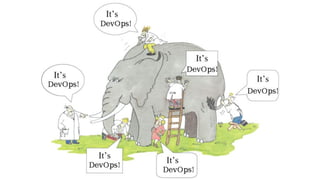
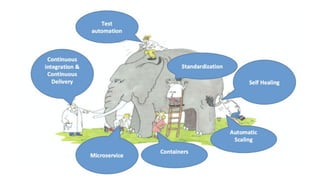
Promise of DevOps
24th meeting of Cloud Native – Kubernetes - ONLINE community
20-Oct-2021
miro.adamy@gmail.com
Agenda
● Original promise of DevOps
● 5 years later: what worked, what changed
● Tools and recommendations that survived
● Outlook - emerging themes
About me
Why I think I may have something to share on the topic / my bias
● 30+ years in IT (FEI-STU, SysAdmin, Developer, Architect, SRE, DevOps)
● C, Perl, C++, Java, C#, Python / Terraform, CFN, CDK
● Cloud - 2015+ (AWS)
● Enterprise level eCommerce: Oracle Commerce (ATG), SAP (Hybris)
● I live(d) on both sides of DevOps - Dev AND Ops:
○ design and build ecommerce site, release it, maintain / deploy / monitor / enhance / support
● Back in Bratislava after 25 years abroad (A, CH, Canada, ES)
● Currently: Cloud Platform team in Spanish subs of Canadian company
○ Cloud infrastructure building (TF / CFN / CDK)
○ DevOps - CI/CD
○ 100+ AWS accounts, 4 Orgs/SSO + ecosystem
Sincere Apologies to Slovak Language purists
● since 1991 I used almost exclusively German, English and Spanish for work
● I am sadly not familiar with the proper technical terminology in Slovak :-(
● This talk => mixture of English and Slovak
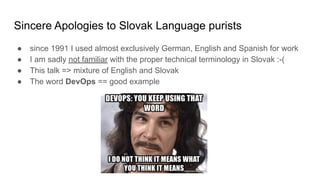
● The word DevOps == good example
Roots and triggers of DevOps
● Agile ~ 2001 : Ops Gap
● ~ 2008-2009 - first mention
● complexity of Apps
● Cloud - AWS (2006+)
● option to automate
● buzzword ~ 2010+
● containers / Docker ~ 2013+
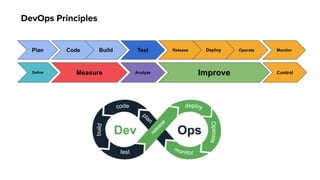
DevOps motivation - and original promise
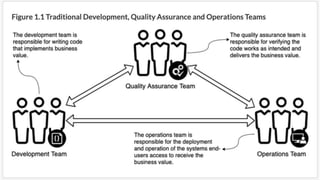
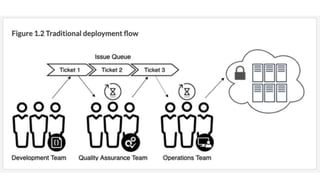
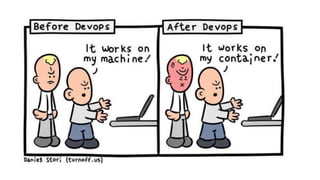
● to bridge the different mindset silos (Dev / QA / Ops)
● release any time
● automated builds and tests (CI)
● automated package and release (CD&D)
● shared ownership
● shared responsibility
● speed gain / cost savings
● cultural / org structure shift
=> tools, techniques, processes
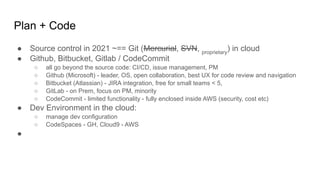
Plan + Code
● Source control in 2021 ~== Git (Mercurial, SVN, proprietary
) in cloud
● Github, Bitbucket, Gitlab / CodeCommit
○ all go beyond the source code: CI/CD, issue management, PM
○ Github (Microsoft) - leader, OS, open collaboration, best UX for code review and navigation
○ Bitbucket (Atlassian) - JIRA integration, free for small teams < 5,
○ GitLab - on Prem, focus on PM, minority
○ CodeCommit - limited functionality - fully enclosed inside AWS (security, cost etc)
● Dev Environment in the cloud:
○ manage dev configuration
○ CodeSpaces - GH, Cloud9 - AWS
●
Which to pick
See the GH - GL - BB compare:
● team structure - org structure impact
○ IDP integration
○ management cost - API
When to consider AWS CodeCommit:
● security / access management inside AWS
● cost attribution - admin overhead
○ per project account(s)
● CI/CD deeply tied to AWS services
Building and packaging, artifact management
● where you build:
○ cloud - part of the Source Code Management (GH / BB / GL / AWS)
○ cloud - 3rd party service
○ onPrem - usually Jenkins
● what you build: Java, Native (Go, C/C++), PHP, Javascript
○ dedicated systems: Java: Gradle, Maven, Ant => JAR/WAR/EAR
● what triggers build:
○ manual - user action
○ source code event: commit, PR, merge, tag
● resulting artifact: in most cases => Docker Image
○ where it is stored: DockerHub, ECR, own registry
○ naming and tagging => super important
● As part of the build:
○ code quality; Sonarqube - rule based, security checks on libraries
○ unit tests
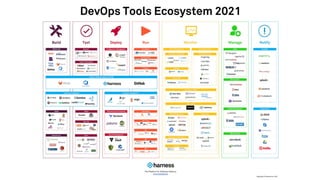
Tools (there are too many of them …)
● Jenkins:
○ oldest, well known, Groovy as pipeline language (maintenance cost) - Java app
○ self hosted or Jenkins as a Service
○ scalability / speed / infrastructure cost
○ plugin hell - complex, fragile
● 3rd party providers: Travis CI / CircleCI
○ important in 2016-2019, fighting for relevance and extending offer, monetization challenges
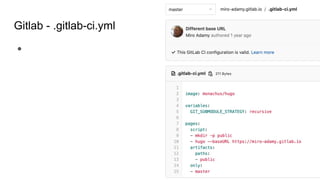
● GitLab:
○ great OOTB support for typical scenarios, largest coverage - PM + VCS + CI/CD
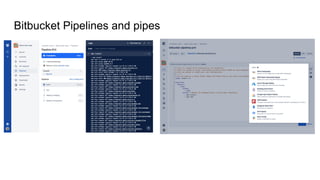
● BitBucket Pipelines:
○ JIRA integration (update ticket), Trello, Confluence
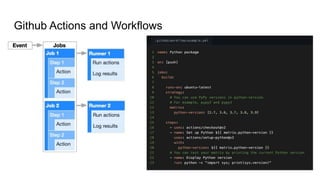
● GitHub Actions:
○ late to the game - 2020, modern, marketplace - https://github.com/marketplace?type=actions
and many many more
Bitbucket Pipelines and pipes
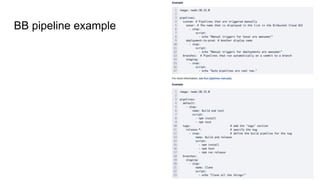
BB pipeline example
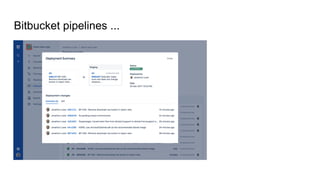
Bitbucket pipelines ...
Github Actions and Workflows
Gitlab - .gitlab-ci.yml
●
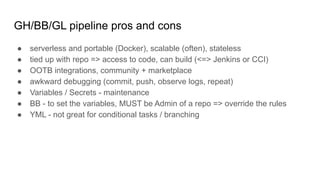
GH/BB/GL pipeline pros and cons
● serverless and portable (Docker), scalable (often), stateless
● tied up with repo => access to code, can build (<=> Jenkins or CCI)
● OOTB integrations, community + marketplace
● awkward debugging (commit, push, observe logs, repeat)
● Variables / Secrets - maintenance
● BB - to set the variables, MUST be Admin of a repo => override the rules
● YML - not great for conditional tasks / branching
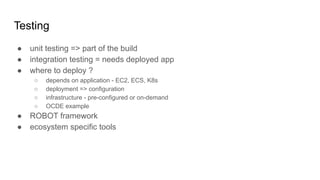
Testing
● unit testing => part of the build
● integration testing = needs deployed app
● where to deploy ?
○ depends on application - EC2, ECS, K8s
○ deployment => configuration
○ infrastructure - pre-configured or on-demand
○ OCDE example
● ROBOT framework
● ecosystem specific tools
Release and Deploy
● what you deploy: container ? JAR ? package ? function ?
● where you deploy: On-Prem ? EC2 ? ECS ? K8s ?
● post-deployment configuration
● who owns the environment configuration ? passwords ?
● deployment - pre-requisite for integration/full testing
● monitoring, alerting, performance / security scans ⇒ SRE
Tools:
● part of CI/CD pipeline
● Cloud providers - Azure / Google / AWS
● 3rd party: too many to list. ? Who will survive ?
AWS DevOps services
● CodeCommit - Git in AWS
● CodePipeline - describe the process
● CodeBuild - execute build, test
● CodeDeploy - Lambda, ECS, EC2,
On-Premises or CFN
● CodeArtifact - package mgr - JS,PY,java
● CodeStar - dashboard for projects
● Cloud9 - Dev Env in the cloud
● ElasticBeanstalk - simplified templated
environments with some CI/CD
● CloudWatch - logs
● CloudTrail - API call audit
● CFN - Infrastructure building
● Lambda + API GW
● ECS
● EKS
● ImageBuilder (Packer)
● ...
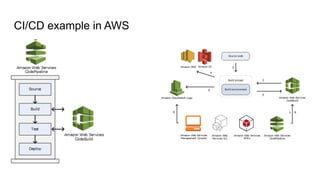
CI/CD example in AWS
AWS DevOps - To use or not to use
● low level - setup intensive
● less polished, crude UX compared to external tool
● often bumpy road compared to “works OOTB” - YMMV
Good use case:
● everything is in AWS
● all actors represented as IAM principals identities / roles
● account based cost attribution - savings of scale
● monitoring tools integration in place- CloudWatch / CloudTrail
● be prepared to invest time
What we learned
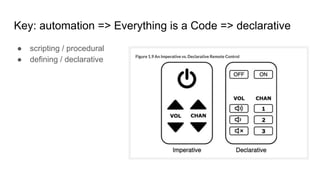
Key: automation => Everything is a Code => declarative
● scripting / procedural
● defining / declarative
Documentation matters
● more distributed / microservices => more complexity => larger teams
● distributed work environments => information sharing
Where:
● Wiki (dedicated, GH/BB)
● part of the source code
● => Documentation as a code https://www.writethedocs.org/guide/docs-as-code/
○ Markdown files
○ part of the repo - read/edit in GH, BB, GL
○ MD => HTML static site generators - Hugo, Gatsby, Jekyll
Non technical factor matter
● organization structure - silos
● org size
● process / tool overhead - ownership
● culture => next speaker
“Man lernt nie aus”
● CI/CD/CL - CL == continuous learning
● Docker/container - 6 years - redefined the workflows
● speed of change increases, complexity increases
● shelf life of skills decreases (except old fashion Unix skills ;-))
Best value for the cost providers (IMHO):
● OReilly Learning = books, courses, live events, Sandboxes/scenarios
● Linux Academy / ACloudGuru => Live Labs
● Udemy - frequent sales - PAYG
Future Themes and Challenges
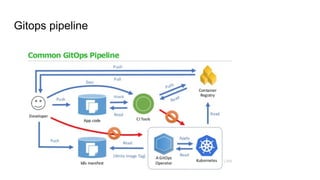
GitOps == EiaC: Everything is a Code
● Code is a code => will be built and packaged as such (into Docker image)
● Config is code => must be versioned controlled
● Release and Deployment event should be a code
● => must be version controlled
● => must leave a trace
● => can be rolled back
Git is the only source of truth for deployed system
Everything uses Git repositories + operations on them
Declarative tools make it all work
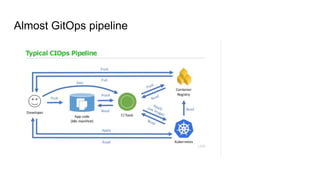
Almost GitOps pipeline
Gitops pipeline
GitOps + IaaC: multiple release cycles
Cloud environment adds more challenges to GitOps:
● Environment creation
○ => must work for multiple environments (dev, qa, uat, prod)
● Environment maintenance / updates (Env release cycle)
● Application deployments and updates / deploys (app release cycle)
○ => some deployments may require environment changes
○ These environment changes must flow through environments
● Application teardown
● Environment teardown (important for QA / On Demand)
=> 2 different release cycles - different frequency / flow
=> Represented by tools used, layers and repositories involved
Immutable Infrastructure
● Create and destroy on demand
● “poor man’s serverless”
● “No server requires less maintenance that no server”
● servers: Pets - Cattle
Tools for IaaC
● Terraform - multi-destination (not only clouds)
● CFN - stacks and stacksets - AWS Specific
● CDK - becoming very important:
CDK, CDK8s, CDKtf - TS, Python - patterns
● 3rd parties - Pulami,
2 CI/CD Examples from my team
Cloud Platform Team
https://pivotree.com/
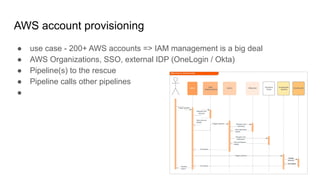
AWS account provisioning
● use case - 200+ AWS accounts => IAM management is a big deal
● AWS Organizations, SSO, external IDP (OneLogin / Okta)
● Pipeline(s) to the rescue
● Pipeline calls other pipelines
●
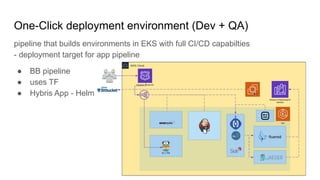
One-Click deployment environment (Dev + QA)
pipeline that builds environments in EKS with full CI/CD capabilties
- deployment target for app pipeline
● BB pipeline
● uses TF
● Hybris App - Helm
Links
● ALL DAY DEVOPS - alldaydevops.com - 28/29 October 2021
● OReilly - https://learning.oreilly.com/home/
● ACloudGuru - https://learn.acloud.guru/dashboard?

Promise of DevOps

  • 1.
    Promise of DevOps 24thmeeting of Cloud Native – Kubernetes - ONLINE community 20-Oct-2021 miro.adamy@gmail.com
  • 2.
    Agenda ● Original promiseof DevOps ● 5 years later: what worked, what changed ● Tools and recommendations that survived ● Outlook - emerging themes
  • 3.
    About me Why Ithink I may have something to share on the topic / my bias ● 30+ years in IT (FEI-STU, SysAdmin, Developer, Architect, SRE, DevOps) ● C, Perl, C++, Java, C#, Python / Terraform, CFN, CDK ● Cloud - 2015+ (AWS) ● Enterprise level eCommerce: Oracle Commerce (ATG), SAP (Hybris) ● I live(d) on both sides of DevOps - Dev AND Ops: ○ design and build ecommerce site, release it, maintain / deploy / monitor / enhance / support ● Back in Bratislava after 25 years abroad (A, CH, Canada, ES) ● Currently: Cloud Platform team in Spanish subs of Canadian company ○ Cloud infrastructure building (TF / CFN / CDK) ○ DevOps - CI/CD ○ 100+ AWS accounts, 4 Orgs/SSO + ecosystem
  • 4.
    Sincere Apologies toSlovak Language purists ● since 1991 I used almost exclusively German, English and Spanish for work ● I am sadly not familiar with the proper technical terminology in Slovak :-( ● This talk => mixture of English and Slovak ● The word DevOps == good example
  • 7.
    Roots and triggersof DevOps ● Agile ~ 2001 : Ops Gap ● ~ 2008-2009 - first mention ● complexity of Apps ● Cloud - AWS (2006+) ● option to automate ● buzzword ~ 2010+ ● containers / Docker ~ 2013+
  • 8.
    DevOps motivation -and original promise ● to bridge the different mindset silos (Dev / QA / Ops) ● release any time ● automated builds and tests (CI) ● automated package and release (CD&D) ● shared ownership ● shared responsibility ● speed gain / cost savings ● cultural / org structure shift => tools, techniques, processes
  • 12.
    Plan + Code ●Source control in 2021 ~== Git (Mercurial, SVN, proprietary ) in cloud ● Github, Bitbucket, Gitlab / CodeCommit ○ all go beyond the source code: CI/CD, issue management, PM ○ Github (Microsoft) - leader, OS, open collaboration, best UX for code review and navigation ○ Bitbucket (Atlassian) - JIRA integration, free for small teams < 5, ○ GitLab - on Prem, focus on PM, minority ○ CodeCommit - limited functionality - fully enclosed inside AWS (security, cost etc) ● Dev Environment in the cloud: ○ manage dev configuration ○ CodeSpaces - GH, Cloud9 - AWS ●
  • 13.
    Which to pick Seethe GH - GL - BB compare: ● team structure - org structure impact ○ IDP integration ○ management cost - API When to consider AWS CodeCommit: ● security / access management inside AWS ● cost attribution - admin overhead ○ per project account(s) ● CI/CD deeply tied to AWS services
  • 14.
    Building and packaging,artifact management ● where you build: ○ cloud - part of the Source Code Management (GH / BB / GL / AWS) ○ cloud - 3rd party service ○ onPrem - usually Jenkins ● what you build: Java, Native (Go, C/C++), PHP, Javascript ○ dedicated systems: Java: Gradle, Maven, Ant => JAR/WAR/EAR ● what triggers build: ○ manual - user action ○ source code event: commit, PR, merge, tag ● resulting artifact: in most cases => Docker Image ○ where it is stored: DockerHub, ECR, own registry ○ naming and tagging => super important ● As part of the build: ○ code quality; Sonarqube - rule based, security checks on libraries ○ unit tests
  • 16.
    Tools (there aretoo many of them …) ● Jenkins: ○ oldest, well known, Groovy as pipeline language (maintenance cost) - Java app ○ self hosted or Jenkins as a Service ○ scalability / speed / infrastructure cost ○ plugin hell - complex, fragile ● 3rd party providers: Travis CI / CircleCI ○ important in 2016-2019, fighting for relevance and extending offer, monetization challenges ● GitLab: ○ great OOTB support for typical scenarios, largest coverage - PM + VCS + CI/CD ● BitBucket Pipelines: ○ JIRA integration (update ticket), Trello, Confluence ● GitHub Actions: ○ late to the game - 2020, modern, marketplace - https://github.com/marketplace?type=actions and many many more
  • 18.
  • 19.
  • 20.
  • 21.
  • 22.
  • 23.
    GH/BB/GL pipeline prosand cons ● serverless and portable (Docker), scalable (often), stateless ● tied up with repo => access to code, can build (<=> Jenkins or CCI) ● OOTB integrations, community + marketplace ● awkward debugging (commit, push, observe logs, repeat) ● Variables / Secrets - maintenance ● BB - to set the variables, MUST be Admin of a repo => override the rules ● YML - not great for conditional tasks / branching
  • 24.
    Testing ● unit testing=> part of the build ● integration testing = needs deployed app ● where to deploy ? ○ depends on application - EC2, ECS, K8s ○ deployment => configuration ○ infrastructure - pre-configured or on-demand ○ OCDE example ● ROBOT framework ● ecosystem specific tools
  • 25.
    Release and Deploy ●what you deploy: container ? JAR ? package ? function ? ● where you deploy: On-Prem ? EC2 ? ECS ? K8s ? ● post-deployment configuration ● who owns the environment configuration ? passwords ? ● deployment - pre-requisite for integration/full testing ● monitoring, alerting, performance / security scans ⇒ SRE Tools: ● part of CI/CD pipeline ● Cloud providers - Azure / Google / AWS ● 3rd party: too many to list. ? Who will survive ?
  • 26.
    AWS DevOps services ●CodeCommit - Git in AWS ● CodePipeline - describe the process ● CodeBuild - execute build, test ● CodeDeploy - Lambda, ECS, EC2, On-Premises or CFN ● CodeArtifact - package mgr - JS,PY,java ● CodeStar - dashboard for projects ● Cloud9 - Dev Env in the cloud ● ElasticBeanstalk - simplified templated environments with some CI/CD ● CloudWatch - logs ● CloudTrail - API call audit ● CFN - Infrastructure building ● Lambda + API GW ● ECS ● EKS ● ImageBuilder (Packer) ● ...
  • 27.
  • 28.
    AWS DevOps -To use or not to use ● low level - setup intensive ● less polished, crude UX compared to external tool ● often bumpy road compared to “works OOTB” - YMMV Good use case: ● everything is in AWS ● all actors represented as IAM principals identities / roles ● account based cost attribution - savings of scale ● monitoring tools integration in place- CloudWatch / CloudTrail ● be prepared to invest time
  • 29.
  • 30.
    Key: automation =>Everything is a Code => declarative ● scripting / procedural ● defining / declarative
  • 31.
    Documentation matters ● moredistributed / microservices => more complexity => larger teams ● distributed work environments => information sharing Where: ● Wiki (dedicated, GH/BB) ● part of the source code ● => Documentation as a code https://www.writethedocs.org/guide/docs-as-code/ ○ Markdown files ○ part of the repo - read/edit in GH, BB, GL ○ MD => HTML static site generators - Hugo, Gatsby, Jekyll
  • 32.
    Non technical factormatter ● organization structure - silos ● org size ● process / tool overhead - ownership ● culture => next speaker
  • 33.
    “Man lernt nieaus” ● CI/CD/CL - CL == continuous learning ● Docker/container - 6 years - redefined the workflows ● speed of change increases, complexity increases ● shelf life of skills decreases (except old fashion Unix skills ;-)) Best value for the cost providers (IMHO): ● OReilly Learning = books, courses, live events, Sandboxes/scenarios ● Linux Academy / ACloudGuru => Live Labs ● Udemy - frequent sales - PAYG
  • 34.
  • 35.
    GitOps == EiaC:Everything is a Code ● Code is a code => will be built and packaged as such (into Docker image) ● Config is code => must be versioned controlled ● Release and Deployment event should be a code ● => must be version controlled ● => must leave a trace ● => can be rolled back Git is the only source of truth for deployed system Everything uses Git repositories + operations on them Declarative tools make it all work
  • 36.
  • 37.
  • 38.
    GitOps + IaaC:multiple release cycles Cloud environment adds more challenges to GitOps: ● Environment creation ○ => must work for multiple environments (dev, qa, uat, prod) ● Environment maintenance / updates (Env release cycle) ● Application deployments and updates / deploys (app release cycle) ○ => some deployments may require environment changes ○ These environment changes must flow through environments ● Application teardown ● Environment teardown (important for QA / On Demand) => 2 different release cycles - different frequency / flow => Represented by tools used, layers and repositories involved
  • 39.
    Immutable Infrastructure ● Createand destroy on demand ● “poor man’s serverless” ● “No server requires less maintenance that no server” ● servers: Pets - Cattle Tools for IaaC ● Terraform - multi-destination (not only clouds) ● CFN - stacks and stacksets - AWS Specific ● CDK - becoming very important: CDK, CDK8s, CDKtf - TS, Python - patterns ● 3rd parties - Pulami,
  • 40.
    2 CI/CD Examplesfrom my team Cloud Platform Team https://pivotree.com/
  • 41.
    AWS account provisioning ●use case - 200+ AWS accounts => IAM management is a big deal ● AWS Organizations, SSO, external IDP (OneLogin / Okta) ● Pipeline(s) to the rescue ● Pipeline calls other pipelines ●
  • 42.
    One-Click deployment environment(Dev + QA) pipeline that builds environments in EKS with full CI/CD capabilties - deployment target for app pipeline ● BB pipeline ● uses TF ● Hybris App - Helm
  • 43.
    Links ● ALL DAYDEVOPS - alldaydevops.com - 28/29 October 2021 ● OReilly - https://learning.oreilly.com/home/ ● ACloudGuru - https://learn.acloud.guru/dashboard?