Microservices and Docker Swarm
Who am I?
Alberto Guimarães Viana
Goiano, atualmente moro em Hamburg/Alemanha
E-mail: albertogviana@gmail.com
Twitter: @albertogviana
Github: https://github.com/albertogviana
Project
■ https://www.getrevue.co/profile/devops-week-news
■ https://twitter.com/devopsweeknews
Presentation
https://github.com/albertogviana/docker-swarm-presentation
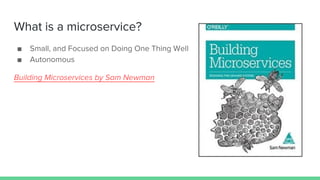
What is a microservice?
■ Small, and Focused on Doing One Thing Well
■ Autonomous
Building Microservices by Sam Newman
Docker
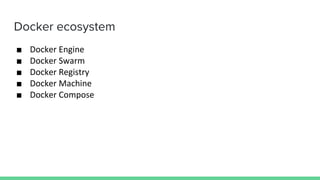
Docker ecosystem
■ Docker Engine
■ Docker Swarm
■ Docker Registry
■ Docker Machine
■ Docker Compose
Docker Swarm
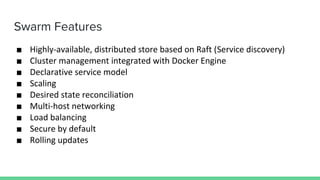
Swarm Features
■ Highly-available, distributed store based on Raft (Service discovery)
■ Cluster management integrated with Docker Engine
■ Declarative service model
■ Scaling
■ Desired state reconciliation
■ Multi-host networking
■ Load balancing
■ Secure by default
■ Rolling updates
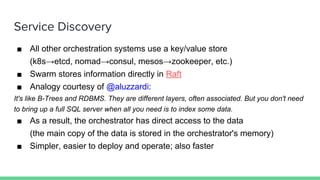
Service Discovery
■ All other orchestration systems use a key/value store
(k8s→etcd, nomad→consul, mesos→zookeeper, etc.)
■ Swarm stores information directly in Raft
■ Analogy courtesy of @aluzzardi:
It's like B-Trees and RDBMS. They are different layers, often associated. But you don't need
to bring up a full SQL server when all you need is to index some data.
■ As a result, the orchestrator has direct access to the data
(the main copy of the data is stored in the orchestrator's memory)
■ Simpler, easier to deploy and operate; also faster
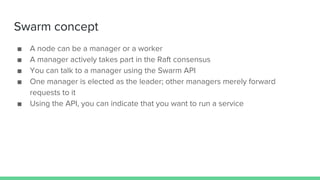
Swarm concept
■ A node can be a manager or a worker
■ A manager actively takes part in the Raft consensus
■ You can talk to a manager using the Swarm API
■ One manager is elected as the leader; other managers merely forward
requests to it
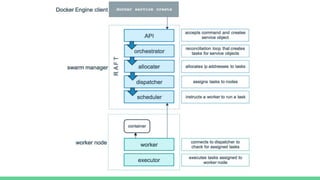
■ Using the API, you can indicate that you want to run a service
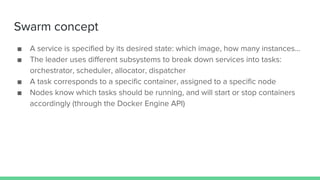
Swarm concept
■ A service is specified by its desired state: which image, how many instances...
■ The leader uses different subsystems to break down services into tasks:
orchestrator, scheduler, allocator, dispatcher
■ A task corresponds to a specific container, assigned to a specific node
■ Nodes know which tasks should be running, and will start or stop containers
accordingly (through the Docker Engine API)
Swarm Mode
■ Docker Engine 1.12 features SwarmKit integration
■ The Docker CLI features three new commands:
○ docker swarm (enable Swarm mode; join a Swarm; adjust cluster
parameters)
○ docker node (view nodes; promote/demote managers; manage nodes)
○ docker service (create and manage services)
Build swarm cluster
Visualizing the cluster
Adding nodes to the cluster
Security
Under the hood
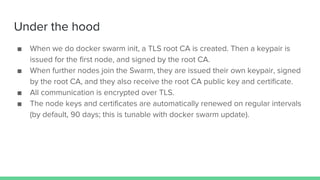
■ When we do docker swarm init, a TLS root CA is created. Then a keypair is
issued for the first node, and signed by the root CA.
■ When further nodes join the Swarm, they are issued their own keypair, signed
by the root CA, and they also receive the root CA public key and certificate.
■ All communication is encrypted over TLS.
■ The node keys and certificates are automatically renewed on regular intervals
(by default, 90 days; this is tunable with docker swarm update).
Docker Service
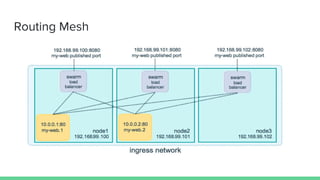
Routing Mesh
Routing Mesh
Scaling a service
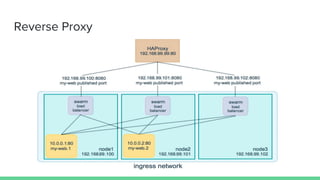
Reverse Proxy
Dockerfile
Rolling Updates
Docker secret
Docker Node
Docker system?
What now?
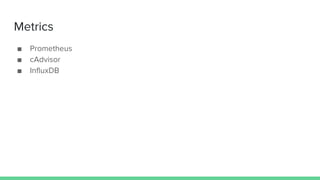
Metrics
■ Prometheus
■ cAdvisor
■ InfluxDB
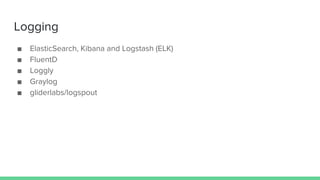
Logging
■ ElasticSearch, Kibana and Logstash (ELK)
■ FluentD
■ Loggly
■ Graylog
■ gliderlabs/logspout
Dashboards
■ Grafana (https://grafana.net/dashboards/609)
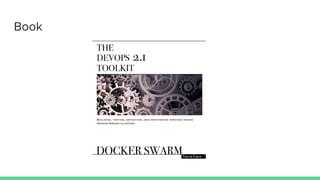
Book
Questions?
E-mail: albertogviana@gmail.com
Thank you! Obrigado!

Docker swarm