Constructing Hypothesis
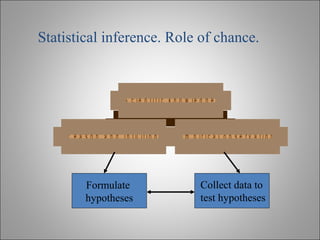
Statistical inference. Role of chance.
R e a s o n a n d i n t u it i o n E m p ir i c a l o b s e r v a t i o n
S c ie n t i f i c k n o w le d g e
Formulate
hypotheses
Collect data to
test hypotheses
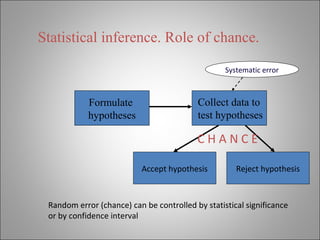
Statistical inference. Role of chance.
Formulate
hypotheses
Collect data to
test hypotheses
Accept hypothesis Reject hypothesis
C H A N C E
Random error (chance) can be controlled by statistical significance
or by confidence interval
Systematic error
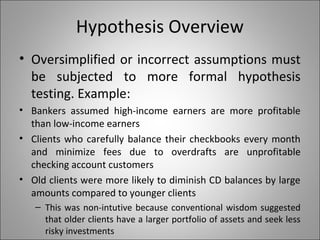
Hypothesis Overview
• Oversimplified or incorrect assumptions must
be subjected to more formal hypothesis
testing. Example:
• Bankers assumed high-income earners are more profitable
than low-income earners
• Clients who carefully balance their checkbooks every month
and minimize fees due to overdrafts are unprofitable
checking account customers
• Old clients were more likely to diminish CD balances by large
amounts compared to younger clients
– This was non-intutive because conventional wisdom suggested
that older clients have a larger portfolio of assets and seek less
risky investments
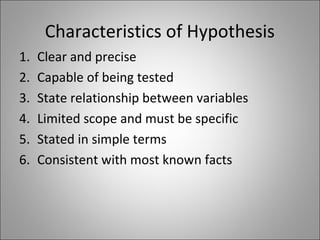
Characteristics of Hypothesis
1. Clear and precise
2. Capable of being tested
3. State relationship between variables
4. Limited scope and must be specific
5. Stated in simple terms
6. Consistent with most known facts
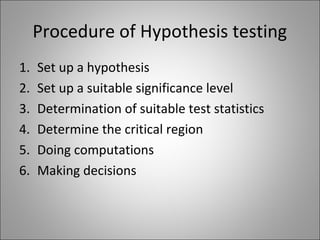
Procedure of Hypothesis testing
1. Set up a hypothesis
2. Set up a suitable significance level
3. Determination of suitable test statistics
4. Determine the critical region
5. Doing computations
6. Making decisions
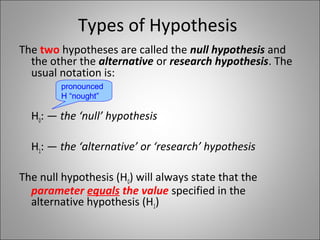
Types of Hypothesis
The two hypotheses are called the null hypothesis and
the other the alternative or research hypothesis. The
usual notation is:
H0: — the ‘null’ hypothesis
H1: — the ‘alternative’ or ‘research’ hypothesis
The null hypothesis (H0) will always state that the
parameter equals the value specified in the
alternative hypothesis (H1)
pronounced
H “nought”
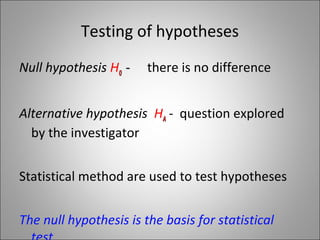
Testing of hypotheses
Null hypothesis H00 -- there is no difference
Alternative hypothesis HAA - question explored
by the investigator
Statistical method are used to test hypotheses
The null hypothesis is the basis for statistical
Are hypothesis always necessary?
• Whether their acceptance or
rejection will help in accomplishing
objectives of research.
• It only adds clarity to the findings.
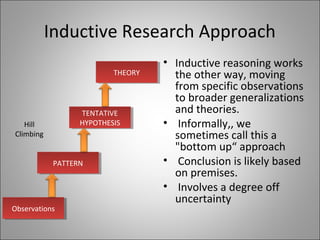
Inductive Research Approach
• Inductive reasoning works
the other way, moving
from specific observations
to broader generalizations
and theories.
• Informally,, we
sometimes call this a
"bottom up“ approach
• Conclusion is likely based
on premises.
• Involves a degree off
uncertainty
ObservationsObservations
PATTERNPATTERN
TENTATIVE
HYPOTHESIS
TENTATIVE
HYPOTHESIS
THEORYTHEORY
Hill
Climbing
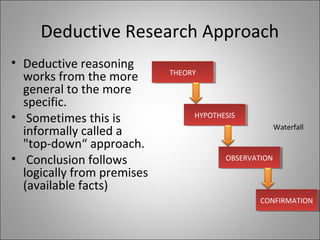
Deductive Research Approach
• Deductive reasoning
works from the more
general to the more
specific.
• Sometimes this is
informally called a
"top-down“ approach.
• Conclusion follows
logically from premises
(available facts)
THEORYTHEORY
HYPOTHESISHYPOTHESIS
OBSERVATIONOBSERVATION
CONFIRMATIONCONFIRMATION
Waterfall
Thanks!

6 constructing hypothesis

  • 1.
  • 2.
    Statistical inference. Roleof chance. R e a s o n a n d i n t u it i o n E m p ir i c a l o b s e r v a t i o n S c ie n t i f i c k n o w le d g e Formulate hypotheses Collect data to test hypotheses
  • 3.
    Statistical inference. Roleof chance. Formulate hypotheses Collect data to test hypotheses Accept hypothesis Reject hypothesis C H A N C E Random error (chance) can be controlled by statistical significance or by confidence interval Systematic error
  • 4.
    Hypothesis Overview • Oversimplifiedor incorrect assumptions must be subjected to more formal hypothesis testing. Example: • Bankers assumed high-income earners are more profitable than low-income earners • Clients who carefully balance their checkbooks every month and minimize fees due to overdrafts are unprofitable checking account customers • Old clients were more likely to diminish CD balances by large amounts compared to younger clients – This was non-intutive because conventional wisdom suggested that older clients have a larger portfolio of assets and seek less risky investments
  • 5.
    Characteristics of Hypothesis 1.Clear and precise 2. Capable of being tested 3. State relationship between variables 4. Limited scope and must be specific 5. Stated in simple terms 6. Consistent with most known facts
  • 6.
    Procedure of Hypothesistesting 1. Set up a hypothesis 2. Set up a suitable significance level 3. Determination of suitable test statistics 4. Determine the critical region 5. Doing computations 6. Making decisions
  • 7.
    Types of Hypothesis Thetwo hypotheses are called the null hypothesis and the other the alternative or research hypothesis. The usual notation is: H0: — the ‘null’ hypothesis H1: — the ‘alternative’ or ‘research’ hypothesis The null hypothesis (H0) will always state that the parameter equals the value specified in the alternative hypothesis (H1) pronounced H “nought”
  • 8.
    Testing of hypotheses Nullhypothesis H00 -- there is no difference Alternative hypothesis HAA - question explored by the investigator Statistical method are used to test hypotheses The null hypothesis is the basis for statistical
  • 9.
    Are hypothesis alwaysnecessary? • Whether their acceptance or rejection will help in accomplishing objectives of research. • It only adds clarity to the findings.
  • 10.
    Inductive Research Approach •Inductive reasoning works the other way, moving from specific observations to broader generalizations and theories. • Informally,, we sometimes call this a "bottom up“ approach • Conclusion is likely based on premises. • Involves a degree off uncertainty ObservationsObservations PATTERNPATTERN TENTATIVE HYPOTHESIS TENTATIVE HYPOTHESIS THEORYTHEORY Hill Climbing
  • 11.
    Deductive Research Approach •Deductive reasoning works from the more general to the more specific. • Sometimes this is informally called a "top-down“ approach. • Conclusion follows logically from premises (available facts) THEORYTHEORY HYPOTHESISHYPOTHESIS OBSERVATIONOBSERVATION CONFIRMATIONCONFIRMATION Waterfall
  • 12.