Research Instruments
Workshop by:
Dr. Jihan Zayed
Mustaqbal University, KSA
April 2019
Research Instruments
• After the formulation of research questions and sample
selection, the next step in research chain is developing
data collection instruments or research instruments.
• They are measurement tools (i.e., tests, questionnaires
or interviews)
• They can be designed by the researcher or can be
previously-developed by other researchers.
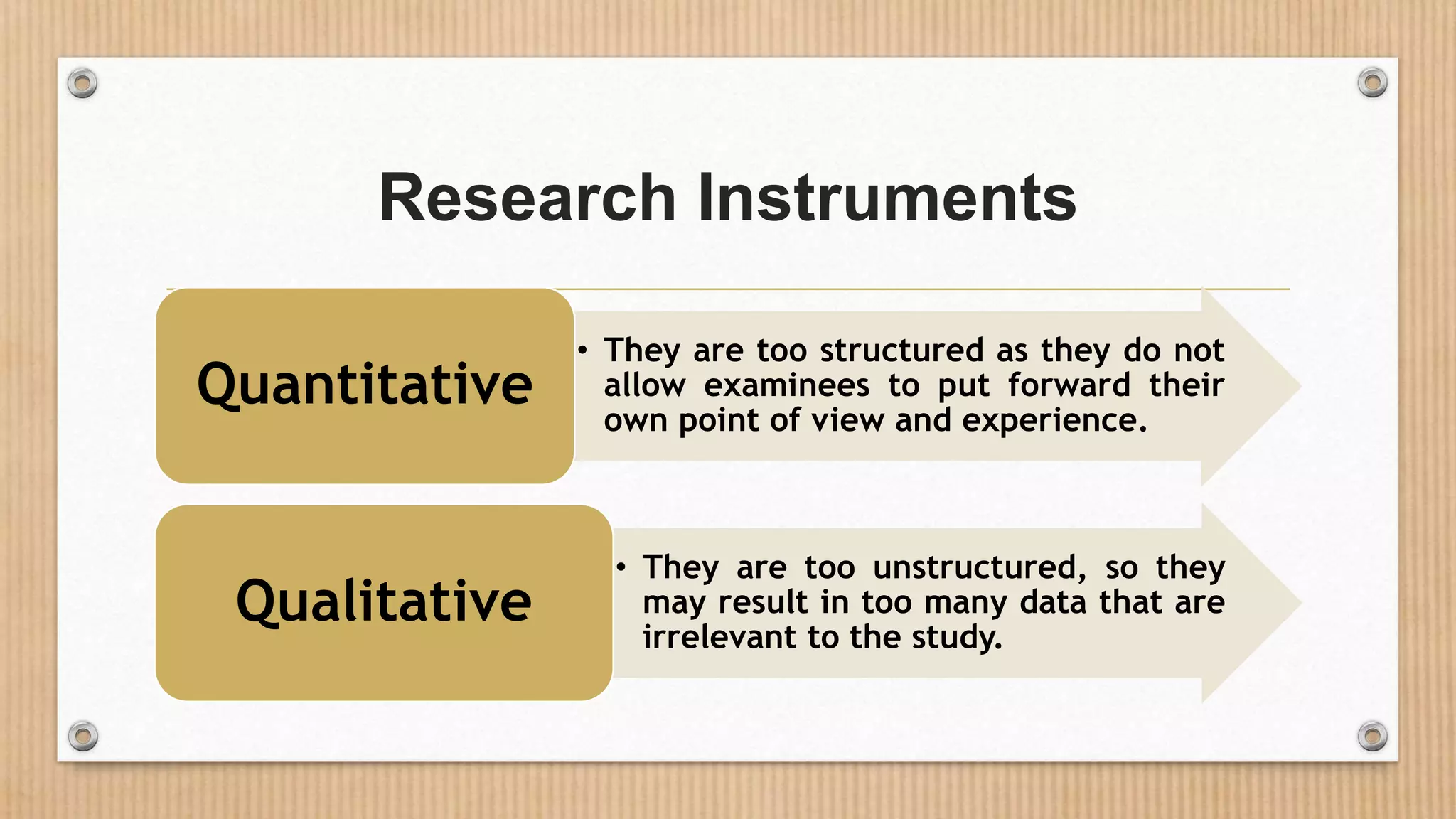
Research Instruments
• They are too structured as they do not
allow examinees to put forward their
own point of view and experience.
Quantitative
• They are too unstructured, so they
may result in too many data that are
irrelevant to the study.
Qualitative
Brainstorming
• Mention some of the
quantitative instruments.
• Mention some of the
qualitative instruments.
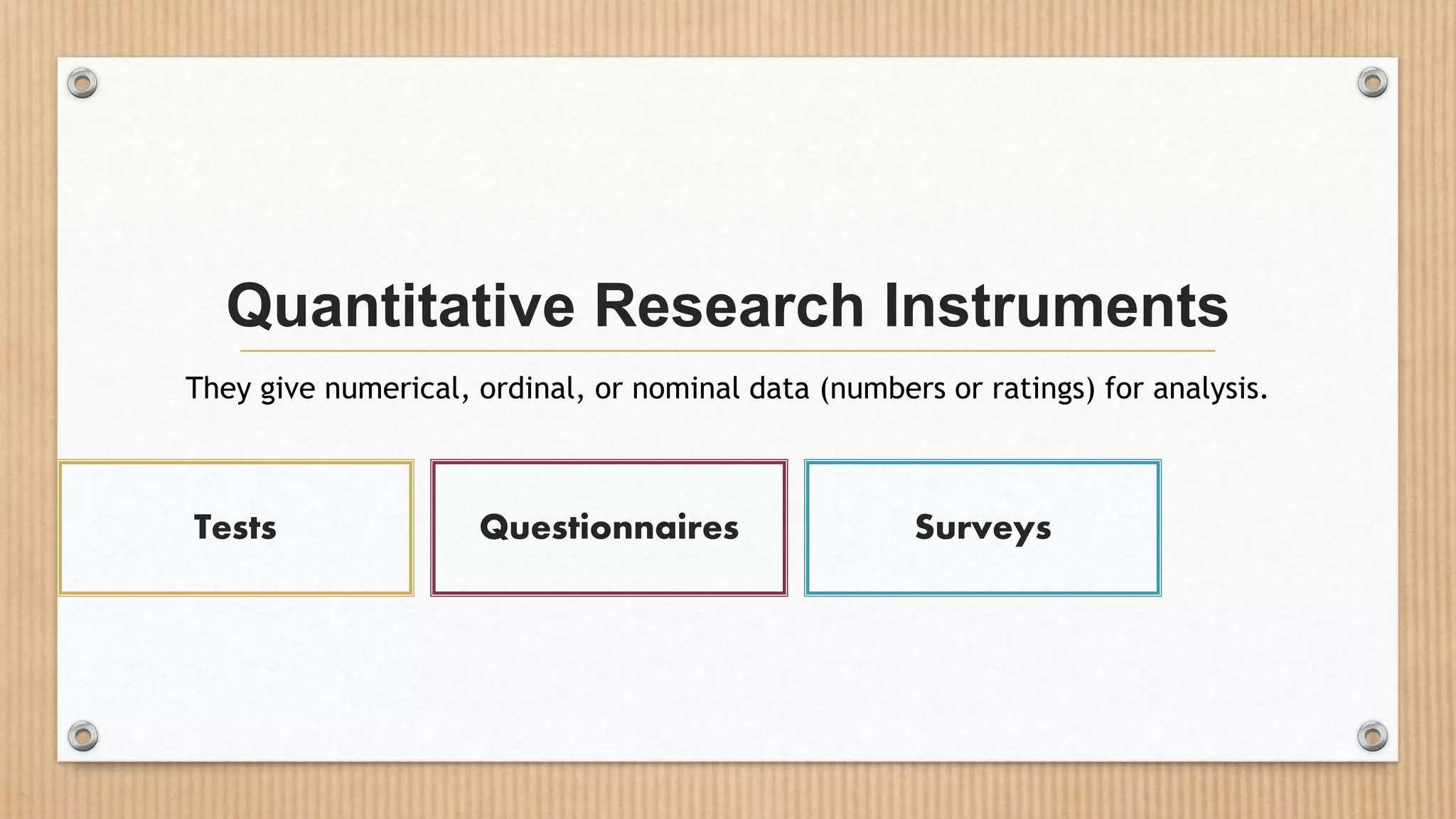
Quantitative Research Instruments
Tests Questionnaires
They give numerical, ordinal, or nominal data (numbers or ratings) for analysis.
Surveys
Brainstorming
• Could you tell the
difference between “a
questionnaire” and “a
survey”?
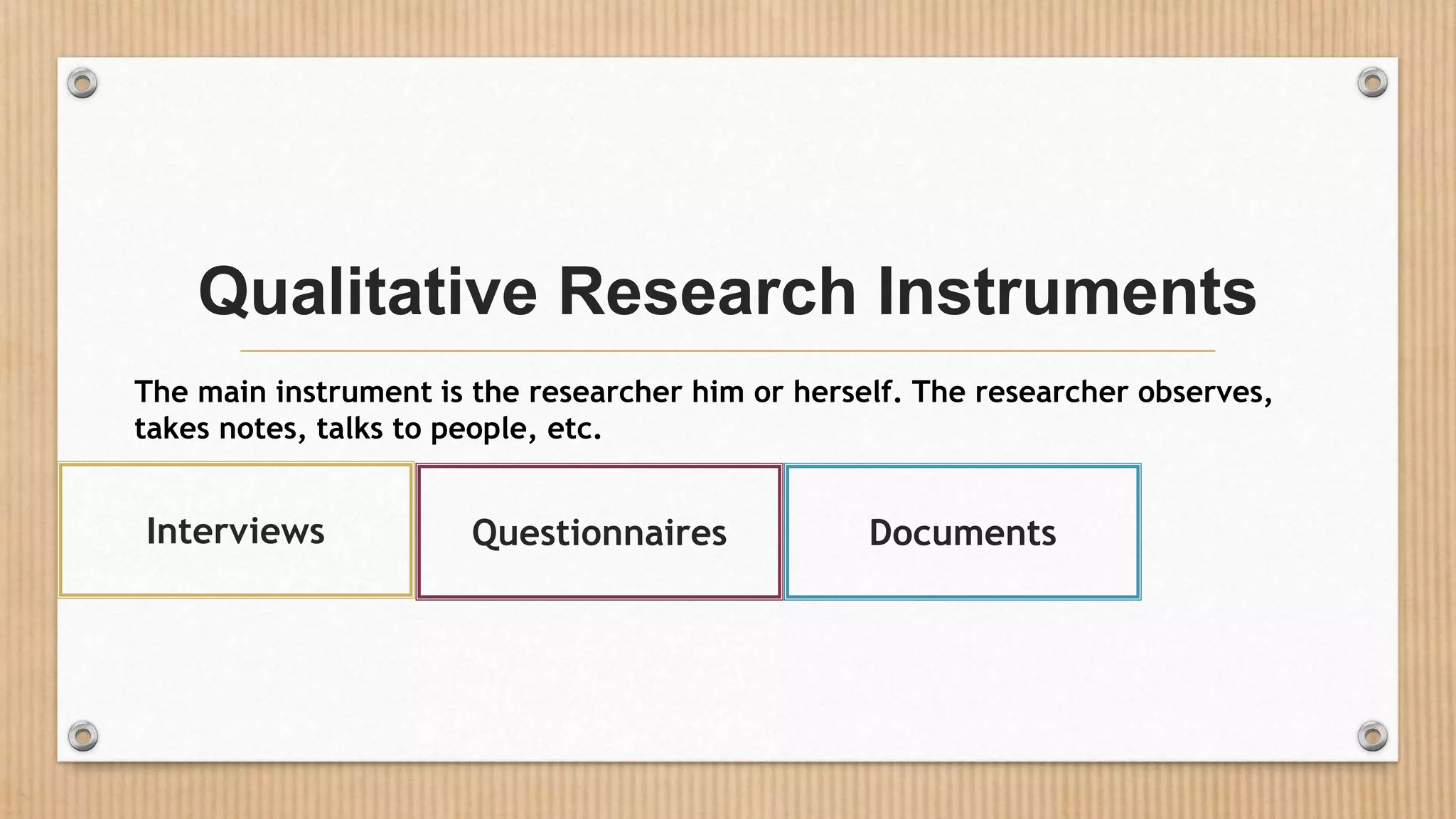
Qualitative Research Instruments
The main instrument is the researcher him or herself. The researcher observes,
takes notes, talks to people, etc.
Interviews Questionnaires Documents
Tests
A test seeks to elicit a representative
sample of an examinee’s performance or
knowledge in a short time.
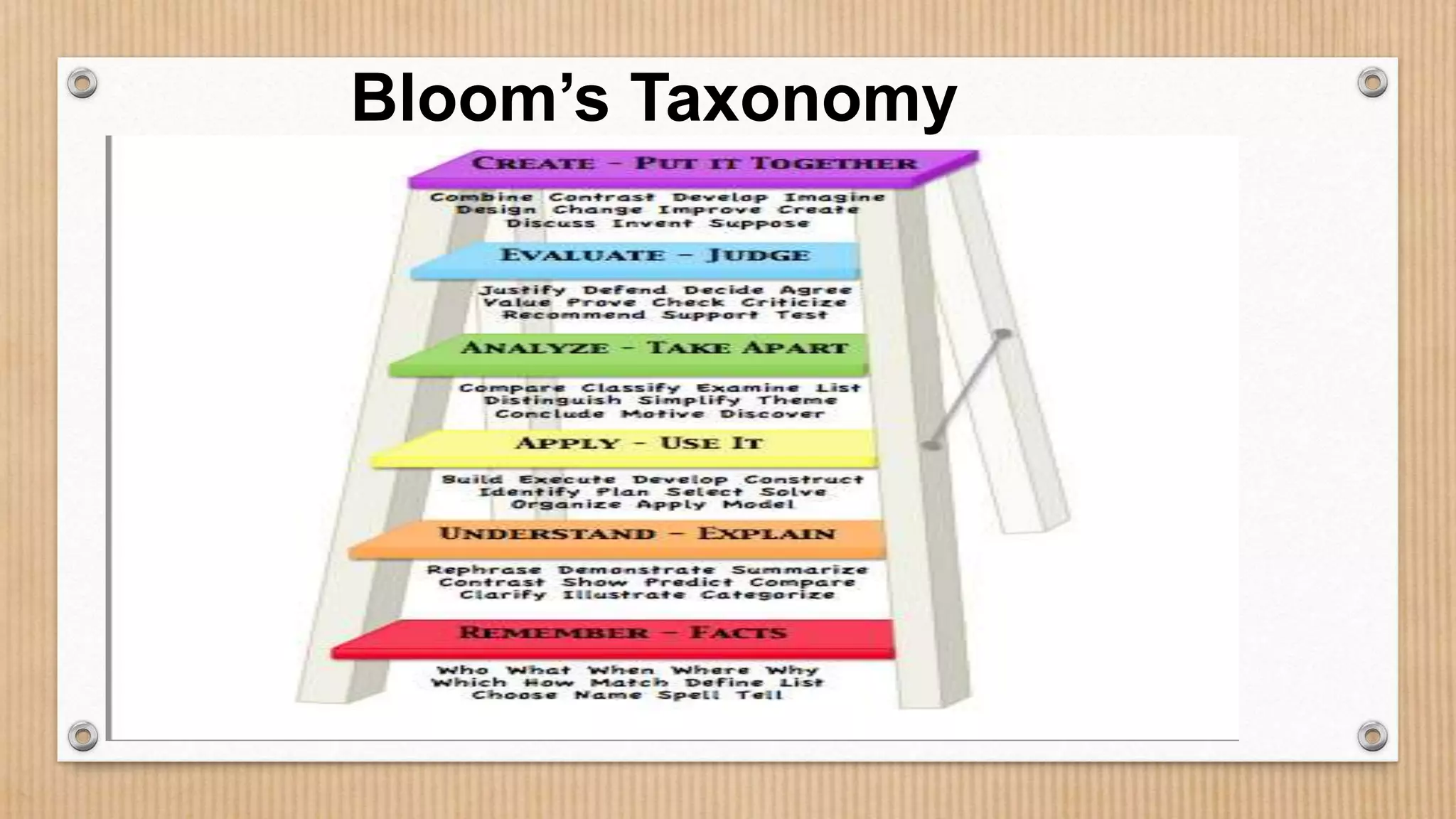
Bloom’s Taxonomy
Bloom’s Taxonomy
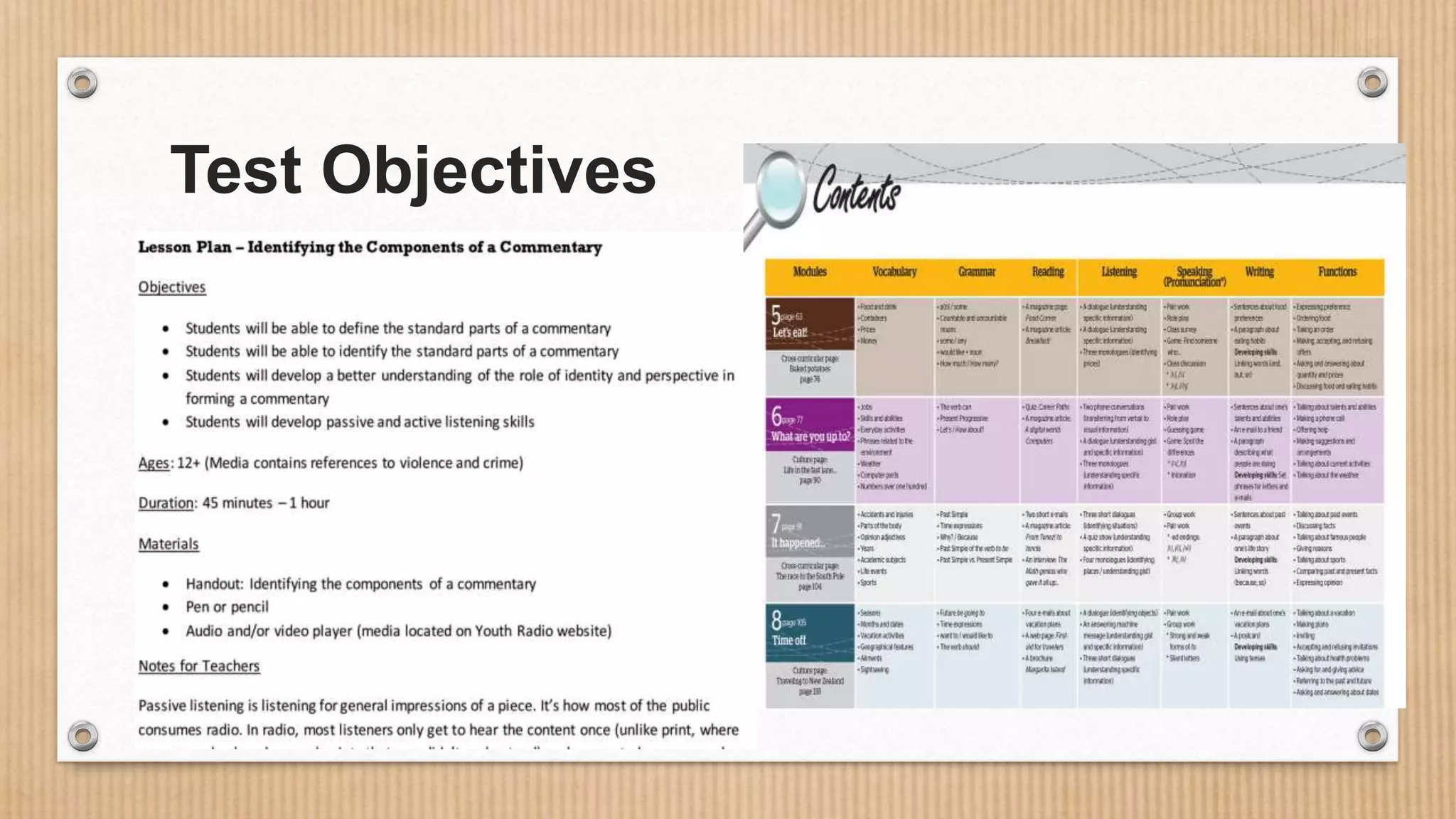
Test Objectives
Brainstorming
• How can you design
a standardized test?
Test Specifications
Skills
Actual Instruction
Marks
Cognitive Skills Questions
Time Spent Weight K C A A S E M S R D C P
Pronunciation 109 m. 29% 29 25% 75% 8 21
Grammar 70 m. 19% 19
Vocabulary 200 m. 52% 52
Total 379 m. 100% 100
Questionnaires
• A questionnaire is a research
instrument consisting of a
series of questions for the
purpose of gathering
information from
respondents. The
questionnaire was invented
by the Statistical Society of
London in 1838.
Types of Questionnaires
(Distributions)
Paper/Computer Telephone In-house
Types of Questionnaires
(Questions)
• Open-ended
• MCQs
• Dichotomous
• Scaling
Validity vs. Reliability
Validity
• If the test measures what is intended to measure.
• Face Validity: If a test appears that it should do what it’s
supposed to do.
• Construct Validity: A construct is a non-observable trait,
such as intelligence, which explains behavior – The degree
to which a test measures an intended hypothetical
construct.
• Content Validity: The degree to which a test measures an
intended content area
• Concurrent Validity: The degree to which the scores on a
test are related to the scores on another, already
established test administered at the same time.
• Predictive Validity: The degree to which a test can predict
how well an individual will do in a future situation.
Reliability
• If you give the test over and over it will
consistently return the same results.
• Test-Retest: Degree to which scores are
consistent over time
• Equivalent forms: Two tests identical in
every way except item order
• Split-half: Give a test to group. Score ½
of test with ½ of class, score other ½ of
test with other ½ of class.
• Interscorer/interrater: A measure of the
agreements and disagreements of 2 or
more judges

Research instruments

  • 1.
    Research Instruments Workshop by: Dr.Jihan Zayed Mustaqbal University, KSA April 2019
  • 2.
    Research Instruments • Afterthe formulation of research questions and sample selection, the next step in research chain is developing data collection instruments or research instruments. • They are measurement tools (i.e., tests, questionnaires or interviews) • They can be designed by the researcher or can be previously-developed by other researchers.
  • 3.
    Research Instruments • Theyare too structured as they do not allow examinees to put forward their own point of view and experience. Quantitative • They are too unstructured, so they may result in too many data that are irrelevant to the study. Qualitative
  • 4.
    Brainstorming • Mention someof the quantitative instruments. • Mention some of the qualitative instruments.
  • 5.
    Quantitative Research Instruments TestsQuestionnaires They give numerical, ordinal, or nominal data (numbers or ratings) for analysis. Surveys
  • 6.
    Brainstorming • Could youtell the difference between “a questionnaire” and “a survey”?
  • 7.
    Qualitative Research Instruments Themain instrument is the researcher him or herself. The researcher observes, takes notes, talks to people, etc. Interviews Questionnaires Documents
  • 8.
    Tests A test seeksto elicit a representative sample of an examinee’s performance or knowledge in a short time.
  • 9.
  • 10.
  • 11.
  • 12.
    Brainstorming • How canyou design a standardized test?
  • 13.
    Test Specifications Skills Actual Instruction Marks CognitiveSkills Questions Time Spent Weight K C A A S E M S R D C P Pronunciation 109 m. 29% 29 25% 75% 8 21 Grammar 70 m. 19% 19 Vocabulary 200 m. 52% 52 Total 379 m. 100% 100
  • 14.
    Questionnaires • A questionnaireis a research instrument consisting of a series of questions for the purpose of gathering information from respondents. The questionnaire was invented by the Statistical Society of London in 1838.
  • 15.
  • 16.
    Types of Questionnaires (Questions) •Open-ended • MCQs • Dichotomous • Scaling
  • 17.
    Validity vs. Reliability Validity •If the test measures what is intended to measure. • Face Validity: If a test appears that it should do what it’s supposed to do. • Construct Validity: A construct is a non-observable trait, such as intelligence, which explains behavior – The degree to which a test measures an intended hypothetical construct. • Content Validity: The degree to which a test measures an intended content area • Concurrent Validity: The degree to which the scores on a test are related to the scores on another, already established test administered at the same time. • Predictive Validity: The degree to which a test can predict how well an individual will do in a future situation. Reliability • If you give the test over and over it will consistently return the same results. • Test-Retest: Degree to which scores are consistent over time • Equivalent forms: Two tests identical in every way except item order • Split-half: Give a test to group. Score ½ of test with ½ of class, score other ½ of test with other ½ of class. • Interscorer/interrater: A measure of the agreements and disagreements of 2 or more judges

Editor's Notes

  • #6 Questionnaire – a written or printed set of questions used in gathering information from people. Survey – a detailed study as by gathering information and analyzing it.
  • #8 Ethnographic interviews,  guided interviews, biographic interviews, problem-centered interviews, semi-structured open ended interviews, group interview or focus groups include printed documents, online documents, web pages, images, audio and video materials or geographic data. 
  • #10 In one sentence, Bloom’s Taxonomy is a hierarchical ordering of cognitive skills that can help teachers teach and students learn. Bloom's Taxonomy was created in 1958 by the educational psychologist Dr Benjamin Bloom in order to promote higher forms of thinking in education, rather than just remembering facts (rote learning).
  • #11 Specific learning objectives can be derived from the taxonomy, though it is most commonly used to assess learning on a variety of cognitive levels. It also helps with assessments in terms of matching your assessment items to the level of your objectives.