ACTION RESEARCHApplication in the Education Profession
What is action research?Action research is an approach by one or two individuals or groups for the purpose of solving a problem or obtaining information to inform local practice.These may have practical applications i.e. How to decrease the incidence of absenteeism in class; motivate apathetic students; improve the teaching of mathematics or to increase funding
What are the kind of questions involved?Examples are: What kind of methods work best with certain types of students?How can teachers encourage students to think about important issues?How can content, teaching strategies and learning activities be varied to help students?How can subject matter be better presented to promote understanding?
Various people may be involvedTeachersCounselorssupervisors AdministratorsPolitical leaders
Basic assumptions underlying action research?Those undertaking the research must be informed individuals capable of identifying problems that need to be solved i.e. Economic experts in talking about what to do with OFW remittancesThe ones involved must be seriously committed to solving the problem and improving their performanceThe participants must engage in the research systematically
What is the system?Identify the problem Decide on investigative proceduresDetermine data collection techniquesAnalyze and interpret dataDevelop plans of action to deal with problemsThe ones undertaking the research must have the authority to undertake the necessary procedures and implement recommendations.
Types of Action ResearchPractical action research – this is intended to address a specific problem within a classroom, school or other communities.It can be carried out in a variety of settings such as the educational, school service or business locationsThe primary purpose of practical action research is to improve practice in the short term and to inform larger issues.  This is performed by individuals, teams or larger groups provided the focus remains clear and specific.The result of this research is an action plan
# 2: Participatory action research This type of research involves individuals which are called stakeholdersThese individuals function as equal partnersIn this type of research the subject and the researcher find ways to bring about social change and improve their lives.Stakeholders may not be involved at the beginning of the research but become active early in the process and jointly plan the study.
Participatory action research is also called “Collaborative Research”A collaborative research provides people with the means to take systematic action in an effort to resolve specific problemsIt is consensual,Democratic ParticipatoryEncourages people to formulate accounts and explanations of their situation and to develop plans to resolve these problems
Tips for the researcherA trained researcher may identify the problem and brings it to the attention of the stakeholders.It is important that the problem is not just of interest to the researcher but also to the stakeholdersThe researcher stands alongside the stakeholders he is not anymore an outsider but is now an internal consultant.
Levels of Participation in action researchInformation gatheringCrafting of the instruments i.e. QuestionnaireParticipants may review the findingsData collection and analysisMaking the recommendation
Steps in action research# 1:  Identify the research question The research question must be clearIt must be manageableLarge-scale and complex questions should be better left to professional researchers
#2: Gathering the necessary informationFind out the best method: experiments, surveys, causal-comparative studies, interviews, ethnography; historical methodTeachers can be active participants (observing computer techniques by students)Taking down notesInterviews and use of questionnairesAnalysis of documents
InstrumentsInterview schedules, checklists, rating scales, attitudinal measuresTriangulation – finding of common dataHow to treat anecdotal data- while it is important to collect such data it is important to get substantive evidence i.e. Common denominators in the interviews
# 3: Analysing and interpreting the informationAfter getting the general focus of the information, it is important to provide a guiding procedure in answering the questionsGet the purpose of the dataThen the what, how, who, where and when and finally the why
TipWhen analyzing and interpreting data gathered in participatory research it is important for the participants to reflect on the perception of all the stakeholders in the study.  They should work together to create description of what the data may reveal.  Finally they must keep all the stakeholders informed of what is going on in the data-gathering stage and provide opportunities for everyone to read accounts of what is happening.  This permits participants to give their inputs continuously as the study progresses.
Developing an action plan A formal document should be prepared and should indicate clear direction for further work on the original problem or concern
Similarities and differences in action research and formal research Sample -Action research almost always focuses on a particular group or individual whereas the sample in formal research is not identicalInternal validity – threats in action research is greater because of collector bias.  The source of data is also the researcherExternal validity – results in external research cannot be generalized compared to formal reserarch
Advantages of action research It can be done by an individual or a groupIt improves educational practice and helps create better professionalsEducators can develop ways to improve their craftThe researchers identify the problems systematicallyIt can lead to the development of research-oriented individualsIt is collaborative and democratic
Examples of practical action research“Investigating the teaching of science concepts by means of comparison-group experiment”Problem:  does using drama help fifth-graders understanding of basic science concepts?Method:  assigning some teachers to use dramatics while others do notThey compare the results with an instrument designed to measure conceptual understanding
Example # 2“Checking for bias in English anthologies by means of a content analysis”Problem: “Is the content presented in the literature anthologies in our district biased in any way?  If so, how?Method:  images of heroes are presented in literature anthologies .  The researcher restricts herself to the texts used in the district and creates a scale adjectives which is analyzed for triangulation
Nature of action research Action research is conducted by a teacher, administrator or an educational professional to solve a problem at a local levelEach of the specific methods of research may apply in research action methods but in a smaller scaleA given research question may often be investigated by any one of several methods
Assumptions underlying action research Several assumptions underlie action research studies.These are the participants that should have the authority to make decisions, want to improve their practice and are committed to continual professional development and will engage in systematic inquiry
Types of action research Practical action research addresses a specific local problemParticipatory action research while also focused on a specific local problem attempts to empower participants or bring about social change
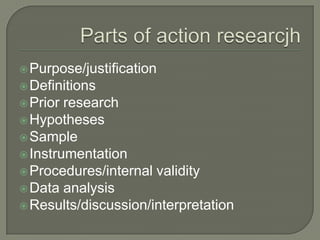
Parts of action researcjhPurpose/justification DefinitionsPrior researchHypothesesSampleInstrumentationProcedures/internal validityData analysisResults/discussion/interpretation

Action research

  • 1.
    ACTION RESEARCHApplication inthe Education Profession
  • 2.
    What is actionresearch?Action research is an approach by one or two individuals or groups for the purpose of solving a problem or obtaining information to inform local practice.These may have practical applications i.e. How to decrease the incidence of absenteeism in class; motivate apathetic students; improve the teaching of mathematics or to increase funding
  • 3.
    What are thekind of questions involved?Examples are: What kind of methods work best with certain types of students?How can teachers encourage students to think about important issues?How can content, teaching strategies and learning activities be varied to help students?How can subject matter be better presented to promote understanding?
  • 4.
    Various people maybe involvedTeachersCounselorssupervisors AdministratorsPolitical leaders
  • 5.
    Basic assumptions underlyingaction research?Those undertaking the research must be informed individuals capable of identifying problems that need to be solved i.e. Economic experts in talking about what to do with OFW remittancesThe ones involved must be seriously committed to solving the problem and improving their performanceThe participants must engage in the research systematically
  • 6.
    What is thesystem?Identify the problem Decide on investigative proceduresDetermine data collection techniquesAnalyze and interpret dataDevelop plans of action to deal with problemsThe ones undertaking the research must have the authority to undertake the necessary procedures and implement recommendations.
  • 7.
    Types of ActionResearchPractical action research – this is intended to address a specific problem within a classroom, school or other communities.It can be carried out in a variety of settings such as the educational, school service or business locationsThe primary purpose of practical action research is to improve practice in the short term and to inform larger issues. This is performed by individuals, teams or larger groups provided the focus remains clear and specific.The result of this research is an action plan
  • 8.
    # 2: Participatoryaction research This type of research involves individuals which are called stakeholdersThese individuals function as equal partnersIn this type of research the subject and the researcher find ways to bring about social change and improve their lives.Stakeholders may not be involved at the beginning of the research but become active early in the process and jointly plan the study.
  • 9.
    Participatory action researchis also called “Collaborative Research”A collaborative research provides people with the means to take systematic action in an effort to resolve specific problemsIt is consensual,Democratic ParticipatoryEncourages people to formulate accounts and explanations of their situation and to develop plans to resolve these problems
  • 10.
    Tips for theresearcherA trained researcher may identify the problem and brings it to the attention of the stakeholders.It is important that the problem is not just of interest to the researcher but also to the stakeholdersThe researcher stands alongside the stakeholders he is not anymore an outsider but is now an internal consultant.
  • 11.
    Levels of Participationin action researchInformation gatheringCrafting of the instruments i.e. QuestionnaireParticipants may review the findingsData collection and analysisMaking the recommendation
  • 12.
    Steps in actionresearch# 1: Identify the research question The research question must be clearIt must be manageableLarge-scale and complex questions should be better left to professional researchers
  • 13.
    #2: Gathering thenecessary informationFind out the best method: experiments, surveys, causal-comparative studies, interviews, ethnography; historical methodTeachers can be active participants (observing computer techniques by students)Taking down notesInterviews and use of questionnairesAnalysis of documents
  • 14.
    InstrumentsInterview schedules, checklists,rating scales, attitudinal measuresTriangulation – finding of common dataHow to treat anecdotal data- while it is important to collect such data it is important to get substantive evidence i.e. Common denominators in the interviews
  • 15.
    # 3: Analysingand interpreting the informationAfter getting the general focus of the information, it is important to provide a guiding procedure in answering the questionsGet the purpose of the dataThen the what, how, who, where and when and finally the why
  • 16.
    TipWhen analyzing andinterpreting data gathered in participatory research it is important for the participants to reflect on the perception of all the stakeholders in the study. They should work together to create description of what the data may reveal. Finally they must keep all the stakeholders informed of what is going on in the data-gathering stage and provide opportunities for everyone to read accounts of what is happening. This permits participants to give their inputs continuously as the study progresses.
  • 17.
    Developing an actionplan A formal document should be prepared and should indicate clear direction for further work on the original problem or concern
  • 18.
    Similarities and differencesin action research and formal research Sample -Action research almost always focuses on a particular group or individual whereas the sample in formal research is not identicalInternal validity – threats in action research is greater because of collector bias. The source of data is also the researcherExternal validity – results in external research cannot be generalized compared to formal reserarch
  • 19.
    Advantages of actionresearch It can be done by an individual or a groupIt improves educational practice and helps create better professionalsEducators can develop ways to improve their craftThe researchers identify the problems systematicallyIt can lead to the development of research-oriented individualsIt is collaborative and democratic
  • 20.
    Examples of practicalaction research“Investigating the teaching of science concepts by means of comparison-group experiment”Problem: does using drama help fifth-graders understanding of basic science concepts?Method: assigning some teachers to use dramatics while others do notThey compare the results with an instrument designed to measure conceptual understanding
  • 21.
    Example # 2“Checkingfor bias in English anthologies by means of a content analysis”Problem: “Is the content presented in the literature anthologies in our district biased in any way? If so, how?Method: images of heroes are presented in literature anthologies . The researcher restricts herself to the texts used in the district and creates a scale adjectives which is analyzed for triangulation
  • 22.
    Nature of actionresearch Action research is conducted by a teacher, administrator or an educational professional to solve a problem at a local levelEach of the specific methods of research may apply in research action methods but in a smaller scaleA given research question may often be investigated by any one of several methods
  • 23.
    Assumptions underlying actionresearch Several assumptions underlie action research studies.These are the participants that should have the authority to make decisions, want to improve their practice and are committed to continual professional development and will engage in systematic inquiry
  • 24.
    Types of actionresearch Practical action research addresses a specific local problemParticipatory action research while also focused on a specific local problem attempts to empower participants or bring about social change
  • 25.
    Parts of actionresearcjhPurpose/justification DefinitionsPrior researchHypothesesSampleInstrumentationProcedures/internal validityData analysisResults/discussion/interpretation