MFET 3451
EXPERIMENT # 3
METALLOGRAPHY LABORATORY
OBJECTIVE: To learn specimen preparation techniques in metallography and study
the microstructures of typical engineering alloy(s).
EQUIPMENT USED: Grinders, polishing wheels, drying fans, and metallurgical microscopes.
SUPPLIES: Acrylic resin etching solutions (nitric acid, alcohol), Al2O3 (5µm, 1µm
and 0.05 µm) and consumable supplies as needed and given
engineering alloy specimens.
REFERENCE MATERIAL: Operating instruction of the equipment to be used.
METALLOGRAPHIC STUDY: Using steel ,aluminum and/or brass (60% Cu; 40% Zn) specimen,
and the metallurgical microscope, analyze the microstructure of your given engineering alloys.
Identify the phase or phases present and the grain size of the material
from your metallographic examination. Study the microstructures using
the metallurgical microscope and appropriate phase diagrams. Provide
interpretation of your microstructures and prepare a laboratory report
of your experiment.
PROCEDURE: See attached experimental procedure.
ASSIGNMENT: Each student is to prepare metallographic specimens as provided in the
laboratory, and to sketch and show typical, representative
microstructure of these specimens.
Draw the microstructure you observe in your specimens. Comment on
the phases, composition of the phase(s), amounts of phase(s), and
estimate the ASTM grain size of the microstructures.
1. Using phase diagram information, identify in your results the
phases, amounts of phases and types of microstructures that
you observe in your metallographic analysis.
2. From your understanding of grain size, calculate or give an
estimate if the material is coarse grained or fine grained, with
its approximate ASTM grain size number.
3. Comment on type of deformation or heat treatment the
specimen might have undergone.
Metallography Observation Record
1
Grind, polish, and etch the two specimens given to you. Draw the microstructures you observe in
your specimens.
Magnification: Magnification:
Specimen: Specimen:
Etchant: Etchant:
Observation: Observation:
2
Stage I: MAKING SPECIMEN MOUNTS:
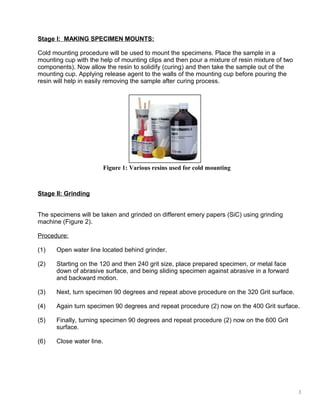
Cold mounting procedure will be used to mount the specimens. Place the sample in a
mounting cup with the help of mounting clips and then pour a mixture of resin mixture of two
components). Now allow the resin to solidify (curing) and then take the sample out of the
mounting cup. Applying release agent to the walls of the mounting cup before pouring the
resin will help in easily removing the sample after curing process.
Stage II: Grinding
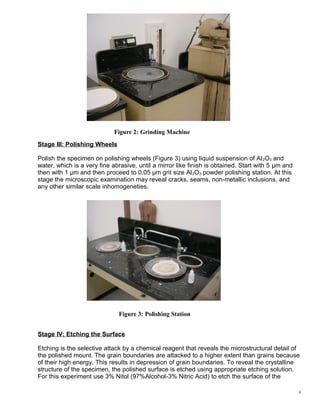
The specimens will be taken and grinded on different emery papers (SiC) using grinding
machine (Figure 2).
Procedure:
(1) Open water line located behind grinder.
(2) Starting on the 120 and then 240 grit size, place prepared specimen, or metal face
down of abrasive surface, and being sliding specimen against abrasive in a forward
and backward motion.
(3) Next, turn specimen 90 degrees and repeat above procedure on the 320 Grit surface.
(4) Again turn specimen 90 degrees and repeat procedure (2) now on the 400 Grit surface.
(5) Finally, turning specimen 90 degrees and repeat procedure (2) now on the 600 Grit
surface.
(6) Close water line.
3
Figure 1: Various resins used for cold mounting
Stage III: Polishing Wheels
Polish the specimen on polishing wheels (Figure 3) using liquid suspension of Al2O3 and
water, which is a very fine abrasive, until a mirror like finish is obtained. Start with 5 µm and
then with 1 µm and then proceed to 0.05 µm grit size Al2O3 powder polishing station. At this
stage the microscopic examination may reveal cracks, seams, non-metallic inclusions, and
any other similar scale inhomogeneties.
Stage IV: Etching the Surface
Etching is the selective attack by a chemical reagent that reveals the microstructural detail of
the polished mount. The grain boundaries are attacked to a higher extent than grains because
of their high energy. This results in depression of grain boundaries. To reveal the crystalline
structure of the specimen, the polished surface is etched using appropriate etching solution.
For this experiment use 3% Nitol (97%Alcohol-3% Nitric Acid) to etch the surface of the
4
Figure 2: Grinding Machine
Figure 3: Polishing Station
polished steel specimen. For brass specimens 50% nitric acid solution can be used. The
etching solution may be applied on the specimen using a swab. It is very important to not over
etch or under etch the specimen.
Stage V: Microscopy
The etched specimen will be examined using metallurgical microscope (shown in Figure 4).
The photographs will be printed and also the digital image of the grain structure will be saved
for further image analysis.
References:
1. ASM Handbook, Metalography, vol. 9, ASM-International, Ohio.
2. William D. Callister Jr., “Fundamentals of Materials Science and Engineering-An
Integrated Approach”, 2nd
edition, 2005, ISBN 0-471-47014-7
3. “Metallurgy and metallography of pure metals”, Edited by V.S. Yemelýanov [and] A.I.
Yevstyukhin, 1962, OCLC # 1629772.
4. Thompson Henry, “Microscopical techniques in metallurgy”, 1954, OCLC# 2144627.
5
Figure 4: Metallurgical Microscopes
polished steel specimen. For brass specimens 50% nitric acid solution can be used. The
etching solution may be applied on the specimen using a swab. It is very important to not over
etch or under etch the specimen.
Stage V: Microscopy
The etched specimen will be examined using metallurgical microscope (shown in Figure 4).
The photographs will be printed and also the digital image of the grain structure will be saved
for further image analysis.
References:
1. ASM Handbook, Metalography, vol. 9, ASM-International, Ohio.
2. William D. Callister Jr., “Fundamentals of Materials Science and Engineering-An
Integrated Approach”, 2nd
edition, 2005, ISBN 0-471-47014-7
3. “Metallurgy and metallography of pure metals”, Edited by V.S. Yemelýanov [and] A.I.
Yevstyukhin, 1962, OCLC # 1629772.
4. Thompson Henry, “Microscopical techniques in metallurgy”, 1954, OCLC# 2144627.
5
Figure 4: Metallurgical Microscopes

3.metallography experiment (engineering lab)

  • 1.
    MFET 3451 EXPERIMENT #3 METALLOGRAPHY LABORATORY OBJECTIVE: To learn specimen preparation techniques in metallography and study the microstructures of typical engineering alloy(s). EQUIPMENT USED: Grinders, polishing wheels, drying fans, and metallurgical microscopes. SUPPLIES: Acrylic resin etching solutions (nitric acid, alcohol), Al2O3 (5µm, 1µm and 0.05 µm) and consumable supplies as needed and given engineering alloy specimens. REFERENCE MATERIAL: Operating instruction of the equipment to be used. METALLOGRAPHIC STUDY: Using steel ,aluminum and/or brass (60% Cu; 40% Zn) specimen, and the metallurgical microscope, analyze the microstructure of your given engineering alloys. Identify the phase or phases present and the grain size of the material from your metallographic examination. Study the microstructures using the metallurgical microscope and appropriate phase diagrams. Provide interpretation of your microstructures and prepare a laboratory report of your experiment. PROCEDURE: See attached experimental procedure. ASSIGNMENT: Each student is to prepare metallographic specimens as provided in the laboratory, and to sketch and show typical, representative microstructure of these specimens. Draw the microstructure you observe in your specimens. Comment on the phases, composition of the phase(s), amounts of phase(s), and estimate the ASTM grain size of the microstructures. 1. Using phase diagram information, identify in your results the phases, amounts of phases and types of microstructures that you observe in your metallographic analysis. 2. From your understanding of grain size, calculate or give an estimate if the material is coarse grained or fine grained, with its approximate ASTM grain size number. 3. Comment on type of deformation or heat treatment the specimen might have undergone. Metallography Observation Record 1
  • 2.
    Grind, polish, andetch the two specimens given to you. Draw the microstructures you observe in your specimens. Magnification: Magnification: Specimen: Specimen: Etchant: Etchant: Observation: Observation: 2
  • 3.
    Stage I: MAKINGSPECIMEN MOUNTS: Cold mounting procedure will be used to mount the specimens. Place the sample in a mounting cup with the help of mounting clips and then pour a mixture of resin mixture of two components). Now allow the resin to solidify (curing) and then take the sample out of the mounting cup. Applying release agent to the walls of the mounting cup before pouring the resin will help in easily removing the sample after curing process. Stage II: Grinding The specimens will be taken and grinded on different emery papers (SiC) using grinding machine (Figure 2). Procedure: (1) Open water line located behind grinder. (2) Starting on the 120 and then 240 grit size, place prepared specimen, or metal face down of abrasive surface, and being sliding specimen against abrasive in a forward and backward motion. (3) Next, turn specimen 90 degrees and repeat above procedure on the 320 Grit surface. (4) Again turn specimen 90 degrees and repeat procedure (2) now on the 400 Grit surface. (5) Finally, turning specimen 90 degrees and repeat procedure (2) now on the 600 Grit surface. (6) Close water line. 3 Figure 1: Various resins used for cold mounting
  • 4.
    Stage III: PolishingWheels Polish the specimen on polishing wheels (Figure 3) using liquid suspension of Al2O3 and water, which is a very fine abrasive, until a mirror like finish is obtained. Start with 5 µm and then with 1 µm and then proceed to 0.05 µm grit size Al2O3 powder polishing station. At this stage the microscopic examination may reveal cracks, seams, non-metallic inclusions, and any other similar scale inhomogeneties. Stage IV: Etching the Surface Etching is the selective attack by a chemical reagent that reveals the microstructural detail of the polished mount. The grain boundaries are attacked to a higher extent than grains because of their high energy. This results in depression of grain boundaries. To reveal the crystalline structure of the specimen, the polished surface is etched using appropriate etching solution. For this experiment use 3% Nitol (97%Alcohol-3% Nitric Acid) to etch the surface of the 4 Figure 2: Grinding Machine Figure 3: Polishing Station
  • 5.
    polished steel specimen.For brass specimens 50% nitric acid solution can be used. The etching solution may be applied on the specimen using a swab. It is very important to not over etch or under etch the specimen. Stage V: Microscopy The etched specimen will be examined using metallurgical microscope (shown in Figure 4). The photographs will be printed and also the digital image of the grain structure will be saved for further image analysis. References: 1. ASM Handbook, Metalography, vol. 9, ASM-International, Ohio. 2. William D. Callister Jr., “Fundamentals of Materials Science and Engineering-An Integrated Approach”, 2nd edition, 2005, ISBN 0-471-47014-7 3. “Metallurgy and metallography of pure metals”, Edited by V.S. Yemelýanov [and] A.I. Yevstyukhin, 1962, OCLC # 1629772. 4. Thompson Henry, “Microscopical techniques in metallurgy”, 1954, OCLC# 2144627. 5 Figure 4: Metallurgical Microscopes
  • 6.
    polished steel specimen.For brass specimens 50% nitric acid solution can be used. The etching solution may be applied on the specimen using a swab. It is very important to not over etch or under etch the specimen. Stage V: Microscopy The etched specimen will be examined using metallurgical microscope (shown in Figure 4). The photographs will be printed and also the digital image of the grain structure will be saved for further image analysis. References: 1. ASM Handbook, Metalography, vol. 9, ASM-International, Ohio. 2. William D. Callister Jr., “Fundamentals of Materials Science and Engineering-An Integrated Approach”, 2nd edition, 2005, ISBN 0-471-47014-7 3. “Metallurgy and metallography of pure metals”, Edited by V.S. Yemelýanov [and] A.I. Yevstyukhin, 1962, OCLC # 1629772. 4. Thompson Henry, “Microscopical techniques in metallurgy”, 1954, OCLC# 2144627. 5 Figure 4: Metallurgical Microscopes