Experiment 3
 U13ME036
 U13ME037
 U13ME039
Prepared by-
Faculty – S. N. PANDYA
Preparation of Specimen
for
Microscopic Observation
RequiredThings:
• Piece of metal (about 30mm length and 18mm dia)
• Bench Grinder
• Belt grinder
• Emery paper or emery disk different grades(1/0,2/0,3/0,4/0)
• A piece of velvet cloth
• Chemical agent
• Drier
Purpose:
• To find out the various phases present in the material.
• To find out Approximate strength, and Hardness.
• To find out Approximate composition material.
• To find out the reason of failure of Material.
PROCEDURE:
Basically preparation of specimen for optical microscopy
is done by respective processes.
Cutting required part of metal for specimen.
Mounting the specimen in mounting press.
Grinding the specimen as per to requirements.
Polishing the specimen.
Etching .
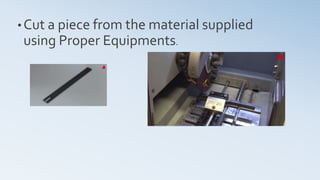
• Cut a piece from the material supplied
using Proper Equipments.
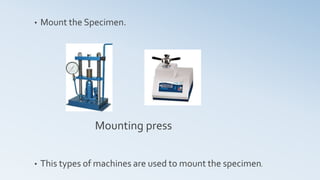
• Mount the Specimen.
• This types of machines are used to mount the specimen.
Mounting press
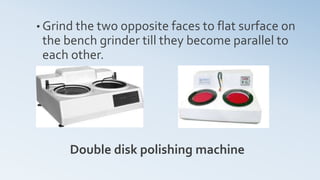
• Grind the two opposite faces to flat surface on
the bench grinder till they become parallel to
each other.
Double disk polishing machine
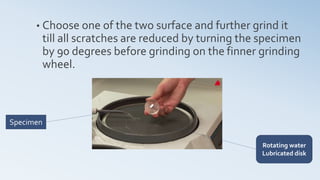
• Choose one of the two surface and further grind it
till all scratches are reduced by turning the specimen
by 90 degrees before grinding on the finner grinding
wheel.
Specimen
Rotating water
Lubricated disk
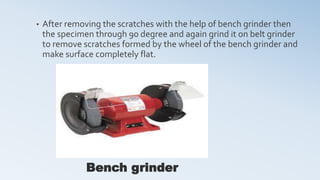
• After removing the scratches with the help of bench grinder then
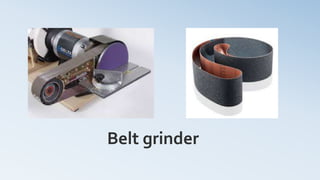
the specimen through 90 degree and again grind it on belt grinder
to remove scratches formed by the wheel of the bench grinder and
make surface completely flat.
Bench grinder
Belt grinder
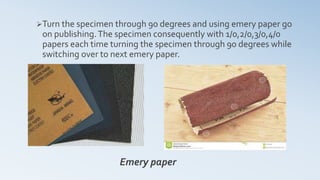
Turn the specimen through 90 degrees and using emery paper go
on publishing.The specimen consequently with 1/0,2/0,3/0,4/0
papers each time turning the specimen through 90 degrees while
switching over to next emery paper.
Emery paper
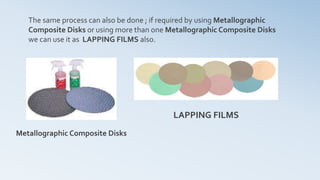
The same process can also be done ; if required by using Metallographic
Composite Disks or using more than one Metallographic Composite Disks
we can use it as LAPPING FILMS also.
Metallographic Composite Disks
LAPPING FILMS
Etching
Apply the chemical agent (etching agent) method of etching,
oSpecimen is dipped in etching agent which is immersion method.
oRubbing cotton soaked in etching agent.
oElectrolyte etching.
Some general purpose Etching Agents:
• Steel and Cast iron:
(a)con. Nitric acid 2 c.c, absolute methyl alcohol 98 c.c.
(b)saturated solution of picric acid in alcohol.
• Cementite:
Picric acid 2 gm,Caustic soda 20 gm ,Water 73 gm.
• Carbide in chromium steel:
Potassium ferocyanide 10 gm , kolt 10gm ,water 100 c.c.
IMMERSION:
• Specimen is immersed in the etching agent . Swabbing agent is
applied with the help of a piece of cloth .This specimen is then
washed in distilled water . A drop of spirit is placed on the surface
and is dried with the help of the drier and then the specimen is
ready to see under the metallurgical microscope.
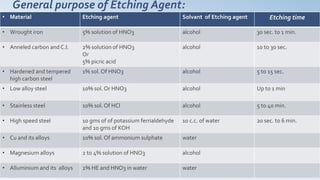
General purpose of Etching Agent:
• Material Etching agent Solvant of Etching agent Etching time
• Wrought iron 5% solution of HNO3 alcohol 30 sec. to 1 min.
• Anneled carbon and C.I. 2% solution of HNO3
Or
5% picric acid
alcohol 10 to 30 sec.
• Hardened and tempered
high carbon steel
1% sol. Of HNO3 alcohol 5 to 15 sec.
• Low alloy steel 10% sol. Or HNO3 alcohol Up to 1 min
• Stainless steel 10% sol. Of HCl alcohol 5 to 40 min.
• High speed steel 10 gms of of potassium ferrialdehyde
and 10 gms of KOH
10 c.c. of water 20 sec. to 6 min.
• Cu and its alloys 10% sol. Of ammonium sulphate water
• Magnesium alloys 2 to 4% solution of HNO3 alcohol
• Alluminium and its alloys 2% HE and HNO3 in water water
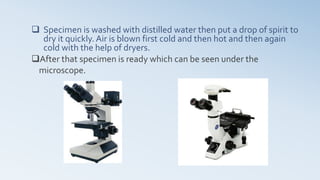
 Specimen is washed with distilled water then put a drop of spirit to
dry it quickly. Air is blown first cold and then hot and then again
cold with the help of dryers.
After that specimen is ready which can be seen under the
microscope.
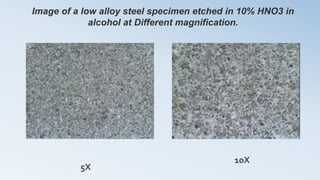
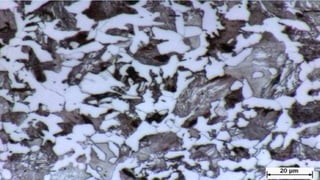
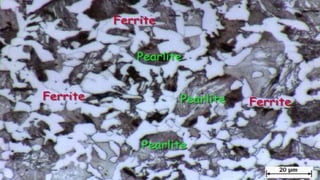
Image of a low alloy steel specimen etched in 10% HNO3 in
alcohol at Different magnification.
10X
5X
U13ME036
U13ME037
U13ME039
SANKET RATANKAR
PARTH RANA
ARCH DESAI

Preparation of specimen for microscopic view

  • 1.
    Experiment 3  U13ME036 U13ME037  U13ME039 Prepared by- Faculty – S. N. PANDYA
  • 2.
  • 3.
    RequiredThings: • Piece ofmetal (about 30mm length and 18mm dia) • Bench Grinder • Belt grinder • Emery paper or emery disk different grades(1/0,2/0,3/0,4/0) • A piece of velvet cloth • Chemical agent • Drier
  • 4.
    Purpose: • To findout the various phases present in the material. • To find out Approximate strength, and Hardness. • To find out Approximate composition material. • To find out the reason of failure of Material.
  • 5.
  • 6.
    Basically preparation ofspecimen for optical microscopy is done by respective processes. Cutting required part of metal for specimen. Mounting the specimen in mounting press. Grinding the specimen as per to requirements. Polishing the specimen. Etching .
  • 7.
    • Cut apiece from the material supplied using Proper Equipments.
  • 8.
    • Mount theSpecimen. • This types of machines are used to mount the specimen. Mounting press
  • 9.
    • Grind thetwo opposite faces to flat surface on the bench grinder till they become parallel to each other. Double disk polishing machine
  • 10.
    • Choose oneof the two surface and further grind it till all scratches are reduced by turning the specimen by 90 degrees before grinding on the finner grinding wheel. Specimen Rotating water Lubricated disk
  • 11.
    • After removingthe scratches with the help of bench grinder then the specimen through 90 degree and again grind it on belt grinder to remove scratches formed by the wheel of the bench grinder and make surface completely flat. Bench grinder
  • 12.
  • 13.
    Turn the specimenthrough 90 degrees and using emery paper go on publishing.The specimen consequently with 1/0,2/0,3/0,4/0 papers each time turning the specimen through 90 degrees while switching over to next emery paper. Emery paper
  • 14.
    The same processcan also be done ; if required by using Metallographic Composite Disks or using more than one Metallographic Composite Disks we can use it as LAPPING FILMS also. Metallographic Composite Disks LAPPING FILMS
  • 15.
    Etching Apply the chemicalagent (etching agent) method of etching, oSpecimen is dipped in etching agent which is immersion method. oRubbing cotton soaked in etching agent. oElectrolyte etching.
  • 16.
    Some general purposeEtching Agents: • Steel and Cast iron: (a)con. Nitric acid 2 c.c, absolute methyl alcohol 98 c.c. (b)saturated solution of picric acid in alcohol. • Cementite: Picric acid 2 gm,Caustic soda 20 gm ,Water 73 gm. • Carbide in chromium steel: Potassium ferocyanide 10 gm , kolt 10gm ,water 100 c.c.
  • 17.
    IMMERSION: • Specimen isimmersed in the etching agent . Swabbing agent is applied with the help of a piece of cloth .This specimen is then washed in distilled water . A drop of spirit is placed on the surface and is dried with the help of the drier and then the specimen is ready to see under the metallurgical microscope.
  • 18.
    General purpose ofEtching Agent: • Material Etching agent Solvant of Etching agent Etching time • Wrought iron 5% solution of HNO3 alcohol 30 sec. to 1 min. • Anneled carbon and C.I. 2% solution of HNO3 Or 5% picric acid alcohol 10 to 30 sec. • Hardened and tempered high carbon steel 1% sol. Of HNO3 alcohol 5 to 15 sec. • Low alloy steel 10% sol. Or HNO3 alcohol Up to 1 min • Stainless steel 10% sol. Of HCl alcohol 5 to 40 min. • High speed steel 10 gms of of potassium ferrialdehyde and 10 gms of KOH 10 c.c. of water 20 sec. to 6 min. • Cu and its alloys 10% sol. Of ammonium sulphate water • Magnesium alloys 2 to 4% solution of HNO3 alcohol • Alluminium and its alloys 2% HE and HNO3 in water water
  • 19.
     Specimen iswashed with distilled water then put a drop of spirit to dry it quickly. Air is blown first cold and then hot and then again cold with the help of dryers. After that specimen is ready which can be seen under the microscope.
  • 20.
    Image of alow alloy steel specimen etched in 10% HNO3 in alcohol at Different magnification. 10X 5X
  • 24.