Baghdad University
College of Engineering
Department of Mechanical Engineering
Name of Experiment
"Preparing a Metal Specimen for Microscopic Examination "
Preparation:
Saif al-Din Ali Madi
The second phase
Group "A "
1.Name of Experiment:
Preparing a Metal Specimen for Microscopic Examination.
2.The objec ve of the Experiment
a. The determination of the size and shape of the grains.
b. To specify what forms are present.
c. To find if the specimen has undergone plastic or elastic deformation.
d. To search for impurities.
e. To find if it has inferior any phase changes
3. Devices Used for Experiment
A. Microscope
B. Steel Specimens
C. tot Mounting Device
D. Grinding Device
E. Polishing Device
F. Hot Air Dryer
G. Etching solution for steel
4. Experimental work
First we choose a specimen of suitable dimensions or
cut a specimen to our requirements taking care not to
raise its temperature. We then mount it and start the
grinding process taking care to rinsing it with water
when changing from one grade of grinding to another
there are four grade starting from the roughest &
gradually moving smoother one) using a polishing device
which is a disk covered with billiard or buffer cloth
diamond is spread and the polishing starts while
constantly moving the specimen In an (8) shape over the
polishing wheel. When we obtain a mirror like surface
the specimen is then washed swapped
gently with an etchant ( Netal : 98% alcohol + 2% HN )
just for a few seconds after which it is quickly rinsed
with water and then alcohol and dried with a blow
dryer.
5. Discussion:
a. Define by what is meant by metallography
A mineral is a naturally occurring chemical compound, usually of
crystalline form and abiogenic in origin (not produced by life processes).
A mineral has one specific chemical composition, whereas a rock can be
an aggregate of different minerals or mineraloids. The study of minerals
is called mineralogy.
There are over 5,300 known mineral species; as of March 2017, over
5,230 of these had been approved by the Interna onal Mineralogical
Associa on (IMA). The silicate minerals compose over 90% of the Earth's
crust. Silicon and oxygen cons tute approximately 75% of the Earth's
crust, which translates directly into the predominance of silicate
minerals.
Minerals are distinguished by various chemical and physical properties.
Differences in chemical composition and crystal structure distinguish the
various species, which were determined by the mineral's geological
environment when formed. Changes in the temperature, pressure, or
bulk composition of a rock mass cause changes in its minerals.
b. What is the difference between metallography and metallurgy?
Mining :
is the extraction of valuable metals, or other geological material from
the ground, usually (and not always) of a raw object, a sweat or a coal
incision. Materials obtained from mining include bauxite, coal, copper,
gold, silver, diamonds, iron, precious metals, lead, limestone, moccasins,
nickel, phosphate, rock, rock salt, tin, uranium and molybdenum. Any
material that can not be developed by agricultural processes, or
artificially created in a plant or plant, is usually obtained by mining.
Mining in a more general sense involves the extraction of any undefined
wealth (such as oil, natural gas, and even water).
Mineralogy :
is a subject of geology specializing in the scientific study of chemistry,
crystal structure, and physical (including optical) properties of minerals
and mineralized artifacts. Specific studies within mineralogy include the
processes of mineral origin and formation, classification of minerals,
their geographical distribution, as well as their utilization
c. Why must we avoid an increase in temperature in the specimens.
Specimens can be hot mounted (at around 200 °C) using a moun ng
press,
either in a thermosetting plastic (e.g. phenolic resin), or a thermo-
softening
plastic (e.g. acrylic resin)
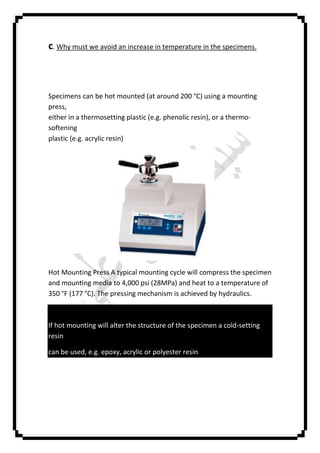
Hot Mounting Press A typical mounting cycle will compress the specimen
and moun ng media to 4,000 psi (28MPa) and heat to a temperature of
350 °F (177 °C). The pressing mechanism is achieved by hydraulics.
If hot mounting will alter the structure of the specimen a cold-setting
resin
can be used, e.g. epoxy, acrylic or polyester resin
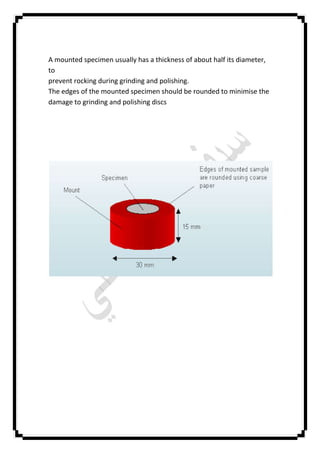
A mounted specimen usually has a thickness of about half its diameter,
to
prevent rocking during grinding and polishing.
The edges of the mounted specimen should be rounded to minimise the
damage to grinding and polishing discs
d. Why must we rotate the specimen 90' each me between polishing
phases.
Fine Grinding
 Each grinding stage removes the scratches from the previous coarser
paper.
 This is more easily achieved by orienting the specimen perpendicular
to the
previous scratches, and watching for these previously oriented scratches
to be
obliterated.
 Between each grade the specimen is washed thoroughly with soapy
water to
prevent contamination from coarser grit present on the specimen
surface.
 In general, successive steps are 240, 320, 400 and 600 grit SiC and the
grinding
rate should steadily decrease from one stage to the next.
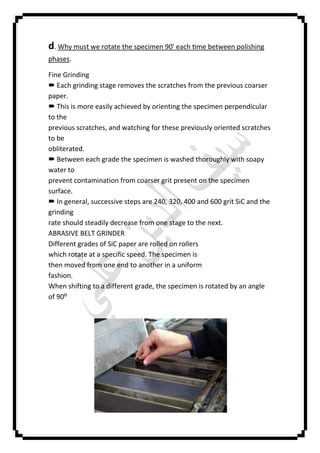
ABRASIVE BELT GRINDER
Different grades of SiC paper are rolled on rollers
which rotate at a specific speed. The specimen is
then moved from one end to another in a uniform
fashion.
When shifting to a different grade, the specimen is rotated by an angle
of 90⁰
e. How can we avoid the oxidation of the specimen's surface while
treating it with etching solution?
 After etching process, the specimen needs to be washed again in
distilled
water to remove any excess reagent present on it.
 If not washed, under microscopic observation, there might be
aberrations
in the colour of the sample.
 Also, slow and continuous reaction for a long time may take place
because of which we cannot use the sample for proper microscopic
observation.
 Cleaning can also be done by placing a drop of spirit and drying it.
 After washing, it can be dried using a low power blower.
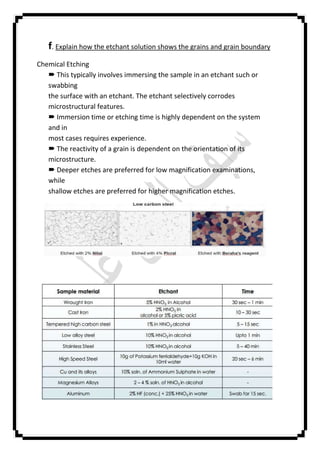
f. Explain how the etchant solution shows the grains and grain boundary
Chemical Etching
 This typically involves immersing the sample in an etchant such or
swabbing
the surface with an etchant. The etchant selectively corrodes
microstructural features.
 Immersion time or etching time is highly dependent on the system
and in
most cases requires experience.
 The reactivity of a grain is dependent on the orientation of its
microstructure.
 Deeper etches are preferred for low magnification examinations,
while
shallow etches are preferred for higher magnification etches.
Electrolytic Etching
 In electrolytic (anodic) etching, electrical
potential is applied to the specimen using
an external circuit
 During electrolytic etching, positive metal
ions leave the specimen surface and
diffuse into the electrolyte
 Typical examples are platinum, graphite
and stainless steels
In electrolytic (anodic) etching, electrical
potential is applied to the specimen using
During electrolytic etching, positive metal
ions leave the specimen surface and
diffuse into the electrolyte
Typical examples are platinum, graphite
g. Why are the grain boundaries oxidization more sever and are the 1"
to be oxidized than the grain surface themselves?
 Process of oxidizing a sample . This induces oxidation of surface
features at different rates, to reveal various features.
 Coloration of the surface takes place at different rates according to
the reaction characteristics of different elements
 The observed interference colours allow the differentiation of phases
and grains

Preparing a metal specimen for microscopic examination

  • 1.
    Baghdad University College ofEngineering Department of Mechanical Engineering Name of Experiment "Preparing a Metal Specimen for Microscopic Examination " Preparation: Saif al-Din Ali Madi The second phase Group "A "
  • 2.
    1.Name of Experiment: Preparinga Metal Specimen for Microscopic Examination. 2.The objec ve of the Experiment a. The determination of the size and shape of the grains. b. To specify what forms are present. c. To find if the specimen has undergone plastic or elastic deformation. d. To search for impurities. e. To find if it has inferior any phase changes 3. Devices Used for Experiment A. Microscope B. Steel Specimens C. tot Mounting Device D. Grinding Device E. Polishing Device F. Hot Air Dryer G. Etching solution for steel
  • 3.
    4. Experimental work Firstwe choose a specimen of suitable dimensions or cut a specimen to our requirements taking care not to raise its temperature. We then mount it and start the grinding process taking care to rinsing it with water when changing from one grade of grinding to another there are four grade starting from the roughest & gradually moving smoother one) using a polishing device which is a disk covered with billiard or buffer cloth diamond is spread and the polishing starts while constantly moving the specimen In an (8) shape over the polishing wheel. When we obtain a mirror like surface the specimen is then washed swapped gently with an etchant ( Netal : 98% alcohol + 2% HN ) just for a few seconds after which it is quickly rinsed with water and then alcohol and dried with a blow dryer.
  • 4.
    5. Discussion: a. Defineby what is meant by metallography A mineral is a naturally occurring chemical compound, usually of crystalline form and abiogenic in origin (not produced by life processes). A mineral has one specific chemical composition, whereas a rock can be an aggregate of different minerals or mineraloids. The study of minerals is called mineralogy. There are over 5,300 known mineral species; as of March 2017, over 5,230 of these had been approved by the Interna onal Mineralogical Associa on (IMA). The silicate minerals compose over 90% of the Earth's crust. Silicon and oxygen cons tute approximately 75% of the Earth's crust, which translates directly into the predominance of silicate minerals. Minerals are distinguished by various chemical and physical properties. Differences in chemical composition and crystal structure distinguish the various species, which were determined by the mineral's geological environment when formed. Changes in the temperature, pressure, or bulk composition of a rock mass cause changes in its minerals.
  • 5.
    b. What isthe difference between metallography and metallurgy? Mining : is the extraction of valuable metals, or other geological material from the ground, usually (and not always) of a raw object, a sweat or a coal incision. Materials obtained from mining include bauxite, coal, copper, gold, silver, diamonds, iron, precious metals, lead, limestone, moccasins, nickel, phosphate, rock, rock salt, tin, uranium and molybdenum. Any material that can not be developed by agricultural processes, or artificially created in a plant or plant, is usually obtained by mining. Mining in a more general sense involves the extraction of any undefined wealth (such as oil, natural gas, and even water). Mineralogy : is a subject of geology specializing in the scientific study of chemistry, crystal structure, and physical (including optical) properties of minerals and mineralized artifacts. Specific studies within mineralogy include the processes of mineral origin and formation, classification of minerals, their geographical distribution, as well as their utilization
  • 6.
    c. Why mustwe avoid an increase in temperature in the specimens. Specimens can be hot mounted (at around 200 °C) using a moun ng press, either in a thermosetting plastic (e.g. phenolic resin), or a thermo- softening plastic (e.g. acrylic resin) Hot Mounting Press A typical mounting cycle will compress the specimen and moun ng media to 4,000 psi (28MPa) and heat to a temperature of 350 °F (177 °C). The pressing mechanism is achieved by hydraulics. If hot mounting will alter the structure of the specimen a cold-setting resin can be used, e.g. epoxy, acrylic or polyester resin
  • 7.
    A mounted specimenusually has a thickness of about half its diameter, to prevent rocking during grinding and polishing. The edges of the mounted specimen should be rounded to minimise the damage to grinding and polishing discs
  • 8.
    d. Why mustwe rotate the specimen 90' each me between polishing phases. Fine Grinding  Each grinding stage removes the scratches from the previous coarser paper.  This is more easily achieved by orienting the specimen perpendicular to the previous scratches, and watching for these previously oriented scratches to be obliterated.  Between each grade the specimen is washed thoroughly with soapy water to prevent contamination from coarser grit present on the specimen surface.  In general, successive steps are 240, 320, 400 and 600 grit SiC and the grinding rate should steadily decrease from one stage to the next. ABRASIVE BELT GRINDER Different grades of SiC paper are rolled on rollers which rotate at a specific speed. The specimen is then moved from one end to another in a uniform fashion. When shifting to a different grade, the specimen is rotated by an angle of 90⁰
  • 9.
    e. How canwe avoid the oxidation of the specimen's surface while treating it with etching solution?  After etching process, the specimen needs to be washed again in distilled water to remove any excess reagent present on it.  If not washed, under microscopic observation, there might be aberrations in the colour of the sample.  Also, slow and continuous reaction for a long time may take place because of which we cannot use the sample for proper microscopic observation.  Cleaning can also be done by placing a drop of spirit and drying it.  After washing, it can be dried using a low power blower.
  • 10.
    f. Explain howthe etchant solution shows the grains and grain boundary Chemical Etching  This typically involves immersing the sample in an etchant such or swabbing the surface with an etchant. The etchant selectively corrodes microstructural features.  Immersion time or etching time is highly dependent on the system and in most cases requires experience.  The reactivity of a grain is dependent on the orientation of its microstructure.  Deeper etches are preferred for low magnification examinations, while shallow etches are preferred for higher magnification etches.
  • 11.
    Electrolytic Etching  Inelectrolytic (anodic) etching, electrical potential is applied to the specimen using an external circuit  During electrolytic etching, positive metal ions leave the specimen surface and diffuse into the electrolyte  Typical examples are platinum, graphite and stainless steels In electrolytic (anodic) etching, electrical potential is applied to the specimen using During electrolytic etching, positive metal ions leave the specimen surface and diffuse into the electrolyte Typical examples are platinum, graphite
  • 12.
    g. Why arethe grain boundaries oxidization more sever and are the 1" to be oxidized than the grain surface themselves?  Process of oxidizing a sample . This induces oxidation of surface features at different rates, to reveal various features.  Coloration of the surface takes place at different rates according to the reaction characteristics of different elements  The observed interference colours allow the differentiation of phases and grains