Authentication
Authentication is a process of validating who you are to
  whom you claimed to be.

 Human authentication techniques are as follows:
    1.Knowledge Based (What you know)
    2.Token Based(what you have)
    3.Biometrics(what you are)
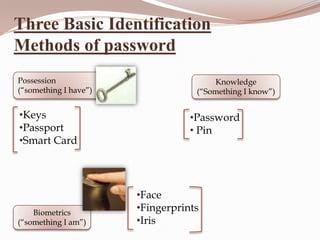
Three Basic Identification
Methods of password
Possession                             Knowledge
(“something I have”)               (“Something I know”)


•Keys                             •Password
•Passport                         • Pin
•Smart Card


                       •Face
    Biometrics
                       •Fingerprints
(“something I am”)     •Iris
• Password is basically an encryption
 algorithms.

 It is 8-15 character or slightly more than that.


 Mostly textual passwords nowadays are kept which are
  very simple.
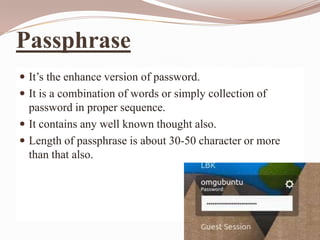
Passphrase
 It’s the enhance version of password.
 It is a combination of words or simply collection of
  password in proper sequence.
 It contains any well known thought also.
 Length of passphrase is about 30-50 character or more
  than that also.
B
I
O
M
E
T
R
I
C
S
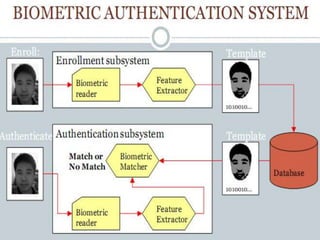
Biometrics

•Refer to a broad range of
 technologies.


•Automate the identification
or verification of an individual.
Based on human characteristics or body organs
Process
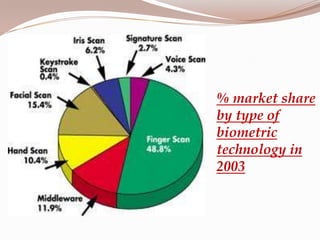
% market share
by type of
biometric
technology in
2003
PASSWORD
           •How secure is your password?

             Now with the technology
             change, fast processors and many
             tools on the Internet, cracking
             password has become a Child's
             Play.
             Ten years back Klein performed
             such tests and he could crack 10-15
             passwords per day.
PASSPHRASE

•Passphrase length is about 30-50 characters or
more than that so it creates ambiguity to remember
if there is no any proper sequence.
BIOMETRICS
•Biometrics has also some
drawbacks.

Suppose you select your fingerprint
as a biometrics..

But what to do when you have crack
or wound in your finger.

And now a days some hackers even
implement exact copy of your
biometrics also….
3D PASSWORD
•The 3D passwords which are more
customizable, and very interesting way of
authentication.

•A 3D password is a multifactor
authentication scheme that
combine

 RECOGNITION
    +RECALL
      +TOKENS
         +BIOMETRICS

 in one authentication system.
 The 3D password presents a virtual environment
  containing various virtual objects.

 The user walks through the environment and interacts
  with the objects.

 It is the combination and sequence of user interactions
  that occur in the 3D environment.
 This is achieved through interacting only with the objects that
  acquire information that the user is comfortable in providing.


It becomes much more difficult for the attacker to guess the user’s
   3-D password.
Virtual objects
 Virtual objects can be any object we encounter in real life:
           A computer on which the user can type in
           A fingerprint reader that requires users fingerprint
           A paper or white board on which user can type
           An Automated teller(ATM) machine that requires a
            token
           A light that can be switched on/off
           A television or radio
           A car that can be driven
           A graphical password scheme
Snapshot of a proof - of - concept virtual
    art gallery , which contains 36
      pictures and six computers
3D VIRTUAL
ENVIRONMENT
3D Virtual Environment
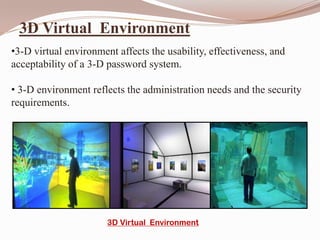
•3-D virtual environment affects the usability, effectiveness, and
acceptability of a 3-D password system.

• 3-D environment reflects the administration needs and the security
requirements.


                       3D Virtual Environment
The design of 3D virtual
environments should follow
these guidelines:

Real Life Similarity
Object Uniqueness & Distinction
3D Virtual Environment Size
Number of objects & their types
System Importance
Advantages
              Flexibility
              Strength
              Ease to Memorize
              Respect of Privacy
Applications

 The 3D password’s main application domains are protecting
 critical systems and resources.

 Critical Servers
 Nuclear Reactors & military Facilities
 Airplanes and missile Guiding
A small virtual environment can be used in the following
 systems like-

Atm


Personal digital assistance


Desktop computers & laptops


Web authentication etc.
Attacks and Countermeasures

 Brute Force Attack


 Well studied Attack


 Shoulder-surfing Attack
Conclusion
 •The authentication can be improved with 3d
 password ,because the unauthorized person may not
 interact with same object at a particular location as
 the legitimate user.

 •It is difficult to crack ,because it has no fixed
 number of steps and a particular procedure.

 •Added with biometrics and token verification this
 schema becomes almost unbreakable.
QUERIES
3D password

3D password

  • 2.
    Authentication Authentication is aprocess of validating who you are to whom you claimed to be.  Human authentication techniques are as follows: 1.Knowledge Based (What you know) 2.Token Based(what you have) 3.Biometrics(what you are)
  • 3.
    Three Basic Identification Methodsof password Possession Knowledge (“something I have”) (“Something I know”) •Keys •Password •Passport • Pin •Smart Card •Face Biometrics •Fingerprints (“something I am”) •Iris
  • 5.
    • Password isbasically an encryption algorithms.  It is 8-15 character or slightly more than that.  Mostly textual passwords nowadays are kept which are very simple.
  • 6.
    Passphrase  It’s theenhance version of password.  It is a combination of words or simply collection of password in proper sequence.  It contains any well known thought also.  Length of passphrase is about 30-50 character or more than that also.
  • 7.
  • 8.
    Biometrics •Refer to abroad range of technologies. •Automate the identification or verification of an individual.
  • 9.
    Based on humancharacteristics or body organs
  • 10.
  • 11.
    % market share bytype of biometric technology in 2003
  • 13.
    PASSWORD •How secure is your password? Now with the technology change, fast processors and many tools on the Internet, cracking password has become a Child's Play. Ten years back Klein performed such tests and he could crack 10-15 passwords per day.
  • 14.
    PASSPHRASE •Passphrase length isabout 30-50 characters or more than that so it creates ambiguity to remember if there is no any proper sequence.
  • 15.
    BIOMETRICS •Biometrics has alsosome drawbacks. Suppose you select your fingerprint as a biometrics.. But what to do when you have crack or wound in your finger. And now a days some hackers even implement exact copy of your biometrics also….
  • 16.
  • 17.
    •The 3D passwordswhich are more customizable, and very interesting way of authentication. •A 3D password is a multifactor authentication scheme that combine RECOGNITION +RECALL +TOKENS +BIOMETRICS in one authentication system.
  • 18.
     The 3Dpassword presents a virtual environment containing various virtual objects.  The user walks through the environment and interacts with the objects.  It is the combination and sequence of user interactions that occur in the 3D environment.
  • 19.
     This isachieved through interacting only with the objects that acquire information that the user is comfortable in providing. It becomes much more difficult for the attacker to guess the user’s 3-D password.
  • 20.
    Virtual objects  Virtualobjects can be any object we encounter in real life: A computer on which the user can type in A fingerprint reader that requires users fingerprint A paper or white board on which user can type An Automated teller(ATM) machine that requires a token A light that can be switched on/off A television or radio A car that can be driven A graphical password scheme
  • 21.
    Snapshot of aproof - of - concept virtual art gallery , which contains 36 pictures and six computers
  • 22.
  • 23.
    3D Virtual Environment •3-Dvirtual environment affects the usability, effectiveness, and acceptability of a 3-D password system. • 3-D environment reflects the administration needs and the security requirements. 3D Virtual Environment
  • 24.
    The design of3D virtual environments should follow these guidelines: Real Life Similarity Object Uniqueness & Distinction 3D Virtual Environment Size Number of objects & their types System Importance
  • 25.
    Advantages  Flexibility  Strength  Ease to Memorize  Respect of Privacy
  • 26.
    Applications The 3Dpassword’s main application domains are protecting critical systems and resources.  Critical Servers  Nuclear Reactors & military Facilities  Airplanes and missile Guiding
  • 27.
    A small virtualenvironment can be used in the following systems like- Atm Personal digital assistance Desktop computers & laptops Web authentication etc.
  • 28.
    Attacks and Countermeasures Brute Force Attack  Well studied Attack  Shoulder-surfing Attack
  • 29.
    Conclusion •The authenticationcan be improved with 3d password ,because the unauthorized person may not interact with same object at a particular location as the legitimate user. •It is difficult to crack ,because it has no fixed number of steps and a particular procedure. •Added with biometrics and token verification this schema becomes almost unbreakable.
  • 30.