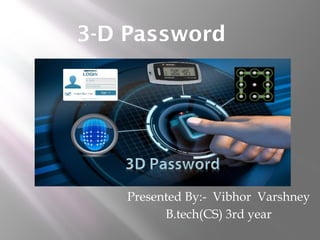

3-D Password
Presented By:- Vibhor Varshney
B.tech(CS) 3rd year
Contents
 Introduction
 Authentication/ Authentication techniques
 Password and Passphrase
 3-D Password
 Virtual Objects
 State Diagram
 Applications
 Advantages / Dis-advantages
 Conclusion
Introduction
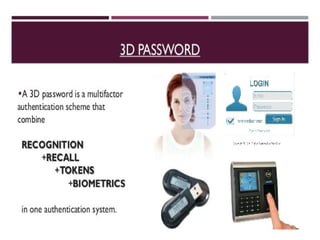
 The 3-D password is a multifactor
authentication scheme.
 It can combine all existing authentication
schemes into a single 3-D virtual environment.
 This 3-D virtual environment contains several
objects or items with which the user can
interact.
 This type of interaction varies from one item to
another.
Authentication
Authentication is a process of validating who you are
to whom you claimed to be.
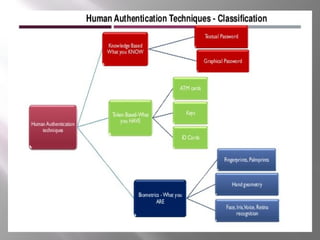
 Human authentication techniques are as follows:
1. Knowledge Based (What you know)
2. Token Based (What you have)
3. Biometrics (What you are)
Password
• Password is basically an encryption
algorithms.
 It is 8-15 character or slightly more than that.
 Mostly textual passwords nowadays are
kept which are very simple.
Passphrase
• Enhanced version of password.
• Combination of words or simply a collection of
passwords in proper sequence.
• Length is about 30 – 50 characters or more than
that also creates ambiguity to remember if
there is no proper sequence.
Conti…
 The 3D password presents a virtual environment
containing various virtual objects.
 The user walks through the environment and
interacts with the objects.
 It is the combination and sequence of user
interactions that occur in the 3D environment.
Conti…
 This is achieved through interacting only with the
objects that acquire information that the user is
comfortable in providing.
 It becomes much more difficult for the attacker to
guess the user’s 3-D password.
Virtual objects
 Virtual objects can be any object we encounter in real life:
●
A computer on which the user can type in.
●
A fingerprint reader that requires users fingerprint.
●
A paper or white board on which user can type.
●
An Automated teller(ATM) machine that requires a
token.
●
A light that can be switched on/off.
●
A television or radio where channels can be selected.
●
A car that can be driven.
●
A graphical password scheme.
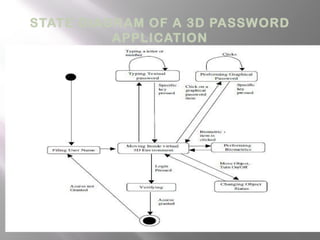
STATE DIAGRAM OF A 3D PASSWORD
APPLICATION
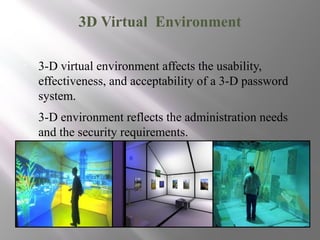
3D Virtual Environment
• 3-D virtual environment affects the usability,
effectiveness, and acceptability of a 3-D password
system.
• 3-D environment reflects the administration needs
and the security requirements.
3D PASSWORD APPLICATION
 Critical server many large organizations have critical
servers that are usually protected by a textual password. A
3D password authentication proposes a sound replacement
for a textual password.
 Nuclear and military facilities such facilities should be
protected by the most.
 Powerful authentication systems. The 3D password has a
very large probable password space, and since it can
contain token, biometrics, recognition and knowledge
based.
Conti..
 Authentications in a single authentication system, it
is a sound choice for high level security locations.
 In small virtual environments:
• ATM
• Personal Digital Assistance
• Desktop Computers & laptop logins
• Web Authentication
Advantages
 Flexibility:3D Passwords allows Multifactor
authentication biometric , textual passwords can be
embedded in 3D password technology.
 Strength: This scenario provides almost unlimited
passwords possibility.
 Ease to Memorize: can be remembered in the form
of short story.
 Respect of Privacy: Organizers can select
authentication schemes that respect users privacy.
Dis-advantages
 Shoulder Surfing Attacks: Attacker uses camera to
record the users 3D passwords. This attack is more
successful.
 Timing Attack: The Attacker observes how long it
takes the legitimate user to perform correct log in
using 3D Password. Which gives an indication of 3-D
Passwords length. This attack cannot be successful
since it gives the attacker mere hints.
3 d password
3 d password

3 d password

  • 1.
    3-D Password Presented By:-Vibhor Varshney B.tech(CS) 3rd year
  • 2.
    Contents  Introduction  Authentication/Authentication techniques  Password and Passphrase  3-D Password  Virtual Objects  State Diagram  Applications  Advantages / Dis-advantages  Conclusion
  • 3.
    Introduction  The 3-Dpassword is a multifactor authentication scheme.  It can combine all existing authentication schemes into a single 3-D virtual environment.  This 3-D virtual environment contains several objects or items with which the user can interact.  This type of interaction varies from one item to another.
  • 4.
    Authentication Authentication is aprocess of validating who you are to whom you claimed to be.  Human authentication techniques are as follows: 1. Knowledge Based (What you know) 2. Token Based (What you have) 3. Biometrics (What you are)
  • 6.
    Password • Password isbasically an encryption algorithms.  It is 8-15 character or slightly more than that.  Mostly textual passwords nowadays are kept which are very simple.
  • 7.
    Passphrase • Enhanced versionof password. • Combination of words or simply a collection of passwords in proper sequence. • Length is about 30 – 50 characters or more than that also creates ambiguity to remember if there is no proper sequence.
  • 9.
    Conti…  The 3Dpassword presents a virtual environment containing various virtual objects.  The user walks through the environment and interacts with the objects.  It is the combination and sequence of user interactions that occur in the 3D environment.
  • 10.
    Conti…  This isachieved through interacting only with the objects that acquire information that the user is comfortable in providing.  It becomes much more difficult for the attacker to guess the user’s 3-D password.
  • 11.
    Virtual objects  Virtualobjects can be any object we encounter in real life: ● A computer on which the user can type in. ● A fingerprint reader that requires users fingerprint. ● A paper or white board on which user can type. ● An Automated teller(ATM) machine that requires a token. ● A light that can be switched on/off. ● A television or radio where channels can be selected. ● A car that can be driven. ● A graphical password scheme.
  • 12.
    STATE DIAGRAM OFA 3D PASSWORD APPLICATION
  • 13.
    3D Virtual Environment •3-D virtual environment affects the usability, effectiveness, and acceptability of a 3-D password system. • 3-D environment reflects the administration needs and the security requirements.
  • 15.
    3D PASSWORD APPLICATION Critical server many large organizations have critical servers that are usually protected by a textual password. A 3D password authentication proposes a sound replacement for a textual password.  Nuclear and military facilities such facilities should be protected by the most.  Powerful authentication systems. The 3D password has a very large probable password space, and since it can contain token, biometrics, recognition and knowledge based.
  • 16.
    Conti..  Authentications ina single authentication system, it is a sound choice for high level security locations.  In small virtual environments: • ATM • Personal Digital Assistance • Desktop Computers & laptop logins • Web Authentication
  • 17.
    Advantages  Flexibility:3D Passwordsallows Multifactor authentication biometric , textual passwords can be embedded in 3D password technology.  Strength: This scenario provides almost unlimited passwords possibility.  Ease to Memorize: can be remembered in the form of short story.  Respect of Privacy: Organizers can select authentication schemes that respect users privacy.
  • 18.
    Dis-advantages  Shoulder SurfingAttacks: Attacker uses camera to record the users 3D passwords. This attack is more successful.  Timing Attack: The Attacker observes how long it takes the legitimate user to perform correct log in using 3D Password. Which gives an indication of 3-D Passwords length. This attack cannot be successful since it gives the attacker mere hints.