
Index
1. 3D Lighting Techniques in Animation
2. 6 3D Lighting Techniques
1. Spot Light
2. Area Light
3. Directional Light
4. Volume Light
5. Omni Light
6. Ambient Light
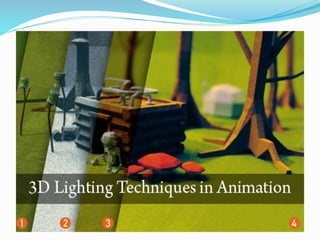
3D Lighting Techniques in
Animation
 There are several wells established in 3D lighting
techniques, and it is often predetermined by type of an
environment, which technique is most appropriate in
the case.
 Some 3D Lighting techniques in animation work well
in an interior environment and make little sense in
exterior modeling.
1. Spot Light
 There are target spotlights and free sports, and it
means that they have no target spotlights and free
sports, which means that they have no target objects.
It is often used to simulate light fixture.
 Example: Desk lamps or streetlights as it casts a
focused ray of light.
2. Area Light
 Area lights emit light within a set boundary of a
certain size and shape.
 This type of light source is often used in the
visualization of architectural models as well as in
product lightning.
 Area lights produce soft-edged shadows that make the
rendering look more realistic.
3. Directional Light
 It is the opposite of Omni light, and it presents a very
distant source of light.
 Directional rays go parallel in a single direction.
 This type of 3D lighting is used to simulate the
sunlight.
 To change the illumination of the scene, you can adjust
the position or color of light and rotate the directional
light source.
4. Volume Light
 It casts rays in all directions from a certain point.
 A volume light has a specified shape and size.
 This volumetric light illuminates only surfaces within
the set volume.
 Volume Light provides the effect of smoke, fog, and so
on.
5. Omni Light
 A point light casts rays in every direction from a single,
small source in the 3D environment.
 It has no specific shape and size. Point lights can add
“fill lighting” effect to a 3D scene, as well as simulate
any light source like Christmas tree lights, candles or
others.
6. Ambient Light
 It casts soft rays in every direction, though it has no
specific directionality and emits no shadow on the
ground.
 It can be compared to dusk after the sunset.
 Often it sources in addition to the color of the main
light source for a 3D scene.
 Usage of 3D lighting technique explained above is
extensive, from simple point studio to complex
animated scenes.
 3D designers and animators always use several lighting
techniques in animation to light a 3D scene.
 It is almost impossible to find a scene with only
directional lights, or only point lights, etc. We can say
that certain light types are good for certain 3D scenes.
Thank You

3D Lighting Techniques in Animation

  • 2.
    Index 1. 3D LightingTechniques in Animation 2. 6 3D Lighting Techniques 1. Spot Light 2. Area Light 3. Directional Light 4. Volume Light 5. Omni Light 6. Ambient Light
  • 3.
    3D Lighting Techniquesin Animation  There are several wells established in 3D lighting techniques, and it is often predetermined by type of an environment, which technique is most appropriate in the case.  Some 3D Lighting techniques in animation work well in an interior environment and make little sense in exterior modeling.
  • 5.
    1. Spot Light There are target spotlights and free sports, and it means that they have no target spotlights and free sports, which means that they have no target objects. It is often used to simulate light fixture.  Example: Desk lamps or streetlights as it casts a focused ray of light.
  • 6.
    2. Area Light Area lights emit light within a set boundary of a certain size and shape.  This type of light source is often used in the visualization of architectural models as well as in product lightning.  Area lights produce soft-edged shadows that make the rendering look more realistic.
  • 7.
    3. Directional Light It is the opposite of Omni light, and it presents a very distant source of light.  Directional rays go parallel in a single direction.  This type of 3D lighting is used to simulate the sunlight.
  • 8.
     To changethe illumination of the scene, you can adjust the position or color of light and rotate the directional light source.
  • 9.
    4. Volume Light It casts rays in all directions from a certain point.  A volume light has a specified shape and size.  This volumetric light illuminates only surfaces within the set volume.  Volume Light provides the effect of smoke, fog, and so on.
  • 10.
    5. Omni Light A point light casts rays in every direction from a single, small source in the 3D environment.  It has no specific shape and size. Point lights can add “fill lighting” effect to a 3D scene, as well as simulate any light source like Christmas tree lights, candles or others.
  • 11.
    6. Ambient Light It casts soft rays in every direction, though it has no specific directionality and emits no shadow on the ground.  It can be compared to dusk after the sunset.  Often it sources in addition to the color of the main light source for a 3D scene.
  • 12.
     Usage of3D lighting technique explained above is extensive, from simple point studio to complex animated scenes.  3D designers and animators always use several lighting techniques in animation to light a 3D scene.  It is almost impossible to find a scene with only directional lights, or only point lights, etc. We can say that certain light types are good for certain 3D scenes.
  • 13.