1


Lighting
The Principles of Lighting
 Preoccupied with daily life, most of us
  give only half an eye to the world around
  us.

 We respond to its influences but seldom
  scrutinize its effects all that closely.

 You recognize the effects, even if you
  have not considered their cause.
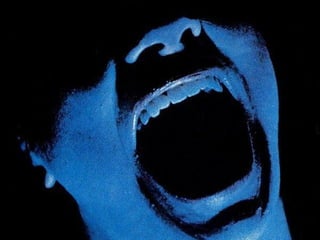
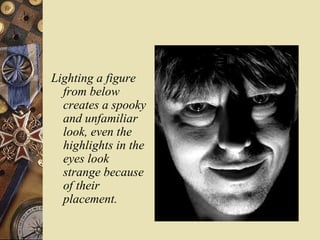
Lighting a figure
  from below
  creates a spooky
  and unfamiliar
  look, even the
  highlights in the
  eyes look
  strange because
  of their
  placement.
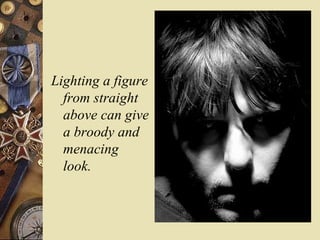
Lighting a figure
  from straight
  above can give
  a broody and
  menacing
  look.
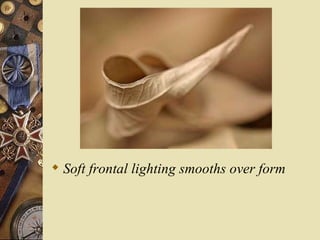
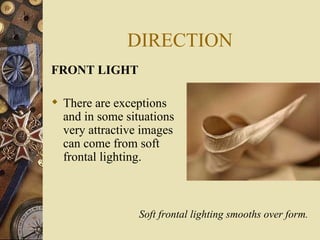
 Soft frontal lighting smooths over form
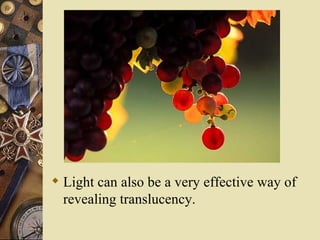
 Light can also be a very effective way of
  revealing translucency.
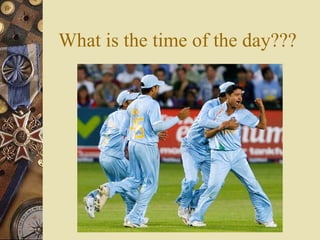
What is the time of the day???
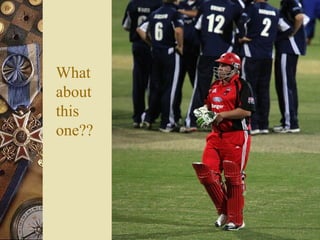
What
about
this
one??
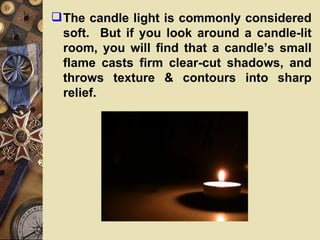
 The candle light is commonly considered
  soft. But if you look around a candle-lit
  room, you will find that a candle’s small
  flame casts firm clear-cut shadows, and
  throws texture & contours into sharp
  relief.
 While working with light, you will
  probably be surprised how many of its
  features are already familiar from
  everyday experience. Let us now
  consciously try and appreciate some of
  these features. Features Like:

   Direction
   Quality / Intensity
   Evenness
   Contrast
   Colour
   Source
DIRECTION
FRONT LIGHT

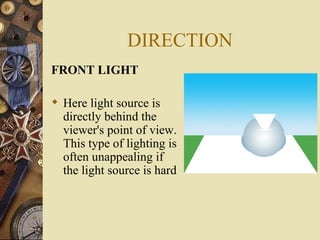
 Here light source is
  directly behind the
  viewer's point of view.
  This type of lighting is
  often unappealing if
  the light source is hard
DIRECTION
FRONT LIGHT
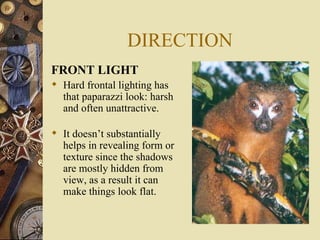
 Hard frontal lighting has
  that paparazzi look: harsh
  and often unattractive.

 It doesn’t substantially
  helps in revealing form or
  texture since the shadows
  are mostly hidden from
  view, as a result it can
  make things look flat.
DIRECTION
FRONT LIGHT

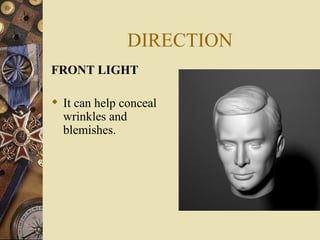
 It can help conceal
  wrinkles and
  blemishes.
DIRECTION
FRONT LIGHT

 There are exceptions
  and in some situations
  very attractive images
  can come from soft
  frontal lighting.


                 Soft frontal lighting smooths over form.
DIRECTION
SIDE LIGHT

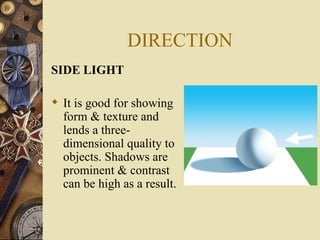
 It is good for showing
  form & texture and
  lends a three-
  dimensional quality to
  objects. Shadows are
  prominent & contrast
  can be high as a result.
DIRECTION
SIDE LIGHT

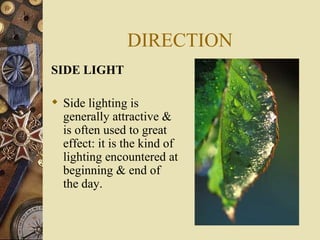
 Side lighting is
  generally attractive &
  is often used to great
  effect: it is the kind of
  lighting encountered at
  beginning & end of
  the day.
DIRECTION
SIDE LIGHT

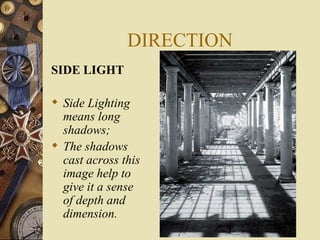
 Side Lighting
  means long
  shadows;
 The shadows
  cast across this
  image help to
  give it a sense
  of depth and
  dimension.
DIRECTION
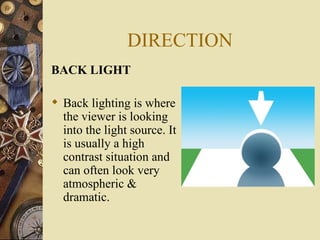
BACK LIGHT

 Back lighting is where
  the viewer is looking
  into the light source. It
  is usually a high
  contrast situation and
  can often look very
  atmospheric &
  dramatic.
DIRECTION
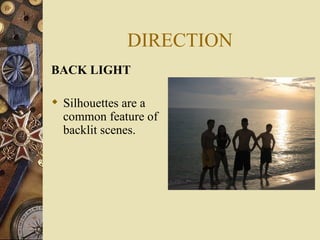
BACK LIGHT

 Silhouettes are a
  common feature of
  backlit scenes.
DIRECTION
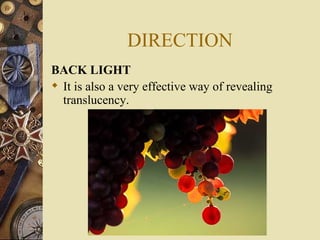
BACK LIGHT
 It is also a very effective way of revealing
  translucency.
DIRECTION
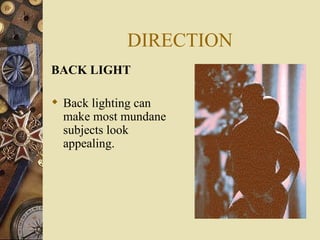
BACK LIGHT

 Back lighting can
  make most mundane
  subjects look
  appealing.
DIRECTION
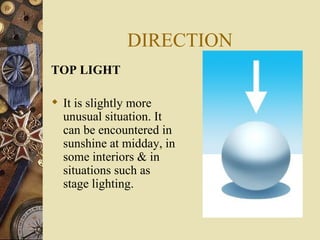
TOP LIGHT

 It is slightly more
  unusual situation. It
  can be encountered in
  sunshine at midday, in
  some interiors & in
  situations such as
  stage lighting.
DIRECTION
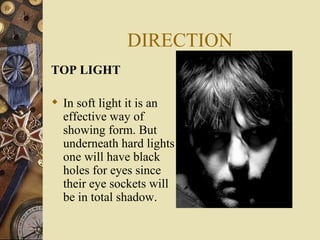
TOP LIGHT

 In soft light it is an
  effective way of
  showing form. But
  underneath hard lights
  one will have black
  holes for eyes since
  their eye sockets will
  be in total shadow.
DIRECTION
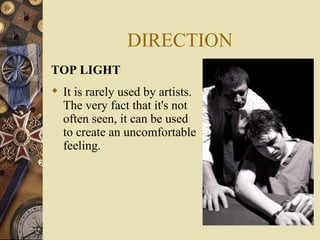
TOP LIGHT
 It is rarely used by artists.
  The very fact that it's not
  often seen, it can be used
  to create an uncomfortable
  feeling.
DIRECTION
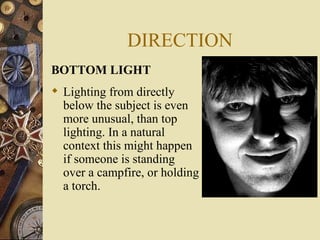
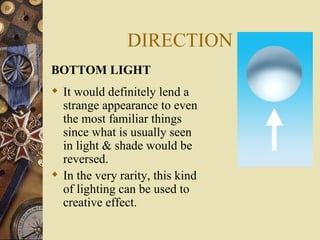
BOTTOM LIGHT
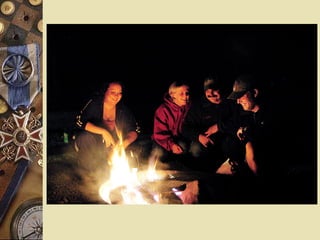
 Lighting from directly
  below the subject is even
  more unusual, than top
  lighting. In a natural
  context this might happen
  if someone is standing
  over a campfire, or holding
  a torch.
DIRECTION
BOTTOM LIGHT
 It would definitely lend a
  strange appearance to even
  the most familiar things
  since what is usually seen
  in light & shade would be
  reversed.
 In the very rarity, this kind
  of lighting can be used to
  creative effect.
Class 11 lighting

Class 11 lighting

  • 1.
  • 2.
    The Principles ofLighting  Preoccupied with daily life, most of us give only half an eye to the world around us.  We respond to its influences but seldom scrutinize its effects all that closely.  You recognize the effects, even if you have not considered their cause.
  • 4.
    Lighting a figure from below creates a spooky and unfamiliar look, even the highlights in the eyes look strange because of their placement.
  • 5.
    Lighting a figure from straight above can give a broody and menacing look.
  • 7.
     Soft frontallighting smooths over form
  • 8.
     Light canalso be a very effective way of revealing translucency.
  • 9.
    What is thetime of the day???
  • 10.
  • 11.
     The candlelight is commonly considered soft. But if you look around a candle-lit room, you will find that a candle’s small flame casts firm clear-cut shadows, and throws texture & contours into sharp relief.
  • 12.
     While workingwith light, you will probably be surprised how many of its features are already familiar from everyday experience. Let us now consciously try and appreciate some of these features. Features Like:  Direction  Quality / Intensity  Evenness  Contrast  Colour  Source
  • 13.
    DIRECTION FRONT LIGHT  Herelight source is directly behind the viewer's point of view. This type of lighting is often unappealing if the light source is hard
  • 14.
    DIRECTION FRONT LIGHT  Hardfrontal lighting has that paparazzi look: harsh and often unattractive.  It doesn’t substantially helps in revealing form or texture since the shadows are mostly hidden from view, as a result it can make things look flat.
  • 15.
    DIRECTION FRONT LIGHT  Itcan help conceal wrinkles and blemishes.
  • 16.
    DIRECTION FRONT LIGHT  Thereare exceptions and in some situations very attractive images can come from soft frontal lighting. Soft frontal lighting smooths over form.
  • 17.
    DIRECTION SIDE LIGHT  Itis good for showing form & texture and lends a three- dimensional quality to objects. Shadows are prominent & contrast can be high as a result.
  • 18.
    DIRECTION SIDE LIGHT  Sidelighting is generally attractive & is often used to great effect: it is the kind of lighting encountered at beginning & end of the day.
  • 19.
    DIRECTION SIDE LIGHT  SideLighting means long shadows;  The shadows cast across this image help to give it a sense of depth and dimension.
  • 20.
    DIRECTION BACK LIGHT  Backlighting is where the viewer is looking into the light source. It is usually a high contrast situation and can often look very atmospheric & dramatic.
  • 21.
    DIRECTION BACK LIGHT  Silhouettesare a common feature of backlit scenes.
  • 22.
    DIRECTION BACK LIGHT  Itis also a very effective way of revealing translucency.
  • 23.
    DIRECTION BACK LIGHT  Backlighting can make most mundane subjects look appealing.
  • 24.
    DIRECTION TOP LIGHT  Itis slightly more unusual situation. It can be encountered in sunshine at midday, in some interiors & in situations such as stage lighting.
  • 25.
    DIRECTION TOP LIGHT  Insoft light it is an effective way of showing form. But underneath hard lights one will have black holes for eyes since their eye sockets will be in total shadow.
  • 26.
    DIRECTION TOP LIGHT  Itis rarely used by artists. The very fact that it's not often seen, it can be used to create an uncomfortable feeling.
  • 27.
    DIRECTION BOTTOM LIGHT  Lightingfrom directly below the subject is even more unusual, than top lighting. In a natural context this might happen if someone is standing over a campfire, or holding a torch.
  • 28.
    DIRECTION BOTTOM LIGHT  Itwould definitely lend a strange appearance to even the most familiar things since what is usually seen in light & shade would be reversed.  In the very rarity, this kind of lighting can be used to creative effect.