Presented By:
K. Pavan kumar
15A51A1208
TOPICS TO BE DISCUSSED
• System
• Embedded System
• Components
• Classifications
• Processors
• Other Hardware
• Software
• Applications
INTRODUCTION
What is a system?
A system is a way of working,
organizing or doing one or many tasks
according to a fixed plan, program or
set of rules.
A system is also an arrangement in
which all its units assemble and work
together according to the plan or
program.
SYSTEM EXAMPLES:-
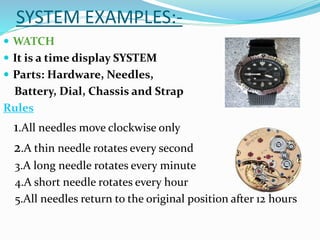
 WATCH
 It is a time display SYSTEM
 Parts: Hardware, Needles,
Battery, Dial, Chassis and Strap
Rules
1.All needles move clockwise only
2.A thin needle rotates every second
3.A long needle rotates every minute
4.A short needle rotates every hour
5.All needles return to the original position after 12 hours
WASHING MACHINE
 It is an automatic clothes washing SYSTEM
 Parts: Status display panel, Switches & Dials, Motor,
Power supply & control unit, Inner water level sensor and
solenoid valve.
Rules
1.Wash by spinning
2.Rinse
3.Drying
4.Wash over by blinking
5.Each step display the process stage
6.In case interruption, execute only the remaining
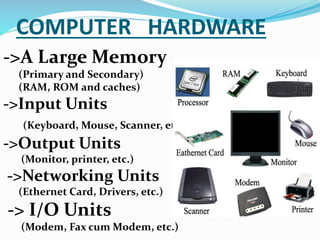
COMPUTER HARDWARE
->A Large Memory
(Primary and Secondary)
(RAM, ROM and caches)
->Input Units
(Keyboard, Mouse, Scanner, etc.)
->Output Units
(Monitor, printer, etc.)
->Networking Units
(Ethernet Card, Drivers, etc.)
-> I/O Units
(Modem, Fax cum Modem, etc.)
COMPONENTS OF EMBEDDED SYSTEM
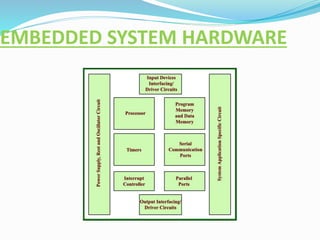
• It has Hardware
Processor, Timers, Interrupt controller, I/O Devices,
Memories, Ports,etc.
• It has main Application Software
Which may perform concurrently the series of tasks or
multiple tasks.
• It has Real Time Operating System
(RTOS)
RTOS defines the way the system work. Which supervise the
applicationsoftware. It sets the rules during the execution of
the applicationprogram. A small scale embedded system
may not need an RTOS.
EMBEDDED SYSTEM HARDWARE
EMBEDDED SYSTEM CONSTRAINTS
An embedded system is software designed to keep
in view three constraints:
– Available system memory
– Available processor speed
– The need to limit the power
dissipation
When running the system continuously in cycles of
wait forevents , run, stop and wakeup.
What makes embedded
systems different?
• Real-time operation
• size
• cost
• time
• reliability
• safety
• security
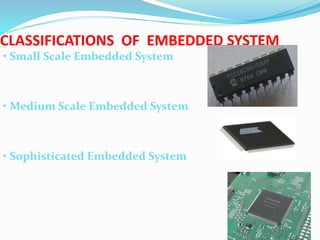
CLASSIFICATIONS OF EMBEDDED SYSTEM
• Small Scale Embedded System
• Medium Scale Embedded System
• Sophisticated Embedded System
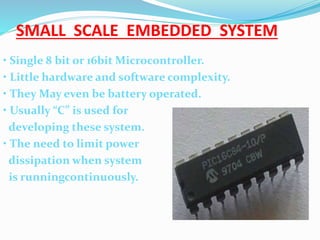
SMALL SCALE EMBEDDED SYSTEM
• Single 8 bit or 16bit Microcontroller.
• Little hardware and software complexity.
• They May even be battery operated.
• Usually “C” is used for
developing these system.
• The need to limit power
dissipation when system
is runningcontinuously.
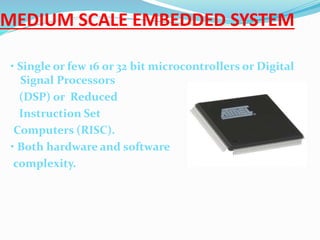
MEDIUM SCALE EMBEDDED SYSTEM
• Single or few 16 or 32 bit microcontrollers or Digital
Signal Processors
(DSP) or Reduced
Instruction Set
Computers (RISC).
• Both hardware and software
complexity.
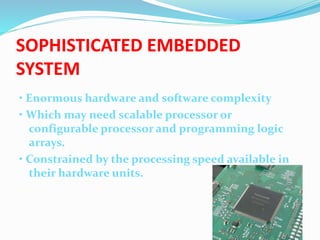
SOPHISTICATED EMBEDDED
SYSTEM
• Enormous hardware and software complexity
• Which may need scalable processor or
configurable processor and programming logic
arrays.
• Constrained by the processing speed available in
their hardware units.
PROCESSOR
• A Processor is the heart of the Embedded
System.
• For an embedded system designer knowledge of
microprocessor and microcontroller is a must.
Two Essential Units: Operations
Control Unit (CU), Fetch
Execution Unit (EU) Execute
VARIOUS PROCESSOR
1. General Purpose processor (GPP)
Microprocessor
Microcontroller
Embedded Processor
Digital signal Processor
2. Application Specific System Processor
(ASSP)
3. Multi Processor System using GPPs
MICROPROCESSOR
• A microprocessor is a single chip semi
conductor device also which is a computer on
chip, but not a complete computer.
• Its CPU contains an ALU, a program counter, a
stack pointer, some working register, a clock
timing circuit and interrupt circuit on a single
chip.
• To make complete micro computer, one must
add memory usually ROM and RAM, memory
decoder, an oscillator and a number of serial
and parallel ports.
MICROCONTROLLER
• A microcontroller is a functional
computer system-on-a-chip. It contains a
processor, memory, and programmable
input/output peripherals.
• Microcontrollers include an integrated
CPU, memory (a small amount of RAM,
program memory, or both) and peripherals
capable of input and output.
EMBEDDED PROCESSOR
 Special microprocessors &
microcontrollers
often called, Embedded processors.
 An embedded processor is used when
fast processing fast context-switching &
atomic ALU operations are needed.
->Examples : ARM 7, INTEL i960, AMD
29050.
DIGITAL SIGNAL PROCESSOR:-
 DSP as a GPP is a single chip VLSI unit.
 It includes the computational capabilities of
microprocessor and multiply & accumulate units
(MAC).
 DSP has large number of applications such as image
processing, audio, video & telecommunication
processing systems.
 It is used when signal processing functions are to be
processed fast.
 Examples : TMS320Cxx, SHARC, Motorola 5600xx
APPLICATION SPECIFIC SYSTEM
PROCESSOR (ASSP)
 ASSP is dedicated to specific tasks and
provides a faster solution.
 An ASSP is used as an additional processing
unit for running the application in place of
using embedded software.
 Examples : IIM7100, W3100A
MULTI PROCESSOR SYSTEM USING
GPPs:-
 Multiple processors are used when a
single processor does not meet the
needs of different task.
 The operations of all the processors are
synchronized to obtain an optimum
performance.
embedded systems ppt 2

embedded systems ppt 2

  • 1.
    Presented By: K. Pavankumar 15A51A1208
  • 2.
    TOPICS TO BEDISCUSSED • System • Embedded System • Components • Classifications • Processors • Other Hardware • Software • Applications
  • 3.
    INTRODUCTION What is asystem? A system is a way of working, organizing or doing one or many tasks according to a fixed plan, program or set of rules. A system is also an arrangement in which all its units assemble and work together according to the plan or program.
  • 4.
    SYSTEM EXAMPLES:-  WATCH It is a time display SYSTEM  Parts: Hardware, Needles, Battery, Dial, Chassis and Strap Rules 1.All needles move clockwise only 2.A thin needle rotates every second 3.A long needle rotates every minute 4.A short needle rotates every hour 5.All needles return to the original position after 12 hours
  • 5.
    WASHING MACHINE  Itis an automatic clothes washing SYSTEM  Parts: Status display panel, Switches & Dials, Motor, Power supply & control unit, Inner water level sensor and solenoid valve. Rules 1.Wash by spinning 2.Rinse 3.Drying 4.Wash over by blinking 5.Each step display the process stage 6.In case interruption, execute only the remaining
  • 7.
    COMPUTER HARDWARE ->A LargeMemory (Primary and Secondary) (RAM, ROM and caches) ->Input Units (Keyboard, Mouse, Scanner, etc.) ->Output Units (Monitor, printer, etc.) ->Networking Units (Ethernet Card, Drivers, etc.) -> I/O Units (Modem, Fax cum Modem, etc.)
  • 8.
    COMPONENTS OF EMBEDDEDSYSTEM • It has Hardware Processor, Timers, Interrupt controller, I/O Devices, Memories, Ports,etc. • It has main Application Software Which may perform concurrently the series of tasks or multiple tasks. • It has Real Time Operating System (RTOS) RTOS defines the way the system work. Which supervise the applicationsoftware. It sets the rules during the execution of the applicationprogram. A small scale embedded system may not need an RTOS.
  • 9.
  • 10.
    EMBEDDED SYSTEM CONSTRAINTS Anembedded system is software designed to keep in view three constraints: – Available system memory – Available processor speed – The need to limit the power dissipation When running the system continuously in cycles of wait forevents , run, stop and wakeup.
  • 11.
    What makes embedded systemsdifferent? • Real-time operation • size • cost • time • reliability • safety • security
  • 12.
    CLASSIFICATIONS OF EMBEDDEDSYSTEM • Small Scale Embedded System • Medium Scale Embedded System • Sophisticated Embedded System
  • 13.
    SMALL SCALE EMBEDDEDSYSTEM • Single 8 bit or 16bit Microcontroller. • Little hardware and software complexity. • They May even be battery operated. • Usually “C” is used for developing these system. • The need to limit power dissipation when system is runningcontinuously.
  • 14.
    MEDIUM SCALE EMBEDDEDSYSTEM • Single or few 16 or 32 bit microcontrollers or Digital Signal Processors (DSP) or Reduced Instruction Set Computers (RISC). • Both hardware and software complexity.
  • 15.
    SOPHISTICATED EMBEDDED SYSTEM • Enormoushardware and software complexity • Which may need scalable processor or configurable processor and programming logic arrays. • Constrained by the processing speed available in their hardware units.
  • 16.
    PROCESSOR • A Processoris the heart of the Embedded System. • For an embedded system designer knowledge of microprocessor and microcontroller is a must. Two Essential Units: Operations Control Unit (CU), Fetch Execution Unit (EU) Execute
  • 17.
    VARIOUS PROCESSOR 1. GeneralPurpose processor (GPP) Microprocessor Microcontroller Embedded Processor Digital signal Processor 2. Application Specific System Processor (ASSP) 3. Multi Processor System using GPPs
  • 18.
    MICROPROCESSOR • A microprocessoris a single chip semi conductor device also which is a computer on chip, but not a complete computer. • Its CPU contains an ALU, a program counter, a stack pointer, some working register, a clock timing circuit and interrupt circuit on a single chip. • To make complete micro computer, one must add memory usually ROM and RAM, memory decoder, an oscillator and a number of serial and parallel ports.
  • 21.
    MICROCONTROLLER • A microcontrolleris a functional computer system-on-a-chip. It contains a processor, memory, and programmable input/output peripherals. • Microcontrollers include an integrated CPU, memory (a small amount of RAM, program memory, or both) and peripherals capable of input and output.
  • 23.
    EMBEDDED PROCESSOR  Specialmicroprocessors & microcontrollers often called, Embedded processors.  An embedded processor is used when fast processing fast context-switching & atomic ALU operations are needed. ->Examples : ARM 7, INTEL i960, AMD 29050.
  • 24.
    DIGITAL SIGNAL PROCESSOR:- DSP as a GPP is a single chip VLSI unit.  It includes the computational capabilities of microprocessor and multiply & accumulate units (MAC).  DSP has large number of applications such as image processing, audio, video & telecommunication processing systems.  It is used when signal processing functions are to be processed fast.  Examples : TMS320Cxx, SHARC, Motorola 5600xx
  • 25.
    APPLICATION SPECIFIC SYSTEM PROCESSOR(ASSP)  ASSP is dedicated to specific tasks and provides a faster solution.  An ASSP is used as an additional processing unit for running the application in place of using embedded software.  Examples : IIM7100, W3100A
  • 26.
    MULTI PROCESSOR SYSTEMUSING GPPs:-  Multiple processors are used when a single processor does not meet the needs of different task.  The operations of all the processors are synchronized to obtain an optimum performance.