ROCKS
- We live on a rocky planet that spins on its axis
once a day and moves in an orbit around a star
(the sun) at 29 km/s.
- How did the star, the earth and its movements
come about?
BIG BANG
EXPLOSION
THE SCIENTISTS BELIEVE THAT THE UNIVERSE CAME INTO EXISTENCE WITH A HUGE EXPLOSION.
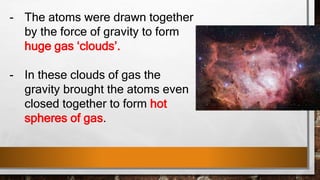
- The atoms were drawn together
by the force of gravity to form
huge gas ‘clouds’.
- In these clouds of gas the
gravity brought the atoms even
closed together to form hot
spheres of gas.
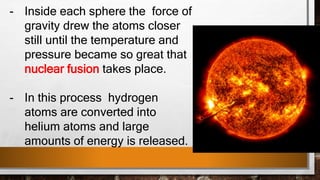
- Inside each sphere the force of
gravity drew the atoms closer
still until the temperature and
pressure became so great that
nuclear fusion takes place.
- In this process hydrogen
atoms are converted into
helium atoms and large
amounts of energy is released.
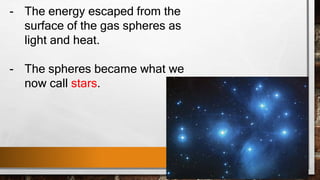
- The energy escaped from the
surface of the gas spheres as
light and heat.
- The spheres became what we
now call stars.
- When the star uses all its supply of hydrogen to
make helium, it starts using helium to make other
elements by nuclear fusion.
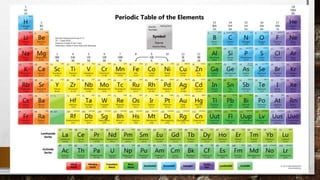
- These elements include carbon, nitrogen, oxygen,
sodium, magnesium, aluminium, silicon
phosphorus, sulphur, chlorine, potassium,
calcium, chromium and iron.
- After the star makes iron, it cannot form further
elements as iron is heavy and cannot be
compressed.
- The star may then swell up and form a giant red
star, then release gas and dust as a nebula
around it, and then shrink to form a white dwarf
star.
- Very large stars do not release gas and dust.
They explode forming a supernova and shoot out
gas and dust over a wide region in space.
- The conditions in very large stars allow larger
elements to be formed.
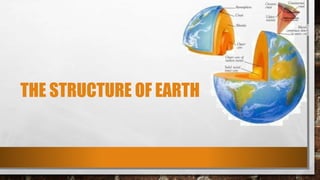
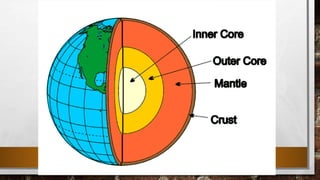
THE STRUCTURE OF EARTH
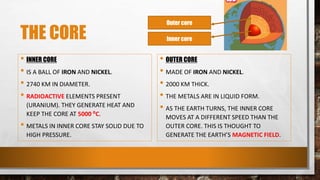
THE CORE
• INNER CORE
• IS A BALL OF IRON AND NICKEL.
• 2740 KM IN DIAMETER.
• RADIOACTIVE ELEMENTS PRESENT
(URANIUM). THEY GENERATE HEAT AND
KEEP THE CORE AT 5000 ⁰C.
• METALS IN INNER CORE STAY SOLID DUE TO
HIGH PRESSURE.
• OUTER CORE
• MADE OF IRON AND NICKEL.
• 2000 KM THICK.
• THE METALS ARE IN LIQUID FORM.
• AS THE EARTH TURNS, THE INNER CORE
MOVES AT A DIFFERENT SPEED THAN THE
OUTER CORE. THIS IS THOUGHT TO
GENERATE THE EARTH’S MAGNETIC FIELD.
Outer core
Inner core
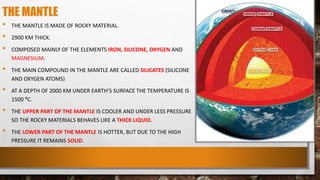
THE MANTLE
• THE MANTLE IS MADE OF ROCKY MATERIAL.
• 2900 KM THICK.
• COMPOSED MAINLY OF THE ELEMENTS IRON, SILICONE, OXYGEN AND
MAGNESIUM.
• THE MAIN COMPOUND IN THE MANTLE ARE CALLED SILICATES (SILICONE
AND OXYGEN ATOMS)
• AT A DEPTH OF 2000 KM UNDER EARTH’S SURFACE THE TEMPERATURE IS
1500 ⁰C.
• THE UPPER PART OF THE MANTLE IS COOLER AND UNDER LESS PRESSURE
SO THE ROCKY MATERIALS BEHAVES LIKE A THICK LIQUID.
• THE LOWER PART OF THE MANTLE IS HOTTER, BUT DUE TO THE HIGH
PRESSURE IT REMAINS SOLID.
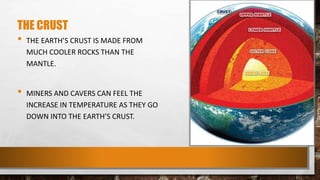
THE CRUST
• THE EARTH’S CRUST IS MADE FROM
MUCH COOLER ROCKS THAN THE
MANTLE.
• MINERS AND CAVERS CAN FEEL THE
INCREASE IN TEMPERATURE AS THEY GO
DOWN INTO THE EARTH’S CRUST.
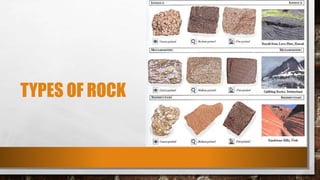
TYPES OF ROCK
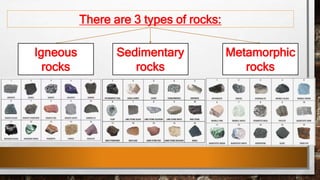
There are 3 types of rocks:
Igneous
rocks
Sedimentary
rocks
Metamorphic
rocks
1) Igneous rocks
( Also called fire rocks - form from magma)
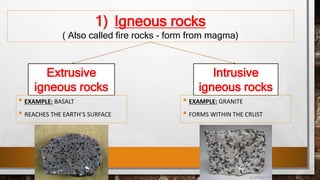
Extrusive
igneous rocks
Intrusive
igneous rocks
• EXAMPLE: BASALT
• REACHES THE EARTH’S SURFACE
• EXAMPLE: GRANITE
• FORMS WITHIN THE CRUST
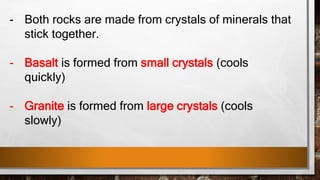
- Both rocks are made from crystals of minerals that
stick together.
- Basalt is formed from small crystals (cools
quickly)
- Granite is formed from large crystals (cools
slowly)
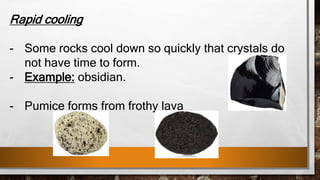
Rapid cooling
- Some rocks cool down so quickly that crystals do
not have time to form.
- Example: obsidian.
- Pumice forms from frothy lava
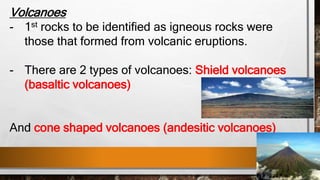
Volcanoes
- 1st rocks to be identified as igneous rocks were
those that formed from volcanic eruptions.
- There are 2 types of volcanoes: Shield volcanoes
(basaltic volcanoes)
And cone shaped volcanoes (andesitic volcanoes)
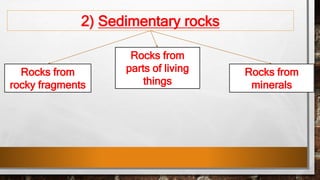
2) Sedimentary rocks
Rocks from
rocky fragments
Rocks from
minerals
Rocks from
parts of living
things
- Rocks are formed from rocky fragments and small
particles of sand that are produced by weathering.
- The rocky fragments and sand are carried by rivers and
settle out when the water current slows down.
- Over thousands or million of years the layers build up
and become squashed together due to the high
pressure.
a) Rocks from rocky fragments
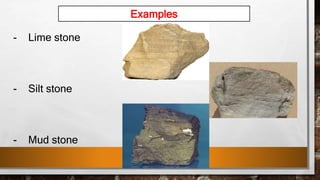
- Lime stone
- Silt stone
- Mud stone
Examples
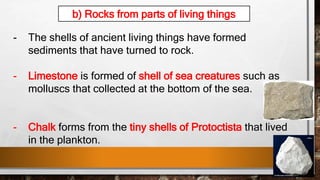
- The shells of ancient living things have formed
sediments that have turned to rock.
- Limestone is formed of shell of sea creatures such as
molluscs that collected at the bottom of the sea.
- Chalk forms from the tiny shells of Protoctista that lived
in the plankton.
b) Rocks from parts of living things
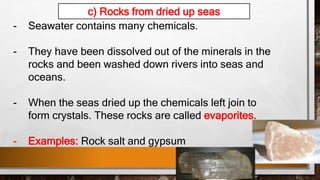
- Seawater contains many chemicals.
- They have been dissolved out of the minerals in the
rocks and been washed down rivers into seas and
oceans.
- When the seas dried up the chemicals left join to
form crystals. These rocks are called evaporites.
- Examples: Rock salt and gypsum
c) Rocks from dried up seas
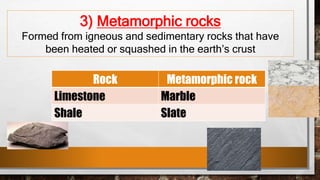
3) Metamorphic rocks
Formed from igneous and sedimentary rocks that have
been heated or squashed in the earth’s crust
Rock Metamorphic rock
Limestone Marble
Shale Slate
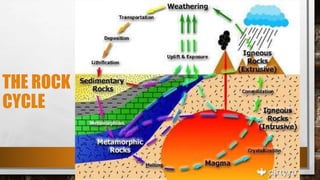
THE ROCK
CYCLE
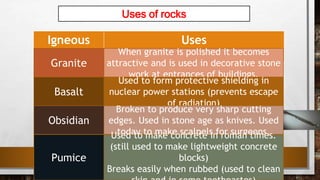
Uses of rocks
Igneous
rocks
Uses
Granite
When granite is polished it becomes
attractive and is used in decorative stone
work at entrances of buildings.
Basalt
Used to form protective shielding in
nuclear power stations (prevents escape
of radiation)
Obsidian
Broken to produce very sharp cutting
edges. Used in stone age as knives. Used
today to make scalpels for surgeons.
Pumice
Used to make concrete in roman times.
(still used to make lightweight concrete
blocks)
Breaks easily when rubbed (used to clean
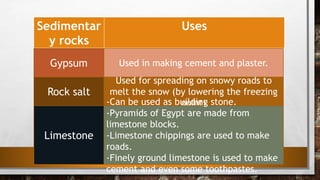
Sedimentar
y rocks
Uses
Gypsum Used in making cement and plaster.
Rock salt
Used for spreading on snowy roads to
melt the snow (by lowering the freezing
point)
Limestone
-Can be used as building stone.
-Pyramids of Egypt are made from
limestone blocks.
-Limestone chippings are used to make
roads.
-Finely ground limestone is used to make
cement and even some toothpastes.
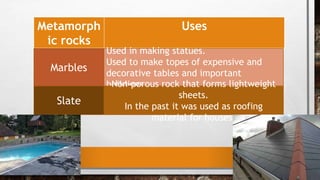
Metamorph
ic rocks
Uses
Marbles
Used in making statues.
Used to make topes of expensive and
decorative tables and important
buildings.
Slate
Non-porous rock that forms lightweight
sheets.
In the past it was used as roofing
material for houses.

38rocks and soil

  • 2.
    ROCKS - We liveon a rocky planet that spins on its axis once a day and moves in an orbit around a star (the sun) at 29 km/s. - How did the star, the earth and its movements come about?
  • 3.
    BIG BANG EXPLOSION THE SCIENTISTSBELIEVE THAT THE UNIVERSE CAME INTO EXISTENCE WITH A HUGE EXPLOSION.
  • 4.
    - The atomswere drawn together by the force of gravity to form huge gas ‘clouds’. - In these clouds of gas the gravity brought the atoms even closed together to form hot spheres of gas.
  • 5.
    - Inside eachsphere the force of gravity drew the atoms closer still until the temperature and pressure became so great that nuclear fusion takes place. - In this process hydrogen atoms are converted into helium atoms and large amounts of energy is released.
  • 6.
    - The energyescaped from the surface of the gas spheres as light and heat. - The spheres became what we now call stars.
  • 7.
    - When thestar uses all its supply of hydrogen to make helium, it starts using helium to make other elements by nuclear fusion. - These elements include carbon, nitrogen, oxygen, sodium, magnesium, aluminium, silicon phosphorus, sulphur, chlorine, potassium, calcium, chromium and iron.
  • 9.
    - After thestar makes iron, it cannot form further elements as iron is heavy and cannot be compressed. - The star may then swell up and form a giant red star, then release gas and dust as a nebula around it, and then shrink to form a white dwarf star.
  • 10.
    - Very largestars do not release gas and dust. They explode forming a supernova and shoot out gas and dust over a wide region in space. - The conditions in very large stars allow larger elements to be formed.
  • 11.
  • 13.
    THE CORE • INNERCORE • IS A BALL OF IRON AND NICKEL. • 2740 KM IN DIAMETER. • RADIOACTIVE ELEMENTS PRESENT (URANIUM). THEY GENERATE HEAT AND KEEP THE CORE AT 5000 ⁰C. • METALS IN INNER CORE STAY SOLID DUE TO HIGH PRESSURE. • OUTER CORE • MADE OF IRON AND NICKEL. • 2000 KM THICK. • THE METALS ARE IN LIQUID FORM. • AS THE EARTH TURNS, THE INNER CORE MOVES AT A DIFFERENT SPEED THAN THE OUTER CORE. THIS IS THOUGHT TO GENERATE THE EARTH’S MAGNETIC FIELD. Outer core Inner core
  • 14.
    THE MANTLE • THEMANTLE IS MADE OF ROCKY MATERIAL. • 2900 KM THICK. • COMPOSED MAINLY OF THE ELEMENTS IRON, SILICONE, OXYGEN AND MAGNESIUM. • THE MAIN COMPOUND IN THE MANTLE ARE CALLED SILICATES (SILICONE AND OXYGEN ATOMS) • AT A DEPTH OF 2000 KM UNDER EARTH’S SURFACE THE TEMPERATURE IS 1500 ⁰C. • THE UPPER PART OF THE MANTLE IS COOLER AND UNDER LESS PRESSURE SO THE ROCKY MATERIALS BEHAVES LIKE A THICK LIQUID. • THE LOWER PART OF THE MANTLE IS HOTTER, BUT DUE TO THE HIGH PRESSURE IT REMAINS SOLID.
  • 15.
    THE CRUST • THEEARTH’S CRUST IS MADE FROM MUCH COOLER ROCKS THAN THE MANTLE. • MINERS AND CAVERS CAN FEEL THE INCREASE IN TEMPERATURE AS THEY GO DOWN INTO THE EARTH’S CRUST.
  • 16.
  • 17.
    There are 3types of rocks: Igneous rocks Sedimentary rocks Metamorphic rocks
  • 18.
    1) Igneous rocks (Also called fire rocks - form from magma) Extrusive igneous rocks Intrusive igneous rocks • EXAMPLE: BASALT • REACHES THE EARTH’S SURFACE • EXAMPLE: GRANITE • FORMS WITHIN THE CRUST
  • 19.
    - Both rocksare made from crystals of minerals that stick together. - Basalt is formed from small crystals (cools quickly) - Granite is formed from large crystals (cools slowly)
  • 20.
    Rapid cooling - Somerocks cool down so quickly that crystals do not have time to form. - Example: obsidian. - Pumice forms from frothy lava
  • 21.
    Volcanoes - 1st rocksto be identified as igneous rocks were those that formed from volcanic eruptions. - There are 2 types of volcanoes: Shield volcanoes (basaltic volcanoes) And cone shaped volcanoes (andesitic volcanoes)
  • 22.
    2) Sedimentary rocks Rocksfrom rocky fragments Rocks from minerals Rocks from parts of living things
  • 23.
    - Rocks areformed from rocky fragments and small particles of sand that are produced by weathering. - The rocky fragments and sand are carried by rivers and settle out when the water current slows down. - Over thousands or million of years the layers build up and become squashed together due to the high pressure. a) Rocks from rocky fragments
  • 24.
    - Lime stone -Silt stone - Mud stone Examples
  • 25.
    - The shellsof ancient living things have formed sediments that have turned to rock. - Limestone is formed of shell of sea creatures such as molluscs that collected at the bottom of the sea. - Chalk forms from the tiny shells of Protoctista that lived in the plankton. b) Rocks from parts of living things
  • 26.
    - Seawater containsmany chemicals. - They have been dissolved out of the minerals in the rocks and been washed down rivers into seas and oceans. - When the seas dried up the chemicals left join to form crystals. These rocks are called evaporites. - Examples: Rock salt and gypsum c) Rocks from dried up seas
  • 27.
    3) Metamorphic rocks Formedfrom igneous and sedimentary rocks that have been heated or squashed in the earth’s crust Rock Metamorphic rock Limestone Marble Shale Slate
  • 28.
  • 29.
    Uses of rocks Igneous rocks Uses Granite Whengranite is polished it becomes attractive and is used in decorative stone work at entrances of buildings. Basalt Used to form protective shielding in nuclear power stations (prevents escape of radiation) Obsidian Broken to produce very sharp cutting edges. Used in stone age as knives. Used today to make scalpels for surgeons. Pumice Used to make concrete in roman times. (still used to make lightweight concrete blocks) Breaks easily when rubbed (used to clean
  • 30.
    Sedimentar y rocks Uses Gypsum Usedin making cement and plaster. Rock salt Used for spreading on snowy roads to melt the snow (by lowering the freezing point) Limestone -Can be used as building stone. -Pyramids of Egypt are made from limestone blocks. -Limestone chippings are used to make roads. -Finely ground limestone is used to make cement and even some toothpastes.
  • 31.
    Metamorph ic rocks Uses Marbles Used inmaking statues. Used to make topes of expensive and decorative tables and important buildings. Slate Non-porous rock that forms lightweight sheets. In the past it was used as roofing material for houses.