Chapter 7
Biology
(part 1)
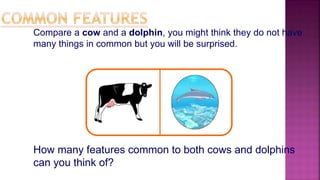
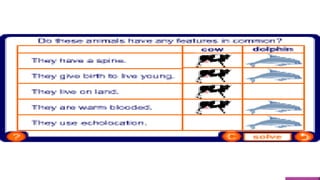
How many features common to both cows and dolphins
can you think of?
Compare a cow and a dolphin, you might think they do not have
many things in common but you will be surprised.
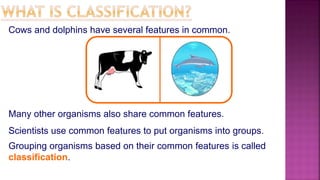
Cows and dolphins have several features in common.
Many other organisms also share common features.
Scientists use common features to put organisms into groups.
Grouping organisms based on their common features is called
classification.
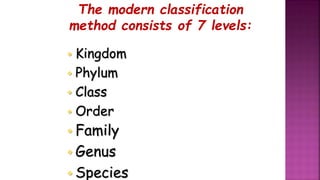
The modern classification
method consists of 7 levels:
 Kingdom
 Phylum
 Class
 Order
 Family
 Genus
 Species
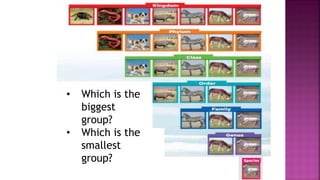
• Which is the
biggest
group?
• Which is the
smallest
group?
King Philip Came Over For Green
Skittles.
Kids Playing Catch On Freeway
Get Squashed.
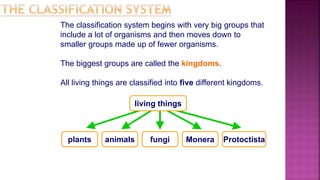
The classification system begins with very big groups that
include a lot of organisms and then moves down to
smaller groups made up of fewer organisms.
The biggest groups are called the kingdoms.
All living things are classified into five different kingdoms.
plants Protoctistaanimals Monerafungi
living things
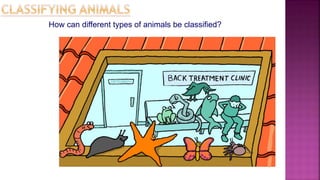
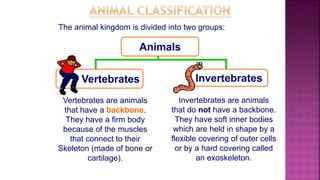
How can different types of animals be classified?
InvertebratesVertebrates
Animals
Invertebrates are animals
that do not have a backbone.
They have soft inner bodies
which are held in shape by a
flexible covering of outer cells
or by a hard covering called
an exoskeleton.
Vertebrates are animals
that have a backbone.
They have a firm body
because of the muscles
that connect to their
Skeleton (made of bone or
cartilage).
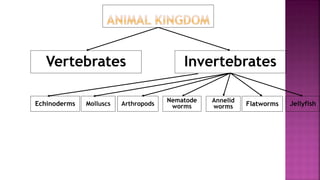
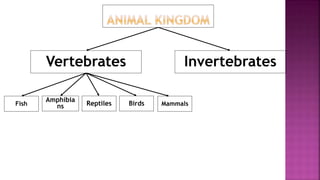
The animal kingdom is divided into two groups:
Vertebrates Invertebrates
JellyfishFlatworms
Annelid
worms
Nematode
wormsArthropodsMolluscsEchinoderms
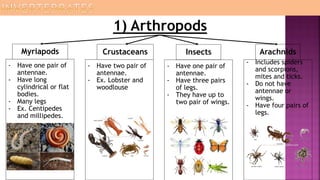
1) Arthropods
ArachnidsInsectsCrustaceansMyriapods
- Includes spiders
and scorpions,
mites and ticks.
- Do not have
antennae or
wings.
- Have four pairs of
legs.
- Have one pair of
antennae.
- Have three pairs
of legs.
- They have up to
two pair of wings.
- Have two pair of
antennae.
- Ex. Lobster and
woodlouse
- Have one pair of
antennae.
- Have long
cylindrical or flat
bodies.
- Many legs
- Ex. Centipedes
and millipedes.
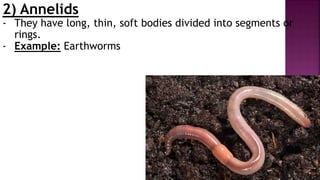
2) Annelids
- They have long, thin, soft bodies divided into segments or
rings.
- Example: Earthworms
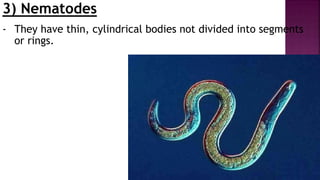
3) Nematodes
- They have thin, cylindrical bodies not divided into segments
or rings.
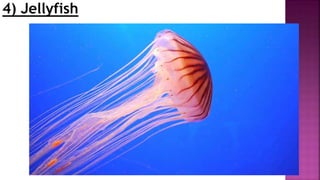
4) Jellyfish
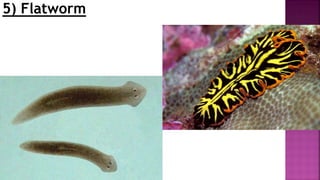
5) Flatworm
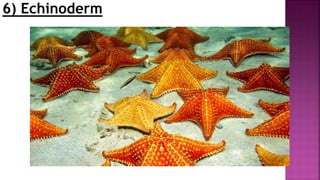
6) Echinoderm
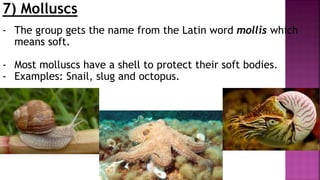
7) Molluscs
- The group gets the name from the Latin word mollis which
means soft.
- Most molluscs have a shell to protect their soft bodies.
- Examples: Snail, slug and octopus.
Vertebrates Invertebrates
BirdsReptiles
Amphibia
ns MammalsFish
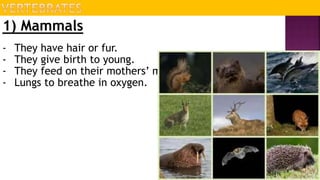
1) Mammals
- They have hair or fur.
- They give birth to young.
- They feed on their mothers’ milk.
- Lungs to breathe in oxygen.
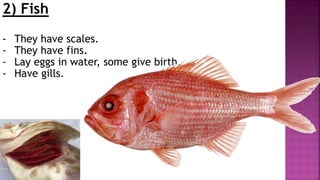
2) Fish
- They have scales.
- They have fins.
- Lay eggs in water, some give birth.
- Have gills.
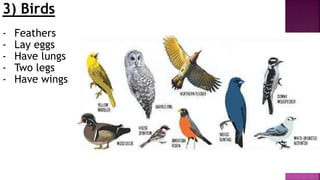
3) Birds
- Feathers
- Lay eggs
- Have lungs
- Two legs
- Have wings
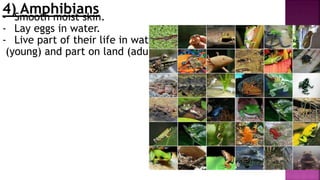
4) Amphibians- Smooth moist skin.
- Lay eggs in water.
- Live part of their life in water
(young) and part on land (adults).
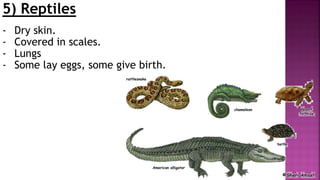
5) Reptiles
- Dry skin.
- Covered in scales.
- Lungs
- Some lay eggs, some give birth.

33classification (part 1)