Communication
People don’t get along
Because they fear each other
People fear each other
Because they don’t know each other
They don’t know each other
Because they have not
Communicated with each other
-Martin Luther King
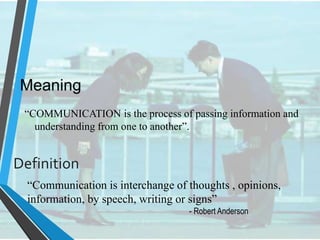
Meaning
“COMMUNICATION is the process of passing information and
understanding from one to another”.
Definition
“Communication is interchange of thoughts , opinions,
information, by speech, writing or signs”
- Robert Anderson
Important Characteristics of an
Effective Communication
1 .Clarity :
 One of the most essential characteristics of an impressive communication is "Clarity".
 Use Simple and Sound words, so that listeners can grab it easily.
 Be clear in your thoughts, jumbled & confused mind cannot deliver a good and clear saying.
 Avoid using any technical terms, try to explain in laymen language.
 Use Examples to explain & support complex scenarios.
 Work a little bit on your accent and pronunciation.
2. Aim or Goal :
• At every stage of your talk/communication, don't forget your "Aim or Goal".
• Communicate with a broad and practical mind.
3.Linkage
• Try to maintain a logic link between your sayings.
• Don't put two opposite faces of coin at a same time.
• Deliver in a structured & planned way.
4.Style of Expressing :
 Control various speech parameters like pitch, tone, intensity etc. according to the environment.
 Don't be too fast or too slow.
 Look straight & forward. Keep a light smile on your face.
 Avoid using words that show arrogance.
 Feel what you say.
 Avoid being too formal, be natural and practical.
5.Know & Analyze your audiences
6.Do a good Homework.
PURPOSE OF COMMUNICATION
1.Communication to inform:
Communication to inform is directed by the desire to expose, develop, and
explain the subject.
It focuses on the subject of the communication. Ex-Scientific writings.
2. Communication to Persuade
the focus is on the receiver and not the message
Communication Process
The Linear Concept
o Passive communication/one-way communication.
o This is the earliest conceptualization of communication.
o A receiver passively receives the message and acts as directed or desired by
the sender
o Assumed that the message reaches the receiver without any distortion or
change
o There is no response from the receiver of the message.
o audio tapes and CDs; videotapes; manuals; printed materials; faxes; radio
and TV broadcasts are some examples.
sender media receiver action
communication Process
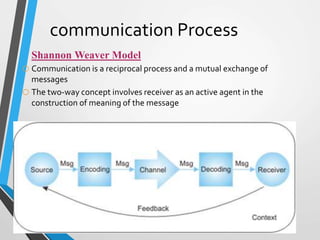
Shannon Weaver Model
oCommunication is a reciprocal process and a mutual exchange of
messages
oThe two-way concept involves receiver as an active agent in the
construction of meaning of the message
Importance of communication in management
Communication skills constitute an important aspect of
effective management.
Some important functions of managing are - forecasting ,
planning , organizing, instructing, coordinating, controlling.
Communication is the system by which these operations are
led and coordinated and the results fed back
Major Classifications of communications
Can be classified on basis of..…..
A) number of persons/ receivers to whom message is addressed :
i) Intrapersonal:- talking to one’s own self.
E.g. Soliloquies
ii) Interpersonal :- exchange of messages between two persons.
E.g. conversation, dialogue, an interview, some other cases like… an
author, a letter etc.
iii) Group:- Can be among small groups like organization, club, class
rooms where all individuals retain their individual identity
iv) Mass:- occurs when the message is sent to large groups of people
E.g. news paper, radio, T.V etc.
B) On basis of medium employed……
 i) Verbal:- means communicating with words, written or
spoken
 ii) Non verbal :- includes using of pictures signs, gestures
and facial expressions for exchanging information between
persons
 E.g. personal space, touch, eyes, sense of smell and time.
 iii) Meta communication:- the speaker’s choice of words
unintentionally communicates something more than what
the actual words state.
Communication Structure in an
Organization
Board of
directors/Trustee
Directors
Senior Management
Middle level management
Senior supervisors
First line supervisors
Employees/floor employees
Types of
communication
Vertical
Downward
Upward
Horizontal Grapevine
Barriers to Communication
Noise
Selective perceptions
Filtering
Information overload
Loss by transmission
Poor retention
Poor listening
Emotions
Lack of planning
Crisis Communication
 “A crisis is unpredictable but
not unexpected”
-Timothy Combs
Communication in crisis
Definition of a Crisis
i. Any situation that…
i. Threatens the operations of an organization
ii. Negatively impacts the reputation of an organization
iii. Affects the lives of beneficiaries, employees or other
stakeholders
ii. Can be a natural or man-made disaster
i. Weather-related, terrorist attacks, IT theft, etc.
managerial_Communication

managerial_Communication

  • 1.
  • 2.
    People don’t getalong Because they fear each other People fear each other Because they don’t know each other They don’t know each other Because they have not Communicated with each other -Martin Luther King
  • 3.
    Meaning “COMMUNICATION is theprocess of passing information and understanding from one to another”. Definition “Communication is interchange of thoughts , opinions, information, by speech, writing or signs” - Robert Anderson
  • 4.
    Important Characteristics ofan Effective Communication 1 .Clarity :  One of the most essential characteristics of an impressive communication is "Clarity".  Use Simple and Sound words, so that listeners can grab it easily.  Be clear in your thoughts, jumbled & confused mind cannot deliver a good and clear saying.  Avoid using any technical terms, try to explain in laymen language.  Use Examples to explain & support complex scenarios.  Work a little bit on your accent and pronunciation. 2. Aim or Goal : • At every stage of your talk/communication, don't forget your "Aim or Goal". • Communicate with a broad and practical mind. 3.Linkage • Try to maintain a logic link between your sayings. • Don't put two opposite faces of coin at a same time. • Deliver in a structured & planned way.
  • 5.
    4.Style of Expressing:  Control various speech parameters like pitch, tone, intensity etc. according to the environment.  Don't be too fast or too slow.  Look straight & forward. Keep a light smile on your face.  Avoid using words that show arrogance.  Feel what you say.  Avoid being too formal, be natural and practical. 5.Know & Analyze your audiences 6.Do a good Homework.
  • 6.
    PURPOSE OF COMMUNICATION 1.Communicationto inform: Communication to inform is directed by the desire to expose, develop, and explain the subject. It focuses on the subject of the communication. Ex-Scientific writings. 2. Communication to Persuade the focus is on the receiver and not the message
  • 7.
    Communication Process The LinearConcept o Passive communication/one-way communication. o This is the earliest conceptualization of communication. o A receiver passively receives the message and acts as directed or desired by the sender o Assumed that the message reaches the receiver without any distortion or change o There is no response from the receiver of the message. o audio tapes and CDs; videotapes; manuals; printed materials; faxes; radio and TV broadcasts are some examples. sender media receiver action
  • 8.
    communication Process Shannon WeaverModel oCommunication is a reciprocal process and a mutual exchange of messages oThe two-way concept involves receiver as an active agent in the construction of meaning of the message
  • 9.
    Importance of communicationin management Communication skills constitute an important aspect of effective management. Some important functions of managing are - forecasting , planning , organizing, instructing, coordinating, controlling. Communication is the system by which these operations are led and coordinated and the results fed back
  • 10.
    Major Classifications ofcommunications Can be classified on basis of..….. A) number of persons/ receivers to whom message is addressed : i) Intrapersonal:- talking to one’s own self. E.g. Soliloquies ii) Interpersonal :- exchange of messages between two persons. E.g. conversation, dialogue, an interview, some other cases like… an author, a letter etc. iii) Group:- Can be among small groups like organization, club, class rooms where all individuals retain their individual identity iv) Mass:- occurs when the message is sent to large groups of people E.g. news paper, radio, T.V etc.
  • 11.
    B) On basisof medium employed……  i) Verbal:- means communicating with words, written or spoken  ii) Non verbal :- includes using of pictures signs, gestures and facial expressions for exchanging information between persons  E.g. personal space, touch, eyes, sense of smell and time.  iii) Meta communication:- the speaker’s choice of words unintentionally communicates something more than what the actual words state.
  • 12.
    Communication Structure inan Organization Board of directors/Trustee Directors Senior Management Middle level management Senior supervisors First line supervisors Employees/floor employees
  • 13.
  • 14.
    Barriers to Communication Noise Selectiveperceptions Filtering Information overload Loss by transmission Poor retention Poor listening Emotions Lack of planning
  • 15.
    Crisis Communication  “Acrisis is unpredictable but not unexpected” -Timothy Combs
  • 16.
    Communication in crisis Definitionof a Crisis i. Any situation that… i. Threatens the operations of an organization ii. Negatively impacts the reputation of an organization iii. Affects the lives of beneficiaries, employees or other stakeholders ii. Can be a natural or man-made disaster i. Weather-related, terrorist attacks, IT theft, etc.

Editor's Notes

  • #5 From my personal experiences, these are the 10 most important characteristics of an Effective Communication and Public Speaking. Also, given below are the quick tips for improving these characteristics.