From Online Conversations
to Actionable Insights:
How to Develop Key Takeaways for Monthly Reports
1. Collective Insights
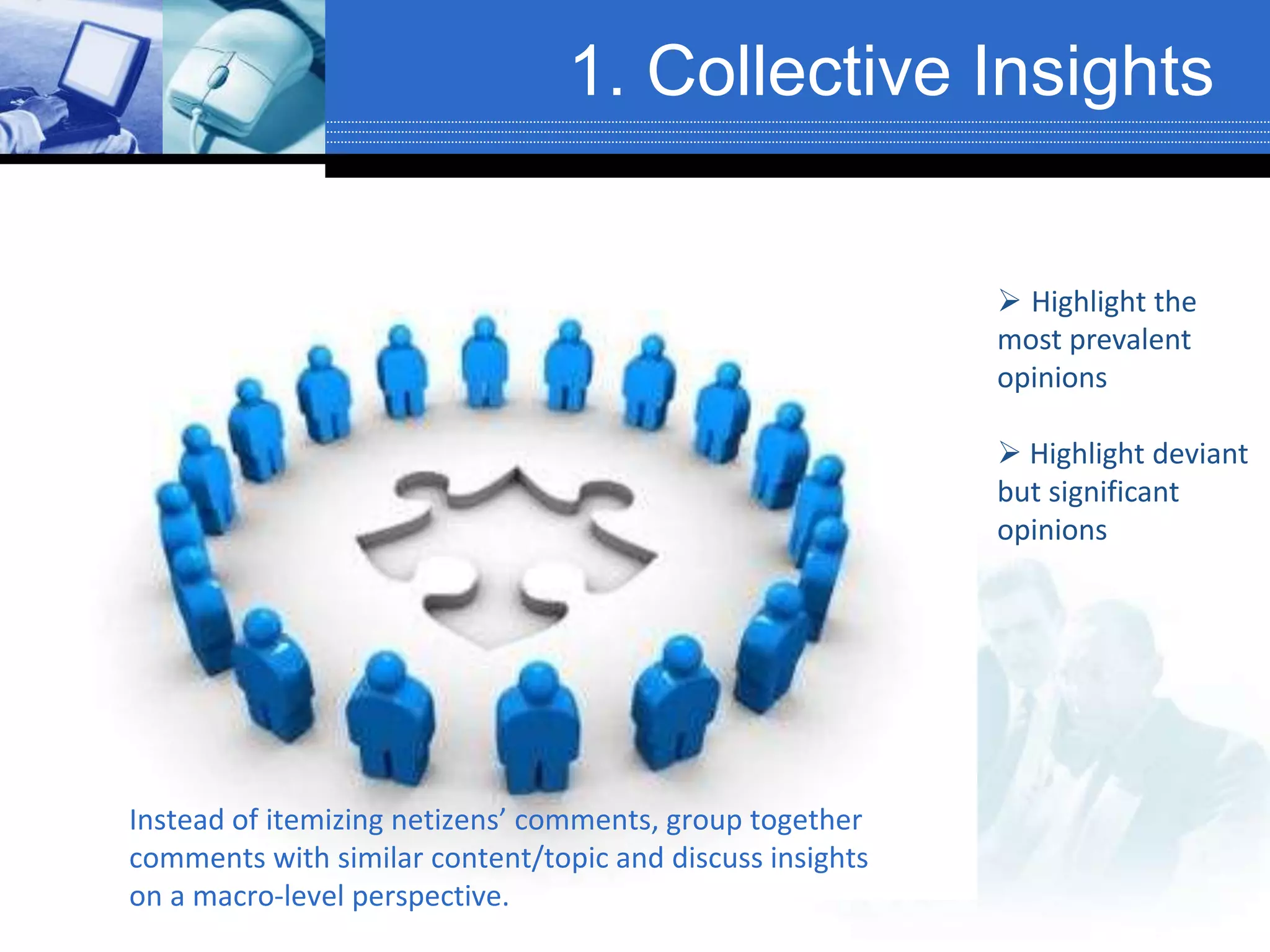
Instead of itemizing netizens’ comments, group together
comments with similar content/topic and discuss insights
on a macro-level perspective.
 Highlight the
most prevalent
opinions
 Highlight deviant
but significant
opinions
Collective Insights
Instead of itemizing netizens’ comments,
group together comments with similar content/topic
and discuss them on a macro-level perspective:
Majority of the posts were positive, and consumers shared how they have used their Toyota
cars for long years and were pleased with their mileage and durability. Many of the
commenters were repeat customers, with as much as six Toyota cars in the family and still
intending to buy a new Toyota car. Toyota cars were said to be “magnificent” and the “best”
owners had driven. Camry Atara, Rukus, Yaris, Corolla, and Aurion were the most mentioned
models.
The following suggestions were, however, made to increase preference for Toyota cars: 1)
bring back the wide-body Camry design, 2) produce more RWD and AWD cars; 3) produce
Camry and Corolla turbo models; 4) include diesel option for many of its ranges; and 5)
improve car features such as adjustability of seats.
From Hothouse Toyota – Brand Audit
Example:
2. Co-mentions
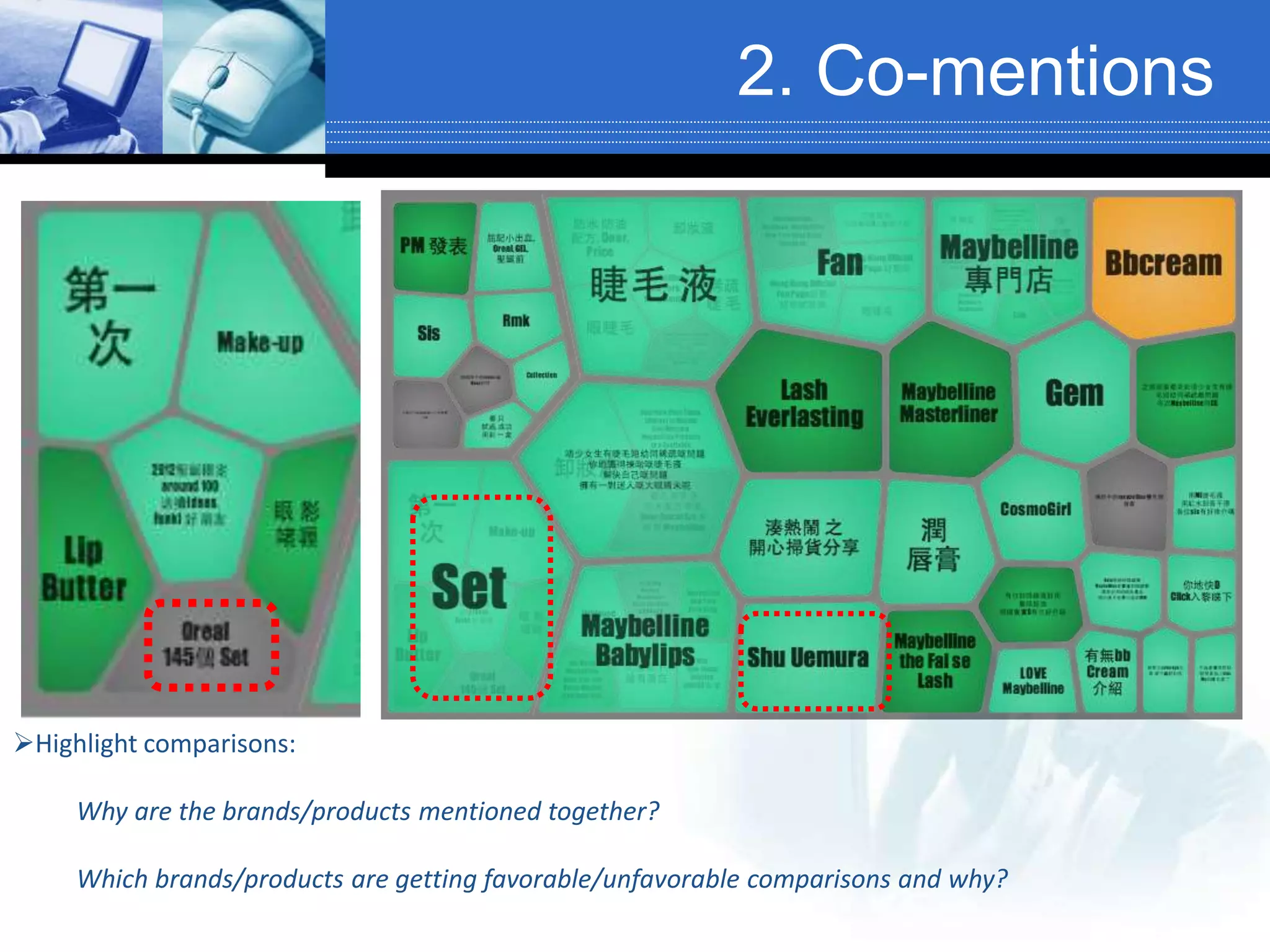
Highlight comparisons:
Why are the brands/products mentioned together?
Which brands/products are getting favorable/unfavorable comparisons and why?
Sample co-mentions
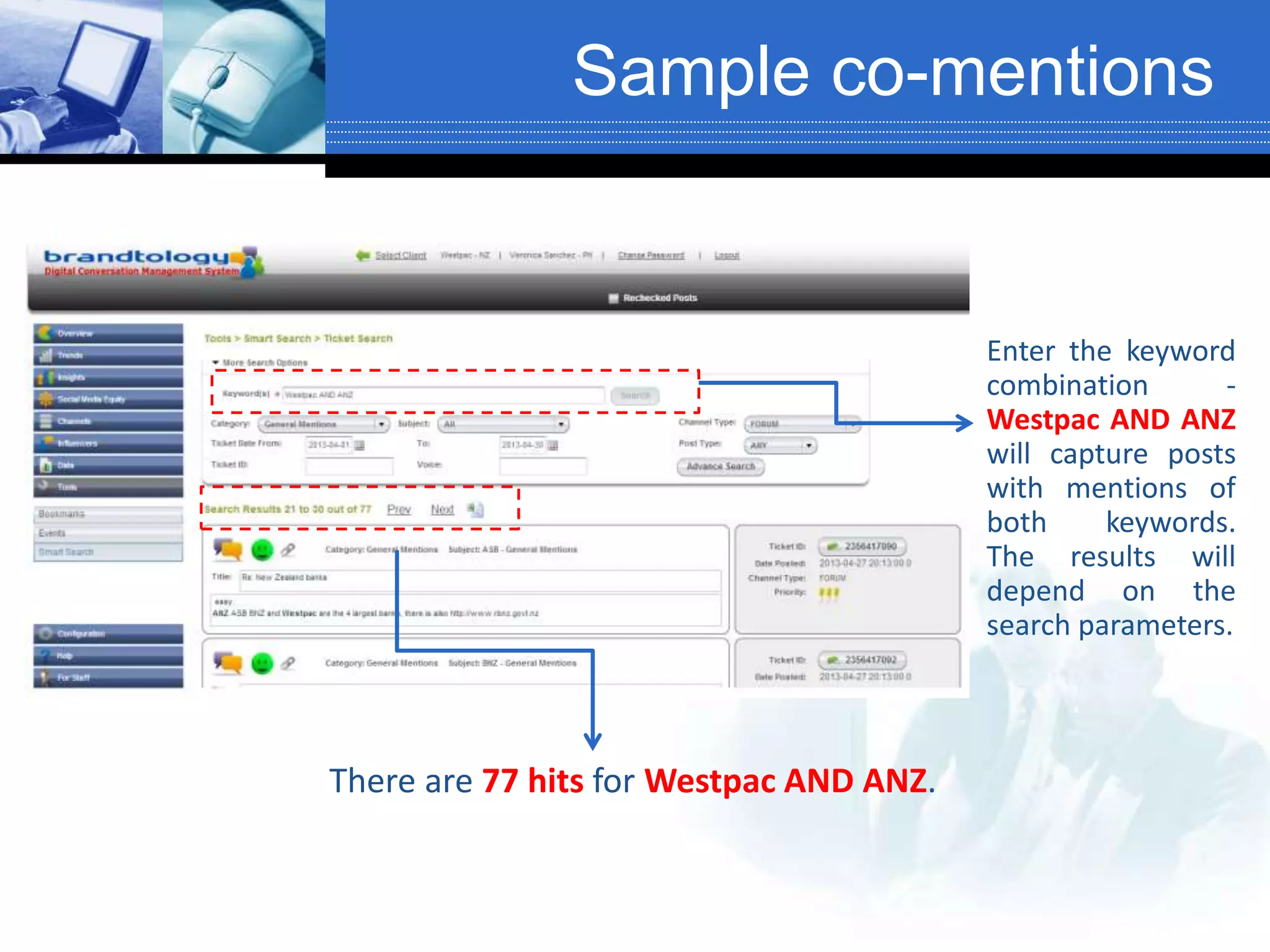
There are 77 hits for Westpac AND ANZ.
Enter the keyword
combination -
Westpac AND ANZ
will capture posts
with mentions of
both keywords.
The results will
depend on the
search parameters.
Sample co-mentions
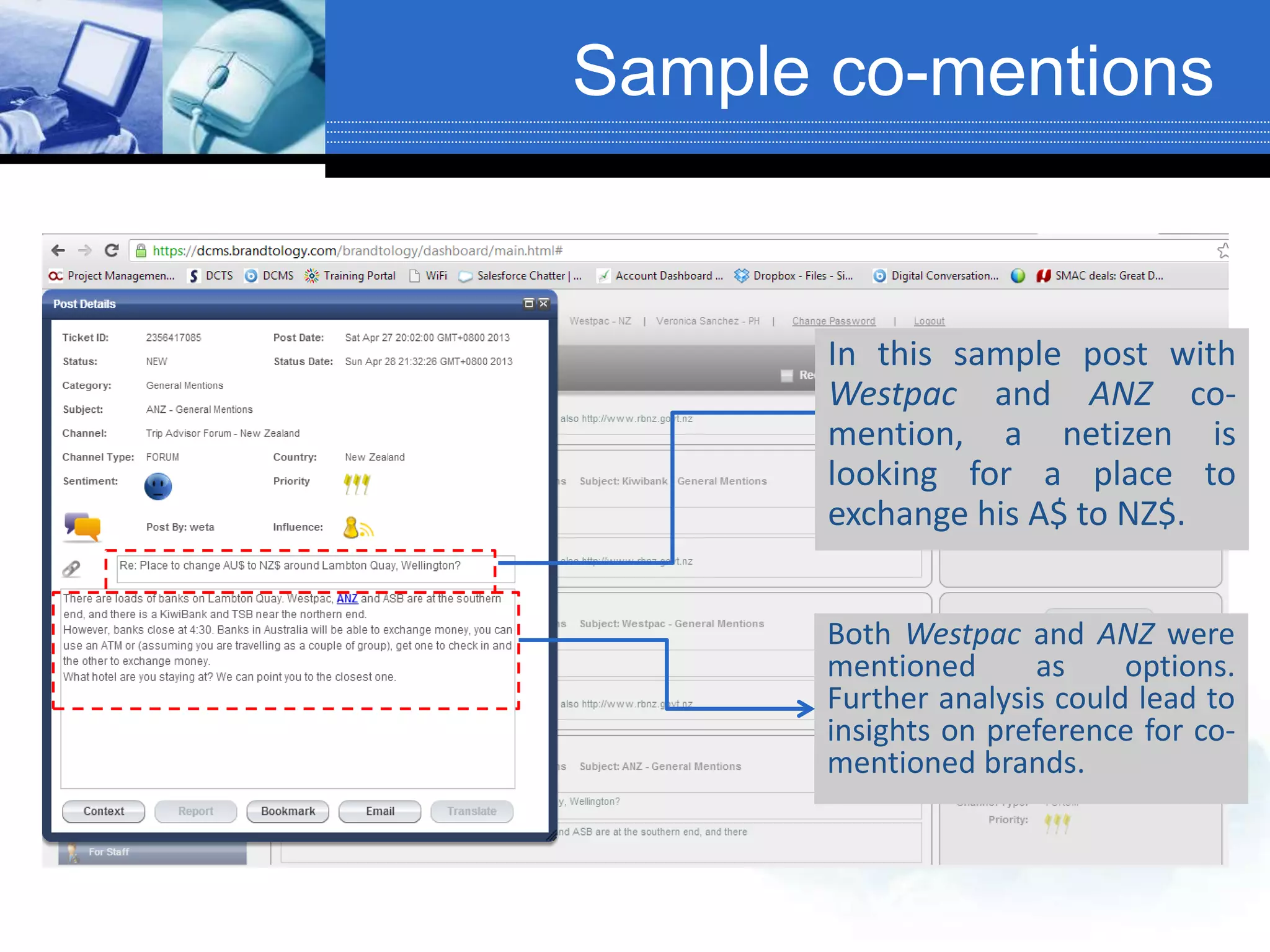
Both Westpac and ANZ were
mentioned as options.
Further analysis could lead to
insights on preference for co-
mentioned brands.
In this sample post with
Westpac and ANZ co-
mention, a netizen is
looking for a place to
exchange his A$ to NZ$.
3. Specific Products / Issues
Using buzz clusters and keyword search, find which products, brands, issues
and campaigns are gaining online traction.
 Find out which new products/campaigns are not getting online traction.
Specific Products / Issues
1. The BNZ KiwiSaver and Westpac Hand Outs TV commercials were also called out for the songs
used. The line, “I’m going to work till I die”, in the BNZ radio advertisement was disliked, and the use
of the track, “Zorba the Greek” by Westpac in the Hand Outs TV commercial, led to mentions that it
was “racist”, and “offended” a group of Greeks in New Zealand. The high engagement for Westpac
Hand Outs was due to different interpretations of the advertisements posted by commenters. The
Old Flatties advertisement received a few negative comments but was said to be “gold” and one of
the “best” advertisements in years.
2. A few negative comments were obtained for the failed refer-a-friend functionality of the Toyota
RAV4 contest where participants could win points for every referral who would join the contest.
Example:
4. Social Media Context
 Views or perspectives on issues/brands/products could vary per channel.
 Compare brand pages not only in terms of various KPIs, e.g. likes, shares and
comments, but also in terms of quality, content and context of comments or replies.
BUZZ COMPARISONS ACROSS CHANNELS
Social Media Context
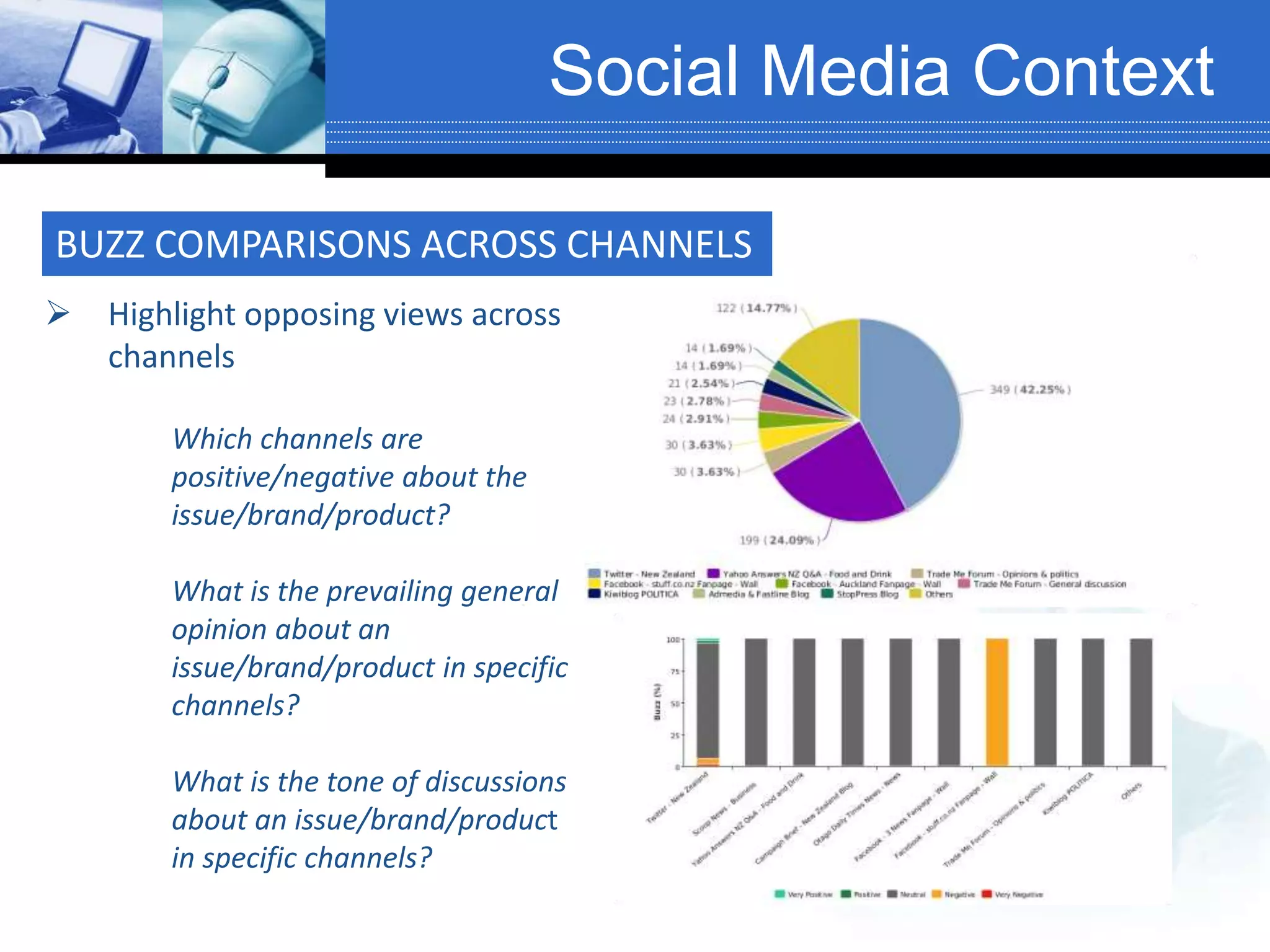
 Highlight opposing views across
channels
Which channels are
positive/negative about the
issue/brand/product?
What is the prevailing general
opinion about an
issue/brand/product in specific
channels?
What is the tone of discussions
about an issue/brand/product
in specific channels?
BUZZ COMPARISONS ACROSS CHANNELS
Social Media Context
Example:
Facebook – Toyota Fan Page – Wall and Facebook – Nissan Australia Fan Page – Wall had the highest
number of positive posts for Toyota. Toyota Land Cruiser was often mentioned on Nissan’s Facebook page
and was found to be better in terms of product quality and customer care. Nissan sales outlets were found
to have an inefficient customer service in resolving car problems and to sell expensive spare parts. Those
who have experienced driving a Nissan either as their new car or as a rental wished to drive their Toyota
cars instead. The Toyota website was also said to be better than Nissan’s.
Negative comments on Facebook – Toyota Australia Fan Page - Wall were about the “boring” and “bland”
looks of Toyota cars, especially Corolla, and the exclusion of spare tires for the late 2012 86 GTS
production. Charges on supposedly free replacement of faulty injectors and higher prices of Toyota cars in
Australia were also some of the concerns.
- Emphasis on + perception on Nissan’s page and negative on Toyota’s own page
BUZZ COMPARISONS ACROSS CHANNELS
Social Media Context
CHANNEL ACTIVITY
Do not just mention which channels have the
most buzz. Instead:
Mention which channels are constantly moving
up and down in the rankings
Highlight increasing/decreasing interest in said
channels in relation to a brand/product
Find out what types of buzz are specifically
prevalent in a channel (e.g. contests, debates etc.)
Social Media Context
CHANNEL ACTIVITY
The top 10 channels consisted of Twitter – New Zealand, the five banks’ Facebook fan pages, and
forums. Buzz on Twitter and Facebook were mostly about new products and services, as well as
customer service situations such as technical glitches and account issues. On Geekzone Forum –
Off Topic, Westpac cards were recommended for use in travels due to lower foreign exchange
fees, good credit limit, and lower/waived overseas transaction fees. In various Trade Me Forum
sub-channels such as General Discussions, Trade Me Discussions, and Christchurch quake,
commenters discussed the best bank advertisements, fees, services, and insurances. The Lumley
insurance through Westpac was one of the most recommended, and one commenter shared that
s/he could not find a fault in Westpac’s Lumley insurance service.
Example:
5. Time Factor
Take note of the changes that occur over
a considerable period of time:
Is buzz trend consistently
increasing/decreasing? Why?
Is sentiment for specific brands/products
consistently increasing/decreasing? Why?
Is there a gradual shift from positive to
negative and vice versa in specific platforms?
Can gradual shifts be tied to specific actions
being done by the brand (e.g. increasing
number of comments about improved response
rate/services over time)?
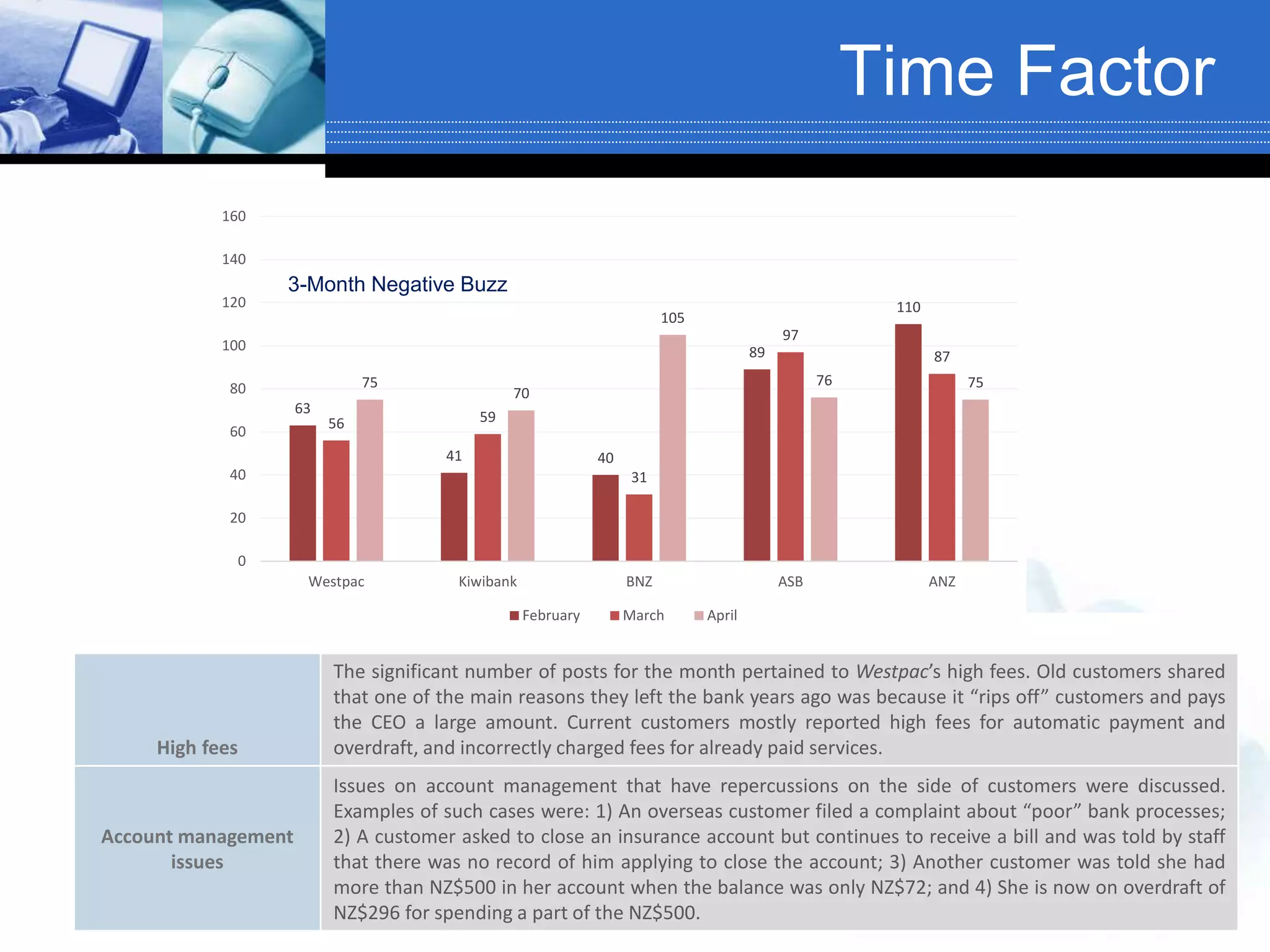
High fees
The significant number of posts for the month pertained to Westpac’s high fees. Old customers shared
that one of the main reasons they left the bank years ago was because it “rips off” customers and pays
the CEO a large amount. Current customers mostly reported high fees for automatic payment and
overdraft, and incorrectly charged fees for already paid services.
Account management
issues
Issues on account management that have repercussions on the side of customers were discussed.
Examples of such cases were: 1) An overseas customer filed a complaint about “poor” bank processes;
2) A customer asked to close an insurance account but continues to receive a bill and was told by staff
that there was no record of him applying to close the account; 3) Another customer was told she had
more than NZ$500 in her account when the balance was only NZ$72; and 4) She is now on overdraft of
NZ$296 for spending a part of the NZ$500.
Time Factor
63
41 40
89
110
56 59
31
97
87
75
70
105
76 75
0
20
40
60
80
100
120
140
160
Westpac Kiwibank BNZ ASB ANZ
February March April
3-Month Negative Buzz
Time Factor
27
56
78
108
34
26
69
62
100
36
45
58
78
113
31
0
20
40
60
80
100
120
140
160
Westpac Kiwibank BNZ ASB ANZ
February March April
3 -Month Positive Buzz
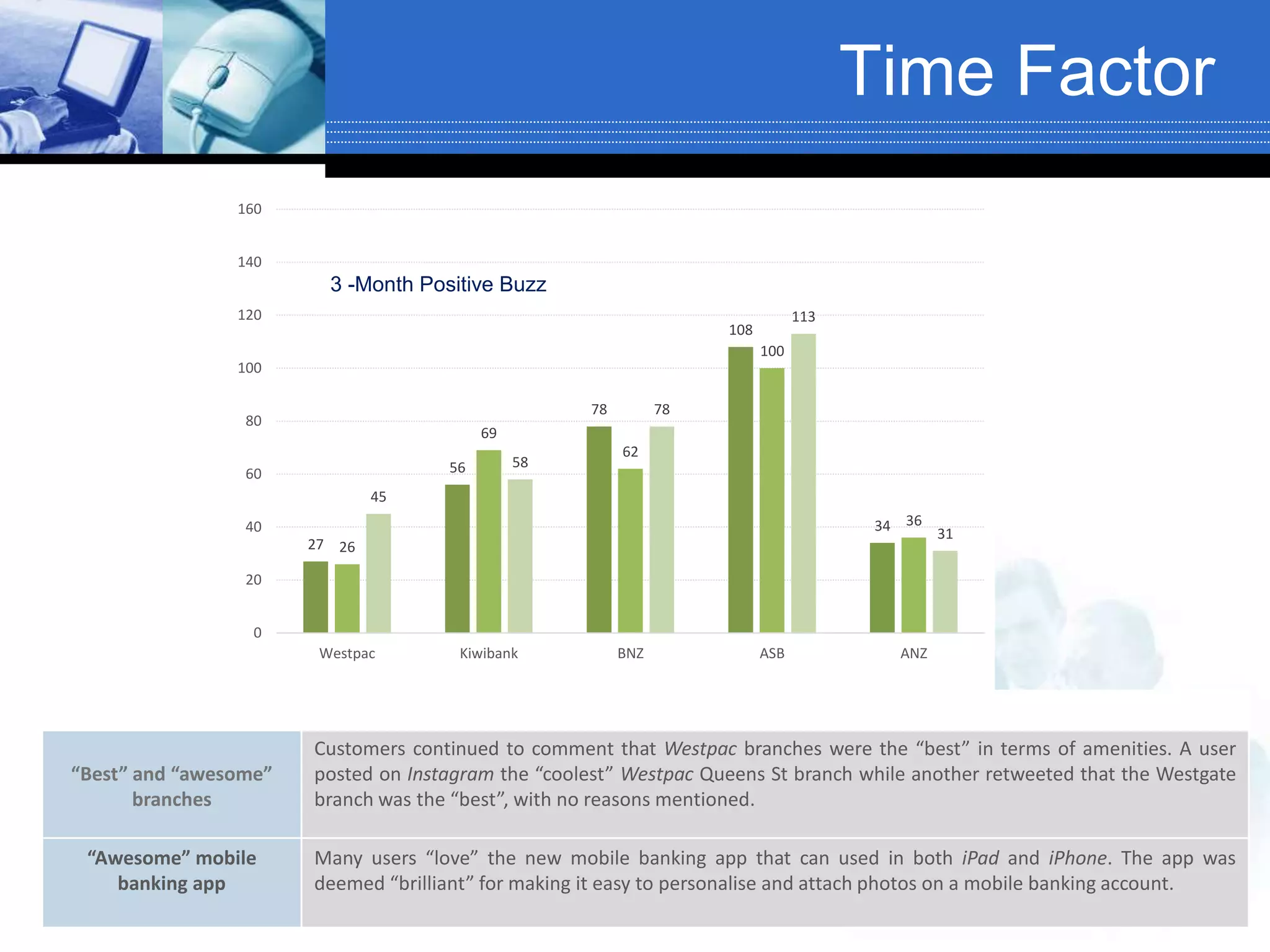
“Best” and “awesome”
branches
Customers continued to comment that Westpac branches were the “best” in terms of amenities. A user
posted on Instagram the “coolest” Westpac Queens St branch while another retweeted that the Westgate
branch was the “best”, with no reasons mentioned.
“Awesome” mobile
banking app
Many users “love” the new mobile banking app that can used in both iPad and iPhone. The app was
deemed “brilliant” for making it easy to personalise and attach photos on a mobile banking account.
6. Voice
Consider the number of unique voices
that participated in discussions
for a topic/issue.
Observe how regular netizens
react to KOLs.
7. Current Events
Look for breaking news not only about
the monitored brand/product, but also
about the industry.
Current Events
Commenters on the Fair Play on Fees – Suing the Banks thread (150 posts) on Trade Me
Forum – Trade Me Discussions had varied opinions about the possible outcomes of the
lawsuit and whether it was appropriate to sue the banks in the first place. Negative outlook
on the outcome was influenced by the perception that the terms and conditions signed by
customers are legally binding and that customers should be responsible for handling their
own accounts. Others believed that the current fees are too high and not proportionate to
the work done by the banks to manage accounts; the restructuring of a fee schedule was
suggested.”
Example:
8. Locations
 Look for location-based insights
Are netizens coming from key
cities/locales?
In which cities do most
commenters come from?
 Determine if location check-ins are
relevant
 Look for mentions of specific
branches or outlets
Locations
Customers expressed how they love their local branches, citing the
music played, the ambiance, the “lovely” people and other
amenities such as cafes and iPad units.
(local branches = branches near them in general as this seems to be the
general look and feel of Westpac branches.)
Example:
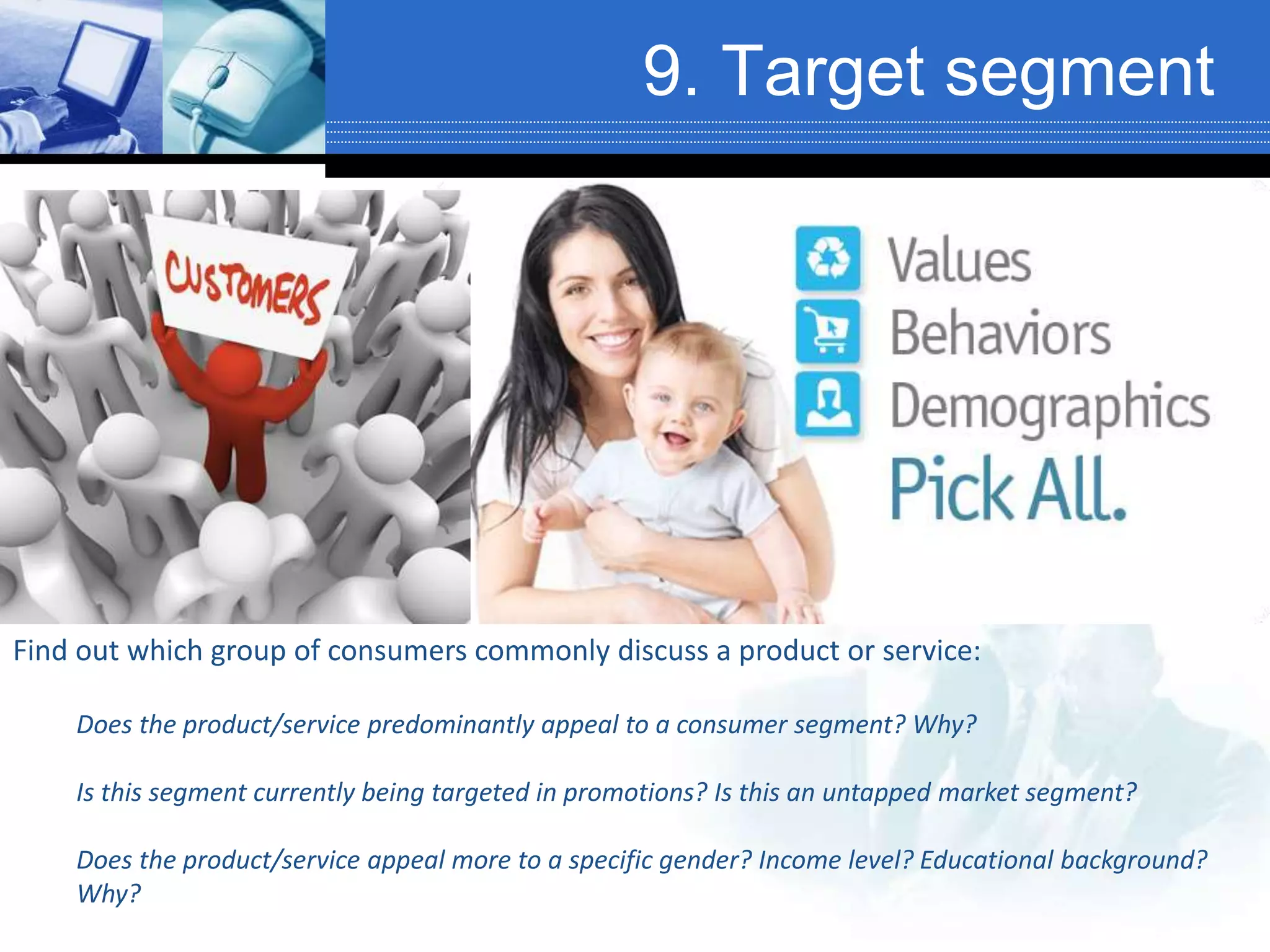
9. Target segment
Find out which group of consumers commonly discuss a product or service:
Does the product/service predominantly appeal to a consumer segment? Why?
Is this segment currently being targeted in promotions? Is this an untapped market segment?
Does the product/service appeal more to a specific gender? Income level? Educational background?
Why?
Target segment
More women, mostly mothers, used and commented about Toyota
Kluger, especially on The Bub Hub Forum – General Chat and
Essential Baby Forum – What do you think?. Few men commented
about the model and referred to the car as a “family” car or the
“wife’s car”. Key points for both sexes were space, comfort, and
safety for long driving across the country. Women were also
concerned about space for extended family and children’s friends.
Other market segments did not mention of these factors.
Example:
10. Practical Insights
Avoid impractical/non-actionable comments.
Search
for
CONTEXT
When netizens say that something is “bad” or “done poorly”, is it mentioned why?
Did they mention specific products/services?
Did they give specific insights on how a product or service could improve?
Do netizens agree or understand a brand/company decision?
11. Brand
Ambassadors/Representatives
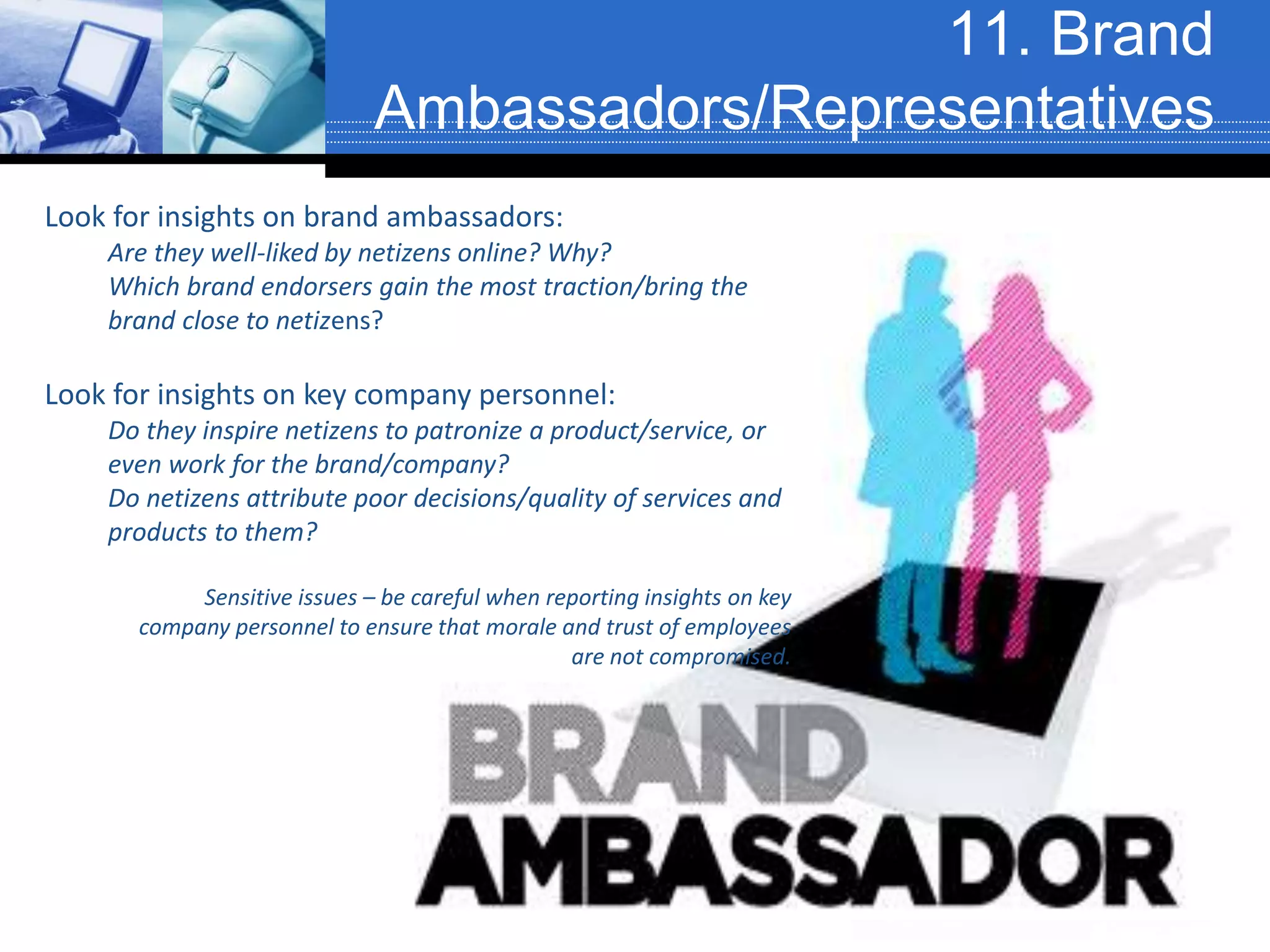
Look for insights on brand ambassadors:
Are they well-liked by netizens online? Why?
Which brand endorsers gain the most traction/bring the
brand close to netizens?
Look for insights on key company personnel:
Do they inspire netizens to patronize a product/service, or
even work for the brand/company?
Do netizens attribute poor decisions/quality of services and
products to them?
Sensitive issues – be careful when reporting insights on key
company personnel to ensure that morale and trust of employees
are not compromised.
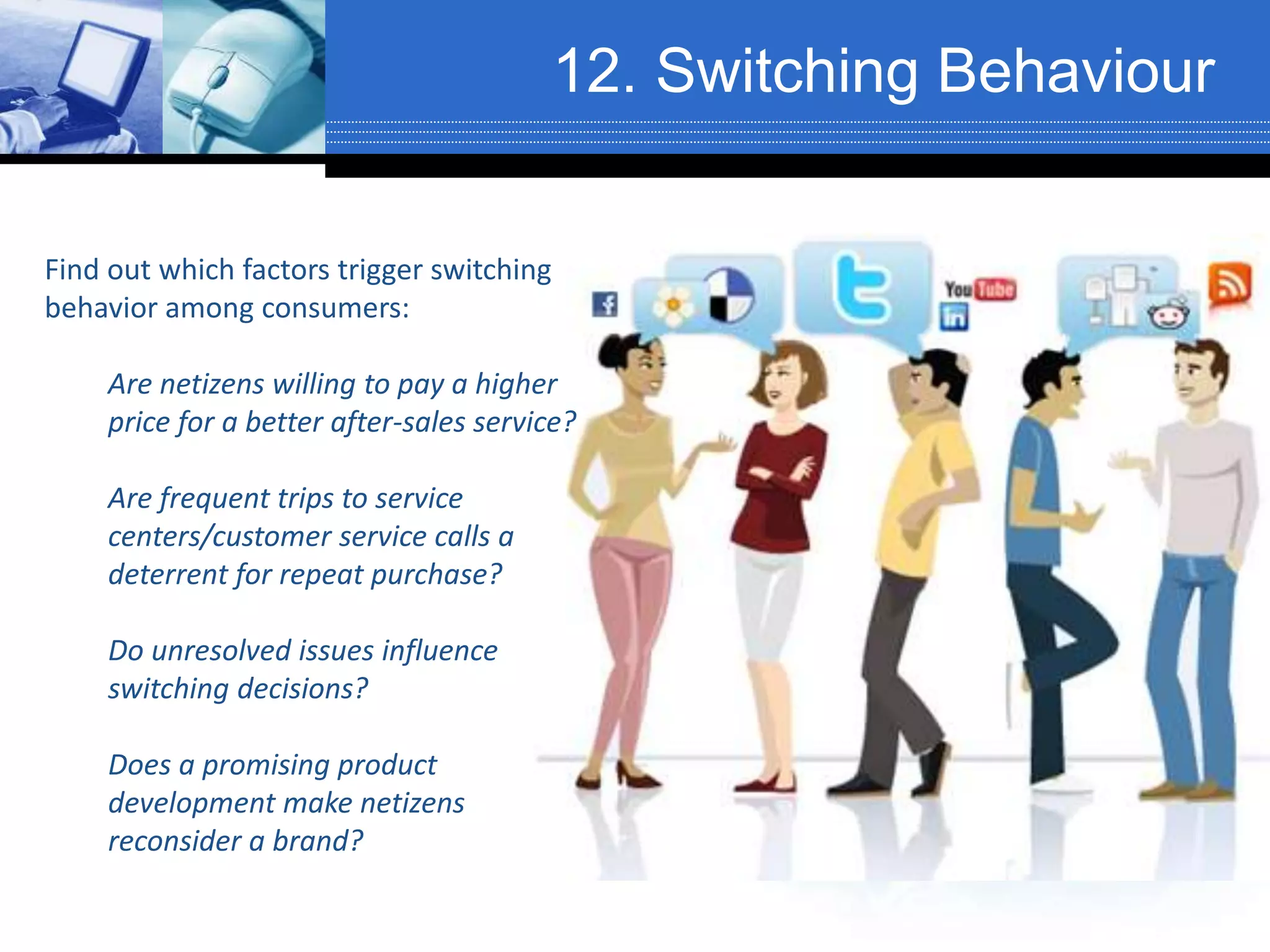
12. Switching Behaviour
Find out which factors trigger switching
behavior among consumers:
Are netizens willing to pay a higher
price for a better after-sales service?
Are frequent trips to service
centers/customer service calls a
deterrent for repeat purchase?
Do unresolved issues influence
switching decisions?
Does a promising product
development make netizens
reconsider a brand?
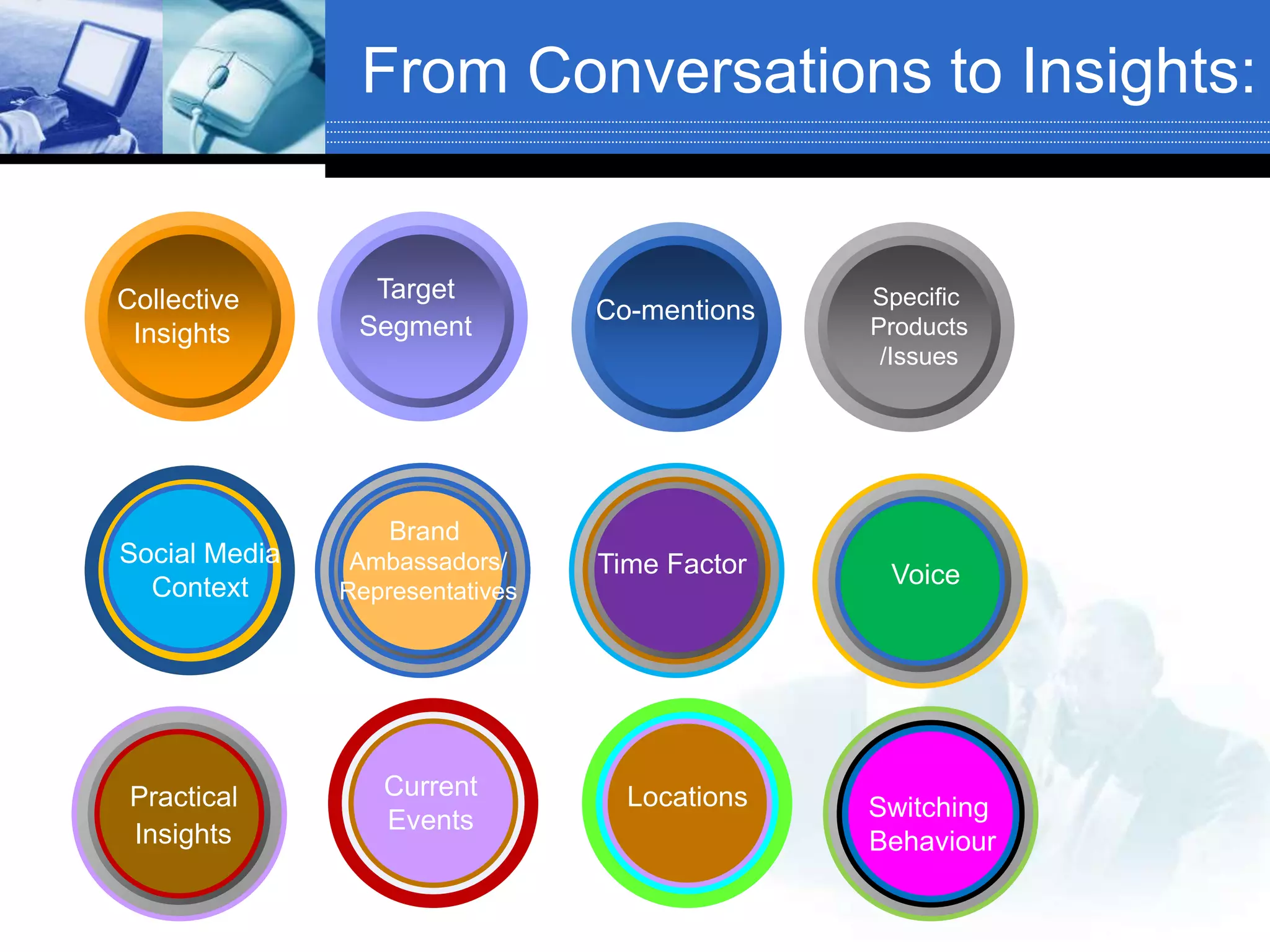
Collective
Insights
Target
Segment
Co-mentions
Specific
Products
/Issues
Social Media
Context
Brand
Ambassadors/
Representatives
Time Factor Voice
Practical
Insights
Current
Events
Locations Switching
Behaviour
From Conversations to Insights:
QC TEAM
Thank you!

From Online Conversations to Actionable Insights

  • 1.
    From Online Conversations toActionable Insights: How to Develop Key Takeaways for Monthly Reports
  • 2.
    1. Collective Insights Insteadof itemizing netizens’ comments, group together comments with similar content/topic and discuss insights on a macro-level perspective.  Highlight the most prevalent opinions  Highlight deviant but significant opinions
  • 3.
    Collective Insights Instead ofitemizing netizens’ comments, group together comments with similar content/topic and discuss them on a macro-level perspective: Majority of the posts were positive, and consumers shared how they have used their Toyota cars for long years and were pleased with their mileage and durability. Many of the commenters were repeat customers, with as much as six Toyota cars in the family and still intending to buy a new Toyota car. Toyota cars were said to be “magnificent” and the “best” owners had driven. Camry Atara, Rukus, Yaris, Corolla, and Aurion were the most mentioned models. The following suggestions were, however, made to increase preference for Toyota cars: 1) bring back the wide-body Camry design, 2) produce more RWD and AWD cars; 3) produce Camry and Corolla turbo models; 4) include diesel option for many of its ranges; and 5) improve car features such as adjustability of seats. From Hothouse Toyota – Brand Audit Example:
  • 4.
    2. Co-mentions Highlight comparisons: Whyare the brands/products mentioned together? Which brands/products are getting favorable/unfavorable comparisons and why?
  • 5.
    Sample co-mentions There are77 hits for Westpac AND ANZ. Enter the keyword combination - Westpac AND ANZ will capture posts with mentions of both keywords. The results will depend on the search parameters.
  • 6.
    Sample co-mentions Both Westpacand ANZ were mentioned as options. Further analysis could lead to insights on preference for co- mentioned brands. In this sample post with Westpac and ANZ co- mention, a netizen is looking for a place to exchange his A$ to NZ$.
  • 7.
    3. Specific Products/ Issues Using buzz clusters and keyword search, find which products, brands, issues and campaigns are gaining online traction.  Find out which new products/campaigns are not getting online traction.
  • 8.
    Specific Products /Issues 1. The BNZ KiwiSaver and Westpac Hand Outs TV commercials were also called out for the songs used. The line, “I’m going to work till I die”, in the BNZ radio advertisement was disliked, and the use of the track, “Zorba the Greek” by Westpac in the Hand Outs TV commercial, led to mentions that it was “racist”, and “offended” a group of Greeks in New Zealand. The high engagement for Westpac Hand Outs was due to different interpretations of the advertisements posted by commenters. The Old Flatties advertisement received a few negative comments but was said to be “gold” and one of the “best” advertisements in years. 2. A few negative comments were obtained for the failed refer-a-friend functionality of the Toyota RAV4 contest where participants could win points for every referral who would join the contest. Example:
  • 9.
    4. Social MediaContext  Views or perspectives on issues/brands/products could vary per channel.  Compare brand pages not only in terms of various KPIs, e.g. likes, shares and comments, but also in terms of quality, content and context of comments or replies. BUZZ COMPARISONS ACROSS CHANNELS
  • 10.
    Social Media Context Highlight opposing views across channels Which channels are positive/negative about the issue/brand/product? What is the prevailing general opinion about an issue/brand/product in specific channels? What is the tone of discussions about an issue/brand/product in specific channels? BUZZ COMPARISONS ACROSS CHANNELS
  • 11.
    Social Media Context Example: Facebook– Toyota Fan Page – Wall and Facebook – Nissan Australia Fan Page – Wall had the highest number of positive posts for Toyota. Toyota Land Cruiser was often mentioned on Nissan’s Facebook page and was found to be better in terms of product quality and customer care. Nissan sales outlets were found to have an inefficient customer service in resolving car problems and to sell expensive spare parts. Those who have experienced driving a Nissan either as their new car or as a rental wished to drive their Toyota cars instead. The Toyota website was also said to be better than Nissan’s. Negative comments on Facebook – Toyota Australia Fan Page - Wall were about the “boring” and “bland” looks of Toyota cars, especially Corolla, and the exclusion of spare tires for the late 2012 86 GTS production. Charges on supposedly free replacement of faulty injectors and higher prices of Toyota cars in Australia were also some of the concerns. - Emphasis on + perception on Nissan’s page and negative on Toyota’s own page BUZZ COMPARISONS ACROSS CHANNELS
  • 12.
    Social Media Context CHANNELACTIVITY Do not just mention which channels have the most buzz. Instead: Mention which channels are constantly moving up and down in the rankings Highlight increasing/decreasing interest in said channels in relation to a brand/product Find out what types of buzz are specifically prevalent in a channel (e.g. contests, debates etc.)
  • 13.
    Social Media Context CHANNELACTIVITY The top 10 channels consisted of Twitter – New Zealand, the five banks’ Facebook fan pages, and forums. Buzz on Twitter and Facebook were mostly about new products and services, as well as customer service situations such as technical glitches and account issues. On Geekzone Forum – Off Topic, Westpac cards were recommended for use in travels due to lower foreign exchange fees, good credit limit, and lower/waived overseas transaction fees. In various Trade Me Forum sub-channels such as General Discussions, Trade Me Discussions, and Christchurch quake, commenters discussed the best bank advertisements, fees, services, and insurances. The Lumley insurance through Westpac was one of the most recommended, and one commenter shared that s/he could not find a fault in Westpac’s Lumley insurance service. Example:
  • 14.
    5. Time Factor Takenote of the changes that occur over a considerable period of time: Is buzz trend consistently increasing/decreasing? Why? Is sentiment for specific brands/products consistently increasing/decreasing? Why? Is there a gradual shift from positive to negative and vice versa in specific platforms? Can gradual shifts be tied to specific actions being done by the brand (e.g. increasing number of comments about improved response rate/services over time)?
  • 15.
    High fees The significantnumber of posts for the month pertained to Westpac’s high fees. Old customers shared that one of the main reasons they left the bank years ago was because it “rips off” customers and pays the CEO a large amount. Current customers mostly reported high fees for automatic payment and overdraft, and incorrectly charged fees for already paid services. Account management issues Issues on account management that have repercussions on the side of customers were discussed. Examples of such cases were: 1) An overseas customer filed a complaint about “poor” bank processes; 2) A customer asked to close an insurance account but continues to receive a bill and was told by staff that there was no record of him applying to close the account; 3) Another customer was told she had more than NZ$500 in her account when the balance was only NZ$72; and 4) She is now on overdraft of NZ$296 for spending a part of the NZ$500. Time Factor 63 41 40 89 110 56 59 31 97 87 75 70 105 76 75 0 20 40 60 80 100 120 140 160 Westpac Kiwibank BNZ ASB ANZ February March April 3-Month Negative Buzz
  • 16.
    Time Factor 27 56 78 108 34 26 69 62 100 36 45 58 78 113 31 0 20 40 60 80 100 120 140 160 Westpac KiwibankBNZ ASB ANZ February March April 3 -Month Positive Buzz “Best” and “awesome” branches Customers continued to comment that Westpac branches were the “best” in terms of amenities. A user posted on Instagram the “coolest” Westpac Queens St branch while another retweeted that the Westgate branch was the “best”, with no reasons mentioned. “Awesome” mobile banking app Many users “love” the new mobile banking app that can used in both iPad and iPhone. The app was deemed “brilliant” for making it easy to personalise and attach photos on a mobile banking account.
  • 17.
    6. Voice Consider thenumber of unique voices that participated in discussions for a topic/issue. Observe how regular netizens react to KOLs.
  • 18.
    7. Current Events Lookfor breaking news not only about the monitored brand/product, but also about the industry.
  • 19.
    Current Events Commenters onthe Fair Play on Fees – Suing the Banks thread (150 posts) on Trade Me Forum – Trade Me Discussions had varied opinions about the possible outcomes of the lawsuit and whether it was appropriate to sue the banks in the first place. Negative outlook on the outcome was influenced by the perception that the terms and conditions signed by customers are legally binding and that customers should be responsible for handling their own accounts. Others believed that the current fees are too high and not proportionate to the work done by the banks to manage accounts; the restructuring of a fee schedule was suggested.” Example:
  • 20.
    8. Locations  Lookfor location-based insights Are netizens coming from key cities/locales? In which cities do most commenters come from?  Determine if location check-ins are relevant  Look for mentions of specific branches or outlets
  • 21.
    Locations Customers expressed howthey love their local branches, citing the music played, the ambiance, the “lovely” people and other amenities such as cafes and iPad units. (local branches = branches near them in general as this seems to be the general look and feel of Westpac branches.) Example:
  • 22.
    9. Target segment Findout which group of consumers commonly discuss a product or service: Does the product/service predominantly appeal to a consumer segment? Why? Is this segment currently being targeted in promotions? Is this an untapped market segment? Does the product/service appeal more to a specific gender? Income level? Educational background? Why?
  • 23.
    Target segment More women,mostly mothers, used and commented about Toyota Kluger, especially on The Bub Hub Forum – General Chat and Essential Baby Forum – What do you think?. Few men commented about the model and referred to the car as a “family” car or the “wife’s car”. Key points for both sexes were space, comfort, and safety for long driving across the country. Women were also concerned about space for extended family and children’s friends. Other market segments did not mention of these factors. Example:
  • 24.
    10. Practical Insights Avoidimpractical/non-actionable comments. Search for CONTEXT When netizens say that something is “bad” or “done poorly”, is it mentioned why? Did they mention specific products/services? Did they give specific insights on how a product or service could improve? Do netizens agree or understand a brand/company decision?
  • 25.
    11. Brand Ambassadors/Representatives Look forinsights on brand ambassadors: Are they well-liked by netizens online? Why? Which brand endorsers gain the most traction/bring the brand close to netizens? Look for insights on key company personnel: Do they inspire netizens to patronize a product/service, or even work for the brand/company? Do netizens attribute poor decisions/quality of services and products to them? Sensitive issues – be careful when reporting insights on key company personnel to ensure that morale and trust of employees are not compromised.
  • 26.
    12. Switching Behaviour Findout which factors trigger switching behavior among consumers: Are netizens willing to pay a higher price for a better after-sales service? Are frequent trips to service centers/customer service calls a deterrent for repeat purchase? Do unresolved issues influence switching decisions? Does a promising product development make netizens reconsider a brand?
  • 27.
    Collective Insights Target Segment Co-mentions Specific Products /Issues Social Media Context Brand Ambassadors/ Representatives Time FactorVoice Practical Insights Current Events Locations Switching Behaviour From Conversations to Insights:
  • 28.

Editor's Notes

  • #26 Note on the Example: 1. The issue with Simon Baker/other endorsers are long-running issues way, way back so in this recent example it wasn’t really expounded on. To give context on the issue, some netizens take issue with Hollywood actors (Simon Baker et al ) in commercials due to the talent fee. In AU market, there were also issues with Simon Baker using an American accent instead of Australian (he is Australian) but that was because he is portraying his “The Mentalist” character which is American – apparently the show is not too popular in AU for people to actually recognize what he was doing in the commercials. Though I’ve never seen such a comment, the use of his “The Mentalist” role also probably cost ANZ some money for rights to use the character.
  • #27 Note on the Example: 1. The issue with Simon Baker/other endorsers are long-running issues way, way back so in this recent example it wasn’t really expounded on. To give context on the issue, some netizens take issue with Hollywood actors (Simon Baker et al ) in commercials due to the talent fee. In AU market, there were also issues with Simon Baker using an American accent instead of Australian (he is Australian) but that was because he is portraying his “The Mentalist” character which is American – apparently the show is not too popular in AU for people to actually recognize what he was doing in the commercials. Though I’ve never seen such a comment, the use of his “The Mentalist” role also probably cost ANZ some money for rights to use the character.