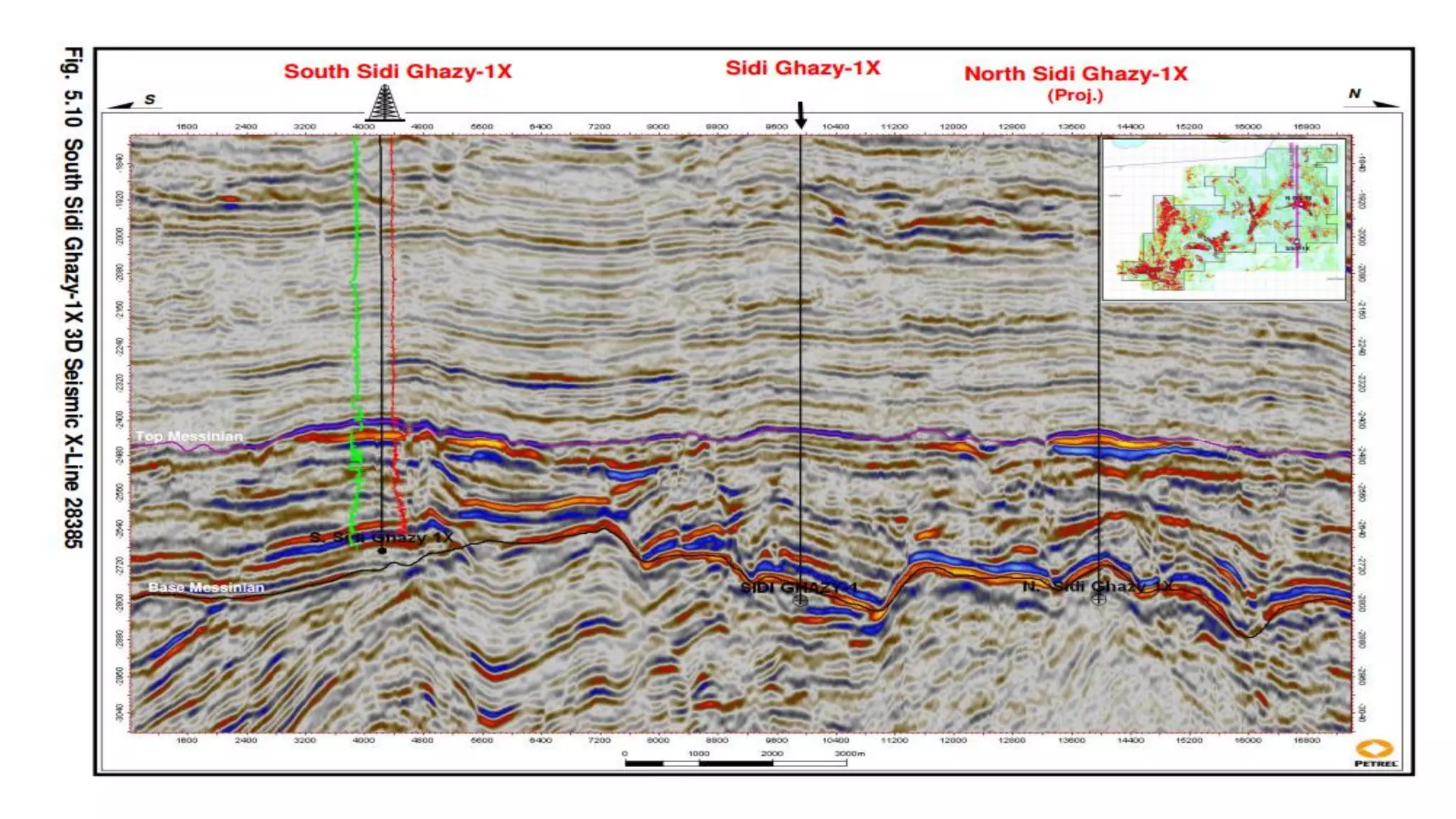
Exploration
Oil & Gas
Oi l f i e l d f r am e wo r k
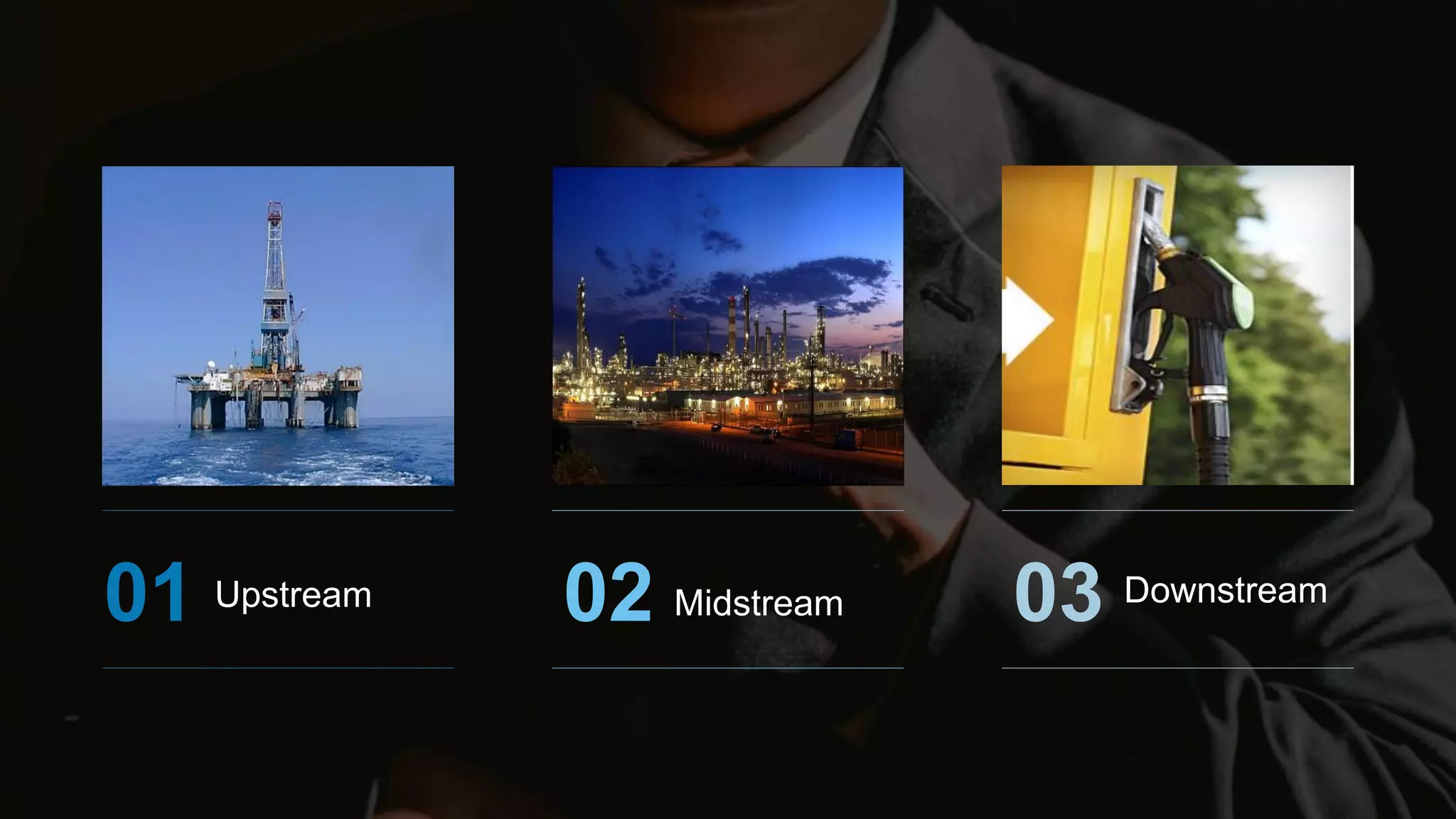
Upstream Midstream Downstream
030201
Field development
Exploration AbandonmentDevelopment production
Oil field development
030201 04
AbandonmentProductionDevelopmentExploration
• Seismic Activities
• Drilling services
• Construction
• Hook up wells
• Engineering
• Operations
• Optimization
• Commissioning
• Well plugging
• Decommissioning
machinery and
equipment
Remember last lectures
Petroleum System
Traps structure
Rock types
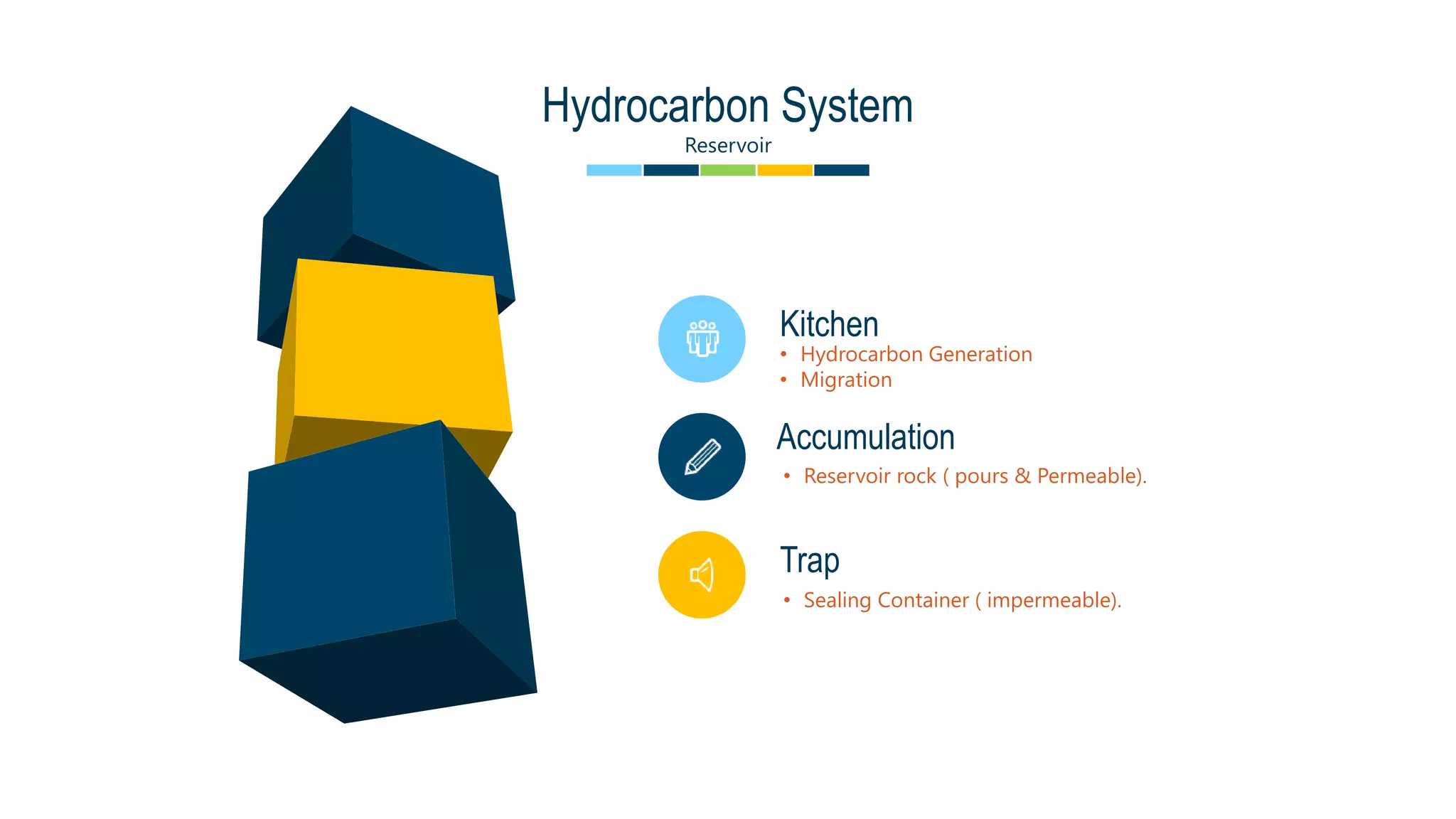
Hydrocarbon System
Reservoir
• Hydrocarbon Generation
• Migration
Kitchen
Accumulation
Trap
• Reservoir rock ( pours & Permeable).
• Sealing Container ( impermeable).
8
24803
Source RockSource Rock
Top Seal RockTop Seal Rock
Reservoir RockReservoir Rock
Anticlinal TrapAnticlinal Trap
(Organic Rich)(Organic Rich)
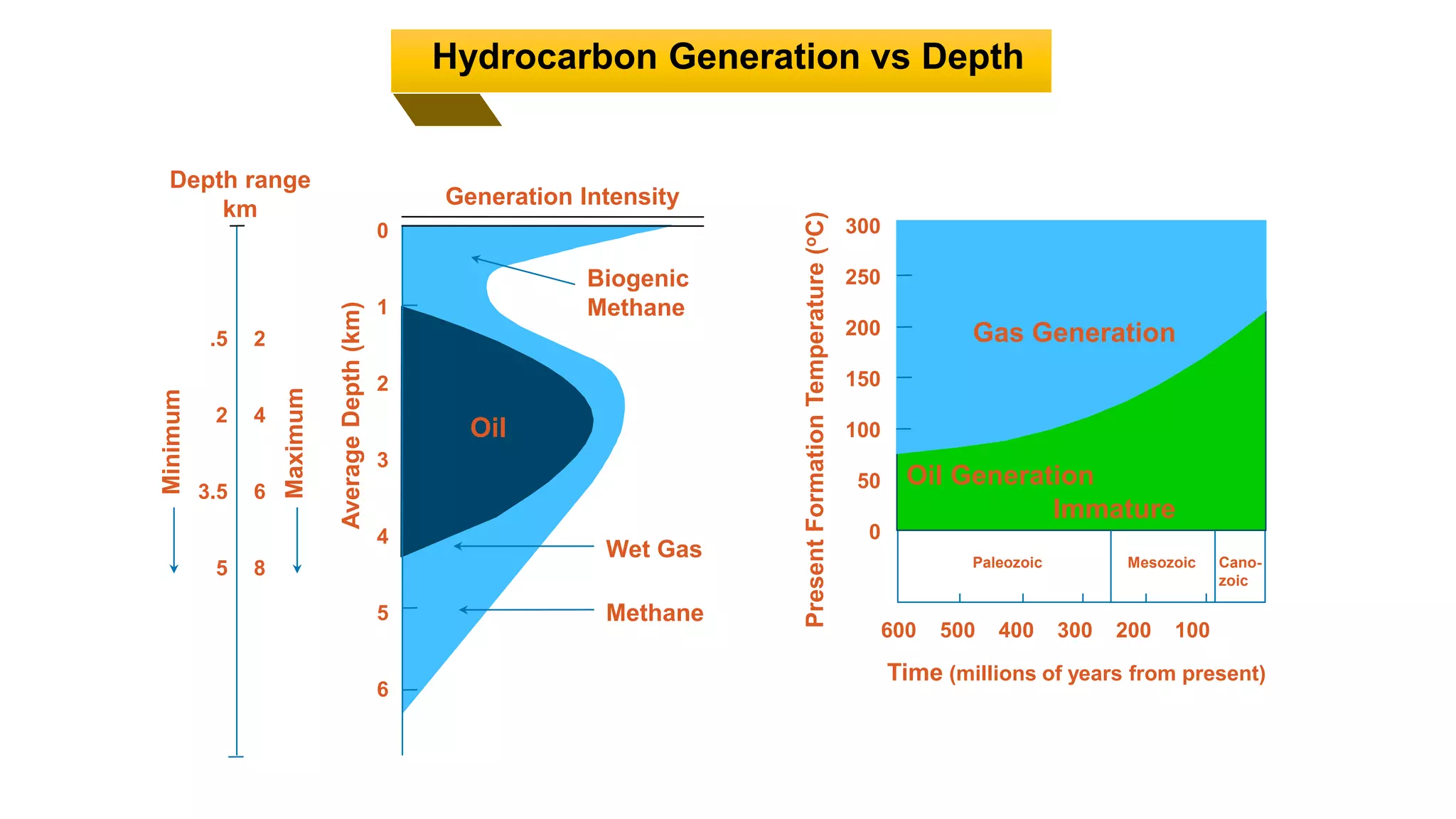
Hydrocarbon Generation vs Depth
Depth range
km
.5
2
3.5
5
2
4
6
8
Minimum
Maximum
AverageDepth(km)
0
1
2
3
4
5
6
Generation Intensity
Biogenic
Methane
Wet Gas
Methane
300
250
200
150
100
50
0
600 500 400 300 200 100
Cano-
zoic
MesozoicPaleozoic
Immature
Oil Generation
Gas Generation
PresentFormationTemperature(oC)
Time (millions of years from present)
Oil
Common Hydrocarbo n Traps
Unconformity Trap
Anticlinal Trap
Fault Trap
Buried Reef
Pinch Out
Grading Trap
Sand Lens
Salt Dome Traps
Unconformity
Surface
Sub-Salt
Sediment Truncation
Anhydrite
Common Hydrocarbo n Traps
Salt Dome
Fault
Unconformity
Pinchout
Anticline
Some people think that oil is in big pools underground.
Actually, most oil is trapped in the tiny pore spaces between grains
of rock or sand. Most of these pores are too small to be seen with
the naked eye.
Exploration
Applied Geophysics
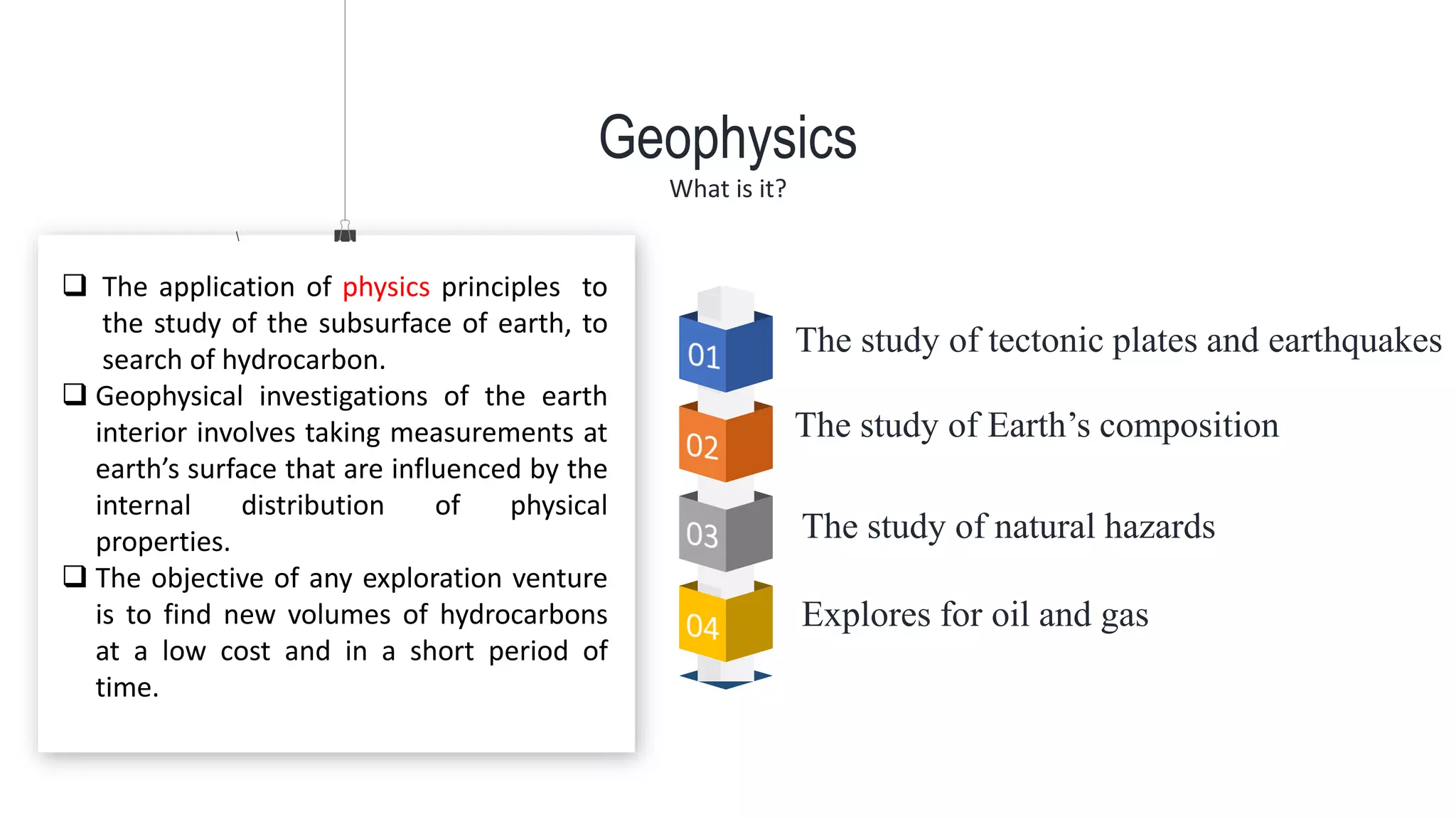
The study of tectonic plates and earthquakes
The study of Earth’s composition
Geophysics
What is it?
The study of natural hazards
Explores for oil and gas
 The application of physics principles to
the study of the subsurface of earth, to
search of hydrocarbon.
 Geophysical investigations of the earth
interior involves taking measurements at
earth’s surface that are influenced by the
internal distribution of physical
properties.
 The objective of any exploration venture
is to find new volumes of hydrocarbons
at a low cost and in a short period of
time.
What does a Geophysicist do?
responsibilities
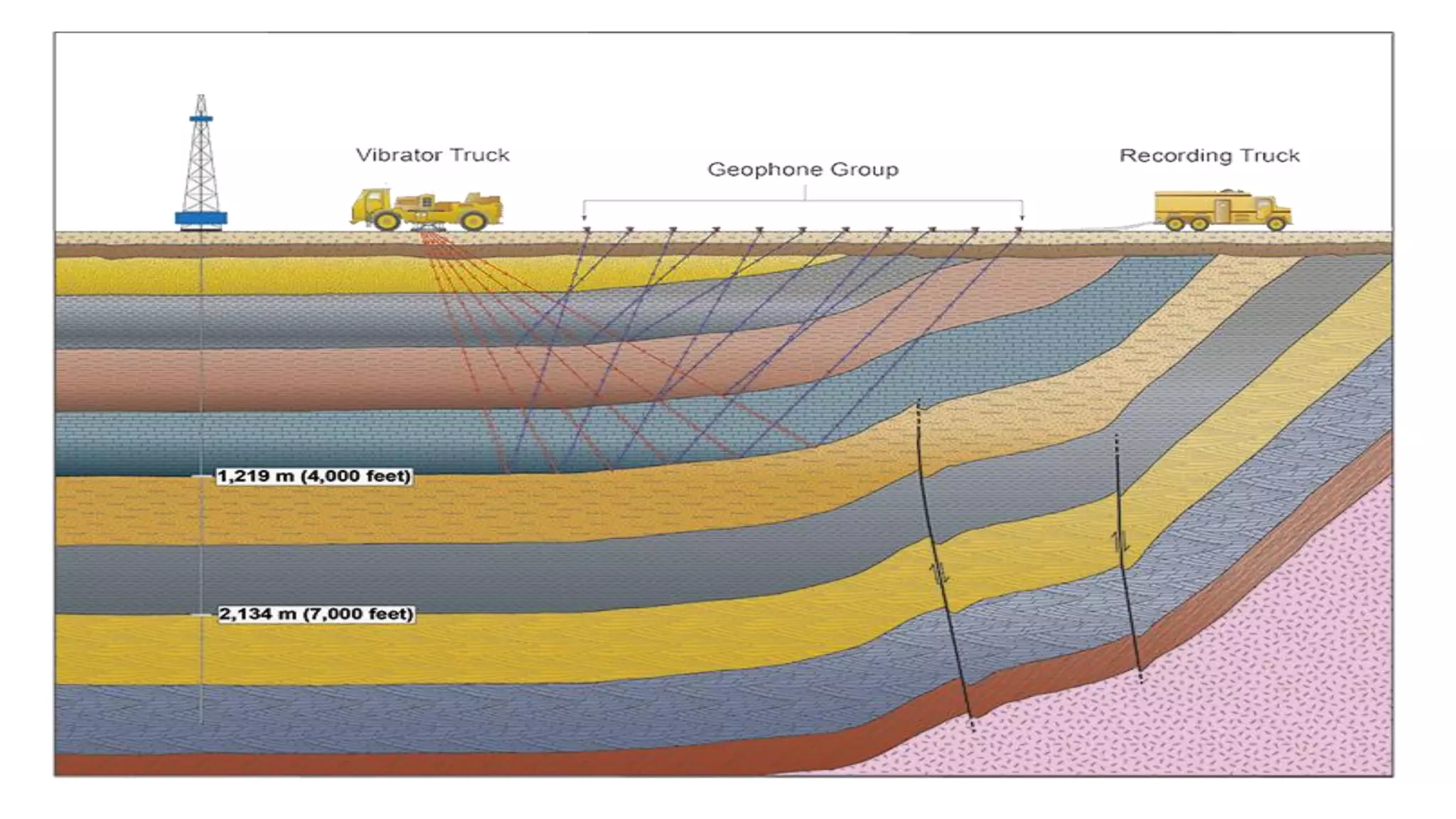
Laying out geophones
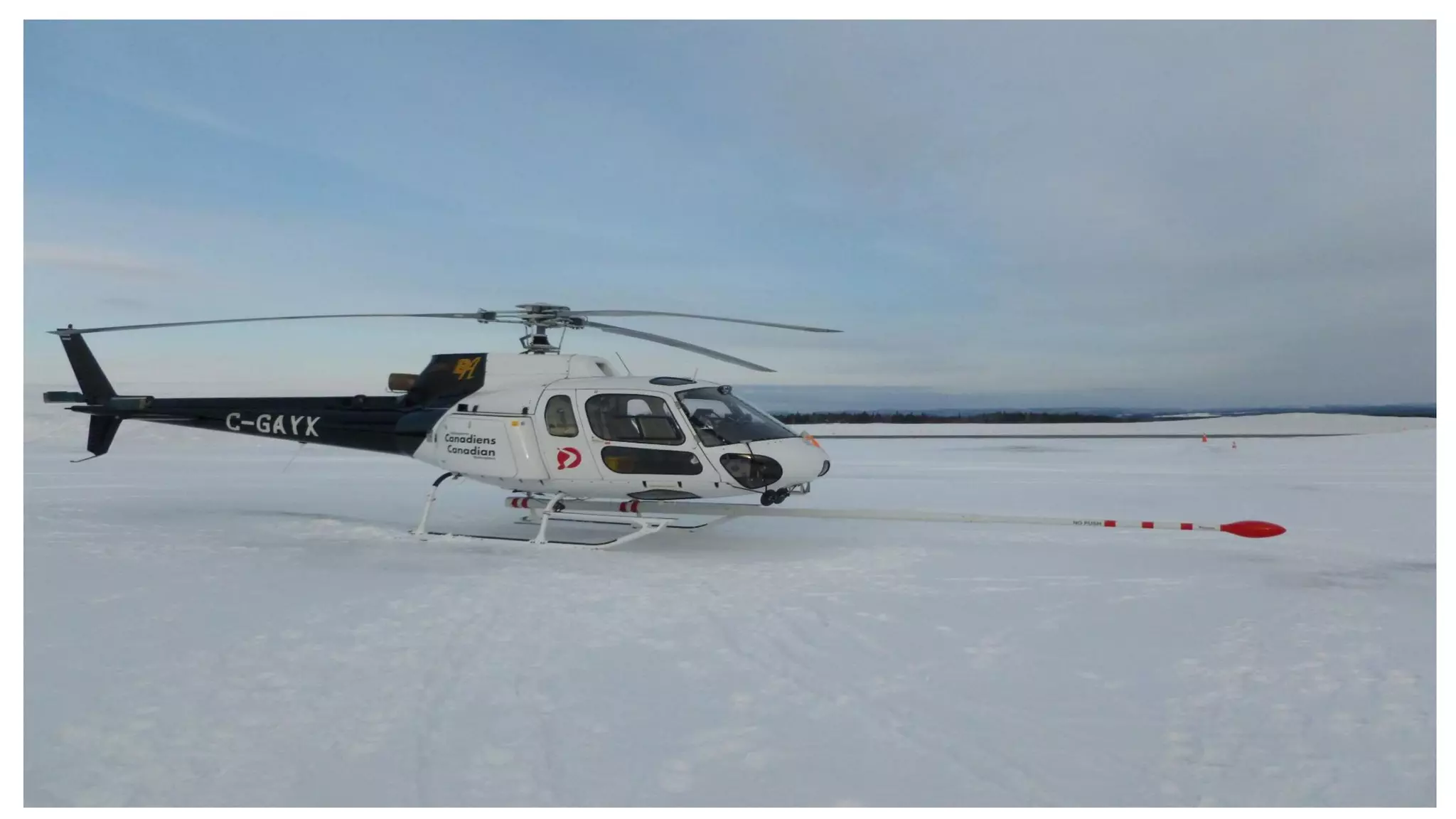
In old days used to have wide, high-impact cut lines Today, in
environmentally sensitive areas we use hand cut, low-impact cut
lines; supported by helicopters, not as much heavy equipment
* As a geophysicist, your responsibility to ensure that work is done
in environmentally sensitive manner
Remote locations
Moving into tougher areas to explore since easier areas have been
evaluated
What does a Geophysicist do?
responsibilities
data processing
Acquired data is processed at data processing centers in the office
Geophysicist at top right is building a velocity model to get better
data to analyze technologists often process as well
Interpreter analyzes
Interpreter analyzes the finished processed data to get an image of
the subsurface.
What does a Geophysicist do?
responsibilities
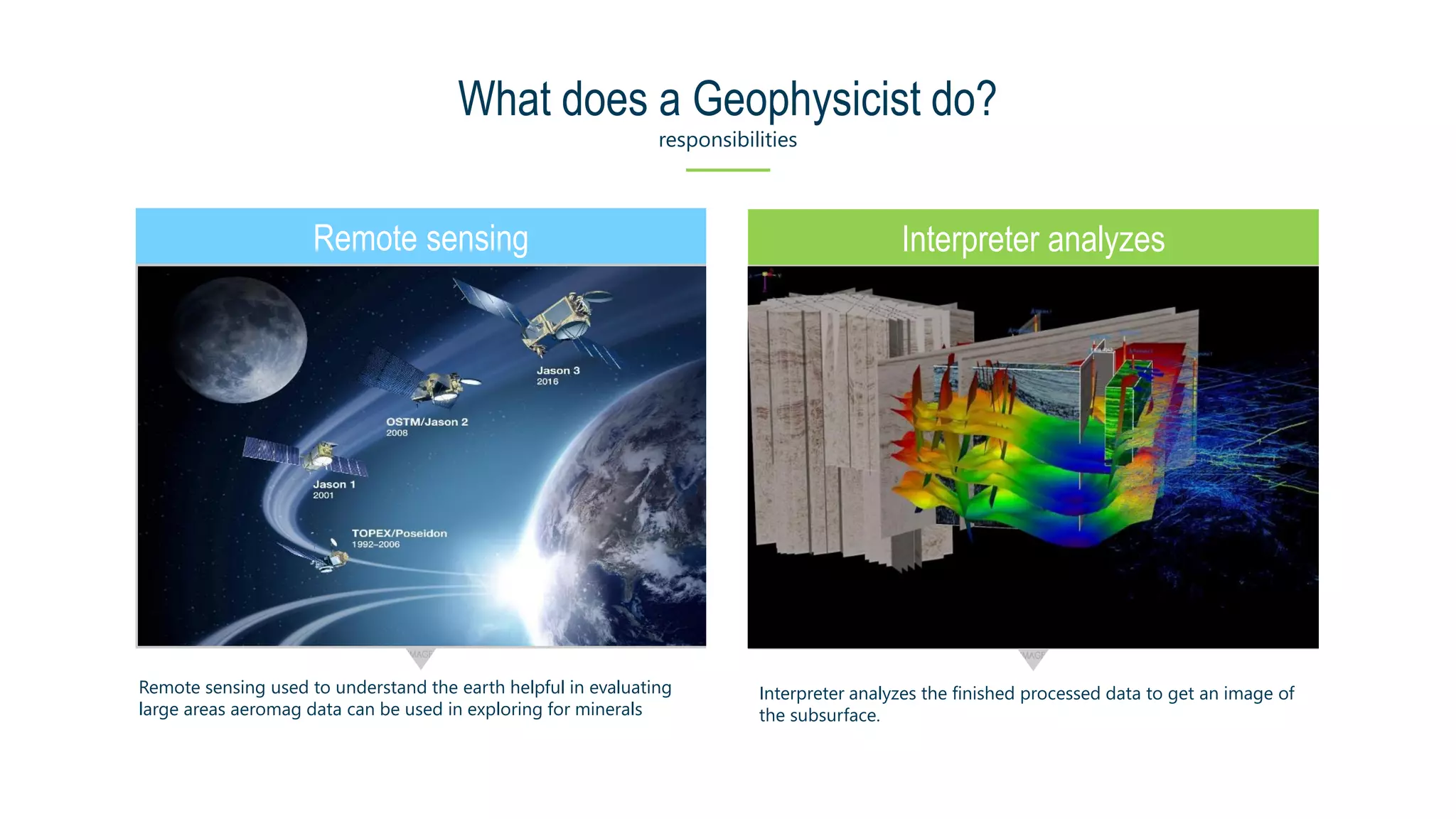
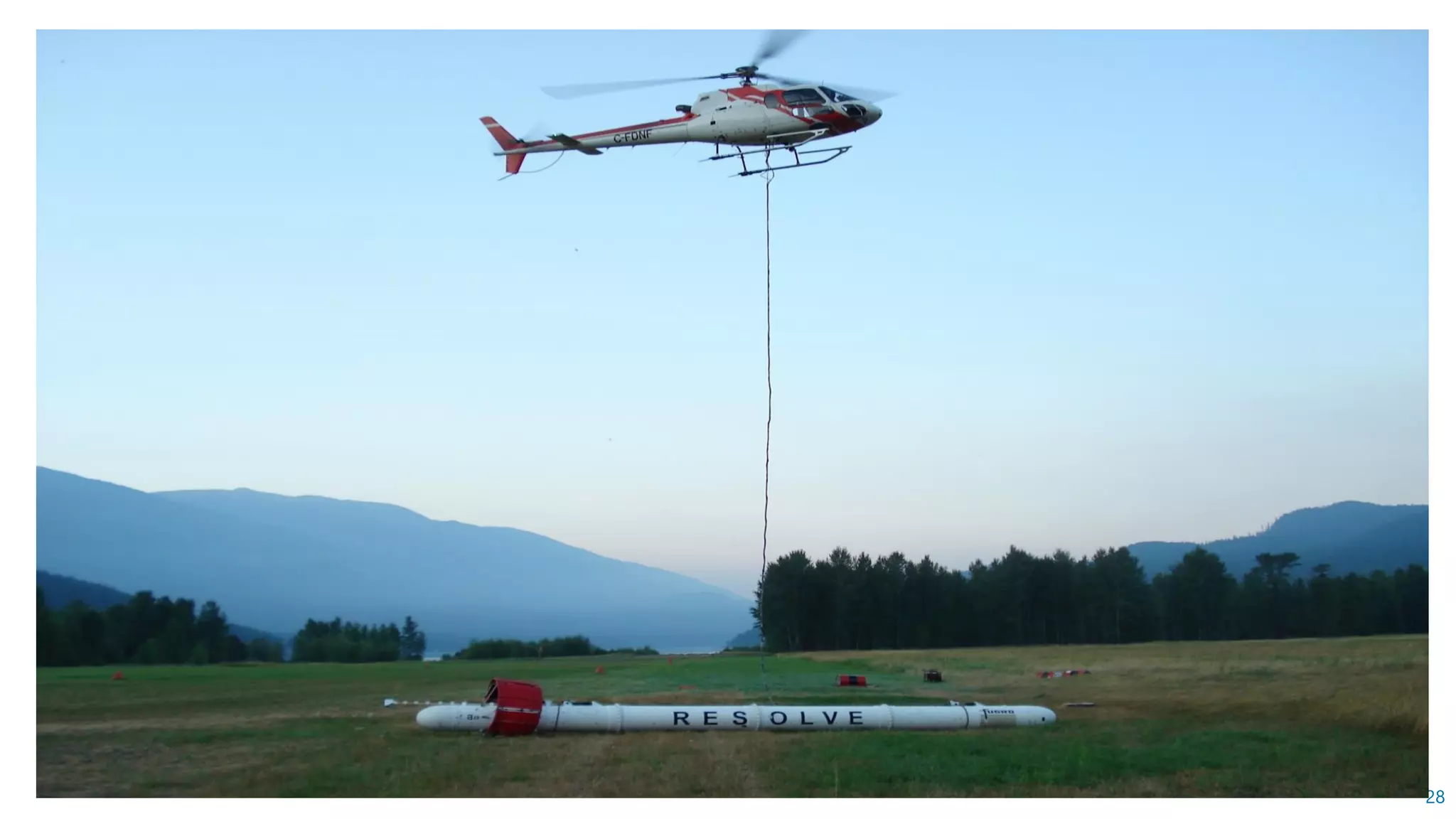
Remote sensing
Remote sensing used to understand the earth helpful in evaluating
large areas aeromag data can be used in exploring for minerals
Interpreter analyzes
Interpreter analyzes the finished processed data to get an image of
the subsurface.
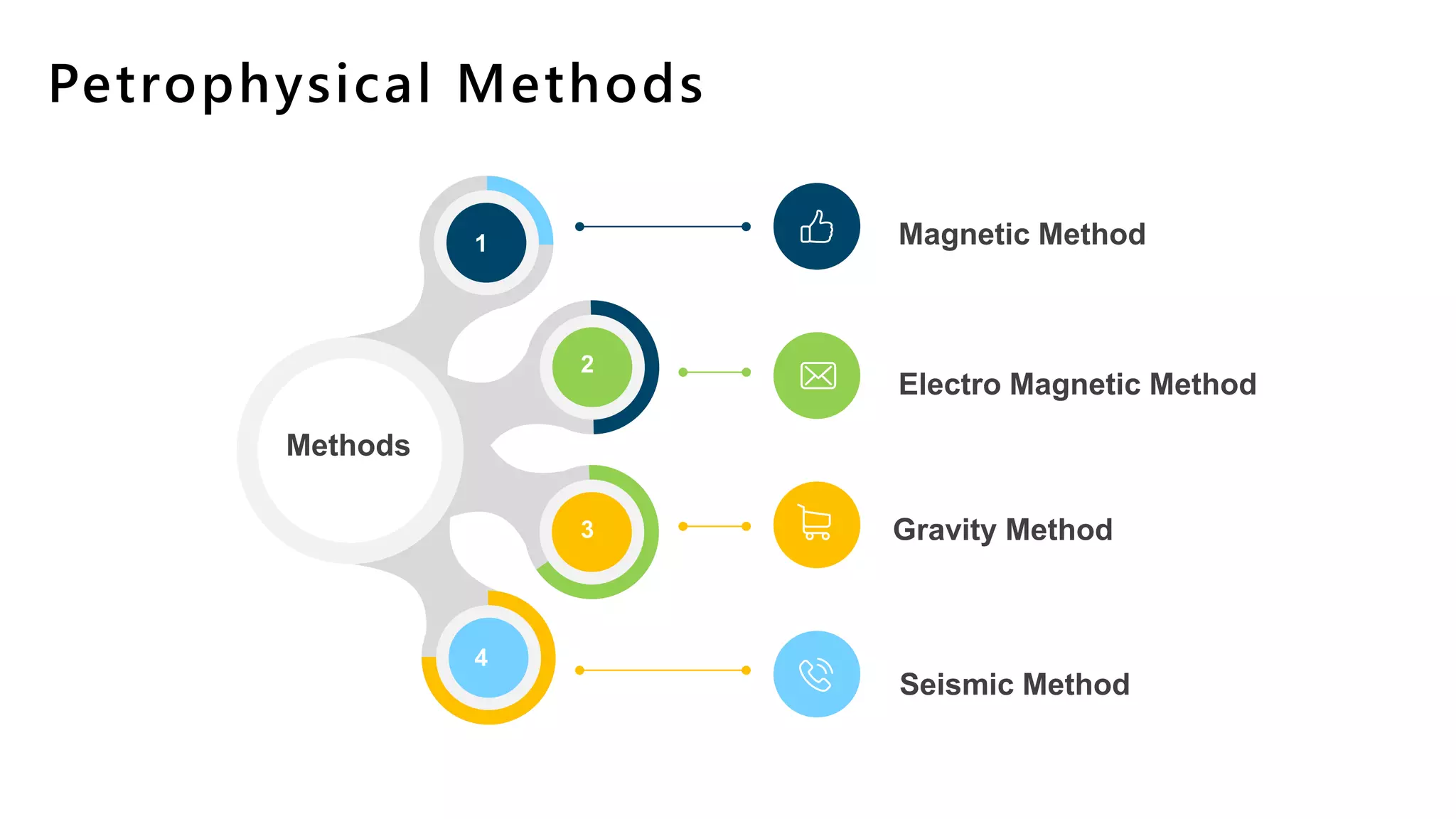
1
2
3
4
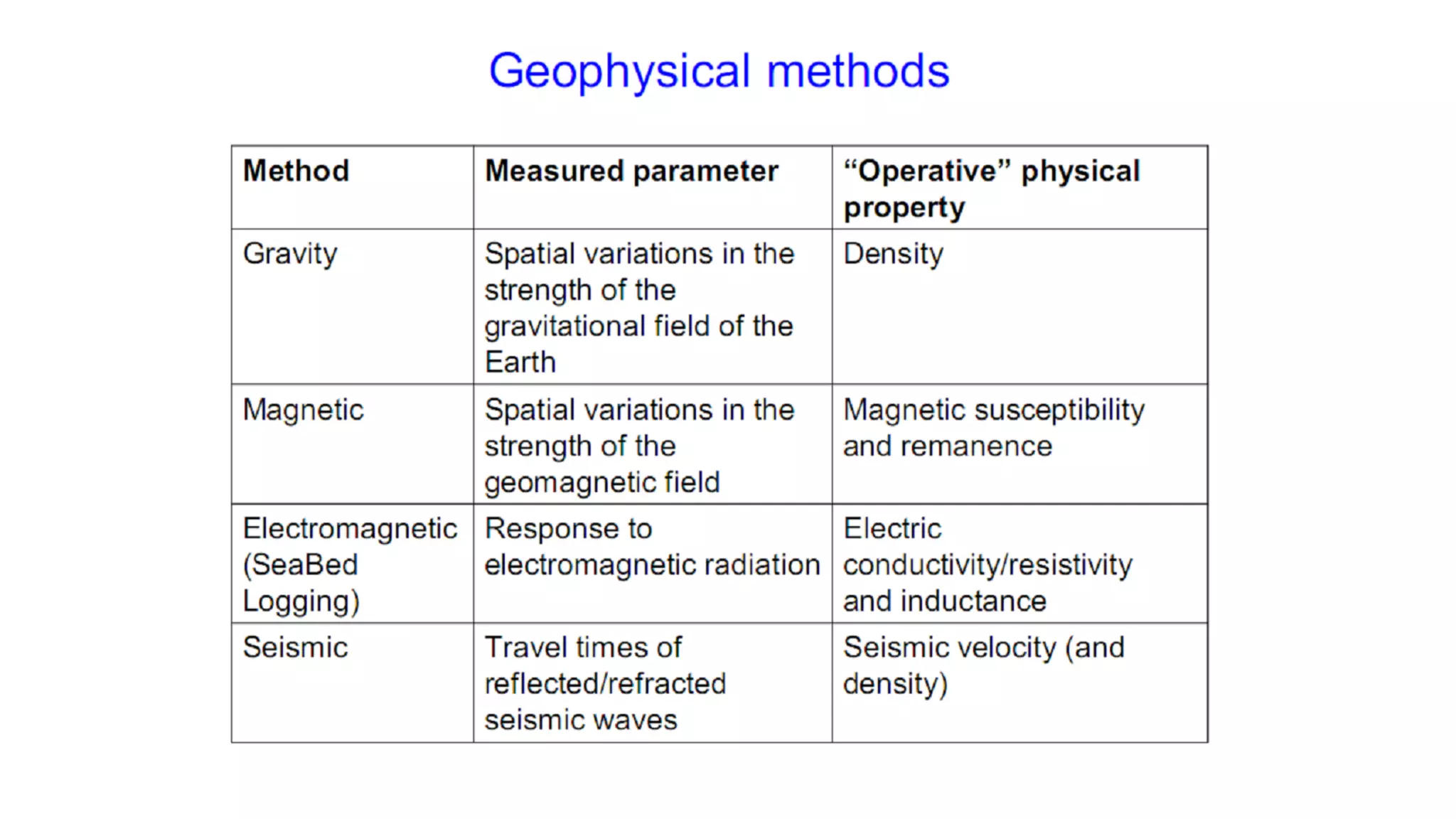
Magnetic Method
Methods
Gravity Method
Electro Magnetic Method
Seismic Method
1.
Magnetic
Method
Sedimentary rocks :
• Lime stone 10 – 25.000
• Sandstone 0 - 21.000
• Shale 60 – 18.600
Igneous Rock
• Granite 10- 65
• Peridolite 95.500 – 196.000
Minerals
• Quartz -15
• Magnetite 70.000-2 x 10^7
Measuring the strength and
Intensity of earth’s magnetic field.
The unit of
measurem
ent is Tesla
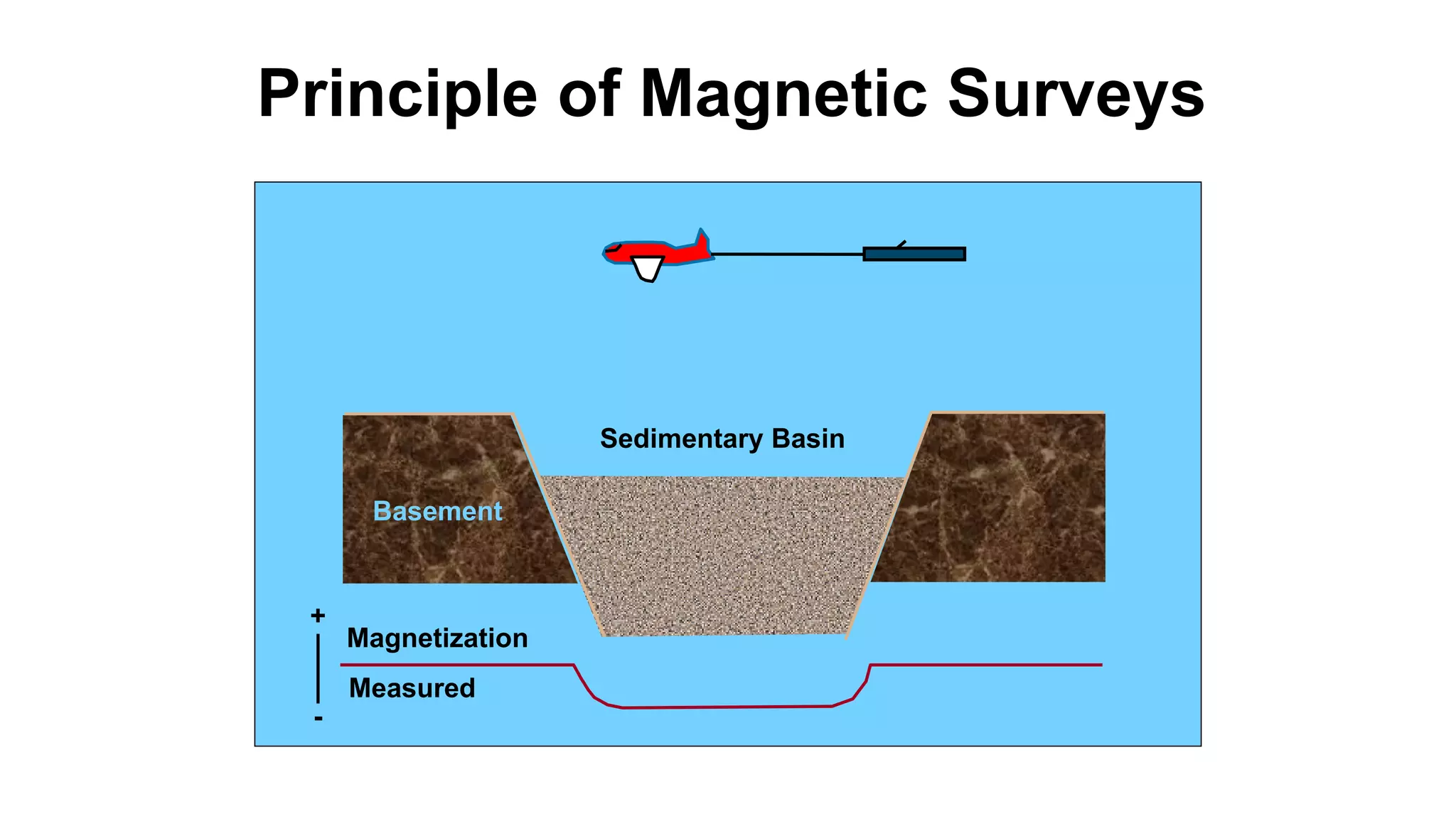
+
-
Basement
Sedimentary Basin
Magnetization
Measured
Principle of Magnetic Surveys
25
28
2.
Gravity
Method
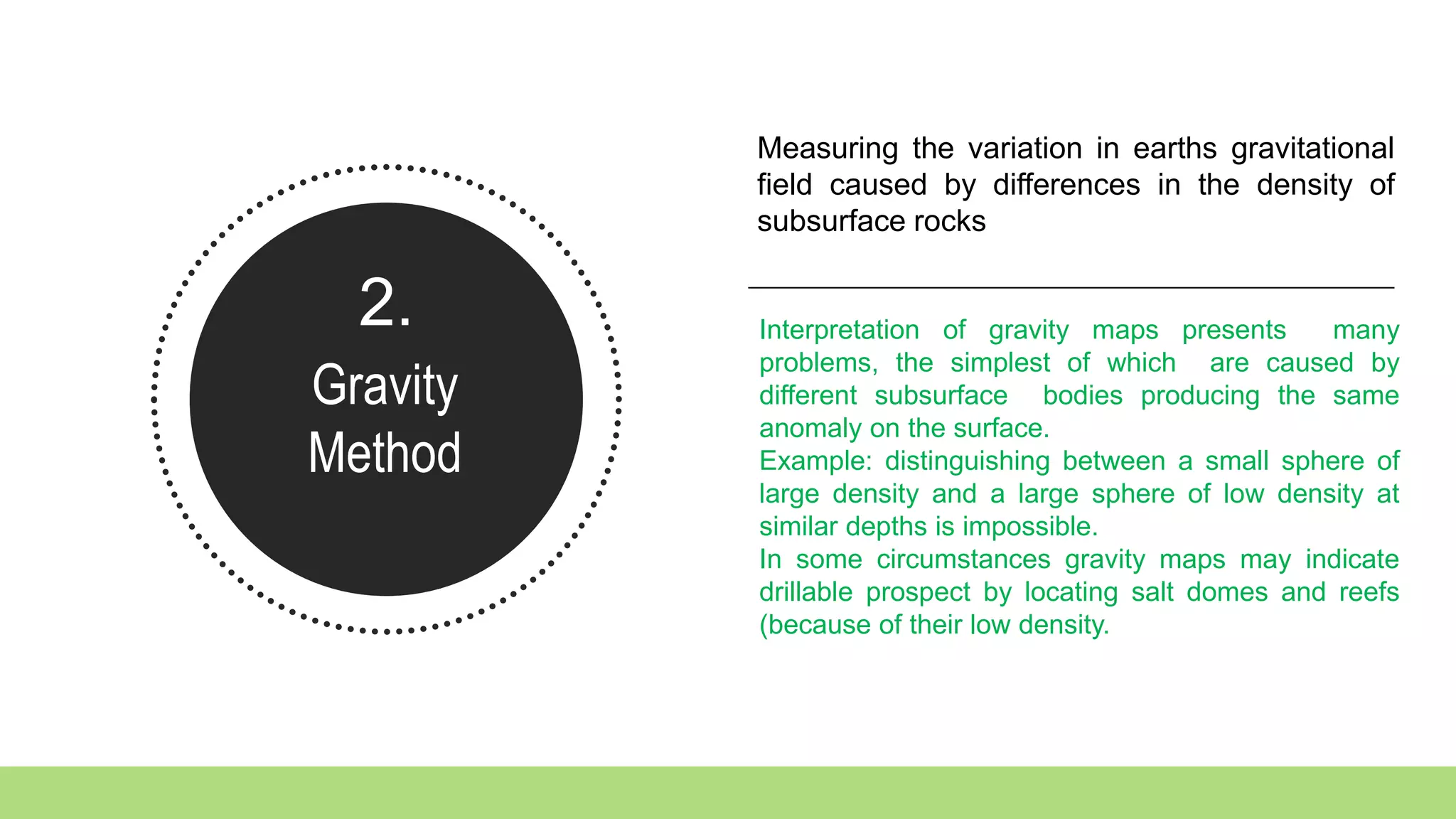
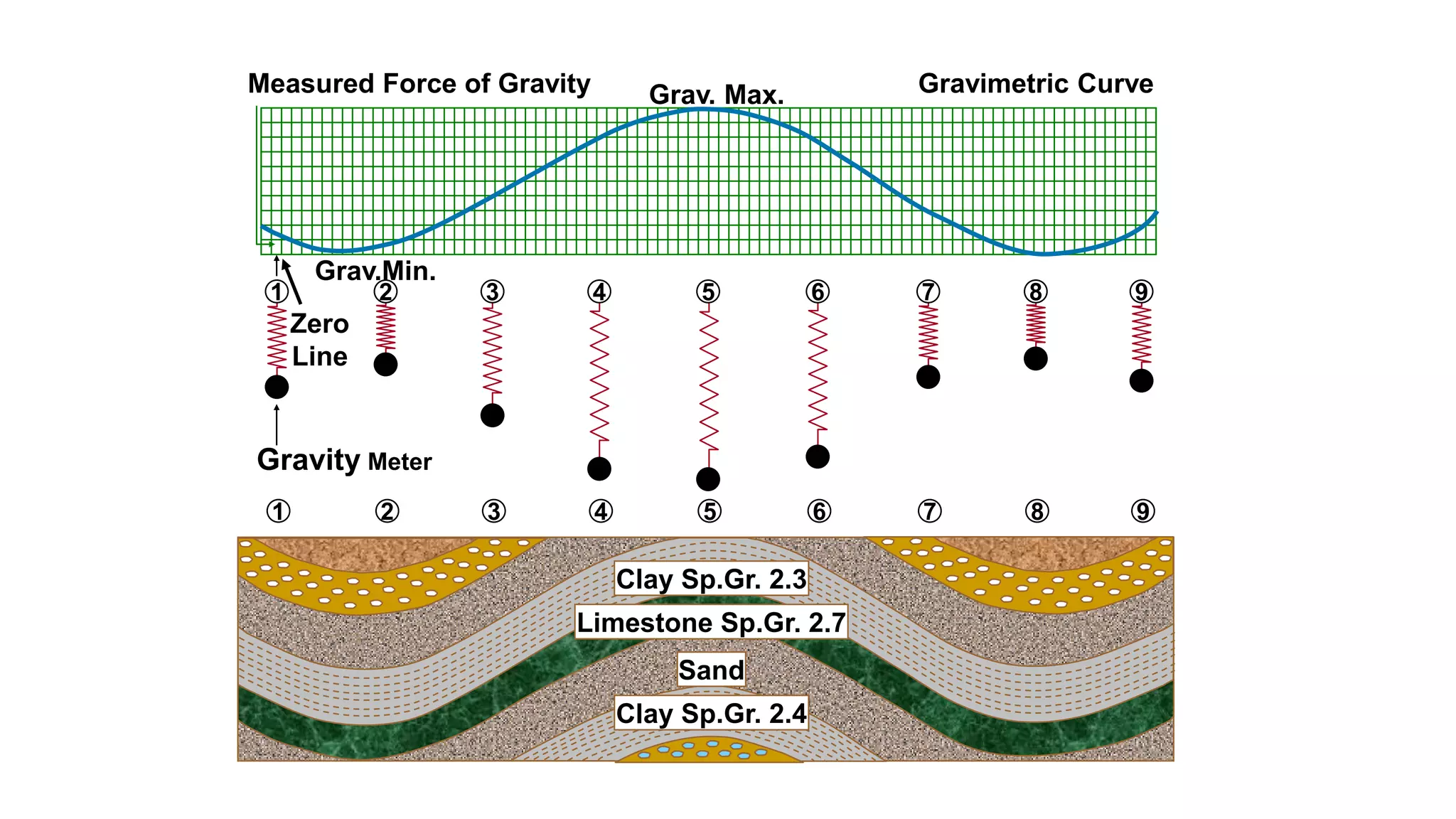
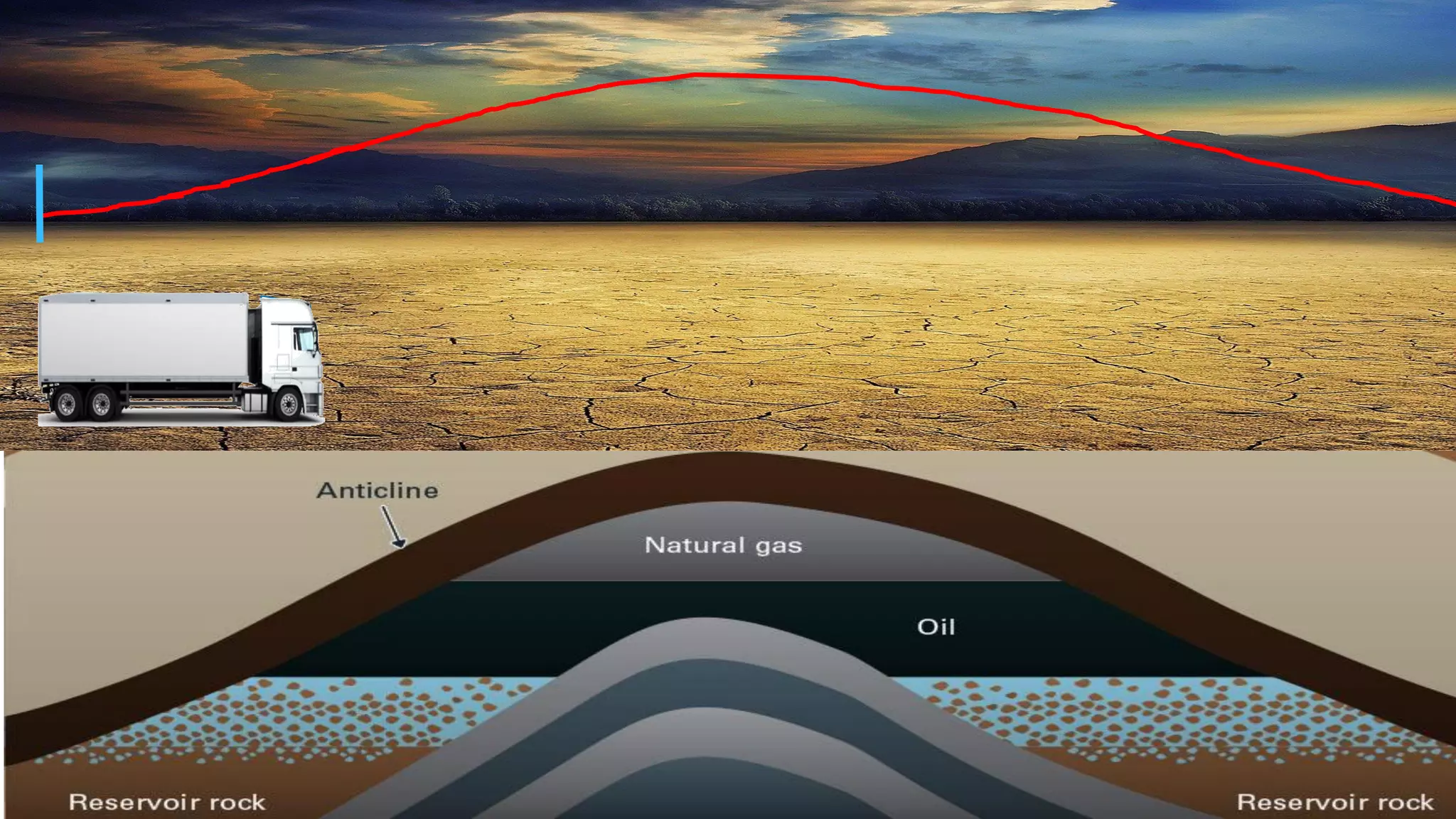
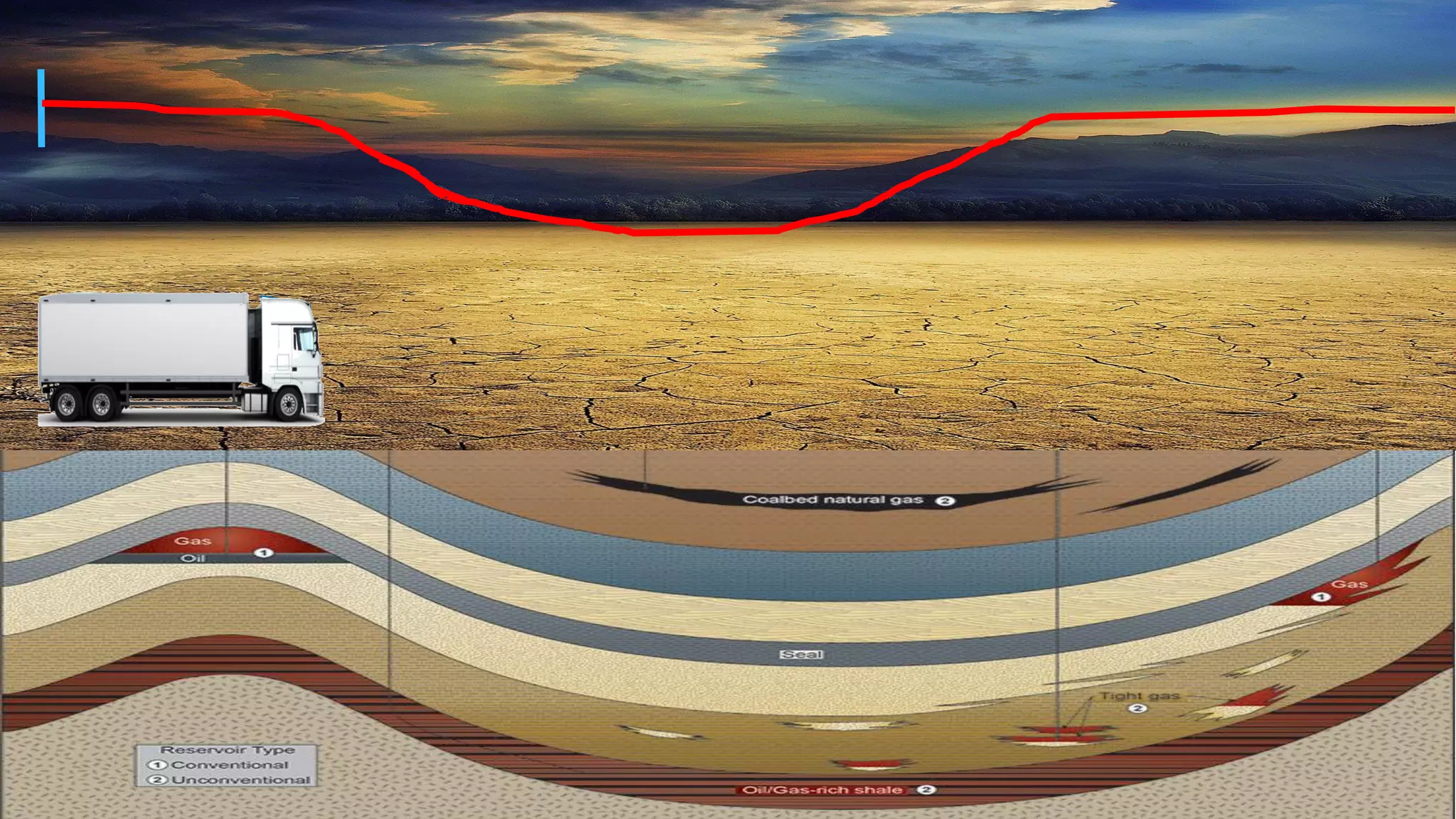
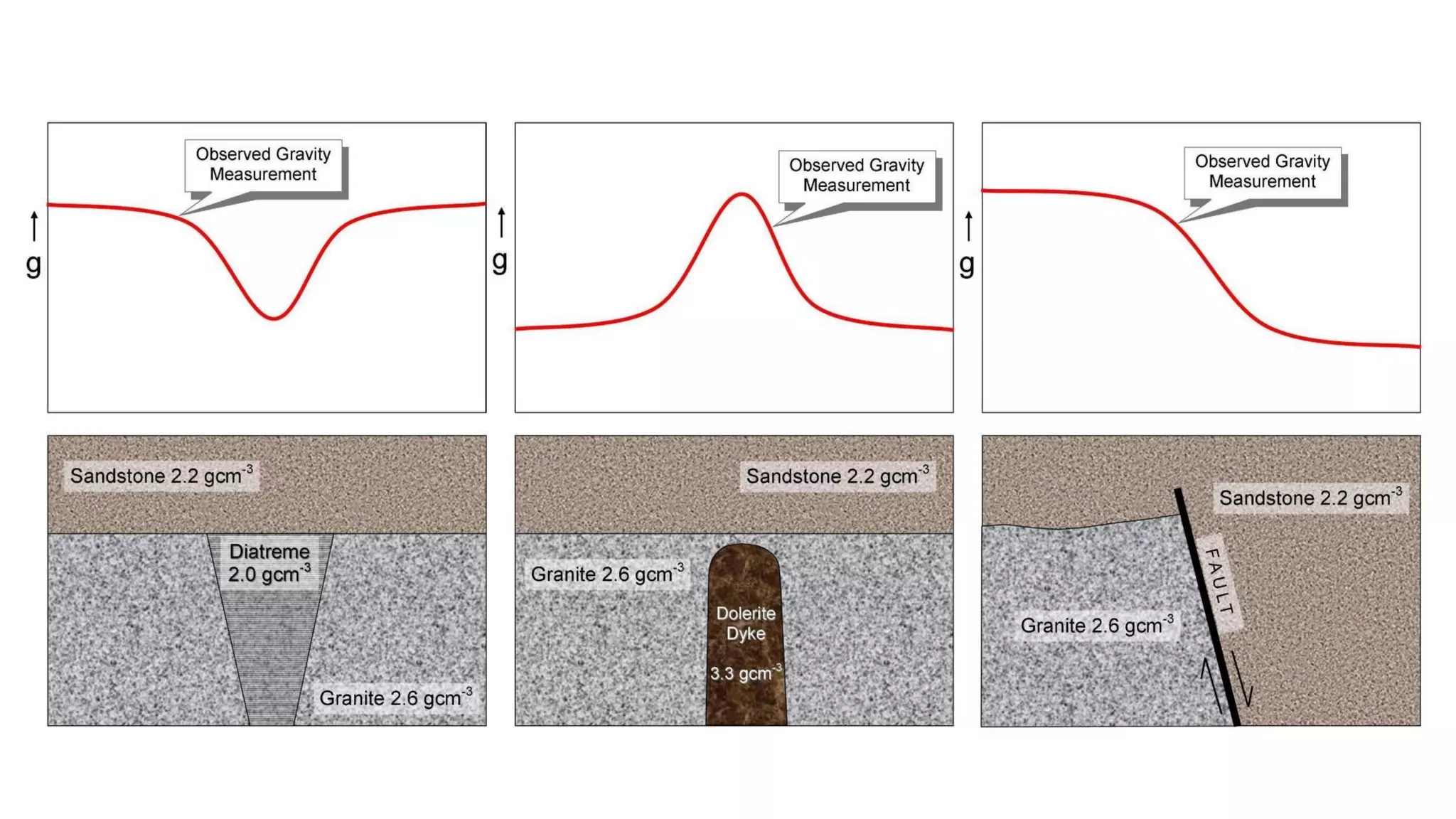
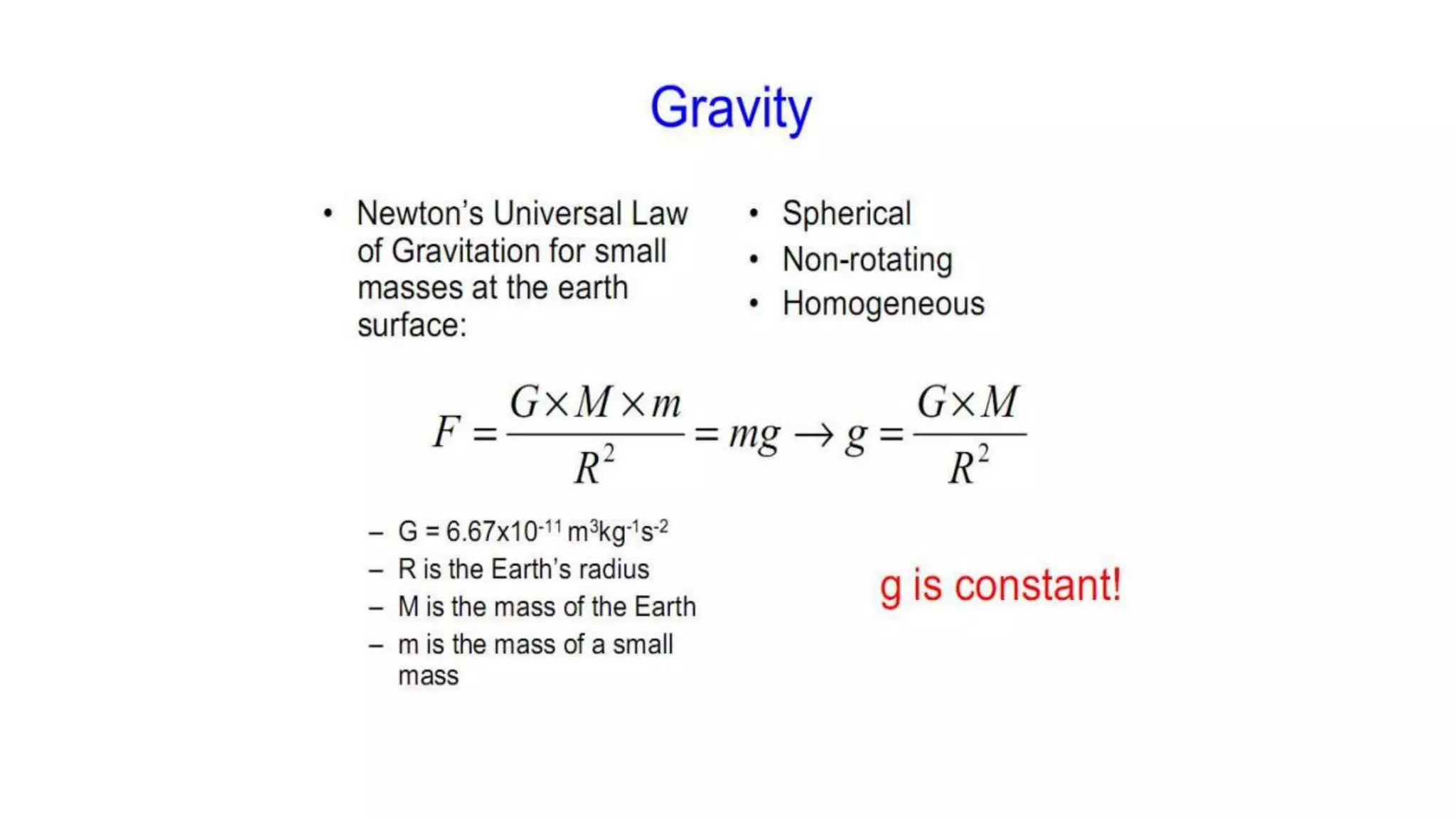
Measuring the variation in earths gravitational
field caused by differences in the density of
subsurface rocks
Interpretation of gravity maps presents many
problems, the simplest of which are caused by
different subsurface bodies producing the same
anomaly on the surface.
Example: distinguishing between a small sphere of
large density and a large sphere of low density at
similar depths is impossible.
In some circumstances gravity maps may indicate
drillable prospect by locating salt domes and reefs
(because of their low density.
Clay Sp.Gr. 2.3
Limestone Sp.Gr. 2.7
Sand
Clay Sp.Gr. 2.4
5 6 7 94 81 2 3
5 6 7 94 81 2 3
Measured Force of Gravity
Zero
Line
Grav.Min.
Gravity Meter
Gravimetric CurveGrav. Max.
-3
-2
-1
+1
Salt
2.1 gm/cm3
Corrected Gravity
(Bouguer Anomaly)
Uncorrected
Gravity
Clastics
2.4 gm/cm3
Meter
Gravity
Value (mgal)
Principles of Gravity Surveys
Seismic Waves
History
Seismic activities
1900 theory of reflected and refracted waves.
1914-1918 (WW1) locating heavy guns by
recording arrival times
1919 Mintrop: patent on the refraction
method (salt dome discovery, Texas)
1920’s reflection method (Oklahoma)
1953 magnetic tape: analog recording
1956 patent on CDP method
1975 first 3D surveys
1980’s development of seismic workstation
software
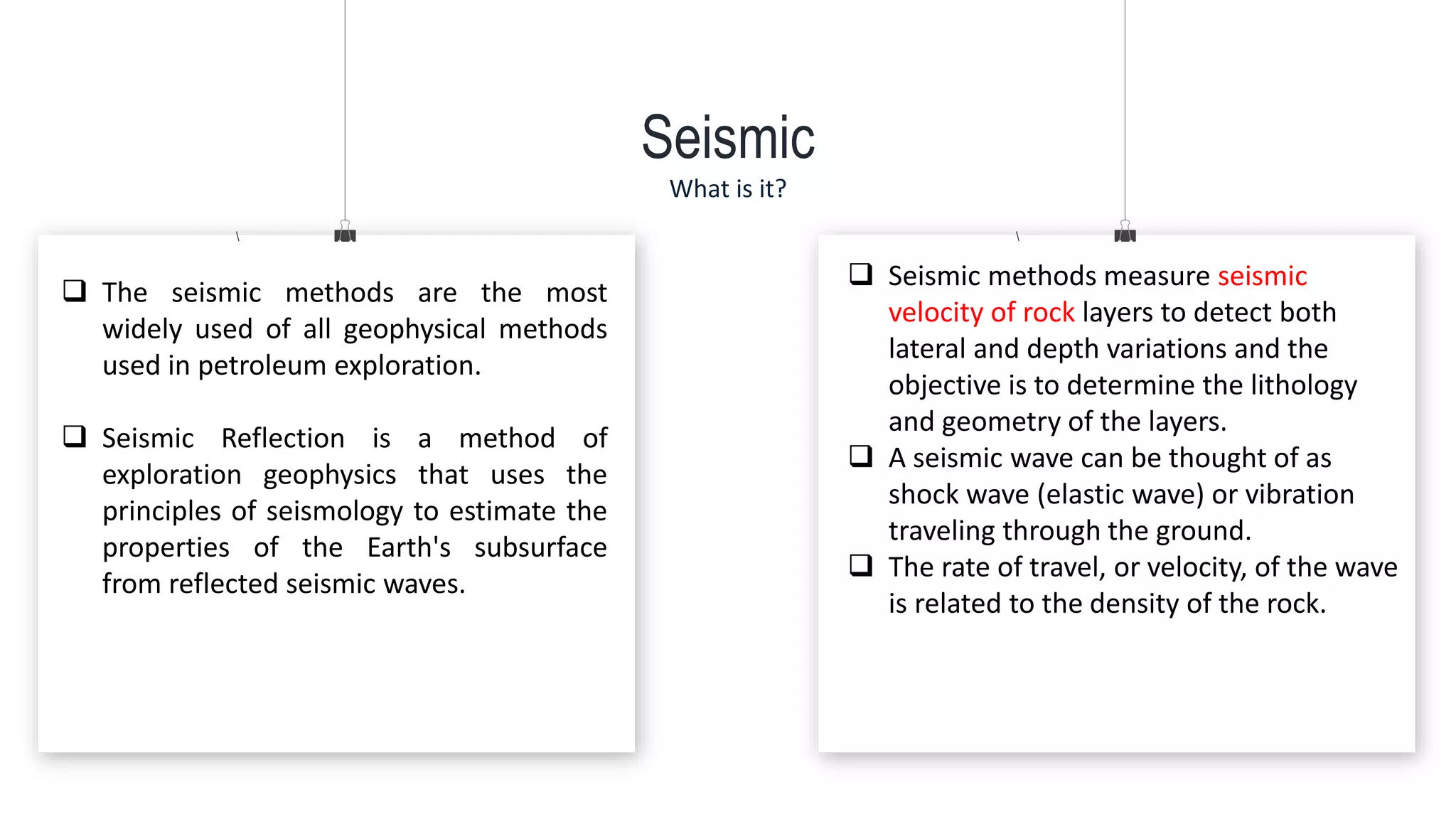
Seismic
What is it?
 The seismic methods are the most
widely used of all geophysical methods
used in petroleum exploration.
 Seismic Reflection is a method of
exploration geophysics that uses the
principles of seismology to estimate the
properties of the Earth's subsurface
from reflected seismic waves.
 Seismic methods measure seismic
velocity of rock layers to detect both
lateral and depth variations and the
objective is to determine the lithology
and geometry of the layers.
 A seismic wave can be thought of as
shock wave (elastic wave) or vibration
traveling through the ground.
 The rate of travel, or velocity, of the wave
is related to the density of the rock.
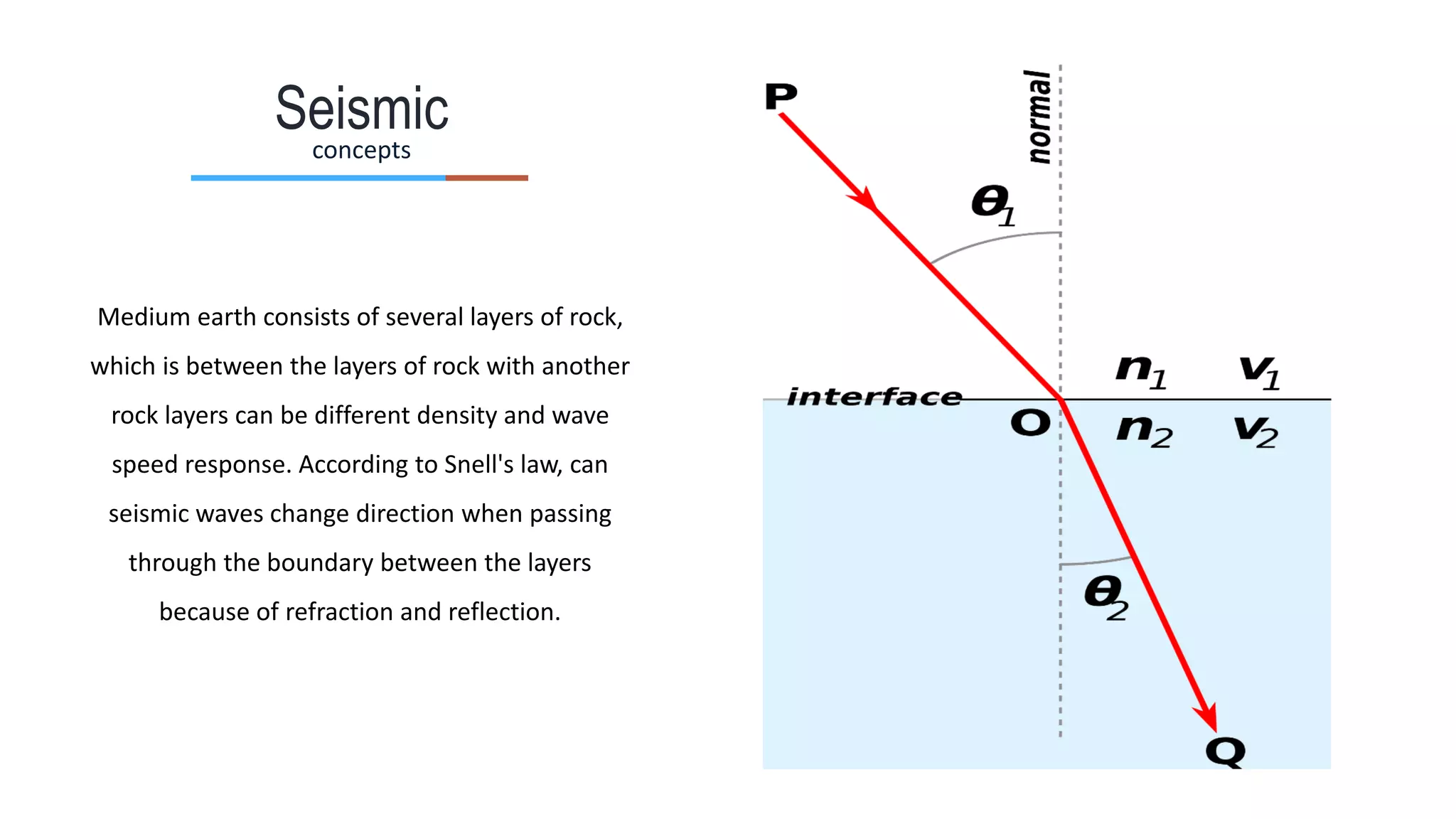
Seismicconcepts
Medium earth consists of several layers of rock,
which is between the layers of rock with another
rock layers can be different density and wave
speed response. According to Snell's law, can
seismic waves change direction when passing
through the boundary between the layers
because of refraction and reflection.
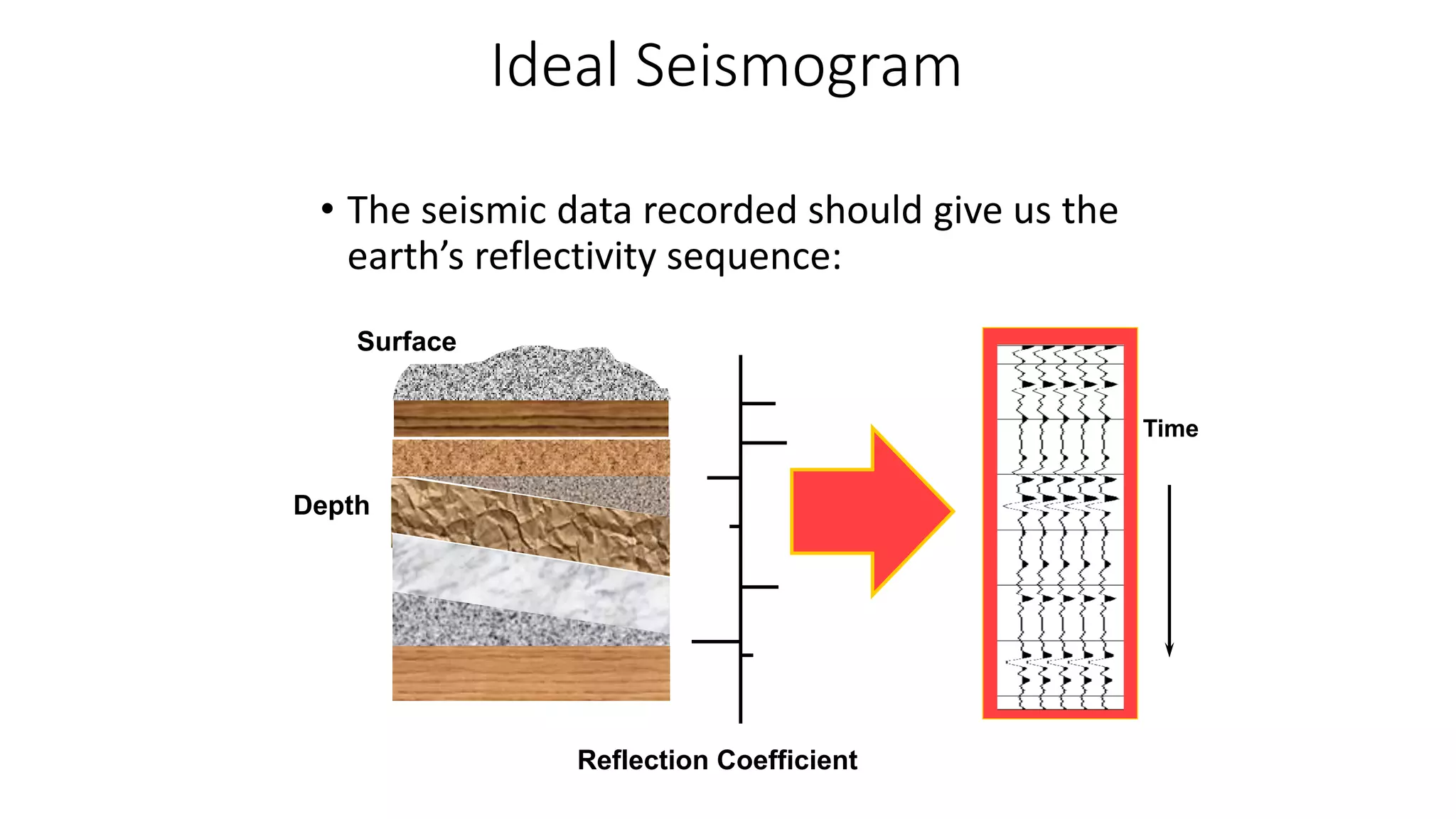
Ideal Seismogram
• The seismic data recorded should give us the
earth’s reflectivity sequence:
Surface
Depth
Time
Reflection Coefficient
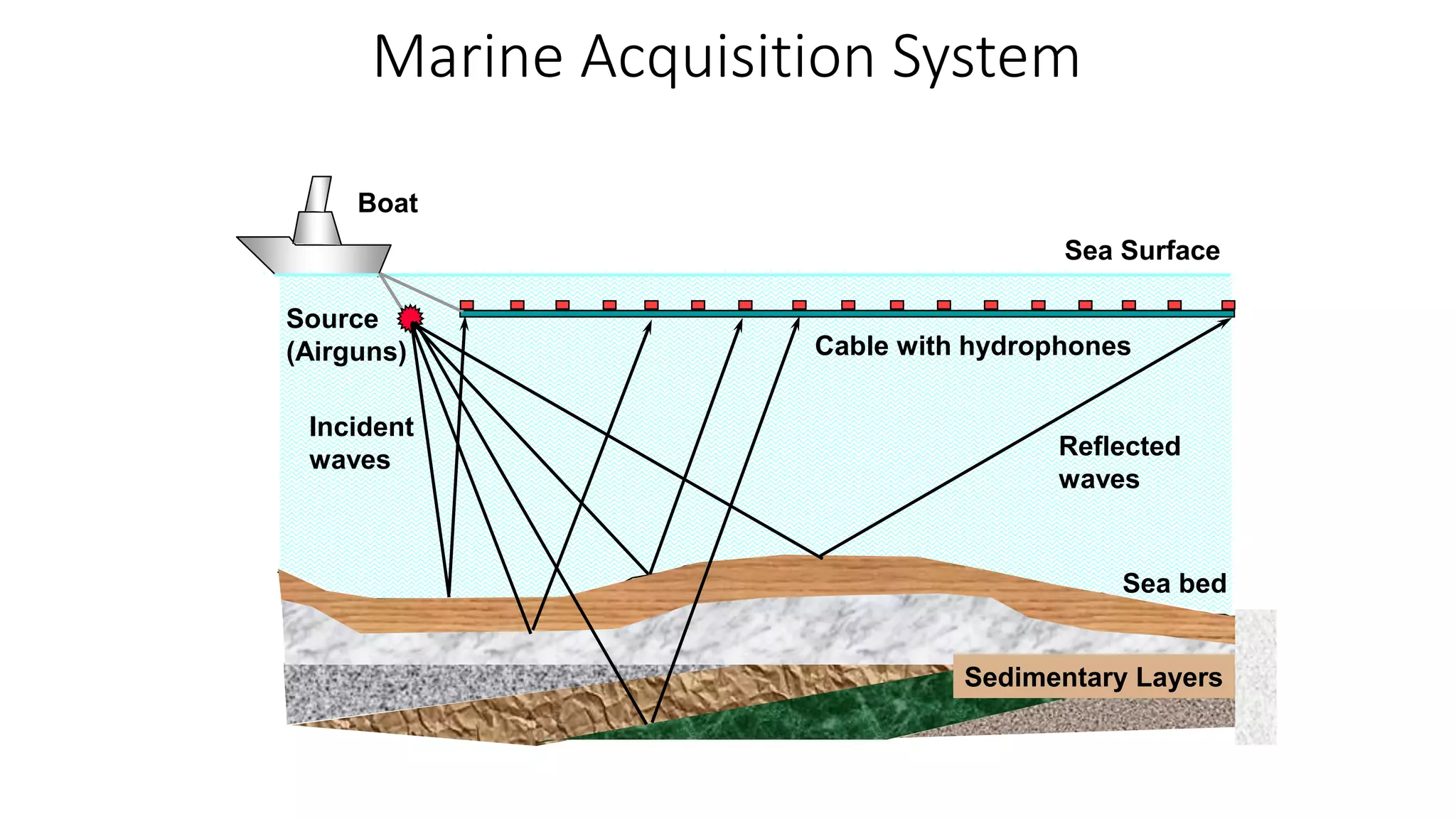
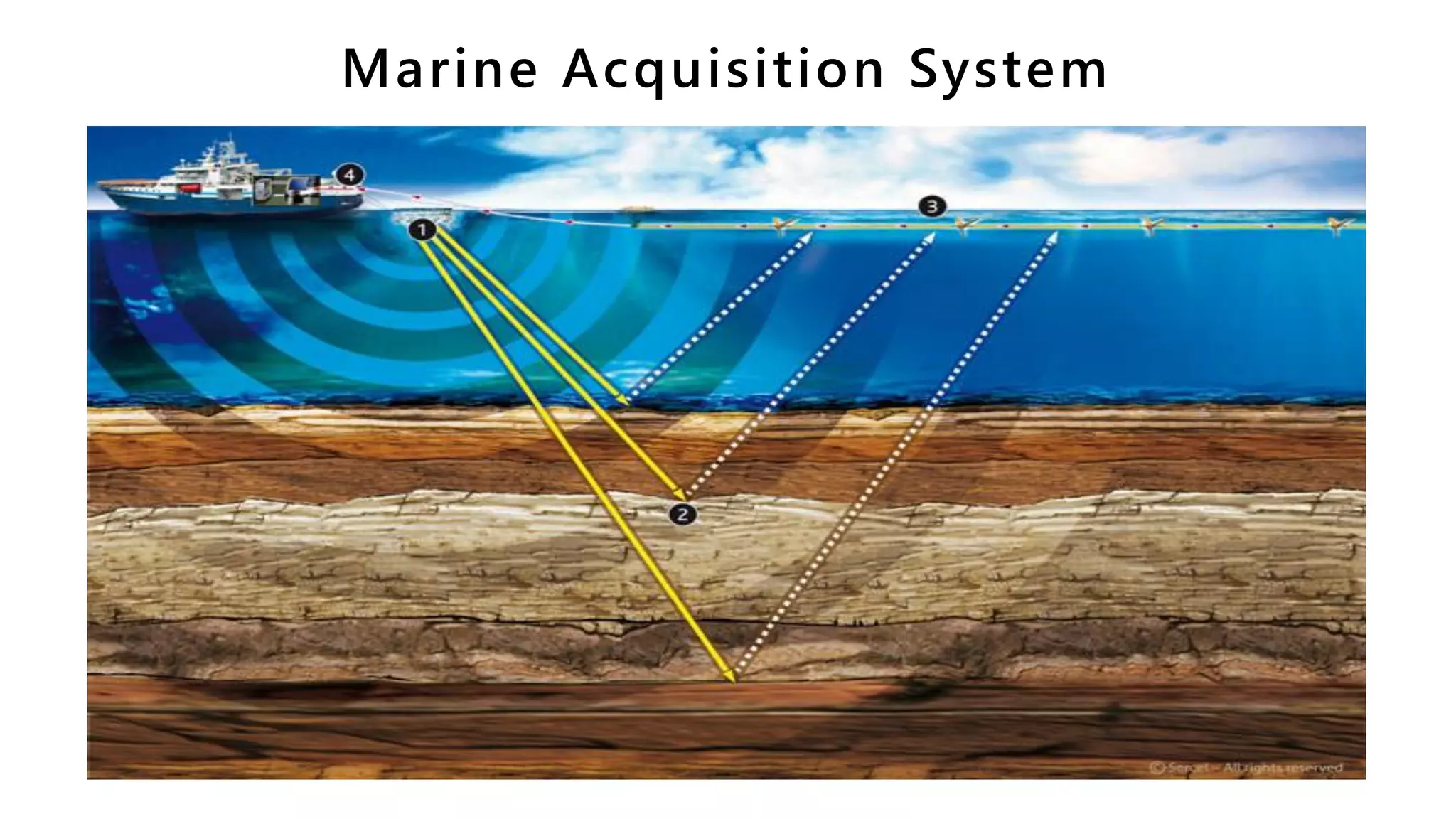
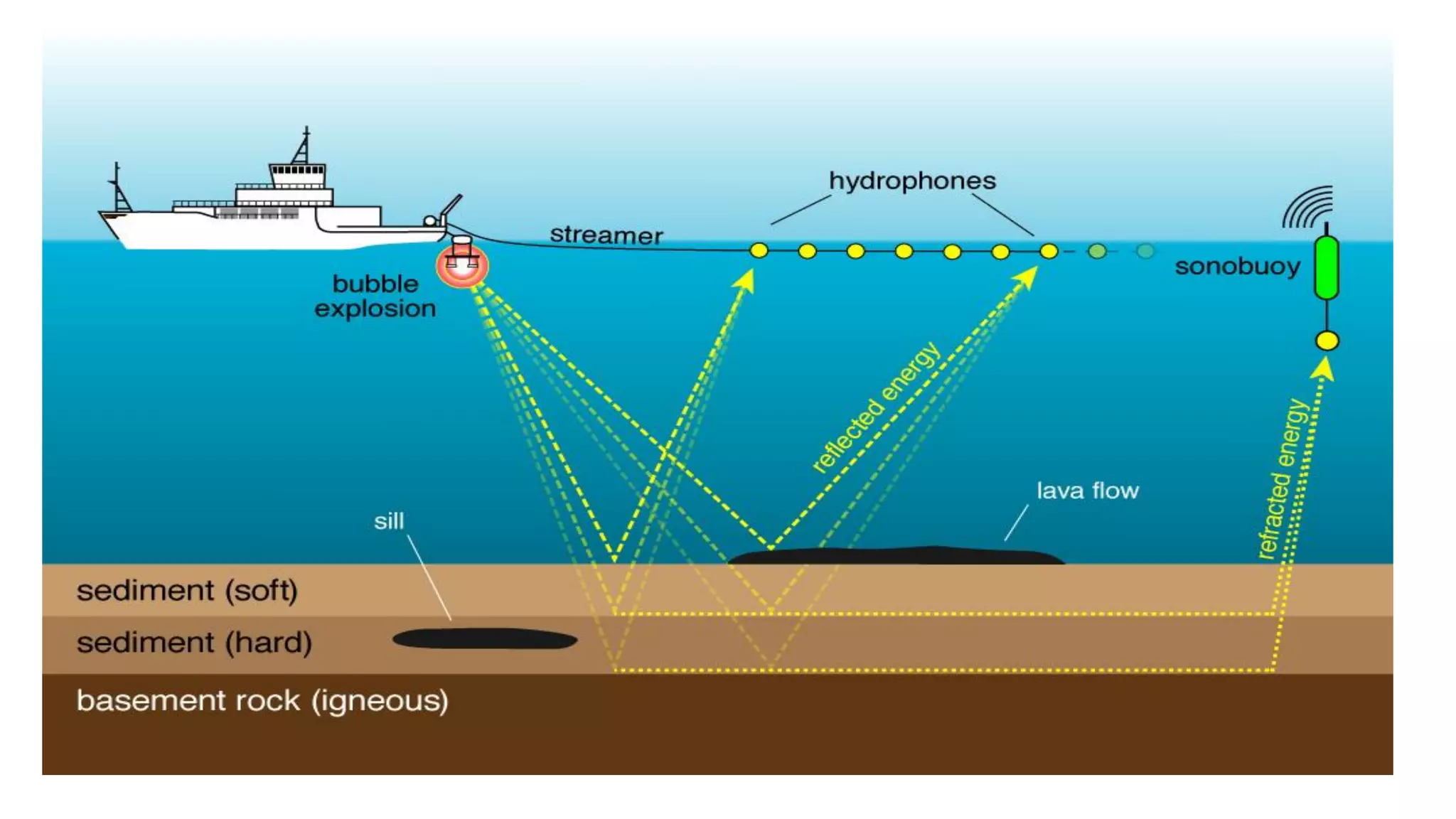
Sea bed
Boat
Cable with hydrophones
Sea Surface
Source
(Airguns)
Sedimentary Layers
Incident
waves Reflected
waves
Marine Acquisition System
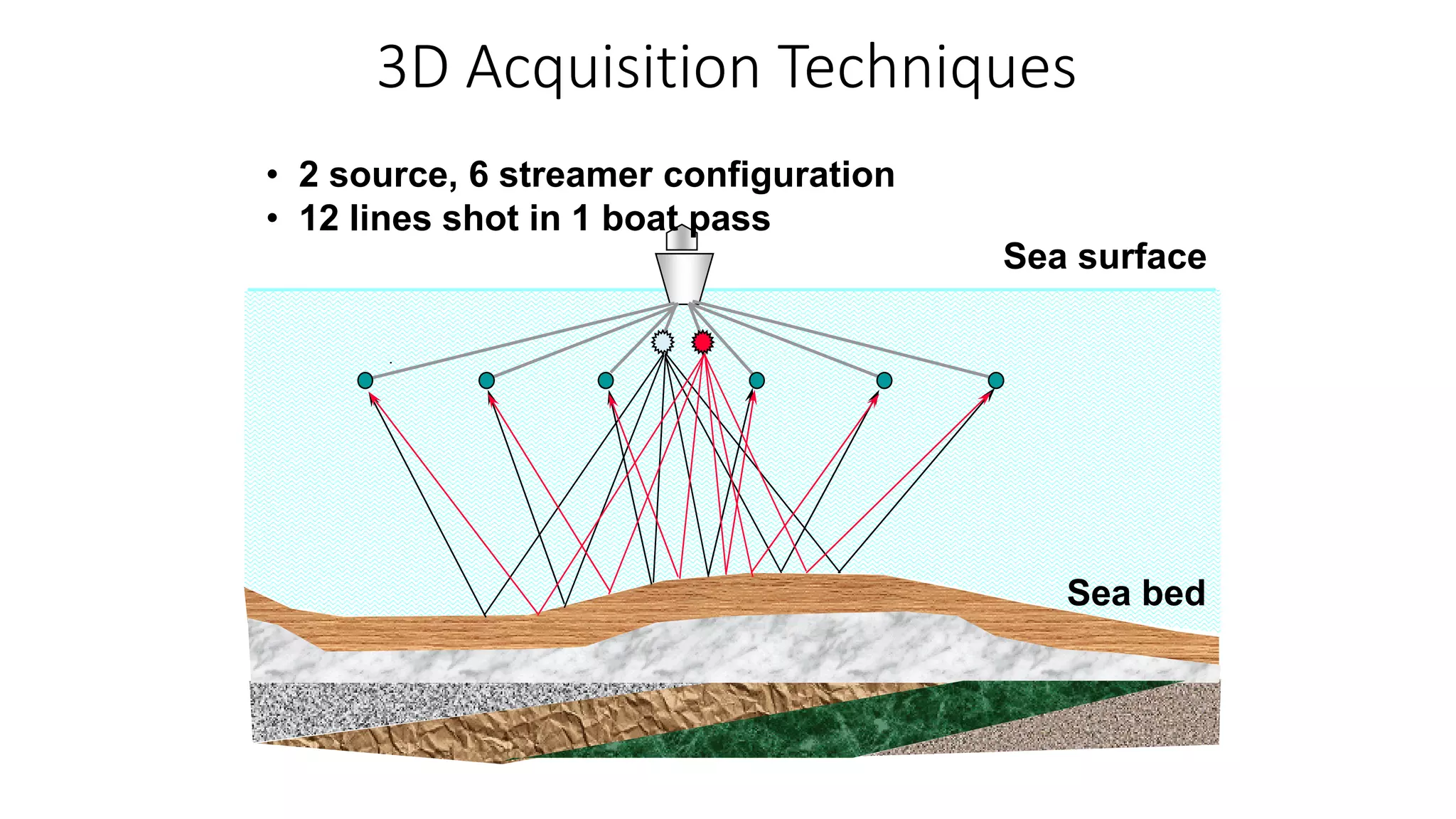
3D Acquisition Techniques
Sea surface
Sea bed
• 2 source, 6 streamer configuration
• 12 lines shot in 1 boat pass
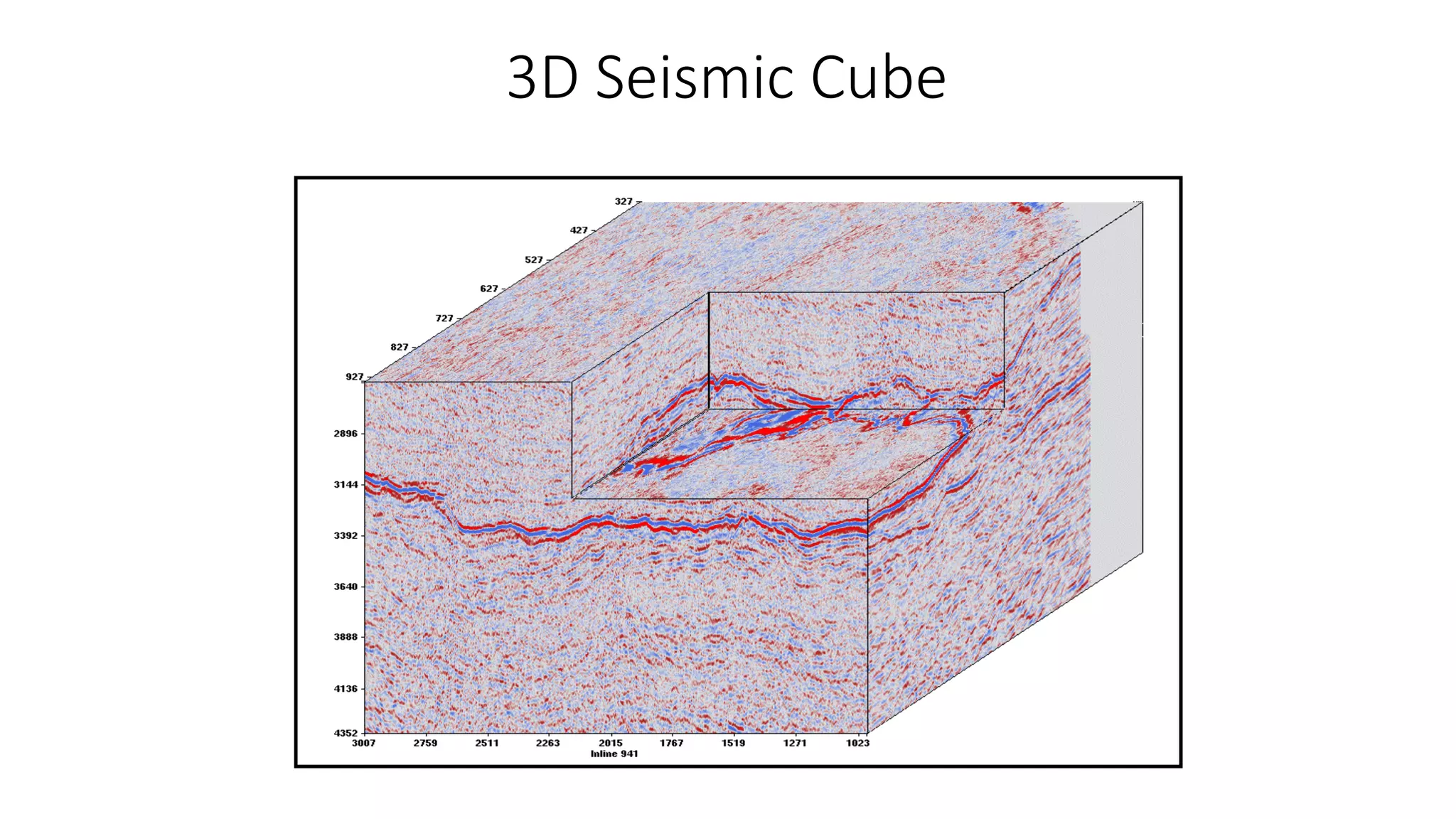
3D Seismic Cube
SeismicResponse
Causes of seismic response
1. Changes in bulk-rock velocity or density
• Lithology (e.g., sandstone, shale, limestone, salt)
Limestone Shale
SeismicResponse
Causes of seismic response
1. Changes in bulk-rock velocity or density
• Porosity (e.g., intrinsic, compaction, diagenesis)
Fast Slow
SeismicResponse
Causes of seismic response
1. Changes in bulk-rock velocity or density
• Mineralogy (e.g., calcite vs. dolomite, carbonaceous shales)
• Fluid type and saturation (water, oil, gas)
Pore Fluid Density
Salt Water 2.164
Fresh Water 2.155
Oil 2.095
Gas 1.856
Sandstone with 30% Porosity:
interface
shot receivers shot receivers
Wave fronts
 How waves actually travel
 Surface of equal travel time
 Surface of equal phase
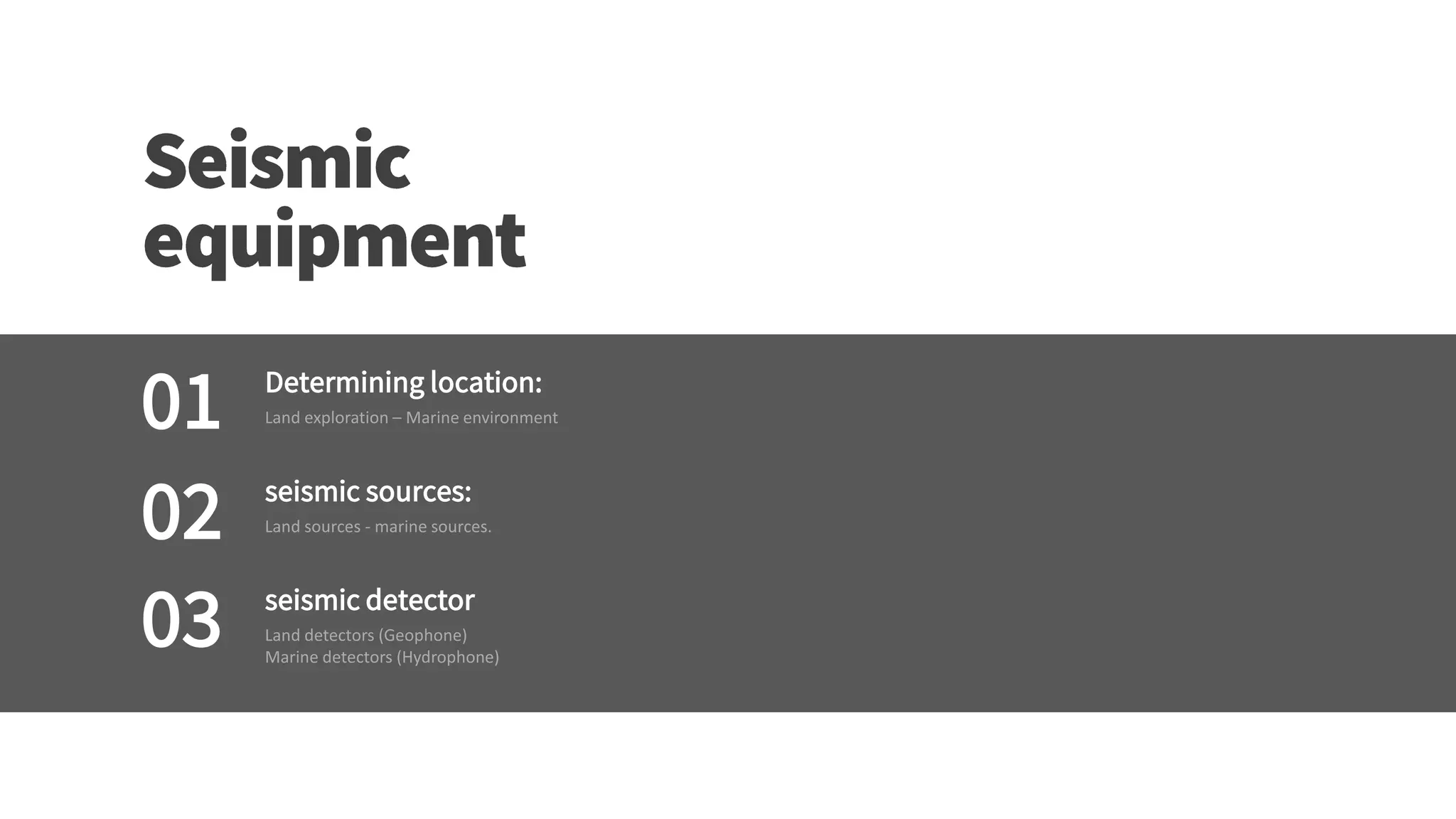
Determining location:
seismic sources:
seismic detector
01
02
03
Petroleum exploration and production are concerned with the geological
interpretation of geophysical data, especially in offshore areas.
The location can be :
 Marine environment
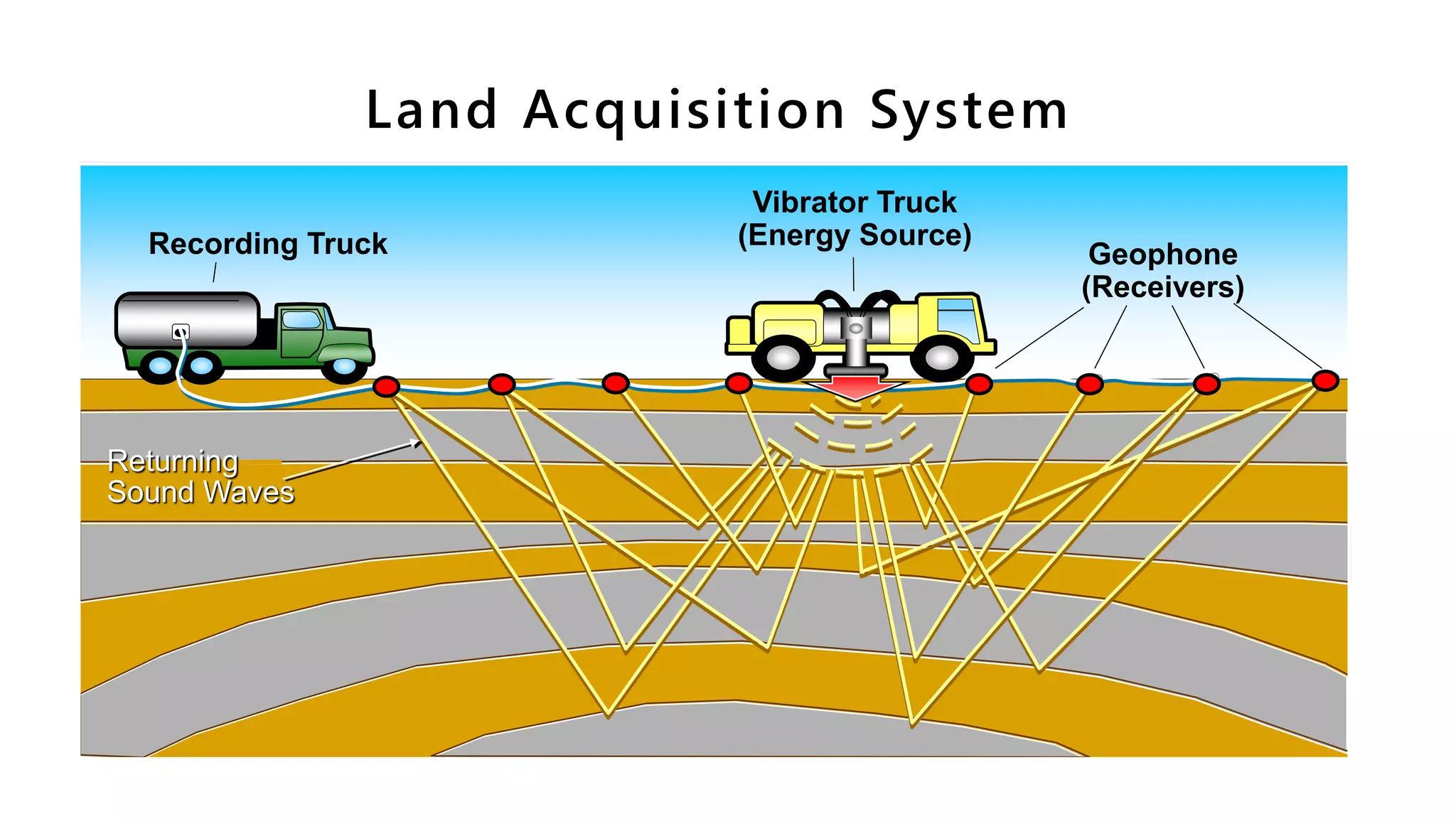
 Land environment
58
Vibrator Truck
(Energy Source)Recording Truck Geophone
(Receivers)
Returning
Sound Waves
seismic source
is a device that generates controlled seismic energy used
to perform both reflection and refraction seismic surveys.
This is a sample text. You can replace this text. Enter your text here. This is a
sample text. You can replace this text. Enter your text here.
source
seismic source
Natural Source Artificial Source
Earthquakes Marine Land
Air Gun
• Hammers
• Weight drops
• Explosive dynamite
• Vibrators
01 02 03 04 05
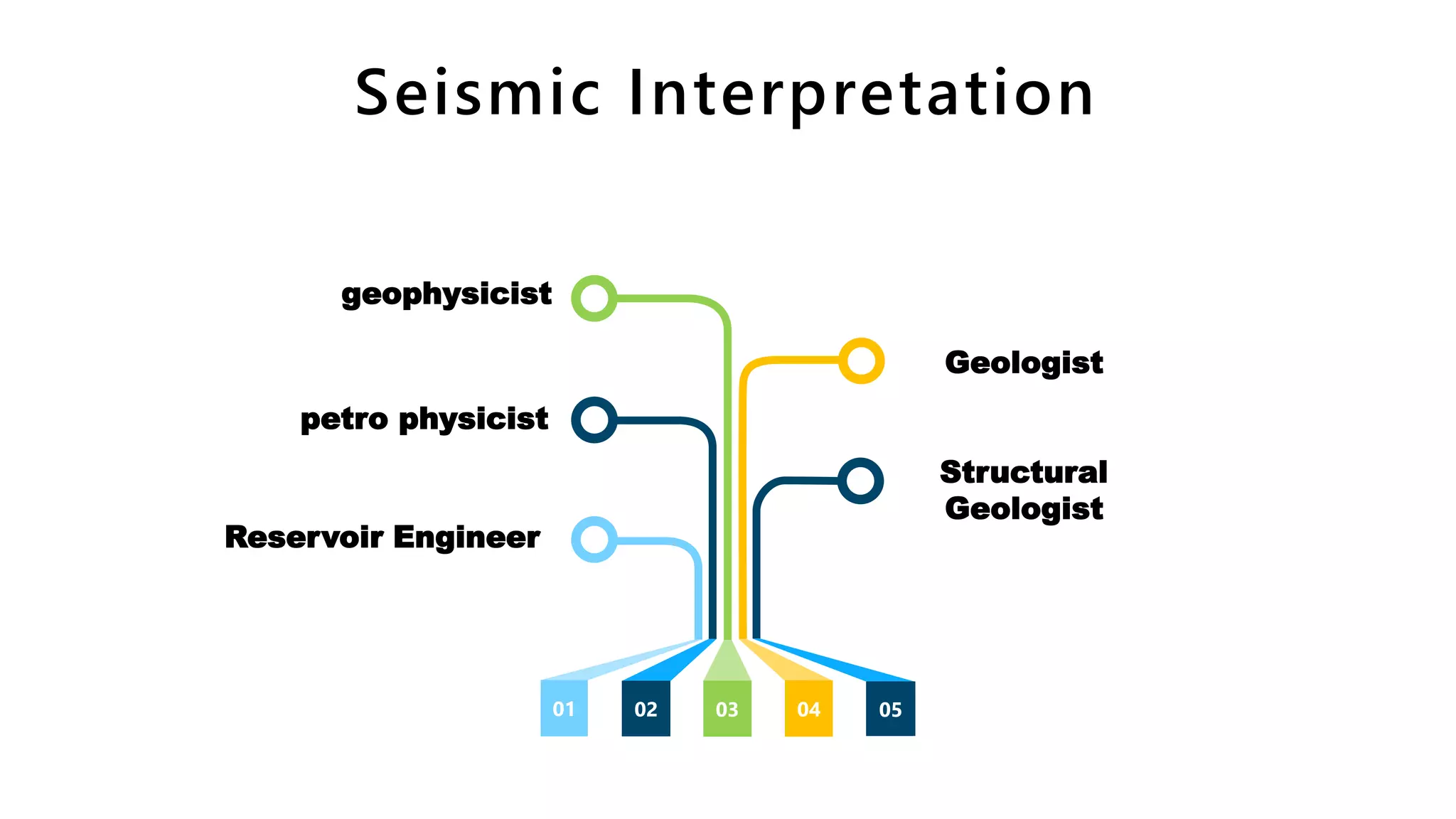
Seismic Interpretation
geophysicist
petro physicist
Reservoir Engineer
Geologist
Structural
Geologist
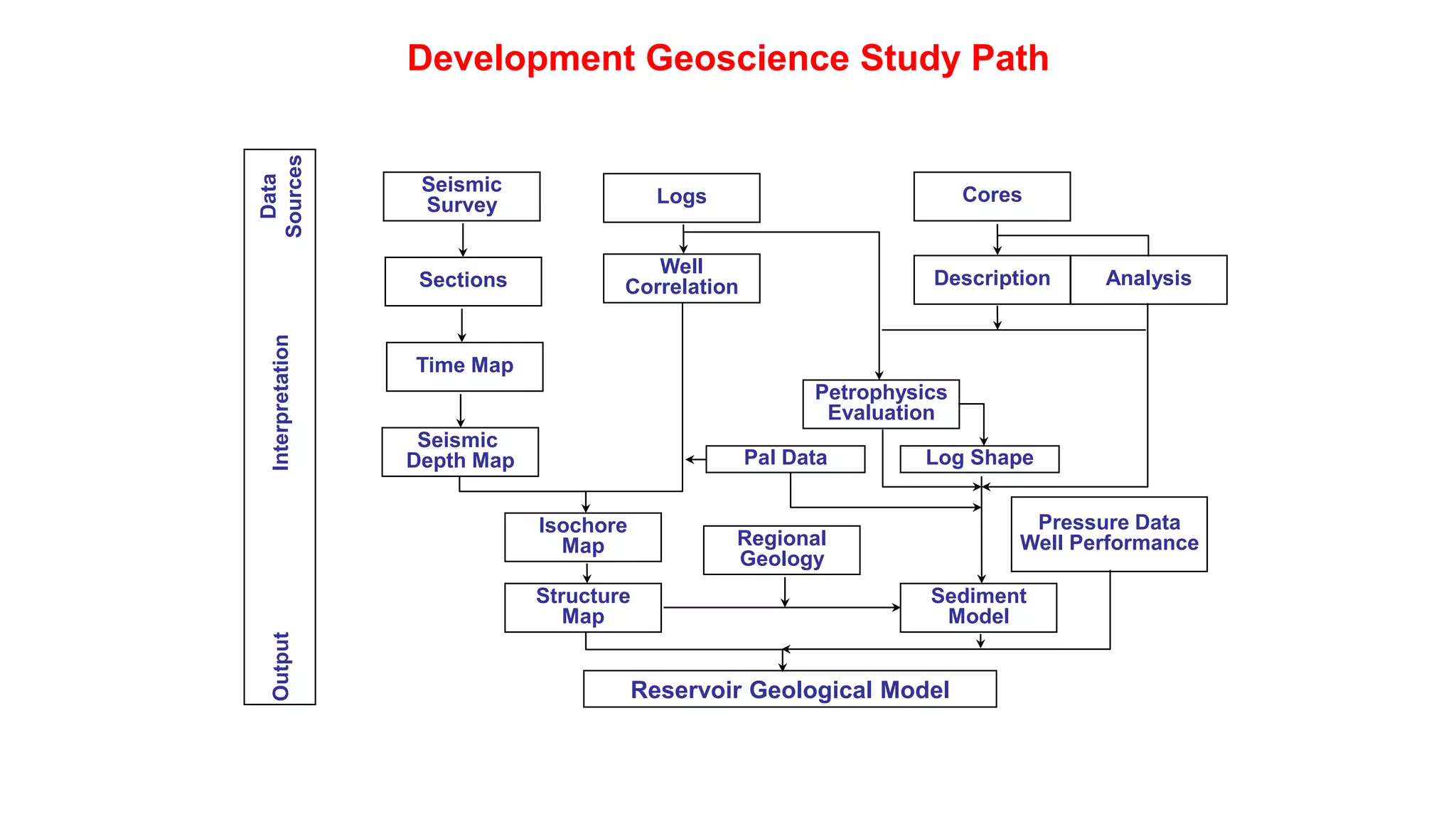
Development Geoscience Study Path
Seismic
Survey
Sections
Time Map
Seismic
Depth Map
Isochore
Map
Structure
Map
Sediment
Model
Regional
Geology
Pressure Data
Well Performance
Logs Cores
Well
Correlation Description Analysis
Petrophysics
Evaluation
Pal Data Log Shape
Output
Reservoir Geological Model
Interpretation
Data
Sources
Test Results
Fluid Properties
Pressures
Core
Lithology
Porosity
Permeability
Mudlogs
Measurement
While Drilling
Indications
Resistivity
Wireline
Logs
Resistivity
Radioactivity
Density
Sonic Velocity
Hydrogen Content
Geology
Lithology
Stratigraphy
Petrophysics
Lithology
Porosity
Hydrocarbon Saturation
Net Reservoir Thickness
Permeability
Oil In-Place
Petrophysics
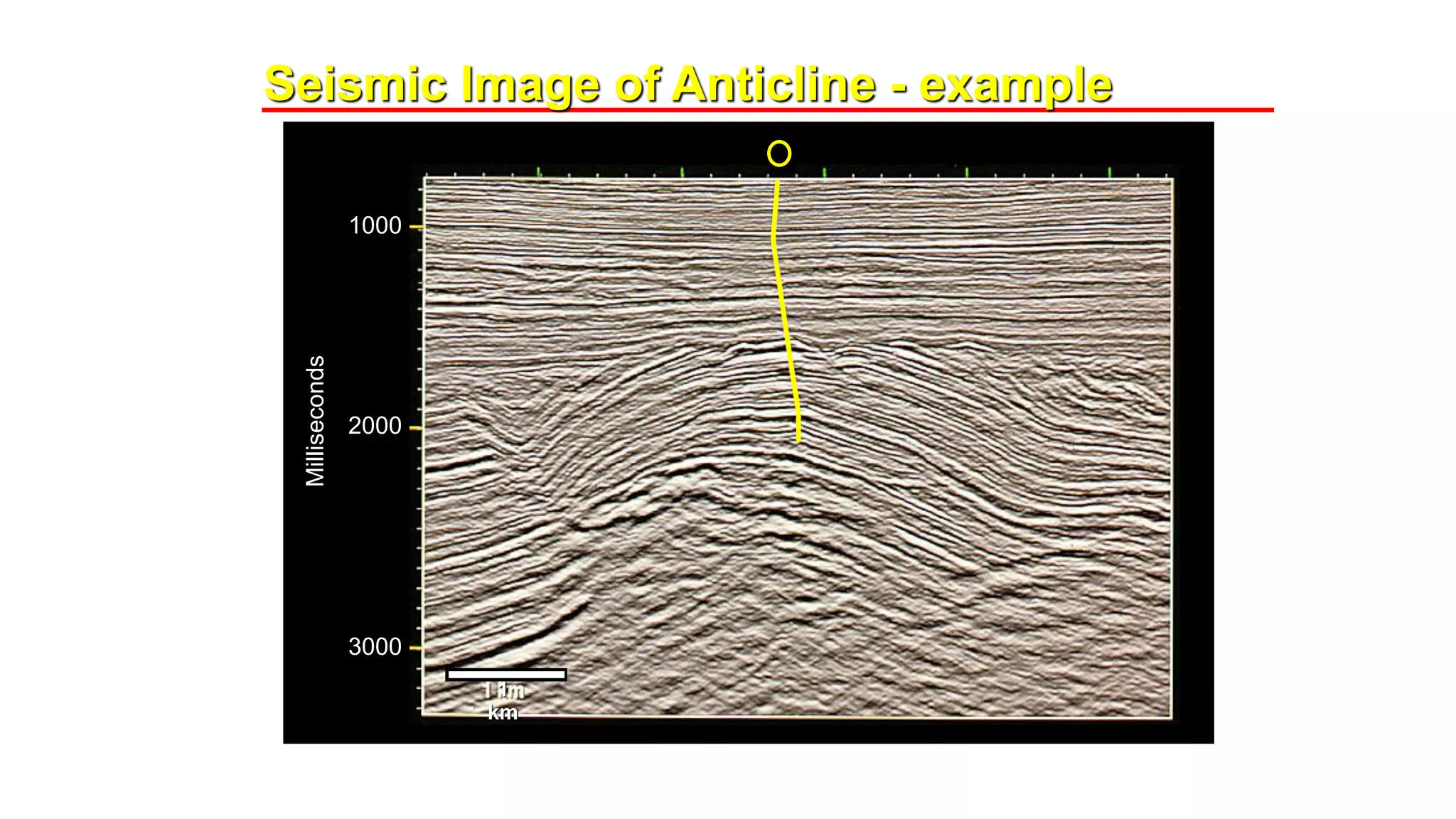
Seismic Image of Anticline - example
1000
2000
3000
Milliseconds
1
km
Seismic Image of Anticline - interpretation
1000
2000
3000
Milliseconds
1
km
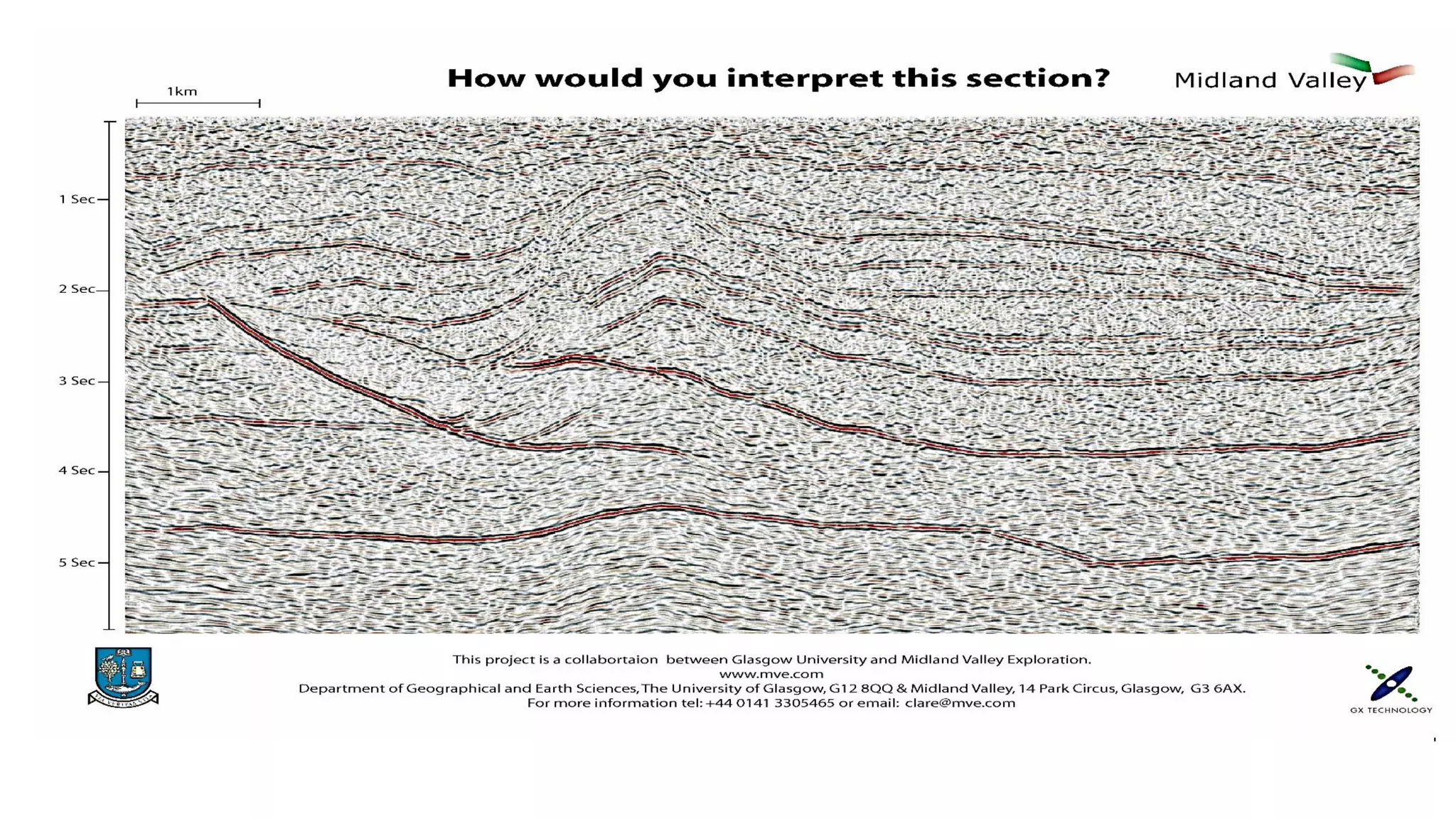
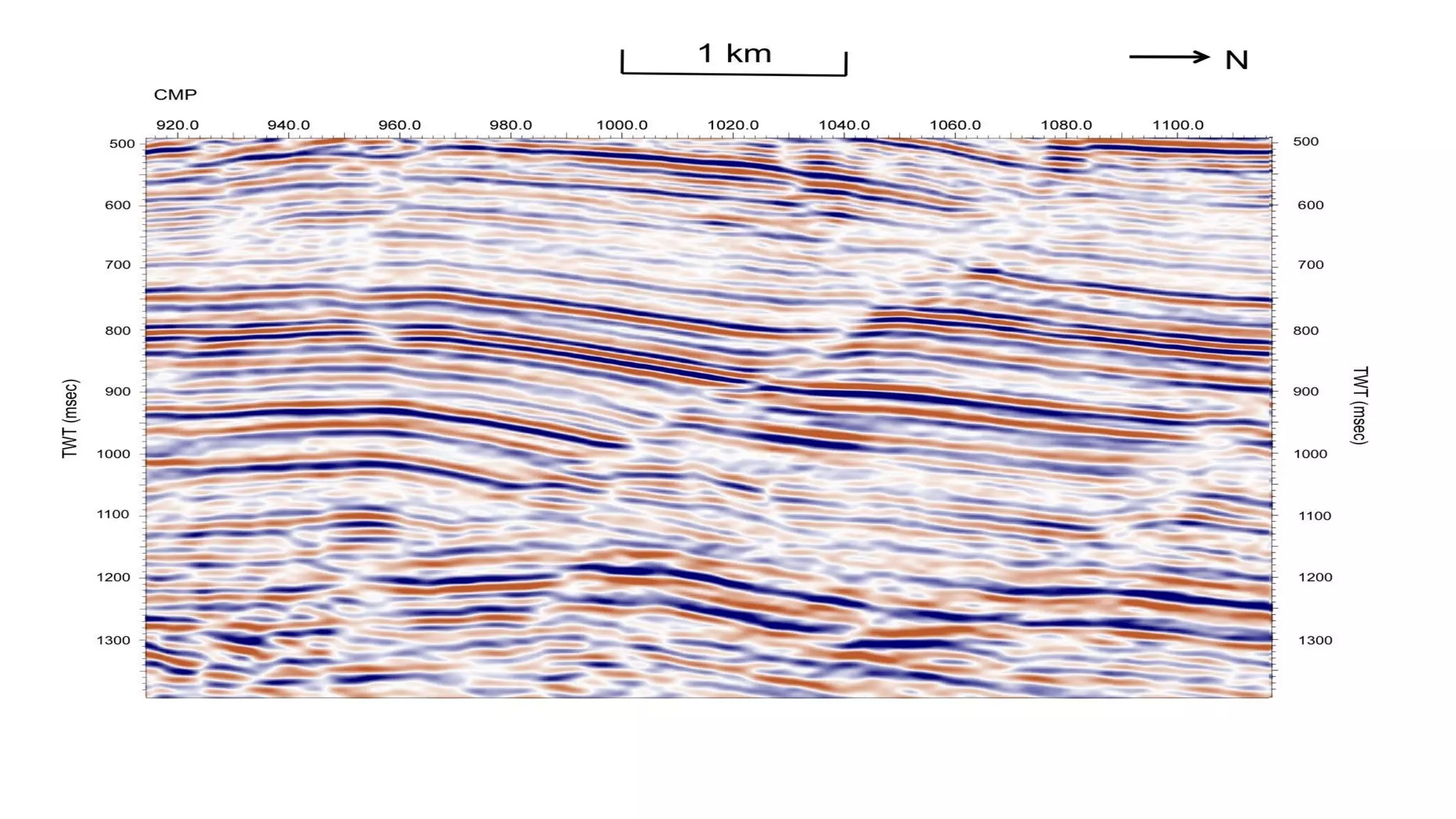
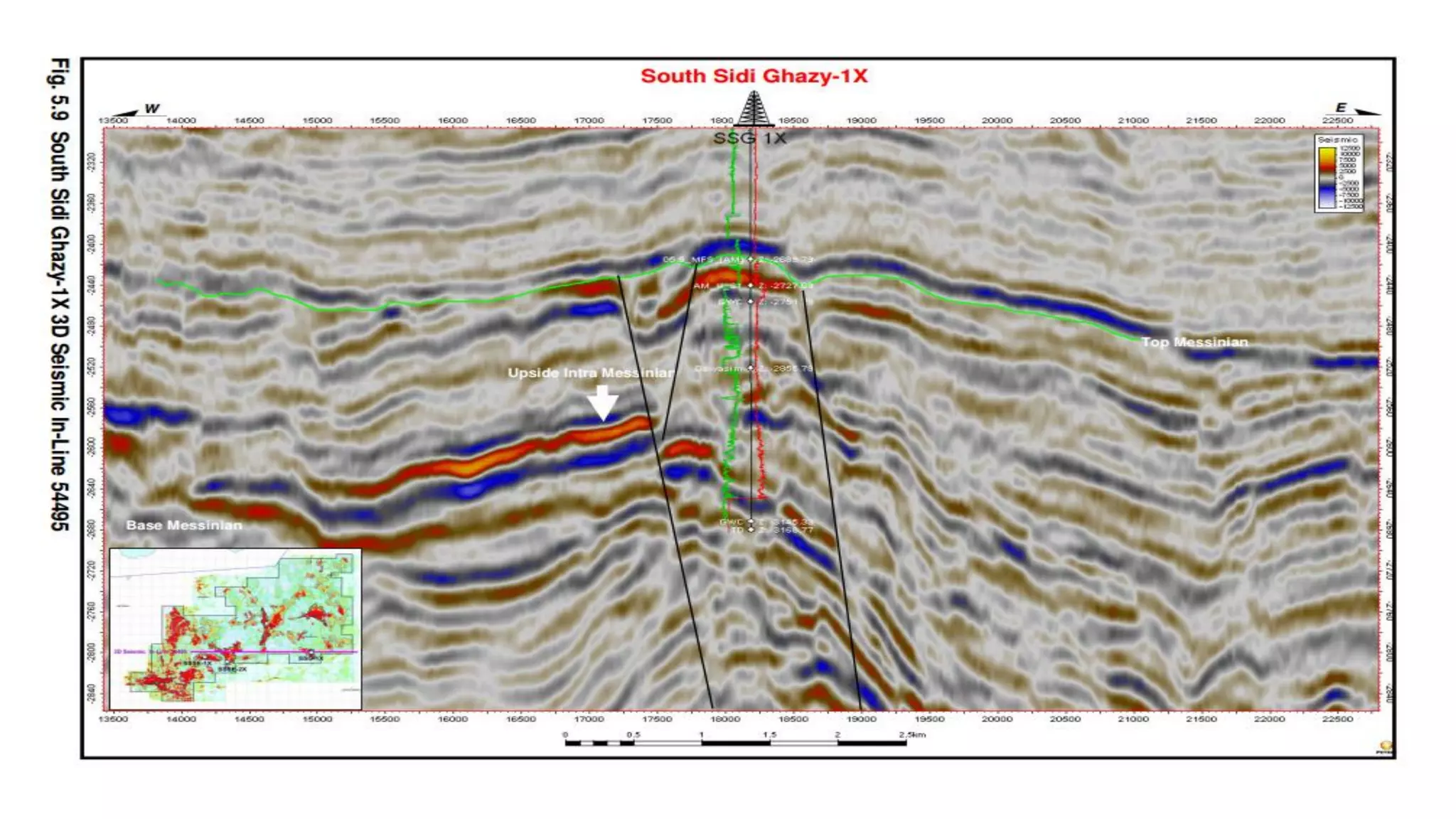
Structure can be identified from seismic data
Seismic Image of the field – 3D example
Faults
Salt Dome
Faults
source Hydrophones -
streamers
RIFTING
ERA
TIME
UNIT
GROUP
ROCK UNIT
FORMATION LITHOLOGY
TYPE SECTION
THICKNESS(m)
SOURCE
RESERVOIR
SEAL
Conglomerate
PRE-CAMBRIAN BASEMENT
POST
RIFT
PLEISTOC.
PLEIOCENE
ZAAFARANA
WARDAN
ZEIT
SOUTH GHARIB
BELAYIM
SYNRIFT
CENOZOIC
MIOCENE
RASMAALABGHARANDAL
KAREEM
RUDEIS
NUKHUL
THAYIBA BED/
ABU ZENIMA
Belayim
112-12 well
THEBES
ESNA
SUDR
DUWI
(BROWN LIMESTONE
MATULLA
WATA
ABU QADA
RAHA
MALHA
QISEIB
ROD
EL HAMAL
MESOZOIC
PRERIFT
PALEOZOIC
OLIGOCENE
EOCENE
PALEOCENE
CRETACEOUS
LATEEARLY
NEZZAZATELTIHELEGMA
NUBIAN-ANUBIAN-B
ABU DURBA
JURASSIC
TRIASSIC
PERMIAN
ATAQA
LATEEARLY
UMM BOGMA
CARBONIFEROUS
NAQUS
ARABA
NUBIAN-CNUBIAN-D
CAMBRIAN-
ORDOVICIAN
QEBLIAT
81
5
South Gharib-2
North Gharib-2
Abu Zenima-1
Rudeis-2
Zeit Bay-1
Zeit Bay-1
Luxor
Esna
Wadi Sudr
Gebel Duwi
Wadi Matulla
Wadi Wata
Wadi
Gharandal
Raha Scarp
Wadi Malha
Wadi Qiseib
Wadi Rod
El Hamal
Gebel
Abu Durba
Gebel Nukhul
Gebel Naqus
Gebel Qabllat
112
940
700
320
461
780
427
90
120
423
60
37
170
64
25
120
149
4
4
274
122
45
410
133
)(
)(
)(
)(
)(
)(
)(
)(
)(
LEGEND
Sandstone
Coarse Sandstone
Limestone
Dolomite
Anhydrite
Salt
Shale
Cherty Limestone
Basement
Primary source rock
Secondary source rock
Reservoir rock
Seal rock
Gebel Zeit-2
HYDROCARBON
GULF OF SUEZ STRATIGRAPHIC COLUMN
105
 Well data
 Basin fill history
 HC systems
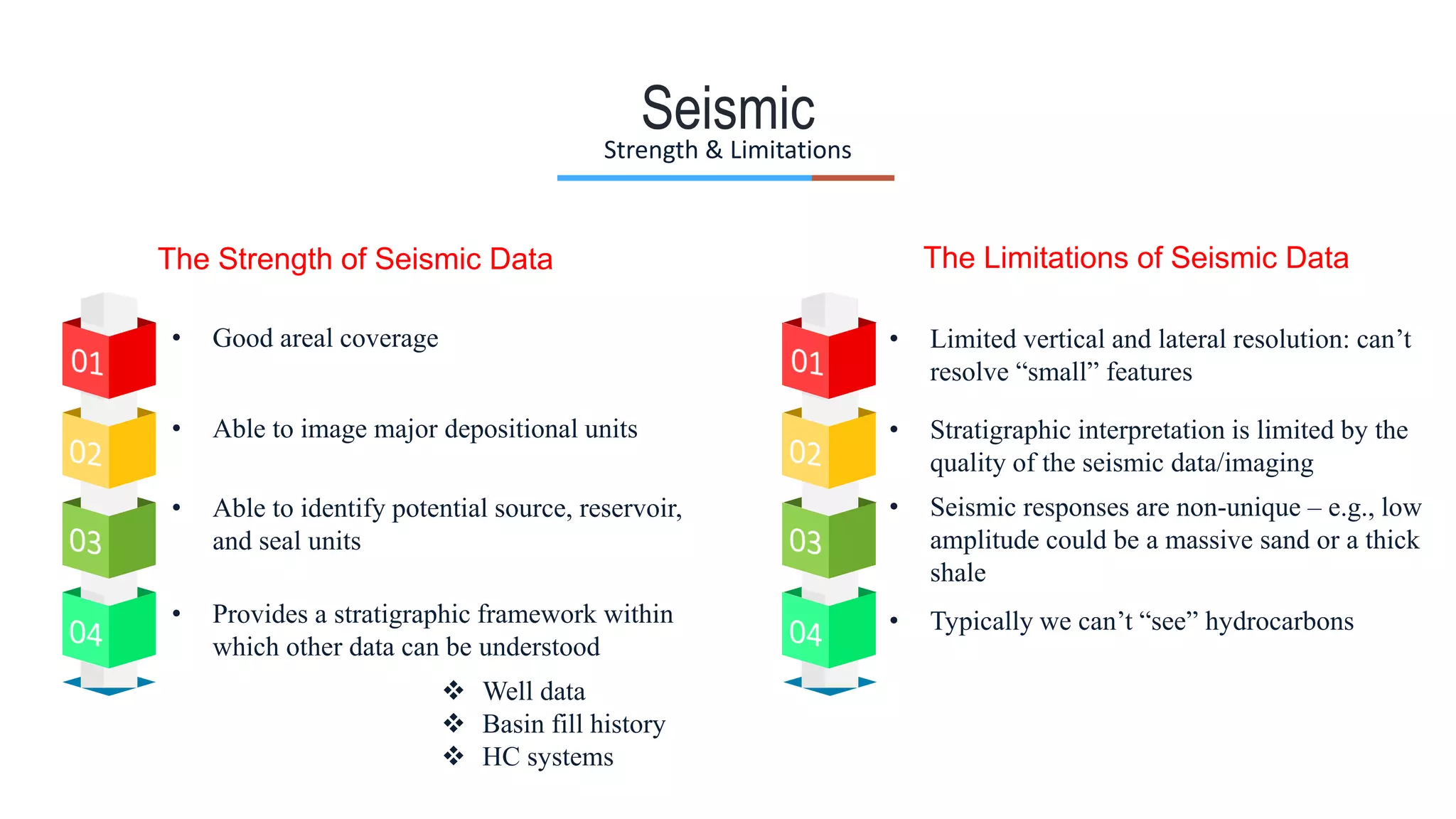
• Able to image major depositional units
SeismicStrength & Limitations
• Able to identify potential source, reservoir,
and seal units
• Provides a stratigraphic framework within
which other data can be understood
The Limitations of Seismic Data
• Good areal coverage
The Strength of Seismic Data
• Limited vertical and lateral resolution: can’t
resolve “small” features
• Stratigraphic interpretation is limited by the
quality of the seismic data/imaging
• Seismic responses are non-unique – e.g., low
amplitude could be a massive sand or a thick
shale
• Typically we can’t “see” hydrocarbons
4- Geophysics and exploration

4- Geophysics and exploration

  • 1.
  • 2.
    Oi l fi e l d f r am e wo r k
  • 3.
  • 4.
  • 5.
    Oil field development 03020104 AbandonmentProductionDevelopmentExploration • Seismic Activities • Drilling services • Construction • Hook up wells • Engineering • Operations • Optimization • Commissioning • Well plugging • Decommissioning machinery and equipment
  • 6.
    Remember last lectures PetroleumSystem Traps structure Rock types
  • 7.
    Hydrocarbon System Reservoir • HydrocarbonGeneration • Migration Kitchen Accumulation Trap • Reservoir rock ( pours & Permeable). • Sealing Container ( impermeable).
  • 8.
    8 24803 Source RockSource Rock TopSeal RockTop Seal Rock Reservoir RockReservoir Rock Anticlinal TrapAnticlinal Trap (Organic Rich)(Organic Rich)
  • 9.
    Hydrocarbon Generation vsDepth Depth range km .5 2 3.5 5 2 4 6 8 Minimum Maximum AverageDepth(km) 0 1 2 3 4 5 6 Generation Intensity Biogenic Methane Wet Gas Methane 300 250 200 150 100 50 0 600 500 400 300 200 100 Cano- zoic MesozoicPaleozoic Immature Oil Generation Gas Generation PresentFormationTemperature(oC) Time (millions of years from present) Oil
  • 10.
    Common Hydrocarbo nTraps Unconformity Trap Anticlinal Trap Fault Trap Buried Reef Pinch Out Grading Trap Sand Lens Salt Dome Traps Unconformity Surface Sub-Salt Sediment Truncation Anhydrite
  • 11.
    Common Hydrocarbo nTraps Salt Dome Fault Unconformity Pinchout Anticline
  • 12.
    Some people thinkthat oil is in big pools underground. Actually, most oil is trapped in the tiny pore spaces between grains of rock or sand. Most of these pores are too small to be seen with the naked eye.
  • 13.
  • 14.
    The study oftectonic plates and earthquakes The study of Earth’s composition Geophysics What is it? The study of natural hazards Explores for oil and gas  The application of physics principles to the study of the subsurface of earth, to search of hydrocarbon.  Geophysical investigations of the earth interior involves taking measurements at earth’s surface that are influenced by the internal distribution of physical properties.  The objective of any exploration venture is to find new volumes of hydrocarbons at a low cost and in a short period of time.
  • 16.
    What does aGeophysicist do? responsibilities Laying out geophones In old days used to have wide, high-impact cut lines Today, in environmentally sensitive areas we use hand cut, low-impact cut lines; supported by helicopters, not as much heavy equipment * As a geophysicist, your responsibility to ensure that work is done in environmentally sensitive manner Remote locations Moving into tougher areas to explore since easier areas have been evaluated
  • 17.
    What does aGeophysicist do? responsibilities data processing Acquired data is processed at data processing centers in the office Geophysicist at top right is building a velocity model to get better data to analyze technologists often process as well Interpreter analyzes Interpreter analyzes the finished processed data to get an image of the subsurface.
  • 18.
    What does aGeophysicist do? responsibilities Remote sensing Remote sensing used to understand the earth helpful in evaluating large areas aeromag data can be used in exploring for minerals Interpreter analyzes Interpreter analyzes the finished processed data to get an image of the subsurface.
  • 22.
  • 23.
    1. Magnetic Method Sedimentary rocks : •Lime stone 10 – 25.000 • Sandstone 0 - 21.000 • Shale 60 – 18.600 Igneous Rock • Granite 10- 65 • Peridolite 95.500 – 196.000 Minerals • Quartz -15 • Magnetite 70.000-2 x 10^7 Measuring the strength and Intensity of earth’s magnetic field. The unit of measurem ent is Tesla
  • 24.
  • 25.
  • 28.
  • 29.
    2. Gravity Method Measuring the variationin earths gravitational field caused by differences in the density of subsurface rocks Interpretation of gravity maps presents many problems, the simplest of which are caused by different subsurface bodies producing the same anomaly on the surface. Example: distinguishing between a small sphere of large density and a large sphere of low density at similar depths is impossible. In some circumstances gravity maps may indicate drillable prospect by locating salt domes and reefs (because of their low density.
  • 30.
    Clay Sp.Gr. 2.3 LimestoneSp.Gr. 2.7 Sand Clay Sp.Gr. 2.4 5 6 7 94 81 2 3 5 6 7 94 81 2 3 Measured Force of Gravity Zero Line Grav.Min. Gravity Meter Gravimetric CurveGrav. Max.
  • 31.
    -3 -2 -1 +1 Salt 2.1 gm/cm3 Corrected Gravity (BouguerAnomaly) Uncorrected Gravity Clastics 2.4 gm/cm3 Meter Gravity Value (mgal) Principles of Gravity Surveys
  • 37.
  • 38.
    History Seismic activities 1900 theoryof reflected and refracted waves. 1914-1918 (WW1) locating heavy guns by recording arrival times
  • 39.
    1919 Mintrop: patenton the refraction method (salt dome discovery, Texas) 1920’s reflection method (Oklahoma) 1953 magnetic tape: analog recording 1956 patent on CDP method
  • 40.
    1975 first 3Dsurveys 1980’s development of seismic workstation software
  • 42.
    Seismic What is it? The seismic methods are the most widely used of all geophysical methods used in petroleum exploration.  Seismic Reflection is a method of exploration geophysics that uses the principles of seismology to estimate the properties of the Earth's subsurface from reflected seismic waves.  Seismic methods measure seismic velocity of rock layers to detect both lateral and depth variations and the objective is to determine the lithology and geometry of the layers.  A seismic wave can be thought of as shock wave (elastic wave) or vibration traveling through the ground.  The rate of travel, or velocity, of the wave is related to the density of the rock.
  • 43.
    Seismicconcepts Medium earth consistsof several layers of rock, which is between the layers of rock with another rock layers can be different density and wave speed response. According to Snell's law, can seismic waves change direction when passing through the boundary between the layers because of refraction and reflection.
  • 44.
    Ideal Seismogram • Theseismic data recorded should give us the earth’s reflectivity sequence: Surface Depth Time Reflection Coefficient
  • 45.
    Sea bed Boat Cable withhydrophones Sea Surface Source (Airguns) Sedimentary Layers Incident waves Reflected waves Marine Acquisition System
  • 46.
    3D Acquisition Techniques Seasurface Sea bed • 2 source, 6 streamer configuration • 12 lines shot in 1 boat pass
  • 47.
  • 48.
    SeismicResponse Causes of seismicresponse 1. Changes in bulk-rock velocity or density • Lithology (e.g., sandstone, shale, limestone, salt) Limestone Shale
  • 49.
    SeismicResponse Causes of seismicresponse 1. Changes in bulk-rock velocity or density • Porosity (e.g., intrinsic, compaction, diagenesis) Fast Slow
  • 50.
    SeismicResponse Causes of seismicresponse 1. Changes in bulk-rock velocity or density • Mineralogy (e.g., calcite vs. dolomite, carbonaceous shales) • Fluid type and saturation (water, oil, gas) Pore Fluid Density Salt Water 2.164 Fresh Water 2.155 Oil 2.095 Gas 1.856 Sandstone with 30% Porosity:
  • 51.
    interface shot receivers shotreceivers Wave fronts  How waves actually travel  Surface of equal travel time  Surface of equal phase
  • 52.
  • 53.
    Petroleum exploration andproduction are concerned with the geological interpretation of geophysical data, especially in offshore areas. The location can be :  Marine environment  Land environment
  • 58.
  • 59.
    Vibrator Truck (Energy Source)RecordingTruck Geophone (Receivers) Returning Sound Waves
  • 60.
    seismic source is adevice that generates controlled seismic energy used to perform both reflection and refraction seismic surveys. This is a sample text. You can replace this text. Enter your text here. This is a sample text. You can replace this text. Enter your text here. source
  • 61.
    seismic source Natural SourceArtificial Source Earthquakes Marine Land Air Gun • Hammers • Weight drops • Explosive dynamite • Vibrators
  • 62.
    01 02 0304 05 Seismic Interpretation geophysicist petro physicist Reservoir Engineer Geologist Structural Geologist
  • 73.
    Development Geoscience StudyPath Seismic Survey Sections Time Map Seismic Depth Map Isochore Map Structure Map Sediment Model Regional Geology Pressure Data Well Performance Logs Cores Well Correlation Description Analysis Petrophysics Evaluation Pal Data Log Shape Output Reservoir Geological Model Interpretation Data Sources
  • 74.
    Test Results Fluid Properties Pressures Core Lithology Porosity Permeability Mudlogs Measurement WhileDrilling Indications Resistivity Wireline Logs Resistivity Radioactivity Density Sonic Velocity Hydrogen Content Geology Lithology Stratigraphy Petrophysics Lithology Porosity Hydrocarbon Saturation Net Reservoir Thickness Permeability Oil In-Place Petrophysics
  • 75.
    Seismic Image ofAnticline - example 1000 2000 3000 Milliseconds 1 km
  • 76.
    Seismic Image ofAnticline - interpretation 1000 2000 3000 Milliseconds 1 km Structure can be identified from seismic data
  • 77.
    Seismic Image ofthe field – 3D example Faults Salt Dome Faults source Hydrophones - streamers
  • 78.
    RIFTING ERA TIME UNIT GROUP ROCK UNIT FORMATION LITHOLOGY TYPESECTION THICKNESS(m) SOURCE RESERVOIR SEAL Conglomerate PRE-CAMBRIAN BASEMENT POST RIFT PLEISTOC. PLEIOCENE ZAAFARANA WARDAN ZEIT SOUTH GHARIB BELAYIM SYNRIFT CENOZOIC MIOCENE RASMAALABGHARANDAL KAREEM RUDEIS NUKHUL THAYIBA BED/ ABU ZENIMA Belayim 112-12 well THEBES ESNA SUDR DUWI (BROWN LIMESTONE MATULLA WATA ABU QADA RAHA MALHA QISEIB ROD EL HAMAL MESOZOIC PRERIFT PALEOZOIC OLIGOCENE EOCENE PALEOCENE CRETACEOUS LATEEARLY NEZZAZATELTIHELEGMA NUBIAN-ANUBIAN-B ABU DURBA JURASSIC TRIASSIC PERMIAN ATAQA LATEEARLY UMM BOGMA CARBONIFEROUS NAQUS ARABA NUBIAN-CNUBIAN-D CAMBRIAN- ORDOVICIAN QEBLIAT 81 5 South Gharib-2 North Gharib-2 Abu Zenima-1 Rudeis-2 Zeit Bay-1 Zeit Bay-1 Luxor Esna Wadi Sudr Gebel Duwi Wadi Matulla Wadi Wata Wadi Gharandal Raha Scarp Wadi Malha Wadi Qiseib Wadi Rod El Hamal Gebel Abu Durba Gebel Nukhul Gebel Naqus Gebel Qabllat 112 940 700 320 461 780 427 90 120 423 60 37 170 64 25 120 149 4 4 274 122 45 410 133 )( )( )( )( )( )( )( )( )( LEGEND Sandstone Coarse Sandstone Limestone Dolomite Anhydrite Salt Shale Cherty Limestone Basement Primary source rock Secondary source rock Reservoir rock Seal rock Gebel Zeit-2 HYDROCARBON GULF OF SUEZ STRATIGRAPHIC COLUMN 105
  • 81.
     Well data Basin fill history  HC systems • Able to image major depositional units SeismicStrength & Limitations • Able to identify potential source, reservoir, and seal units • Provides a stratigraphic framework within which other data can be understood The Limitations of Seismic Data • Good areal coverage The Strength of Seismic Data • Limited vertical and lateral resolution: can’t resolve “small” features • Stratigraphic interpretation is limited by the quality of the seismic data/imaging • Seismic responses are non-unique – e.g., low amplitude could be a massive sand or a thick shale • Typically we can’t “see” hydrocarbons