2nd-Degree-Equation Word Problems
The simplest type of formulas leads to 2nd degree equations
are the ones of the form AB = C.
2nd-Degree-Equation Word Problems
The simplest type of formulas leads to 2nd degree equations
are the ones of the form AB = C.
Specifically, if the two factors A and B are related linearly,
then their product is a 2nd degree expression.
2nd-Degree-Equation Word Problems
The simplest type of formulas leads to 2nd degree equations
are the ones of the form AB = C.
Specifically, if the two factors A and B are related linearly,
then their product is a 2nd degree expression.
2nd-Degree-Equation Word Problems
The simplest type of formulas leads to 2nd degree equations
are the ones of the form AB = C.
Specifically, if the two factors A and B are related linearly,
then their product is a 2nd degree expression.
Hence the problem of finding A and B when their product
is known, is a 2nd degree equation.
2nd-Degree-Equation Word Problems
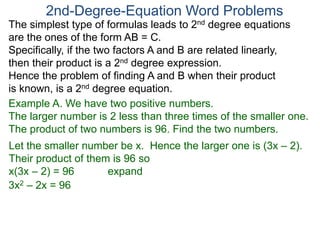
Example A. We have two positive numbers.
The larger number is 2 less than three times of the smaller one.
The product of two numbers is 96. Find the two numbers.
The simplest type of formulas leads to 2nd degree equations
are the ones of the form AB = C.
Specifically, if the two factors A and B are related linearly,
then their product is a 2nd degree expression.
Hence the problem of finding A and B when their product
is known, is a 2nd degree equation.
2nd-Degree-Equation Word Problems
Example A. We have two positive numbers.
The larger number is 2 less than three times of the smaller one.
The product of two numbers is 96. Find the two numbers.
Let the smaller number be x.
The simplest type of formulas leads to 2nd degree equations
are the ones of the form AB = C.
Specifically, if the two factors A and B are related linearly,
then their product is a 2nd degree expression.
Hence the problem of finding A and B when their product
is known, is a 2nd degree equation.
2nd-Degree-Equation Word Problems
Example A. We have two positive numbers.
The larger number is 2 less than three times of the smaller one.
The product of two numbers is 96. Find the two numbers.
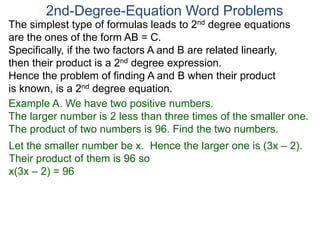
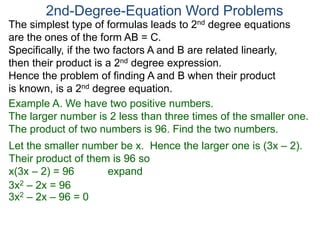
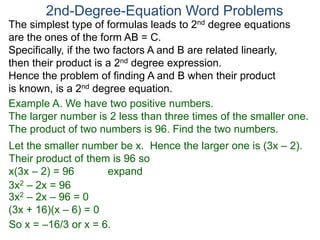
Let the smaller number be x. Hence the larger one is (3x – 2).
Their product of them is 96 so
x(3x – 2) = 96
The simplest type of formulas leads to 2nd degree equations
are the ones of the form AB = C.
Specifically, if the two factors A and B are related linearly,
then their product is a 2nd degree expression.
Hence the problem of finding A and B when their product
is known, is a 2nd degree equation.
2nd-Degree-Equation Word Problems
Example A. We have two positive numbers.
The larger number is 2 less than three times of the smaller one.
The product of two numbers is 96. Find the two numbers.
Let the smaller number be x. Hence the larger one is (3x – 2).
Their product of them is 96 so
x(3x – 2) = 96 expand
3x2 – 2x = 96
The simplest type of formulas leads to 2nd degree equations
are the ones of the form AB = C.
Specifically, if the two factors A and B are related linearly,
then their product is a 2nd degree expression.
Hence the problem of finding A and B when their product
is known, is a 2nd degree equation.
2nd-Degree-Equation Word Problems
Example A. We have two positive numbers.
The larger number is 2 less than three times of the smaller one.
The product of two numbers is 96. Find the two numbers.
Let the smaller number be x. Hence the larger one is (3x – 2).
Their product of them is 96 so
x(3x – 2) = 96 expand
3x2 – 2x = 96
3x2 – 2x – 96 = 0
The simplest type of formulas leads to 2nd degree equations
are the ones of the form AB = C.
Specifically, if the two factors A and B are related linearly,
then their product is a 2nd degree expression.
Hence the problem of finding A and B when their product
is known, is a 2nd degree equation.
2nd-Degree-Equation Word Problems
Example A. We have two positive numbers.
The larger number is 2 less than three times of the smaller one.
The product of two numbers is 96. Find the two numbers.
Let the smaller number be x. Hence the larger one is (3x – 2).
Their product of them is 96 so
x(3x – 2) = 96 expand
3x2 – 2x = 96
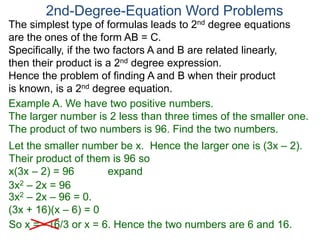
3x2 – 2x – 96 = 0
(3x + 16)(x – 6) = 0
So x = –16/3 or x = 6.
The simplest type of formulas leads to 2nd degree equations
are the ones of the form AB = C.
Specifically, if the two factors A and B are related linearly,
then their product is a 2nd degree expression.
Hence the problem of finding A and B when their product
is known, is a 2nd degree equation.
2nd-Degree-Equation Word Problems
Example A. We have two positive numbers.
The larger number is 2 less than three times of the smaller one.
The product of two numbers is 96. Find the two numbers.
Let the smaller number be x. Hence the larger one is (3x – 2).
Their product of them is 96 so
x(3x – 2) = 96 expand
3x2 – 2x = 96
3x2 – 2x – 96 = 0.
(3x + 16)(x – 6) = 0
So x = –16/3 or x = 6. Hence the two numbers are 6 and 16.
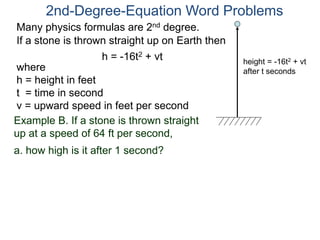
Many physics formulas are 2nd degree.
2nd-Degree-Equation Word Problems
Many physics formulas are 2nd degree.
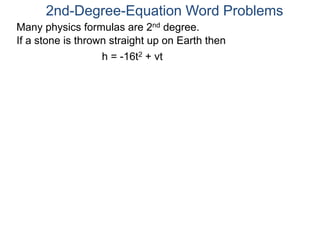
If a stone is thrown straight up on Earth then
h = -16t2 + vt
2nd-Degree-Equation Word Problems
Many physics formulas are 2nd degree.
If a stone is thrown straight up on Earth then
h = -16t2 + vt
2nd-Degree-Equation Word Problems
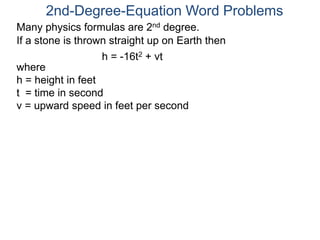
where
h = height in feet
t = time in second
v = upward speed in feet per second
Many physics formulas are 2nd degree.
If a stone is thrown straight up on Earth then
h = -16t2 + vt
2nd-Degree-Equation Word Problems
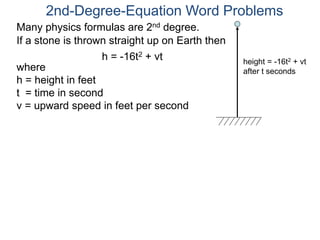
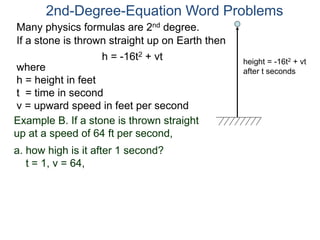
height = -16t2 + vt
after t secondswhere
h = height in feet
t = time in second
v = upward speed in feet per second
Many physics formulas are 2nd degree.
If a stone is thrown straight up on Earth then
h = -16t2 + vt
2nd-Degree-Equation Word Problems
height = -16t2 + vt
after t secondswhere
h = height in feet
t = time in second
v = upward speed in feet per second
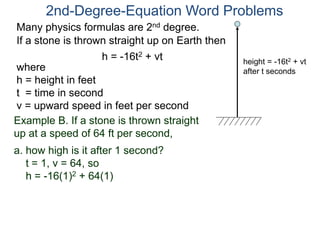
Example B. If a stone is thrown straight
up at a speed of 64 ft per second,
a. how high is it after 1 second?
Many physics formulas are 2nd degree.
If a stone is thrown straight up on Earth then
h = -16t2 + vt
2nd-Degree-Equation Word Problems
height = -16t2 + vt
after t secondswhere
h = height in feet
t = time in second
v = upward speed in feet per second
Example B. If a stone is thrown straight
up at a speed of 64 ft per second,
a. how high is it after 1 second?
t = 1, v = 64,
Many physics formulas are 2nd degree.
If a stone is thrown straight up on Earth then
h = -16t2 + vt
2nd-Degree-Equation Word Problems
height = -16t2 + vt
after t secondswhere
h = height in feet
t = time in second
v = upward speed in feet per second
Example B. If a stone is thrown straight
up at a speed of 64 ft per second,
a. how high is it after 1 second?
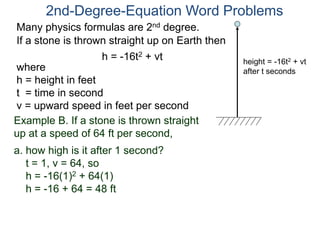
t = 1, v = 64, so
h = -16(1)2 + 64(1)
Many physics formulas are 2nd degree.
If a stone is thrown straight up on Earth then
h = -16t2 + vt
2nd-Degree-Equation Word Problems
height = -16t2 + vt
after t secondswhere
h = height in feet
t = time in second
v = upward speed in feet per second
Example B. If a stone is thrown straight
up at a speed of 64 ft per second,
a. how high is it after 1 second?
t = 1, v = 64, so
h = -16(1)2 + 64(1)
h = -16 + 64 = 48 ft
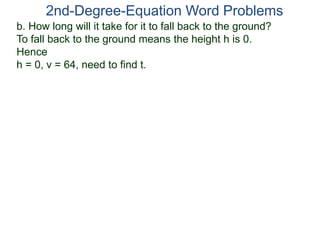
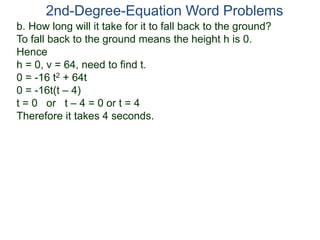
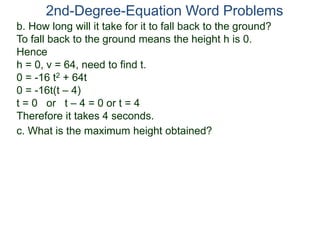
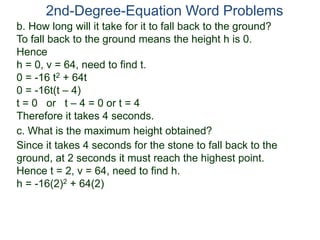
b. How long will it take for it to fall back to the ground?
2nd-Degree-Equation Word Problems
b. How long will it take for it to fall back to the ground?
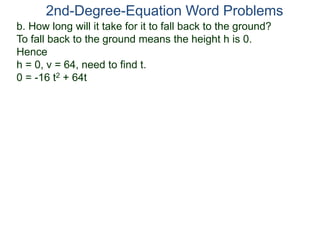
To fall back to the ground means the height h is 0.
2nd-Degree-Equation Word Problems
b. How long will it take for it to fall back to the ground?
To fall back to the ground means the height h is 0.
Hence
h = 0, v = 64, need to find t.
2nd-Degree-Equation Word Problems
b. How long will it take for it to fall back to the ground?
To fall back to the ground means the height h is 0.
Hence
h = 0, v = 64, need to find t.
0 = -16 t2 + 64t
2nd-Degree-Equation Word Problems
b. How long will it take for it to fall back to the ground?
To fall back to the ground means the height h is 0.
Hence
h = 0, v = 64, need to find t.
0 = -16 t2 + 64t
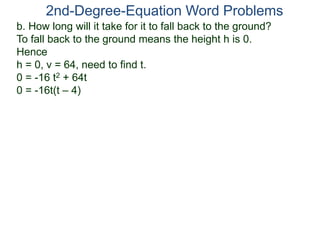
0 = -16t(t – 4)
2nd-Degree-Equation Word Problems
b. How long will it take for it to fall back to the ground?
To fall back to the ground means the height h is 0.
Hence
h = 0, v = 64, need to find t.
0 = -16 t2 + 64t
0 = -16t(t – 4)
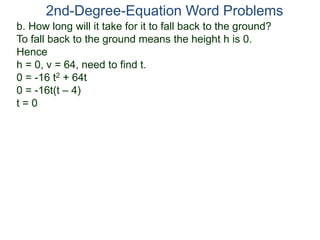
t = 0
2nd-Degree-Equation Word Problems
b. How long will it take for it to fall back to the ground?
To fall back to the ground means the height h is 0.
Hence
h = 0, v = 64, need to find t.
0 = -16 t2 + 64t
0 = -16t(t – 4)
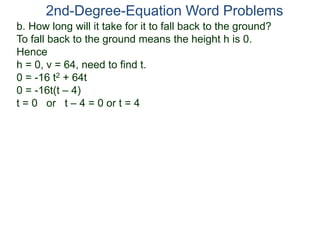
t = 0 or t – 4 = 0 or t = 4
2nd-Degree-Equation Word Problems
b. How long will it take for it to fall back to the ground?
To fall back to the ground means the height h is 0.
Hence
h = 0, v = 64, need to find t.
0 = -16 t2 + 64t
0 = -16t(t – 4)
t = 0 or t – 4 = 0 or t = 4
Therefore it takes 4 seconds.
2nd-Degree-Equation Word Problems
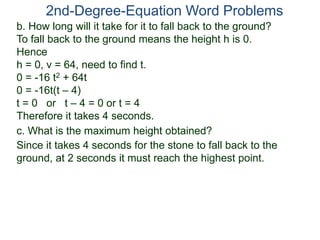
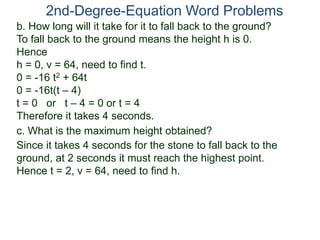
c. What is the maximum height obtained?
b. How long will it take for it to fall back to the ground?
To fall back to the ground means the height h is 0.
Hence
h = 0, v = 64, need to find t.
0 = -16 t2 + 64t
0 = -16t(t – 4)
t = 0 or t – 4 = 0 or t = 4
Therefore it takes 4 seconds.
2nd-Degree-Equation Word Problems
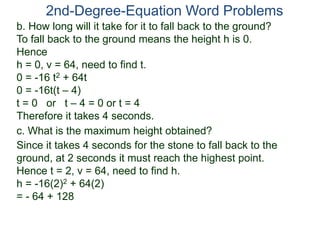
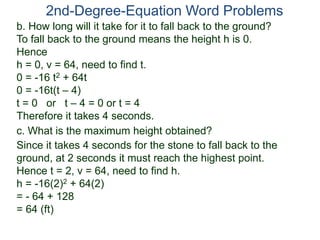
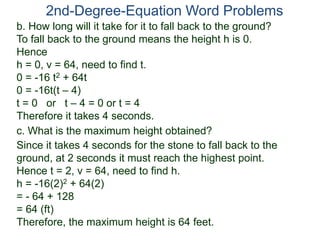
c. What is the maximum height obtained?
Since it takes 4 seconds for the stone to fall back to the
ground, at 2 seconds it must reach the highest point.
b. How long will it take for it to fall back to the ground?
To fall back to the ground means the height h is 0.
Hence
h = 0, v = 64, need to find t.
0 = -16 t2 + 64t
0 = -16t(t – 4)
t = 0 or t – 4 = 0 or t = 4
Therefore it takes 4 seconds.
2nd-Degree-Equation Word Problems
c. What is the maximum height obtained?
Since it takes 4 seconds for the stone to fall back to the
ground, at 2 seconds it must reach the highest point.
Hence t = 2, v = 64, need to find h.
b. How long will it take for it to fall back to the ground?
To fall back to the ground means the height h is 0.
Hence
h = 0, v = 64, need to find t.
0 = -16 t2 + 64t
0 = -16t(t – 4)
t = 0 or t – 4 = 0 or t = 4
Therefore it takes 4 seconds.
2nd-Degree-Equation Word Problems
c. What is the maximum height obtained?
Since it takes 4 seconds for the stone to fall back to the
ground, at 2 seconds it must reach the highest point.
Hence t = 2, v = 64, need to find h.
h = -16(2)2 + 64(2)
b. How long will it take for it to fall back to the ground?
To fall back to the ground means the height h is 0.
Hence
h = 0, v = 64, need to find t.
0 = -16 t2 + 64t
0 = -16t(t – 4)
t = 0 or t – 4 = 0 or t = 4
Therefore it takes 4 seconds.
2nd-Degree-Equation Word Problems
c. What is the maximum height obtained?
Since it takes 4 seconds for the stone to fall back to the
ground, at 2 seconds it must reach the highest point.
Hence t = 2, v = 64, need to find h.
h = -16(2)2 + 64(2)
= - 64 + 128
b. How long will it take for it to fall back to the ground?
To fall back to the ground means the height h is 0.
Hence
h = 0, v = 64, need to find t.
0 = -16 t2 + 64t
0 = -16t(t – 4)
t = 0 or t – 4 = 0 or t = 4
Therefore it takes 4 seconds.
2nd-Degree-Equation Word Problems
c. What is the maximum height obtained?
Since it takes 4 seconds for the stone to fall back to the
ground, at 2 seconds it must reach the highest point.
Hence t = 2, v = 64, need to find h.
h = -16(2)2 + 64(2)
= - 64 + 128
= 64 (ft)
b. How long will it take for it to fall back to the ground?
To fall back to the ground means the height h is 0.
Hence
h = 0, v = 64, need to find t.
0 = -16 t2 + 64t
0 = -16t(t – 4)
t = 0 or t – 4 = 0 or t = 4
Therefore it takes 4 seconds.
2nd-Degree-Equation Word Problems
c. What is the maximum height obtained?
Since it takes 4 seconds for the stone to fall back to the
ground, at 2 seconds it must reach the highest point.
Hence t = 2, v = 64, need to find h.
h = -16(2)2 + 64(2)
= - 64 + 128
= 64 (ft)
Therefore, the maximum height is 64 feet.
b. How long will it take for it to fall back to the ground?
To fall back to the ground means the height h is 0.
Hence
h = 0, v = 64, need to find t.
0 = -16 t2 + 64t
0 = -16t(t – 4)
t = 0 or t – 4 = 0 or t = 4
Therefore it takes 4 seconds.
2nd-Degree-Equation Word Problems
Formulas of area in mathematics also lead to 2nd degree
equations.
2nd-Degree-Equation Word Problems
Area of a Rectangle
Formulas of area in mathematics also lead to 2nd degree
equations.
2nd-Degree-Equation Word Problems
Area of a Rectangle
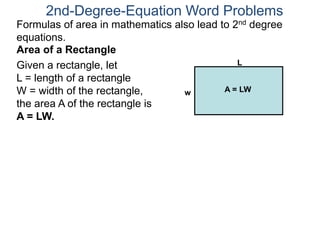
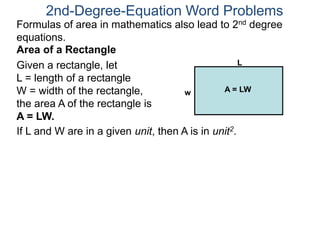
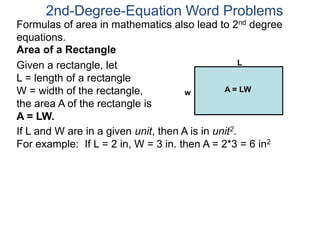
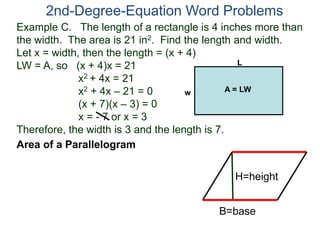
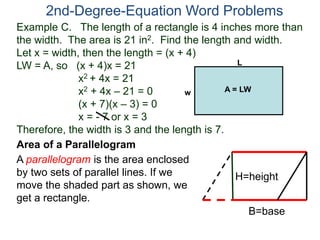
Given a rectangle, let
L = length of a rectangle
W = width of the rectangle,
Formulas of area in mathematics also lead to 2nd degree
equations.
2nd-Degree-Equation Word Problems
Area of a Rectangle
Given a rectangle, let
L = length of a rectangle
W = width of the rectangle,
the area A of the rectangle is
A = LW.
Formulas of area in mathematics also lead to 2nd degree
equations.
2nd-Degree-Equation Word Problems
Area of a Rectangle
Given a rectangle, let
L = length of a rectangle
W = width of the rectangle,
the area A of the rectangle is
A = LW.
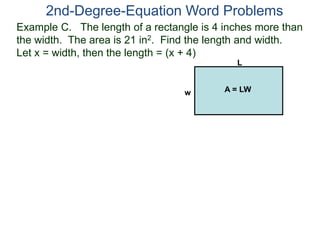
L
w A = LW
Formulas of area in mathematics also lead to 2nd degree
equations.
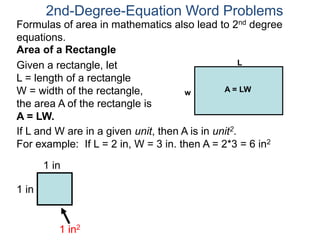
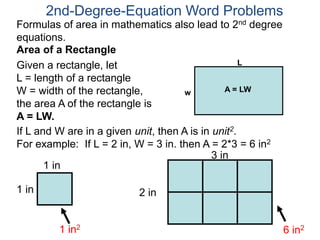
If L and W are in a given unit, then A is in unit2.
2nd-Degree-Equation Word Problems
Area of a Rectangle
Given a rectangle, let
L = length of a rectangle
W = width of the rectangle,
the area A of the rectangle is
A = LW.
L
w A = LW
Formulas of area in mathematics also lead to 2nd degree
equations.
If L and W are in a given unit, then A is in unit2.
For example: If L = 2 in, W = 3 in. then A = 2*3 = 6 in2
2nd-Degree-Equation Word Problems
Area of a Rectangle
Given a rectangle, let
L = length of a rectangle
W = width of the rectangle,
the area A of the rectangle is
A = LW.
L
w A = LW
Formulas of area in mathematics also lead to 2nd degree
equations.
If L and W are in a given unit, then A is in unit2.
For example: If L = 2 in, W = 3 in. then A = 2*3 = 6 in2
1 in
1 in
1 in2
2nd-Degree-Equation Word Problems
Area of a Rectangle
Given a rectangle, let
L = length of a rectangle
W = width of the rectangle,
the area A of the rectangle is
A = LW.
L
w A = LW
Formulas of area in mathematics also lead to 2nd degree
equations.
If L and W are in a given unit, then A is in unit2.
For example: If L = 2 in, W = 3 in. then A = 2*3 = 6 in2
1 in
1 in
1 in2
2 in
3 in
6 in2
2nd-Degree-Equation Word Problems
Area of a Rectangle
Given a rectangle, let
L = length of a rectangle
W = width of the rectangle,
the area A of the rectangle is
A = LW.
L
w A = LW
Formulas of area in mathematics also lead to 2nd degree
equations.
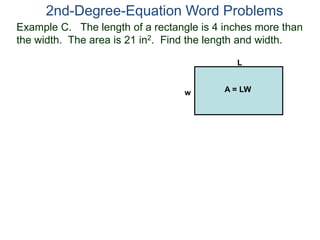
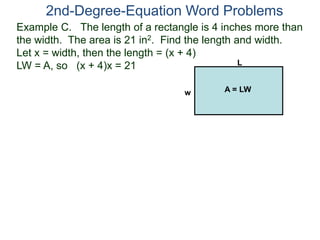
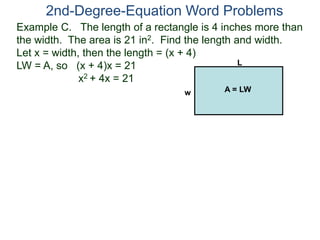
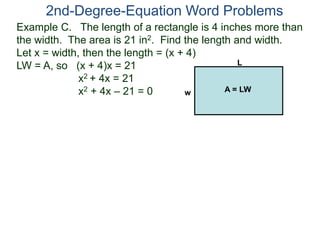
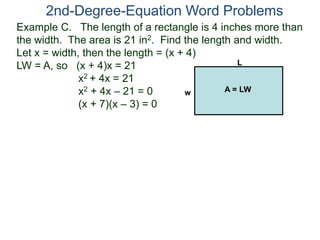
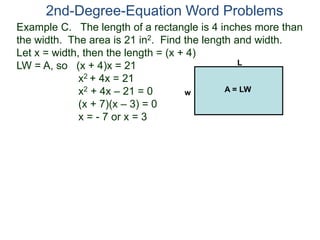
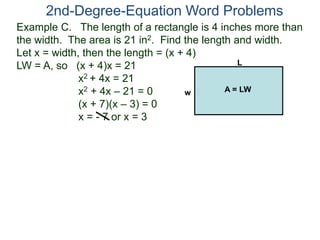
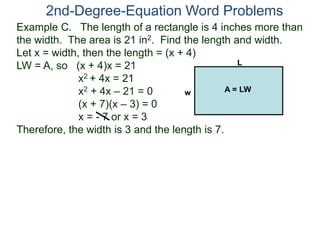
Example C. The length of a rectangle is 4 inches more than
the width. The area is 21 in2. Find the length and width.
2nd-Degree-Equation Word Problems
L
w A = LW
Example C. The length of a rectangle is 4 inches more than
the width. The area is 21 in2. Find the length and width.
Let x = width, then the length = (x + 4)
2nd-Degree-Equation Word Problems
L
w A = LW
Example C. The length of a rectangle is 4 inches more than
the width. The area is 21 in2. Find the length and width.
Let x = width, then the length = (x + 4)
LW = A, so (x + 4)x = 21
2nd-Degree-Equation Word Problems
L
w A = LW
Example C. The length of a rectangle is 4 inches more than
the width. The area is 21 in2. Find the length and width.
Let x = width, then the length = (x + 4)
LW = A, so (x + 4)x = 21
x2 + 4x = 21
2nd-Degree-Equation Word Problems
L
w A = LW
Example C. The length of a rectangle is 4 inches more than
the width. The area is 21 in2. Find the length and width.
Let x = width, then the length = (x + 4)
LW = A, so (x + 4)x = 21
x2 + 4x = 21
x2 + 4x – 21 = 0
2nd-Degree-Equation Word Problems
L
w A = LW
Example C. The length of a rectangle is 4 inches more than
the width. The area is 21 in2. Find the length and width.
Let x = width, then the length = (x + 4)
LW = A, so (x + 4)x = 21
x2 + 4x = 21
x2 + 4x – 21 = 0
(x + 7)(x – 3) = 0
2nd-Degree-Equation Word Problems
L
w A = LW
Example C. The length of a rectangle is 4 inches more than
the width. The area is 21 in2. Find the length and width.
Let x = width, then the length = (x + 4)
LW = A, so (x + 4)x = 21
x2 + 4x = 21
x2 + 4x – 21 = 0
(x + 7)(x – 3) = 0
x = - 7 or x = 3
2nd-Degree-Equation Word Problems
L
w A = LW
Example C. The length of a rectangle is 4 inches more than
the width. The area is 21 in2. Find the length and width.
Let x = width, then the length = (x + 4)
LW = A, so (x + 4)x = 21
x2 + 4x = 21
x2 + 4x – 21 = 0
(x + 7)(x – 3) = 0
x = - 7 or x = 3
2nd-Degree-Equation Word Problems
L
w A = LW
Example C. The length of a rectangle is 4 inches more than
the width. The area is 21 in2. Find the length and width.
Let x = width, then the length = (x + 4)
LW = A, so (x + 4)x = 21
x2 + 4x = 21
x2 + 4x – 21 = 0
(x + 7)(x – 3) = 0
x = - 7 or x = 3
Therefore, the width is 3 and the length is 7.
2nd-Degree-Equation Word Problems
L
w A = LW
Example C. The length of a rectangle is 4 inches more than
the width. The area is 21 in2. Find the length and width.
Let x = width, then the length = (x + 4)
LW = A, so (x + 4)x = 21
x2 + 4x = 21
x2 + 4x – 21 = 0
(x + 7)(x – 3) = 0
x = - 7 or x = 3
Therefore, the width is 3 and the length is 7.
2nd-Degree-Equation Word Problems
Area of a Parallelogram
B=base
H=height
L
w A = LW
Example C. The length of a rectangle is 4 inches more than
the width. The area is 21 in2. Find the length and width.
Let x = width, then the length = (x + 4)
LW = A, so (x + 4)x = 21
x2 + 4x = 21
x2 + 4x – 21 = 0
(x + 7)(x – 3) = 0
x = - 7 or x = 3
Therefore, the width is 3 and the length is 7.
2nd-Degree-Equation Word Problems
Area of a Parallelogram
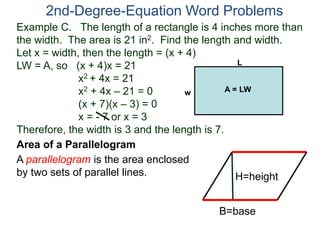
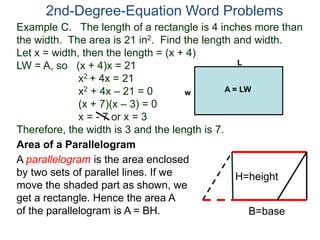
A parallelogram is the area enclosed
by two sets of parallel lines.
B=base
H=height
L
w A = LW
Example C. The length of a rectangle is 4 inches more than
the width. The area is 21 in2. Find the length and width.
Let x = width, then the length = (x + 4)
LW = A, so (x + 4)x = 21
x2 + 4x = 21
x2 + 4x – 21 = 0
(x + 7)(x – 3) = 0
x = - 7 or x = 3
Therefore, the width is 3 and the length is 7.
2nd-Degree-Equation Word Problems
Area of a Parallelogram
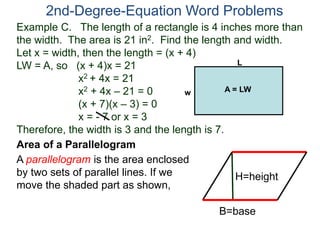
A parallelogram is the area enclosed
by two sets of parallel lines. If we
move the shaded part as shown,
H=height
B=base
L
w A = LW
Example C. The length of a rectangle is 4 inches more than
the width. The area is 21 in2. Find the length and width.
Let x = width, then the length = (x + 4)
LW = A, so (x + 4)x = 21
x2 + 4x = 21
x2 + 4x – 21 = 0
(x + 7)(x – 3) = 0
x = - 7 or x = 3
Therefore, the width is 3 and the length is 7.
2nd-Degree-Equation Word Problems
Area of a Parallelogram
A parallelogram is the area enclosed
by two sets of parallel lines. If we
move the shaded part as shown,
H=height
B=base
L
w A = LW
Example C. The length of a rectangle is 4 inches more than
the width. The area is 21 in2. Find the length and width.
Let x = width, then the length = (x + 4)
LW = A, so (x + 4)x = 21
x2 + 4x = 21
x2 + 4x – 21 = 0
(x + 7)(x – 3) = 0
x = - 7 or x = 3
Therefore, the width is 3 and the length is 7.
2nd-Degree-Equation Word Problems
Area of a Parallelogram
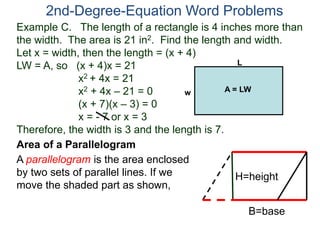
A parallelogram is the area enclosed
by two sets of parallel lines. If we
move the shaded part as shown, we
get a rectangle.
B=base
H=height
L
w A = LW
Example C. The length of a rectangle is 4 inches more than
the width. The area is 21 in2. Find the length and width.
Let x = width, then the length = (x + 4)
LW = A, so (x + 4)x = 21
x2 + 4x = 21
x2 + 4x – 21 = 0
(x + 7)(x – 3) = 0
x = - 7 or x = 3
Therefore, the width is 3 and the length is 7.
2nd-Degree-Equation Word Problems
Area of a Parallelogram
A parallelogram is the area enclosed
by two sets of parallel lines. If we
move the shaded part as shown, we
get a rectangle. Hence the area A
of the parallelogram is A = BH.
H=height
B=base
L
w A = LW
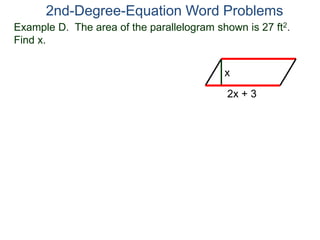
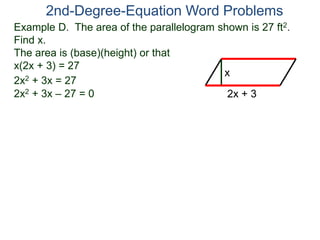
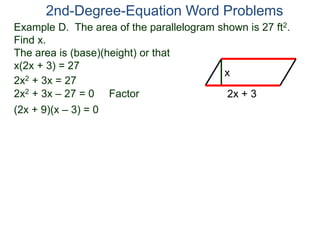
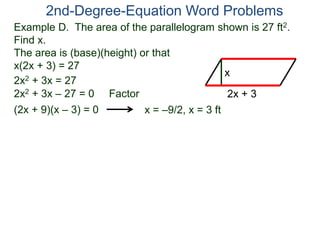
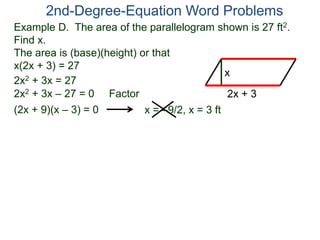
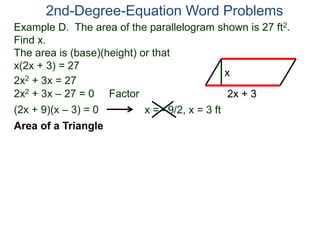
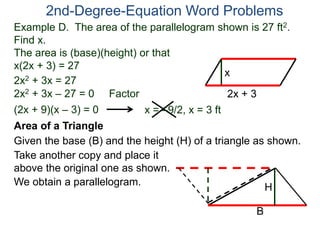
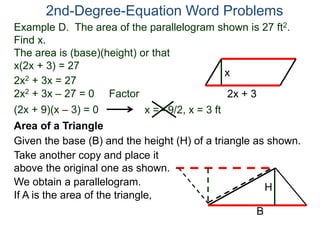
Example D. The area of the parallelogram shown is 27 ft2.
Find x.
2nd-Degree-Equation Word Problems
2x + 3
x
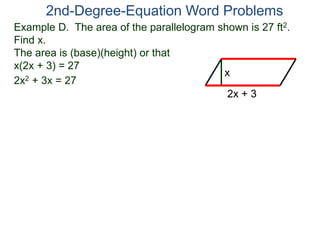
Example D. The area of the parallelogram shown is 27 ft2.
Find x.
The area is (base)(height) or that
x(2x + 3) = 27
2nd-Degree-Equation Word Problems
2x + 3
x
2x2 + 3x = 27
Example D. The area of the parallelogram shown is 27 ft2.
Find x.
The area is (base)(height) or that
x(2x + 3) = 27
2nd-Degree-Equation Word Problems
2x + 3
x
2x2 + 3x = 27
2x2 + 3x – 27 = 0
Example D. The area of the parallelogram shown is 27 ft2.
Find x.
The area is (base)(height) or that
x(2x + 3) = 27
2nd-Degree-Equation Word Problems
2x + 3
x
2x2 + 3x = 27
2x2 + 3x – 27 = 0 Factor
(2x + 9)(x – 3) = 0
Example D. The area of the parallelogram shown is 27 ft2.
Find x.
The area is (base)(height) or that
x(2x + 3) = 27
2nd-Degree-Equation Word Problems
2x + 3
x
2x2 + 3x = 27
2x2 + 3x – 27 = 0 Factor
(2x + 9)(x – 3) = 0 x = –9/2, x = 3 ft
Example D. The area of the parallelogram shown is 27 ft2.
Find x.
The area is (base)(height) or that
x(2x + 3) = 27
2nd-Degree-Equation Word Problems
2x + 3
x
2x2 + 3x = 27
2x2 + 3x – 27 = 0 Factor
(2x + 9)(x – 3) = 0 x = –9/2, x = 3 ft
Example D. The area of the parallelogram shown is 27 ft2.
Find x.
The area is (base)(height) or that
x(2x + 3) = 27
2nd-Degree-Equation Word Problems
Area of a Triangle
2x + 3
x
2x2 + 3x = 27
2x2 + 3x – 27 = 0 Factor
(2x + 9)(x – 3) = 0 x = –9/2, x = 3 ft
Example D. The area of the parallelogram shown is 27 ft2.
Find x.
The area is (base)(height) or that
x(2x + 3) = 27
2nd-Degree-Equation Word Problems
Area of a Triangle
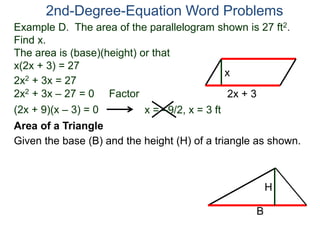
Given the base (B) and the height (H) of a triangle as shown.
2x + 3
x
2x2 + 3x = 27
2x2 + 3x – 27 = 0 Factor
(2x + 9)(x – 3) = 0 x = –9/2, x = 3 ft
B
H
Example D. The area of the parallelogram shown is 27 ft2.
Find x.
The area is (base)(height) or that
x(2x + 3) = 27
2nd-Degree-Equation Word Problems
Area of a Triangle
Given the base (B) and the height (H) of a triangle as shown.
B
H
2x + 3
x
2x2 + 3x = 27
2x2 + 3x – 27 = 0 Factor
(2x + 9)(x – 3) = 0 x = –9/2, x = 3 ft
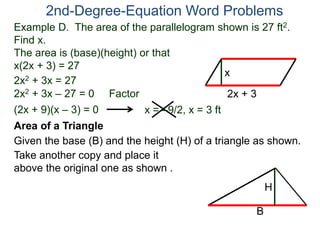
Take another copy and place it
above the original one as shown .
Example D. The area of the parallelogram shown is 27 ft2.
Find x.
The area is (base)(height) or that
x(2x + 3) = 27
2nd-Degree-Equation Word Problems
Area of a Triangle
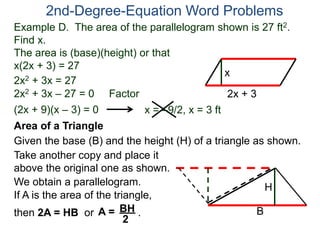
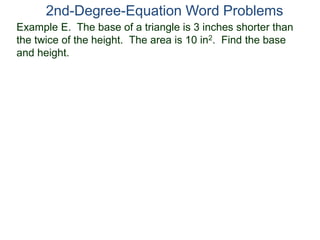
Given the base (B) and the height (H) of a triangle as shown.
B
H
2x + 3
x
2x2 + 3x = 27
2x2 + 3x – 27 = 0 Factor
(2x + 9)(x – 3) = 0 x = –9/2, x = 3 ft
Take another copy and place it
above the original one as shown.
Example D. The area of the parallelogram shown is 27 ft2.
Find x.
The area is (base)(height) or that
x(2x + 3) = 27
2nd-Degree-Equation Word Problems
Area of a Triangle
Given the base (B) and the height (H) of a triangle as shown.
B
H
2x + 3
x
2x2 + 3x = 27
2x2 + 3x – 27 = 0 Factor
(2x + 9)(x – 3) = 0 x = –9/2, x = 3 ft
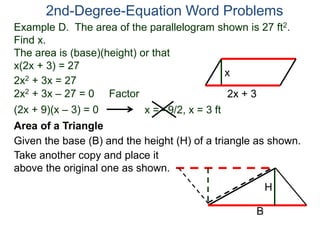
Take another copy and place it
above the original one as shown.
We obtain a parallelogram.
Example D. The area of the parallelogram shown is 27 ft2.
Find x.
The area is (base)(height) or that
x(2x + 3) = 27
2nd-Degree-Equation Word Problems
Area of a Triangle
Given the base (B) and the height (H) of a triangle as shown.
B
H
2x + 3
x
2x2 + 3x = 27
2x2 + 3x – 27 = 0 Factor
(2x + 9)(x – 3) = 0 x = –9/2, x = 3 ft
Take another copy and place it
above the original one as shown.
We obtain a parallelogram.
If A is the area of the triangle,
Example D. The area of the parallelogram shown is 27 ft2.
Find x.
The area is (base)(height) or that
x(2x + 3) = 27
2nd-Degree-Equation Word Problems
Area of a Triangle
Given the base (B) and the height (H) of a triangle as shown.
B
H
2x + 3
x
2x2 + 3x = 27
2x2 + 3x – 27 = 0 Factor
(2x + 9)(x – 3) = 0 x = –9/2, x = 3 ft
Take another copy and place it
above the original one as shown.
We obtain a parallelogram.
If A is the area of the triangle,
then 2A = HB or .A = BH
2
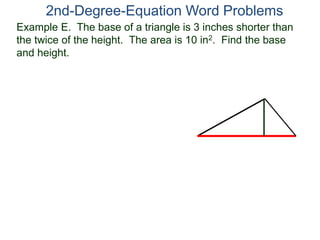
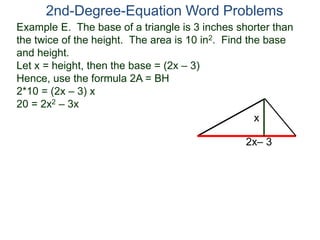
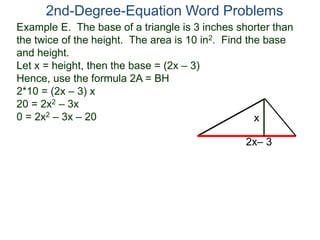
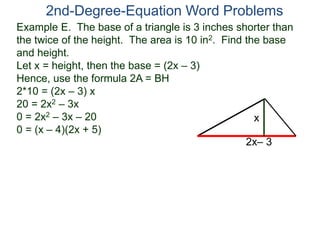
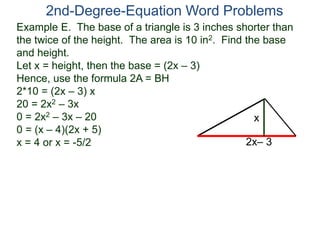
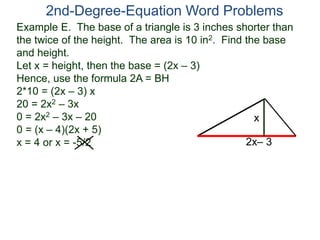
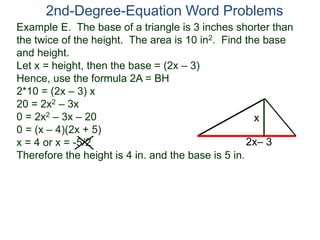
Example E. The base of a triangle is 3 inches shorter than
the twice of the height. The area is 10 in2. Find the base
and height.
2nd-Degree-Equation Word Problems
Example E. The base of a triangle is 3 inches shorter than
the twice of the height. The area is 10 in2. Find the base
and height.
2nd-Degree-Equation Word Problems
Example E. The base of a triangle is 3 inches shorter than
the twice of the height. The area is 10 in2. Find the base
and height.
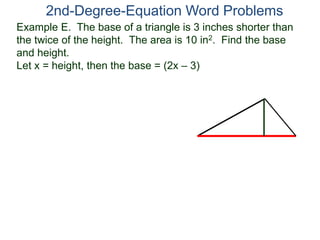
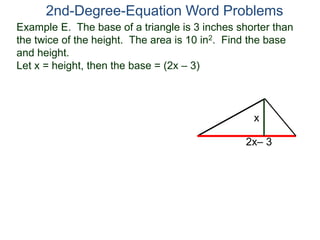
Let x = height, then the base = (2x – 3)
2nd-Degree-Equation Word Problems
Example E. The base of a triangle is 3 inches shorter than
the twice of the height. The area is 10 in2. Find the base
and height.
Let x = height, then the base = (2x – 3)
2nd-Degree-Equation Word Problems
2x– 3
x
Example E. The base of a triangle is 3 inches shorter than
the twice of the height. The area is 10 in2. Find the base
and height.
Let x = height, then the base = (2x – 3)
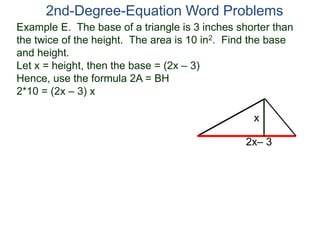
Hence, use the formula 2A = BH
2*10 = (2x – 3) x
2nd-Degree-Equation Word Problems
2x– 3
x
Example E. The base of a triangle is 3 inches shorter than
the twice of the height. The area is 10 in2. Find the base
and height.
Let x = height, then the base = (2x – 3)
Hence, use the formula 2A = BH
2*10 = (2x – 3) x
20 = 2x2 – 3x
2nd-Degree-Equation Word Problems
2x– 3
x
Example E. The base of a triangle is 3 inches shorter than
the twice of the height. The area is 10 in2. Find the base
and height.
Let x = height, then the base = (2x – 3)
Hence, use the formula 2A = BH
2*10 = (2x – 3) x
20 = 2x2 – 3x
0 = 2x2 – 3x – 20
2nd-Degree-Equation Word Problems
2x– 3
x
Example E. The base of a triangle is 3 inches shorter than
the twice of the height. The area is 10 in2. Find the base
and height.
Let x = height, then the base = (2x – 3)
Hence, use the formula 2A = BH
2*10 = (2x – 3) x
20 = 2x2 – 3x
0 = 2x2 – 3x – 20
0 = (x – 4)(2x + 5)
2nd-Degree-Equation Word Problems
2x– 3
x
Example E. The base of a triangle is 3 inches shorter than
the twice of the height. The area is 10 in2. Find the base
and height.
Let x = height, then the base = (2x – 3)
Hence, use the formula 2A = BH
2*10 = (2x – 3) x
20 = 2x2 – 3x
0 = 2x2 – 3x – 20
0 = (x – 4)(2x + 5)
x = 4 or x = -5/2
2nd-Degree-Equation Word Problems
2x– 3
x
Example E. The base of a triangle is 3 inches shorter than
the twice of the height. The area is 10 in2. Find the base
and height.
Let x = height, then the base = (2x – 3)
Hence, use the formula 2A = BH
2*10 = (2x – 3) x
20 = 2x2 – 3x
0 = 2x2 – 3x – 20
0 = (x – 4)(2x + 5)
x = 4 or x = -5/2
2nd-Degree-Equation Word Problems
2x– 3
x
Example E. The base of a triangle is 3 inches shorter than
the twice of the height. The area is 10 in2. Find the base
and height.
Let x = height, then the base = (2x – 3)
Hence, use the formula 2A = BH
2*10 = (2x – 3) x
20 = 2x2 – 3x
0 = 2x2 – 3x – 20
0 = (x – 4)(2x + 5)
x = 4 or x = -5/2
Therefore the height is 4 in. and the base is 5 in.
2nd-Degree-Equation Word Problems
2x– 3
x
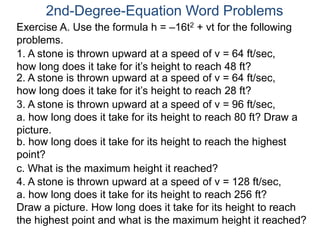
Exercise A. Use the formula h = –16t2 + vt for the following
problems.
2nd-Degree-Equation Word Problems
1. A stone is thrown upward at a speed of v = 64 ft/sec,
how long does it take for it’s height to reach 48 ft?
2. A stone is thrown upward at a speed of v = 64 ft/sec,
how long does it take for it’s height to reach 28 ft?
3. A stone is thrown upward at a speed of v = 96 ft/sec,
a. how long does it take for its height to reach 80 ft? Draw a
picture.
b. how long does it take for its height to reach the highest
point?
c. What is the maximum height it reached?
4. A stone is thrown upward at a speed of v = 128 ft/sec,
a. how long does it take for its height to reach 256 ft?
Draw a picture. How long does it take for its height to reach
the highest point and what is the maximum height it reached?
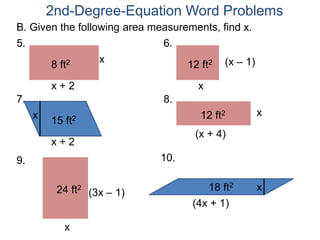
B. Given the following area measurements, find x.
2nd-Degree-Equation Word Problems
5.
8 ft2
x + 2
x
6.
12 ft2
x
(x – 1)
7.
x + 2
8.
12 ft2 x
(x + 4)
9.
24 ft2
(3x – 1)
x
10.
15 ft2x
18 ft2 x
(4x + 1)
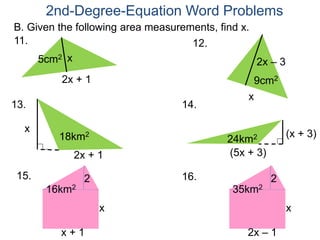
B. Given the following area measurements, find x.
2nd-Degree-Equation Word Problems
2x + 1
11.
x5cm2
12.
x
2x – 3
9cm2
2x + 1
13.
x
18km2
14.
(x + 3)
(5x + 3)
24km2
15. 16.
16km2
2
x
x + 1
35km2
2
x
2x – 1

5 82nd-degree-equation word problems

  • 1.
  • 2.
    The simplest typeof formulas leads to 2nd degree equations are the ones of the form AB = C. 2nd-Degree-Equation Word Problems
  • 3.
    The simplest typeof formulas leads to 2nd degree equations are the ones of the form AB = C. Specifically, if the two factors A and B are related linearly, then their product is a 2nd degree expression. 2nd-Degree-Equation Word Problems
  • 4.
    The simplest typeof formulas leads to 2nd degree equations are the ones of the form AB = C. Specifically, if the two factors A and B are related linearly, then their product is a 2nd degree expression. 2nd-Degree-Equation Word Problems
  • 5.
    The simplest typeof formulas leads to 2nd degree equations are the ones of the form AB = C. Specifically, if the two factors A and B are related linearly, then their product is a 2nd degree expression. Hence the problem of finding A and B when their product is known, is a 2nd degree equation. 2nd-Degree-Equation Word Problems Example A. We have two positive numbers. The larger number is 2 less than three times of the smaller one. The product of two numbers is 96. Find the two numbers.
  • 6.
    The simplest typeof formulas leads to 2nd degree equations are the ones of the form AB = C. Specifically, if the two factors A and B are related linearly, then their product is a 2nd degree expression. Hence the problem of finding A and B when their product is known, is a 2nd degree equation. 2nd-Degree-Equation Word Problems Example A. We have two positive numbers. The larger number is 2 less than three times of the smaller one. The product of two numbers is 96. Find the two numbers. Let the smaller number be x.
  • 7.
    The simplest typeof formulas leads to 2nd degree equations are the ones of the form AB = C. Specifically, if the two factors A and B are related linearly, then their product is a 2nd degree expression. Hence the problem of finding A and B when their product is known, is a 2nd degree equation. 2nd-Degree-Equation Word Problems Example A. We have two positive numbers. The larger number is 2 less than three times of the smaller one. The product of two numbers is 96. Find the two numbers. Let the smaller number be x. Hence the larger one is (3x – 2). Their product of them is 96 so x(3x – 2) = 96
  • 8.
    The simplest typeof formulas leads to 2nd degree equations are the ones of the form AB = C. Specifically, if the two factors A and B are related linearly, then their product is a 2nd degree expression. Hence the problem of finding A and B when their product is known, is a 2nd degree equation. 2nd-Degree-Equation Word Problems Example A. We have two positive numbers. The larger number is 2 less than three times of the smaller one. The product of two numbers is 96. Find the two numbers. Let the smaller number be x. Hence the larger one is (3x – 2). Their product of them is 96 so x(3x – 2) = 96 expand 3x2 – 2x = 96
  • 9.
    The simplest typeof formulas leads to 2nd degree equations are the ones of the form AB = C. Specifically, if the two factors A and B are related linearly, then their product is a 2nd degree expression. Hence the problem of finding A and B when their product is known, is a 2nd degree equation. 2nd-Degree-Equation Word Problems Example A. We have two positive numbers. The larger number is 2 less than three times of the smaller one. The product of two numbers is 96. Find the two numbers. Let the smaller number be x. Hence the larger one is (3x – 2). Their product of them is 96 so x(3x – 2) = 96 expand 3x2 – 2x = 96 3x2 – 2x – 96 = 0
  • 10.
    The simplest typeof formulas leads to 2nd degree equations are the ones of the form AB = C. Specifically, if the two factors A and B are related linearly, then their product is a 2nd degree expression. Hence the problem of finding A and B when their product is known, is a 2nd degree equation. 2nd-Degree-Equation Word Problems Example A. We have two positive numbers. The larger number is 2 less than three times of the smaller one. The product of two numbers is 96. Find the two numbers. Let the smaller number be x. Hence the larger one is (3x – 2). Their product of them is 96 so x(3x – 2) = 96 expand 3x2 – 2x = 96 3x2 – 2x – 96 = 0 (3x + 16)(x – 6) = 0 So x = –16/3 or x = 6.
  • 11.
    The simplest typeof formulas leads to 2nd degree equations are the ones of the form AB = C. Specifically, if the two factors A and B are related linearly, then their product is a 2nd degree expression. Hence the problem of finding A and B when their product is known, is a 2nd degree equation. 2nd-Degree-Equation Word Problems Example A. We have two positive numbers. The larger number is 2 less than three times of the smaller one. The product of two numbers is 96. Find the two numbers. Let the smaller number be x. Hence the larger one is (3x – 2). Their product of them is 96 so x(3x – 2) = 96 expand 3x2 – 2x = 96 3x2 – 2x – 96 = 0. (3x + 16)(x – 6) = 0 So x = –16/3 or x = 6. Hence the two numbers are 6 and 16.
  • 12.
    Many physics formulasare 2nd degree. 2nd-Degree-Equation Word Problems
  • 13.
    Many physics formulasare 2nd degree. If a stone is thrown straight up on Earth then h = -16t2 + vt 2nd-Degree-Equation Word Problems
  • 14.
    Many physics formulasare 2nd degree. If a stone is thrown straight up on Earth then h = -16t2 + vt 2nd-Degree-Equation Word Problems where h = height in feet t = time in second v = upward speed in feet per second
  • 15.
    Many physics formulasare 2nd degree. If a stone is thrown straight up on Earth then h = -16t2 + vt 2nd-Degree-Equation Word Problems height = -16t2 + vt after t secondswhere h = height in feet t = time in second v = upward speed in feet per second
  • 16.
    Many physics formulasare 2nd degree. If a stone is thrown straight up on Earth then h = -16t2 + vt 2nd-Degree-Equation Word Problems height = -16t2 + vt after t secondswhere h = height in feet t = time in second v = upward speed in feet per second Example B. If a stone is thrown straight up at a speed of 64 ft per second, a. how high is it after 1 second?
  • 17.
    Many physics formulasare 2nd degree. If a stone is thrown straight up on Earth then h = -16t2 + vt 2nd-Degree-Equation Word Problems height = -16t2 + vt after t secondswhere h = height in feet t = time in second v = upward speed in feet per second Example B. If a stone is thrown straight up at a speed of 64 ft per second, a. how high is it after 1 second? t = 1, v = 64,
  • 18.
    Many physics formulasare 2nd degree. If a stone is thrown straight up on Earth then h = -16t2 + vt 2nd-Degree-Equation Word Problems height = -16t2 + vt after t secondswhere h = height in feet t = time in second v = upward speed in feet per second Example B. If a stone is thrown straight up at a speed of 64 ft per second, a. how high is it after 1 second? t = 1, v = 64, so h = -16(1)2 + 64(1)
  • 19.
    Many physics formulasare 2nd degree. If a stone is thrown straight up on Earth then h = -16t2 + vt 2nd-Degree-Equation Word Problems height = -16t2 + vt after t secondswhere h = height in feet t = time in second v = upward speed in feet per second Example B. If a stone is thrown straight up at a speed of 64 ft per second, a. how high is it after 1 second? t = 1, v = 64, so h = -16(1)2 + 64(1) h = -16 + 64 = 48 ft
  • 20.
    b. How longwill it take for it to fall back to the ground? 2nd-Degree-Equation Word Problems
  • 21.
    b. How longwill it take for it to fall back to the ground? To fall back to the ground means the height h is 0. 2nd-Degree-Equation Word Problems
  • 22.
    b. How longwill it take for it to fall back to the ground? To fall back to the ground means the height h is 0. Hence h = 0, v = 64, need to find t. 2nd-Degree-Equation Word Problems
  • 23.
    b. How longwill it take for it to fall back to the ground? To fall back to the ground means the height h is 0. Hence h = 0, v = 64, need to find t. 0 = -16 t2 + 64t 2nd-Degree-Equation Word Problems
  • 24.
    b. How longwill it take for it to fall back to the ground? To fall back to the ground means the height h is 0. Hence h = 0, v = 64, need to find t. 0 = -16 t2 + 64t 0 = -16t(t – 4) 2nd-Degree-Equation Word Problems
  • 25.
    b. How longwill it take for it to fall back to the ground? To fall back to the ground means the height h is 0. Hence h = 0, v = 64, need to find t. 0 = -16 t2 + 64t 0 = -16t(t – 4) t = 0 2nd-Degree-Equation Word Problems
  • 26.
    b. How longwill it take for it to fall back to the ground? To fall back to the ground means the height h is 0. Hence h = 0, v = 64, need to find t. 0 = -16 t2 + 64t 0 = -16t(t – 4) t = 0 or t – 4 = 0 or t = 4 2nd-Degree-Equation Word Problems
  • 27.
    b. How longwill it take for it to fall back to the ground? To fall back to the ground means the height h is 0. Hence h = 0, v = 64, need to find t. 0 = -16 t2 + 64t 0 = -16t(t – 4) t = 0 or t – 4 = 0 or t = 4 Therefore it takes 4 seconds. 2nd-Degree-Equation Word Problems
  • 28.
    2nd-Degree-Equation Word Problems c.What is the maximum height obtained? b. How long will it take for it to fall back to the ground? To fall back to the ground means the height h is 0. Hence h = 0, v = 64, need to find t. 0 = -16 t2 + 64t 0 = -16t(t – 4) t = 0 or t – 4 = 0 or t = 4 Therefore it takes 4 seconds.
  • 29.
    2nd-Degree-Equation Word Problems c.What is the maximum height obtained? Since it takes 4 seconds for the stone to fall back to the ground, at 2 seconds it must reach the highest point. b. How long will it take for it to fall back to the ground? To fall back to the ground means the height h is 0. Hence h = 0, v = 64, need to find t. 0 = -16 t2 + 64t 0 = -16t(t – 4) t = 0 or t – 4 = 0 or t = 4 Therefore it takes 4 seconds.
  • 30.
    2nd-Degree-Equation Word Problems c.What is the maximum height obtained? Since it takes 4 seconds for the stone to fall back to the ground, at 2 seconds it must reach the highest point. Hence t = 2, v = 64, need to find h. b. How long will it take for it to fall back to the ground? To fall back to the ground means the height h is 0. Hence h = 0, v = 64, need to find t. 0 = -16 t2 + 64t 0 = -16t(t – 4) t = 0 or t – 4 = 0 or t = 4 Therefore it takes 4 seconds.
  • 31.
    2nd-Degree-Equation Word Problems c.What is the maximum height obtained? Since it takes 4 seconds for the stone to fall back to the ground, at 2 seconds it must reach the highest point. Hence t = 2, v = 64, need to find h. h = -16(2)2 + 64(2) b. How long will it take for it to fall back to the ground? To fall back to the ground means the height h is 0. Hence h = 0, v = 64, need to find t. 0 = -16 t2 + 64t 0 = -16t(t – 4) t = 0 or t – 4 = 0 or t = 4 Therefore it takes 4 seconds.
  • 32.
    2nd-Degree-Equation Word Problems c.What is the maximum height obtained? Since it takes 4 seconds for the stone to fall back to the ground, at 2 seconds it must reach the highest point. Hence t = 2, v = 64, need to find h. h = -16(2)2 + 64(2) = - 64 + 128 b. How long will it take for it to fall back to the ground? To fall back to the ground means the height h is 0. Hence h = 0, v = 64, need to find t. 0 = -16 t2 + 64t 0 = -16t(t – 4) t = 0 or t – 4 = 0 or t = 4 Therefore it takes 4 seconds.
  • 33.
    2nd-Degree-Equation Word Problems c.What is the maximum height obtained? Since it takes 4 seconds for the stone to fall back to the ground, at 2 seconds it must reach the highest point. Hence t = 2, v = 64, need to find h. h = -16(2)2 + 64(2) = - 64 + 128 = 64 (ft) b. How long will it take for it to fall back to the ground? To fall back to the ground means the height h is 0. Hence h = 0, v = 64, need to find t. 0 = -16 t2 + 64t 0 = -16t(t – 4) t = 0 or t – 4 = 0 or t = 4 Therefore it takes 4 seconds.
  • 34.
    2nd-Degree-Equation Word Problems c.What is the maximum height obtained? Since it takes 4 seconds for the stone to fall back to the ground, at 2 seconds it must reach the highest point. Hence t = 2, v = 64, need to find h. h = -16(2)2 + 64(2) = - 64 + 128 = 64 (ft) Therefore, the maximum height is 64 feet. b. How long will it take for it to fall back to the ground? To fall back to the ground means the height h is 0. Hence h = 0, v = 64, need to find t. 0 = -16 t2 + 64t 0 = -16t(t – 4) t = 0 or t – 4 = 0 or t = 4 Therefore it takes 4 seconds.
  • 35.
    2nd-Degree-Equation Word Problems Formulasof area in mathematics also lead to 2nd degree equations.
  • 36.
    2nd-Degree-Equation Word Problems Areaof a Rectangle Formulas of area in mathematics also lead to 2nd degree equations.
  • 37.
    2nd-Degree-Equation Word Problems Areaof a Rectangle Given a rectangle, let L = length of a rectangle W = width of the rectangle, Formulas of area in mathematics also lead to 2nd degree equations.
  • 38.
    2nd-Degree-Equation Word Problems Areaof a Rectangle Given a rectangle, let L = length of a rectangle W = width of the rectangle, the area A of the rectangle is A = LW. Formulas of area in mathematics also lead to 2nd degree equations.
  • 39.
    2nd-Degree-Equation Word Problems Areaof a Rectangle Given a rectangle, let L = length of a rectangle W = width of the rectangle, the area A of the rectangle is A = LW. L w A = LW Formulas of area in mathematics also lead to 2nd degree equations.
  • 40.
    If L andW are in a given unit, then A is in unit2. 2nd-Degree-Equation Word Problems Area of a Rectangle Given a rectangle, let L = length of a rectangle W = width of the rectangle, the area A of the rectangle is A = LW. L w A = LW Formulas of area in mathematics also lead to 2nd degree equations.
  • 41.
    If L andW are in a given unit, then A is in unit2. For example: If L = 2 in, W = 3 in. then A = 2*3 = 6 in2 2nd-Degree-Equation Word Problems Area of a Rectangle Given a rectangle, let L = length of a rectangle W = width of the rectangle, the area A of the rectangle is A = LW. L w A = LW Formulas of area in mathematics also lead to 2nd degree equations.
  • 42.
    If L andW are in a given unit, then A is in unit2. For example: If L = 2 in, W = 3 in. then A = 2*3 = 6 in2 1 in 1 in 1 in2 2nd-Degree-Equation Word Problems Area of a Rectangle Given a rectangle, let L = length of a rectangle W = width of the rectangle, the area A of the rectangle is A = LW. L w A = LW Formulas of area in mathematics also lead to 2nd degree equations.
  • 43.
    If L andW are in a given unit, then A is in unit2. For example: If L = 2 in, W = 3 in. then A = 2*3 = 6 in2 1 in 1 in 1 in2 2 in 3 in 6 in2 2nd-Degree-Equation Word Problems Area of a Rectangle Given a rectangle, let L = length of a rectangle W = width of the rectangle, the area A of the rectangle is A = LW. L w A = LW Formulas of area in mathematics also lead to 2nd degree equations.
  • 44.
    Example C. Thelength of a rectangle is 4 inches more than the width. The area is 21 in2. Find the length and width. 2nd-Degree-Equation Word Problems L w A = LW
  • 45.
    Example C. Thelength of a rectangle is 4 inches more than the width. The area is 21 in2. Find the length and width. Let x = width, then the length = (x + 4) 2nd-Degree-Equation Word Problems L w A = LW
  • 46.
    Example C. Thelength of a rectangle is 4 inches more than the width. The area is 21 in2. Find the length and width. Let x = width, then the length = (x + 4) LW = A, so (x + 4)x = 21 2nd-Degree-Equation Word Problems L w A = LW
  • 47.
    Example C. Thelength of a rectangle is 4 inches more than the width. The area is 21 in2. Find the length and width. Let x = width, then the length = (x + 4) LW = A, so (x + 4)x = 21 x2 + 4x = 21 2nd-Degree-Equation Word Problems L w A = LW
  • 48.
    Example C. Thelength of a rectangle is 4 inches more than the width. The area is 21 in2. Find the length and width. Let x = width, then the length = (x + 4) LW = A, so (x + 4)x = 21 x2 + 4x = 21 x2 + 4x – 21 = 0 2nd-Degree-Equation Word Problems L w A = LW
  • 49.
    Example C. Thelength of a rectangle is 4 inches more than the width. The area is 21 in2. Find the length and width. Let x = width, then the length = (x + 4) LW = A, so (x + 4)x = 21 x2 + 4x = 21 x2 + 4x – 21 = 0 (x + 7)(x – 3) = 0 2nd-Degree-Equation Word Problems L w A = LW
  • 50.
    Example C. Thelength of a rectangle is 4 inches more than the width. The area is 21 in2. Find the length and width. Let x = width, then the length = (x + 4) LW = A, so (x + 4)x = 21 x2 + 4x = 21 x2 + 4x – 21 = 0 (x + 7)(x – 3) = 0 x = - 7 or x = 3 2nd-Degree-Equation Word Problems L w A = LW
  • 51.
    Example C. Thelength of a rectangle is 4 inches more than the width. The area is 21 in2. Find the length and width. Let x = width, then the length = (x + 4) LW = A, so (x + 4)x = 21 x2 + 4x = 21 x2 + 4x – 21 = 0 (x + 7)(x – 3) = 0 x = - 7 or x = 3 2nd-Degree-Equation Word Problems L w A = LW
  • 52.
    Example C. Thelength of a rectangle is 4 inches more than the width. The area is 21 in2. Find the length and width. Let x = width, then the length = (x + 4) LW = A, so (x + 4)x = 21 x2 + 4x = 21 x2 + 4x – 21 = 0 (x + 7)(x – 3) = 0 x = - 7 or x = 3 Therefore, the width is 3 and the length is 7. 2nd-Degree-Equation Word Problems L w A = LW
  • 53.
    Example C. Thelength of a rectangle is 4 inches more than the width. The area is 21 in2. Find the length and width. Let x = width, then the length = (x + 4) LW = A, so (x + 4)x = 21 x2 + 4x = 21 x2 + 4x – 21 = 0 (x + 7)(x – 3) = 0 x = - 7 or x = 3 Therefore, the width is 3 and the length is 7. 2nd-Degree-Equation Word Problems Area of a Parallelogram B=base H=height L w A = LW
  • 54.
    Example C. Thelength of a rectangle is 4 inches more than the width. The area is 21 in2. Find the length and width. Let x = width, then the length = (x + 4) LW = A, so (x + 4)x = 21 x2 + 4x = 21 x2 + 4x – 21 = 0 (x + 7)(x – 3) = 0 x = - 7 or x = 3 Therefore, the width is 3 and the length is 7. 2nd-Degree-Equation Word Problems Area of a Parallelogram A parallelogram is the area enclosed by two sets of parallel lines. B=base H=height L w A = LW
  • 55.
    Example C. Thelength of a rectangle is 4 inches more than the width. The area is 21 in2. Find the length and width. Let x = width, then the length = (x + 4) LW = A, so (x + 4)x = 21 x2 + 4x = 21 x2 + 4x – 21 = 0 (x + 7)(x – 3) = 0 x = - 7 or x = 3 Therefore, the width is 3 and the length is 7. 2nd-Degree-Equation Word Problems Area of a Parallelogram A parallelogram is the area enclosed by two sets of parallel lines. If we move the shaded part as shown, H=height B=base L w A = LW
  • 56.
    Example C. Thelength of a rectangle is 4 inches more than the width. The area is 21 in2. Find the length and width. Let x = width, then the length = (x + 4) LW = A, so (x + 4)x = 21 x2 + 4x = 21 x2 + 4x – 21 = 0 (x + 7)(x – 3) = 0 x = - 7 or x = 3 Therefore, the width is 3 and the length is 7. 2nd-Degree-Equation Word Problems Area of a Parallelogram A parallelogram is the area enclosed by two sets of parallel lines. If we move the shaded part as shown, H=height B=base L w A = LW
  • 57.
    Example C. Thelength of a rectangle is 4 inches more than the width. The area is 21 in2. Find the length and width. Let x = width, then the length = (x + 4) LW = A, so (x + 4)x = 21 x2 + 4x = 21 x2 + 4x – 21 = 0 (x + 7)(x – 3) = 0 x = - 7 or x = 3 Therefore, the width is 3 and the length is 7. 2nd-Degree-Equation Word Problems Area of a Parallelogram A parallelogram is the area enclosed by two sets of parallel lines. If we move the shaded part as shown, we get a rectangle. B=base H=height L w A = LW
  • 58.
    Example C. Thelength of a rectangle is 4 inches more than the width. The area is 21 in2. Find the length and width. Let x = width, then the length = (x + 4) LW = A, so (x + 4)x = 21 x2 + 4x = 21 x2 + 4x – 21 = 0 (x + 7)(x – 3) = 0 x = - 7 or x = 3 Therefore, the width is 3 and the length is 7. 2nd-Degree-Equation Word Problems Area of a Parallelogram A parallelogram is the area enclosed by two sets of parallel lines. If we move the shaded part as shown, we get a rectangle. Hence the area A of the parallelogram is A = BH. H=height B=base L w A = LW
  • 59.
    Example D. Thearea of the parallelogram shown is 27 ft2. Find x. 2nd-Degree-Equation Word Problems 2x + 3 x
  • 60.
    Example D. Thearea of the parallelogram shown is 27 ft2. Find x. The area is (base)(height) or that x(2x + 3) = 27 2nd-Degree-Equation Word Problems 2x + 3 x 2x2 + 3x = 27
  • 61.
    Example D. Thearea of the parallelogram shown is 27 ft2. Find x. The area is (base)(height) or that x(2x + 3) = 27 2nd-Degree-Equation Word Problems 2x + 3 x 2x2 + 3x = 27 2x2 + 3x – 27 = 0
  • 62.
    Example D. Thearea of the parallelogram shown is 27 ft2. Find x. The area is (base)(height) or that x(2x + 3) = 27 2nd-Degree-Equation Word Problems 2x + 3 x 2x2 + 3x = 27 2x2 + 3x – 27 = 0 Factor (2x + 9)(x – 3) = 0
  • 63.
    Example D. Thearea of the parallelogram shown is 27 ft2. Find x. The area is (base)(height) or that x(2x + 3) = 27 2nd-Degree-Equation Word Problems 2x + 3 x 2x2 + 3x = 27 2x2 + 3x – 27 = 0 Factor (2x + 9)(x – 3) = 0 x = –9/2, x = 3 ft
  • 64.
    Example D. Thearea of the parallelogram shown is 27 ft2. Find x. The area is (base)(height) or that x(2x + 3) = 27 2nd-Degree-Equation Word Problems 2x + 3 x 2x2 + 3x = 27 2x2 + 3x – 27 = 0 Factor (2x + 9)(x – 3) = 0 x = –9/2, x = 3 ft
  • 65.
    Example D. Thearea of the parallelogram shown is 27 ft2. Find x. The area is (base)(height) or that x(2x + 3) = 27 2nd-Degree-Equation Word Problems Area of a Triangle 2x + 3 x 2x2 + 3x = 27 2x2 + 3x – 27 = 0 Factor (2x + 9)(x – 3) = 0 x = –9/2, x = 3 ft
  • 66.
    Example D. Thearea of the parallelogram shown is 27 ft2. Find x. The area is (base)(height) or that x(2x + 3) = 27 2nd-Degree-Equation Word Problems Area of a Triangle Given the base (B) and the height (H) of a triangle as shown. 2x + 3 x 2x2 + 3x = 27 2x2 + 3x – 27 = 0 Factor (2x + 9)(x – 3) = 0 x = –9/2, x = 3 ft B H
  • 67.
    Example D. Thearea of the parallelogram shown is 27 ft2. Find x. The area is (base)(height) or that x(2x + 3) = 27 2nd-Degree-Equation Word Problems Area of a Triangle Given the base (B) and the height (H) of a triangle as shown. B H 2x + 3 x 2x2 + 3x = 27 2x2 + 3x – 27 = 0 Factor (2x + 9)(x – 3) = 0 x = –9/2, x = 3 ft Take another copy and place it above the original one as shown .
  • 68.
    Example D. Thearea of the parallelogram shown is 27 ft2. Find x. The area is (base)(height) or that x(2x + 3) = 27 2nd-Degree-Equation Word Problems Area of a Triangle Given the base (B) and the height (H) of a triangle as shown. B H 2x + 3 x 2x2 + 3x = 27 2x2 + 3x – 27 = 0 Factor (2x + 9)(x – 3) = 0 x = –9/2, x = 3 ft Take another copy and place it above the original one as shown.
  • 69.
    Example D. Thearea of the parallelogram shown is 27 ft2. Find x. The area is (base)(height) or that x(2x + 3) = 27 2nd-Degree-Equation Word Problems Area of a Triangle Given the base (B) and the height (H) of a triangle as shown. B H 2x + 3 x 2x2 + 3x = 27 2x2 + 3x – 27 = 0 Factor (2x + 9)(x – 3) = 0 x = –9/2, x = 3 ft Take another copy and place it above the original one as shown. We obtain a parallelogram.
  • 70.
    Example D. Thearea of the parallelogram shown is 27 ft2. Find x. The area is (base)(height) or that x(2x + 3) = 27 2nd-Degree-Equation Word Problems Area of a Triangle Given the base (B) and the height (H) of a triangle as shown. B H 2x + 3 x 2x2 + 3x = 27 2x2 + 3x – 27 = 0 Factor (2x + 9)(x – 3) = 0 x = –9/2, x = 3 ft Take another copy and place it above the original one as shown. We obtain a parallelogram. If A is the area of the triangle,
  • 71.
    Example D. Thearea of the parallelogram shown is 27 ft2. Find x. The area is (base)(height) or that x(2x + 3) = 27 2nd-Degree-Equation Word Problems Area of a Triangle Given the base (B) and the height (H) of a triangle as shown. B H 2x + 3 x 2x2 + 3x = 27 2x2 + 3x – 27 = 0 Factor (2x + 9)(x – 3) = 0 x = –9/2, x = 3 ft Take another copy and place it above the original one as shown. We obtain a parallelogram. If A is the area of the triangle, then 2A = HB or .A = BH 2
  • 72.
    Example E. Thebase of a triangle is 3 inches shorter than the twice of the height. The area is 10 in2. Find the base and height. 2nd-Degree-Equation Word Problems
  • 73.
    Example E. Thebase of a triangle is 3 inches shorter than the twice of the height. The area is 10 in2. Find the base and height. 2nd-Degree-Equation Word Problems
  • 74.
    Example E. Thebase of a triangle is 3 inches shorter than the twice of the height. The area is 10 in2. Find the base and height. Let x = height, then the base = (2x – 3) 2nd-Degree-Equation Word Problems
  • 75.
    Example E. Thebase of a triangle is 3 inches shorter than the twice of the height. The area is 10 in2. Find the base and height. Let x = height, then the base = (2x – 3) 2nd-Degree-Equation Word Problems 2x– 3 x
  • 76.
    Example E. Thebase of a triangle is 3 inches shorter than the twice of the height. The area is 10 in2. Find the base and height. Let x = height, then the base = (2x – 3) Hence, use the formula 2A = BH 2*10 = (2x – 3) x 2nd-Degree-Equation Word Problems 2x– 3 x
  • 77.
    Example E. Thebase of a triangle is 3 inches shorter than the twice of the height. The area is 10 in2. Find the base and height. Let x = height, then the base = (2x – 3) Hence, use the formula 2A = BH 2*10 = (2x – 3) x 20 = 2x2 – 3x 2nd-Degree-Equation Word Problems 2x– 3 x
  • 78.
    Example E. Thebase of a triangle is 3 inches shorter than the twice of the height. The area is 10 in2. Find the base and height. Let x = height, then the base = (2x – 3) Hence, use the formula 2A = BH 2*10 = (2x – 3) x 20 = 2x2 – 3x 0 = 2x2 – 3x – 20 2nd-Degree-Equation Word Problems 2x– 3 x
  • 79.
    Example E. Thebase of a triangle is 3 inches shorter than the twice of the height. The area is 10 in2. Find the base and height. Let x = height, then the base = (2x – 3) Hence, use the formula 2A = BH 2*10 = (2x – 3) x 20 = 2x2 – 3x 0 = 2x2 – 3x – 20 0 = (x – 4)(2x + 5) 2nd-Degree-Equation Word Problems 2x– 3 x
  • 80.
    Example E. Thebase of a triangle is 3 inches shorter than the twice of the height. The area is 10 in2. Find the base and height. Let x = height, then the base = (2x – 3) Hence, use the formula 2A = BH 2*10 = (2x – 3) x 20 = 2x2 – 3x 0 = 2x2 – 3x – 20 0 = (x – 4)(2x + 5) x = 4 or x = -5/2 2nd-Degree-Equation Word Problems 2x– 3 x
  • 81.
    Example E. Thebase of a triangle is 3 inches shorter than the twice of the height. The area is 10 in2. Find the base and height. Let x = height, then the base = (2x – 3) Hence, use the formula 2A = BH 2*10 = (2x – 3) x 20 = 2x2 – 3x 0 = 2x2 – 3x – 20 0 = (x – 4)(2x + 5) x = 4 or x = -5/2 2nd-Degree-Equation Word Problems 2x– 3 x
  • 82.
    Example E. Thebase of a triangle is 3 inches shorter than the twice of the height. The area is 10 in2. Find the base and height. Let x = height, then the base = (2x – 3) Hence, use the formula 2A = BH 2*10 = (2x – 3) x 20 = 2x2 – 3x 0 = 2x2 – 3x – 20 0 = (x – 4)(2x + 5) x = 4 or x = -5/2 Therefore the height is 4 in. and the base is 5 in. 2nd-Degree-Equation Word Problems 2x– 3 x
  • 83.
    Exercise A. Usethe formula h = –16t2 + vt for the following problems. 2nd-Degree-Equation Word Problems 1. A stone is thrown upward at a speed of v = 64 ft/sec, how long does it take for it’s height to reach 48 ft? 2. A stone is thrown upward at a speed of v = 64 ft/sec, how long does it take for it’s height to reach 28 ft? 3. A stone is thrown upward at a speed of v = 96 ft/sec, a. how long does it take for its height to reach 80 ft? Draw a picture. b. how long does it take for its height to reach the highest point? c. What is the maximum height it reached? 4. A stone is thrown upward at a speed of v = 128 ft/sec, a. how long does it take for its height to reach 256 ft? Draw a picture. How long does it take for its height to reach the highest point and what is the maximum height it reached?
  • 84.
    B. Given thefollowing area measurements, find x. 2nd-Degree-Equation Word Problems 5. 8 ft2 x + 2 x 6. 12 ft2 x (x – 1) 7. x + 2 8. 12 ft2 x (x + 4) 9. 24 ft2 (3x – 1) x 10. 15 ft2x 18 ft2 x (4x + 1)
  • 85.
    B. Given thefollowing area measurements, find x. 2nd-Degree-Equation Word Problems 2x + 1 11. x5cm2 12. x 2x – 3 9cm2 2x + 1 13. x 18km2 14. (x + 3) (5x + 3) 24km2 15. 16. 16km2 2 x x + 1 35km2 2 x 2x – 1