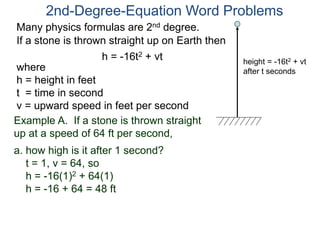
2nd-Degree-Equation Word Problems
2nd-Degree-Equation Word Problems 
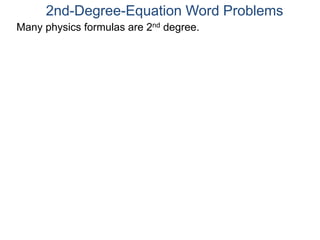
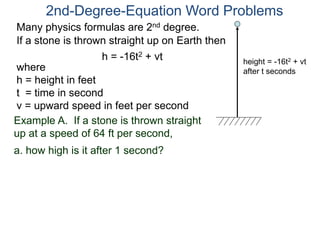
Many physics formulas are 2nd degree.
2nd-Degree-Equation Word Problems 
Many physics formulas are 2nd degree. 
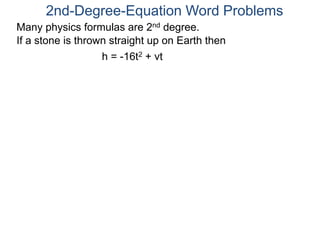
If a stone is thrown straight up on Earth then 
h = -16t2 + vt
2nd-Degree-Equation Word Problems 
Many physics formulas are 2nd degree. 
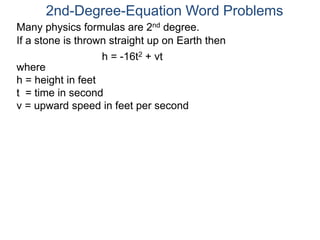
If a stone is thrown straight up on Earth then 
h = -16t2 + vt 
where 
h = height in feet 
t = time in second 
v = upward speed in feet per second
2nd-Degree-Equation Word Problems 
Many physics formulas are 2nd degree. 
If a stone is thrown straight up on Earth then 
h = -16t2 + vt 
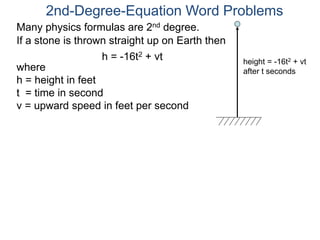
height = -16t2 + vt 
after t seconds where 
h = height in feet 
t = time in second 
v = upward speed in feet per second
2nd-Degree-Equation Word Problems 
Many physics formulas are 2nd degree. 
If a stone is thrown straight up on Earth then 
h = -16t2 + vt 
height = -16t2 + vt 
after t seconds where 
h = height in feet 
t = time in second 
v = upward speed in feet per second 
Example A. If a stone is thrown straight 
up at a speed of 64 ft per second, 
a. how high is it after 1 second?
2nd-Degree-Equation Word Problems 
Many physics formulas are 2nd degree. 
If a stone is thrown straight up on Earth then 
h = -16t2 + vt 
height = -16t2 + vt 
after t seconds where 
h = height in feet 
t = time in second 
v = upward speed in feet per second 
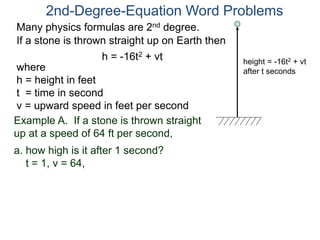
Example A. If a stone is thrown straight 
up at a speed of 64 ft per second, 
a. how high is it after 1 second? 
t = 1, v = 64,
2nd-Degree-Equation Word Problems 
Many physics formulas are 2nd degree. 
If a stone is thrown straight up on Earth then 
h = -16t2 + vt 
height = -16t2 + vt 
after t seconds where 
h = height in feet 
t = time in second 
v = upward speed in feet per second 
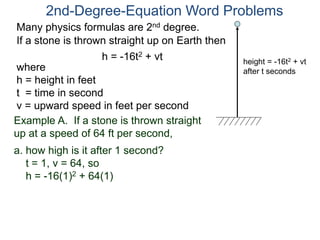
Example A. If a stone is thrown straight 
up at a speed of 64 ft per second, 
a. how high is it after 1 second? 
t = 1, v = 64, so 
h = -16(1)2 + 64(1)
2nd-Degree-Equation Word Problems 
Many physics formulas are 2nd degree. 
If a stone is thrown straight up on Earth then 
h = -16t2 + vt 
height = -16t2 + vt 
after t seconds where 
h = height in feet 
t = time in second 
v = upward speed in feet per second 
Example A. If a stone is thrown straight 
up at a speed of 64 ft per second, 
a. how high is it after 1 second? 
t = 1, v = 64, so 
h = -16(1)2 + 64(1) 
h = -16 + 64 = 48 ft
2nd-Degree-Equation Word Problems 
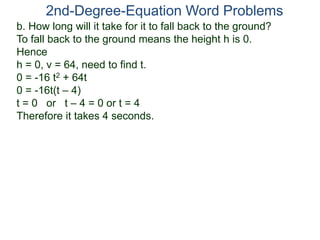
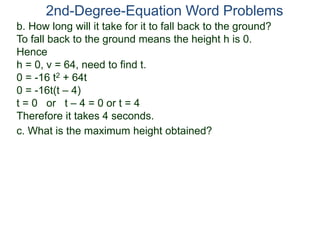
b. How long will it take for it to fall back to the ground?
2nd-Degree-Equation Word Problems 
b. How long will it take for it to fall back to the ground? 
To fall back to the ground means the height h is 0.
2nd-Degree-Equation Word Problems 
b. How long will it take for it to fall back to the ground? 
To fall back to the ground means the height h is 0. 
Hence 
h = 0, v = 64, need to find t.
2nd-Degree-Equation Word Problems 
b. How long will it take for it to fall back to the ground? 
To fall back to the ground means the height h is 0. 
Hence 
h = 0, v = 64, need to find t. 
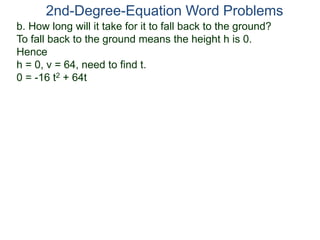
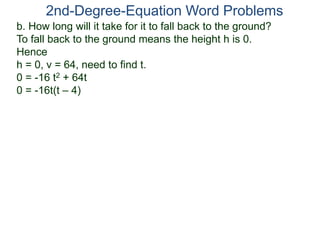
0 = -16 t2 + 64t
2nd-Degree-Equation Word Problems 
b. How long will it take for it to fall back to the ground? 
To fall back to the ground means the height h is 0. 
Hence 
h = 0, v = 64, need to find t. 
0 = -16 t2 + 64t 
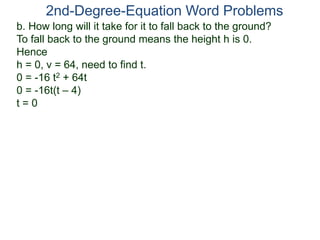
0 = -16t(t – 4)
2nd-Degree-Equation Word Problems 
b. How long will it take for it to fall back to the ground? 
To fall back to the ground means the height h is 0. 
Hence 
h = 0, v = 64, need to find t. 
0 = -16 t2 + 64t 
0 = -16t(t – 4) 
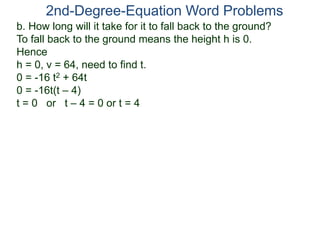
t = 0
2nd-Degree-Equation Word Problems 
b. How long will it take for it to fall back to the ground? 
To fall back to the ground means the height h is 0. 
Hence 
h = 0, v = 64, need to find t. 
0 = -16 t2 + 64t 
0 = -16t(t – 4) 
t = 0 or t – 4 = 0 or t = 4
2nd-Degree-Equation Word Problems 
b. How long will it take for it to fall back to the ground? 
To fall back to the ground means the height h is 0. 
Hence 
h = 0, v = 64, need to find t. 
0 = -16 t2 + 64t 
0 = -16t(t – 4) 
t = 0 or t – 4 = 0 or t = 4 
Therefore it takes 4 seconds.
2nd-Degree-Equation Word Problems 
b. How long will it take for it to fall back to the ground? 
To fall back to the ground means the height h is 0. 
Hence 
h = 0, v = 64, need to find t. 
0 = -16 t2 + 64t 
0 = -16t(t – 4) 
t = 0 or t – 4 = 0 or t = 4 
Therefore it takes 4 seconds. 
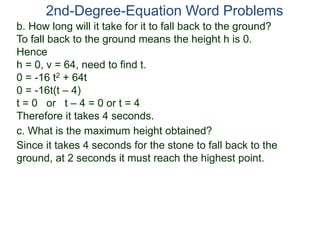
c. What is the maximum height obtained?
2nd-Degree-Equation Word Problems 
b. How long will it take for it to fall back to the ground? 
To fall back to the ground means the height h is 0. 
Hence 
h = 0, v = 64, need to find t. 
0 = -16 t2 + 64t 
0 = -16t(t – 4) 
t = 0 or t – 4 = 0 or t = 4 
Therefore it takes 4 seconds. 
c. What is the maximum height obtained? 
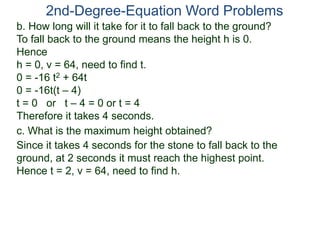
Since it takes 4 seconds for the stone to fall back to the 
ground, at 2 seconds it must reach the highest point.
2nd-Degree-Equation Word Problems 
b. How long will it take for it to fall back to the ground? 
To fall back to the ground means the height h is 0. 
Hence 
h = 0, v = 64, need to find t. 
0 = -16 t2 + 64t 
0 = -16t(t – 4) 
t = 0 or t – 4 = 0 or t = 4 
Therefore it takes 4 seconds. 
c. What is the maximum height obtained? 
Since it takes 4 seconds for the stone to fall back to the 
ground, at 2 seconds it must reach the highest point. 
Hence t = 2, v = 64, need to find h.
2nd-Degree-Equation Word Problems 
b. How long will it take for it to fall back to the ground? 
To fall back to the ground means the height h is 0. 
Hence 
h = 0, v = 64, need to find t. 
0 = -16 t2 + 64t 
0 = -16t(t – 4) 
t = 0 or t – 4 = 0 or t = 4 
Therefore it takes 4 seconds. 
c. What is the maximum height obtained? 
Since it takes 4 seconds for the stone to fall back to the 
ground, at 2 seconds it must reach the highest point. 
Hence t = 2, v = 64, need to find h. 
h = -16(2)2 + 64(2)
2nd-Degree-Equation Word Problems 
b. How long will it take for it to fall back to the ground? 
To fall back to the ground means the height h is 0. 
Hence 
h = 0, v = 64, need to find t. 
0 = -16 t2 + 64t 
0 = -16t(t – 4) 
t = 0 or t – 4 = 0 or t = 4 
Therefore it takes 4 seconds. 
c. What is the maximum height obtained? 
Since it takes 4 seconds for the stone to fall back to the 
ground, at 2 seconds it must reach the highest point. 
Hence t = 2, v = 64, need to find h. 
h = -16(2)2 + 64(2) 
= - 64 + 128
2nd-Degree-Equation Word Problems 
b. How long will it take for it to fall back to the ground? 
To fall back to the ground means the height h is 0. 
Hence 
h = 0, v = 64, need to find t. 
0 = -16 t2 + 64t 
0 = -16t(t – 4) 
t = 0 or t – 4 = 0 or t = 4 
Therefore it takes 4 seconds. 
c. What is the maximum height obtained? 
Since it takes 4 seconds for the stone to fall back to the 
ground, at 2 seconds it must reach the highest point. 
Hence t = 2, v = 64, need to find h. 
h = -16(2)2 + 64(2) 
= - 64 + 128 
= 64 (ft)
2nd-Degree-Equation Word Problems 
b. How long will it take for it to fall back to the ground? 
To fall back to the ground means the height h is 0. 
Hence 
h = 0, v = 64, need to find t. 
0 = -16 t2 + 64t 
0 = -16t(t – 4) 
t = 0 or t – 4 = 0 or t = 4 
Therefore it takes 4 seconds. 
c. What is the maximum height obtained? 
Since it takes 4 seconds for the stone to fall back to the 
ground, at 2 seconds it must reach the highest point. 
Hence t = 2, v = 64, need to find h. 
h = -16(2)2 + 64(2) 
= - 64 + 128 
= 64 (ft) 
Therefore, the maximum height is 64 feet.
2nd-Degree-Equation Word Problems 
Formulas of area in mathematics also lead to 2nd degree 
equations.
2nd-Degree-Equation Word Problems 
Formulas of area in mathematics also lead to 2nd degree 
equations. 
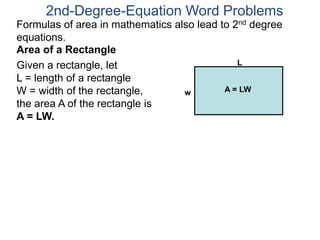
Area of a Rectangle
2nd-Degree-Equation Word Problems 
Formulas of area in mathematics also lead to 2nd degree 
equations. 
Area of a Rectangle 
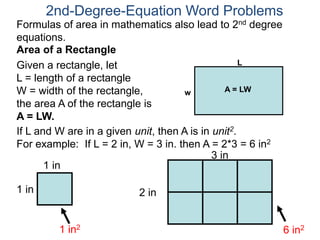
Given a rectangle, let 
L = length of a rectangle 
W = width of the rectangle,
2nd-Degree-Equation Word Problems 
Formulas of area in mathematics also lead to 2nd degree 
equations. 
Area of a Rectangle 
Given a rectangle, let 
L = length of a rectangle 
W = width of the rectangle, 
the area A of the rectangle is 
A = LW.
2nd-Degree-Equation Word Problems 
Formulas of area in mathematics also lead to 2nd degree 
equations. 
Area of a Rectangle 
Given a rectangle, let 
L = length of a rectangle 
W = width of the rectangle, 
the area A of the rectangle is 
A = LW. 
L 
w A = LW
2nd-Degree-Equation Word Problems 
Formulas of area in mathematics also lead to 2nd degree 
equations. 
Area of a Rectangle 
Given a rectangle, let 
L = length of a rectangle 
W = width of the rectangle, 
the area A of the rectangle is 
A = LW. 
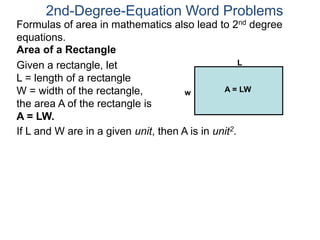
If L and W are in a given unit, then A is in unit2. 
L 
w A = LW
2nd-Degree-Equation Word Problems 
Formulas of area in mathematics also lead to 2nd degree 
equations. 
Area of a Rectangle 
Given a rectangle, let 
L = length of a rectangle 
W = width of the rectangle, 
the area A of the rectangle is 
A = LW. 
L 
w A = LW 
If L and W are in a given unit, then A is in unit2. 
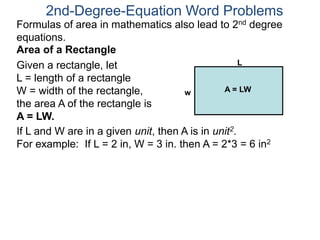
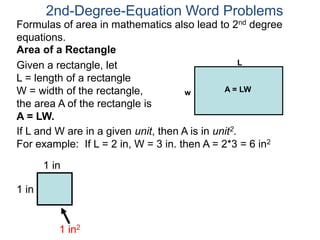
For example: If L = 2 in, W = 3 in. then A = 2*3 = 6 in2
2nd-Degree-Equation Word Problems 
Formulas of area in mathematics also lead to 2nd degree 
equations. 
Area of a Rectangle 
Given a rectangle, let 
L = length of a rectangle 
W = width of the rectangle, 
the area A of the rectangle is 
A = LW. 
If L and W are in a given unit, then A is in unit2. 
For example: If L = 2 in, W = 3 in. then A = 2*3 = 6 in2 
1 in 
1 in 
1 in2 
L 
w A = LW
Formulas of area in mathematics also lead to 2nd degree 
equations. 
If L and W are in a given unit, then A is in unit2. 
For example: If L = 2 in, W = 3 in. then A = 2*3 = 6 in2 
1 in 
1 in 
1 in2 
2 in 
3 in 
6 in2 
2nd-Degree-Equation Word Problems 
Area of a Rectangle 
Given a rectangle, let 
L = length of a rectangle 
W = width of the rectangle, 
the area A of the rectangle is 
A = LW. 
L 
w A = LW
2nd-Degree-Equation Word Problems 
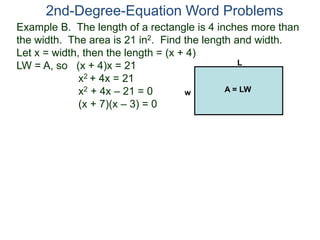
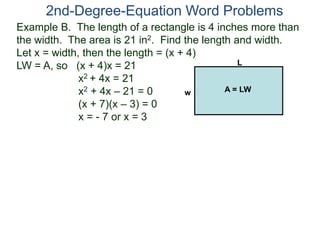
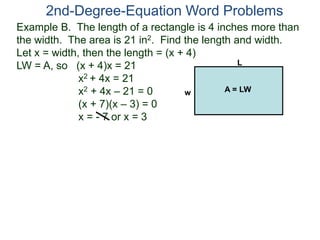
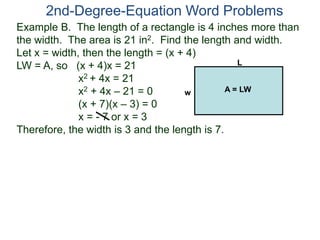
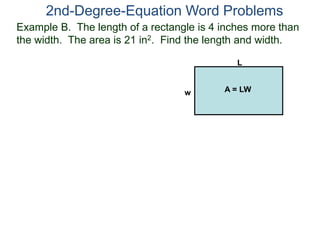
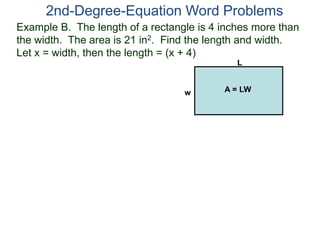
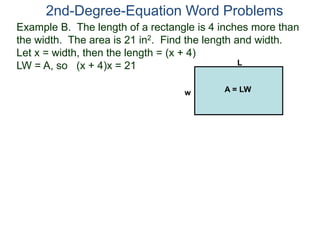
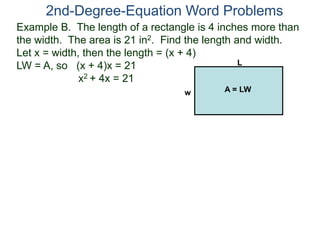
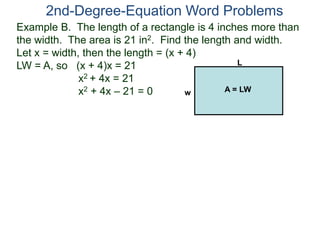
Example B. The length of a rectangle is 4 inches more than 
the width. The area is 21 in2. Find the length and width. 
L 
w A = LW
2nd-Degree-Equation Word Problems 
Example B. The length of a rectangle is 4 inches more than 
the width. The area is 21 in2. Find the length and width. 
Let x = width, then the length = (x + 4) 
L 
w A = LW
2nd-Degree-Equation Word Problems 
Example B. The length of a rectangle is 4 inches more than 
the width. The area is 21 in2. Find the length and width. 
Let x = width, then the length = (x + 4) 
LW = A, so (x + 4)x = 21 
L 
w A = LW
2nd-Degree-Equation Word Problems 
Example B. The length of a rectangle is 4 inches more than 
the width. The area is 21 in2. Find the length and width. 
Let x = width, then the length = (x + 4) 
LW = A, so (x + 4)x = 21 
x2 + 4x = 21 
L 
w A = LW
2nd-Degree-Equation Word Problems 
Example B. The length of a rectangle is 4 inches more than 
the width. The area is 21 in2. Find the length and width. 
Let x = width, then the length = (x + 4) 
LW = A, so (x + 4)x = 21 
x2 + 4x = 21 
x2 + 4x – 21 = 0 
L 
w A = LW
2nd-Degree-Equation Word Problems 
Example B. The length of a rectangle is 4 inches more than 
the width. The area is 21 in2. Find the length and width. 
Let x = width, then the length = (x + 4) 
LW = A, so (x + 4)x = 21 
x2 + 4x = 21 
x2 + 4x – 21 = 0 
(x + 7)(x – 3) = 0 
L 
w A = LW
2nd-Degree-Equation Word Problems 
Example B. The length of a rectangle is 4 inches more than 
the width. The area is 21 in2. Find the length and width. 
Let x = width, then the length = (x + 4) 
LW = A, so (x + 4)x = 21 
x2 + 4x = 21 
x2 + 4x – 21 = 0 
(x + 7)(x – 3) = 0 
x = - 7 or x = 3 
L 
w A = LW
2nd-Degree-Equation Word Problems 
Example B. The length of a rectangle is 4 inches more than 
the width. The area is 21 in2. Find the length and width. 
Let x = width, then the length = (x + 4) 
LW = A, so (x + 4)x = 21 
x2 + 4x = 21 
x2 + 4x – 21 = 0 
(x + 7)(x – 3) = 0 
x = - 7 or x = 3 
L 
w A = LW
2nd-Degree-Equation Word Problems 
Example B. The length of a rectangle is 4 inches more than 
the width. The area is 21 in2. Find the length and width. 
Let x = width, then the length = (x + 4) 
LW = A, so (x + 4)x = 21 
x2 + 4x = 21 
x2 + 4x – 21 = 0 
(x + 7)(x – 3) = 0 
x = - 7 or x = 3 
Therefore, the width is 3 and the length is 7. 
L 
w A = LW
2nd-Degree-Equation Word Problems 
Example B. The length of a rectangle is 4 inches more than 
the width. The area is 21 in2. Find the length and width. 
Let x = width, then the length = (x + 4) 
LW = A, so (x + 4)x = 21 
x2 + 4x = 21 
x2 + 4x – 21 = 0 
(x + 7)(x – 3) = 0 
x = - 7 or x = 3 
w A = LW 
Therefore, the width is 3 and the length is 7. 
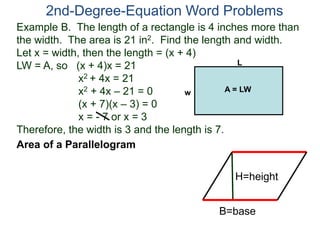
Area of a Parallelogram 
L 
H=height 
B=base
2nd-Degree-Equation Word Problems 
Example B. The length of a rectangle is 4 inches more than 
the width. The area is 21 in2. Find the length and width. 
Let x = width, then the length = (x + 4) 
LW = A, so (x + 4)x = 21 
x2 + 4x = 21 
x2 + 4x – 21 = 0 
(x + 7)(x – 3) = 0 
x = - 7 or x = 3 
w A = LW 
Therefore, the width is 3 and the length is 7. 
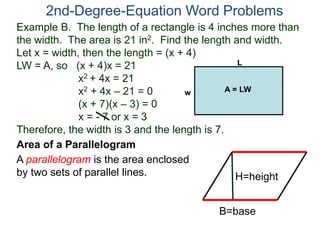
Area of a Parallelogram 
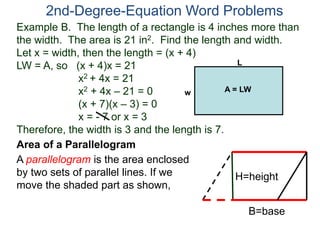
A parallelogram is the area enclosed 
by two sets of parallel lines. 
L 
H=height 
B=base
2nd-Degree-Equation Word Problems 
Example B. The length of a rectangle is 4 inches more than 
the width. The area is 21 in2. Find the length and width. 
Let x = width, then the length = (x + 4) 
LW = A, so (x + 4)x = 21 
x2 + 4x = 21 
x2 + 4x – 21 = 0 
(x + 7)(x – 3) = 0 
x = - 7 or x = 3 
w A = LW 
Therefore, the width is 3 and the length is 7. 
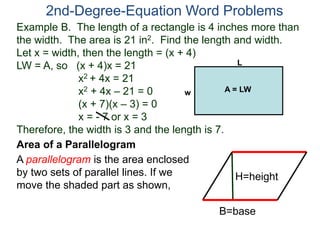
Area of a Parallelogram 
A parallelogram is the area enclosed 
by two sets of parallel lines. If we 
move the shaded part as shown, 
L 
H=height 
B=base
2nd-Degree-Equation Word Problems 
Example B. The length of a rectangle is 4 inches more than 
the width. The area is 21 in2. Find the length and width. 
Let x = width, then the length = (x + 4) 
LW = A, so (x + 4)x = 21 
x2 + 4x = 21 
x2 + 4x – 21 = 0 
(x + 7)(x – 3) = 0 
x = - 7 or x = 3 
Therefore, the width is 3 and the length is 7. 
Area of a Parallelogram 
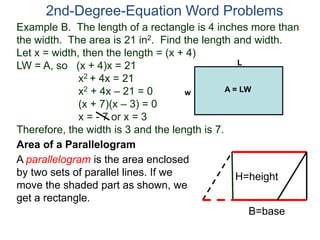
A parallelogram is the area enclosed 
by two sets of parallel lines. If we 
move the shaded part as shown, 
H=height 
B=base 
L 
w A = LW
2nd-Degree-Equation Word Problems 
Example B. The length of a rectangle is 4 inches more than 
the width. The area is 21 in2. Find the length and width. 
Let x = width, then the length = (x + 4) 
LW = A, so (x + 4)x = 21 
x2 + 4x = 21 
x2 + 4x – 21 = 0 
(x + 7)(x – 3) = 0 
x = - 7 or x = 3 
Therefore, the width is 3 and the length is 7. 
Area of a Parallelogram 
A parallelogram is the area enclosed 
by two sets of parallel lines. If we 
move the shaded part as shown, we 
get a rectangle. 
H=height 
B=base 
L 
w A = LW
2nd-Degree-Equation Word Problems 
Example B. The length of a rectangle is 4 inches more than 
the width. The area is 21 in2. Find the length and width. 
Let x = width, then the length = (x + 4) 
LW = A, so (x + 4)x = 21 
x2 + 4x = 21 
x2 + 4x – 21 = 0 
(x + 7)(x – 3) = 0 
x = - 7 or x = 3 
Therefore, the width is 3 and the length is 7. 
Area of a Parallelogram 
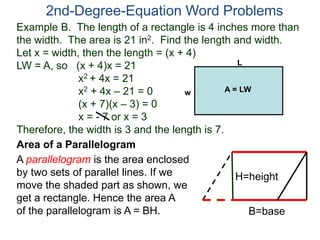
A parallelogram is the area enclosed 
by two sets of parallel lines. If we 
move the shaded part as shown, we 
get a rectangle. Hence the area A 
of the parallelogram is A = BH. 
H=height 
B=base 
L 
w A = LW
2nd-Degree-Equation Word Problems 
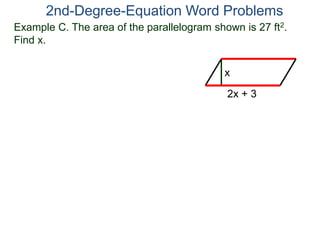
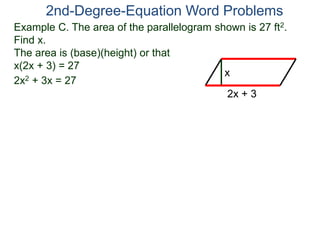
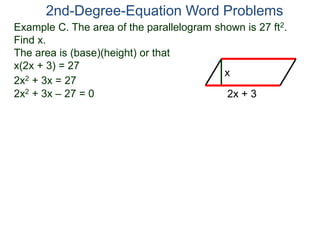
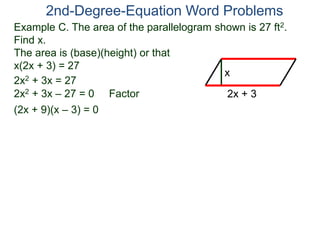
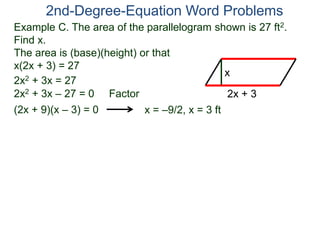
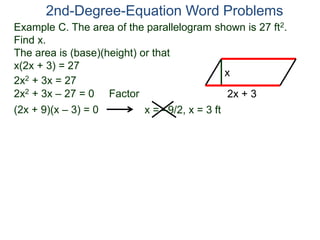
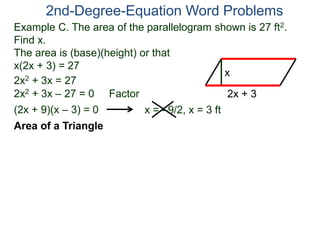
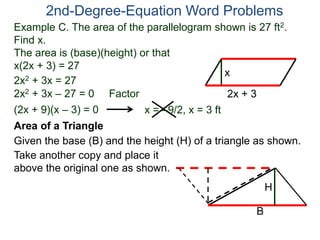
Example C. The area of the parallelogram shown is 27 ft2. 
Find x. 
x 
2x + 3
2nd-Degree-Equation Word Problems 
Example C. The area of the parallelogram shown is 27 ft2. 
Find x. 
The area is (base)(height) or that 
x(2x + 3) = 27 
x 
2x + 3 
2x2 + 3x = 27
2nd-Degree-Equation Word Problems 
Example C. The area of the parallelogram shown is 27 ft2. 
Find x. 
The area is (base)(height) or that 
x(2x + 3) = 27 
x 
2x + 3 
2x2 + 3x = 27 
2x2 + 3x – 27 = 0
2nd-Degree-Equation Word Problems 
Example C. The area of the parallelogram shown is 27 ft2. 
Find x. 
The area is (base)(height) or that 
x(2x + 3) = 27 
x 
2x + 3 
2x2 + 3x = 27 
2x2 + 3x – 27 = 0 Factor 
(2x + 9)(x – 3) = 0
2nd-Degree-Equation Word Problems 
Example C. The area of the parallelogram shown is 27 ft2. 
Find x. 
The area is (base)(height) or that 
x(2x + 3) = 27 
x 
2x + 3 
2x2 + 3x = 27 
2x2 + 3x – 27 = 0 Factor 
(2x + 9)(x – 3) = 0 x = –9/2, x = 3 ft
2nd-Degree-Equation Word Problems 
Example C. The area of the parallelogram shown is 27 ft2. 
Find x. 
The area is (base)(height) or that 
x(2x + 3) = 27 
x 
2x + 3 
2x2 + 3x = 27 
2x2 + 3x – 27 = 0 Factor 
(2x + 9)(x – 3) = 0 x = –9/2, x = 3 ft
2nd-Degree-Equation Word Problems 
Example C. The area of the parallelogram shown is 27 ft2. 
Find x. 
The area is (base)(height) or that 
x(2x + 3) = 27 
Area of a Triangle 
x 
2x + 3 
2x2 + 3x = 27 
2x2 + 3x – 27 = 0 Factor 
(2x + 9)(x – 3) = 0 x = –9/2, x = 3 ft
2nd-Degree-Equation Word Problems 
Example C. The area of the parallelogram shown is 27 ft2. 
Find x. 
The area is (base)(height) or that 
x(2x + 3) = 27 
x 
2x + 3 
2x2 + 3x = 27 
2x2 + 3x – 27 = 0 Factor 
(2x + 9)(x – 3) = 0 x = –9/2, x = 3 ft 
Area of a Triangle 
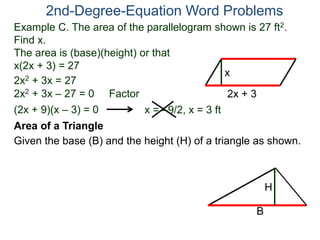
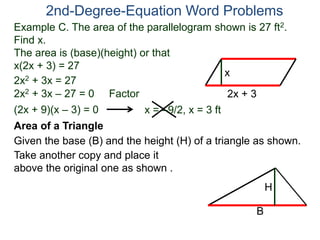
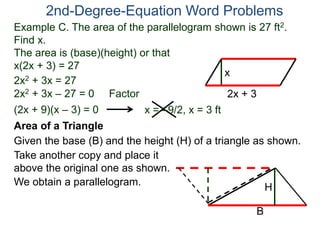
Given the base (B) and the height (H) of a triangle as shown. 
B 
H
2nd-Degree-Equation Word Problems 
Example C. The area of the parallelogram shown is 27 ft2. 
Find x. 
The area is (base)(height) or that 
x(2x + 3) = 27 
x 
Area of a Triangle 
Given the base (B) and the height (H) of a triangle as shown. 
B 
H 
2x + 3 
2x2 + 3x = 27 
2x2 + 3x – 27 = 0 Factor 
(2x + 9)(x – 3) = 0 x = –9/2, x = 3 ft 
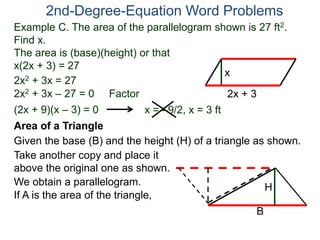
Take another copy and place it 
above the original one as shown .
2nd-Degree-Equation Word Problems 
Example C. The area of the parallelogram shown is 27 ft2. 
Find x. 
The area is (base)(height) or that 
x(2x + 3) = 27 
x 
Area of a Triangle 
Given the base (B) and the height (H) of a triangle as shown. 
B 
H 
2x + 3 
2x2 + 3x = 27 
2x2 + 3x – 27 = 0 Factor 
(2x + 9)(x – 3) = 0 x = –9/2, x = 3 ft 
Take another copy and place it 
above the original one as shown.
2nd-Degree-Equation Word Problems 
Example C. The area of the parallelogram shown is 27 ft2. 
Find x. 
The area is (base)(height) or that 
x(2x + 3) = 27 
x 
Area of a Triangle 
Given the base (B) and the height (H) of a triangle as shown. 
B 
H 
2x + 3 
2x2 + 3x = 27 
2x2 + 3x – 27 = 0 Factor 
(2x + 9)(x – 3) = 0 x = –9/2, x = 3 ft 
Take another copy and place it 
above the original one as shown. 
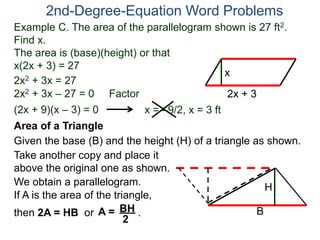
We obtain a parallelogram.
2nd-Degree-Equation Word Problems 
Example C. The area of the parallelogram shown is 27 ft2. 
Find x. 
The area is (base)(height) or that 
x(2x + 3) = 27 
x 
Area of a Triangle 
Given the base (B) and the height (H) of a triangle as shown. 
B 
H 
2x + 3 
2x2 + 3x = 27 
2x2 + 3x – 27 = 0 Factor 
(2x + 9)(x – 3) = 0 x = –9/2, x = 3 ft 
Take another copy and place it 
above the original one as shown. 
We obtain a parallelogram. 
If A is the area of the triangle,
2nd-Degree-Equation Word Problems 
Example C. The area of the parallelogram shown is 27 ft2. 
Find x. 
The area is (base)(height) or that 
x(2x + 3) = 27 
x 
Area of a Triangle 
Given the base (B) and the height (H) of a triangle as shown. 
B 
H 
2x + 3 
2x2 + 3x = 27 
2x2 + 3x – 27 = 0 Factor 
(2x + 9)(x – 3) = 0 x = –9/2, x = 3 ft 
Take another copy and place it 
above the original one as shown. 
We obtain a parallelogram. 
If A is the area of the triangle, 
then 2A = HB or A = B H . 
2
2nd-Degree-Equation Word Problems 
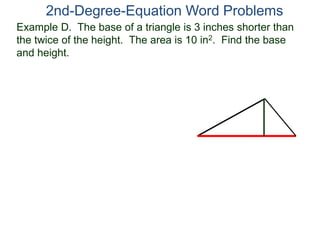
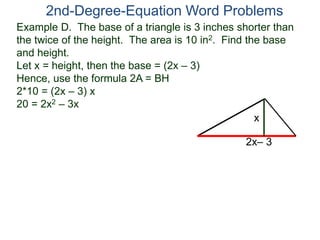
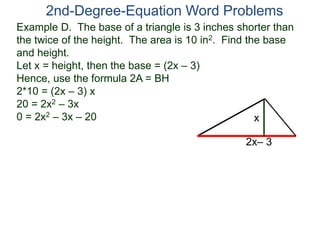
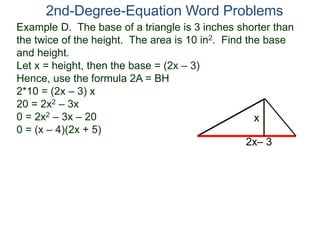
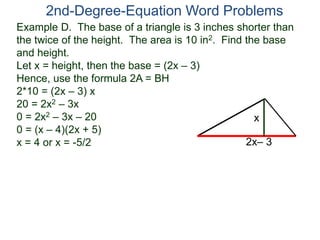
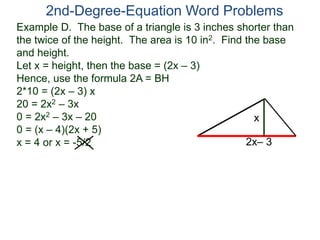
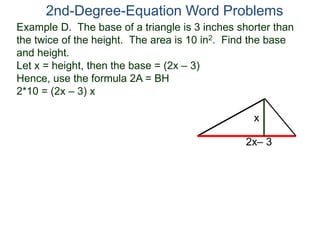
Example D. The base of a triangle is 3 inches shorter than 
the twice of the height. The area is 10 in2. Find the base 
and height.
2nd-Degree-Equation Word Problems 
Example D. The base of a triangle is 3 inches shorter than 
the twice of the height. The area is 10 in2. Find the base 
and height.
2nd-Degree-Equation Word Problems 
Example D. The base of a triangle is 3 inches shorter than 
the twice of the height. The area is 10 in2. Find the base 
and height. 
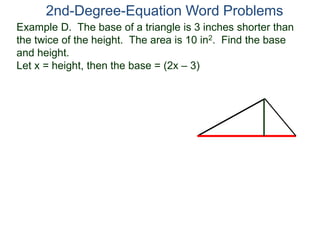
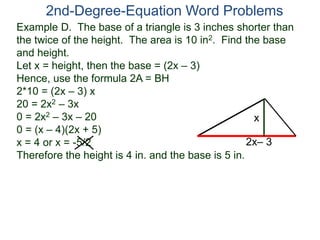
Let x = height, then the base = (2x – 3)
2nd-Degree-Equation Word Problems 
Example D. The base of a triangle is 3 inches shorter than 
the twice of the height. The area is 10 in2. Find the base 
and height. 
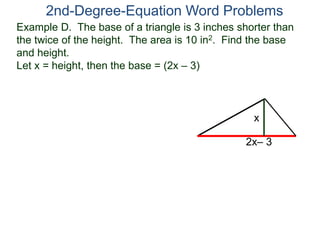
Let x = height, then the base = (2x – 3) 
x 
2x– 3
2nd-Degree-Equation Word Problems 
Example D. The base of a triangle is 3 inches shorter than 
the twice of the height. The area is 10 in2. Find the base 
and height. 
Let x = height, then the base = (2x – 3) 
Hence, use the formula 2A = BH 
2*10 = (2x – 3) x 
x 
2x– 3
2nd-Degree-Equation Word Problems 
Example D. The base of a triangle is 3 inches shorter than 
the twice of the height. The area is 10 in2. Find the base 
and height. 
Let x = height, then the base = (2x – 3) 
Hence, use the formula 2A = BH 
2*10 = (2x – 3) x 
20 = 2x2 – 3x 
x 
2x– 3
2nd-Degree-Equation Word Problems 
Example D. The base of a triangle is 3 inches shorter than 
the twice of the height. The area is 10 in2. Find the base 
and height. 
Let x = height, then the base = (2x – 3) 
Hence, use the formula 2A = BH 
2*10 = (2x – 3) x 
20 = 2x2 – 3x 
0 = 2x2 – 3x – 20 
x 
2x– 3
2nd-Degree-Equation Word Problems 
Example D. The base of a triangle is 3 inches shorter than 
the twice of the height. The area is 10 in2. Find the base 
and height. 
Let x = height, then the base = (2x – 3) 
Hence, use the formula 2A = BH 
2*10 = (2x – 3) x 
20 = 2x2 – 3x 
0 = 2x2 – 3x – 20 
x 
0 = (x – 4)(2x + 5) 
2x– 3
2nd-Degree-Equation Word Problems 
Example D. The base of a triangle is 3 inches shorter than 
the twice of the height. The area is 10 in2. Find the base 
and height. 
Let x = height, then the base = (2x – 3) 
Hence, use the formula 2A = BH 
2*10 = (2x – 3) x 
20 = 2x2 – 3x 
0 = 2x2 – 3x – 20 
x 
0 = (x – 4)(2x + 5) 
x = 4 or x = -5/2 
2x– 3
2nd-Degree-Equation Word Problems 
Example D. The base of a triangle is 3 inches shorter than 
the twice of the height. The area is 10 in2. Find the base 
and height. 
Let x = height, then the base = (2x – 3) 
Hence, use the formula 2A = BH 
2*10 = (2x – 3) x 
20 = 2x2 – 3x 
0 = 2x2 – 3x – 20 
x 
0 = (x – 4)(2x + 5) 
x = 4 or x = -5/2 
2x– 3
2nd-Degree-Equation Word Problems 
Example D. The base of a triangle is 3 inches shorter than 
the twice of the height. The area is 10 in2. Find the base 
and height. 
Let x = height, then the base = (2x – 3) 
Hence, use the formula 2A = BH 
2*10 = (2x – 3) x 
20 = 2x2 – 3x 
0 = 2x2 – 3x – 20 
x 
0 = (x – 4)(2x + 5) 
x = 4 or x = -5/2 
2x– 3 
Therefore the height is 4 in. and the base is 5 in.
2nd-Degree-Equation Word Problems 
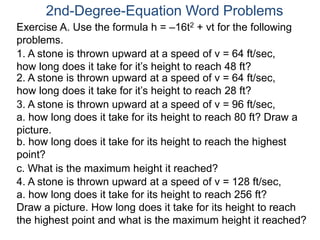
Exercise A. Use the formula h = –16t2 + vt for the following 
problems. 
1. A stone is thrown upward at a speed of v = 64 ft/sec, 
how long does it take for it’s height to reach 48 ft? 
2. A stone is thrown upward at a speed of v = 64 ft/sec, 
how long does it take for it’s height to reach 28 ft? 
3. A stone is thrown upward at a speed of v = 96 ft/sec, 
a. how long does it take for its height to reach 80 ft? Draw a 
picture. 
b. how long does it take for its height to reach the highest 
point? 
c. What is the maximum height it reached? 
4. A stone is thrown upward at a speed of v = 128 ft/sec, 
a. how long does it take for its height to reach 256 ft? 
Draw a picture. How long does it take for its height to reach 
the highest point and what is the maximum height it reached?
2nd-Degree-Equation Word Problems 
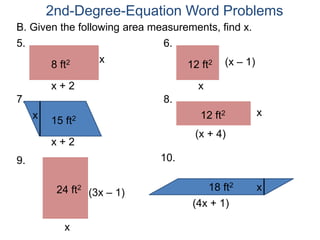
B. Given the following area measurements, find x. 
5. 
8 ft2 
x + 2 
x 
6. 
12 ft2 
x 
(x – 1) 
7. 
x + 2 
8. 
12 ft2 x 
(x + 4) 
9. 
24 ft2 
(3x – 1) 
x 
10. 
15 ft x 2 
18 ft2 x 
(4x + 1)
2nd-Degree-Equation Word Problems 
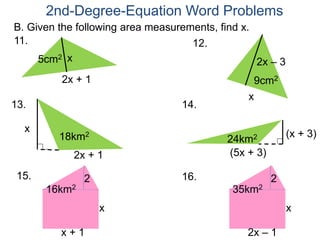
B. Given the following area measurements, find x. 
2x + 1 
11. 
5cm2 x 
12. 
2x – 3 
9cm2 
x 
2x + 1 
13. 
x 
18km2 
14. 
(x + 3) 
24km2 
(5x + 3) 
15. 16. 
16km2 
2 
x 
x + 1 
35km2 
2 
x 
2x – 1

14 2nd degree-equation word problems

  • 1.
  • 2.
    2nd-Degree-Equation Word Problems Many physics formulas are 2nd degree.
  • 3.
    2nd-Degree-Equation Word Problems Many physics formulas are 2nd degree. If a stone is thrown straight up on Earth then h = -16t2 + vt
  • 4.
    2nd-Degree-Equation Word Problems Many physics formulas are 2nd degree. If a stone is thrown straight up on Earth then h = -16t2 + vt where h = height in feet t = time in second v = upward speed in feet per second
  • 5.
    2nd-Degree-Equation Word Problems Many physics formulas are 2nd degree. If a stone is thrown straight up on Earth then h = -16t2 + vt height = -16t2 + vt after t seconds where h = height in feet t = time in second v = upward speed in feet per second
  • 6.
    2nd-Degree-Equation Word Problems Many physics formulas are 2nd degree. If a stone is thrown straight up on Earth then h = -16t2 + vt height = -16t2 + vt after t seconds where h = height in feet t = time in second v = upward speed in feet per second Example A. If a stone is thrown straight up at a speed of 64 ft per second, a. how high is it after 1 second?
  • 7.
    2nd-Degree-Equation Word Problems Many physics formulas are 2nd degree. If a stone is thrown straight up on Earth then h = -16t2 + vt height = -16t2 + vt after t seconds where h = height in feet t = time in second v = upward speed in feet per second Example A. If a stone is thrown straight up at a speed of 64 ft per second, a. how high is it after 1 second? t = 1, v = 64,
  • 8.
    2nd-Degree-Equation Word Problems Many physics formulas are 2nd degree. If a stone is thrown straight up on Earth then h = -16t2 + vt height = -16t2 + vt after t seconds where h = height in feet t = time in second v = upward speed in feet per second Example A. If a stone is thrown straight up at a speed of 64 ft per second, a. how high is it after 1 second? t = 1, v = 64, so h = -16(1)2 + 64(1)
  • 9.
    2nd-Degree-Equation Word Problems Many physics formulas are 2nd degree. If a stone is thrown straight up on Earth then h = -16t2 + vt height = -16t2 + vt after t seconds where h = height in feet t = time in second v = upward speed in feet per second Example A. If a stone is thrown straight up at a speed of 64 ft per second, a. how high is it after 1 second? t = 1, v = 64, so h = -16(1)2 + 64(1) h = -16 + 64 = 48 ft
  • 10.
    2nd-Degree-Equation Word Problems b. How long will it take for it to fall back to the ground?
  • 11.
    2nd-Degree-Equation Word Problems b. How long will it take for it to fall back to the ground? To fall back to the ground means the height h is 0.
  • 12.
    2nd-Degree-Equation Word Problems b. How long will it take for it to fall back to the ground? To fall back to the ground means the height h is 0. Hence h = 0, v = 64, need to find t.
  • 13.
    2nd-Degree-Equation Word Problems b. How long will it take for it to fall back to the ground? To fall back to the ground means the height h is 0. Hence h = 0, v = 64, need to find t. 0 = -16 t2 + 64t
  • 14.
    2nd-Degree-Equation Word Problems b. How long will it take for it to fall back to the ground? To fall back to the ground means the height h is 0. Hence h = 0, v = 64, need to find t. 0 = -16 t2 + 64t 0 = -16t(t – 4)
  • 15.
    2nd-Degree-Equation Word Problems b. How long will it take for it to fall back to the ground? To fall back to the ground means the height h is 0. Hence h = 0, v = 64, need to find t. 0 = -16 t2 + 64t 0 = -16t(t – 4) t = 0
  • 16.
    2nd-Degree-Equation Word Problems b. How long will it take for it to fall back to the ground? To fall back to the ground means the height h is 0. Hence h = 0, v = 64, need to find t. 0 = -16 t2 + 64t 0 = -16t(t – 4) t = 0 or t – 4 = 0 or t = 4
  • 17.
    2nd-Degree-Equation Word Problems b. How long will it take for it to fall back to the ground? To fall back to the ground means the height h is 0. Hence h = 0, v = 64, need to find t. 0 = -16 t2 + 64t 0 = -16t(t – 4) t = 0 or t – 4 = 0 or t = 4 Therefore it takes 4 seconds.
  • 18.
    2nd-Degree-Equation Word Problems b. How long will it take for it to fall back to the ground? To fall back to the ground means the height h is 0. Hence h = 0, v = 64, need to find t. 0 = -16 t2 + 64t 0 = -16t(t – 4) t = 0 or t – 4 = 0 or t = 4 Therefore it takes 4 seconds. c. What is the maximum height obtained?
  • 19.
    2nd-Degree-Equation Word Problems b. How long will it take for it to fall back to the ground? To fall back to the ground means the height h is 0. Hence h = 0, v = 64, need to find t. 0 = -16 t2 + 64t 0 = -16t(t – 4) t = 0 or t – 4 = 0 or t = 4 Therefore it takes 4 seconds. c. What is the maximum height obtained? Since it takes 4 seconds for the stone to fall back to the ground, at 2 seconds it must reach the highest point.
  • 20.
    2nd-Degree-Equation Word Problems b. How long will it take for it to fall back to the ground? To fall back to the ground means the height h is 0. Hence h = 0, v = 64, need to find t. 0 = -16 t2 + 64t 0 = -16t(t – 4) t = 0 or t – 4 = 0 or t = 4 Therefore it takes 4 seconds. c. What is the maximum height obtained? Since it takes 4 seconds for the stone to fall back to the ground, at 2 seconds it must reach the highest point. Hence t = 2, v = 64, need to find h.
  • 21.
    2nd-Degree-Equation Word Problems b. How long will it take for it to fall back to the ground? To fall back to the ground means the height h is 0. Hence h = 0, v = 64, need to find t. 0 = -16 t2 + 64t 0 = -16t(t – 4) t = 0 or t – 4 = 0 or t = 4 Therefore it takes 4 seconds. c. What is the maximum height obtained? Since it takes 4 seconds for the stone to fall back to the ground, at 2 seconds it must reach the highest point. Hence t = 2, v = 64, need to find h. h = -16(2)2 + 64(2)
  • 22.
    2nd-Degree-Equation Word Problems b. How long will it take for it to fall back to the ground? To fall back to the ground means the height h is 0. Hence h = 0, v = 64, need to find t. 0 = -16 t2 + 64t 0 = -16t(t – 4) t = 0 or t – 4 = 0 or t = 4 Therefore it takes 4 seconds. c. What is the maximum height obtained? Since it takes 4 seconds for the stone to fall back to the ground, at 2 seconds it must reach the highest point. Hence t = 2, v = 64, need to find h. h = -16(2)2 + 64(2) = - 64 + 128
  • 23.
    2nd-Degree-Equation Word Problems b. How long will it take for it to fall back to the ground? To fall back to the ground means the height h is 0. Hence h = 0, v = 64, need to find t. 0 = -16 t2 + 64t 0 = -16t(t – 4) t = 0 or t – 4 = 0 or t = 4 Therefore it takes 4 seconds. c. What is the maximum height obtained? Since it takes 4 seconds for the stone to fall back to the ground, at 2 seconds it must reach the highest point. Hence t = 2, v = 64, need to find h. h = -16(2)2 + 64(2) = - 64 + 128 = 64 (ft)
  • 24.
    2nd-Degree-Equation Word Problems b. How long will it take for it to fall back to the ground? To fall back to the ground means the height h is 0. Hence h = 0, v = 64, need to find t. 0 = -16 t2 + 64t 0 = -16t(t – 4) t = 0 or t – 4 = 0 or t = 4 Therefore it takes 4 seconds. c. What is the maximum height obtained? Since it takes 4 seconds for the stone to fall back to the ground, at 2 seconds it must reach the highest point. Hence t = 2, v = 64, need to find h. h = -16(2)2 + 64(2) = - 64 + 128 = 64 (ft) Therefore, the maximum height is 64 feet.
  • 25.
    2nd-Degree-Equation Word Problems Formulas of area in mathematics also lead to 2nd degree equations.
  • 26.
    2nd-Degree-Equation Word Problems Formulas of area in mathematics also lead to 2nd degree equations. Area of a Rectangle
  • 27.
    2nd-Degree-Equation Word Problems Formulas of area in mathematics also lead to 2nd degree equations. Area of a Rectangle Given a rectangle, let L = length of a rectangle W = width of the rectangle,
  • 28.
    2nd-Degree-Equation Word Problems Formulas of area in mathematics also lead to 2nd degree equations. Area of a Rectangle Given a rectangle, let L = length of a rectangle W = width of the rectangle, the area A of the rectangle is A = LW.
  • 29.
    2nd-Degree-Equation Word Problems Formulas of area in mathematics also lead to 2nd degree equations. Area of a Rectangle Given a rectangle, let L = length of a rectangle W = width of the rectangle, the area A of the rectangle is A = LW. L w A = LW
  • 30.
    2nd-Degree-Equation Word Problems Formulas of area in mathematics also lead to 2nd degree equations. Area of a Rectangle Given a rectangle, let L = length of a rectangle W = width of the rectangle, the area A of the rectangle is A = LW. If L and W are in a given unit, then A is in unit2. L w A = LW
  • 31.
    2nd-Degree-Equation Word Problems Formulas of area in mathematics also lead to 2nd degree equations. Area of a Rectangle Given a rectangle, let L = length of a rectangle W = width of the rectangle, the area A of the rectangle is A = LW. L w A = LW If L and W are in a given unit, then A is in unit2. For example: If L = 2 in, W = 3 in. then A = 2*3 = 6 in2
  • 32.
    2nd-Degree-Equation Word Problems Formulas of area in mathematics also lead to 2nd degree equations. Area of a Rectangle Given a rectangle, let L = length of a rectangle W = width of the rectangle, the area A of the rectangle is A = LW. If L and W are in a given unit, then A is in unit2. For example: If L = 2 in, W = 3 in. then A = 2*3 = 6 in2 1 in 1 in 1 in2 L w A = LW
  • 33.
    Formulas of areain mathematics also lead to 2nd degree equations. If L and W are in a given unit, then A is in unit2. For example: If L = 2 in, W = 3 in. then A = 2*3 = 6 in2 1 in 1 in 1 in2 2 in 3 in 6 in2 2nd-Degree-Equation Word Problems Area of a Rectangle Given a rectangle, let L = length of a rectangle W = width of the rectangle, the area A of the rectangle is A = LW. L w A = LW
  • 34.
    2nd-Degree-Equation Word Problems Example B. The length of a rectangle is 4 inches more than the width. The area is 21 in2. Find the length and width. L w A = LW
  • 35.
    2nd-Degree-Equation Word Problems Example B. The length of a rectangle is 4 inches more than the width. The area is 21 in2. Find the length and width. Let x = width, then the length = (x + 4) L w A = LW
  • 36.
    2nd-Degree-Equation Word Problems Example B. The length of a rectangle is 4 inches more than the width. The area is 21 in2. Find the length and width. Let x = width, then the length = (x + 4) LW = A, so (x + 4)x = 21 L w A = LW
  • 37.
    2nd-Degree-Equation Word Problems Example B. The length of a rectangle is 4 inches more than the width. The area is 21 in2. Find the length and width. Let x = width, then the length = (x + 4) LW = A, so (x + 4)x = 21 x2 + 4x = 21 L w A = LW
  • 38.
    2nd-Degree-Equation Word Problems Example B. The length of a rectangle is 4 inches more than the width. The area is 21 in2. Find the length and width. Let x = width, then the length = (x + 4) LW = A, so (x + 4)x = 21 x2 + 4x = 21 x2 + 4x – 21 = 0 L w A = LW
  • 39.
    2nd-Degree-Equation Word Problems Example B. The length of a rectangle is 4 inches more than the width. The area is 21 in2. Find the length and width. Let x = width, then the length = (x + 4) LW = A, so (x + 4)x = 21 x2 + 4x = 21 x2 + 4x – 21 = 0 (x + 7)(x – 3) = 0 L w A = LW
  • 40.
    2nd-Degree-Equation Word Problems Example B. The length of a rectangle is 4 inches more than the width. The area is 21 in2. Find the length and width. Let x = width, then the length = (x + 4) LW = A, so (x + 4)x = 21 x2 + 4x = 21 x2 + 4x – 21 = 0 (x + 7)(x – 3) = 0 x = - 7 or x = 3 L w A = LW
  • 41.
    2nd-Degree-Equation Word Problems Example B. The length of a rectangle is 4 inches more than the width. The area is 21 in2. Find the length and width. Let x = width, then the length = (x + 4) LW = A, so (x + 4)x = 21 x2 + 4x = 21 x2 + 4x – 21 = 0 (x + 7)(x – 3) = 0 x = - 7 or x = 3 L w A = LW
  • 42.
    2nd-Degree-Equation Word Problems Example B. The length of a rectangle is 4 inches more than the width. The area is 21 in2. Find the length and width. Let x = width, then the length = (x + 4) LW = A, so (x + 4)x = 21 x2 + 4x = 21 x2 + 4x – 21 = 0 (x + 7)(x – 3) = 0 x = - 7 or x = 3 Therefore, the width is 3 and the length is 7. L w A = LW
  • 43.
    2nd-Degree-Equation Word Problems Example B. The length of a rectangle is 4 inches more than the width. The area is 21 in2. Find the length and width. Let x = width, then the length = (x + 4) LW = A, so (x + 4)x = 21 x2 + 4x = 21 x2 + 4x – 21 = 0 (x + 7)(x – 3) = 0 x = - 7 or x = 3 w A = LW Therefore, the width is 3 and the length is 7. Area of a Parallelogram L H=height B=base
  • 44.
    2nd-Degree-Equation Word Problems Example B. The length of a rectangle is 4 inches more than the width. The area is 21 in2. Find the length and width. Let x = width, then the length = (x + 4) LW = A, so (x + 4)x = 21 x2 + 4x = 21 x2 + 4x – 21 = 0 (x + 7)(x – 3) = 0 x = - 7 or x = 3 w A = LW Therefore, the width is 3 and the length is 7. Area of a Parallelogram A parallelogram is the area enclosed by two sets of parallel lines. L H=height B=base
  • 45.
    2nd-Degree-Equation Word Problems Example B. The length of a rectangle is 4 inches more than the width. The area is 21 in2. Find the length and width. Let x = width, then the length = (x + 4) LW = A, so (x + 4)x = 21 x2 + 4x = 21 x2 + 4x – 21 = 0 (x + 7)(x – 3) = 0 x = - 7 or x = 3 w A = LW Therefore, the width is 3 and the length is 7. Area of a Parallelogram A parallelogram is the area enclosed by two sets of parallel lines. If we move the shaded part as shown, L H=height B=base
  • 46.
    2nd-Degree-Equation Word Problems Example B. The length of a rectangle is 4 inches more than the width. The area is 21 in2. Find the length and width. Let x = width, then the length = (x + 4) LW = A, so (x + 4)x = 21 x2 + 4x = 21 x2 + 4x – 21 = 0 (x + 7)(x – 3) = 0 x = - 7 or x = 3 Therefore, the width is 3 and the length is 7. Area of a Parallelogram A parallelogram is the area enclosed by two sets of parallel lines. If we move the shaded part as shown, H=height B=base L w A = LW
  • 47.
    2nd-Degree-Equation Word Problems Example B. The length of a rectangle is 4 inches more than the width. The area is 21 in2. Find the length and width. Let x = width, then the length = (x + 4) LW = A, so (x + 4)x = 21 x2 + 4x = 21 x2 + 4x – 21 = 0 (x + 7)(x – 3) = 0 x = - 7 or x = 3 Therefore, the width is 3 and the length is 7. Area of a Parallelogram A parallelogram is the area enclosed by two sets of parallel lines. If we move the shaded part as shown, we get a rectangle. H=height B=base L w A = LW
  • 48.
    2nd-Degree-Equation Word Problems Example B. The length of a rectangle is 4 inches more than the width. The area is 21 in2. Find the length and width. Let x = width, then the length = (x + 4) LW = A, so (x + 4)x = 21 x2 + 4x = 21 x2 + 4x – 21 = 0 (x + 7)(x – 3) = 0 x = - 7 or x = 3 Therefore, the width is 3 and the length is 7. Area of a Parallelogram A parallelogram is the area enclosed by two sets of parallel lines. If we move the shaded part as shown, we get a rectangle. Hence the area A of the parallelogram is A = BH. H=height B=base L w A = LW
  • 49.
    2nd-Degree-Equation Word Problems Example C. The area of the parallelogram shown is 27 ft2. Find x. x 2x + 3
  • 50.
    2nd-Degree-Equation Word Problems Example C. The area of the parallelogram shown is 27 ft2. Find x. The area is (base)(height) or that x(2x + 3) = 27 x 2x + 3 2x2 + 3x = 27
  • 51.
    2nd-Degree-Equation Word Problems Example C. The area of the parallelogram shown is 27 ft2. Find x. The area is (base)(height) or that x(2x + 3) = 27 x 2x + 3 2x2 + 3x = 27 2x2 + 3x – 27 = 0
  • 52.
    2nd-Degree-Equation Word Problems Example C. The area of the parallelogram shown is 27 ft2. Find x. The area is (base)(height) or that x(2x + 3) = 27 x 2x + 3 2x2 + 3x = 27 2x2 + 3x – 27 = 0 Factor (2x + 9)(x – 3) = 0
  • 53.
    2nd-Degree-Equation Word Problems Example C. The area of the parallelogram shown is 27 ft2. Find x. The area is (base)(height) or that x(2x + 3) = 27 x 2x + 3 2x2 + 3x = 27 2x2 + 3x – 27 = 0 Factor (2x + 9)(x – 3) = 0 x = –9/2, x = 3 ft
  • 54.
    2nd-Degree-Equation Word Problems Example C. The area of the parallelogram shown is 27 ft2. Find x. The area is (base)(height) or that x(2x + 3) = 27 x 2x + 3 2x2 + 3x = 27 2x2 + 3x – 27 = 0 Factor (2x + 9)(x – 3) = 0 x = –9/2, x = 3 ft
  • 55.
    2nd-Degree-Equation Word Problems Example C. The area of the parallelogram shown is 27 ft2. Find x. The area is (base)(height) or that x(2x + 3) = 27 Area of a Triangle x 2x + 3 2x2 + 3x = 27 2x2 + 3x – 27 = 0 Factor (2x + 9)(x – 3) = 0 x = –9/2, x = 3 ft
  • 56.
    2nd-Degree-Equation Word Problems Example C. The area of the parallelogram shown is 27 ft2. Find x. The area is (base)(height) or that x(2x + 3) = 27 x 2x + 3 2x2 + 3x = 27 2x2 + 3x – 27 = 0 Factor (2x + 9)(x – 3) = 0 x = –9/2, x = 3 ft Area of a Triangle Given the base (B) and the height (H) of a triangle as shown. B H
  • 57.
    2nd-Degree-Equation Word Problems Example C. The area of the parallelogram shown is 27 ft2. Find x. The area is (base)(height) or that x(2x + 3) = 27 x Area of a Triangle Given the base (B) and the height (H) of a triangle as shown. B H 2x + 3 2x2 + 3x = 27 2x2 + 3x – 27 = 0 Factor (2x + 9)(x – 3) = 0 x = –9/2, x = 3 ft Take another copy and place it above the original one as shown .
  • 58.
    2nd-Degree-Equation Word Problems Example C. The area of the parallelogram shown is 27 ft2. Find x. The area is (base)(height) or that x(2x + 3) = 27 x Area of a Triangle Given the base (B) and the height (H) of a triangle as shown. B H 2x + 3 2x2 + 3x = 27 2x2 + 3x – 27 = 0 Factor (2x + 9)(x – 3) = 0 x = –9/2, x = 3 ft Take another copy and place it above the original one as shown.
  • 59.
    2nd-Degree-Equation Word Problems Example C. The area of the parallelogram shown is 27 ft2. Find x. The area is (base)(height) or that x(2x + 3) = 27 x Area of a Triangle Given the base (B) and the height (H) of a triangle as shown. B H 2x + 3 2x2 + 3x = 27 2x2 + 3x – 27 = 0 Factor (2x + 9)(x – 3) = 0 x = –9/2, x = 3 ft Take another copy and place it above the original one as shown. We obtain a parallelogram.
  • 60.
    2nd-Degree-Equation Word Problems Example C. The area of the parallelogram shown is 27 ft2. Find x. The area is (base)(height) or that x(2x + 3) = 27 x Area of a Triangle Given the base (B) and the height (H) of a triangle as shown. B H 2x + 3 2x2 + 3x = 27 2x2 + 3x – 27 = 0 Factor (2x + 9)(x – 3) = 0 x = –9/2, x = 3 ft Take another copy and place it above the original one as shown. We obtain a parallelogram. If A is the area of the triangle,
  • 61.
    2nd-Degree-Equation Word Problems Example C. The area of the parallelogram shown is 27 ft2. Find x. The area is (base)(height) or that x(2x + 3) = 27 x Area of a Triangle Given the base (B) and the height (H) of a triangle as shown. B H 2x + 3 2x2 + 3x = 27 2x2 + 3x – 27 = 0 Factor (2x + 9)(x – 3) = 0 x = –9/2, x = 3 ft Take another copy and place it above the original one as shown. We obtain a parallelogram. If A is the area of the triangle, then 2A = HB or A = B H . 2
  • 62.
    2nd-Degree-Equation Word Problems Example D. The base of a triangle is 3 inches shorter than the twice of the height. The area is 10 in2. Find the base and height.
  • 63.
    2nd-Degree-Equation Word Problems Example D. The base of a triangle is 3 inches shorter than the twice of the height. The area is 10 in2. Find the base and height.
  • 64.
    2nd-Degree-Equation Word Problems Example D. The base of a triangle is 3 inches shorter than the twice of the height. The area is 10 in2. Find the base and height. Let x = height, then the base = (2x – 3)
  • 65.
    2nd-Degree-Equation Word Problems Example D. The base of a triangle is 3 inches shorter than the twice of the height. The area is 10 in2. Find the base and height. Let x = height, then the base = (2x – 3) x 2x– 3
  • 66.
    2nd-Degree-Equation Word Problems Example D. The base of a triangle is 3 inches shorter than the twice of the height. The area is 10 in2. Find the base and height. Let x = height, then the base = (2x – 3) Hence, use the formula 2A = BH 2*10 = (2x – 3) x x 2x– 3
  • 67.
    2nd-Degree-Equation Word Problems Example D. The base of a triangle is 3 inches shorter than the twice of the height. The area is 10 in2. Find the base and height. Let x = height, then the base = (2x – 3) Hence, use the formula 2A = BH 2*10 = (2x – 3) x 20 = 2x2 – 3x x 2x– 3
  • 68.
    2nd-Degree-Equation Word Problems Example D. The base of a triangle is 3 inches shorter than the twice of the height. The area is 10 in2. Find the base and height. Let x = height, then the base = (2x – 3) Hence, use the formula 2A = BH 2*10 = (2x – 3) x 20 = 2x2 – 3x 0 = 2x2 – 3x – 20 x 2x– 3
  • 69.
    2nd-Degree-Equation Word Problems Example D. The base of a triangle is 3 inches shorter than the twice of the height. The area is 10 in2. Find the base and height. Let x = height, then the base = (2x – 3) Hence, use the formula 2A = BH 2*10 = (2x – 3) x 20 = 2x2 – 3x 0 = 2x2 – 3x – 20 x 0 = (x – 4)(2x + 5) 2x– 3
  • 70.
    2nd-Degree-Equation Word Problems Example D. The base of a triangle is 3 inches shorter than the twice of the height. The area is 10 in2. Find the base and height. Let x = height, then the base = (2x – 3) Hence, use the formula 2A = BH 2*10 = (2x – 3) x 20 = 2x2 – 3x 0 = 2x2 – 3x – 20 x 0 = (x – 4)(2x + 5) x = 4 or x = -5/2 2x– 3
  • 71.
    2nd-Degree-Equation Word Problems Example D. The base of a triangle is 3 inches shorter than the twice of the height. The area is 10 in2. Find the base and height. Let x = height, then the base = (2x – 3) Hence, use the formula 2A = BH 2*10 = (2x – 3) x 20 = 2x2 – 3x 0 = 2x2 – 3x – 20 x 0 = (x – 4)(2x + 5) x = 4 or x = -5/2 2x– 3
  • 72.
    2nd-Degree-Equation Word Problems Example D. The base of a triangle is 3 inches shorter than the twice of the height. The area is 10 in2. Find the base and height. Let x = height, then the base = (2x – 3) Hence, use the formula 2A = BH 2*10 = (2x – 3) x 20 = 2x2 – 3x 0 = 2x2 – 3x – 20 x 0 = (x – 4)(2x + 5) x = 4 or x = -5/2 2x– 3 Therefore the height is 4 in. and the base is 5 in.
  • 73.
    2nd-Degree-Equation Word Problems Exercise A. Use the formula h = –16t2 + vt for the following problems. 1. A stone is thrown upward at a speed of v = 64 ft/sec, how long does it take for it’s height to reach 48 ft? 2. A stone is thrown upward at a speed of v = 64 ft/sec, how long does it take for it’s height to reach 28 ft? 3. A stone is thrown upward at a speed of v = 96 ft/sec, a. how long does it take for its height to reach 80 ft? Draw a picture. b. how long does it take for its height to reach the highest point? c. What is the maximum height it reached? 4. A stone is thrown upward at a speed of v = 128 ft/sec, a. how long does it take for its height to reach 256 ft? Draw a picture. How long does it take for its height to reach the highest point and what is the maximum height it reached?
  • 74.
    2nd-Degree-Equation Word Problems B. Given the following area measurements, find x. 5. 8 ft2 x + 2 x 6. 12 ft2 x (x – 1) 7. x + 2 8. 12 ft2 x (x + 4) 9. 24 ft2 (3x – 1) x 10. 15 ft x 2 18 ft2 x (4x + 1)
  • 75.
    2nd-Degree-Equation Word Problems B. Given the following area measurements, find x. 2x + 1 11. 5cm2 x 12. 2x – 3 9cm2 x 2x + 1 13. x 18km2 14. (x + 3) 24km2 (5x + 3) 15. 16. 16km2 2 x x + 1 35km2 2 x 2x – 1