The Animal Kingdom
Group 3 Amazing
Invertebrates and vertebrates are the two
groups where all the animal kingdom are
classified. There are many difference
between invertebrate and vertebrate.
However, the significant difference is the
body system of invertebrate and
vertebrate. The main difference is that
invertebrates do not have a spinal column
or a backbone, for example insects and
flatworms. While, vertebrates have spinal
column or a backbone, having a good
skeletal structure.
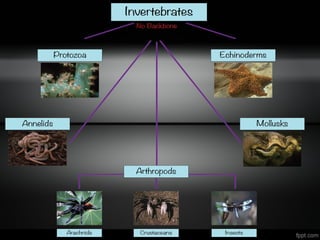
Invertebrates
Invertebrates
Invertebrates can be simply identified as
animals that don’t have a backbone. They
holds more than 97 percent in the animal
kingdom with many species of animals. For
example mollusks' like Squid, Snails,
Octopus, Bivalves, while other species like
Sponges, Annelids, Arthropods, echinoderms
and coelenterates belongs to invertebrates.
There are some classification in
invertebrates: having external skeletons for
insects and mollusks have. The lack of
supportive system, many invertebrates are
smaller in size.
Protozoa
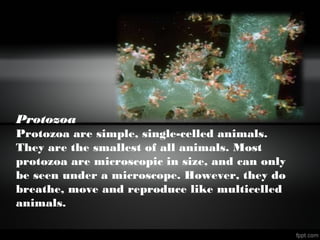
Protozoa are simple, single-celled animals.
They are the smallest of all animals. Most
protozoa are microscopic in size, and can only
be seen under a microscope. However, they do
breathe, move and reproduce like multicelled
animals.
Echinoderms
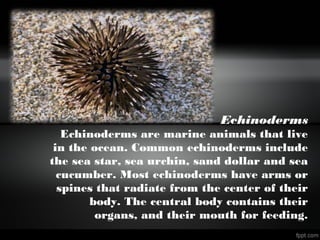
Echinoderms are marine animals that live
in the ocean. Common echinoderms include
the sea star, sea urchin, sand dollar and sea
cucumber. Most echinoderms have arms or
spines that radiate from the center of their
body. The central body contains their
organs, and their mouth for feeding.
Annelids: Worms & Leeches
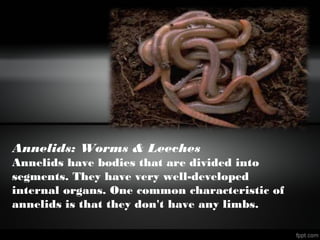
Annelids have bodies that are divided into
segments. They have very well-developed
internal organs. One common characteristic of
annelids is that they don't have any limbs.
Mollusks
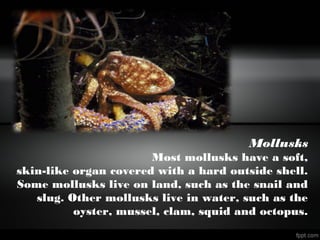
Most mollusks have a soft,
skin-like organ covered with a hard outside shell.
Some mollusks live on land, such as the snail and
slug. Other mollusks live in water, such as the
oyster, mussel, clam, squid and octopus.
Arthropods
Arthropods have limbs with joints that allow
them to move. They also have an exoskeleton,
which is a hard, external skeleton. Their body
cavity contains the nervous system, circulatory
system, reproductive system and digestive system.
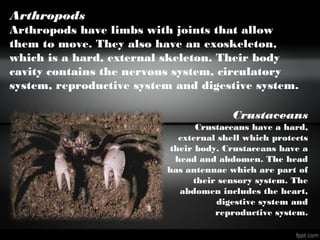
Crustaceans
Crustaceans have a hard,
external shell which protects
their body. Crustaceans have a
head and abdomen. The head
has antennae which are part of
their sensory system. The
abdomen includes the heart,
digestive system and
reproductive system.
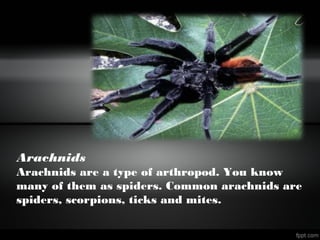
Arachnids
Arachnids are a type of arthropod. You know
many of them as spiders. Common arachnids are
spiders, scorpions, ticks and mites.
Insects
Insects have an exoskeleton that covers their
entire body. An insect's body consists of 3 parts:
the head, thorax and abdomen.
Vertebrates
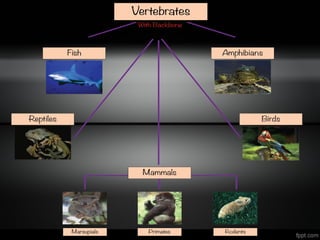
Vertebrates
Vertebrates have unique backbone. The
spinal cord runs along the body between
caudal and cranial regions connecting to the
nervous tissue. Examples of vertebrate
includes the members of Chordates,
mammals, birds, fish, reptiles and
amphibians. The main characteristics of the
vertebrates have a bilaterally symmetrical
bodies and brain covered by skull.
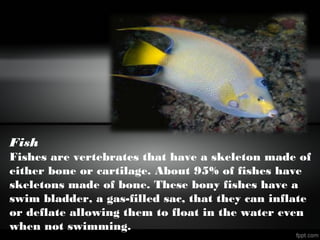
Fish
Fishes are vertebrates that have a skeleton made of
either bone or cartilage. About 95% of fishes have
skeletons made of bone. These bony fishes have a
swim bladder, a gas-filled sac, that they can inflate
or deflate allowing them to float in the water even
when not swimming.
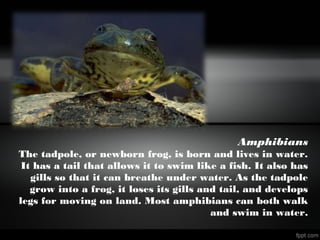
Amphibians
The tadpole, or newborn frog, is born and lives in water.
It has a tail that allows it to swim like a fish. It also has
gills so that it can breathe under water. As the tadpole
grow into a frog, it loses its gills and tail, and develops
legs for moving on land. Most amphibians can both walk
and swim in water.
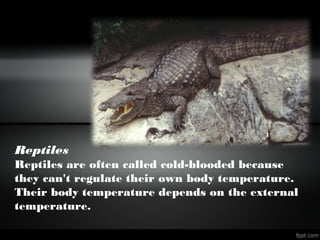
Reptiles
Reptiles are often called cold-blooded because
they can't regulate their own body temperature.
Their body temperature depends on the external
temperature.
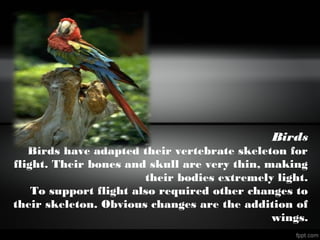
Birds
Birds have adapted their vertebrate skeleton for
flight. Their bones and skull are very thin, making
their bodies extremely light.
To support flight also required other changes to
their skeleton. Obvious changes are the addition of
wings.
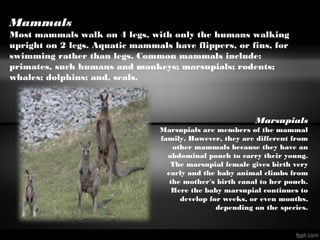
Mammals
Most mammals walk on 4 legs, with only the humans walking
upright on 2 legs. Aquatic mammals have flippers, or fins, for
swimming rather than legs. Common mammals include:
primates, such humans and monkeys; marsupials; rodents;
whales; dolphins; and, seals.
Marsupials
Marsupials are members of the mammal
family. However, they are different from
other mammals because they have an
abdominal pouch to carry their young.
The marsupial female gives birth very
early and the baby animal climbs from
the mother's birth canal to her pouch.
Here the baby marsupial continues to
develop for weeks, or even months,
depending on the species.
Primates
Primates have several distinctive features that
separate them from other mammals. Primates
have well developed hands and feet, with fingers
and toes. Their opposable thumb makes it easy
for them to grab things.
Rodents
The largest family of mammals are the rodents.
These mammals are named rodent, which means
"gnawing animal," because of their large incisor
teeth and the way they eat. The two long pairs of
incisors are used like chisels to gnaw on hard foods
like nuts and wood. These incisors must grow
continuously since they are worn down by gnawing.
Invertebrates
• Around 23% of all marine organisms are mollusks.
• The only hard body part of an octopus is a hooked beak at the end of its tentacles.
• Some invertebrates, such as echinoderms, do not have heads.
• There are likely millions of invertebrates living in your house right now. They are called dust
mites and you can't see them.
• When a crustacean outgrows its shell, it sheds the shell and grows a new one.
• Lobsters, crabs, and shrimp all have 10 legs. The front two legs have pincers they can use to
catch food and fight off predators.
• Some scorpion mothers protect their young by carrying them on their backs.
Vertebrates
• The only mammals that lay eggs are monotremes such as
the platypus and spiny anteater.
• There are reptiles that live on every continent except
Antarctica.
• Most fish have skeletons made of bone, they are called
bony fish. Other fish have skeletons made of cartilage.
These include sharks and rays.
• Frogs can breathe through their skin.
• The shortest childhood of any mammal is the hooded seal.
They are considered adults when they are just four days
old.
• Vertebrates tend to be much more intelligent than
Group 3
Rhian Thane T. Alzona
Qyzyl Gangawan
Julius Tinidero
Richard Sabida
Ashly Palo
Stephen Taboso
Jhezyah Fernandez
Lea Arevalo

Invertebrates and vertebrates

  • 1.
  • 3.
    Invertebrates and vertebratesare the two groups where all the animal kingdom are classified. There are many difference between invertebrate and vertebrate. However, the significant difference is the body system of invertebrate and vertebrate. The main difference is that invertebrates do not have a spinal column or a backbone, for example insects and flatworms. While, vertebrates have spinal column or a backbone, having a good skeletal structure.
  • 4.
  • 5.
    Invertebrates Invertebrates can besimply identified as animals that don’t have a backbone. They holds more than 97 percent in the animal kingdom with many species of animals. For example mollusks' like Squid, Snails, Octopus, Bivalves, while other species like Sponges, Annelids, Arthropods, echinoderms and coelenterates belongs to invertebrates. There are some classification in invertebrates: having external skeletons for insects and mollusks have. The lack of supportive system, many invertebrates are smaller in size.
  • 7.
    Protozoa Protozoa are simple,single-celled animals. They are the smallest of all animals. Most protozoa are microscopic in size, and can only be seen under a microscope. However, they do breathe, move and reproduce like multicelled animals.
  • 8.
    Echinoderms Echinoderms are marineanimals that live in the ocean. Common echinoderms include the sea star, sea urchin, sand dollar and sea cucumber. Most echinoderms have arms or spines that radiate from the center of their body. The central body contains their organs, and their mouth for feeding.
  • 9.
    Annelids: Worms &Leeches Annelids have bodies that are divided into segments. They have very well-developed internal organs. One common characteristic of annelids is that they don't have any limbs.
  • 10.
    Mollusks Most mollusks havea soft, skin-like organ covered with a hard outside shell. Some mollusks live on land, such as the snail and slug. Other mollusks live in water, such as the oyster, mussel, clam, squid and octopus.
  • 11.
    Arthropods Arthropods have limbswith joints that allow them to move. They also have an exoskeleton, which is a hard, external skeleton. Their body cavity contains the nervous system, circulatory system, reproductive system and digestive system. Crustaceans Crustaceans have a hard, external shell which protects their body. Crustaceans have a head and abdomen. The head has antennae which are part of their sensory system. The abdomen includes the heart, digestive system and reproductive system.
  • 12.
    Arachnids Arachnids are atype of arthropod. You know many of them as spiders. Common arachnids are spiders, scorpions, ticks and mites.
  • 13.
    Insects Insects have anexoskeleton that covers their entire body. An insect's body consists of 3 parts: the head, thorax and abdomen.
  • 14.
  • 15.
    Vertebrates Vertebrates have uniquebackbone. The spinal cord runs along the body between caudal and cranial regions connecting to the nervous tissue. Examples of vertebrate includes the members of Chordates, mammals, birds, fish, reptiles and amphibians. The main characteristics of the vertebrates have a bilaterally symmetrical bodies and brain covered by skull.
  • 17.
    Fish Fishes are vertebratesthat have a skeleton made of either bone or cartilage. About 95% of fishes have skeletons made of bone. These bony fishes have a swim bladder, a gas-filled sac, that they can inflate or deflate allowing them to float in the water even when not swimming.
  • 18.
    Amphibians The tadpole, ornewborn frog, is born and lives in water. It has a tail that allows it to swim like a fish. It also has gills so that it can breathe under water. As the tadpole grow into a frog, it loses its gills and tail, and develops legs for moving on land. Most amphibians can both walk and swim in water.
  • 19.
    Reptiles Reptiles are oftencalled cold-blooded because they can't regulate their own body temperature. Their body temperature depends on the external temperature.
  • 20.
    Birds Birds have adaptedtheir vertebrate skeleton for flight. Their bones and skull are very thin, making their bodies extremely light. To support flight also required other changes to their skeleton. Obvious changes are the addition of wings.
  • 21.
    Mammals Most mammals walkon 4 legs, with only the humans walking upright on 2 legs. Aquatic mammals have flippers, or fins, for swimming rather than legs. Common mammals include: primates, such humans and monkeys; marsupials; rodents; whales; dolphins; and, seals. Marsupials Marsupials are members of the mammal family. However, they are different from other mammals because they have an abdominal pouch to carry their young. The marsupial female gives birth very early and the baby animal climbs from the mother's birth canal to her pouch. Here the baby marsupial continues to develop for weeks, or even months, depending on the species.
  • 22.
    Primates Primates have severaldistinctive features that separate them from other mammals. Primates have well developed hands and feet, with fingers and toes. Their opposable thumb makes it easy for them to grab things.
  • 23.
    Rodents The largest familyof mammals are the rodents. These mammals are named rodent, which means "gnawing animal," because of their large incisor teeth and the way they eat. The two long pairs of incisors are used like chisels to gnaw on hard foods like nuts and wood. These incisors must grow continuously since they are worn down by gnawing.
  • 24.
    Invertebrates • Around 23%of all marine organisms are mollusks. • The only hard body part of an octopus is a hooked beak at the end of its tentacles. • Some invertebrates, such as echinoderms, do not have heads. • There are likely millions of invertebrates living in your house right now. They are called dust mites and you can't see them. • When a crustacean outgrows its shell, it sheds the shell and grows a new one. • Lobsters, crabs, and shrimp all have 10 legs. The front two legs have pincers they can use to catch food and fight off predators. • Some scorpion mothers protect their young by carrying them on their backs.
  • 25.
    Vertebrates • The onlymammals that lay eggs are monotremes such as the platypus and spiny anteater. • There are reptiles that live on every continent except Antarctica. • Most fish have skeletons made of bone, they are called bony fish. Other fish have skeletons made of cartilage. These include sharks and rays. • Frogs can breathe through their skin. • The shortest childhood of any mammal is the hooded seal. They are considered adults when they are just four days old. • Vertebrates tend to be much more intelligent than
  • 26.
    Group 3 Rhian ThaneT. Alzona Qyzyl Gangawan Julius Tinidero Richard Sabida Ashly Palo Stephen Taboso Jhezyah Fernandez Lea Arevalo