Table Of Content
Introduction
Goals
Types of Load Balancing….
Static Load Balancing
Dynamic Load Balancing
Strategies of Load Balancing…
 Centralized
 Distributed
Conclusion
Introduction
With the ease of access to Internet, each individual,
organization uses Cloud computing services. NIST defines
Cloud computing is a computing model used everywhere and
provides convenient, on-demand access to a shared pool of
computing resources such as networks, servers, storage,
applications, etc.These resources can be dynamically
assigned and released with minimal management effort or
service provider interaction.
 It provides 3 services such as :-
 Software as Service (SaaS).
 Platform as a Service (PaaS).
 Infrastructure as a Service (IaaS).
Continue….
Different physical and virtual resources are provided to
the users on demand. In Cloud computing, access to the
resource is based on Virtualization. We can create larger
number of less powered servers through virtualization,
which in turn reduces the overall cost in space, power,
and infrastructure. Cloud resources can be scaled rapidly
using virtualization technique.
Cloud resources are dynamically allocated to users on
demand. As the number of user increases, the available
resources decrease dynamically.
 Allocation of cloud resources to users on demand gives
rise to the problem of load balancing.
Load Balancing
If workload is not distributed properly, then some nodes in
cloud will be heavily loaded and some nodes will be under
loaded.
 In the same way if the resources provided by the cloud
are not allocated efficiently, it leads to delay in providing
service to the users.
 Load imbalance may cause system bottleneck. To achieve
resource utilization and no delay in providing service,
resource allocation should be done in an efficient way.
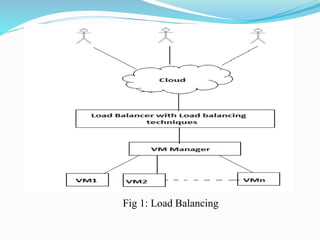
Nodes of the system can be logically grouped into cluster
and task of load balancing is distributed among clusters.
Fig 1: Load Balancing
Goals of Load-Balancing
Load balancing aims to optimize resource use.
Maximize throughput.
 Minimize response time.
Avoid overload of any single resource.
 Using multiple components with load balancing instead
of a single component may increase reliability and
availability through redundancy.
Load balancing usually involves dedicated software or
hardware, such as a multilayer switch or a Domain Name
System server process.
LOAD BALANCING ALGORITHMS
STATIC ALGORITHMS.
DYNAMIC ALGORITHMS
HIERARCHICAL LOAD BALANCING
ALGORITHM
STATIC ALGORITHMS
Static algorithms are best in homogeneous and stable
environments.
 However, static algorithms are not flexible and cannot
consider the dynamic changes to the attributes.
While assigning tasks to the nodes, static load balancing
algorithms will not check the state and functionality of the
node in previous tasks.
Types Of Static Load Balancing
Algorithm
Round Robin Load Balancing Algorithm (RR)
Load Balancing Min-Min Algorithm (LB Min-Min)
Load Balancing Min-Max Algorithm (LB Min-Max)
Round Robin Load Balancing Algorithm
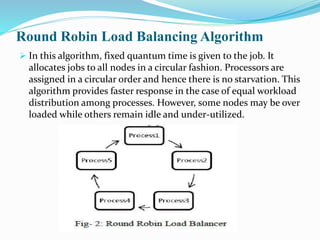
 In this algorithm, fixed quantum time is given to the job. It
allocates jobs to all nodes in a circular fashion. Processors are
assigned in a circular order and hence there is no starvation. This
algorithm provides faster response in the case of equal workload
distribution among processes. However, some nodes may be over
loaded while others remain idle and under-utilized.
MIN-MIN Load Balancing Algorithm
A list of task is maintained and minimum completion
time is calculated for all the available nodes. A task
with minimum completion time is assigned to the
machine. Hence the name of the algorithm is min-
min.
Update the list and running time of the machine. It
provides good results when small task are more.
MIN-MAX Load Balancing Algorithm
A list of task is maintained and minimum completion time
is calculated for all the available nodes. A task with
maximum completion time is assigned to the machine.
Hence the name of the algorithm is min-max.
 Update the list and running time of the machine.
DYNAMIC ALGORITHMS
Dynamic algorithms provide better results in
heterogeneous and dynamic environments. These
algorithms are more flexible. Dynamic algorithms can
consider the dynamic changes to the attributes. However,
these algorithms are more complex.
Main advantage of this is that selection of task is based on
current state and this will help to improve the performance
of the system.
Dynamic algorithms can be implemented in following two
forms.
Dynamic algorithms can be implemented in
following two forms:-
1. Distributed System
Here all the nodes interact with each other and load
balancing algorithm is executed by all the nodes in the
system. The task of load balancing is distributed among all
the nodes. Interaction among nodes can be cooperative or
non-cooperative. If any node fails in the system, it will not
stop the functionality.
i) In cooperative distributed system, all node works together.
ii) In non-cooperative distributed system, each node works
independently.
Continue….
2.Non-distributed System
Non-distributed can be centralized or semi-distributed.
1. Centralized System :-In centralized system, central node
is responsible for load balancing of the whole system. The
other nodes interact with this central node. If central node
fails, it will stop the functionality. In case of failure,
recovery will not be easy.
2. Semi-Distributed system :-In semi-distributed system,
nodes are grouped to form a cluster. A central node of each
cluster performs load balancing of whole system. If central
node of cluster fails, it will stop the functionality of that
cluster only [9]. Multiple central nodes manage the load
balancing. Hence more accurate load balancing .
Types Of Dynamic Load Balancing Algorithm
A)Honeybee Foraging Behavior Load Balancing
Algorithm.
B) Throttled Load Balancing Algorithm.
C) ESCE (Equally Spread Current Execution) Load
Balancing Algorithm.
D) Ant Colony Load Balancing Algorithm.
E) Biased Random Sampling Load Balancing Algorithm.
F) Modified Throttled Load Balancing Algorithm.
HIERARCHICAL LOAD BALANCING
ALGORITHM
Hierarchical Load Balancing involves different levels in
load balancing decisions. Every node is managed or
balanced by its parent node. Parent node is responsible for
load balancing.
Hierarchical load balancing can be used in homogeneous
as well as heterogeneous environment. Cluster can also be
used in hierarchical load balancing. Clustering is the
process of organizing similar type of objects into groups.
VM’s having similar characteristics are logically grouped.
Fig-3: Hierarchical Load Balancing
CONCLUSION
Cloud computing allows wide range of users to access
distributed, scalable, virtualized, hardware and software
resources over the Internet.
Load balancing is one of the most important issue of cloud
computing. It is a mechanism which distributes workload
evenly across all the nodes in the whole cloud. Through
efficient load balancing, we can achieve a high user
satisfaction and resource utilization. Hence, this will
improve the overall performance and resource utility of
the system.
Through hierarchical structure of system, performance of
the system will be increased.

Load Balancing.pptx

  • 2.
    Table Of Content Introduction Goals Typesof Load Balancing…. Static Load Balancing Dynamic Load Balancing Strategies of Load Balancing…  Centralized  Distributed Conclusion
  • 3.
    Introduction With the easeof access to Internet, each individual, organization uses Cloud computing services. NIST defines Cloud computing is a computing model used everywhere and provides convenient, on-demand access to a shared pool of computing resources such as networks, servers, storage, applications, etc.These resources can be dynamically assigned and released with minimal management effort or service provider interaction.  It provides 3 services such as :-  Software as Service (SaaS).  Platform as a Service (PaaS).  Infrastructure as a Service (IaaS). Continue….
  • 4.
    Different physical andvirtual resources are provided to the users on demand. In Cloud computing, access to the resource is based on Virtualization. We can create larger number of less powered servers through virtualization, which in turn reduces the overall cost in space, power, and infrastructure. Cloud resources can be scaled rapidly using virtualization technique. Cloud resources are dynamically allocated to users on demand. As the number of user increases, the available resources decrease dynamically.  Allocation of cloud resources to users on demand gives rise to the problem of load balancing.
  • 5.
    Load Balancing If workloadis not distributed properly, then some nodes in cloud will be heavily loaded and some nodes will be under loaded.  In the same way if the resources provided by the cloud are not allocated efficiently, it leads to delay in providing service to the users.  Load imbalance may cause system bottleneck. To achieve resource utilization and no delay in providing service, resource allocation should be done in an efficient way. Nodes of the system can be logically grouped into cluster and task of load balancing is distributed among clusters.
  • 6.
    Fig 1: LoadBalancing
  • 7.
    Goals of Load-Balancing Loadbalancing aims to optimize resource use. Maximize throughput.  Minimize response time. Avoid overload of any single resource.  Using multiple components with load balancing instead of a single component may increase reliability and availability through redundancy. Load balancing usually involves dedicated software or hardware, such as a multilayer switch or a Domain Name System server process.
  • 8.
    LOAD BALANCING ALGORITHMS STATICALGORITHMS. DYNAMIC ALGORITHMS HIERARCHICAL LOAD BALANCING ALGORITHM
  • 9.
    STATIC ALGORITHMS Static algorithmsare best in homogeneous and stable environments.  However, static algorithms are not flexible and cannot consider the dynamic changes to the attributes. While assigning tasks to the nodes, static load balancing algorithms will not check the state and functionality of the node in previous tasks.
  • 10.
    Types Of StaticLoad Balancing Algorithm Round Robin Load Balancing Algorithm (RR) Load Balancing Min-Min Algorithm (LB Min-Min) Load Balancing Min-Max Algorithm (LB Min-Max)
  • 11.
    Round Robin LoadBalancing Algorithm  In this algorithm, fixed quantum time is given to the job. It allocates jobs to all nodes in a circular fashion. Processors are assigned in a circular order and hence there is no starvation. This algorithm provides faster response in the case of equal workload distribution among processes. However, some nodes may be over loaded while others remain idle and under-utilized.
  • 12.
    MIN-MIN Load BalancingAlgorithm A list of task is maintained and minimum completion time is calculated for all the available nodes. A task with minimum completion time is assigned to the machine. Hence the name of the algorithm is min- min. Update the list and running time of the machine. It provides good results when small task are more.
  • 13.
    MIN-MAX Load BalancingAlgorithm A list of task is maintained and minimum completion time is calculated for all the available nodes. A task with maximum completion time is assigned to the machine. Hence the name of the algorithm is min-max.  Update the list and running time of the machine.
  • 14.
    DYNAMIC ALGORITHMS Dynamic algorithmsprovide better results in heterogeneous and dynamic environments. These algorithms are more flexible. Dynamic algorithms can consider the dynamic changes to the attributes. However, these algorithms are more complex. Main advantage of this is that selection of task is based on current state and this will help to improve the performance of the system. Dynamic algorithms can be implemented in following two forms.
  • 15.
    Dynamic algorithms canbe implemented in following two forms:- 1. Distributed System Here all the nodes interact with each other and load balancing algorithm is executed by all the nodes in the system. The task of load balancing is distributed among all the nodes. Interaction among nodes can be cooperative or non-cooperative. If any node fails in the system, it will not stop the functionality. i) In cooperative distributed system, all node works together. ii) In non-cooperative distributed system, each node works independently. Continue….
  • 16.
    2.Non-distributed System Non-distributed canbe centralized or semi-distributed. 1. Centralized System :-In centralized system, central node is responsible for load balancing of the whole system. The other nodes interact with this central node. If central node fails, it will stop the functionality. In case of failure, recovery will not be easy. 2. Semi-Distributed system :-In semi-distributed system, nodes are grouped to form a cluster. A central node of each cluster performs load balancing of whole system. If central node of cluster fails, it will stop the functionality of that cluster only [9]. Multiple central nodes manage the load balancing. Hence more accurate load balancing .
  • 17.
    Types Of DynamicLoad Balancing Algorithm A)Honeybee Foraging Behavior Load Balancing Algorithm. B) Throttled Load Balancing Algorithm. C) ESCE (Equally Spread Current Execution) Load Balancing Algorithm. D) Ant Colony Load Balancing Algorithm. E) Biased Random Sampling Load Balancing Algorithm. F) Modified Throttled Load Balancing Algorithm.
  • 18.
    HIERARCHICAL LOAD BALANCING ALGORITHM HierarchicalLoad Balancing involves different levels in load balancing decisions. Every node is managed or balanced by its parent node. Parent node is responsible for load balancing. Hierarchical load balancing can be used in homogeneous as well as heterogeneous environment. Cluster can also be used in hierarchical load balancing. Clustering is the process of organizing similar type of objects into groups. VM’s having similar characteristics are logically grouped.
  • 19.
  • 20.
    CONCLUSION Cloud computing allowswide range of users to access distributed, scalable, virtualized, hardware and software resources over the Internet. Load balancing is one of the most important issue of cloud computing. It is a mechanism which distributes workload evenly across all the nodes in the whole cloud. Through efficient load balancing, we can achieve a high user satisfaction and resource utilization. Hence, this will improve the overall performance and resource utility of the system. Through hierarchical structure of system, performance of the system will be increased.