Welcome to Psychiatric Mental Health  Nursing Psychiatric Nurses care and communicate All good nurses are psych nurses whether they want to admit it or not!
Mental Health Definition Absence of mental illness Adaptation to stress with culturally age appropriate thoughts, feelings and behaviors Successful ability to perform in mental functions which result in productive activities, fulfilling relationships and adaptation to change
Mental Illness Definition Any disorder that affects the mind or behavior Maladaptation to stress with culturally age inappropriate thoughts, feelings and behaviors Behavioral or psychological syndrome with distress, disability & loss Mental illness has been applied to those who do not conform to society.  The “strange” or “different” i.e. Gandhi, Abraham Lincoln, Mother Teresa…Have all been independent thinkers thus labeled different.  So who are the mentally ill-anyone can have a mental illness.
Mental Health vs. Mental Illness Adequate self concept Effective coping Good problem solving & decision making Independent Reality based thinking Sets goals Optimistic Delays gratification Effective socialization Poor self concept  Ineffective coping Poor problem solving & decision making Dependent Nonreality based  thinking Poor goal setting Pessimistic Immediate gratification Poor socialization
Myths about Mental Illness Mentally ill people are easily recognized Mentally ill people are dangerous Mental illness is inherited Mental illness can be predicted Mental illness is caused by internal forces or maybe the devil! Mental illness is incurable
Interdisciplinary/ Multidisciplinary Treatment Team  Goal: Form & implement an individualized plan of care for each client
Definition:  A team of health care providers who together provide a holistic view of the client.  Each member has a specific role within the treatment planning of the client,  However some of the roles are duplicated such as providing therapeutic communication  Examples of members:
Treatment Team members Psychiatrist Psychologist Nurse & nursing staff Case Manager Counselor Social Worker Rehabilitation Specialist Others
Psychiatrist A medical doctor who prescribes treatment & is the head of the team.  Responsible for medical diagnosis Guidelines for making diagnosis found in: DSM-IV-R  Diagnostic Statistical Manual 4 th  edition revised Diagnosis is made on a multiaxial system
MULTIAXIAL DIAGNOSIS Used to assess several aspects of the client Axis I-The Psychiatric Disorder i.e. Depression Axis II-The Personality Disorder or Developmental Disorder  / deferred i.e. Antisocial Personality Disorder Remaining 3 are not needed, but helpful Axis III-The Medical Diagnosis i.e. Hypertension Axis IV-Psychosocial or environmental problems i.e. financial problems, family conflict Axis V-Global Assessment Functioning
Global Assessment Functioning Is an indication of the client’s best level of psychological, social and occupational functioning during the preceding year A score of 1 indicates persistent danger of severely hurting oneself or others and 100 indicates superior functioning See page 26 in your book for a complete scale
Treatment Team cont. Psychologist Masters or doctorate prepared member who provides the client with psychological testing, behavioral plan, individual therapy/Psychotherapy, and Family Therapy
Nurse-offers a holistic view of the client & maintains care 24 hours a day 7 days a week RN’s & LPN’s plus Mental Health technicians/ Workers -non licensed nursing staff who provide direct care Nursing Staff Responsible for maintaining a safe therapeutic Milieu Treatment Team Cont.
ANA Standards for Psychiatric  & Mental Health Nursing Utilizing nursing process which includes identifying outcomes Counseling Milieu Therapy Promotion of self-care activities Psychobiological Interventions Health teaching Case Management Health Promotion & Maintenance
Advanced Practice Psych nurses Psychotherapy Prescriptive Authority & treatment Consultation Psychiatric Nurse Practitioner  &  Clinical Psychiatric Nurse Specialist
Nurses Care People want to know how much you  CARE Before they care how much you  Know!
Principles of Caring Patient centered Accept the client-nonjudgmental Need to express negative emotions Do not use a highly intelligent approach Be consistent.  Maintain a therapeutic not social relationship
Caring cont. Make no promises that you cannot keep Always call the patient by the preferred name Offer praise & sincere compliments Treat clients & family like you would want to be treated
Stigma “ If I Had A Wish”
Treatment Team cont. Case Manager Achieve managed care in hospital and community Coordinate client care on a broad continuum from insurance to legal to medical needs Improve client access to resources within the community Coordinate care across fragmented health care delivery systems
Treatment Team cont.  Counselor Masters or doctorate, focus is on counseling regarding Client needs i.e. addiction, family crisis,
Treatment Team Cont. Social Worker Masters degree or doctorate;  assists the client & support system in discharge planning.
Treatment Team cont. Rehabilitation specialists-focus is in a specialized area i.e. occupation, recreation Others:  Educational specialist, Art Therapist, Dietician, Music Therapist, Out patient
HISTORY OF MENTAL ILLNESS ANCIENT BELIEFS: Hippocrates (400 BC)—disequilibrium of four humors (blood, black bile, yellow bile, and phlegm) MIDDLE AGES (500-1500 AD): Europe=associated with witchcraft and supernatural; “ship of fools” to search for their lost rationality Middle Eastern Islamic: first asylums for mentally ill by Moslems  CHRISTIANITY (16 TH -17 TH  century): demon possessed; Rx by theologians and witch doctors; incarcerated in dungeons, beaten and starved; witch hunts
HISTORY OF MENTAL ILLNESS 1751: Benjamin Franklin est. Pennsylvania Hospital in Philadelphia: first institution in Us to treat MI. Dr Benjamin Rush: Father of American Psychiatry; attempted to offer medical interventions (bloodletting, spinning chair, tranquilizer chair 1800’s: Dorothea Dix, school teacher, promoted State Hospitals; crusade was that MI should receive equal care to physical illness 1873: Linda Richards first American psychiatric nurse, emphasized assessing physical and emotional needs.  Established first School of Psychiatric Nursing
HISTORY OF MENTAL ILLNESS 1935: Insulin Shock Therapy developed 1936: Psychosurgery/Lobotomy popular thru 1950’s—still used in Europe 1937: Electroconvulsive therapy (ECT) still used in US today 1950: National League of Nursing required psychiatric nursing course in curriculum 1952: Hildegard Peplau published theory on Interpersonal Relations in Nursing 1954: first tranquilizer/psychotropic medication (Thorazine)
HISTORY OF MENTAL ILLNESS 1963: Deinstitutionalization of State Hospitals 1970: Mentally Ill Pt Bill of Rights approved by federal government 1973: ANA established Standards of Psych-mental health nursing 1990: declared Decade of the Brain—goal was to discover cause of MI;  ANA established Standards for child & adolescent mental health nursing & addictions nursing
HISTORY OF MENTAL ILLNESS 21 st  Century: Healthy People 2010 goals: decrease in MI & suicides, substance abuse; continue research of new medications with minimal SE, search for cause of MI; insurance to pay for self help RX & effective de-stress techniques, increase in herbal medicine, increase in preventive care West Virginia Mental Health crisis: admissions to mental hospitals increased 45% 1999-2003.  Beds have decreased & spending has increased.  Group homes have decreased & jail admissions have increased.  In 2005 Group Homes decreased in WV from 205 to 86.
HISTORY OF MENTAL ILLNESS Recent Cabell County Substance Abuse health care providers believe part of problem regarding substance abuse is lack of accessible treatment.  Law enforcement believed need more money spent with law enforcement & jail system Prevalence of Psychiatric Disorders in US 2.2 million people affected with Schizophrenia 18.8 million have Affective Disorder( Depression, Bipolar) 19.1 million have Anxiety Disorder 1 in 3 families affected with a mental illness (2006)
Legal and ethical Mentally Ill Clients have the same rights as all individuals
Rights of hospitalized client Examples: Right to dignity Right to individualized treatment Right to vote Right to mail Right to worship Right to legal counsel Right to informed consent Right to visitors Right to be assessed within a limited period of time ( usually 72 hours)
Important Legal Rights Confidentiality Right to treatment Right to least restrictive treatment  Right to refuse treatment
Right to Confidentiality Nurses must maintain confidentiality Breach of confidentiality could cause termination of employment/expulsion from college program Law requires disclosure of info:  suspected child abuse(Nurses are mandated reporters), criminal cases, government  requests & public has the right to know (Duty to Warn & Protect) Stigma of being mentally ill makes need for  confidentiality greater than with many physical illnesses.
Right to Treatment Legal courts uphold that mentally ill have the right to fair and humane treatment Federal law mandates that all states must provide mental health care.  For example: State mental health facilities Client must be informed of the individualized treatment-commonly known as Treatment Team meetings
Right to Least Restrictive Treatment Examples: Will receive the least amount of medication that decreases symptoms Communication  Medication  most restrictive-Seclusion &/restraints Discharge to least restrictive environment
Right to Refuse Treatment Client has the right to refuse treatment if client is not a threat to self or others Cannot be kept hospitalized against his/her will Physician & legal system can petition for continued treatment if client is threat to self or other May need physician second opinion-example:  Paranoid client believes medication is poison & refuses the meds
Ethical Issues often also legal issues Nurse maintains ethics by following professional code of conduct established by the professional society-ANA Ethical situations often present with moral issues
Legal ethical components must always be  considered by the  professional nurse
CULTURAL ISSUES Learned behavior based on values, beliefs & perceptions as established by cohesive group Reflected in food, religion, communication, personal space, dress, level of independence, role expectations ETHNICITY: sense of belonging to a cultural group ETHNOCENTRISM: belief that one’s culture is superior to another STEREOTYPES: formulating a belief system based on negative biases DISCRIMINATION: prejudice that is demonstrated thru behavior (ageism, sexism, racism)
CULTURAL ISSUES Caring for culturally diverse populations requires: Open-mindedness: allows nurse to be more sensitive about needs Knowledge: educate self about culture Communicating: use interpreter or recognize level of English fluency
PSYCHOSOCIAL REHABILITATION Teach individuals disabled by mental illness to work & live independently, overcome blocks in opportunity & motivation and follow regimens of living likely to maintain or restore highest possible level of well-being Use eclectic/holistic approach to help persons with psychiatric disabilities become satisfied and successful in their environments with least amount of professional assistance
PSYCHOSOCIAL REHABILITATION TERTIARY PREVENTION teach persons disabled by MI to work & live independently, develop new skills & take medications NONCOMPLIANCE Reasons: side effects, transportation, cost, stigma, lack family support, lifestyle (homeless) EMPOWERMENT Acceptance of what is Responsibility for one’s experience of what is Trust in one’s self & ability to make appropriate choices LEVELS: Participation; choosing; supporting/relating; negotiating; accessing resources
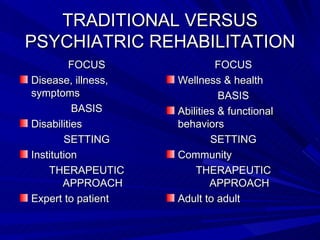
TRADITIONAL VERSUS PSYCHIATRIC REHABILITATION FOCUS Disease, illness, symptoms BASIS Disabilities SETTING Institution THERAPEUTIC APPROACH Expert to patient FOCUS Wellness & health BASIS Abilities & functional behaviors SETTING Community THERAPEUTIC APPROACH Adult to adult
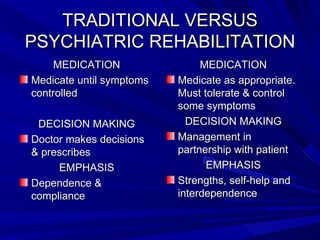
TRADITIONAL VERSUS PSYCHIATRIC REHABILITATION MEDICATION Medicate until symptoms controlled DECISION MAKING Doctor makes decisions & prescribes EMPHASIS Dependence & compliance MEDICATION Medicate as appropriate.  Must tolerate & control some symptoms DECISION MAKING Management in partnership with patient  EMPHASIS Strengths, self-help and interdependence

322 Unit 1 Lecture

  • 1.
    Welcome to PsychiatricMental Health Nursing Psychiatric Nurses care and communicate All good nurses are psych nurses whether they want to admit it or not!
  • 2.
    Mental Health DefinitionAbsence of mental illness Adaptation to stress with culturally age appropriate thoughts, feelings and behaviors Successful ability to perform in mental functions which result in productive activities, fulfilling relationships and adaptation to change
  • 3.
    Mental Illness DefinitionAny disorder that affects the mind or behavior Maladaptation to stress with culturally age inappropriate thoughts, feelings and behaviors Behavioral or psychological syndrome with distress, disability & loss Mental illness has been applied to those who do not conform to society. The “strange” or “different” i.e. Gandhi, Abraham Lincoln, Mother Teresa…Have all been independent thinkers thus labeled different. So who are the mentally ill-anyone can have a mental illness.
  • 4.

    Mental Health vs.Mental Illness Adequate self concept Effective coping Good problem solving & decision making Independent Reality based thinking Sets goals Optimistic Delays gratification Effective socialization Poor self concept Ineffective coping Poor problem solving & decision making Dependent Nonreality based thinking Poor goal setting Pessimistic Immediate gratification Poor socialization
  • 5.
    Myths about MentalIllness Mentally ill people are easily recognized Mentally ill people are dangerous Mental illness is inherited Mental illness can be predicted Mental illness is caused by internal forces or maybe the devil! Mental illness is incurable
  • 6.
    Interdisciplinary/ Multidisciplinary TreatmentTeam Goal: Form & implement an individualized plan of care for each client
  • 7.
    Definition: Ateam of health care providers who together provide a holistic view of the client. Each member has a specific role within the treatment planning of the client, However some of the roles are duplicated such as providing therapeutic communication Examples of members:
  • 8.
    Treatment Team membersPsychiatrist Psychologist Nurse & nursing staff Case Manager Counselor Social Worker Rehabilitation Specialist Others
  • 9.
    Psychiatrist A medicaldoctor who prescribes treatment & is the head of the team. Responsible for medical diagnosis Guidelines for making diagnosis found in: DSM-IV-R Diagnostic Statistical Manual 4 th edition revised Diagnosis is made on a multiaxial system
  • 10.
    MULTIAXIAL DIAGNOSIS Usedto assess several aspects of the client Axis I-The Psychiatric Disorder i.e. Depression Axis II-The Personality Disorder or Developmental Disorder / deferred i.e. Antisocial Personality Disorder Remaining 3 are not needed, but helpful Axis III-The Medical Diagnosis i.e. Hypertension Axis IV-Psychosocial or environmental problems i.e. financial problems, family conflict Axis V-Global Assessment Functioning
  • 11.
    Global Assessment FunctioningIs an indication of the client’s best level of psychological, social and occupational functioning during the preceding year A score of 1 indicates persistent danger of severely hurting oneself or others and 100 indicates superior functioning See page 26 in your book for a complete scale
  • 12.
    Treatment Team cont.Psychologist Masters or doctorate prepared member who provides the client with psychological testing, behavioral plan, individual therapy/Psychotherapy, and Family Therapy
  • 13.
    Nurse-offers a holisticview of the client & maintains care 24 hours a day 7 days a week RN’s & LPN’s plus Mental Health technicians/ Workers -non licensed nursing staff who provide direct care Nursing Staff Responsible for maintaining a safe therapeutic Milieu Treatment Team Cont.
  • 14.
    ANA Standards forPsychiatric & Mental Health Nursing Utilizing nursing process which includes identifying outcomes Counseling Milieu Therapy Promotion of self-care activities Psychobiological Interventions Health teaching Case Management Health Promotion & Maintenance
  • 15.
    Advanced Practice Psychnurses Psychotherapy Prescriptive Authority & treatment Consultation Psychiatric Nurse Practitioner & Clinical Psychiatric Nurse Specialist
  • 16.
    Nurses Care Peoplewant to know how much you CARE Before they care how much you Know!
  • 17.
    Principles of CaringPatient centered Accept the client-nonjudgmental Need to express negative emotions Do not use a highly intelligent approach Be consistent. Maintain a therapeutic not social relationship
  • 18.
    Caring cont. Makeno promises that you cannot keep Always call the patient by the preferred name Offer praise & sincere compliments Treat clients & family like you would want to be treated
  • 19.
    Stigma “ IfI Had A Wish”
  • 20.
    Treatment Team cont.Case Manager Achieve managed care in hospital and community Coordinate client care on a broad continuum from insurance to legal to medical needs Improve client access to resources within the community Coordinate care across fragmented health care delivery systems
  • 21.
    Treatment Team cont. Counselor Masters or doctorate, focus is on counseling regarding Client needs i.e. addiction, family crisis,
  • 22.
    Treatment Team Cont.Social Worker Masters degree or doctorate; assists the client & support system in discharge planning.
  • 23.
    Treatment Team cont.Rehabilitation specialists-focus is in a specialized area i.e. occupation, recreation Others: Educational specialist, Art Therapist, Dietician, Music Therapist, Out patient
  • 24.
    HISTORY OF MENTALILLNESS ANCIENT BELIEFS: Hippocrates (400 BC)—disequilibrium of four humors (blood, black bile, yellow bile, and phlegm) MIDDLE AGES (500-1500 AD): Europe=associated with witchcraft and supernatural; “ship of fools” to search for their lost rationality Middle Eastern Islamic: first asylums for mentally ill by Moslems CHRISTIANITY (16 TH -17 TH century): demon possessed; Rx by theologians and witch doctors; incarcerated in dungeons, beaten and starved; witch hunts
  • 25.
    HISTORY OF MENTALILLNESS 1751: Benjamin Franklin est. Pennsylvania Hospital in Philadelphia: first institution in Us to treat MI. Dr Benjamin Rush: Father of American Psychiatry; attempted to offer medical interventions (bloodletting, spinning chair, tranquilizer chair 1800’s: Dorothea Dix, school teacher, promoted State Hospitals; crusade was that MI should receive equal care to physical illness 1873: Linda Richards first American psychiatric nurse, emphasized assessing physical and emotional needs. Established first School of Psychiatric Nursing
  • 26.
    HISTORY OF MENTALILLNESS 1935: Insulin Shock Therapy developed 1936: Psychosurgery/Lobotomy popular thru 1950’s—still used in Europe 1937: Electroconvulsive therapy (ECT) still used in US today 1950: National League of Nursing required psychiatric nursing course in curriculum 1952: Hildegard Peplau published theory on Interpersonal Relations in Nursing 1954: first tranquilizer/psychotropic medication (Thorazine)
  • 27.
    HISTORY OF MENTALILLNESS 1963: Deinstitutionalization of State Hospitals 1970: Mentally Ill Pt Bill of Rights approved by federal government 1973: ANA established Standards of Psych-mental health nursing 1990: declared Decade of the Brain—goal was to discover cause of MI; ANA established Standards for child & adolescent mental health nursing & addictions nursing
  • 28.
    HISTORY OF MENTALILLNESS 21 st Century: Healthy People 2010 goals: decrease in MI & suicides, substance abuse; continue research of new medications with minimal SE, search for cause of MI; insurance to pay for self help RX & effective de-stress techniques, increase in herbal medicine, increase in preventive care West Virginia Mental Health crisis: admissions to mental hospitals increased 45% 1999-2003. Beds have decreased & spending has increased. Group homes have decreased & jail admissions have increased. In 2005 Group Homes decreased in WV from 205 to 86.
  • 29.
    HISTORY OF MENTALILLNESS Recent Cabell County Substance Abuse health care providers believe part of problem regarding substance abuse is lack of accessible treatment. Law enforcement believed need more money spent with law enforcement & jail system Prevalence of Psychiatric Disorders in US 2.2 million people affected with Schizophrenia 18.8 million have Affective Disorder( Depression, Bipolar) 19.1 million have Anxiety Disorder 1 in 3 families affected with a mental illness (2006)
  • 30.
    Legal and ethicalMentally Ill Clients have the same rights as all individuals
  • 31.
    Rights of hospitalizedclient Examples: Right to dignity Right to individualized treatment Right to vote Right to mail Right to worship Right to legal counsel Right to informed consent Right to visitors Right to be assessed within a limited period of time ( usually 72 hours)
  • 32.
    Important Legal RightsConfidentiality Right to treatment Right to least restrictive treatment Right to refuse treatment
  • 33.
    Right to ConfidentialityNurses must maintain confidentiality Breach of confidentiality could cause termination of employment/expulsion from college program Law requires disclosure of info: suspected child abuse(Nurses are mandated reporters), criminal cases, government requests & public has the right to know (Duty to Warn & Protect) Stigma of being mentally ill makes need for confidentiality greater than with many physical illnesses.
  • 34.
    Right to TreatmentLegal courts uphold that mentally ill have the right to fair and humane treatment Federal law mandates that all states must provide mental health care. For example: State mental health facilities Client must be informed of the individualized treatment-commonly known as Treatment Team meetings
  • 35.
    Right to LeastRestrictive Treatment Examples: Will receive the least amount of medication that decreases symptoms Communication Medication most restrictive-Seclusion &/restraints Discharge to least restrictive environment
  • 36.
    Right to RefuseTreatment Client has the right to refuse treatment if client is not a threat to self or others Cannot be kept hospitalized against his/her will Physician & legal system can petition for continued treatment if client is threat to self or other May need physician second opinion-example: Paranoid client believes medication is poison & refuses the meds
  • 37.
    Ethical Issues oftenalso legal issues Nurse maintains ethics by following professional code of conduct established by the professional society-ANA Ethical situations often present with moral issues
  • 38.
    Legal ethical componentsmust always be considered by the professional nurse
  • 39.
    CULTURAL ISSUES Learnedbehavior based on values, beliefs & perceptions as established by cohesive group Reflected in food, religion, communication, personal space, dress, level of independence, role expectations ETHNICITY: sense of belonging to a cultural group ETHNOCENTRISM: belief that one’s culture is superior to another STEREOTYPES: formulating a belief system based on negative biases DISCRIMINATION: prejudice that is demonstrated thru behavior (ageism, sexism, racism)
  • 40.
    CULTURAL ISSUES Caringfor culturally diverse populations requires: Open-mindedness: allows nurse to be more sensitive about needs Knowledge: educate self about culture Communicating: use interpreter or recognize level of English fluency
  • 41.
    PSYCHOSOCIAL REHABILITATION Teachindividuals disabled by mental illness to work & live independently, overcome blocks in opportunity & motivation and follow regimens of living likely to maintain or restore highest possible level of well-being Use eclectic/holistic approach to help persons with psychiatric disabilities become satisfied and successful in their environments with least amount of professional assistance
  • 42.
    PSYCHOSOCIAL REHABILITATION TERTIARYPREVENTION teach persons disabled by MI to work & live independently, develop new skills & take medications NONCOMPLIANCE Reasons: side effects, transportation, cost, stigma, lack family support, lifestyle (homeless) EMPOWERMENT Acceptance of what is Responsibility for one’s experience of what is Trust in one’s self & ability to make appropriate choices LEVELS: Participation; choosing; supporting/relating; negotiating; accessing resources
  • 43.
    TRADITIONAL VERSUS PSYCHIATRICREHABILITATION FOCUS Disease, illness, symptoms BASIS Disabilities SETTING Institution THERAPEUTIC APPROACH Expert to patient FOCUS Wellness & health BASIS Abilities & functional behaviors SETTING Community THERAPEUTIC APPROACH Adult to adult
  • 44.
    TRADITIONAL VERSUS PSYCHIATRICREHABILITATION MEDICATION Medicate until symptoms controlled DECISION MAKING Doctor makes decisions & prescribes EMPHASIS Dependence & compliance MEDICATION Medicate as appropriate. Must tolerate & control some symptoms DECISION MAKING Management in partnership with patient EMPHASIS Strengths, self-help and interdependence