



Suicide:
Risk Assessment and Prevention


           Dr Imran Waheed
         Consultant Psychiatrist
Overview
•   Context
•   Statistical update
•   DoH Suicide Prevention Strategy
•   Risk factors
•   Risk assessment and management
Coroner’s Inquest Media Coverage
“Her GP Dr Ryley accepted that when he saw her on 24th
March, a month before her death, he had considered only her
problems of tiredness and getting to school late and had not
asked her about depression.”
“He was concerned her problem could be due to iron deficiency
or low thyroid level and, as she was a vegetarian, he treated her
accordingly, he said.”
“Asked by the coroner if he felt there had been a missed
opportunity to help her, given her suicide bid at Beachey Head,
Dr Ryley said "Certainly, in retrospect. I agree I would have
looked to enquire closely about mood and depression but I
didn't on that occasion.””
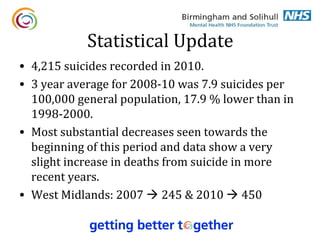
Statistical Update
• 4,215 suicides recorded in 2010.
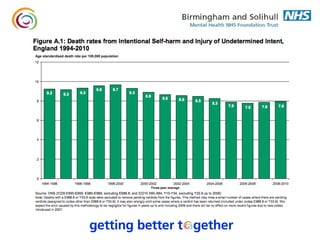
• 3 year average for 2008-10 was 7.9 suicides per
  100,000 general population, 17.9 % lower than in
  1998-2000.
• Most substantial decreases seen towards the
  beginning of this period and data show a very
  slight increase in deaths from suicide in more
  recent years.
• West Midlands: 2007  245 & 2010  450
Statistical Update
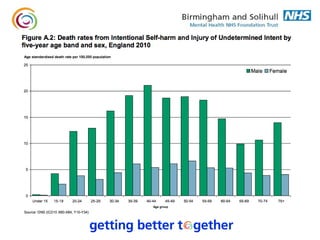
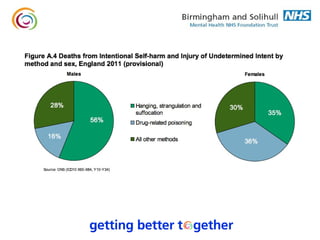
• Majority in adult males – 4 times more M than F in 25-29
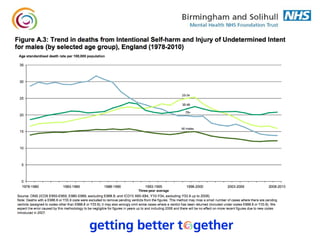
• Rate is now highest for middle age men – slight increase
• 1 % of population have suicidal thoughts per week
• Between a quarter and a half of those committing suicide
  have previously carried out a non-fatal act
• Average estimated cost per completed suicide is £1.67m
• Challenge is that suicide is rare event, prediction has very
  low specificity (so lots of false positives)
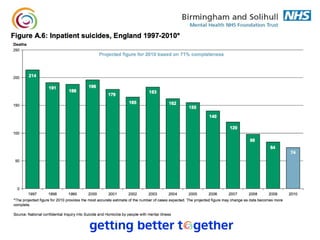
Mental Health Patient Suicide
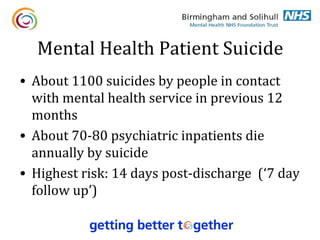
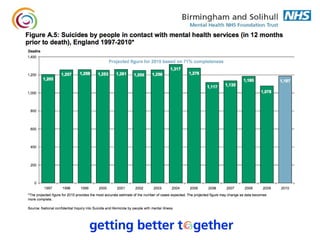
• About 1100 suicides by people in contact
  with mental health service in previous 12
  months
• About 70-80 psychiatric inpatients die
  annually by suicide
• Highest risk: 14 days post-discharge (‘7 day
  follow up’)
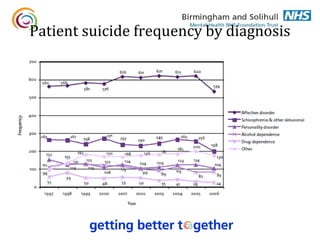
Patient suicide frequency by diagnosis
Primary care and suicide
• List size of 1000 – would take 8 years of
  consultations before a GP will consult with a
  patient who will shortly thereafter commit suicide
• About 90% of those in contact with MH services
  will see GP in year preceding suicide, and about
  45% in the month preceding suicide
• Mean of 8 consultations with GP in year preceding
  death
• Is there a role for suicide prevention in primary
  care?
DoH Suicide Prevention Strategy
• Published in September 2012

1. Reduce risk in key high risk groups
2. Tailor approaches to improve MH in specific groups
3. Reduce access to the means of suicide
4. Better information and support to those bereaved or
   affected by suicide
5. Support the media in delivering sensitive approaches to
   suicide and suicidal behaviour
6. Support research, data collection and monitoring
High risk groups
1. Young and middle-aged men
2. People in the care of mental health services, including
   inpatients
3. People with a history of self-harm
4. People in contact with the criminal justice system
5. Specific occupational groups, such as doctors, nurses,
   veterinary workers, farmers and agricultural workers.
Suicide Prevention Strategy
• “Those who work with men in different settings, especially
  primary care, need to be particularly alert to the signs of
  suicidal behaviour.”
• “Accessible, high-quality mental health services are
  fundamental to reducing the suicide risk in people of all ages
  with mental health problems.”
• “Emergency departments and primary care have important
  roles in the care of people who self-harm, with a focus on
  good communication and follow-up.”
• “Depression is one of the most important risk factors for
  suicide. The early identification and prompt, effective
  treatment of depression has a major role to play in
  preventing suicide across the whole population.”
Primary Care
• “GPs have a key role in the care of people who self-harm.
  Good communication between secondary and primary care
  is vital, as many people who present at emergency
  departments following an episode of self-harm consult their
  GP soon afterwards.”
• “Work undertaken by the London School of Economics has
  shown that suicide prevention education for GPs can have an
  impact as a population level intervention to prevent suicide.”
  [ASIST course costs about £200 per GP]
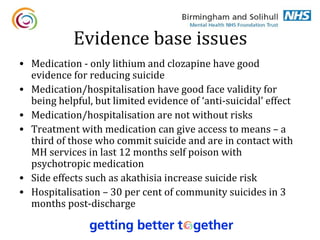
Evidence base issues
• Medication - only lithium and clozapine have good
  evidence for reducing suicide
• Medication/hospitalisation have good face validity for
  being helpful, but limited evidence of ‘anti-suicidal’ effect
• Medication/hospitalisation are not without risks
• Treatment with medication can give access to means – a
  third of those who commit suicide and are in contact with
  MH services in last 12 months self poison with
  psychotropic medication
• Side effects such as akathisia increase suicide risk
• Hospitalisation – 30 per cent of community suicides in 3
  months post-discharge
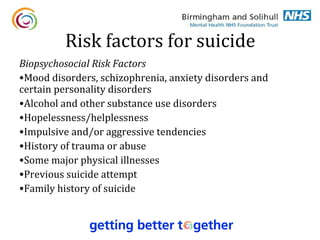
Risk factors for suicide
Biopsychosocial Risk Factors
•Mood disorders, schizophrenia, anxiety disorders and
certain personality disorders
•Alcohol and other substance use disorders
•Hopelessness/helplessness
•Impulsive and/or aggressive tendencies
•History of trauma or abuse
•Some major physical illnesses
•Previous suicide attempt
•Family history of suicide
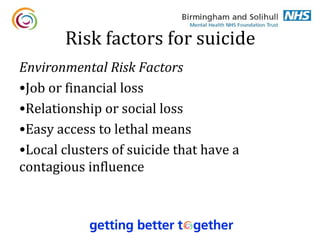
Risk factors for suicide
Environmental Risk Factors
•Job or financial loss
•Relationship or social loss
•Easy access to lethal means
•Local clusters of suicide that have a
contagious influence
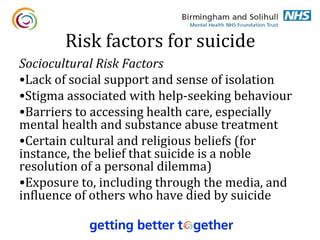
Risk factors for suicide
Sociocultural Risk Factors
•Lack of social support and sense of isolation
•Stigma associated with help-seeking behaviour
•Barriers to accessing health care, especially
mental health and substance abuse treatment
•Certain cultural and religious beliefs (for
instance, the belief that suicide is a noble
resolution of a personal dilemma)
•Exposure to, including through the media, and
influence of others who have died by suicide
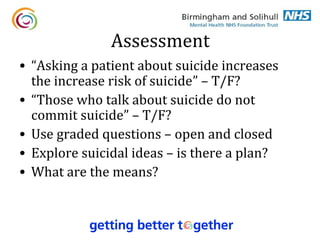
Assessment
• “Asking a patient about suicide increases
  the increase risk of suicide” – T/F?
• “Those who talk about suicide do not
  commit suicide” – T/F?
• Use graded questions – open and closed
• Explore suicidal ideas – is there a plan?
• What are the means?
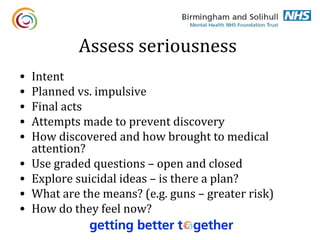
Assess seriousness
•   Intent
•   Planned vs. impulsive
•   Final acts
•   Attempts made to prevent discovery
•   How discovered and how brought to medical
    attention?
•   Use graded questions – open and closed
•   Explore suicidal ideas – is there a plan?
•   What are the means? (e.g. guns – greater risk)
•   How do they feel now?
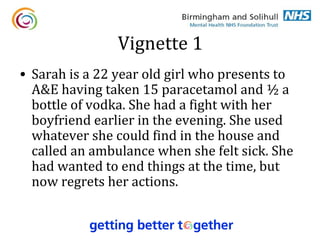
Vignette 1
• Sarah is a 22 year old girl who presents to
  A&E having taken 15 paracetamol and ½ a
  bottle of vodka. She had a fight with her
  boyfriend earlier in the evening. She used
  whatever she could find in the house and
  called an ambulance when she felt sick. She
  had wanted to end things at the time, but
  now regrets her actions.
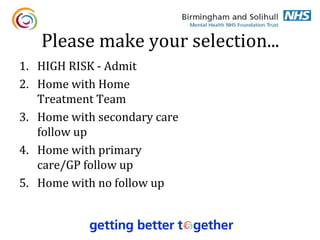
Please make your selection...
1. HIGH RISK - Admit
2. Home with Home
   Treatment Team
3. Home with secondary care
   follow up
4. Home with primary
   care/GP follow up
5. Home with no follow up
Vignette 2
• Jennifer is a 43 year old divorced, unemployed
  mother of 2. She has been depressed for 6 months
  and was recently discharged from hospital. She
  was found by a neighbour in a newly bought car
  in the garage, with the motor running, and
  brought to A&E. She had sent her children away
  for the weekend and had parked her own car in
  front of the garage hoping no one would discover
  her. She is bitterly disappointed to have failed to
  end her life.
Please make your selection...
1. HIGH RISK - Admit
2. Home with Home Treatment
   Team
3. Home with secondary care
   follow up
4. Home with primary care/GP
   follow up
5. Home with no follow up
Key messages
• Suicide is major cause of death and major public
  health issue
• Risk assessment is an important intervention
• Risk is dynamic and needs regular reassessment
• Early identification and treatment of depression is
  important
• Good relationships between primary and
  secondary care essential
Fighting stigma - a final thought
“Killing oneself is, anyway, a misnomer. We don't kill
ourselves. We are simply defeated by the long, hard
struggle to stay alive. When somebody dies after a
long illness, people are apt to say, with a note of
approval, "He fought so hard." And they are inclined
to think, about a suicide, that no fight was involved,
that somebody simply gave up. This is quite wrong.”

Sally Brampton, Shoot The Damn Dog: A Memoir Of Depression

Suicide: Risk Assessment and Prevention

  • 1.
    Suicide: Risk Assessment andPrevention Dr Imran Waheed Consultant Psychiatrist
  • 2.
    Overview • Context • Statistical update • DoH Suicide Prevention Strategy • Risk factors • Risk assessment and management
  • 7.
    Coroner’s Inquest MediaCoverage “Her GP Dr Ryley accepted that when he saw her on 24th March, a month before her death, he had considered only her problems of tiredness and getting to school late and had not asked her about depression.” “He was concerned her problem could be due to iron deficiency or low thyroid level and, as she was a vegetarian, he treated her accordingly, he said.” “Asked by the coroner if he felt there had been a missed opportunity to help her, given her suicide bid at Beachey Head, Dr Ryley said "Certainly, in retrospect. I agree I would have looked to enquire closely about mood and depression but I didn't on that occasion.””
  • 8.
    Statistical Update • 4,215suicides recorded in 2010. • 3 year average for 2008-10 was 7.9 suicides per 100,000 general population, 17.9 % lower than in 1998-2000. • Most substantial decreases seen towards the beginning of this period and data show a very slight increase in deaths from suicide in more recent years. • West Midlands: 2007  245 & 2010  450
  • 9.
    Statistical Update • Majorityin adult males – 4 times more M than F in 25-29 • Rate is now highest for middle age men – slight increase • 1 % of population have suicidal thoughts per week • Between a quarter and a half of those committing suicide have previously carried out a non-fatal act • Average estimated cost per completed suicide is £1.67m • Challenge is that suicide is rare event, prediction has very low specificity (so lots of false positives)
  • 14.
    Mental Health PatientSuicide • About 1100 suicides by people in contact with mental health service in previous 12 months • About 70-80 psychiatric inpatients die annually by suicide • Highest risk: 14 days post-discharge (‘7 day follow up’)
  • 15.
  • 18.
    Primary care andsuicide • List size of 1000 – would take 8 years of consultations before a GP will consult with a patient who will shortly thereafter commit suicide • About 90% of those in contact with MH services will see GP in year preceding suicide, and about 45% in the month preceding suicide • Mean of 8 consultations with GP in year preceding death • Is there a role for suicide prevention in primary care?
  • 19.
    DoH Suicide PreventionStrategy • Published in September 2012 1. Reduce risk in key high risk groups 2. Tailor approaches to improve MH in specific groups 3. Reduce access to the means of suicide 4. Better information and support to those bereaved or affected by suicide 5. Support the media in delivering sensitive approaches to suicide and suicidal behaviour 6. Support research, data collection and monitoring
  • 20.
    High risk groups 1.Young and middle-aged men 2. People in the care of mental health services, including inpatients 3. People with a history of self-harm 4. People in contact with the criminal justice system 5. Specific occupational groups, such as doctors, nurses, veterinary workers, farmers and agricultural workers.
  • 21.
    Suicide Prevention Strategy •“Those who work with men in different settings, especially primary care, need to be particularly alert to the signs of suicidal behaviour.” • “Accessible, high-quality mental health services are fundamental to reducing the suicide risk in people of all ages with mental health problems.” • “Emergency departments and primary care have important roles in the care of people who self-harm, with a focus on good communication and follow-up.” • “Depression is one of the most important risk factors for suicide. The early identification and prompt, effective treatment of depression has a major role to play in preventing suicide across the whole population.”
  • 22.
    Primary Care • “GPshave a key role in the care of people who self-harm. Good communication between secondary and primary care is vital, as many people who present at emergency departments following an episode of self-harm consult their GP soon afterwards.” • “Work undertaken by the London School of Economics has shown that suicide prevention education for GPs can have an impact as a population level intervention to prevent suicide.” [ASIST course costs about £200 per GP]
  • 23.
    Evidence base issues •Medication - only lithium and clozapine have good evidence for reducing suicide • Medication/hospitalisation have good face validity for being helpful, but limited evidence of ‘anti-suicidal’ effect • Medication/hospitalisation are not without risks • Treatment with medication can give access to means – a third of those who commit suicide and are in contact with MH services in last 12 months self poison with psychotropic medication • Side effects such as akathisia increase suicide risk • Hospitalisation – 30 per cent of community suicides in 3 months post-discharge
  • 24.
    Risk factors forsuicide Biopsychosocial Risk Factors •Mood disorders, schizophrenia, anxiety disorders and certain personality disorders •Alcohol and other substance use disorders •Hopelessness/helplessness •Impulsive and/or aggressive tendencies •History of trauma or abuse •Some major physical illnesses •Previous suicide attempt •Family history of suicide
  • 25.
    Risk factors forsuicide Environmental Risk Factors •Job or financial loss •Relationship or social loss •Easy access to lethal means •Local clusters of suicide that have a contagious influence
  • 26.
    Risk factors forsuicide Sociocultural Risk Factors •Lack of social support and sense of isolation •Stigma associated with help-seeking behaviour •Barriers to accessing health care, especially mental health and substance abuse treatment •Certain cultural and religious beliefs (for instance, the belief that suicide is a noble resolution of a personal dilemma) •Exposure to, including through the media, and influence of others who have died by suicide
  • 27.
    Assessment • “Asking apatient about suicide increases the increase risk of suicide” – T/F? • “Those who talk about suicide do not commit suicide” – T/F? • Use graded questions – open and closed • Explore suicidal ideas – is there a plan? • What are the means?
  • 28.
    Assess seriousness • Intent • Planned vs. impulsive • Final acts • Attempts made to prevent discovery • How discovered and how brought to medical attention? • Use graded questions – open and closed • Explore suicidal ideas – is there a plan? • What are the means? (e.g. guns – greater risk) • How do they feel now?
  • 29.
    Vignette 1 • Sarahis a 22 year old girl who presents to A&E having taken 15 paracetamol and ½ a bottle of vodka. She had a fight with her boyfriend earlier in the evening. She used whatever she could find in the house and called an ambulance when she felt sick. She had wanted to end things at the time, but now regrets her actions.
  • 30.
    Please make yourselection... 1. HIGH RISK - Admit 2. Home with Home Treatment Team 3. Home with secondary care follow up 4. Home with primary care/GP follow up 5. Home with no follow up
  • 31.
    Vignette 2 • Jenniferis a 43 year old divorced, unemployed mother of 2. She has been depressed for 6 months and was recently discharged from hospital. She was found by a neighbour in a newly bought car in the garage, with the motor running, and brought to A&E. She had sent her children away for the weekend and had parked her own car in front of the garage hoping no one would discover her. She is bitterly disappointed to have failed to end her life.
  • 32.
    Please make yourselection... 1. HIGH RISK - Admit 2. Home with Home Treatment Team 3. Home with secondary care follow up 4. Home with primary care/GP follow up 5. Home with no follow up
  • 33.
    Key messages • Suicideis major cause of death and major public health issue • Risk assessment is an important intervention • Risk is dynamic and needs regular reassessment • Early identification and treatment of depression is important • Good relationships between primary and secondary care essential
  • 34.
    Fighting stigma -a final thought “Killing oneself is, anyway, a misnomer. We don't kill ourselves. We are simply defeated by the long, hard struggle to stay alive. When somebody dies after a long illness, people are apt to say, with a note of approval, "He fought so hard." And they are inclined to think, about a suicide, that no fight was involved, that somebody simply gave up. This is quite wrong.” Sally Brampton, Shoot The Damn Dog: A Memoir Of Depression

Editor's Notes

  • #16 Other diagnoses have increased, particularly adjustment disorder Depression will be the second leading cause of death worldwide by 2020 and experts are seeking ways to reduce the burden. Lifetime risk for suicide in severe depression is 6%. Lifetime risk for suicide in gen population is 1.3% Samaritans website http://www.samaritans.org/your_emotional_health/about_suicide/depression_and_suicide.aspx Lifetime risk of suicide in schizophrenia 4.9%. Palmer et al, 2005 http://archpsyc.ama-assn.org/cgi/reprint/62/3/247.pdf
  • #31 3
  • #33 1