
OUTLINE
• Concepts of mental health and illness
• Definition of Mental health
• Definition of psychiatric mental health nursing
• Concept of positive mental health
• Characteristics of people with good mental health
• Concept of mental illness
• Possible signs of mental illness
• Causative factors of mental illness
• Members of mental health team
• Role of psychiatric nurse
• Nature of mental health Nursing
CONCEPTS OF MENTAL HEALTH AND ILLNESS
DEFINITION OF HEALTH:
Health is the dynamic state in which the individual
adapt to internal and external stimuli to maintain condition
of physical, social, intellectual and spiritual well being.
It’s the ability to adjust to stress and meet his needs
without hearting others and having emotional maturity. It’s
the ability to develop a realistic self-understanding and
accepting self knowledge.
WHO DEFINITION FOR MENTAL HEALTH
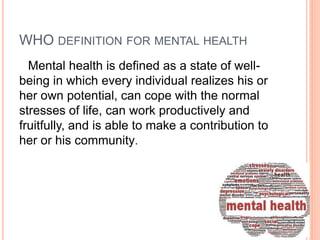
Mental health is defined as a state of well-
being in which every individual realizes his or
her own potential, can cope with the normal
stresses of life, can work productively and
fruitfully, and is able to make a contribution to
her or his community.
DEFINITION OF MENTAL HEALTH
-It is a state of emotional, psychological and
social wellness evidenced by satisfying
interpersonal relationships, effective behavior
and coping, a positive self- concept and
emotional stability.
-Others see M.H as the individual's ability to
be, to act, to grow, to master and to become
whatever he wants to be.
Self-esteem:
One’s opinion of oneself; a confidence and satisfaction in
oneself.
Self-awareness:
An awareness of one’s own personality or individuality.
Sanity:
Soundness or health of mind; one’s ability to bear legal
responsibility for one’s actions.
Resilience:
Ability to recover from or adjust easily to misfortune or
change.
Assertiveness:
The expression of opinions, needs, and feelings without
negating the opinions, needs, and feelings of others.
DEFINITION OF PSYCHIATRIC-MENTAL
HEALTH NURSING
 "A speciality nursing practice focusing on the identification
of mental health issues, prevention of mental health
problems, and the care and treatment of persons with
psychiatric disorders."
- The American Psychiatric Nurses Association
CONCEPT OF POSITIVE MENTAL HEALTH
 Attitudes towards the individual self :-
The ability to accept owns self and knowing owns
limitation with proper self-esteem.
 Growth and development:-
It is the ability to plan for future and to use his
potentialities and capabilities.
 Integrative capacity:-
The ability to tolerate tension and frustration
• Autonomous behavior :-
The ability of the individual to make his own decision
without any social or physical influence and to behave
according to his value system
• Perception of reality:-
The ability and the ways in which the individual view and
reacts toward his surrounding.
• Mastery of one’s environment:-
The ability to adopt or adjust and behave according to
culturally approved standards and the ability to solve
problems
CHARACTERISTICS OF PEOPLE WITH GOOD
MENTAL HEALTH
1- Feel comfortable about themselves they are not
overwhelmed by their own emotions.
 Can cope with life disappointments
 Know their own short comings.
 Have self-respect.
 Feel able to deal with most situations.
 Get satisfaction from simple every day pressures.
2-THEY FEEL RIGHT ABOUT OTHER PEOPLE
 Able to love and consider the interests of others.
 Have lasting and satisfying personal relationship.
 Expect to like and trust others and feel that other like and trust him.
 Not push people around or allow them selves to be pushed.
 Feel sense of responsibility to others.
3-THEY ARE ABLE TO MEET THE DEMANDS OF LIFE.
 Try to solve their problems.
 Accept their responsibilities.
 Shape environment whenever possible and try to adjust
to it
 Plan ahead and don’t fear the future
4-THEY HAVE EMOTIONAL MATURITY
• Having the capacity to adapt to change
• Having the ability to deal constructively with reality
• Having a relative freedom from symptoms that are
produces by tension and anxieties
• Having the capacity to find more satisfaction in giving
than receiving
• Having the capacity to relate to others people in a
consistent manner with natural satisfaction and helpfulness
MENTAL ILLNESS
 A clinically significant behavioral or psychological
syndrome or pattern that occurs in a person and that
is associated with present distress or disability or
with a significantly increased risk of suffering death,
pain , disability, or an important loss of freedom and
is not merely an expectable and culturally
sanctioned response to a particular event.”
– American Psychiatric Association (2000)
The American Nurse Association defines a mental
disorder or illness as a disturbance in thoughts or
mood that causes maladaptive behavior, inability to
cope with normal stressors and/or impaired
functioning.
POSSIBLE SIGNS OF MENTAL ILLNESS:-
 Marked personality changed over times
 Confused thinking, strange or grandiose ideas
 Prolonged severe depression and apathy
 Excessive anxiety, fear or suspiciousness, blaming others
 Withdrawal from society, friendlessness, abnormal self
centeredness.
 Thinking or talking about suicide
 Denial of obvious problems, strong resistance to help.
Numerous, unexplained physical ailments
Marked changes in eating or sleeping patterns
Anger or hostility out of proportion to the situation
Delusions (false beliefs that are firmly maintained even
though they are not shared by others)
Abuse of alcohols or drugs
Hallucination (perceptual distortions, arising from any of the
senses, hearing voices, or seeing images that others don't
hear or see)
Growing inability to cope with problems and the daily
activities as school, jobs or personal needs.
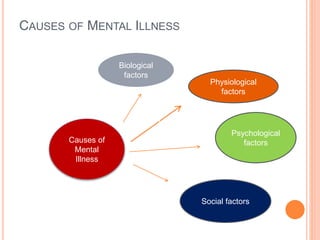
CAUSES OF MENTAL ILLNESS
Causes of
Mental
Illness
Physiological
factors
Social factors
Psychological
factors
i
Biological
factors
BIOLOGICAL FACTORS:
1. Genetic causes
2. Biochemical imbalance
3. Brain damage
-Infection
-Injury
-Intoxication
-Vascular
-Alteration in brain function
-Tumors
-Vitamin deficiency
-Degenerative diseases
-Endocrine disturbances
-Physical defects and physical illness
PHYSIOLOGICAL CHANGES
 Mental disorders are more likely to occur at
certain critical periods of life namely puberty,
menstruation, pregnancy, delivery,
puerperium and geriatric.
PSYCHOLOGICAL FACTORS:
-Personality types
-strained interpersonal relationships
-childhood insecurities
-social and recreational deprivations
-marriage problems
-Sexual problems
-Stress
- Seasonal variation
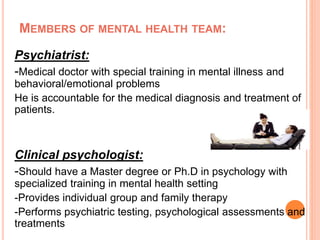
MEMBERS OF MENTAL HEALTH TEAM:
Psychiatrist:
-Medical doctor with special training in mental illness and
behavioral/emotional problems
He is accountable for the medical diagnosis and treatment of
patients.
Clinical psychologist:
-Should have a Master degree or Ph.D in psychology with
specialized training in mental health setting
-Provides individual group and family therapy
-Performs psychiatric testing, psychological assessments and
treatments
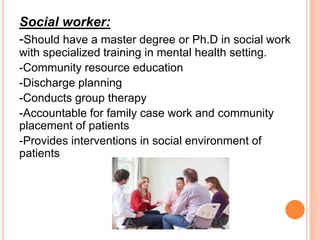
Social worker:
-Should have a master degree or Ph.D in social work
with specialized training in mental health setting.
-Community resource education
-Discharge planning
-Conducts group therapy
-Accountable for family case work and community
placement of patients
-Provides interventions in social environment of
patients
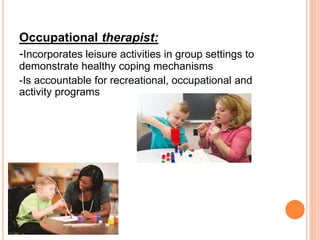
Occupational therapist:
-Incorporates leisure activities in group settings to
demonstrate healthy coping mechanisms
-Is accountable for recreational, occupational and
activity programs
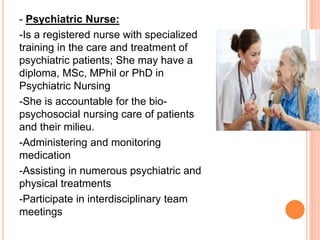
- Psychiatric Nurse:
-Is a registered nurse with specialized
training in the care and treatment of
psychiatric patients; She may have a
diploma, MSc, MPhil or PhD in
Psychiatric Nursing
-She is accountable for the bio-
psychosocial nursing care of patients
and their milieu.
-Administering and monitoring
medication
-Assisting in numerous psychiatric and
physical treatments
-Participate in interdisciplinary team
meetings
- Teach patient and families
- Take responsibility for patient records
- Act as a patient advocate
- Interact with patient’s significant others
Counselor:
- Provides basic supportive counseling and assist in
psycho educational and recreational activities.
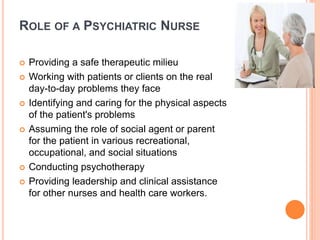
ROLE OF A PSYCHIATRIC NURSE
 Providing a safe therapeutic milieu
 Working with patients or clients on the real
day-to-day problems they face
 Identifying and caring for the physical aspects
of the patient's problems
 Assuming the role of social agent or parent
for the patient in various recreational,
occupational, and social situations
 Conducting psychotherapy
 Providing leadership and clinical assistance
for other nurses and health care workers.
NATURE OF MENTAL HEALTH NURSING
 -Psychiatric nursing is a profession ,possessing its
unique history ,ideology, knowledge and skills.
 -It provides services to individuals whose primary needs
are related to mental , emotional and developmental
problems, especially serious disorders and persistent
disabilities.
 -It is committed to the maintenance, promotion and
restoration of optimal mental health for individuals,
families, community groups and society through the use
of therapeutic relationships and interventions.
 - The science of psychiatric nursing includes
understanding and use of principles of nursing
on all levels. In addition, there is required
commitment to remain current in knowledge
and to practice all learned skills and procedures
that ensure patient safety and well being.
Mental health and illness- Basic theoretical concepts

Mental health and illness- Basic theoretical concepts

  • 2.
    OUTLINE • Concepts ofmental health and illness • Definition of Mental health • Definition of psychiatric mental health nursing • Concept of positive mental health • Characteristics of people with good mental health • Concept of mental illness • Possible signs of mental illness • Causative factors of mental illness • Members of mental health team • Role of psychiatric nurse • Nature of mental health Nursing
  • 3.
    CONCEPTS OF MENTALHEALTH AND ILLNESS DEFINITION OF HEALTH: Health is the dynamic state in which the individual adapt to internal and external stimuli to maintain condition of physical, social, intellectual and spiritual well being. It’s the ability to adjust to stress and meet his needs without hearting others and having emotional maturity. It’s the ability to develop a realistic self-understanding and accepting self knowledge.
  • 4.
    WHO DEFINITION FORMENTAL HEALTH Mental health is defined as a state of well- being in which every individual realizes his or her own potential, can cope with the normal stresses of life, can work productively and fruitfully, and is able to make a contribution to her or his community.
  • 5.
    DEFINITION OF MENTALHEALTH -It is a state of emotional, psychological and social wellness evidenced by satisfying interpersonal relationships, effective behavior and coping, a positive self- concept and emotional stability. -Others see M.H as the individual's ability to be, to act, to grow, to master and to become whatever he wants to be.
  • 6.
    Self-esteem: One’s opinion ofoneself; a confidence and satisfaction in oneself. Self-awareness: An awareness of one’s own personality or individuality. Sanity: Soundness or health of mind; one’s ability to bear legal responsibility for one’s actions. Resilience: Ability to recover from or adjust easily to misfortune or change. Assertiveness: The expression of opinions, needs, and feelings without negating the opinions, needs, and feelings of others.
  • 7.
    DEFINITION OF PSYCHIATRIC-MENTAL HEALTHNURSING  "A speciality nursing practice focusing on the identification of mental health issues, prevention of mental health problems, and the care and treatment of persons with psychiatric disorders." - The American Psychiatric Nurses Association
  • 8.
    CONCEPT OF POSITIVEMENTAL HEALTH  Attitudes towards the individual self :- The ability to accept owns self and knowing owns limitation with proper self-esteem.  Growth and development:- It is the ability to plan for future and to use his potentialities and capabilities.  Integrative capacity:- The ability to tolerate tension and frustration
  • 9.
    • Autonomous behavior:- The ability of the individual to make his own decision without any social or physical influence and to behave according to his value system • Perception of reality:- The ability and the ways in which the individual view and reacts toward his surrounding. • Mastery of one’s environment:- The ability to adopt or adjust and behave according to culturally approved standards and the ability to solve problems
  • 10.
    CHARACTERISTICS OF PEOPLEWITH GOOD MENTAL HEALTH 1- Feel comfortable about themselves they are not overwhelmed by their own emotions.  Can cope with life disappointments  Know their own short comings.  Have self-respect.  Feel able to deal with most situations.  Get satisfaction from simple every day pressures.
  • 11.
    2-THEY FEEL RIGHTABOUT OTHER PEOPLE  Able to love and consider the interests of others.  Have lasting and satisfying personal relationship.  Expect to like and trust others and feel that other like and trust him.  Not push people around or allow them selves to be pushed.  Feel sense of responsibility to others.
  • 12.
    3-THEY ARE ABLETO MEET THE DEMANDS OF LIFE.  Try to solve their problems.  Accept their responsibilities.  Shape environment whenever possible and try to adjust to it  Plan ahead and don’t fear the future
  • 13.
    4-THEY HAVE EMOTIONALMATURITY • Having the capacity to adapt to change • Having the ability to deal constructively with reality • Having a relative freedom from symptoms that are produces by tension and anxieties • Having the capacity to find more satisfaction in giving than receiving • Having the capacity to relate to others people in a consistent manner with natural satisfaction and helpfulness
  • 14.
    MENTAL ILLNESS  Aclinically significant behavioral or psychological syndrome or pattern that occurs in a person and that is associated with present distress or disability or with a significantly increased risk of suffering death, pain , disability, or an important loss of freedom and is not merely an expectable and culturally sanctioned response to a particular event.” – American Psychiatric Association (2000)
  • 15.
    The American NurseAssociation defines a mental disorder or illness as a disturbance in thoughts or mood that causes maladaptive behavior, inability to cope with normal stressors and/or impaired functioning.
  • 16.
    POSSIBLE SIGNS OFMENTAL ILLNESS:-  Marked personality changed over times  Confused thinking, strange or grandiose ideas  Prolonged severe depression and apathy  Excessive anxiety, fear or suspiciousness, blaming others  Withdrawal from society, friendlessness, abnormal self centeredness.  Thinking or talking about suicide  Denial of obvious problems, strong resistance to help.
  • 17.
    Numerous, unexplained physicalailments Marked changes in eating or sleeping patterns Anger or hostility out of proportion to the situation Delusions (false beliefs that are firmly maintained even though they are not shared by others) Abuse of alcohols or drugs Hallucination (perceptual distortions, arising from any of the senses, hearing voices, or seeing images that others don't hear or see) Growing inability to cope with problems and the daily activities as school, jobs or personal needs.
  • 18.
    CAUSES OF MENTALILLNESS Causes of Mental Illness Physiological factors Social factors Psychological factors i Biological factors
  • 19.
    BIOLOGICAL FACTORS: 1. Geneticcauses 2. Biochemical imbalance 3. Brain damage -Infection -Injury -Intoxication -Vascular -Alteration in brain function -Tumors -Vitamin deficiency -Degenerative diseases -Endocrine disturbances -Physical defects and physical illness
  • 20.
    PHYSIOLOGICAL CHANGES  Mentaldisorders are more likely to occur at certain critical periods of life namely puberty, menstruation, pregnancy, delivery, puerperium and geriatric.
  • 21.
    PSYCHOLOGICAL FACTORS: -Personality types -strainedinterpersonal relationships -childhood insecurities -social and recreational deprivations -marriage problems -Sexual problems -Stress - Seasonal variation
  • 22.
    MEMBERS OF MENTALHEALTH TEAM: Psychiatrist: -Medical doctor with special training in mental illness and behavioral/emotional problems He is accountable for the medical diagnosis and treatment of patients. Clinical psychologist: -Should have a Master degree or Ph.D in psychology with specialized training in mental health setting -Provides individual group and family therapy -Performs psychiatric testing, psychological assessments and treatments
  • 23.
    Social worker: -Should havea master degree or Ph.D in social work with specialized training in mental health setting. -Community resource education -Discharge planning -Conducts group therapy -Accountable for family case work and community placement of patients -Provides interventions in social environment of patients
  • 24.
    Occupational therapist: -Incorporates leisureactivities in group settings to demonstrate healthy coping mechanisms -Is accountable for recreational, occupational and activity programs
  • 25.
    - Psychiatric Nurse: -Isa registered nurse with specialized training in the care and treatment of psychiatric patients; She may have a diploma, MSc, MPhil or PhD in Psychiatric Nursing -She is accountable for the bio- psychosocial nursing care of patients and their milieu. -Administering and monitoring medication -Assisting in numerous psychiatric and physical treatments -Participate in interdisciplinary team meetings
  • 26.
    - Teach patientand families - Take responsibility for patient records - Act as a patient advocate - Interact with patient’s significant others Counselor: - Provides basic supportive counseling and assist in psycho educational and recreational activities.
  • 27.
    ROLE OF APSYCHIATRIC NURSE  Providing a safe therapeutic milieu  Working with patients or clients on the real day-to-day problems they face  Identifying and caring for the physical aspects of the patient's problems  Assuming the role of social agent or parent for the patient in various recreational, occupational, and social situations  Conducting psychotherapy  Providing leadership and clinical assistance for other nurses and health care workers.
  • 28.
    NATURE OF MENTALHEALTH NURSING  -Psychiatric nursing is a profession ,possessing its unique history ,ideology, knowledge and skills.  -It provides services to individuals whose primary needs are related to mental , emotional and developmental problems, especially serious disorders and persistent disabilities.  -It is committed to the maintenance, promotion and restoration of optimal mental health for individuals, families, community groups and society through the use of therapeutic relationships and interventions.
  • 29.
     - Thescience of psychiatric nursing includes understanding and use of principles of nursing on all levels. In addition, there is required commitment to remain current in knowledge and to practice all learned skills and procedures that ensure patient safety and well being.