Mental Health Assessment Standard M.S.A. Specific Assessment Tools. Documentation. Interviewing
M.S.A. ABCAPCRI Appearance. Behaviour. Conversation. Affect Perception. Cognition. Rapport. Insight.
Appearance Describe what the client looks like and include physical characteristics, manner of dress, level of hygiene and posture. It is important to document this information in a value free manner or if values are expressed (e.g inappropriately dressed) that they are substantiated.
Behaviour The aim here is to describe what the client does in terms of observable behaviour considering characteristics such as gait, gestures, unusual movements and other observable features of body language.
Conversation This includes how the client talks, quantity, rate, volume, the content of the conversation and the organisation of that content.
Affect This term is used to describe the clients emotional state or mood. It is important to report both you own and the clients perception of how they feel incase of discrepancies.
Perception Refers to the clients experience of their world via their senses. This includes the possibility of hallucinations which may be visual, auditory, tactile, gustatory, and olfactory.
Cognition This includes assessing orientation (to time, place and person) and memory (is the clients short and long term memory intact?)
Rapport This involves making a judgment about the nature of the clients interpersonal relationships. How easy or difficult is it to talk to the client? What is the nature of the relationship between the client and staff, other clients and significant others?
Insight This refers to the clients ability to to think objectively about their experience and situations they face.
Recognising and Managing Depression in Residents the survey indicated that that 51% of high care residents and 30% of low care residents are above the threshold for depression on the GDS (geriatric depression scale).  This is compared to 20% considered depressed in the community. The GDS and use of assessment tools
Documentation and Specific Behaviours. Physically aggressive. Problem wandering or intrusive. Verbally disruptive or noisy.
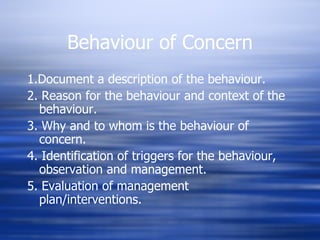
Behaviour of Concern 1.Document a description of the behaviour. 2. Reason for the behaviour and context of the behaviour. 3. Why and to whom is the behaviour of concern. 4. Identification of triggers for the behaviour, observation and management. 5. Evaluation of management plan/interventions.
Interviewing Be Empathetic. Be Non judgmental. Question your questions. What is the purpose of the interview. Seek clarification ( reflect feelings and content) Summarise clients statements.

Mental Health Assessment

  • 1.
    Mental Health AssessmentStandard M.S.A. Specific Assessment Tools. Documentation. Interviewing
  • 2.
    M.S.A. ABCAPCRI Appearance.Behaviour. Conversation. Affect Perception. Cognition. Rapport. Insight.
  • 3.
    Appearance Describe whatthe client looks like and include physical characteristics, manner of dress, level of hygiene and posture. It is important to document this information in a value free manner or if values are expressed (e.g inappropriately dressed) that they are substantiated.
  • 4.
    Behaviour The aimhere is to describe what the client does in terms of observable behaviour considering characteristics such as gait, gestures, unusual movements and other observable features of body language.
  • 5.
    Conversation This includeshow the client talks, quantity, rate, volume, the content of the conversation and the organisation of that content.
  • 6.
    Affect This termis used to describe the clients emotional state or mood. It is important to report both you own and the clients perception of how they feel incase of discrepancies.
  • 7.
    Perception Refers tothe clients experience of their world via their senses. This includes the possibility of hallucinations which may be visual, auditory, tactile, gustatory, and olfactory.
  • 8.
    Cognition This includesassessing orientation (to time, place and person) and memory (is the clients short and long term memory intact?)
  • 9.
    Rapport This involvesmaking a judgment about the nature of the clients interpersonal relationships. How easy or difficult is it to talk to the client? What is the nature of the relationship between the client and staff, other clients and significant others?
  • 10.
    Insight This refersto the clients ability to to think objectively about their experience and situations they face.
  • 11.
    Recognising and ManagingDepression in Residents the survey indicated that that 51% of high care residents and 30% of low care residents are above the threshold for depression on the GDS (geriatric depression scale). This is compared to 20% considered depressed in the community. The GDS and use of assessment tools
  • 12.
    Documentation and SpecificBehaviours. Physically aggressive. Problem wandering or intrusive. Verbally disruptive or noisy.
  • 13.
    Behaviour of Concern1.Document a description of the behaviour. 2. Reason for the behaviour and context of the behaviour. 3. Why and to whom is the behaviour of concern. 4. Identification of triggers for the behaviour, observation and management. 5. Evaluation of management plan/interventions.
  • 14.
    Interviewing Be Empathetic.Be Non judgmental. Question your questions. What is the purpose of the interview. Seek clarification ( reflect feelings and content) Summarise clients statements.