Journal Club Presentation
Presented By:
Name: Sworup KC
Roll No: 34
BPH, VIII Semester, SHAS, PU.
12/10/2020
Sworup KC
1
Presented for the partial fulfillment of requirement
of
PHA 451 Journal Club/Health Seminar
of
Bachelor of Public Health, VIII Semester,
School of Health and Allied Sciences, Pokhara University
under the cardinal supervision of
Assistant Professor Dr. Hari Prasad Kaphle
By
Sworup KC,
Exam Roll No.: 17370211
PU Registration No.: 2016-1-37-0135
12/10/2020 Sworup KC 2
Selected Article for Presentation
• Authors: Shuang-Jiang Zhou, Lei-Lei Wang, Rui Yang, Xing-Jie
Yang, Li-Gang Zhang, ZhaoChang Guo, Jin-Cheng Chen, Jing-Qi
Wang, Jing-Xu Chen
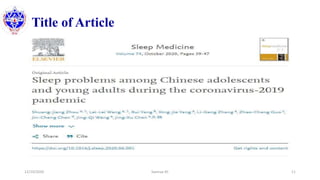
• Title of article: Sleep problems among Chinese adolescents and
young adults during the coronavirus-2019 pandemic
• Journal name: Sleep Medicine
• Year: 2020
• Volume(Issue): 74
• Page number: 39-47
12/10/2020 Sworup KC 3
Journal Information
• The Journal of Clinical Sleep Medicine is a monthly peer-reviewed
medical journal covering sleep medicine. It supports open access. It
was established in 2005 and is published by the American Academy
of Sleep Medicine, of which it is the official journal.
• A journal primarily focusing on the human aspects of sleep,
integrating the various disciplines that are involved in sleep medicine.
• The journal publishes the following types of articles: Reviews (also
intended as a way to bridge the gap between basic sleep research and
clinical relevance); Original Research Articles; Full-length articles;
Brief communications; Controversies; Case reports; Letters to the
Editor; Journal search and commentaries; Book reviews; Meeting
announcements; Listing of relevant organizations plus web sites.
12/10/2020 Sworup KC 4
Peer Review Process
• This journal operates a single anonymized review process. All
contributions will be initially assessed by the editor for suitability for
the journal. Papers deemed suitable are then typically sent to a
minimum of two independent expert reviewers to assess the scientific
quality of the paper.
• The Editor is responsible for the final decision regarding acceptance or
rejection of articles. The Editor's decision is final.
• Editors are not involved in decisions about papers which they have
written themselves or have been written by family members or
colleagues or which relate to products or services in which the editor
has an interest
12/10/2020 Sworup KC 5
Editors
• Editor-in-Chief: Dr. Sudhansu Chokroverty, JFK Medical Center. He
is a neurologist in Edison, New Jersey and is affiliated in Hackensack
Meridian Health JFK Medical Center. He has been in practice for more
than 20 years.
• Field Editors: Dr. R.P. Allen, Dr. O. Bruni, Professor L. Ferini-
Strambi, Dr. M. Hirshkowitz, Dr. W. Randerath
• Associate Editors: Professor C.L.A. Bassetti, MD, Professor A.
Culebras, Dr. R.A. Ferber, Professor J. Hedner, Dr. S. Katayama,
Professor J. Montplaisir, Professor M.J. Thorpy, Dr. T.B. Young.
• Special Section Editors: 8 members
• Editorial Board: 70 members
12/10/2020 Sworup KC 6
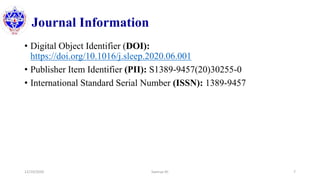
Journal Information
• Digital Object Identifier (DOI):
https://doi.org/10.1016/j.sleep.2020.06.001
• Publisher Item Identifier (PII): S1389-9457(20)30255-0
• International Standard Serial Number (ISSN): 1389-9457
12/10/2020 Sworup KC 7
Indexing
• Embase
• Neuroscience Citation Index
• PubMed/Medline
• Science Citation Index Expanded
• Scopus
12/10/2020 Sworup KC 8
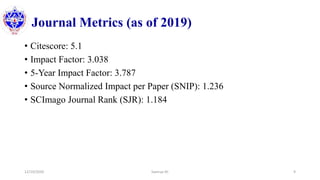
Journal Metrics (as of 2019)
12/10/2020 Sworup KC 9
• Citescore: 5.1
• Impact Factor: 3.038
• 5-Year Impact Factor: 3.787
• Source Normalized Impact per Paper (SNIP): 1.236
• SCImago Journal Rank (SJR): 1.184
Critical Appraisal of Journal
• The journal is open access.
• The journal uses a single anonymized review process, so reviewers
could use the fact that they are anonymous as an opportunity to be
unusually critical of authors.
• It has a good impact factor .
• It has been indexed in various reliable and well known search engines
and databases.
• The journal has an excellent teams of editors who are active and
dedicated in publishing quality articles.
• The journal has adequate and appropriate information on the human
aspects of sleep.
12/10/2020 Sworup KC 10
Title of Article
12/10/2020 Sworup KC 11
Title of Article
• Title: Sleep problems among Chinese adolescents and young adults
during the coronavirus-2019 pandemic.
12/10/2020 Sworup KC 12
Critical Appraisal of Title
• The title of the article is specific and simple.
• The title gives an idea of the study population and the study setting.
• It clearly indicates the topic and focus of the study.
• The title is short and meaningful.
• It does not give any idea about the design of the study.
• The title is a bit misleading since it mentions “Sleep problems” but the
study only assesses insomnia.
12/10/2020 Sworup KC 13
Authors
• Shuang-Jiang Zhou,
• Lei-Lei Wang,
• Rui Yang,
• Xing-Jie Yang,
• Li-Gang Zhang,
• ZhaoChang Guo,
• Jin-Cheng Chen,
• Jing-Qi Wang,
• Jing-Xu Chen
12/10/2020 Sworup KC 14
Authors Information
12/10/2020 Sworup KC 15
Authors Contribution
• Shuang-Jiang Zhou and Lei-lei Wang were involved in interpretation
of data and drafted the paper.
• Jing-Xu Chen conceived and designed the study. Lei-lei Wang did
statistical analysis.
• Data acquisition: Shuang-Jiang Zhou, Rui Yang, Xing-jie Yang, Li-
Gang Zhang, Zhao-Chang Guo, Jin-Cheng Chen, Jing-Qi Wang.
• All the authors have revised the manuscript for important intellectual
content and have read and approved the final manuscript.
12/10/2020 Sworup KC 16
Critical Appraisal of Authors
• The authors seem to have adequate knowledge and enough expertise to
conduct this research because they’ve conducted similar researches on
relevant topics in the past.
• The authors have an impressive profile on research related to mental
health and sleep health.
• They have excellent coordination and collaboration in various other
relevant research articles.
• All authors declare no competing financial interest.
12/10/2020 Sworup KC 17
Abstract
• Objective: To assess the prevalence and sociodemographic correlates of
insomnia symptoms among Chinese adolescents and young adults affected
by the outbreak of coronavirus disease-2019 (COVID-19).
• Methods: This cross-sectional study included Chinese adolescents and
young adults 12–29 years of age during part of the COVID-19 epidemic
period. An online survey was used to collect demographic data, and to
assess recognition of COVID-19, insomnia, depression, and anxiety
symptoms using the Pittsburgh Sleep Quality Index (PSQI), the Patient
Health Questionnaire (PHQ-9), and the Generalized Anxiety Disorder
(GAD-7) questionnaires, respectively. The Social Support Rate Scale was
used to assess social support.
12/10/2020 Sworup KC 18
Abstract Contd…
• Results: Among 11,835 adolescents and young adults included in the study, the
prevalence of insomnia symptoms during part of the COVID-19 epidemic period
was 23.2%. Binomial logistic regression analysis revealed that female sex and
residing in the city were greater risk factors for insomnia symptoms. Depression
or anxiety were risk factors for insomnia symptoms; however, social support, both
subjective and objective, was protective factors against insomnia symptoms.
• Conclusions: Results of this study revealed a high prevalence of sleep problems
among adolescents and young adults during the COVID-19 epidemic, especially
senior high school and college students, which were negatively associated with
students’ projections of trends in COVID-19. The adverse impact of COVID-19
was a risk factor for insomnia symptoms; as such, the government must devote
more attention to sleep disorders in this patient population while combating
COVID-19.
12/10/2020 Sworup KC 19
Critical Appraisal of Abstract
• The abstract clearly summarizes the major aspects of the entire paper.
• It is an informative abstract.
• The abstract is structured.
• The abstract is made up of less than 250 words which respects the
journal guideline.
• The abstract is concise and comprehensive.
• It gives the gist of the whole text.
• The information given in abstract matches with what is present in
detail text.
12/10/2020 Sworup KC 20
Introduction
• Sleep disorders represent an important public health problem, and affect
individuals across several age groups, including adolescents and young adults,
with severe consequences for both the individual and society.
• Previous studies have found that insomnia is the most prevalent sleep disorder
among adolescents and young adults.
• The prevalence of insomnia symptoms in Chinese adolescents range from 3.4% to
12.2%, and the percentage of Chinese young adults experiencing insomnia
symptoms is 20.3%.
• Insomnia in adolescents and young adults is mainly related to demographic and
psychosocial factors. Stress and poor mental health are important psychosocial
factors contributing to insomnia.
12/10/2020 Sworup KC 21
Introduction Contd…
• Coronavirus disease-2019 (COVID-19) first emerged in Wuhan, Hubei province,
China, on December 31, 2019 and was later declared an international public health
emergency by the World Health Organization.
• COVID-19 has spread to 212 countries/territories outside of China and, the
causative virus, severe acute respiratory syndrome coronavirus-2 (SARS CoV-2)
has infected 3,018,681 patients globally (82,862 in China) as of April 30, 2020.
• Previous studies have focused primarily on health care workers and adults, and
little attention has been devoted to the relationship between mental health status
and insomnia symptoms in adolescents and young adults. In particular, adolescents
and young adults are experiencing complex situations such as school suspension,
online classes at home, and reduced activities during the COVID-19 epidemic.
• Therefore, it is necessary to quickly assess sleep disorders related to emergencies
induced by the epidemic.
12/10/2020 Sworup KC 22
Critical Appraisal of Introduction
• The introduction introduces the literature to the reader and provides
the context and creates a rationale for the study.
• The introduction in this article is meaningful and built on existing
literature .
• It is logically presented and includes important citations.
• It presents the rationale for the study.
• The introduction includes relevant information regarding the
prevalence and etiology of sleep disorders in the Chinese adolescent
and young adult population.
• There is no mention of any hypothesis in the introduction.
12/10/2020 Sworup KC 23
Materials and methods
• Cross-sectional study.
• Study population: Junior and senior high school students and college students in
China, comprising of adolescents and young adults 12-29 years of age, were
invited to participate in the online survey through the Wenjuanxing platform
(online survey tool) during part of the COVID-19 epidemic period.
• Study Setting: 11,835 subjects from 21 provinces and autonomous regions were
included in the analysis.
• Sampling method: Non probability sampling method
• Data collection interval: March 8 to March 15, 2020.
• Data collection process: A data collection sheet was designed to collect basic
sociodemographic information, while student awareness of COVID-19, adverse
impacts of COVID-19, and insomnia symptoms were assessed using an online
survey.
12/10/2020 Sworup KC 24
Materials Used
• Insomnia symptoms were assessed using the Pittsburgh Sleep Quality
Index (PSQI).
• Depression symptoms were assessed using the Patient Health Questionnaire
(PHQ-9).
• Anxiety symptoms were assessed using the Chinese version of the
Generalized Anxiety Disorder Scale (GAD-7).
• Social support was assessed using the Social Support Rate Scale (SSRS).
• Data were analyzed using SPSS version 24.0 (IBM Corporation, Armonk,
NY, USA).
12/10/2020 Sworup KC 25
Critical Appraisal of Materials used
• The PSQI is a self-rated questionnaire that assesses seven components
of sleep quality during the previous month. Previous studies have
demonstrated that the scale has good reliability and validity in the
Chinese adolescent and college population. Cronbach’s alpha for the
questionnaire was found to be 0.736 (Acceptable).
• The PHQ-9 is a simple, highly effective, self-assessment tool for
depression. The PHQ-9 has good internal consistency, with a
Cronbach's alpha coefficient of 0.80–0.90 (Good).
12/10/2020 Sworup KC 26
Critical Appraisal of Materials used
• Anxiety symptoms were assessed using the Chinese version of the
Generalized Anxiety Disorder Scale (GAD-7). Good retesting
reliability and validity for the GAD-7 have been confirmed in Chinese
individuals, with a Cronbach's alpha of 0.90–0.92 (Excellent).
• Social support was assessed using the Social Support Rate Scale
(SSRS). The Cronbach coefficient for the SSRS is 0.89–0.94
(Excellent).
12/10/2020 Sworup KC 27
Critical Appraisal of Materials and Methods
• The methods and materials used were reliable, appropriate and useful
to answer the research question.
• The materials and methods used are very cost and time effective.
• The sample size is large enough to find meaningful findings and
inferences.
• All the materials used have an acceptable Cronbach coefficient (≥ 0.7).
• Ethical Approval for the study was obtained from the Ethics
Committee of Beijing HuiLongGuan Hospital (Beijing, China).
• All subjects provided informed online consent to participate in the
study.
12/10/2020 Sworup KC 28
Contd…
• Individuals who submitted incomplete questionnaires were removed
from the study.
• There were differences in the proportion of men and women in the
study. Female students accounted for a relatively large proportion.
This may account for some sampling bias.
• The participants chosen for the study were selected using non
probability sampling so it is hard to know if the population is well
represented and we also cannot calculate confidence intervals and
margin of errors.
12/10/2020 Sworup KC 29
Results (Graphs)
12/10/2020 Sworup KC 30
Results (Graphs)
12/10/2020 Sworup KC 31
Results (Graphs)
12/10/2020 Sworup KC 32
Results (Graphs)
12/10/2020 Sworup KC 33
Results
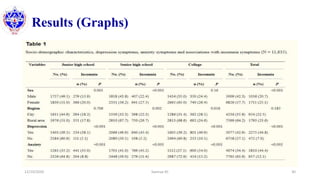
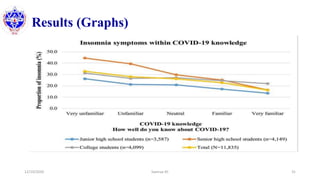
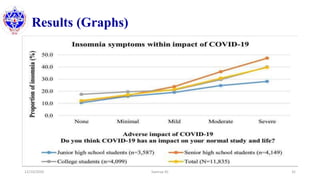
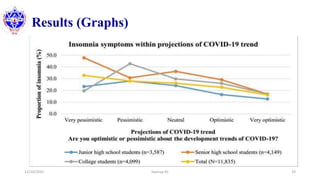
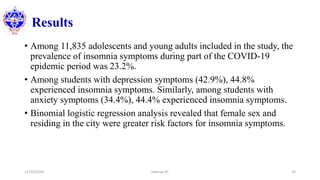
• Among 11,835 adolescents and young adults included in the study, the
prevalence of insomnia symptoms during part of the COVID-19
epidemic period was 23.2%.
• Among students with depression symptoms (42.9%), 44.8%
experienced insomnia symptoms. Similarly, among students with
anxiety symptoms (34.4%), 44.4% experienced insomnia symptoms.
• Binomial logistic regression analysis revealed that female sex and
residing in the city were greater risk factors for insomnia symptoms.
12/10/2020 Sworup KC 34
Results
• Depression or anxiety were risk factors for insomnia symptoms;
however, social support, both subjective and objective, was protective
factors against insomnia symptoms.
• Furthermore, anxiety and depression symptoms were mediators of
social support and insomnia symptoms.
12/10/2020 Sworup KC 35
Critical Appraisal of Results
12/10/2020 Sworup KC 36
• The results shown have been interpreted clearly and later discussed on.
• The questions posed in the study are adequately addressed in the
results and the results are based on the aims and objectives of the
study.
• Appropriate graphics have been used to represent the results clearly.
• The tables, charts, and graphs are numbered and titled properly.
• The tables are simple and the alignment of information is properly
done.
• The results of the study have been compared with the results of similar
studies performed.
Discussion
• The COVID-19 epidemic has had a significant impact and is a risk factor for
insomnia. The percentage of insomnia symptoms in young adults (25.7%) has
been reported to be higher than the incidence reported for the general population
in China (18.3–23.6%) in the absence of epidemics.
• Results of analysis revealed that, during part of the COVID-19 epidemic, college
students were more likely to experience declines in sleep quality, increased sleep
times, later bedtimes, and sleep disturbances.
• Regarding senior high school students, the percentage of insomnia symptoms was
also higher (25.3%), which was higher than that in the students without COVID-
19 in China or other countries.
• Insomnia was strongly associated with female sex.
12/10/2020 Sworup KC 37
Discussions
• This research has shown that good social support can reduce insomnia
symptoms as well as indirectly reduce insomnia symptoms by reducing
anxiety and depression symptoms.
• It is particularly important for parents, teachers, and other social groups to
provide support to students during the COVID-19 outbreak to reduce
insomnia symptoms.
• We can also provide some sleep knowledge and videos of sleep intervention
through mobile phones or computers, such as relaxation training and
cognitive behavioral therapy for insomnia, to alleviate or relieve insomnia
symptoms.
• COVID-19 remains widespread around the world. Most of the world's
schools are not open; as such, this may be an opportunity to devote attention
to sleep problems.
12/10/2020 Sworup KC 38
Limitations of the study
• Various limitations of the study have been noted such as:
1. Possible bias could have led to the underestimation of the prevalence
of insomnia symptoms. This sample was a non-probability sample,
which is a sample of voluntary participants. For some areas with a
severe epidemic, insomnia rates may be higher
2. Because the online questionnaire was a self-administered evaluation,
the indicated levels of insomnia symptoms may not always be
consistent with the evaluations of mental health professionals.
3. There were differences in the proportion of men and women in the
study. Female students accounted for a relatively large proportion.
The relatively high proportion of female students is mainly caused
by the imbalance between male and female students in schools.
12/10/2020 Sworup KC 39
Critical Appraisal of Discussion
• The discussion is meaningful and highlights various aspects of sleep
problems and the factors associated with them.
• The discussion shines light upon the important findings of the study
and offers enough explanation of all significant findings.
• The findings of the study are compared to various studies that were
conducted in the past on similar topics which validates the findings of
the study.
• This discussions are logical and reasoned properly.
• The limitations of the study have been honestly mentioned.
12/10/2020 Sworup KC 40
Conclusion and Recommendations
• This study revealed a high prevalence of sleep problems among adolescents and
young adults during the COVID-19 epidemic, especially senior high school and
college students, which were negatively associated with students’ projections of
trends in COVID-19.
• Social support can alleviate or reduce symptoms of insomnia by reducing
symptoms of anxiety and depression, so parents, school organizations, and other
groups should provide some social support to adolescents and young adults during
the COVID-19 outbreak.
• The adverse impact of COVID-19 was a risk factor for insomnia symptoms; as
such, the government must devote more attention to sleep disorders in this patient
population while combating COVID-19.
• More attention should be devoted to sleep disorders, especially among senior high
school and college students.
12/10/2020 Sworup KC 41
Critical Appraisal of Conclusion
• The conclusion is justified as to the obtained data.
• The conclusion is meaningful and based on the aims and objectives of
the study and also answers the research question.
• The shortcomings of the study have been addressed and constructive
suggestions have been given for future research.
• The conclusions seem believable since they are based on findings
which were a product of rigorous data analysis and management.
• The recommendations made are a result of logical discussions.
12/10/2020 Sworup KC 42
References
12/10/2020 Sworup KC 43
Critical Appraisal of References
• There are references for every citation in the article.
• The references seem to be accurate and adequate.
• There are enough references to recent publications.
• The references have been presented according to specific scientific
conventions.
• The references are from reliable and reputed sites and databases.
• The references are in Vancouver style.
• A total of 66 references have been mentioned.
12/10/2020 Sworup KC 44
Strengths
• The contents of the research are well defined.
• The methodology, data collection and management is sound and
scientific.
• The findings from this study are clear and coherent and proper
comparisons have been made to other relevant studies.
• The authors have honestly mentioned their limitations and have clearly
mentioned all the methods and materials used.
• It has been published in reliable journals and databases after strict
reviewing process.
12/10/2020 Sworup KC 45
Strengths contd…
• This study stresses the situation of mental health problems and more
specifically insomnia and its findings might be helpful to generate
further interest in the research field of Insomnia and Sleep health as
well as to government and stakeholders to take appropriate actions.
• This research helps to open up new areas for further research.
• This study was conducted by experts in this area of health which helps
validate its findings and act as a reference for further research in
similar areas of health.
12/10/2020 Sworup KC 46
Weaknesses
• Because the online questionnaire was a self-administered evaluation,
the indicated levels of insomnia symptoms may not always be
consistent with the evaluations of mental health professionals.
• There were differences in the proportion of men and women in the
study. Female students accounted for a relatively large proportion.
• The participants chosen for the study were selected using non
probability sampling so it is hard to know if the population is well
represented and we also cannot calculate confidence intervals and
margin of errors.
• The findings from this study may not be generalizable in some cases.
12/10/2020 Sworup KC 47
Overall significance of the article
• The findings of the article were clearly stated and justified.
• Depending on the types of research and method used, the results are
precise.
• The results of this research article fits and does not contradict the
existing body of evidence.
• The results from this research article generates and adds to the existing
evidence.
12/10/2020 Sworup KC 48
Overall significance of the article
• The article contributes to the scientific society of sleep health by
providing data to the Sleep Med journal. Various findings and
evidences have been generated on the existing sleep problems which
may further yield remarkable interventions and ideas that may help in
the prevention and treatment of sleeping disorders.
• The research article is cost effective since it generated such valuable
inferences and findings at a relatively low investment of capital being
an online survey.
• This research helps to open up new areas for further research.
12/10/2020 Sworup KC 49
Contribution of the article in my research
• My Research title: Prevalence and factors associated with insomnia among
college students of Pokhara.
• The article acts as a crucial reference for my research and the references
mentioned in the article are valuable sources of information and literatures.
• The methodology of the article is similar to the methodology of my research
so it informs me of the limitations that comes with this kind of research.
• The materials and tools used in the article can help me to develop tools and
material for my own research.
• The findings from my research can be compared with the findings from this
article.
12/10/2020 Sworup KC 50
Feedbacks and Suggestions
Any questions or queries?
12/10/2020 Sworup KC 51
Thank You!
12/10/2020 Sworup KC 52

34 sworup kc-journal-club-presentation

  • 1.
    Journal Club Presentation PresentedBy: Name: Sworup KC Roll No: 34 BPH, VIII Semester, SHAS, PU. 12/10/2020 Sworup KC 1
  • 2.
    Presented for thepartial fulfillment of requirement of PHA 451 Journal Club/Health Seminar of Bachelor of Public Health, VIII Semester, School of Health and Allied Sciences, Pokhara University under the cardinal supervision of Assistant Professor Dr. Hari Prasad Kaphle By Sworup KC, Exam Roll No.: 17370211 PU Registration No.: 2016-1-37-0135 12/10/2020 Sworup KC 2
  • 3.
    Selected Article forPresentation • Authors: Shuang-Jiang Zhou, Lei-Lei Wang, Rui Yang, Xing-Jie Yang, Li-Gang Zhang, ZhaoChang Guo, Jin-Cheng Chen, Jing-Qi Wang, Jing-Xu Chen • Title of article: Sleep problems among Chinese adolescents and young adults during the coronavirus-2019 pandemic • Journal name: Sleep Medicine • Year: 2020 • Volume(Issue): 74 • Page number: 39-47 12/10/2020 Sworup KC 3
  • 4.
    Journal Information • TheJournal of Clinical Sleep Medicine is a monthly peer-reviewed medical journal covering sleep medicine. It supports open access. It was established in 2005 and is published by the American Academy of Sleep Medicine, of which it is the official journal. • A journal primarily focusing on the human aspects of sleep, integrating the various disciplines that are involved in sleep medicine. • The journal publishes the following types of articles: Reviews (also intended as a way to bridge the gap between basic sleep research and clinical relevance); Original Research Articles; Full-length articles; Brief communications; Controversies; Case reports; Letters to the Editor; Journal search and commentaries; Book reviews; Meeting announcements; Listing of relevant organizations plus web sites. 12/10/2020 Sworup KC 4
  • 5.
    Peer Review Process •This journal operates a single anonymized review process. All contributions will be initially assessed by the editor for suitability for the journal. Papers deemed suitable are then typically sent to a minimum of two independent expert reviewers to assess the scientific quality of the paper. • The Editor is responsible for the final decision regarding acceptance or rejection of articles. The Editor's decision is final. • Editors are not involved in decisions about papers which they have written themselves or have been written by family members or colleagues or which relate to products or services in which the editor has an interest 12/10/2020 Sworup KC 5
  • 6.
    Editors • Editor-in-Chief: Dr.Sudhansu Chokroverty, JFK Medical Center. He is a neurologist in Edison, New Jersey and is affiliated in Hackensack Meridian Health JFK Medical Center. He has been in practice for more than 20 years. • Field Editors: Dr. R.P. Allen, Dr. O. Bruni, Professor L. Ferini- Strambi, Dr. M. Hirshkowitz, Dr. W. Randerath • Associate Editors: Professor C.L.A. Bassetti, MD, Professor A. Culebras, Dr. R.A. Ferber, Professor J. Hedner, Dr. S. Katayama, Professor J. Montplaisir, Professor M.J. Thorpy, Dr. T.B. Young. • Special Section Editors: 8 members • Editorial Board: 70 members 12/10/2020 Sworup KC 6
  • 7.
    Journal Information • DigitalObject Identifier (DOI): https://doi.org/10.1016/j.sleep.2020.06.001 • Publisher Item Identifier (PII): S1389-9457(20)30255-0 • International Standard Serial Number (ISSN): 1389-9457 12/10/2020 Sworup KC 7
  • 8.
    Indexing • Embase • NeuroscienceCitation Index • PubMed/Medline • Science Citation Index Expanded • Scopus 12/10/2020 Sworup KC 8
  • 9.
    Journal Metrics (asof 2019) 12/10/2020 Sworup KC 9 • Citescore: 5.1 • Impact Factor: 3.038 • 5-Year Impact Factor: 3.787 • Source Normalized Impact per Paper (SNIP): 1.236 • SCImago Journal Rank (SJR): 1.184
  • 10.
    Critical Appraisal ofJournal • The journal is open access. • The journal uses a single anonymized review process, so reviewers could use the fact that they are anonymous as an opportunity to be unusually critical of authors. • It has a good impact factor . • It has been indexed in various reliable and well known search engines and databases. • The journal has an excellent teams of editors who are active and dedicated in publishing quality articles. • The journal has adequate and appropriate information on the human aspects of sleep. 12/10/2020 Sworup KC 10
  • 11.
  • 12.
    Title of Article •Title: Sleep problems among Chinese adolescents and young adults during the coronavirus-2019 pandemic. 12/10/2020 Sworup KC 12
  • 13.
    Critical Appraisal ofTitle • The title of the article is specific and simple. • The title gives an idea of the study population and the study setting. • It clearly indicates the topic and focus of the study. • The title is short and meaningful. • It does not give any idea about the design of the study. • The title is a bit misleading since it mentions “Sleep problems” but the study only assesses insomnia. 12/10/2020 Sworup KC 13
  • 14.
    Authors • Shuang-Jiang Zhou, •Lei-Lei Wang, • Rui Yang, • Xing-Jie Yang, • Li-Gang Zhang, • ZhaoChang Guo, • Jin-Cheng Chen, • Jing-Qi Wang, • Jing-Xu Chen 12/10/2020 Sworup KC 14
  • 15.
  • 16.
    Authors Contribution • Shuang-JiangZhou and Lei-lei Wang were involved in interpretation of data and drafted the paper. • Jing-Xu Chen conceived and designed the study. Lei-lei Wang did statistical analysis. • Data acquisition: Shuang-Jiang Zhou, Rui Yang, Xing-jie Yang, Li- Gang Zhang, Zhao-Chang Guo, Jin-Cheng Chen, Jing-Qi Wang. • All the authors have revised the manuscript for important intellectual content and have read and approved the final manuscript. 12/10/2020 Sworup KC 16
  • 17.
    Critical Appraisal ofAuthors • The authors seem to have adequate knowledge and enough expertise to conduct this research because they’ve conducted similar researches on relevant topics in the past. • The authors have an impressive profile on research related to mental health and sleep health. • They have excellent coordination and collaboration in various other relevant research articles. • All authors declare no competing financial interest. 12/10/2020 Sworup KC 17
  • 18.
    Abstract • Objective: Toassess the prevalence and sociodemographic correlates of insomnia symptoms among Chinese adolescents and young adults affected by the outbreak of coronavirus disease-2019 (COVID-19). • Methods: This cross-sectional study included Chinese adolescents and young adults 12–29 years of age during part of the COVID-19 epidemic period. An online survey was used to collect demographic data, and to assess recognition of COVID-19, insomnia, depression, and anxiety symptoms using the Pittsburgh Sleep Quality Index (PSQI), the Patient Health Questionnaire (PHQ-9), and the Generalized Anxiety Disorder (GAD-7) questionnaires, respectively. The Social Support Rate Scale was used to assess social support. 12/10/2020 Sworup KC 18
  • 19.
    Abstract Contd… • Results:Among 11,835 adolescents and young adults included in the study, the prevalence of insomnia symptoms during part of the COVID-19 epidemic period was 23.2%. Binomial logistic regression analysis revealed that female sex and residing in the city were greater risk factors for insomnia symptoms. Depression or anxiety were risk factors for insomnia symptoms; however, social support, both subjective and objective, was protective factors against insomnia symptoms. • Conclusions: Results of this study revealed a high prevalence of sleep problems among adolescents and young adults during the COVID-19 epidemic, especially senior high school and college students, which were negatively associated with students’ projections of trends in COVID-19. The adverse impact of COVID-19 was a risk factor for insomnia symptoms; as such, the government must devote more attention to sleep disorders in this patient population while combating COVID-19. 12/10/2020 Sworup KC 19
  • 20.
    Critical Appraisal ofAbstract • The abstract clearly summarizes the major aspects of the entire paper. • It is an informative abstract. • The abstract is structured. • The abstract is made up of less than 250 words which respects the journal guideline. • The abstract is concise and comprehensive. • It gives the gist of the whole text. • The information given in abstract matches with what is present in detail text. 12/10/2020 Sworup KC 20
  • 21.
    Introduction • Sleep disordersrepresent an important public health problem, and affect individuals across several age groups, including adolescents and young adults, with severe consequences for both the individual and society. • Previous studies have found that insomnia is the most prevalent sleep disorder among adolescents and young adults. • The prevalence of insomnia symptoms in Chinese adolescents range from 3.4% to 12.2%, and the percentage of Chinese young adults experiencing insomnia symptoms is 20.3%. • Insomnia in adolescents and young adults is mainly related to demographic and psychosocial factors. Stress and poor mental health are important psychosocial factors contributing to insomnia. 12/10/2020 Sworup KC 21
  • 22.
    Introduction Contd… • Coronavirusdisease-2019 (COVID-19) first emerged in Wuhan, Hubei province, China, on December 31, 2019 and was later declared an international public health emergency by the World Health Organization. • COVID-19 has spread to 212 countries/territories outside of China and, the causative virus, severe acute respiratory syndrome coronavirus-2 (SARS CoV-2) has infected 3,018,681 patients globally (82,862 in China) as of April 30, 2020. • Previous studies have focused primarily on health care workers and adults, and little attention has been devoted to the relationship between mental health status and insomnia symptoms in adolescents and young adults. In particular, adolescents and young adults are experiencing complex situations such as school suspension, online classes at home, and reduced activities during the COVID-19 epidemic. • Therefore, it is necessary to quickly assess sleep disorders related to emergencies induced by the epidemic. 12/10/2020 Sworup KC 22
  • 23.
    Critical Appraisal ofIntroduction • The introduction introduces the literature to the reader and provides the context and creates a rationale for the study. • The introduction in this article is meaningful and built on existing literature . • It is logically presented and includes important citations. • It presents the rationale for the study. • The introduction includes relevant information regarding the prevalence and etiology of sleep disorders in the Chinese adolescent and young adult population. • There is no mention of any hypothesis in the introduction. 12/10/2020 Sworup KC 23
  • 24.
    Materials and methods •Cross-sectional study. • Study population: Junior and senior high school students and college students in China, comprising of adolescents and young adults 12-29 years of age, were invited to participate in the online survey through the Wenjuanxing platform (online survey tool) during part of the COVID-19 epidemic period. • Study Setting: 11,835 subjects from 21 provinces and autonomous regions were included in the analysis. • Sampling method: Non probability sampling method • Data collection interval: March 8 to March 15, 2020. • Data collection process: A data collection sheet was designed to collect basic sociodemographic information, while student awareness of COVID-19, adverse impacts of COVID-19, and insomnia symptoms were assessed using an online survey. 12/10/2020 Sworup KC 24
  • 25.
    Materials Used • Insomniasymptoms were assessed using the Pittsburgh Sleep Quality Index (PSQI). • Depression symptoms were assessed using the Patient Health Questionnaire (PHQ-9). • Anxiety symptoms were assessed using the Chinese version of the Generalized Anxiety Disorder Scale (GAD-7). • Social support was assessed using the Social Support Rate Scale (SSRS). • Data were analyzed using SPSS version 24.0 (IBM Corporation, Armonk, NY, USA). 12/10/2020 Sworup KC 25
  • 26.
    Critical Appraisal ofMaterials used • The PSQI is a self-rated questionnaire that assesses seven components of sleep quality during the previous month. Previous studies have demonstrated that the scale has good reliability and validity in the Chinese adolescent and college population. Cronbach’s alpha for the questionnaire was found to be 0.736 (Acceptable). • The PHQ-9 is a simple, highly effective, self-assessment tool for depression. The PHQ-9 has good internal consistency, with a Cronbach's alpha coefficient of 0.80–0.90 (Good). 12/10/2020 Sworup KC 26
  • 27.
    Critical Appraisal ofMaterials used • Anxiety symptoms were assessed using the Chinese version of the Generalized Anxiety Disorder Scale (GAD-7). Good retesting reliability and validity for the GAD-7 have been confirmed in Chinese individuals, with a Cronbach's alpha of 0.90–0.92 (Excellent). • Social support was assessed using the Social Support Rate Scale (SSRS). The Cronbach coefficient for the SSRS is 0.89–0.94 (Excellent). 12/10/2020 Sworup KC 27
  • 28.
    Critical Appraisal ofMaterials and Methods • The methods and materials used were reliable, appropriate and useful to answer the research question. • The materials and methods used are very cost and time effective. • The sample size is large enough to find meaningful findings and inferences. • All the materials used have an acceptable Cronbach coefficient (≥ 0.7). • Ethical Approval for the study was obtained from the Ethics Committee of Beijing HuiLongGuan Hospital (Beijing, China). • All subjects provided informed online consent to participate in the study. 12/10/2020 Sworup KC 28
  • 29.
    Contd… • Individuals whosubmitted incomplete questionnaires were removed from the study. • There were differences in the proportion of men and women in the study. Female students accounted for a relatively large proportion. This may account for some sampling bias. • The participants chosen for the study were selected using non probability sampling so it is hard to know if the population is well represented and we also cannot calculate confidence intervals and margin of errors. 12/10/2020 Sworup KC 29
  • 30.
  • 31.
  • 32.
  • 33.
  • 34.
    Results • Among 11,835adolescents and young adults included in the study, the prevalence of insomnia symptoms during part of the COVID-19 epidemic period was 23.2%. • Among students with depression symptoms (42.9%), 44.8% experienced insomnia symptoms. Similarly, among students with anxiety symptoms (34.4%), 44.4% experienced insomnia symptoms. • Binomial logistic regression analysis revealed that female sex and residing in the city were greater risk factors for insomnia symptoms. 12/10/2020 Sworup KC 34
  • 35.
    Results • Depression oranxiety were risk factors for insomnia symptoms; however, social support, both subjective and objective, was protective factors against insomnia symptoms. • Furthermore, anxiety and depression symptoms were mediators of social support and insomnia symptoms. 12/10/2020 Sworup KC 35
  • 36.
    Critical Appraisal ofResults 12/10/2020 Sworup KC 36 • The results shown have been interpreted clearly and later discussed on. • The questions posed in the study are adequately addressed in the results and the results are based on the aims and objectives of the study. • Appropriate graphics have been used to represent the results clearly. • The tables, charts, and graphs are numbered and titled properly. • The tables are simple and the alignment of information is properly done. • The results of the study have been compared with the results of similar studies performed.
  • 37.
    Discussion • The COVID-19epidemic has had a significant impact and is a risk factor for insomnia. The percentage of insomnia symptoms in young adults (25.7%) has been reported to be higher than the incidence reported for the general population in China (18.3–23.6%) in the absence of epidemics. • Results of analysis revealed that, during part of the COVID-19 epidemic, college students were more likely to experience declines in sleep quality, increased sleep times, later bedtimes, and sleep disturbances. • Regarding senior high school students, the percentage of insomnia symptoms was also higher (25.3%), which was higher than that in the students without COVID- 19 in China or other countries. • Insomnia was strongly associated with female sex. 12/10/2020 Sworup KC 37
  • 38.
    Discussions • This researchhas shown that good social support can reduce insomnia symptoms as well as indirectly reduce insomnia symptoms by reducing anxiety and depression symptoms. • It is particularly important for parents, teachers, and other social groups to provide support to students during the COVID-19 outbreak to reduce insomnia symptoms. • We can also provide some sleep knowledge and videos of sleep intervention through mobile phones or computers, such as relaxation training and cognitive behavioral therapy for insomnia, to alleviate or relieve insomnia symptoms. • COVID-19 remains widespread around the world. Most of the world's schools are not open; as such, this may be an opportunity to devote attention to sleep problems. 12/10/2020 Sworup KC 38
  • 39.
    Limitations of thestudy • Various limitations of the study have been noted such as: 1. Possible bias could have led to the underestimation of the prevalence of insomnia symptoms. This sample was a non-probability sample, which is a sample of voluntary participants. For some areas with a severe epidemic, insomnia rates may be higher 2. Because the online questionnaire was a self-administered evaluation, the indicated levels of insomnia symptoms may not always be consistent with the evaluations of mental health professionals. 3. There were differences in the proportion of men and women in the study. Female students accounted for a relatively large proportion. The relatively high proportion of female students is mainly caused by the imbalance between male and female students in schools. 12/10/2020 Sworup KC 39
  • 40.
    Critical Appraisal ofDiscussion • The discussion is meaningful and highlights various aspects of sleep problems and the factors associated with them. • The discussion shines light upon the important findings of the study and offers enough explanation of all significant findings. • The findings of the study are compared to various studies that were conducted in the past on similar topics which validates the findings of the study. • This discussions are logical and reasoned properly. • The limitations of the study have been honestly mentioned. 12/10/2020 Sworup KC 40
  • 41.
    Conclusion and Recommendations •This study revealed a high prevalence of sleep problems among adolescents and young adults during the COVID-19 epidemic, especially senior high school and college students, which were negatively associated with students’ projections of trends in COVID-19. • Social support can alleviate or reduce symptoms of insomnia by reducing symptoms of anxiety and depression, so parents, school organizations, and other groups should provide some social support to adolescents and young adults during the COVID-19 outbreak. • The adverse impact of COVID-19 was a risk factor for insomnia symptoms; as such, the government must devote more attention to sleep disorders in this patient population while combating COVID-19. • More attention should be devoted to sleep disorders, especially among senior high school and college students. 12/10/2020 Sworup KC 41
  • 42.
    Critical Appraisal ofConclusion • The conclusion is justified as to the obtained data. • The conclusion is meaningful and based on the aims and objectives of the study and also answers the research question. • The shortcomings of the study have been addressed and constructive suggestions have been given for future research. • The conclusions seem believable since they are based on findings which were a product of rigorous data analysis and management. • The recommendations made are a result of logical discussions. 12/10/2020 Sworup KC 42
  • 43.
  • 44.
    Critical Appraisal ofReferences • There are references for every citation in the article. • The references seem to be accurate and adequate. • There are enough references to recent publications. • The references have been presented according to specific scientific conventions. • The references are from reliable and reputed sites and databases. • The references are in Vancouver style. • A total of 66 references have been mentioned. 12/10/2020 Sworup KC 44
  • 45.
    Strengths • The contentsof the research are well defined. • The methodology, data collection and management is sound and scientific. • The findings from this study are clear and coherent and proper comparisons have been made to other relevant studies. • The authors have honestly mentioned their limitations and have clearly mentioned all the methods and materials used. • It has been published in reliable journals and databases after strict reviewing process. 12/10/2020 Sworup KC 45
  • 46.
    Strengths contd… • Thisstudy stresses the situation of mental health problems and more specifically insomnia and its findings might be helpful to generate further interest in the research field of Insomnia and Sleep health as well as to government and stakeholders to take appropriate actions. • This research helps to open up new areas for further research. • This study was conducted by experts in this area of health which helps validate its findings and act as a reference for further research in similar areas of health. 12/10/2020 Sworup KC 46
  • 47.
    Weaknesses • Because theonline questionnaire was a self-administered evaluation, the indicated levels of insomnia symptoms may not always be consistent with the evaluations of mental health professionals. • There were differences in the proportion of men and women in the study. Female students accounted for a relatively large proportion. • The participants chosen for the study were selected using non probability sampling so it is hard to know if the population is well represented and we also cannot calculate confidence intervals and margin of errors. • The findings from this study may not be generalizable in some cases. 12/10/2020 Sworup KC 47
  • 48.
    Overall significance ofthe article • The findings of the article were clearly stated and justified. • Depending on the types of research and method used, the results are precise. • The results of this research article fits and does not contradict the existing body of evidence. • The results from this research article generates and adds to the existing evidence. 12/10/2020 Sworup KC 48
  • 49.
    Overall significance ofthe article • The article contributes to the scientific society of sleep health by providing data to the Sleep Med journal. Various findings and evidences have been generated on the existing sleep problems which may further yield remarkable interventions and ideas that may help in the prevention and treatment of sleeping disorders. • The research article is cost effective since it generated such valuable inferences and findings at a relatively low investment of capital being an online survey. • This research helps to open up new areas for further research. 12/10/2020 Sworup KC 49
  • 50.
    Contribution of thearticle in my research • My Research title: Prevalence and factors associated with insomnia among college students of Pokhara. • The article acts as a crucial reference for my research and the references mentioned in the article are valuable sources of information and literatures. • The methodology of the article is similar to the methodology of my research so it informs me of the limitations that comes with this kind of research. • The materials and tools used in the article can help me to develop tools and material for my own research. • The findings from my research can be compared with the findings from this article. 12/10/2020 Sworup KC 50
  • 51.
    Feedbacks and Suggestions Anyquestions or queries? 12/10/2020 Sworup KC 51
  • 52.