

THE
MODERN
AGE
1915-1946
BASICSOF MODERNLITERATURE
BASICSOF MODERN
LITERATURE
• A period of sudden and unexpected
breaks with traditional ways of viewing
and interacting with the world.
Experimentation and individualism
became virtues, where in the past they
were often heartily discouraged.
• Pursuit of the American Dream
• America as the new Eden
• Optimism
• Importance of the individual
HISTORICAL
SETTING
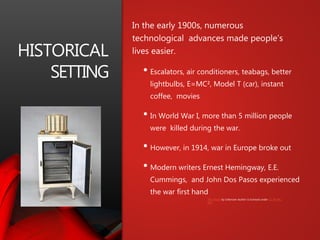
In the early 1900s, numerous
technological advances made people’s
lives easier.
• Escalators, air conditioners, teabags, better
lightbulbs, E=MC², Model T (car), instant
coffee, movies
• In World War I, more than 5 million people
were killed during the war.
• However, in 1914, war in Europe broke out
• Modern writers Ernest Hemingway, E.E.
Cummings, and John Dos Pasos experienced
the war first hand
This Photo by Unknown Author is licensed under CC BY-NC-
ND
MORE
HISTORY
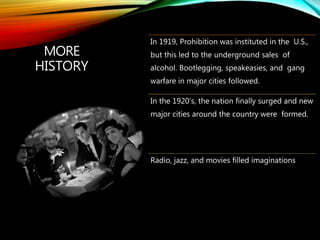
In 1919, Prohibition was instituted in the U.S.,
but this led to the underground sales of
alcohol. Bootlegging, speakeasies, and gang
warfare in major cities followed.
In the 1920’s, the nation finally surged and new
major cities around the country were formed.
Radio, jazz, and movies filled imaginations
THELASTOF THE HISTORY
• F. Scott Fitzgerald wrote about both the glamourous and
pitiful sides of the American dream in The Great Gatsby.
• Artists and writers flocked to New York’s Greenwich
Village.
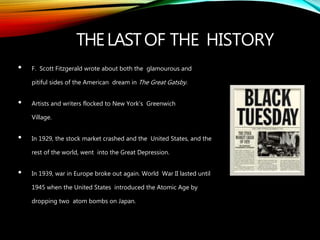
• In 1929, the stock market crashed and the United States, and the
rest of the world, went into the Great Depression.
• In 1939, war in Europe broke out again. World War II lasted until
1945 when the United States introduced the Atomic Age by
dropping two atom bombs on Japan.
THE BIRTH OF
MODERNISM
THE BIRTH OF MODERNISM
• WWI ended the years of optimism of the
early 20th Century.
• People no longer trusted the values of the
world and sought new ideas that were more
applicable to modern life.
• Modernists experimented with a wide variety
of new approaches and techniques.
MODERNISM
“Make it New”
SCIENTIFIC RATIONALISM
• During 19th Century, the Enlightenment notion
of the world as a machine—something whose
parts could be named and seen to function—
came back into favor.
• Positivism—the 19th Century belief that
everything, including human nature, could be
explained and understood through science.
• Modernism rejects this idea.
AN UGLY WAR
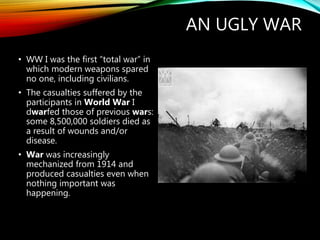
• WW I was the first “total war” in
which modern weapons spared
no one, including civilians.
• The casualties suffered by the
participants in World War I
dwarfed those of previous wars:
some 8,500,000 soldiers died as
a result of wounds and/or
disease.
• War was increasingly
mechanized from 1914 and
produced casualties even when
nothing important was
happening.
CIVILIANS
• It has been estimated that the number of civilian deaths
attributable to the war was higher than the military
casualties, or around 13,000,000. These civilian deaths
were largely caused by starvation, exposure, disease,
military encounters, and massacres.
• The enormity of the war had undermined humankind's
faith in Western society and culture.
• A generation of young men lost.
• Survivors reexamine bases of certainly, structure of knowledge,
systems of belief and authorities.
• Creating a feeling of hopelessness.
• Postwar modernist literature reflected a sense of
disillusionment and fragmentation.
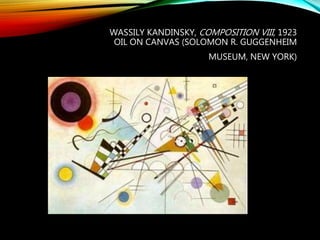
WASSILY KANDINSKY, COMPOSITION VIII, 1923
OIL ON CANVAS (SOLOMON R. GUGGENHEIM
MUSEUM, NEW YORK)
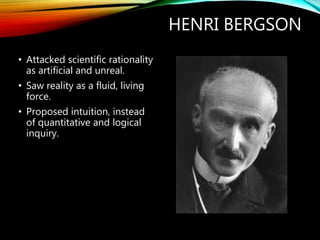
HENRI BERGSON
• Attacked scientific rationality
as artificial and unreal.
• Saw reality as a fluid, living
force.
• Proposed intuition, instead
of quantitative and logical
inquiry.
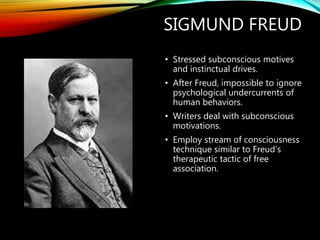
SIGMUND FREUD
• Stressed subconscious motives
and instinctual drives.
• After Freud, impossible to ignore
psychological undercurrents of
human behaviors.
• Writers deal with subconscious
motivations.
• Employ stream of consciousness
technique similar to Freud’s
therapeutic tactic of free
association.
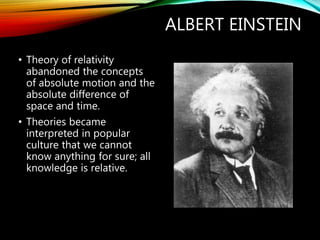
ALBERT EINSTEIN
• Theory of relativity
abandoned the concepts
of absolute motion and the
absolute difference of
space and time.
• Theories became
interpreted in popular
culture that we cannot
know anything for sure; all
knowledge is relative.
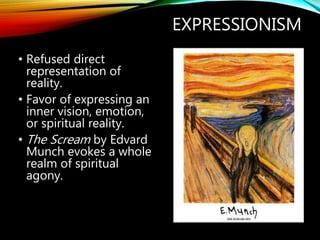
EXPRESSIONISM
• Refused direct
representation of
reality.
• Favor of expressing an
inner vision, emotion,
or spiritual reality.
• The Scream by Edvard
Munch evokes a whole
realm of spiritual
agony.
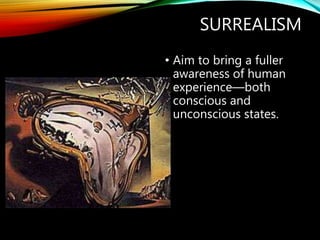
SURREALISM
• Aim to bring a fuller
awareness of human
experience—both
conscious and
unconscious states.
MODERNIST LITERATURE
• Urging experimentation in both literary form and subject
matter, American poet Ezra Pound advised authors to
“make it new.”
• The choice of subject matter was often a revolt against the
traditional conception of what was appropriate for
literature.
• Experiments with point of view and narrative structure.
• Rejection of chronological and narrative continuity.
• Literature and language as a game.
• Precise images and common speech.
• Literature = art object produced by consummate craft
rather than as a statement of emotion.
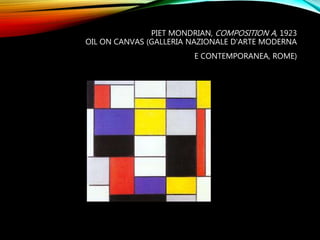
PIET MONDRIAN, COMPOSITION A, 1923
OIL ON CANVAS (GALLERIA NAZIONALE D'ARTE MODERNA
E CONTEMPORANEA, ROME)
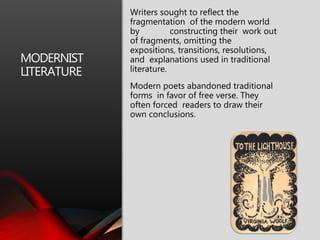
MODERNIST
LITERATURE
Writers sought to reflect the
fragmentation of the modern world
by constructing their work out
of fragments, omitting the
expositions, transitions, resolutions,
and explanations used in traditional
literature.
Modern poets abandoned traditional
forms in favor of free verse. They
often forced readers to draw their
own conclusions.
MODERN
MOVEMENTS
MODERN MOVEMENTS
•Imagism (1909-1917) - Poets rebelled against
sentimental poetry and instead demanded hard,
clear expressions, concrete images, and the
language of everyday speech.
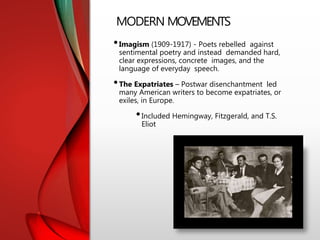
•The Expatriates – Postwar disenchantment led
many American writers to become expatriates, or
exiles, in Europe.
•Included Hemingway, Fitzgerald, and T.S.
Eliot
OTHER MODERN
MOVEMENTS
OTHER MODERN MOVEMENTS
New approaches:
• Writers practiced the stream-of-
consciousness technique to produce novels
• Poets stretched boundaries by paying
attention to wordplay, typography, and
punctuation
• American authors finally began to garner
international renown
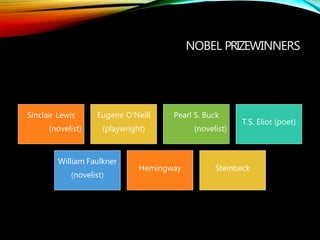
NOBEL PRIZEWINNERS
Sinclair Lewis
(novelist)
Eugene O’Neill
(playwright)
Pearl S. Buck
(novelist)
T.S. Eliot (poet)
William Faulkner
(novelist)
Hemingway Steinbeck
THEHARLEM RENAISSANCE
Beginning in 1921 in Harlem, New
York, African-American writers, most
of them newcomers from the South,
led a burst of creativity by black
writers that changed the landscape of
American art.
The writers of this movement opened
the door for African-American artists
who followed them.

Introduction to Modernism

  • 1.
  • 2.
  • 3.
    BASICSOF MODERN LITERATURE • Aperiod of sudden and unexpected breaks with traditional ways of viewing and interacting with the world. Experimentation and individualism became virtues, where in the past they were often heartily discouraged. • Pursuit of the American Dream • America as the new Eden • Optimism • Importance of the individual
  • 4.
    HISTORICAL SETTING In the early1900s, numerous technological advances made people’s lives easier. • Escalators, air conditioners, teabags, better lightbulbs, E=MC², Model T (car), instant coffee, movies • In World War I, more than 5 million people were killed during the war. • However, in 1914, war in Europe broke out • Modern writers Ernest Hemingway, E.E. Cummings, and John Dos Pasos experienced the war first hand This Photo by Unknown Author is licensed under CC BY-NC- ND
  • 5.
    MORE HISTORY In 1919, Prohibitionwas instituted in the U.S., but this led to the underground sales of alcohol. Bootlegging, speakeasies, and gang warfare in major cities followed. In the 1920’s, the nation finally surged and new major cities around the country were formed. Radio, jazz, and movies filled imaginations
  • 6.
    THELASTOF THE HISTORY •F. Scott Fitzgerald wrote about both the glamourous and pitiful sides of the American dream in The Great Gatsby. • Artists and writers flocked to New York’s Greenwich Village. • In 1929, the stock market crashed and the United States, and the rest of the world, went into the Great Depression. • In 1939, war in Europe broke out again. World War II lasted until 1945 when the United States introduced the Atomic Age by dropping two atom bombs on Japan.
  • 7.
  • 8.
    THE BIRTH OFMODERNISM • WWI ended the years of optimism of the early 20th Century. • People no longer trusted the values of the world and sought new ideas that were more applicable to modern life. • Modernists experimented with a wide variety of new approaches and techniques.
  • 9.
  • 10.
    SCIENTIFIC RATIONALISM • During19th Century, the Enlightenment notion of the world as a machine—something whose parts could be named and seen to function— came back into favor. • Positivism—the 19th Century belief that everything, including human nature, could be explained and understood through science. • Modernism rejects this idea.
  • 11.
    AN UGLY WAR •WW I was the first “total war” in which modern weapons spared no one, including civilians. • The casualties suffered by the participants in World War I dwarfed those of previous wars: some 8,500,000 soldiers died as a result of wounds and/or disease. • War was increasingly mechanized from 1914 and produced casualties even when nothing important was happening.
  • 12.
    CIVILIANS • It hasbeen estimated that the number of civilian deaths attributable to the war was higher than the military casualties, or around 13,000,000. These civilian deaths were largely caused by starvation, exposure, disease, military encounters, and massacres. • The enormity of the war had undermined humankind's faith in Western society and culture. • A generation of young men lost. • Survivors reexamine bases of certainly, structure of knowledge, systems of belief and authorities. • Creating a feeling of hopelessness. • Postwar modernist literature reflected a sense of disillusionment and fragmentation.
  • 13.
    WASSILY KANDINSKY, COMPOSITIONVIII, 1923 OIL ON CANVAS (SOLOMON R. GUGGENHEIM MUSEUM, NEW YORK)
  • 14.
    HENRI BERGSON • Attackedscientific rationality as artificial and unreal. • Saw reality as a fluid, living force. • Proposed intuition, instead of quantitative and logical inquiry.
  • 15.
    SIGMUND FREUD • Stressedsubconscious motives and instinctual drives. • After Freud, impossible to ignore psychological undercurrents of human behaviors. • Writers deal with subconscious motivations. • Employ stream of consciousness technique similar to Freud’s therapeutic tactic of free association.
  • 16.
    ALBERT EINSTEIN • Theoryof relativity abandoned the concepts of absolute motion and the absolute difference of space and time. • Theories became interpreted in popular culture that we cannot know anything for sure; all knowledge is relative.
  • 17.
    EXPRESSIONISM • Refused direct representationof reality. • Favor of expressing an inner vision, emotion, or spiritual reality. • The Scream by Edvard Munch evokes a whole realm of spiritual agony.
  • 18.
    SURREALISM • Aim tobring a fuller awareness of human experience—both conscious and unconscious states.
  • 19.
    MODERNIST LITERATURE • Urgingexperimentation in both literary form and subject matter, American poet Ezra Pound advised authors to “make it new.” • The choice of subject matter was often a revolt against the traditional conception of what was appropriate for literature. • Experiments with point of view and narrative structure. • Rejection of chronological and narrative continuity. • Literature and language as a game. • Precise images and common speech. • Literature = art object produced by consummate craft rather than as a statement of emotion.
  • 20.
    PIET MONDRIAN, COMPOSITIONA, 1923 OIL ON CANVAS (GALLERIA NAZIONALE D'ARTE MODERNA E CONTEMPORANEA, ROME)
  • 21.
    MODERNIST LITERATURE Writers sought toreflect the fragmentation of the modern world by constructing their work out of fragments, omitting the expositions, transitions, resolutions, and explanations used in traditional literature. Modern poets abandoned traditional forms in favor of free verse. They often forced readers to draw their own conclusions.
  • 22.
  • 23.
    MODERN MOVEMENTS •Imagism (1909-1917)- Poets rebelled against sentimental poetry and instead demanded hard, clear expressions, concrete images, and the language of everyday speech. •The Expatriates – Postwar disenchantment led many American writers to become expatriates, or exiles, in Europe. •Included Hemingway, Fitzgerald, and T.S. Eliot
  • 24.
  • 25.
    OTHER MODERN MOVEMENTS Newapproaches: • Writers practiced the stream-of- consciousness technique to produce novels • Poets stretched boundaries by paying attention to wordplay, typography, and punctuation • American authors finally began to garner international renown
  • 26.
    NOBEL PRIZEWINNERS Sinclair Lewis (novelist) EugeneO’Neill (playwright) Pearl S. Buck (novelist) T.S. Eliot (poet) William Faulkner (novelist) Hemingway Steinbeck
  • 27.
    THEHARLEM RENAISSANCE Beginning in1921 in Harlem, New York, African-American writers, most of them newcomers from the South, led a burst of creativity by black writers that changed the landscape of American art. The writers of this movement opened the door for African-American artists who followed them.