VViittaall SSiiggnnss
VViittaall SSiiggnnss 
• Provide information about body function 
• Include: 
– temperature 
– pulse 
– respiration 
– blood pressure 
• Changes may be the first 
sign of disease 
• Accuracy is imperative! 
3.01 Understand Diagnostic and 
Therapeutic Services 
2
VViittaall SSiiggnnss 
Temperature 
Measurement of the balance between heat 
lost and heat produced 
Heat lost through: 
• Perspiration 
• Respiration 
• Excretion 
Heat produced by: 
• Metabolism of food 
• Muscle and gland activity 
3.01 Understand Diagnostic and 
Therapeutic Services 
3
VViittaall SSiiggnnss 
Temperature 
3.01 Understand Diagnostic and 
Therapeutic Services 
NNoorrmmaall rraannggeess 
– 97º - 100º F 
– 36.1º - 37.8º C 
4
VViittaall SSiiggnnss 
Temperature 
Hypothermia 
•Temperature below 95º F 
•Death can occur if below 93º F 
3.01 Understand Diagnostic and 
Therapeutic Services 
5
VViittaall SSiiggnnss 
Temperature 
Hypothermia 
Temperature decreases with: 
– environment 
– exposure to cold 
– inactivity 
– sleep 
– starvation 
Symptoms: 
– shivering 
– cold skin 
– confusion 
3.01 Understand Diagnostic and 
Therapeutic Services 
6
VViittaall SSiiggnnss 
Temperature 
Hyperthermia 
•Temperature 100-104º F 
•Temperature above 104º F is life-threatening 
•Prolonged hyperthermia may cause brain 
injury. 
3.01 Understand Diagnostic and 
Therapeutic Services 
7
VViittaall SSiiggnnss 
Temperature 
Hyperthermia 
Temperature increases with: 
– environment 
– exercise 
– illness, infection, injury 
– stress 
Symptoms: 
– hot, dry, red skin 
– nausea/vomiting 
– headache 
– low blood pressure 
3.01 Understand Diagnostic and 
Therapeutic Services 
8
VViittaall SSiiggnnss 
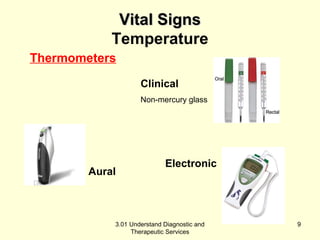
Temperature 
Clinical 
Non-mercury glass 
Electronic 
Thermometers 
3.01 Understand Diagnostic and 
Therapeutic Services 
Aural 
9
VViittaall SSiiggnnss 
Temperature 
Sites to measure temperature: 
•Aural – auditory canal 
•Axillary – armpit 
•Oral – mouth 
•Rectal – rectum 
3.01 Understand Diagnostic and 
Therapeutic Services 
10
VViittaall SSiiggnnss 
Temperature 
To record temperature: 
– Oral 98.6º (O) 
– Rectal 99.6º (R) 
– Axillary 97.6º (ax) 
– Aural 98.6º (T) 
3.01 Understand Diagnostic and 
Therapeutic Services 
11
VViittaall SSiiggnnss 
Temperature Measurement 
OOrraall 
•Ask the patient if they have ingested hot or 
cold food or drink, or smoked within the last 
½ hour 
•If yes, wait at least 15 minutes before 
measuring the oral temperature 
3.01 Understand Diagnostic and 
Therapeutic Services 
12
RREEPPOORRTT 
AABBNNOORRMMAALL RREESSUULLTTSS 
OOFF AANNYY VVIITTAALL SSIIGGNN 
IIMMMMEEDDIIAATTEELLYY 
3.01 Understand Diagnostic and 
Therapeutic Services 
13 
VViittaall SSiiggnnss
TTeemmppeerraattuurree 
Demonstrate the skill 
Provide for guided practice 
Provide for independent practice 
Verify student passing 
3.01 Understand Diagnostic and 
Therapeutic Services 
14 
VViittaall SSiiggnnss 
OOrraall
VViittaall SSiiggnnss 
Temperature Measurement 
• AAuurraall 
• Pros: 
– Measures core body temperature 
– Fast and convenient 
• Con: 
– Inaccurate if not placed correctly in the ear 
canal 
– Ear infection 
– Ear wax 
3.01 Understand Diagnostic and 
Therapeutic Services 
15
TTeemmppeerraattuurree 
Demonstrate the skill 
Provide for guided practice 
Provide for independent practice 
Verify student passing 
3.01 Understand Diagnostic and 
Therapeutic Services 
16 
VViittaall SSiiggnnss 
AAuurraall
VViittaall SSiiggnnss 
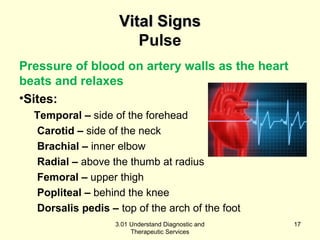
Pulse 
Pressure of blood on artery walls as the heart 
beats and relaxes 
•Sites: 
Temporal – side of the forehead 
Carotid – side of the neck 
Brachial – inner elbow 
Radial – above the thumb at radius 
Femoral – upper thigh 
Popliteal – behind the knee 
Dorsalis pedis – top of the arch of the foot 
3.01 Understand Diagnostic and 
Therapeutic Services 
17
VViittaall SSiiggnnss 
Pulse 
When would you use these pulse sites? 
Temporal 
Carotid 
Brachial 
Radial 
Femoral 
Popliteal 
Dorsalis pedis 3.01 Understand Diagnostic and 
Therapeutic Services 
18
VViittaall SSiiggnnss 
Pulse 
Normal rate adult (male) 60 – 70 beats per minute 
adult (female) 65 – 80 beats per minute 
children (over 7) 70 – 100 beats per minute 
children (1 – 7) 80 – 110 beats per minute 
infants (less than 1 year) 100 – 160 beats per 
minute 
Rhythm regular or irregular 
Volume strength of the pulse 
3.01 Understand Diagnostic and 
Therapeutic Services 
19
VViittaall SSiiggnnss 
Pulse 
• Pulse can be increased by: 
– exercise 
– stimulant drugs 
– excitement 
– fever 
– shock 
– nervousness 
3.01 Understand Diagnostic and 
Therapeutic Services 
20
VViittaall SSiiggnnss 
Pulse 
• Pulse can be decreased by: 
– sleep 
– depressant drugs 
– heart disease 
– coma 
3.01 Understand Diagnostic and 
Therapeutic Services 
21
RREEPPOORRTT 
AABBNNOORRMMAALL RREESSUULLTTSS 
OOFF AANNYY VVIITTAALL SSIIGGNN 
IIMMMMEEDDIIAATTEELLYY 
3.01 Understand Diagnostic and 
Therapeutic Services 
22 
VViittaall SSiiggnnss
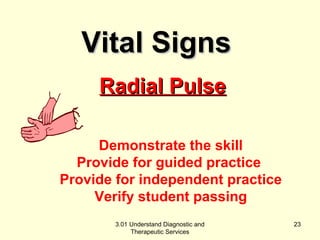
RRaaddiiaall PPuullssee 
Demonstrate the skill 
Provide for guided practice 
Provide for independent practice 
Verify student passing 
3.01 Understand Diagnostic and 
Therapeutic Services 
23 
VViittaall SSiiggnnss
VViittaall SSiiggnnss 
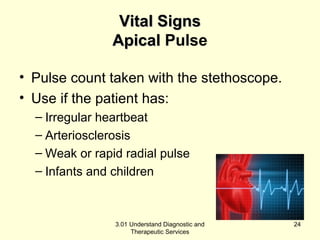
AAppiiccaall Pulse 
• Pulse count taken with the stethoscope. 
• Use if the patient has: 
– Irregular heartbeat 
– Arteriosclerosis 
– Weak or rapid radial pulse 
– Infants and children 
3.01 Understand Diagnostic and 
Therapeutic Services 
24
AAppiiccaall PPuullssee 
Demonstrate the skill 
Provide for guided practice 
Provide for independent practice 
Verify student passing 
3.01 Understand Diagnostic and 
Therapeutic Services 
25 
VViittaall SSiiggnnss
VViittaall SSiiggnnss 
Respiration 
Process of taking in oxygen and expelling 
carbon dioxide 
1 inspiration + 1 expiration = respiration 
Normal rate: 
adults – 12 – 20 breaths per minute 
children – 16 – 30 breaths per minute 
Evaluate for rhythm and character 
Rhythm – regular or irregular 
Character – depth, ease of breaths 
3.01 Understand Diagnostic and 
Therapeutic Services 
26
VViittaall SSiiggnnss 
Respiration 
• Abnormal respiratory patterns 
Apnea – periods of absent breathing 
Cheyne-stokes – periods of apnea and 
dyspnea 
Dyspnea – difficult breathing 
3.01 Understand Diagnostic and 
Therapeutic Services 
27
RREEPPOORRTT 
AABBNNOORRMMAALL RREESSUULLTTSS 
OOFF AANNYY VVIITTAALL SSIIGGNN 
IIMMMMEEDDIIAATTEELLYY 
3.01 Understand Diagnostic and 
Therapeutic Services 
28 
VViittaall SSiiggnnss
RReessppiirraattiioonnss 
Demonstrate the skill 
Provide for guided practice 
Provide for independent practice 
Verify student passing 
3.01 Understand Diagnostic and 
Therapeutic Services 
29 
VViittaall SSiiggnnss
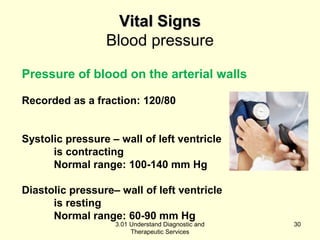
VViittaall SSiiggnnss 
Blood pressure 
Pressure of blood on the arterial walls 
Recorded as a fraction: 120/80 
Systolic pressure – wall of left ventricle 
is contracting 
Normal range: 100-140 mm Hg 
Diastolic pressure– wall of left ventricle 
is resting 
Normal range: 60-90 mm Hg 
3.01 Understand Diagnostic and 
Therapeutic Services 
30
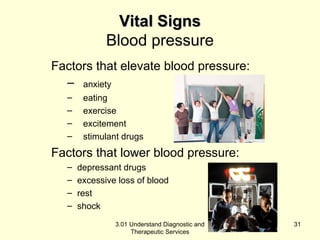
VViittaall SSiiggnnss 
Blood pressure 
Factors that elevate blood pressure: 
– anxiety 
– eating 
– exercise 
– excitement 
– stimulant drugs 
Factors that lower blood pressure: 
– depressant drugs 
– excessive loss of blood 
– rest 
– shock 
3.01 Understand Diagnostic and 
Therapeutic Services 
31
RREEPPOORRTT 
AABBNNOORRMMAALL RREESSUULLTTSS 
OOFF AANNYY VVIITTAALL SSIIGGNN 
IIMMMMEEDDIIAATTEELLYY 
3.01 Understand Diagnostic and 
Therapeutic Services 
32 
VViittaall SSiiggnnss
BBlloooodd PPrreessssuurree 
Demonstrate the skill 
Provide for guided practice 
Provide for independent practice 
Verify student passing 
3.01 Understand Diagnostic and 
Therapeutic Services 
33 
VViittaall SSiiggnnss
CCoommbbiinneedd VViittaall SSiiggnnss 
TTPPRR BBPP 
Demonstrate the skill 
Provide for guided practice 
Provide for independent practice 
Verify student passing 
3.01 Understand Diagnostic and 
Therapeutic Services 
34 
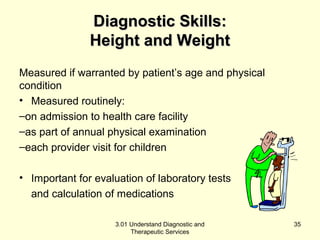
VViittaall SSiiggnnss
DDiiaaggnnoossttiicc SSkkiillllss:: 
HHeeiigghhtt aanndd WWeeiigghhtt 
Measured if warranted by patient’s age and physical 
condition 
• Measured routinely: 
–on admission to health care facility 
–as part of annual physical examination 
–each provider visit for children 
• Important for evaluation of laboratory tests 
and calculation of medications 
3.01 Understand Diagnostic and 
Therapeutic Services 
35
DDiiaaggnnoossttiicc SSkkiillllss:: 
DDaaiillyy WWeeiigghhttss 
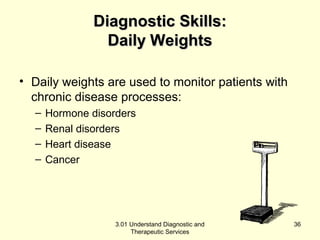
• Daily weights are used to monitor patients with 
chronic disease processes: 
– Hormone disorders 
– Renal disorders 
– Heart disease 
– Cancer 
3.01 Understand Diagnostic and 
Therapeutic Services 
36
DDiiaaggnnoossttiicc SSkkiillllss:: 
DDaaiillyy WWeeiigghhttss 
• Guidelines for daily weights: 
use the same scales 
at the same time 
wearing the same type of clothing 
patient voids to empty bladder 
• Make sure to balance the scales before 
weighing the patient. 
3.01 Understand Diagnostic and 
Therapeutic Services 
37
DDiiaaggnnoossttiicc SSkkiillllss:: 
DDaaiillyy WWeeiigghhttss 
OOBBSSEERRVVEE SSAAFFEETTYY PPRREECCAAUUTTOONNSS!! 
Prevent injury from falls and the 
protruding height lever. 
3.01 Understand Diagnostic and 
Therapeutic Services 
38
MMeeaassuurriinngg HHeeiigghhtt aanndd WWeeiigghhtt 
Demonstrate the skill 
Provide for guided practice 
Provide for independent practice 
Verify student passing 
3.01 Understand Diagnostic and 
Therapeutic Services 
39 
DDiiaaggnnoossttiicc SSkkiillllss
DDiiaaggnnoossttiicc SSkkiillllss:: 
MMeeaassuurree VViissuuaall AAccuuiittyy 
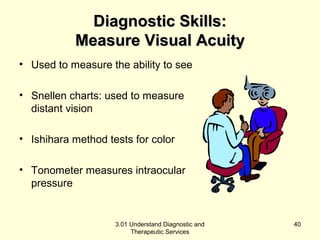
• Used to measure the ability to see 
• Snellen charts: used to measure 
distant vision 
• Ishihara method tests for color 
• Tonometer measures intraocular 
pressure 
3.01 Understand Diagnostic and 
Therapeutic Services 
40
DDiiaaggnnoossttiicc SSkkiillllss:: 
MMeeaassuurree VViissuuaall AAccuuiittyy 
• OD – right eye (oculus dexter) 
• OS – left eye (oculus sinister) 
• OU – both eyes (oculus uterque) 
• Myopia – nearsightedness, defect in 
distant vision 
• Hyperopia – farsightedness, defect in 
near vision 
3.01 Understand Diagnostic and 
Therapeutic Services 
41
MMeeaassuurree VViissuuaall AAccuuiittyy 
Demonstrate the skill 
Provide for guided practice 
Provide for independent practice 
Verify student passing 
3.01 Understand Diagnostic and 
Therapeutic Services 
42 
DDiiaaggnnoossttiicc SSkkiillllss

3.01 Vital Signs

  • 1.
  • 2.
    VViittaall SSiiggnnss •Provide information about body function • Include: – temperature – pulse – respiration – blood pressure • Changes may be the first sign of disease • Accuracy is imperative! 3.01 Understand Diagnostic and Therapeutic Services 2
  • 3.
    VViittaall SSiiggnnss Temperature Measurement of the balance between heat lost and heat produced Heat lost through: • Perspiration • Respiration • Excretion Heat produced by: • Metabolism of food • Muscle and gland activity 3.01 Understand Diagnostic and Therapeutic Services 3
  • 4.
    VViittaall SSiiggnnss Temperature 3.01 Understand Diagnostic and Therapeutic Services NNoorrmmaall rraannggeess – 97º - 100º F – 36.1º - 37.8º C 4
  • 5.
    VViittaall SSiiggnnss Temperature Hypothermia •Temperature below 95º F •Death can occur if below 93º F 3.01 Understand Diagnostic and Therapeutic Services 5
  • 6.
    VViittaall SSiiggnnss Temperature Hypothermia Temperature decreases with: – environment – exposure to cold – inactivity – sleep – starvation Symptoms: – shivering – cold skin – confusion 3.01 Understand Diagnostic and Therapeutic Services 6
  • 7.
    VViittaall SSiiggnnss Temperature Hyperthermia •Temperature 100-104º F •Temperature above 104º F is life-threatening •Prolonged hyperthermia may cause brain injury. 3.01 Understand Diagnostic and Therapeutic Services 7
  • 8.
    VViittaall SSiiggnnss Temperature Hyperthermia Temperature increases with: – environment – exercise – illness, infection, injury – stress Symptoms: – hot, dry, red skin – nausea/vomiting – headache – low blood pressure 3.01 Understand Diagnostic and Therapeutic Services 8
  • 9.
    VViittaall SSiiggnnss Temperature Clinical Non-mercury glass Electronic Thermometers 3.01 Understand Diagnostic and Therapeutic Services Aural 9
  • 10.
    VViittaall SSiiggnnss Temperature Sites to measure temperature: •Aural – auditory canal •Axillary – armpit •Oral – mouth •Rectal – rectum 3.01 Understand Diagnostic and Therapeutic Services 10
  • 11.
    VViittaall SSiiggnnss Temperature To record temperature: – Oral 98.6º (O) – Rectal 99.6º (R) – Axillary 97.6º (ax) – Aural 98.6º (T) 3.01 Understand Diagnostic and Therapeutic Services 11
  • 12.
    VViittaall SSiiggnnss TemperatureMeasurement OOrraall •Ask the patient if they have ingested hot or cold food or drink, or smoked within the last ½ hour •If yes, wait at least 15 minutes before measuring the oral temperature 3.01 Understand Diagnostic and Therapeutic Services 12
  • 13.
    RREEPPOORRTT AABBNNOORRMMAALL RREESSUULLTTSS OOFF AANNYY VVIITTAALL SSIIGGNN IIMMMMEEDDIIAATTEELLYY 3.01 Understand Diagnostic and Therapeutic Services 13 VViittaall SSiiggnnss
  • 14.
    TTeemmppeerraattuurree Demonstrate theskill Provide for guided practice Provide for independent practice Verify student passing 3.01 Understand Diagnostic and Therapeutic Services 14 VViittaall SSiiggnnss OOrraall
  • 15.
    VViittaall SSiiggnnss TemperatureMeasurement • AAuurraall • Pros: – Measures core body temperature – Fast and convenient • Con: – Inaccurate if not placed correctly in the ear canal – Ear infection – Ear wax 3.01 Understand Diagnostic and Therapeutic Services 15
  • 16.
    TTeemmppeerraattuurree Demonstrate theskill Provide for guided practice Provide for independent practice Verify student passing 3.01 Understand Diagnostic and Therapeutic Services 16 VViittaall SSiiggnnss AAuurraall
  • 17.
    VViittaall SSiiggnnss Pulse Pressure of blood on artery walls as the heart beats and relaxes •Sites: Temporal – side of the forehead Carotid – side of the neck Brachial – inner elbow Radial – above the thumb at radius Femoral – upper thigh Popliteal – behind the knee Dorsalis pedis – top of the arch of the foot 3.01 Understand Diagnostic and Therapeutic Services 17
  • 18.
    VViittaall SSiiggnnss Pulse When would you use these pulse sites? Temporal Carotid Brachial Radial Femoral Popliteal Dorsalis pedis 3.01 Understand Diagnostic and Therapeutic Services 18
  • 19.
    VViittaall SSiiggnnss Pulse Normal rate adult (male) 60 – 70 beats per minute adult (female) 65 – 80 beats per minute children (over 7) 70 – 100 beats per minute children (1 – 7) 80 – 110 beats per minute infants (less than 1 year) 100 – 160 beats per minute Rhythm regular or irregular Volume strength of the pulse 3.01 Understand Diagnostic and Therapeutic Services 19
  • 20.
    VViittaall SSiiggnnss Pulse • Pulse can be increased by: – exercise – stimulant drugs – excitement – fever – shock – nervousness 3.01 Understand Diagnostic and Therapeutic Services 20
  • 21.
    VViittaall SSiiggnnss Pulse • Pulse can be decreased by: – sleep – depressant drugs – heart disease – coma 3.01 Understand Diagnostic and Therapeutic Services 21
  • 22.
    RREEPPOORRTT AABBNNOORRMMAALL RREESSUULLTTSS OOFF AANNYY VVIITTAALL SSIIGGNN IIMMMMEEDDIIAATTEELLYY 3.01 Understand Diagnostic and Therapeutic Services 22 VViittaall SSiiggnnss
  • 23.
    RRaaddiiaall PPuullssee Demonstratethe skill Provide for guided practice Provide for independent practice Verify student passing 3.01 Understand Diagnostic and Therapeutic Services 23 VViittaall SSiiggnnss
  • 24.
    VViittaall SSiiggnnss AAppiiccaallPulse • Pulse count taken with the stethoscope. • Use if the patient has: – Irregular heartbeat – Arteriosclerosis – Weak or rapid radial pulse – Infants and children 3.01 Understand Diagnostic and Therapeutic Services 24
  • 25.
    AAppiiccaall PPuullssee Demonstratethe skill Provide for guided practice Provide for independent practice Verify student passing 3.01 Understand Diagnostic and Therapeutic Services 25 VViittaall SSiiggnnss
  • 26.
    VViittaall SSiiggnnss Respiration Process of taking in oxygen and expelling carbon dioxide 1 inspiration + 1 expiration = respiration Normal rate: adults – 12 – 20 breaths per minute children – 16 – 30 breaths per minute Evaluate for rhythm and character Rhythm – regular or irregular Character – depth, ease of breaths 3.01 Understand Diagnostic and Therapeutic Services 26
  • 27.
    VViittaall SSiiggnnss Respiration • Abnormal respiratory patterns Apnea – periods of absent breathing Cheyne-stokes – periods of apnea and dyspnea Dyspnea – difficult breathing 3.01 Understand Diagnostic and Therapeutic Services 27
  • 28.
    RREEPPOORRTT AABBNNOORRMMAALL RREESSUULLTTSS OOFF AANNYY VVIITTAALL SSIIGGNN IIMMMMEEDDIIAATTEELLYY 3.01 Understand Diagnostic and Therapeutic Services 28 VViittaall SSiiggnnss
  • 29.
    RReessppiirraattiioonnss Demonstrate theskill Provide for guided practice Provide for independent practice Verify student passing 3.01 Understand Diagnostic and Therapeutic Services 29 VViittaall SSiiggnnss
  • 30.
    VViittaall SSiiggnnss Bloodpressure Pressure of blood on the arterial walls Recorded as a fraction: 120/80 Systolic pressure – wall of left ventricle is contracting Normal range: 100-140 mm Hg Diastolic pressure– wall of left ventricle is resting Normal range: 60-90 mm Hg 3.01 Understand Diagnostic and Therapeutic Services 30
  • 31.
    VViittaall SSiiggnnss Bloodpressure Factors that elevate blood pressure: – anxiety – eating – exercise – excitement – stimulant drugs Factors that lower blood pressure: – depressant drugs – excessive loss of blood – rest – shock 3.01 Understand Diagnostic and Therapeutic Services 31
  • 32.
    RREEPPOORRTT AABBNNOORRMMAALL RREESSUULLTTSS OOFF AANNYY VVIITTAALL SSIIGGNN IIMMMMEEDDIIAATTEELLYY 3.01 Understand Diagnostic and Therapeutic Services 32 VViittaall SSiiggnnss
  • 33.
    BBlloooodd PPrreessssuurree Demonstratethe skill Provide for guided practice Provide for independent practice Verify student passing 3.01 Understand Diagnostic and Therapeutic Services 33 VViittaall SSiiggnnss
  • 34.
    CCoommbbiinneedd VViittaall SSiiggnnss TTPPRR BBPP Demonstrate the skill Provide for guided practice Provide for independent practice Verify student passing 3.01 Understand Diagnostic and Therapeutic Services 34 VViittaall SSiiggnnss
  • 35.
    DDiiaaggnnoossttiicc SSkkiillllss:: HHeeiigghhttaanndd WWeeiigghhtt Measured if warranted by patient’s age and physical condition • Measured routinely: –on admission to health care facility –as part of annual physical examination –each provider visit for children • Important for evaluation of laboratory tests and calculation of medications 3.01 Understand Diagnostic and Therapeutic Services 35
  • 36.
    DDiiaaggnnoossttiicc SSkkiillllss:: DDaaiillyyWWeeiigghhttss • Daily weights are used to monitor patients with chronic disease processes: – Hormone disorders – Renal disorders – Heart disease – Cancer 3.01 Understand Diagnostic and Therapeutic Services 36
  • 37.
    DDiiaaggnnoossttiicc SSkkiillllss:: DDaaiillyyWWeeiigghhttss • Guidelines for daily weights: use the same scales at the same time wearing the same type of clothing patient voids to empty bladder • Make sure to balance the scales before weighing the patient. 3.01 Understand Diagnostic and Therapeutic Services 37
  • 38.
    DDiiaaggnnoossttiicc SSkkiillllss:: DDaaiillyyWWeeiigghhttss OOBBSSEERRVVEE SSAAFFEETTYY PPRREECCAAUUTTOONNSS!! Prevent injury from falls and the protruding height lever. 3.01 Understand Diagnostic and Therapeutic Services 38
  • 39.
    MMeeaassuurriinngg HHeeiigghhtt aannddWWeeiigghhtt Demonstrate the skill Provide for guided practice Provide for independent practice Verify student passing 3.01 Understand Diagnostic and Therapeutic Services 39 DDiiaaggnnoossttiicc SSkkiillllss
  • 40.
    DDiiaaggnnoossttiicc SSkkiillllss:: MMeeaassuurreeVViissuuaall AAccuuiittyy • Used to measure the ability to see • Snellen charts: used to measure distant vision • Ishihara method tests for color • Tonometer measures intraocular pressure 3.01 Understand Diagnostic and Therapeutic Services 40
  • 41.
    DDiiaaggnnoossttiicc SSkkiillllss:: MMeeaassuurreeVViissuuaall AAccuuiittyy • OD – right eye (oculus dexter) • OS – left eye (oculus sinister) • OU – both eyes (oculus uterque) • Myopia – nearsightedness, defect in distant vision • Hyperopia – farsightedness, defect in near vision 3.01 Understand Diagnostic and Therapeutic Services 41
  • 42.
    MMeeaassuurree VViissuuaall AAccuuiittyy Demonstrate the skill Provide for guided practice Provide for independent practice Verify student passing 3.01 Understand Diagnostic and Therapeutic Services 42 DDiiaaggnnoossttiicc SSkkiillllss