UnderstandingUnderstanding vitalvital
signs, height,signs, height, andand
weightweight measurementmeasurement
skills.skills.
Unit BUnit B
Resident Care SkillsResident Care Skills
Essential Standard NA4.00Essential Standard NA4.00
Understand nurse aide skills related to the residents’ vital function and movementUnderstand nurse aide skills related to the residents’ vital function and movement
Indicator 4.01Indicator 4.01
Understand vital signs, height, and weight skills.Understand vital signs, height, and weight skills.
4.01 Nursing Fundamentals 7243 1
FF YY II -- Intentional RepeatIntentional Repeat
There is intentional repeat of some HSIIThere is intentional repeat of some HSII
course content in Nursing Fundamentals.course content in Nursing Fundamentals.
Repeating course content distributes learningRepeating course content distributes learning
over time and increases long term memory.over time and increases long term memory.
Academic and skill competence must beAcademic and skill competence must be
maintained at amaintained at a very high level for directvery high level for direct
resident careresident care..
4.01 Nursing Fundamentals 7243 2
IntroductionIntroduction
IndicatorIndicator 4.014.01 introducesintroduces
skills the nurse aide will needskills the nurse aide will need
to measure and record theto measure and record the
resident’sresident’s vital signsvital signs,, heightheight
andand weightweight..
4.01 Nursing Fundamentals 7243 3
provide informationprovide information
aboutabout changeschanges inin
normal body functionnormal body function
and theand the resident’sresident’s
response to treatmentresponse to treatment..
4.01 Nursing Fundamentals 7243 4
Vital SignsVital Signs
Often theOften the
FIRSTFIRST
signsign thatthat
there is athere is a
problem!problem!
4.01 Nursing Fundamentals 7243 5
Vital SignsVital Signs
TPR+BP =TPR+BP = Vital SignsVital Signs
4.01 Nursing Fundamentals 7243 6
TPR+BP = Vital SignsTPR+BP = Vital Signs
• Reflect the function of three body
processes that are essential for life.
–Regulation of body temperature
–Heart function
–Breathing
4.01 Nursing Fundamentals 7243 7
TPR+BP = Vital SignsTPR+BP = Vital Signs
• Abbreviations:
–Temperature – T
–Pulse – P
–Respirations – R
–Blood Pressure – BP
–Vital signs - TPR and BP
4.01 Nursing Fundamentals 7243 8
TPR+BP = Vital SignsTPR+BP = Vital Signs
• Purpose
–Measured to detect
any changes in
normal body
function
–Used to determine
response to
treatment
4.01 Nursing Fundamentals 7243 9
TTPR+BP = Vital SignsPR+BP = Vital Signs
TemperatureTemperature
4.01 Nursing Fundamentals 7243 10
TTPR+BP = Vital SignsPR+BP = Vital Signs
TemperatureTemperature
• Heat production
–muscles
–glands
–oxidation of
food
• Heat loss
–respiration
–perspiration
–excretion
4.01 Nursing Fundamentals 7243 11
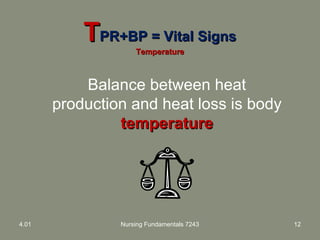
TTPR+BP = Vital SignsPR+BP = Vital Signs
TemperatureTemperature
Balance between heat
production and heat loss is body
temperaturetemperature
4.01 Nursing Fundamentals 7243 12
Factors Affecting Temperature
• Exercise
• Illness
• Age
• Time of day
• Medications
• Infection
• Emotions
• Hydration
• Clothing
• Environmental
temperature/air
movement
4.01 Nursing Fundamentals 7243 13
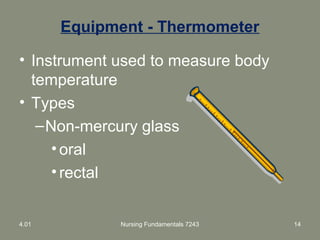
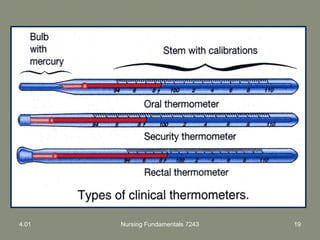
Equipment - Thermometer
• Instrument used to measure body
temperature
• Types
–Non-mercury glass
•oral
•rectal
4.01 Nursing Fundamentals 7243 14
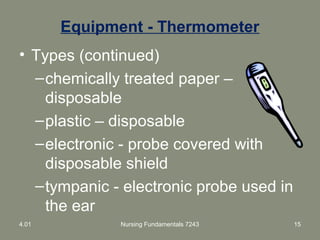
Equipment - Thermometer
• Types (continued)
–chemically treated paper –
disposable
–plastic – disposable
–electronic - probe covered with
disposable shield
–tympanic - electronic probe used in
the ear
4.01 Nursing Fundamentals 7243 15
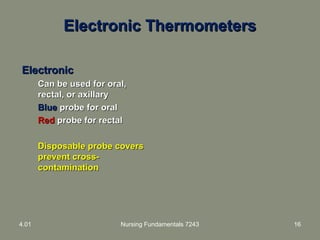
Electronic ThermometersElectronic Thermometers
ElectronicElectronic
Can be used for oral,Can be used for oral,
rectal, or axillaryrectal, or axillary
BlueBlue probe for oralprobe for oral
RedRed probe for rectalprobe for rectal
Disposable probe coversDisposable probe covers
prevent cross-prevent cross-
contaminationcontamination
4.01 Nursing Fundamentals 7243 16
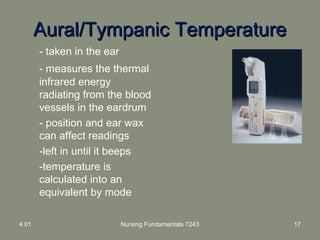
Aural/Tympanic TemperatureAural/Tympanic Temperature
- taken in the ear
- measures the thermal
infrared energy
radiating from the blood
vessels in the eardrum
- position and ear wax
can affect readings
-left in until it beeps
-temperature is
calculated into an
equivalent by mode
4.01 Nursing Fundamentals 7243 17
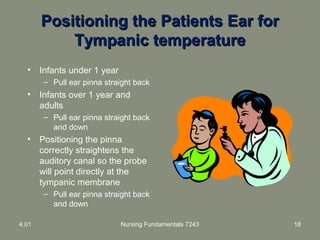
Positioning the Patients Ear forPositioning the Patients Ear for
Tympanic temperatureTympanic temperature
• Infants under 1 year
– Pull ear pinna straight back
• Infants over 1 year and
adults
– Pull ear pinna straight back
and down
• Positioning the pinna
correctly straightens the
auditory canal so the probe
will point directly at the
tympanic membrane
– Pull ear pinna straight back
and down
4.01 Nursing Fundamentals 7243 18
4.01 Nursing Fundamentals 7243 19
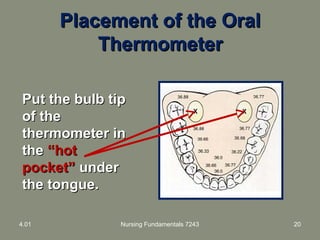
Placement of the OralPlacement of the Oral
ThermometerThermometer
Put the bulb tipPut the bulb tip
of theof the
thermometer inthermometer in
thethe “hot“hot
pocket”pocket” underunder
the tongue.the tongue.
4.01 Nursing Fundamentals 7243 20
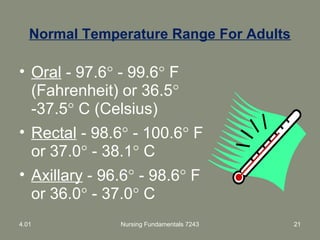
Normal Temperature Range For Adults
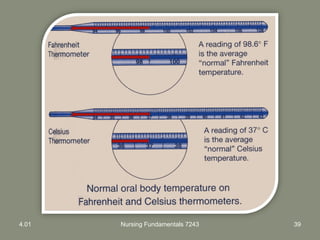
• Oral - 97.6° - 99.6° F
(Fahrenheit) or 36.5°
-37.5° C (Celsius)
• Rectal - 98.6° - 100.6° F
or 37.0° - 38.1° C
• Axillary - 96.6° - 98.6° F
or 36.0° - 37.0° C
4.01 Nursing Fundamentals 7243 21
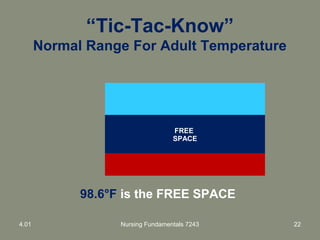
“Tic-Tac-Know”
Normal Range For Adult Temperature
FREE
SPACE
98.6°F is the FREE SPACE
4.01 Nursing Fundamentals 7243 22
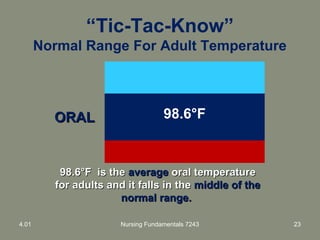
“Tic-Tac-Know”
Normal Range For Adult Temperature
ORALORAL 98.6°F
98.6°F is the98.6°F is the averageaverage oral temperatureoral temperature
for adults and it falls in thefor adults and it falls in the middle of themiddle of the
normal range.normal range.
4.01 Nursing Fundamentals 7243 23
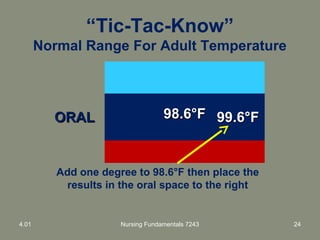
“Tic-Tac-Know”
Normal Range For Adult Temperature
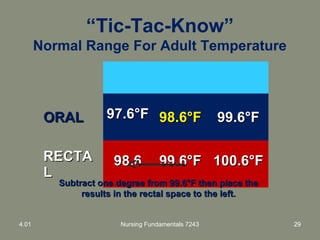
ORALORAL 98.6°F98.6°F 99.6°F99.6°F
Add one degree to 98.6°F then place the
results in the oral space to the right
4.01 Nursing Fundamentals 7243 24
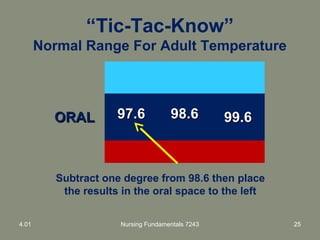
“Tic-Tac-Know”
Normal Range For Adult Temperature
ORALORAL 97.697.6 98.698.6 99.699.6
Subtract one degree from 98.6 then place
the results in the oral space to the left
4.01 Nursing Fundamentals 7243 25
“Tic-Tac-Know”
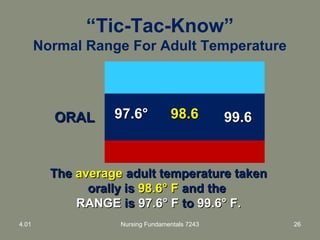
Normal Range For Adult Temperature
ORALORAL 97.6°97.6° 98.698.6 99.699.6
TheThe averageaverage adult temperature takenadult temperature taken
orally isorally is 98.6° F98.6° F and theand the
RANGERANGE isis 97.6° F97.6° F toto 99.6° F.99.6° F.
4.01 Nursing Fundamentals 7243 26
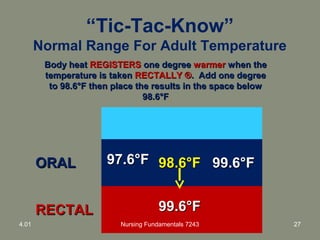
“Tic-Tac-Know”
Normal Range For Adult Temperature
ORALORAL 97.6°F97.6°F 98.6°F98.6°F 99.6°F99.6°F
RECTALRECTAL 99.6°F99.6°F
Body heatBody heat REGISTERSREGISTERS one degreeone degree warmerwarmer when thewhen the
temperature is takentemperature is taken RECTALLY ®RECTALLY ®. Add one degree. Add one degree
to 98.6°F then place the results in the space belowto 98.6°F then place the results in the space below
98.6°F98.6°F
4.01 Nursing Fundamentals 7243 27
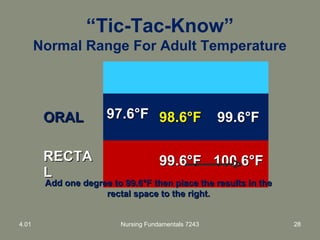
“Tic-Tac-Know”
Normal Range For Adult Temperature
ORALORAL 97.6°F97.6°F 98.6°F98.6°F 99.6°F99.6°F
RECTARECTA
LL
99.6°F99.6°F 100.6°F100.6°F
Add one degree to 99.6°F then place the results in theAdd one degree to 99.6°F then place the results in the
rectal space to the right.rectal space to the right.
4.01 Nursing Fundamentals 7243 28
“Tic-Tac-Know”
Normal Range For Adult Temperature
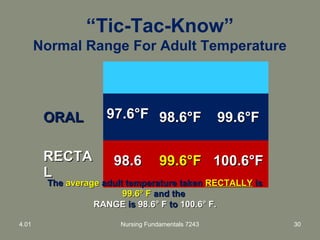
ORALORAL 97.6°F97.6°F 98.6°F98.6°F 99.6°F99.6°F
RECTARECTA
LL
98.698.6 99.6°F99.6°F 100.6°F100.6°F
Subtract one degree from 99.6°F then place theSubtract one degree from 99.6°F then place the
results in the rectal space to the left.results in the rectal space to the left.
4.01 Nursing Fundamentals 7243 29
“Tic-Tac-Know”
Normal Range For Adult Temperature
ORALORAL 97.6°F97.6°F 98.6°F98.6°F 99.6°F99.6°F
RECTARECTA
LL
98.698.6 99.6°F99.6°F 100.6°F100.6°F
TheThe averageaverage adult temperature takenadult temperature taken RECTALLYRECTALLY isis
99.6° F99.6° F and theand the
RANGERANGE isis 98.6° F98.6° F toto 100.6° F.100.6° F.
4.01 Nursing Fundamentals 7243 30
“Tic-Tac-Know”
Normal Range For Adult Temperature
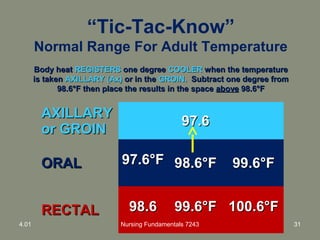
AXILLARYAXILLARY
or GROINor GROIN
97.697.6
ORALORAL 97.6°F97.6°F 98.6°F98.6°F 99.6°F99.6°F
RECTALRECTAL 98.698.6 99.6°F99.6°F 100.6°F100.6°F
Body heatBody heat REGISTERSREGISTERS one degreeone degree COOLERCOOLER when the temperaturewhen the temperature
is takenis taken AXILLARY (Ax)AXILLARY (Ax) or in theor in the GROIN.GROIN. Subtract one degree fromSubtract one degree from
98.6°F then place the results in the space98.6°F then place the results in the space aboveabove 98.6°F98.6°F
4.01 Nursing Fundamentals 7243 31
“Tic-Tac-Know”
Normal Range For Adult Temperature
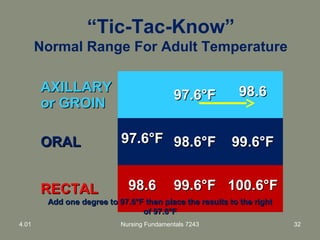
AXILLARYAXILLARY
or GROINor GROIN
97.6°F97.6°F 98.698.6
ORALORAL 97.6°F97.6°F 98.6°F98.6°F 99.6°F99.6°F
RECTALRECTAL 98.698.6 99.6°F99.6°F 100.6°F100.6°F
Add one degree to 97.6°F then place the results to the rightAdd one degree to 97.6°F then place the results to the right
of 97.6°Fof 97.6°F
4.01 Nursing Fundamentals 7243 32
“Tic-Tac-Know”
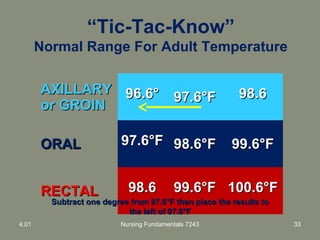
Normal Range For Adult Temperature
AXILLARYAXILLARY
or GROINor GROIN
96.6°96.6° 97.6°F97.6°F 98.698.6
ORALORAL 97.6°F97.6°F 98.6°F98.6°F 99.6°F99.6°F
RECTALRECTAL 98.698.6 99.6°F99.6°F 100.6°F100.6°F
Subtract one degree from 97.6°F then place the results toSubtract one degree from 97.6°F then place the results to
the left of 97.6°Fthe left of 97.6°F
4.01 Nursing Fundamentals 7243 33
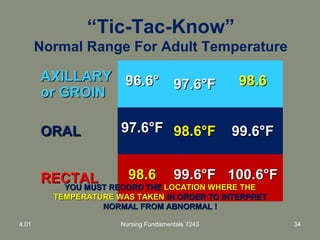
“Tic-Tac-Know”
Normal Range For Adult Temperature
AXILLARYAXILLARY
or GROINor GROIN
96.6°96.6° 97.6°F97.6°F 98.698.6
ORALORAL 97.6°F97.6°F 98.6°F98.6°F 99.6°F99.6°F
RECTALRECTAL 98.698.6 99.6°F99.6°F 100.6°F100.6°F
YOU MUST RECORD THEYOU MUST RECORD THE LOCATION WHERE THELOCATION WHERE THE
TEMPERATURE WAS TAKENTEMPERATURE WAS TAKEN IN ORDER TO INTERPRETIN ORDER TO INTERPRET
NORMAL FROM ABNORMAL !NORMAL FROM ABNORMAL !
4.01 Nursing Fundamentals 7243 34
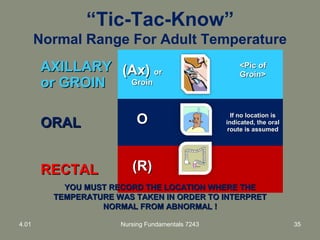
“Tic-Tac-Know”
Normal Range For Adult Temperature
AXILLARYAXILLARY
or GROINor GROIN
(Ax)(Ax) oror
GroinGroin
<Pic of<Pic of
Groin>Groin>
ORALORAL OO If no location isIf no location is
indicated, the oralindicated, the oral
route is assumedroute is assumed
RECTALRECTAL (R)(R)
YOU MUST RECORD THE LOCATION WHERE THEYOU MUST RECORD THE LOCATION WHERE THE
TEMPERATURE WAS TAKEN IN ORDER TO INTERPRETTEMPERATURE WAS TAKEN IN ORDER TO INTERPRET
NORMAL FROM ABNORMAL !NORMAL FROM ABNORMAL !
4.01 Nursing Fundamentals 7243 35
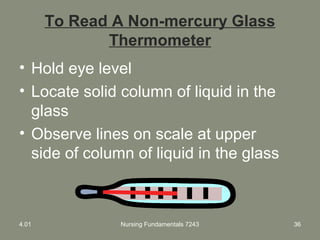
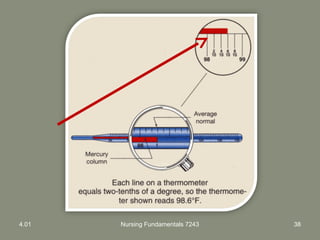
To Read A Non-mercury Glass
Thermometer
• Hold eye level
• Locate solid column of liquid in the
glass
• Observe lines on scale at upper
side of column of liquid in the glass
4.01 Nursing Fundamentals 7243 36
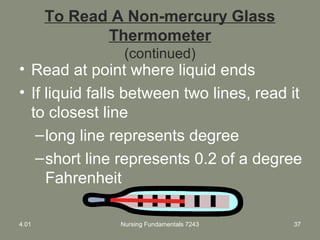
To Read A Non-mercury Glass
Thermometer
(continued)
• Read at point where liquid ends
• If liquid falls between two lines, read it
to closest line
–long line represents degree
–short line represents 0.2 of a degree
Fahrenheit
4.01 Nursing Fundamentals 7243 37
4.01 Nursing Fundamentals 7243 38
4.01 Nursing Fundamentals 7243 39
Sites To Take A Temperature
• Oral – most common
• Rectal – registers one degree
Fahrenheit higher than oral
• Axillary – least accurate; registers
one degree Fahrenheit lower than
oral
• Tympanic – probe inserted into the
ear canal
4.01 Nursing Fundamentals 7243 40
Sites To Take A Temperature
(continued)
Condition of resident
determines which is the
best site for measuring
body temperature
4.01 Nursing Fundamentals 7243 41
Temperature: Safety Precautions
• Hold rectal and axillary thermometers
in place
• Stay with resident when taking
temperature
• Check glass thermometers for chips
• Prior to use, shake liquid in glass
down
• Shake thermometer away from
resident and hard objects
4.01 Nursing Fundamentals 7243 42
Temperature: Safety Precautions
(continued)
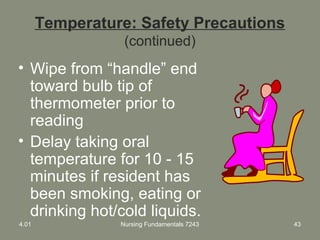
• Wipe from “handle” end
toward bulb tip of
thermometer prior to
reading
• Delay taking oral
temperature for 10 - 15
minutes if resident has
been smoking, eating or
drinking hot/cold liquids.
4.01 Nursing Fundamentals 7243 43
Temperature ConditionsTemperature Conditions
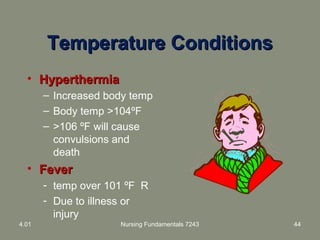
• HyperthermiaHyperthermia
– Increased body temp
– Body temp >104ºF
– >106 ºF will cause
convulsions and
death
• FeverFever
- temp over 101 ºF R
- Due to illness or
injury
4.01 Nursing Fundamentals 7243 44
Temperature ConditionsTemperature Conditions
• HypothermiaHypothermia
– Body temp below
– 96 ºF
– due to exposure to
cold temperatures
– Depends on core
temperature, age
and length of
exposure
4.01 Nursing Fundamentals 7243 45
4.01 Nursing Fundamentals 7243 46
SKILLSKILL 4.01A4.01A
Oral temperature using a non-mercuryOral temperature using a non-mercury
glass thermometerglass thermometer
Training Lab AssignmentTraining Lab Assignment
Engage in the Skill Acquisition Process for:Engage in the Skill Acquisition Process for:
4.01 Nursing Fundamentals 7243 47
SKILLSKILL 4.01B4.01B
Axillary temperature using aAxillary temperature using a
non-mercury glass thermometernon-mercury glass thermometer
Training Lab AssignmentTraining Lab Assignment
Engage in the Skill Acquisition Process for:Engage in the Skill Acquisition Process for:
4.01 Nursing Fundamentals 7243 48
SKILLSKILL 4.01C4.01C
Rectal Temperature using aRectal Temperature using a
non-mercury glass thermometernon-mercury glass thermometer
Training Lab AssignmentTraining Lab Assignment
Engage in the Skill Acquisition Process for:Engage in the Skill Acquisition Process for:
4.01 Nursing Fundamentals 7243 49
SKILLSKILL 4.01Dto4.01Dto
Measure Temperature withMeasure Temperature with
Electronic ThermometerElectronic Thermometer
Training Lab AssignmentTraining Lab Assignment
Engage in the Skill Acquisition Process for:Engage in the Skill Acquisition Process for:
4.01 Nursing Fundamentals 7243 50
SKILLSKILL 4.01E4.01E
Measure Temperature withMeasure Temperature with
Tympanic ThermometerTympanic Thermometer
Training Lab AssignmentTraining Lab Assignment
Engage in the Skill Acquisition Process for:Engage in the Skill Acquisition Process for:
TTPPR+BP = Vital SignsR+BP = Vital Signs
PULSEPULSE
4.01 Nursing Fundamentals 7243 51
PULSEPULSE
4.01 Nursing Fundamentals 7243 52
Measuring the pulse is one way of
checking on the circulatory system
4.01 Nursing Fundamentals 7243 53
Circulatory SystemCirculatory System
Nursing Fundamentals 7243 54
Circulatory System
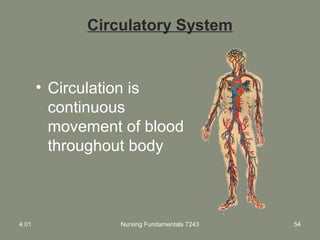
• Circulation is
continuous
movement of blood
throughout body
4.01
Nursing Fundamentals 7243 55
Circulatory System
(continued)
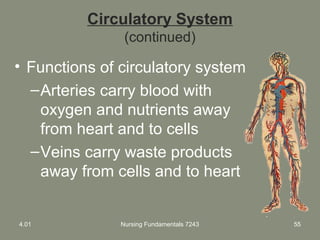
• Functions of circulatory system
–Arteries carry blood with
oxygen and nutrients away
from heart and to cells
–Veins carry waste products
away from cells and to heart
4.01
Nursing Fundamentals 7243 56
Blood
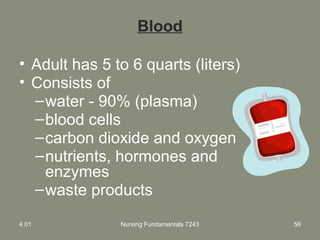
• Adult has 5 to 6 quarts (liters)
• Consists of
–water - 90% (plasma)
–blood cells
–carbon dioxide and oxygen
–nutrients, hormones and
enzymes
–waste products
4.01
Nursing Fundamentals 7243 57
Blood
(continued)
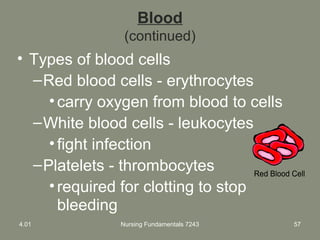
• Types of blood cells
–Red blood cells - erythrocytes
•carry oxygen from blood to cells
–White blood cells - leukocytes
•fight infection
–Platelets - thrombocytes
•required for clotting to stop
bleeding
4.01
Nursing Fundamentals 7243 58
Blood Vessels
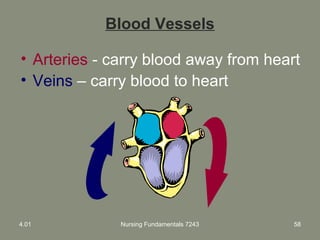
• Arteries - carry blood away from heart
• Veins – carry blood to heart
4.01
Nursing Fundamentals 7243 59
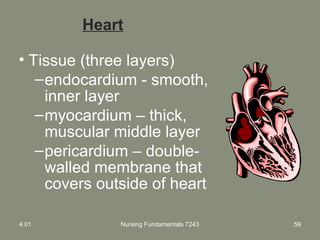
Heart
• Tissue (three layers)
–endocardium - smooth,
inner layer
–myocardium – thick,
muscular middle layer
–pericardium – double-
walled membrane that
covers outside of heart
4.01
Nursing Fundamentals 7243 60
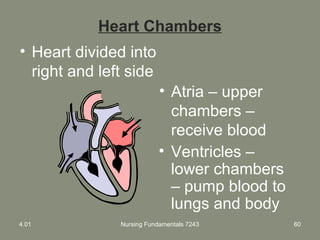
Heart Chambers
• Heart divided into
right and left side
• Atria – upper
chambers –
receive blood
• Ventricles –
lower chambers
– pump blood to
lungs and body
4.01
Nursing Fundamentals 7243 61
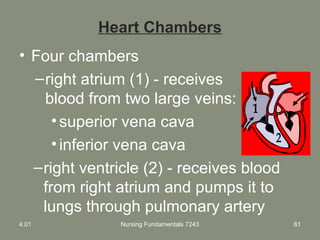
Heart Chambers
• Four chambers
–right atrium (1) - receives
blood from two large veins:
•superior vena cava
•inferior vena cava
–right ventricle (2) - receives blood
from right atrium and pumps it to
lungs through pulmonary artery
4.01
Nursing Fundamentals 7243 62
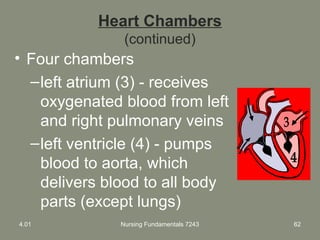
Heart Chambers
(continued)
• Four chambers
–left atrium (3) - receives
oxygenated blood from left
and right pulmonary veins
–left ventricle (4) - pumps
blood to aorta, which
delivers blood to all body
parts (except lungs)
4.01
Nursing Fundamentals 7243 63
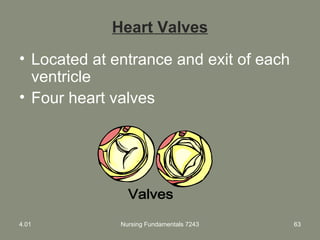
Heart Valves
• Located at entrance and exit of each
ventricle
• Four heart valves
4.01
Nursing Fundamentals 7243 64
Heartbeat
• Systole - contraction of heart muscle
• Diastole - relaxation of heart muscle
• Blood pressure – highest and lowest
pressure against walls of blood
vessels as heart contracts and
relaxes
• Pulse - expansion and contraction of
artery
4.01
Nursing Fundamentals 7243 65
Common Disorders of the
Circulatory System
• Arteriosclerosis - walls of arteries
become thick and harden
• Hypertension - high blood pressure
• Peripheral vascular disease -
decrease in flow of blood to
extremities and brain
• Angina pectoris - chest pain
4.01
Nursing Fundamentals 7243 66
Common Disorders of the
Circulatory System
(continued)
• Varicose veins - enlarged, twisted
veins usually in legs
• Congestive heart failure -
circulatory congestion caused by
weak pumping of heart muscle
• Myocardial infarction (MI) - heart
attack due to blockage in coronary
arteries
4.01
Nursing Fundamentals 7243 67
Common Disorders of the
Circulatory System
(continued)
• Anemia – low red blood cell counts
• Thrombus – blood clot
• Phlebitis – inflammation of vein
• Atherosclerosis - fatty deposits on
walls of arteries that reduce blood
flow
4.01
Nursing Fundamentals 7243 68
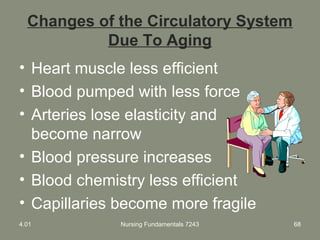
Changes of the Circulatory System
Due To Aging
• Heart muscle less efficient
• Blood pumped with less force
• Arteries lose elasticity and
become narrow
• Blood pressure increases
• Blood chemistry less efficient
• Capillaries become more fragile
4.01
Nursing Fundamentals 7243 69
Observations of the Circulatory
System
• Changes in pulse rate and
blood pressure
• Changes in skin color
• Changes in skin
temperature – coldness
4.01
Nursing Fundamentals 7243 70
Observations of the Circulatory
System
(continued)
• Complaint of dizziness and
headaches
• Complaint of pain in chest
and/or indigestion
• Edema in feet and legs
• Shortness of breath
4.01
Nursing Fundamentals 7243 71
Observations of the Circulatory
System
(continued)
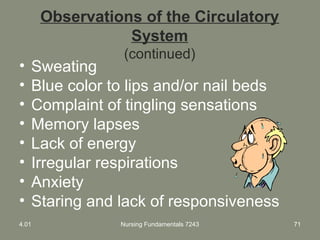
• Sweating
• Blue color to lips and/or nail beds
• Complaint of tingling sensations
• Memory lapses
• Lack of energy
• Irregular respirations
• Anxiety
• Staring and lack of responsiveness
4.01
TTPPR+BP = Vital SignsR+BP = Vital Signs
PULSEPULSE
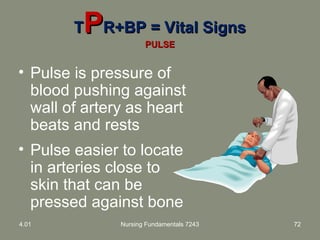
• Pulse is pressure of
blood pushing against
wall of artery as heart
beats and rests
• Pulse easier to locate
in arteries close to
skin that can be
pressed against bone
4.01 Nursing Fundamentals 7243 72
Sites For Taking Pulse
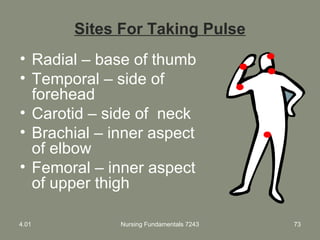
• Radial – base of thumb
• Temporal – side of
forehead
• Carotid – side of neck
• Brachial – inner aspect
of elbow
• Femoral – inner aspect
of upper thigh
4.01 Nursing Fundamentals 7243 73
Sites For Taking Pulse
(continued)
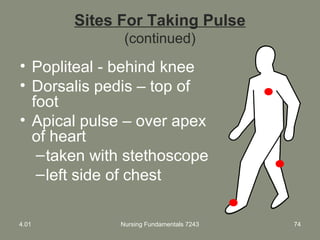
• Popliteal - behind knee
• Dorsalis pedis – top of
foot
• Apical pulse – over apex
of heart
–taken with stethoscope
–left side of chest
4.01 Nursing Fundamentals 7243 74
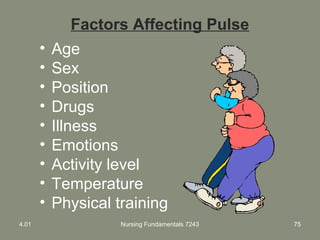
Factors Affecting Pulse
• Age
• Sex
• Position
• Drugs
• Illness
• Emotions
• Activity level
• Temperature
• Physical training
4.01 Nursing Fundamentals 7243 75
Measurement of Pulse
• Normal pulse range/characteristics:
60 -100 beats per minute and regular
• Documenting pulse rate
–Noted as number of beats per
minute
–Rhythm - regular or irregular
–Volume - strong, weak, thready,
bounding
4.01 Nursing Fundamentals 7243 76
4.01 Nursing Fundamentals 7243 77
SKILLSKILL 4.01F4.01F
Count and RecordCount and Record
Radial PulseRadial Pulse
Training Lab AssignmentTraining Lab Assignment
Engage in the Skill Acquisition Process for:Engage in the Skill Acquisition Process for:
4.01 Nursing Fundamentals 7243 78
SKILLSKILL 4.01G4.01G
Measure and RecordMeasure and Record
Apical PulseApical Pulse
Training Lab AssignmentTraining Lab Assignment
Engage in the Skill Acquisition Process for:Engage in the Skill Acquisition Process for:
TPTPRR+BP = Vital Signs+BP = Vital Signs
RESPIRATIONSRESPIRATIONS
4.01 Nursing Fundamentals 7243 79
RESPIRATIONSRESPIRATIONS
Measuring respirations is one way ofMeasuring respirations is one way of
checking on thechecking on the respiratory systemrespiratory system
4.01 Nursing Fundamentals 7243 80
4.01 Nursing Fundamentals 7243 81
Respiratory SystemRespiratory System
Nursing Fundamentals 7243 82
The Respiratory System
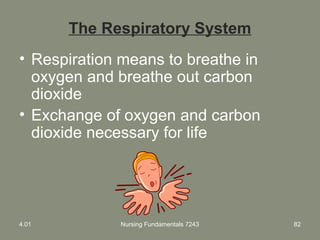
• Respiration means to breathe in
oxygen and breathe out carbon
dioxide
• Exchange of oxygen and carbon
dioxide necessary for life
4.01
Nursing Fundamentals 7243 83
The Respiratory System
(continued)
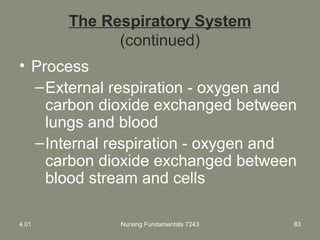
• Process
–External respiration - oxygen and
carbon dioxide exchanged between
lungs and blood
–Internal respiration - oxygen and
carbon dioxide exchanged between
blood stream and cells
4.01
Nursing Fundamentals 7243 84
The Respiratory System
Structure
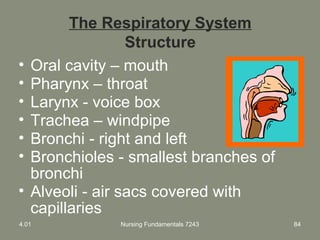
• Oral cavity – mouth
• Pharynx – throat
• Larynx - voice box
• Trachea – windpipe
• Bronchi - right and left
• Bronchioles - smallest branches of
bronchi
• Alveoli - air sacs covered with
capillaries
4.01
Nursing Fundamentals 7243 85
The Respiratory System
Structure
(continued)
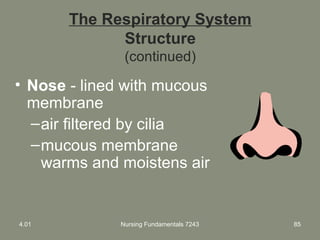
• Nose - lined with mucous
membrane
–air filtered by cilia
–mucous membrane
warms and moistens air
4.01
Nursing Fundamentals 7243 86
The Respiratory System
Structure
(continued)
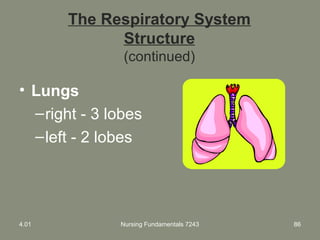
• Lungs
–right - 3 lobes
–left - 2 lobes
4.01
Nursing Fundamentals 7243 87
The Respiratory System
Structure
(continued)
• Pleura – membrane that encloses
lungs
• Diaphragm - muscle that separates
the chest and abdomen
–contraction - draws air into lungs
–relaxation - forces air out of lungs
4.01
Nursing Fundamentals 7243 88
Common Disorders of Respiratory
System
• URI – Upper Respiratory Infection -
infection of nose, throat, larynx,
trachea
• Pneumonia - inflammation or
infection of the lungs
4.01
Nursing Fundamentals 7243 89
Common Disorders of Respiratory
System
(continued)
• Emphysema (Chronic Obstructive
Pulmonary Disease – COPD) –
alveoli become stretched and stiff
preventing adequate exchange of
oxygen and carbon dioxide
• Asthma – spasms of bronchial tube
walls causing narrowing of air
passages usually due to allergies
4.01
Nursing Fundamentals 7243 90
Common Disorders of Respiratory
System
(continued)
• Allergy – reaction to substances that
leads to slight or severe response by
body.
• Influenza – highly contagious URI
• Pleurisy – inflammation of the pleura
surrounding the lungs
4.01
Nursing Fundamentals 7243 91
Common Disorders of Respiratory
System
(continued)
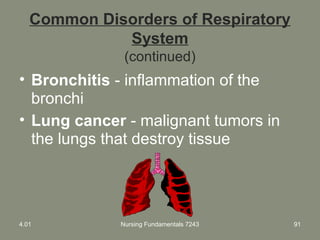
• Bronchitis - inflammation of the
bronchi
• Lung cancer - malignant tumors in
the lungs that destroy tissue
4.01
Nursing Fundamentals 7243 92
Changes in Respiratory System
Due To Aging
• Lung tissue becomes less elastic
• Respiratory muscles weaken
• Number of alveoli decrease
• Respirations increase
• Voice pitched higher and weaker due
to changes in larynx
• Chest wall and structures become
more rigid
4.01
Nursing Fundamentals 7243 93
Observations Of Respiratory System
• Rate and rhythm of respirations
• Respiratory secretions – character
• Character of cough
• Changes in skin color - pale or bluish
gray
• Temperature changes
• Difficulty breathing
4.01
Nursing Fundamentals 7243 94
Observations Of Respiratory System
(continued)
• Color of sputum
• Complaint of pain in
chest, back, sides
• Shortness of breath
• Noisy respirations
• Sneezing
• Gasping for breath
• Anxiety
4.01
Measuring Respirations
• Respiration – process
of taking in oxygen
and expelling carbon
dioxide from lungs
and respiratory tract
4.01 Nursing Fundamentals 7243 95
Measuring Respirations
(continued)
• Age
• Activity
level
• Position
• Drugs
• Sex
• Illness
• Emotions
• Temperature
Factors Affecting Rate
4.01 Nursing Fundamentals 7243 96
Measuring Respirations
(continued)
• Qualities of normal respirations
–12-20 respirations per minute
–Quiet
–Effortless
–Regular
4.01 Nursing Fundamentals 7243 97
Measuring Respirations
(continued)
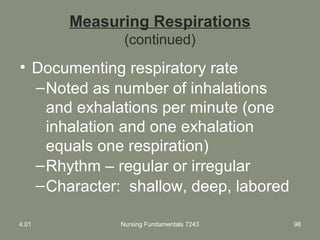
• Documenting respiratory rate
–Noted as number of inhalations
and exhalations per minute (one
inhalation and one exhalation
equals one respiration)
–Rhythm – regular or irregular
–Character: shallow, deep, labored
4.01 Nursing Fundamentals 7243 98
4.01 Nursing Fundamentals 7243 99
SKILLSKILL 4.01H4.01H
Count and RecordCount and Record
RespirationRespiration
Training Lab AssignmentTraining Lab Assignment
Engage in the Skill Acquisition Process for:Engage in the Skill Acquisition Process for:
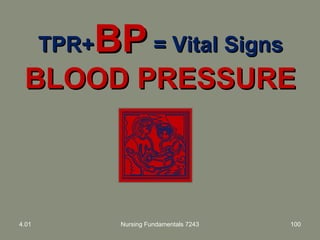
TPR+TPR+BPBP = Vital Signs= Vital Signs
BLOOD PRESSUREBLOOD PRESSURE
4.01 Nursing Fundamentals 7243 100
Blood PressureBlood Pressure
4.01 Nursing Fundamentals 7243 101
Measuring the pulse is one way of
checking on the circulatory system
Measuring Blood Pressure
• Blood pressure is the force of blood
pushing against walls of arteries
–Systolic pressure: greatest force
exerted when heart contracting
–Diastolic pressure: least force
exerted as heart relaxes
4.01 Nursing Fundamentals 7243 102
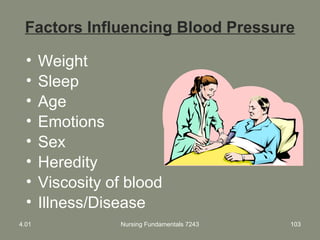
Factors Influencing Blood Pressure
• Weight
• Sleep
• Age
• Emotions
• Sex
• Heredity
• Viscosity of blood
• Illness/Disease
4.01 Nursing Fundamentals 7243 103
Blood Pressure: Equipment
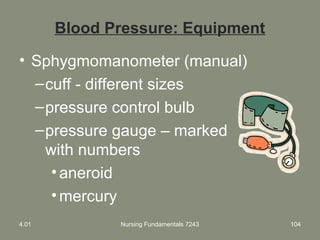
• Sphygmomanometer (manual)
–cuff - different sizes
–pressure control bulb
–pressure gauge – marked
with numbers
•aneroid
•mercury
4.01 Nursing Fundamentals 7243 104
Blood Pressure: Equipment
(continued)
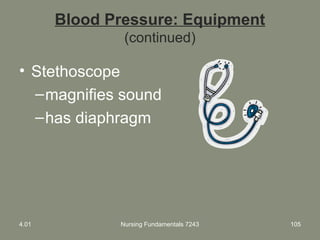
• Stethoscope
–magnifies sound
–has diaphragm
4.01 Nursing Fundamentals 7243 105
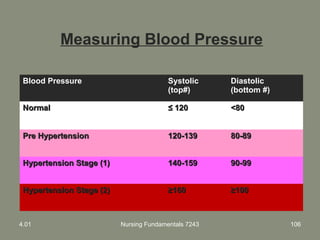
Measuring Blood Pressure
Blood Pressure Systolic
(top#)
Diastolic
(bottom #)
NormalNormal ≤≤ 120120 <80<80
Pre HypertensionPre Hypertension 120-139120-139 80-8980-89
Hypertension Stage (1)Hypertension Stage (1) 140-159140-159 90-9990-99
Hypertension Stage (2)Hypertension Stage (2) ≥≥160160 ≥≥100100
4.01 Nursing Fundamentals 7243 106
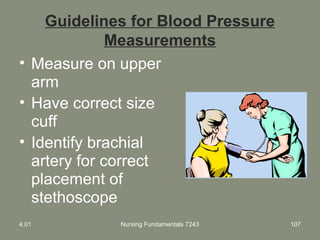
Guidelines for Blood Pressure
Measurements
• Measure on upper
arm
• Have correct size
cuff
• Identify brachial
artery for correct
placement of
stethoscope
4.01 Nursing Fundamentals 7243 107
4.01 Nursing Fundamentals 7243 108
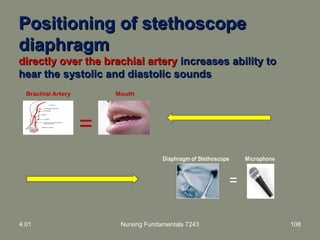
=
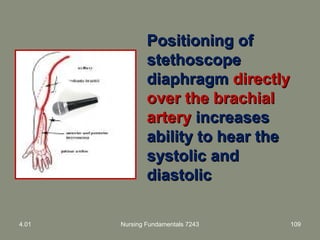
Positioning of stethoscopePositioning of stethoscope
diaphragmdiaphragm
directly over the brachial arterydirectly over the brachial artery increases ability toincreases ability to
hear the systolic and diastolic soundshear the systolic and diastolic sounds
4.01 Nursing Fundamentals 7243 109
Positioning ofPositioning of
stethoscopestethoscope
diaphragmdiaphragm directlydirectly
over the brachialover the brachial
arteryartery increasesincreases
ability to hear theability to hear the
systolic andsystolic and
diastolicdiastolic
Guidelines for Blood Pressure
Measurements
(continued)
• First sound heard –
systolic pressure
• Last sound heard or
change - diastolic
pressure
4.01 Nursing Fundamentals 7243 110
4.01 Nursing Fundamentals 7243 111
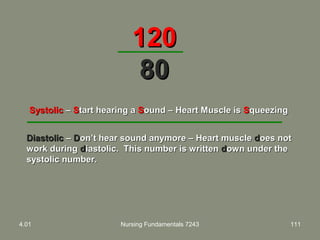
SystolicSystolic –– SStart hearing atart hearing a SSound – Heart Muscle isound – Heart Muscle is SSqueezingqueezing
DiastolicDiastolic –– DDon’t hear sound anymore – Heart muscleon’t hear sound anymore – Heart muscle ddoes notoes not
work duringwork during ddiastolic. This number is writteniastolic. This number is written ddown under theown under the
systolic number.systolic number.
120120
8080
Guidelines for Blood Pressure
Measurements
(continued)
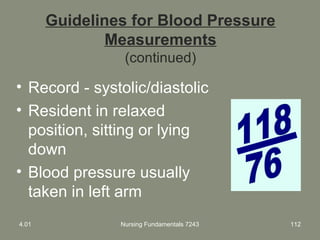
• Record - systolic/diastolic
• Resident in relaxed
position, sitting or lying
down
• Blood pressure usually
taken in left arm
4.01 Nursing Fundamentals 7243 112
Guidelines for Blood Pressure
Measurements
(continued)
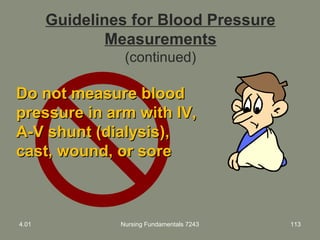
Do not measure bloodDo not measure blood
pressure in arm with IV,pressure in arm with IV,
A-V shunt (dialysis),A-V shunt (dialysis),
cast, wound, or sorecast, wound, or sore
4.01 Nursing Fundamentals 7243 113
Guidelines for Blood Pressure
Measurements
(continued)
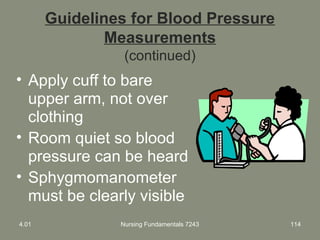
• Apply cuff to bare
upper arm, not over
clothing
• Room quiet so blood
pressure can be heard
• Sphygmomanometer
must be clearly visible
4.01 Nursing Fundamentals 7243 114
Blood Pressure: Reading Gauge
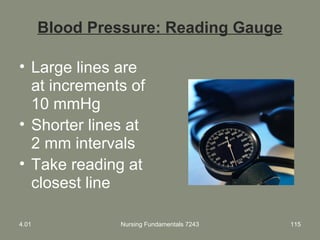
• Large lines are
at increments of
10 mmHg
• Shorter lines at
2 mm intervals
• Take reading at
closest line
4.01 Nursing Fundamentals 7243 115
4.01 Nursing Fundamentals 7243 116
SKILLSKILL 4.01I4.01I
Measure Blood PressureMeasure Blood Pressure
ManualManual
Training Lab AssignmentTraining Lab Assignment
Engage in the Skill Acquisition Process for:Engage in the Skill Acquisition Process for:
4.01 Nursing Fundamentals 7243 117
SKILLSKILL 4.01J4.01J
Combined Vital SignsCombined Vital Signs
Training Lab AssignmentTraining Lab Assignment
Engage in the Skill Acquisition Process for:Engage in the Skill Acquisition Process for:
4.01 Nursing Fundamentals 7243 118
MeasuringMeasuring
Height and WeightHeight and Weight
The resident’sThe resident’s weightweight,,
compared with thecompared with the heightheight,,
gives information aboutgives information about
his/herhis/her nutritional statusnutritional status
and changes in theand changes in the medicalmedical
condition.condition.
4.01 Nursing Fundamentals 7243 119
Measuring Height And Weight
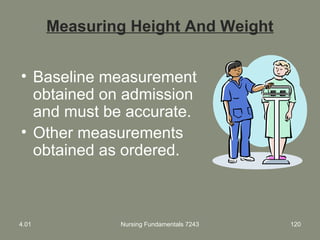
• Baseline measurement
obtained on admission
and must be accurate.
• Other measurements
obtained as ordered.
4.01 Nursing Fundamentals 7243 120
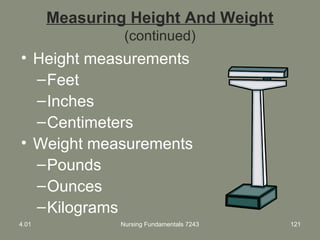
Measuring Height And Weight
(continued)
• Height measurements
–Feet
–Inches
–Centimeters
• Weight measurements
–Pounds
–Ounces
–Kilograms
4.01 Nursing Fundamentals 7243 121
Measuring Height and Weight
(continued)
• Reasons for obtaining height and
weight
–Indicator of nutritional status
–Indicator of change in medical
condition
–Used by doctor to order medications
4.01 Nursing Fundamentals 7243 122
Special Case for Height
Measurement
• Residents who are contractured or
• Residents who cannot stand
• Must be measured using a tape
measure
4.01 Nursing Fundamentals 7243 123
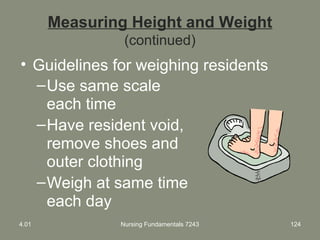
Measuring Height and Weight
(continued)
–Use same scale
each time
–Have resident void,
remove shoes and
outer clothing
–Weigh at same time
each day
• Guidelines for weighing residents
4.01 Nursing Fundamentals 7243 124
Measuring Height and Weight
(continued)
• Scales
–Remain more accurate if moved as
little as possible.
–Various types of scales
•bathroom scale
•standing scale
•scales attached to hydraulic lifts
•wheelchair scales
•bed scales
4.01 Nursing Fundamentals 7243 125
4.01 Nursing Fundamentals 7243 126
SKILLSKILL 4.01K4.01K
Measure HeightMeasure Height
& Weight& Weight
Training Lab AssignmentTraining Lab Assignment
Engage in the Skill Acquisition Process for:Engage in the Skill Acquisition Process for:
UnderstandUnderstand vital signsvital signs,, heightheight, and, and
weightweight measurement skills.measurement skills.
127
 ENDEND 
4.014.01
4.01 Nursing Fundamentals 7243

4.01 ppt height weight measurements

  • 1.
    UnderstandingUnderstanding vitalvital signs, height,signs,height, andand weightweight measurementmeasurement skills.skills. Unit BUnit B Resident Care SkillsResident Care Skills Essential Standard NA4.00Essential Standard NA4.00 Understand nurse aide skills related to the residents’ vital function and movementUnderstand nurse aide skills related to the residents’ vital function and movement Indicator 4.01Indicator 4.01 Understand vital signs, height, and weight skills.Understand vital signs, height, and weight skills. 4.01 Nursing Fundamentals 7243 1
  • 2.
    FF YY II-- Intentional RepeatIntentional Repeat There is intentional repeat of some HSIIThere is intentional repeat of some HSII course content in Nursing Fundamentals.course content in Nursing Fundamentals. Repeating course content distributes learningRepeating course content distributes learning over time and increases long term memory.over time and increases long term memory. Academic and skill competence must beAcademic and skill competence must be maintained at amaintained at a very high level for directvery high level for direct resident careresident care.. 4.01 Nursing Fundamentals 7243 2
  • 3.
    IntroductionIntroduction IndicatorIndicator 4.014.01 introducesintroduces skillsthe nurse aide will needskills the nurse aide will need to measure and record theto measure and record the resident’sresident’s vital signsvital signs,, heightheight andand weightweight.. 4.01 Nursing Fundamentals 7243 3
  • 4.
    provide informationprovide information aboutaboutchangeschanges inin normal body functionnormal body function and theand the resident’sresident’s response to treatmentresponse to treatment.. 4.01 Nursing Fundamentals 7243 4 Vital SignsVital Signs
  • 5.
    Often theOften the FIRSTFIRST signsignthatthat there is athere is a problem!problem! 4.01 Nursing Fundamentals 7243 5 Vital SignsVital Signs
  • 6.
    TPR+BP =TPR+BP =Vital SignsVital Signs 4.01 Nursing Fundamentals 7243 6
  • 7.
    TPR+BP = VitalSignsTPR+BP = Vital Signs • Reflect the function of three body processes that are essential for life. –Regulation of body temperature –Heart function –Breathing 4.01 Nursing Fundamentals 7243 7
  • 8.
    TPR+BP = VitalSignsTPR+BP = Vital Signs • Abbreviations: –Temperature – T –Pulse – P –Respirations – R –Blood Pressure – BP –Vital signs - TPR and BP 4.01 Nursing Fundamentals 7243 8
  • 9.
    TPR+BP = VitalSignsTPR+BP = Vital Signs • Purpose –Measured to detect any changes in normal body function –Used to determine response to treatment 4.01 Nursing Fundamentals 7243 9
  • 10.
    TTPR+BP = VitalSignsPR+BP = Vital Signs TemperatureTemperature 4.01 Nursing Fundamentals 7243 10
  • 11.
    TTPR+BP = VitalSignsPR+BP = Vital Signs TemperatureTemperature • Heat production –muscles –glands –oxidation of food • Heat loss –respiration –perspiration –excretion 4.01 Nursing Fundamentals 7243 11
  • 12.
    TTPR+BP = VitalSignsPR+BP = Vital Signs TemperatureTemperature Balance between heat production and heat loss is body temperaturetemperature 4.01 Nursing Fundamentals 7243 12
  • 13.
    Factors Affecting Temperature •Exercise • Illness • Age • Time of day • Medications • Infection • Emotions • Hydration • Clothing • Environmental temperature/air movement 4.01 Nursing Fundamentals 7243 13
  • 14.
    Equipment - Thermometer •Instrument used to measure body temperature • Types –Non-mercury glass •oral •rectal 4.01 Nursing Fundamentals 7243 14
  • 15.
    Equipment - Thermometer •Types (continued) –chemically treated paper – disposable –plastic – disposable –electronic - probe covered with disposable shield –tympanic - electronic probe used in the ear 4.01 Nursing Fundamentals 7243 15
  • 16.
    Electronic ThermometersElectronic Thermometers ElectronicElectronic Canbe used for oral,Can be used for oral, rectal, or axillaryrectal, or axillary BlueBlue probe for oralprobe for oral RedRed probe for rectalprobe for rectal Disposable probe coversDisposable probe covers prevent cross-prevent cross- contaminationcontamination 4.01 Nursing Fundamentals 7243 16
  • 17.
    Aural/Tympanic TemperatureAural/Tympanic Temperature -taken in the ear - measures the thermal infrared energy radiating from the blood vessels in the eardrum - position and ear wax can affect readings -left in until it beeps -temperature is calculated into an equivalent by mode 4.01 Nursing Fundamentals 7243 17
  • 18.
    Positioning the PatientsEar forPositioning the Patients Ear for Tympanic temperatureTympanic temperature • Infants under 1 year – Pull ear pinna straight back • Infants over 1 year and adults – Pull ear pinna straight back and down • Positioning the pinna correctly straightens the auditory canal so the probe will point directly at the tympanic membrane – Pull ear pinna straight back and down 4.01 Nursing Fundamentals 7243 18
  • 19.
  • 20.
    Placement of theOralPlacement of the Oral ThermometerThermometer Put the bulb tipPut the bulb tip of theof the thermometer inthermometer in thethe “hot“hot pocket”pocket” underunder the tongue.the tongue. 4.01 Nursing Fundamentals 7243 20
  • 21.
    Normal Temperature RangeFor Adults • Oral - 97.6° - 99.6° F (Fahrenheit) or 36.5° -37.5° C (Celsius) • Rectal - 98.6° - 100.6° F or 37.0° - 38.1° C • Axillary - 96.6° - 98.6° F or 36.0° - 37.0° C 4.01 Nursing Fundamentals 7243 21
  • 22.
    “Tic-Tac-Know” Normal Range ForAdult Temperature FREE SPACE 98.6°F is the FREE SPACE 4.01 Nursing Fundamentals 7243 22
  • 23.
    “Tic-Tac-Know” Normal Range ForAdult Temperature ORALORAL 98.6°F 98.6°F is the98.6°F is the averageaverage oral temperatureoral temperature for adults and it falls in thefor adults and it falls in the middle of themiddle of the normal range.normal range. 4.01 Nursing Fundamentals 7243 23
  • 24.
    “Tic-Tac-Know” Normal Range ForAdult Temperature ORALORAL 98.6°F98.6°F 99.6°F99.6°F Add one degree to 98.6°F then place the results in the oral space to the right 4.01 Nursing Fundamentals 7243 24
  • 25.
    “Tic-Tac-Know” Normal Range ForAdult Temperature ORALORAL 97.697.6 98.698.6 99.699.6 Subtract one degree from 98.6 then place the results in the oral space to the left 4.01 Nursing Fundamentals 7243 25
  • 26.
    “Tic-Tac-Know” Normal Range ForAdult Temperature ORALORAL 97.6°97.6° 98.698.6 99.699.6 TheThe averageaverage adult temperature takenadult temperature taken orally isorally is 98.6° F98.6° F and theand the RANGERANGE isis 97.6° F97.6° F toto 99.6° F.99.6° F. 4.01 Nursing Fundamentals 7243 26
  • 27.
    “Tic-Tac-Know” Normal Range ForAdult Temperature ORALORAL 97.6°F97.6°F 98.6°F98.6°F 99.6°F99.6°F RECTALRECTAL 99.6°F99.6°F Body heatBody heat REGISTERSREGISTERS one degreeone degree warmerwarmer when thewhen the temperature is takentemperature is taken RECTALLY ®RECTALLY ®. Add one degree. Add one degree to 98.6°F then place the results in the space belowto 98.6°F then place the results in the space below 98.6°F98.6°F 4.01 Nursing Fundamentals 7243 27
  • 28.
    “Tic-Tac-Know” Normal Range ForAdult Temperature ORALORAL 97.6°F97.6°F 98.6°F98.6°F 99.6°F99.6°F RECTARECTA LL 99.6°F99.6°F 100.6°F100.6°F Add one degree to 99.6°F then place the results in theAdd one degree to 99.6°F then place the results in the rectal space to the right.rectal space to the right. 4.01 Nursing Fundamentals 7243 28
  • 29.
    “Tic-Tac-Know” Normal Range ForAdult Temperature ORALORAL 97.6°F97.6°F 98.6°F98.6°F 99.6°F99.6°F RECTARECTA LL 98.698.6 99.6°F99.6°F 100.6°F100.6°F Subtract one degree from 99.6°F then place theSubtract one degree from 99.6°F then place the results in the rectal space to the left.results in the rectal space to the left. 4.01 Nursing Fundamentals 7243 29
  • 30.
    “Tic-Tac-Know” Normal Range ForAdult Temperature ORALORAL 97.6°F97.6°F 98.6°F98.6°F 99.6°F99.6°F RECTARECTA LL 98.698.6 99.6°F99.6°F 100.6°F100.6°F TheThe averageaverage adult temperature takenadult temperature taken RECTALLYRECTALLY isis 99.6° F99.6° F and theand the RANGERANGE isis 98.6° F98.6° F toto 100.6° F.100.6° F. 4.01 Nursing Fundamentals 7243 30
  • 31.
    “Tic-Tac-Know” Normal Range ForAdult Temperature AXILLARYAXILLARY or GROINor GROIN 97.697.6 ORALORAL 97.6°F97.6°F 98.6°F98.6°F 99.6°F99.6°F RECTALRECTAL 98.698.6 99.6°F99.6°F 100.6°F100.6°F Body heatBody heat REGISTERSREGISTERS one degreeone degree COOLERCOOLER when the temperaturewhen the temperature is takenis taken AXILLARY (Ax)AXILLARY (Ax) or in theor in the GROIN.GROIN. Subtract one degree fromSubtract one degree from 98.6°F then place the results in the space98.6°F then place the results in the space aboveabove 98.6°F98.6°F 4.01 Nursing Fundamentals 7243 31
  • 32.
    “Tic-Tac-Know” Normal Range ForAdult Temperature AXILLARYAXILLARY or GROINor GROIN 97.6°F97.6°F 98.698.6 ORALORAL 97.6°F97.6°F 98.6°F98.6°F 99.6°F99.6°F RECTALRECTAL 98.698.6 99.6°F99.6°F 100.6°F100.6°F Add one degree to 97.6°F then place the results to the rightAdd one degree to 97.6°F then place the results to the right of 97.6°Fof 97.6°F 4.01 Nursing Fundamentals 7243 32
  • 33.
    “Tic-Tac-Know” Normal Range ForAdult Temperature AXILLARYAXILLARY or GROINor GROIN 96.6°96.6° 97.6°F97.6°F 98.698.6 ORALORAL 97.6°F97.6°F 98.6°F98.6°F 99.6°F99.6°F RECTALRECTAL 98.698.6 99.6°F99.6°F 100.6°F100.6°F Subtract one degree from 97.6°F then place the results toSubtract one degree from 97.6°F then place the results to the left of 97.6°Fthe left of 97.6°F 4.01 Nursing Fundamentals 7243 33
  • 34.
    “Tic-Tac-Know” Normal Range ForAdult Temperature AXILLARYAXILLARY or GROINor GROIN 96.6°96.6° 97.6°F97.6°F 98.698.6 ORALORAL 97.6°F97.6°F 98.6°F98.6°F 99.6°F99.6°F RECTALRECTAL 98.698.6 99.6°F99.6°F 100.6°F100.6°F YOU MUST RECORD THEYOU MUST RECORD THE LOCATION WHERE THELOCATION WHERE THE TEMPERATURE WAS TAKENTEMPERATURE WAS TAKEN IN ORDER TO INTERPRETIN ORDER TO INTERPRET NORMAL FROM ABNORMAL !NORMAL FROM ABNORMAL ! 4.01 Nursing Fundamentals 7243 34
  • 35.
    “Tic-Tac-Know” Normal Range ForAdult Temperature AXILLARYAXILLARY or GROINor GROIN (Ax)(Ax) oror GroinGroin <Pic of<Pic of Groin>Groin> ORALORAL OO If no location isIf no location is indicated, the oralindicated, the oral route is assumedroute is assumed RECTALRECTAL (R)(R) YOU MUST RECORD THE LOCATION WHERE THEYOU MUST RECORD THE LOCATION WHERE THE TEMPERATURE WAS TAKEN IN ORDER TO INTERPRETTEMPERATURE WAS TAKEN IN ORDER TO INTERPRET NORMAL FROM ABNORMAL !NORMAL FROM ABNORMAL ! 4.01 Nursing Fundamentals 7243 35
  • 36.
    To Read ANon-mercury Glass Thermometer • Hold eye level • Locate solid column of liquid in the glass • Observe lines on scale at upper side of column of liquid in the glass 4.01 Nursing Fundamentals 7243 36
  • 37.
    To Read ANon-mercury Glass Thermometer (continued) • Read at point where liquid ends • If liquid falls between two lines, read it to closest line –long line represents degree –short line represents 0.2 of a degree Fahrenheit 4.01 Nursing Fundamentals 7243 37
  • 38.
  • 39.
  • 40.
    Sites To TakeA Temperature • Oral – most common • Rectal – registers one degree Fahrenheit higher than oral • Axillary – least accurate; registers one degree Fahrenheit lower than oral • Tympanic – probe inserted into the ear canal 4.01 Nursing Fundamentals 7243 40
  • 41.
    Sites To TakeA Temperature (continued) Condition of resident determines which is the best site for measuring body temperature 4.01 Nursing Fundamentals 7243 41
  • 42.
    Temperature: Safety Precautions •Hold rectal and axillary thermometers in place • Stay with resident when taking temperature • Check glass thermometers for chips • Prior to use, shake liquid in glass down • Shake thermometer away from resident and hard objects 4.01 Nursing Fundamentals 7243 42
  • 43.
    Temperature: Safety Precautions (continued) •Wipe from “handle” end toward bulb tip of thermometer prior to reading • Delay taking oral temperature for 10 - 15 minutes if resident has been smoking, eating or drinking hot/cold liquids. 4.01 Nursing Fundamentals 7243 43
  • 44.
    Temperature ConditionsTemperature Conditions •HyperthermiaHyperthermia – Increased body temp – Body temp >104ºF – >106 ºF will cause convulsions and death • FeverFever - temp over 101 ºF R - Due to illness or injury 4.01 Nursing Fundamentals 7243 44
  • 45.
    Temperature ConditionsTemperature Conditions •HypothermiaHypothermia – Body temp below – 96 ºF – due to exposure to cold temperatures – Depends on core temperature, age and length of exposure 4.01 Nursing Fundamentals 7243 45
  • 46.
    4.01 Nursing Fundamentals7243 46 SKILLSKILL 4.01A4.01A Oral temperature using a non-mercuryOral temperature using a non-mercury glass thermometerglass thermometer Training Lab AssignmentTraining Lab Assignment Engage in the Skill Acquisition Process for:Engage in the Skill Acquisition Process for:
  • 47.
    4.01 Nursing Fundamentals7243 47 SKILLSKILL 4.01B4.01B Axillary temperature using aAxillary temperature using a non-mercury glass thermometernon-mercury glass thermometer Training Lab AssignmentTraining Lab Assignment Engage in the Skill Acquisition Process for:Engage in the Skill Acquisition Process for:
  • 48.
    4.01 Nursing Fundamentals7243 48 SKILLSKILL 4.01C4.01C Rectal Temperature using aRectal Temperature using a non-mercury glass thermometernon-mercury glass thermometer Training Lab AssignmentTraining Lab Assignment Engage in the Skill Acquisition Process for:Engage in the Skill Acquisition Process for:
  • 49.
    4.01 Nursing Fundamentals7243 49 SKILLSKILL 4.01Dto4.01Dto Measure Temperature withMeasure Temperature with Electronic ThermometerElectronic Thermometer Training Lab AssignmentTraining Lab Assignment Engage in the Skill Acquisition Process for:Engage in the Skill Acquisition Process for:
  • 50.
    4.01 Nursing Fundamentals7243 50 SKILLSKILL 4.01E4.01E Measure Temperature withMeasure Temperature with Tympanic ThermometerTympanic Thermometer Training Lab AssignmentTraining Lab Assignment Engage in the Skill Acquisition Process for:Engage in the Skill Acquisition Process for:
  • 51.
    TTPPR+BP = VitalSignsR+BP = Vital Signs PULSEPULSE 4.01 Nursing Fundamentals 7243 51
  • 52.
    PULSEPULSE 4.01 Nursing Fundamentals7243 52 Measuring the pulse is one way of checking on the circulatory system
  • 53.
    4.01 Nursing Fundamentals7243 53 Circulatory SystemCirculatory System
  • 54.
    Nursing Fundamentals 724354 Circulatory System • Circulation is continuous movement of blood throughout body 4.01
  • 55.
    Nursing Fundamentals 724355 Circulatory System (continued) • Functions of circulatory system –Arteries carry blood with oxygen and nutrients away from heart and to cells –Veins carry waste products away from cells and to heart 4.01
  • 56.
    Nursing Fundamentals 724356 Blood • Adult has 5 to 6 quarts (liters) • Consists of –water - 90% (plasma) –blood cells –carbon dioxide and oxygen –nutrients, hormones and enzymes –waste products 4.01
  • 57.
    Nursing Fundamentals 724357 Blood (continued) • Types of blood cells –Red blood cells - erythrocytes •carry oxygen from blood to cells –White blood cells - leukocytes •fight infection –Platelets - thrombocytes •required for clotting to stop bleeding 4.01
  • 58.
    Nursing Fundamentals 724358 Blood Vessels • Arteries - carry blood away from heart • Veins – carry blood to heart 4.01
  • 59.
    Nursing Fundamentals 724359 Heart • Tissue (three layers) –endocardium - smooth, inner layer –myocardium – thick, muscular middle layer –pericardium – double- walled membrane that covers outside of heart 4.01
  • 60.
    Nursing Fundamentals 724360 Heart Chambers • Heart divided into right and left side • Atria – upper chambers – receive blood • Ventricles – lower chambers – pump blood to lungs and body 4.01
  • 61.
    Nursing Fundamentals 724361 Heart Chambers • Four chambers –right atrium (1) - receives blood from two large veins: •superior vena cava •inferior vena cava –right ventricle (2) - receives blood from right atrium and pumps it to lungs through pulmonary artery 4.01
  • 62.
    Nursing Fundamentals 724362 Heart Chambers (continued) • Four chambers –left atrium (3) - receives oxygenated blood from left and right pulmonary veins –left ventricle (4) - pumps blood to aorta, which delivers blood to all body parts (except lungs) 4.01
  • 63.
    Nursing Fundamentals 724363 Heart Valves • Located at entrance and exit of each ventricle • Four heart valves 4.01
  • 64.
    Nursing Fundamentals 724364 Heartbeat • Systole - contraction of heart muscle • Diastole - relaxation of heart muscle • Blood pressure – highest and lowest pressure against walls of blood vessels as heart contracts and relaxes • Pulse - expansion and contraction of artery 4.01
  • 65.
    Nursing Fundamentals 724365 Common Disorders of the Circulatory System • Arteriosclerosis - walls of arteries become thick and harden • Hypertension - high blood pressure • Peripheral vascular disease - decrease in flow of blood to extremities and brain • Angina pectoris - chest pain 4.01
  • 66.
    Nursing Fundamentals 724366 Common Disorders of the Circulatory System (continued) • Varicose veins - enlarged, twisted veins usually in legs • Congestive heart failure - circulatory congestion caused by weak pumping of heart muscle • Myocardial infarction (MI) - heart attack due to blockage in coronary arteries 4.01
  • 67.
    Nursing Fundamentals 724367 Common Disorders of the Circulatory System (continued) • Anemia – low red blood cell counts • Thrombus – blood clot • Phlebitis – inflammation of vein • Atherosclerosis - fatty deposits on walls of arteries that reduce blood flow 4.01
  • 68.
    Nursing Fundamentals 724368 Changes of the Circulatory System Due To Aging • Heart muscle less efficient • Blood pumped with less force • Arteries lose elasticity and become narrow • Blood pressure increases • Blood chemistry less efficient • Capillaries become more fragile 4.01
  • 69.
    Nursing Fundamentals 724369 Observations of the Circulatory System • Changes in pulse rate and blood pressure • Changes in skin color • Changes in skin temperature – coldness 4.01
  • 70.
    Nursing Fundamentals 724370 Observations of the Circulatory System (continued) • Complaint of dizziness and headaches • Complaint of pain in chest and/or indigestion • Edema in feet and legs • Shortness of breath 4.01
  • 71.
    Nursing Fundamentals 724371 Observations of the Circulatory System (continued) • Sweating • Blue color to lips and/or nail beds • Complaint of tingling sensations • Memory lapses • Lack of energy • Irregular respirations • Anxiety • Staring and lack of responsiveness 4.01
  • 72.
    TTPPR+BP = VitalSignsR+BP = Vital Signs PULSEPULSE • Pulse is pressure of blood pushing against wall of artery as heart beats and rests • Pulse easier to locate in arteries close to skin that can be pressed against bone 4.01 Nursing Fundamentals 7243 72
  • 73.
    Sites For TakingPulse • Radial – base of thumb • Temporal – side of forehead • Carotid – side of neck • Brachial – inner aspect of elbow • Femoral – inner aspect of upper thigh 4.01 Nursing Fundamentals 7243 73
  • 74.
    Sites For TakingPulse (continued) • Popliteal - behind knee • Dorsalis pedis – top of foot • Apical pulse – over apex of heart –taken with stethoscope –left side of chest 4.01 Nursing Fundamentals 7243 74
  • 75.
    Factors Affecting Pulse •Age • Sex • Position • Drugs • Illness • Emotions • Activity level • Temperature • Physical training 4.01 Nursing Fundamentals 7243 75
  • 76.
    Measurement of Pulse •Normal pulse range/characteristics: 60 -100 beats per minute and regular • Documenting pulse rate –Noted as number of beats per minute –Rhythm - regular or irregular –Volume - strong, weak, thready, bounding 4.01 Nursing Fundamentals 7243 76
  • 77.
    4.01 Nursing Fundamentals7243 77 SKILLSKILL 4.01F4.01F Count and RecordCount and Record Radial PulseRadial Pulse Training Lab AssignmentTraining Lab Assignment Engage in the Skill Acquisition Process for:Engage in the Skill Acquisition Process for:
  • 78.
    4.01 Nursing Fundamentals7243 78 SKILLSKILL 4.01G4.01G Measure and RecordMeasure and Record Apical PulseApical Pulse Training Lab AssignmentTraining Lab Assignment Engage in the Skill Acquisition Process for:Engage in the Skill Acquisition Process for:
  • 79.
    TPTPRR+BP = VitalSigns+BP = Vital Signs RESPIRATIONSRESPIRATIONS 4.01 Nursing Fundamentals 7243 79
  • 80.
    RESPIRATIONSRESPIRATIONS Measuring respirations isone way ofMeasuring respirations is one way of checking on thechecking on the respiratory systemrespiratory system 4.01 Nursing Fundamentals 7243 80
  • 81.
    4.01 Nursing Fundamentals7243 81 Respiratory SystemRespiratory System
  • 82.
    Nursing Fundamentals 724382 The Respiratory System • Respiration means to breathe in oxygen and breathe out carbon dioxide • Exchange of oxygen and carbon dioxide necessary for life 4.01
  • 83.
    Nursing Fundamentals 724383 The Respiratory System (continued) • Process –External respiration - oxygen and carbon dioxide exchanged between lungs and blood –Internal respiration - oxygen and carbon dioxide exchanged between blood stream and cells 4.01
  • 84.
    Nursing Fundamentals 724384 The Respiratory System Structure • Oral cavity – mouth • Pharynx – throat • Larynx - voice box • Trachea – windpipe • Bronchi - right and left • Bronchioles - smallest branches of bronchi • Alveoli - air sacs covered with capillaries 4.01
  • 85.
    Nursing Fundamentals 724385 The Respiratory System Structure (continued) • Nose - lined with mucous membrane –air filtered by cilia –mucous membrane warms and moistens air 4.01
  • 86.
    Nursing Fundamentals 724386 The Respiratory System Structure (continued) • Lungs –right - 3 lobes –left - 2 lobes 4.01
  • 87.
    Nursing Fundamentals 724387 The Respiratory System Structure (continued) • Pleura – membrane that encloses lungs • Diaphragm - muscle that separates the chest and abdomen –contraction - draws air into lungs –relaxation - forces air out of lungs 4.01
  • 88.
    Nursing Fundamentals 724388 Common Disorders of Respiratory System • URI – Upper Respiratory Infection - infection of nose, throat, larynx, trachea • Pneumonia - inflammation or infection of the lungs 4.01
  • 89.
    Nursing Fundamentals 724389 Common Disorders of Respiratory System (continued) • Emphysema (Chronic Obstructive Pulmonary Disease – COPD) – alveoli become stretched and stiff preventing adequate exchange of oxygen and carbon dioxide • Asthma – spasms of bronchial tube walls causing narrowing of air passages usually due to allergies 4.01
  • 90.
    Nursing Fundamentals 724390 Common Disorders of Respiratory System (continued) • Allergy – reaction to substances that leads to slight or severe response by body. • Influenza – highly contagious URI • Pleurisy – inflammation of the pleura surrounding the lungs 4.01
  • 91.
    Nursing Fundamentals 724391 Common Disorders of Respiratory System (continued) • Bronchitis - inflammation of the bronchi • Lung cancer - malignant tumors in the lungs that destroy tissue 4.01
  • 92.
    Nursing Fundamentals 724392 Changes in Respiratory System Due To Aging • Lung tissue becomes less elastic • Respiratory muscles weaken • Number of alveoli decrease • Respirations increase • Voice pitched higher and weaker due to changes in larynx • Chest wall and structures become more rigid 4.01
  • 93.
    Nursing Fundamentals 724393 Observations Of Respiratory System • Rate and rhythm of respirations • Respiratory secretions – character • Character of cough • Changes in skin color - pale or bluish gray • Temperature changes • Difficulty breathing 4.01
  • 94.
    Nursing Fundamentals 724394 Observations Of Respiratory System (continued) • Color of sputum • Complaint of pain in chest, back, sides • Shortness of breath • Noisy respirations • Sneezing • Gasping for breath • Anxiety 4.01
  • 95.
    Measuring Respirations • Respiration– process of taking in oxygen and expelling carbon dioxide from lungs and respiratory tract 4.01 Nursing Fundamentals 7243 95
  • 96.
    Measuring Respirations (continued) • Age •Activity level • Position • Drugs • Sex • Illness • Emotions • Temperature Factors Affecting Rate 4.01 Nursing Fundamentals 7243 96
  • 97.
    Measuring Respirations (continued) • Qualitiesof normal respirations –12-20 respirations per minute –Quiet –Effortless –Regular 4.01 Nursing Fundamentals 7243 97
  • 98.
    Measuring Respirations (continued) • Documentingrespiratory rate –Noted as number of inhalations and exhalations per minute (one inhalation and one exhalation equals one respiration) –Rhythm – regular or irregular –Character: shallow, deep, labored 4.01 Nursing Fundamentals 7243 98
  • 99.
    4.01 Nursing Fundamentals7243 99 SKILLSKILL 4.01H4.01H Count and RecordCount and Record RespirationRespiration Training Lab AssignmentTraining Lab Assignment Engage in the Skill Acquisition Process for:Engage in the Skill Acquisition Process for:
  • 100.
    TPR+TPR+BPBP = VitalSigns= Vital Signs BLOOD PRESSUREBLOOD PRESSURE 4.01 Nursing Fundamentals 7243 100
  • 101.
    Blood PressureBlood Pressure 4.01Nursing Fundamentals 7243 101 Measuring the pulse is one way of checking on the circulatory system
  • 102.
    Measuring Blood Pressure •Blood pressure is the force of blood pushing against walls of arteries –Systolic pressure: greatest force exerted when heart contracting –Diastolic pressure: least force exerted as heart relaxes 4.01 Nursing Fundamentals 7243 102
  • 103.
    Factors Influencing BloodPressure • Weight • Sleep • Age • Emotions • Sex • Heredity • Viscosity of blood • Illness/Disease 4.01 Nursing Fundamentals 7243 103
  • 104.
    Blood Pressure: Equipment •Sphygmomanometer (manual) –cuff - different sizes –pressure control bulb –pressure gauge – marked with numbers •aneroid •mercury 4.01 Nursing Fundamentals 7243 104
  • 105.
    Blood Pressure: Equipment (continued) •Stethoscope –magnifies sound –has diaphragm 4.01 Nursing Fundamentals 7243 105
  • 106.
    Measuring Blood Pressure BloodPressure Systolic (top#) Diastolic (bottom #) NormalNormal ≤≤ 120120 <80<80 Pre HypertensionPre Hypertension 120-139120-139 80-8980-89 Hypertension Stage (1)Hypertension Stage (1) 140-159140-159 90-9990-99 Hypertension Stage (2)Hypertension Stage (2) ≥≥160160 ≥≥100100 4.01 Nursing Fundamentals 7243 106
  • 107.
    Guidelines for BloodPressure Measurements • Measure on upper arm • Have correct size cuff • Identify brachial artery for correct placement of stethoscope 4.01 Nursing Fundamentals 7243 107
  • 108.
    4.01 Nursing Fundamentals7243 108 = Positioning of stethoscopePositioning of stethoscope diaphragmdiaphragm directly over the brachial arterydirectly over the brachial artery increases ability toincreases ability to hear the systolic and diastolic soundshear the systolic and diastolic sounds
  • 109.
    4.01 Nursing Fundamentals7243 109 Positioning ofPositioning of stethoscopestethoscope diaphragmdiaphragm directlydirectly over the brachialover the brachial arteryartery increasesincreases ability to hear theability to hear the systolic andsystolic and diastolicdiastolic
  • 110.
    Guidelines for BloodPressure Measurements (continued) • First sound heard – systolic pressure • Last sound heard or change - diastolic pressure 4.01 Nursing Fundamentals 7243 110
  • 111.
    4.01 Nursing Fundamentals7243 111 SystolicSystolic –– SStart hearing atart hearing a SSound – Heart Muscle isound – Heart Muscle is SSqueezingqueezing DiastolicDiastolic –– DDon’t hear sound anymore – Heart muscleon’t hear sound anymore – Heart muscle ddoes notoes not work duringwork during ddiastolic. This number is writteniastolic. This number is written ddown under theown under the systolic number.systolic number. 120120 8080
  • 112.
    Guidelines for BloodPressure Measurements (continued) • Record - systolic/diastolic • Resident in relaxed position, sitting or lying down • Blood pressure usually taken in left arm 4.01 Nursing Fundamentals 7243 112
  • 113.
    Guidelines for BloodPressure Measurements (continued) Do not measure bloodDo not measure blood pressure in arm with IV,pressure in arm with IV, A-V shunt (dialysis),A-V shunt (dialysis), cast, wound, or sorecast, wound, or sore 4.01 Nursing Fundamentals 7243 113
  • 114.
    Guidelines for BloodPressure Measurements (continued) • Apply cuff to bare upper arm, not over clothing • Room quiet so blood pressure can be heard • Sphygmomanometer must be clearly visible 4.01 Nursing Fundamentals 7243 114
  • 115.
    Blood Pressure: ReadingGauge • Large lines are at increments of 10 mmHg • Shorter lines at 2 mm intervals • Take reading at closest line 4.01 Nursing Fundamentals 7243 115
  • 116.
    4.01 Nursing Fundamentals7243 116 SKILLSKILL 4.01I4.01I Measure Blood PressureMeasure Blood Pressure ManualManual Training Lab AssignmentTraining Lab Assignment Engage in the Skill Acquisition Process for:Engage in the Skill Acquisition Process for:
  • 117.
    4.01 Nursing Fundamentals7243 117 SKILLSKILL 4.01J4.01J Combined Vital SignsCombined Vital Signs Training Lab AssignmentTraining Lab Assignment Engage in the Skill Acquisition Process for:Engage in the Skill Acquisition Process for:
  • 118.
    4.01 Nursing Fundamentals7243 118 MeasuringMeasuring Height and WeightHeight and Weight
  • 119.
    The resident’sThe resident’sweightweight,, compared with thecompared with the heightheight,, gives information aboutgives information about his/herhis/her nutritional statusnutritional status and changes in theand changes in the medicalmedical condition.condition. 4.01 Nursing Fundamentals 7243 119
  • 120.
    Measuring Height AndWeight • Baseline measurement obtained on admission and must be accurate. • Other measurements obtained as ordered. 4.01 Nursing Fundamentals 7243 120
  • 121.
    Measuring Height AndWeight (continued) • Height measurements –Feet –Inches –Centimeters • Weight measurements –Pounds –Ounces –Kilograms 4.01 Nursing Fundamentals 7243 121
  • 122.
    Measuring Height andWeight (continued) • Reasons for obtaining height and weight –Indicator of nutritional status –Indicator of change in medical condition –Used by doctor to order medications 4.01 Nursing Fundamentals 7243 122
  • 123.
    Special Case forHeight Measurement • Residents who are contractured or • Residents who cannot stand • Must be measured using a tape measure 4.01 Nursing Fundamentals 7243 123
  • 124.
    Measuring Height andWeight (continued) –Use same scale each time –Have resident void, remove shoes and outer clothing –Weigh at same time each day • Guidelines for weighing residents 4.01 Nursing Fundamentals 7243 124
  • 125.
    Measuring Height andWeight (continued) • Scales –Remain more accurate if moved as little as possible. –Various types of scales •bathroom scale •standing scale •scales attached to hydraulic lifts •wheelchair scales •bed scales 4.01 Nursing Fundamentals 7243 125
  • 126.
    4.01 Nursing Fundamentals7243 126 SKILLSKILL 4.01K4.01K Measure HeightMeasure Height & Weight& Weight Training Lab AssignmentTraining Lab Assignment Engage in the Skill Acquisition Process for:Engage in the Skill Acquisition Process for:
  • 127.
    UnderstandUnderstand vital signsvitalsigns,, heightheight, and, and weightweight measurement skills.measurement skills. 127  ENDEND  4.014.01 4.01 Nursing Fundamentals 7243