1
Vital Signs
Produced By
Mohamad A.Ghanim
MSc Pediatric Nursing
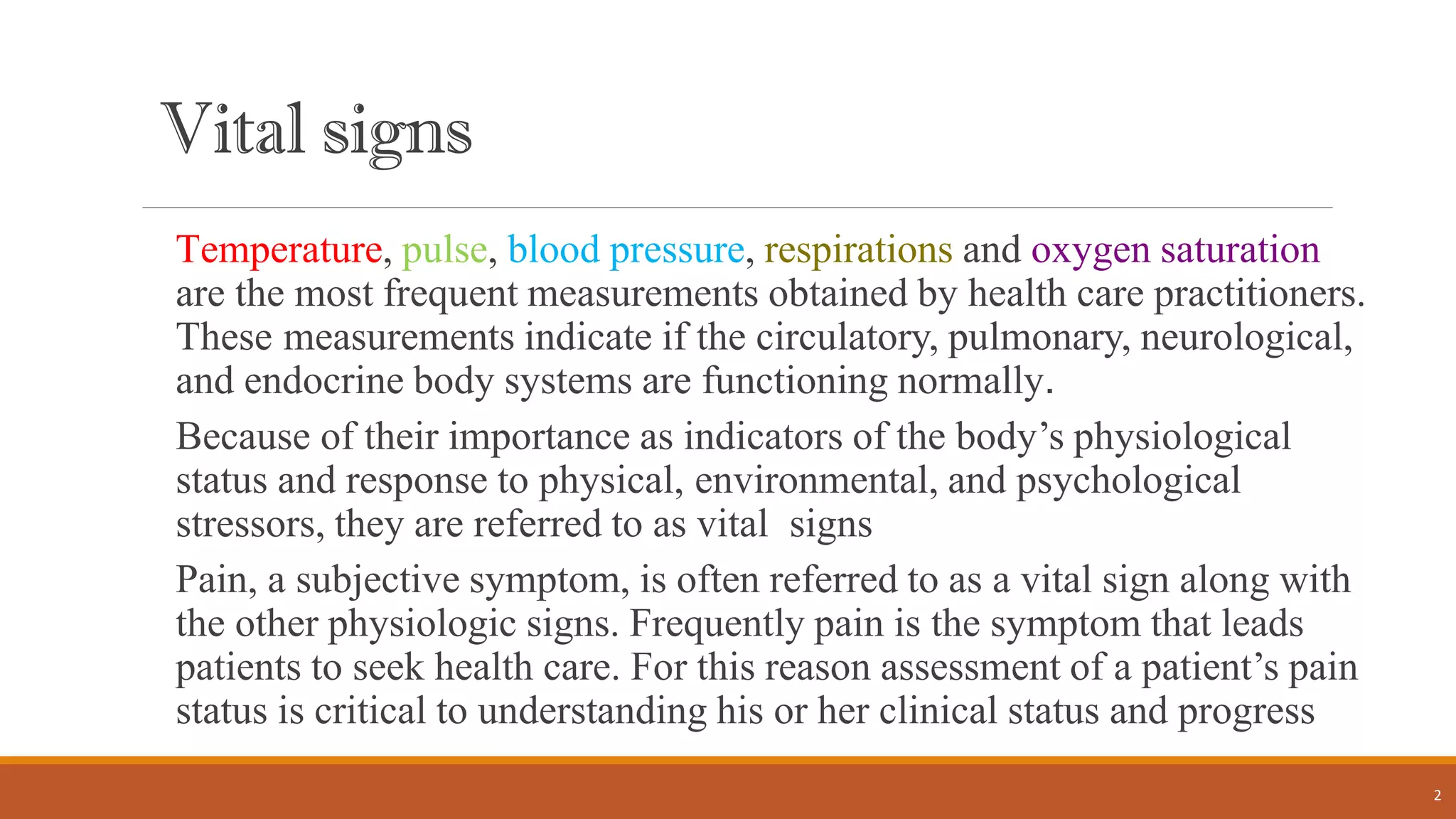
Vital signs
Temperature, pulse, blood pressure, respirations and oxygen saturation
are the most frequent measurements obtained by health care practitioners.
These measurements indicate if the circulatory, pulmonary, neurological,
and endocrine body systems are functioning normally.
Because of their importance as indicators of the body’s physiological
status and response to physical, environmental, and psychological
stressors, they are referred to as vital signs
Pain, a subjective symptom, is often referred to as a vital sign along with
the other physiologic signs. Frequently pain is the symptom that leads
patients to seek health care. For this reason assessment of a patient’s pain
status is critical to understanding his or her clinical status and progress
2
Factors Influencing Vital Signs
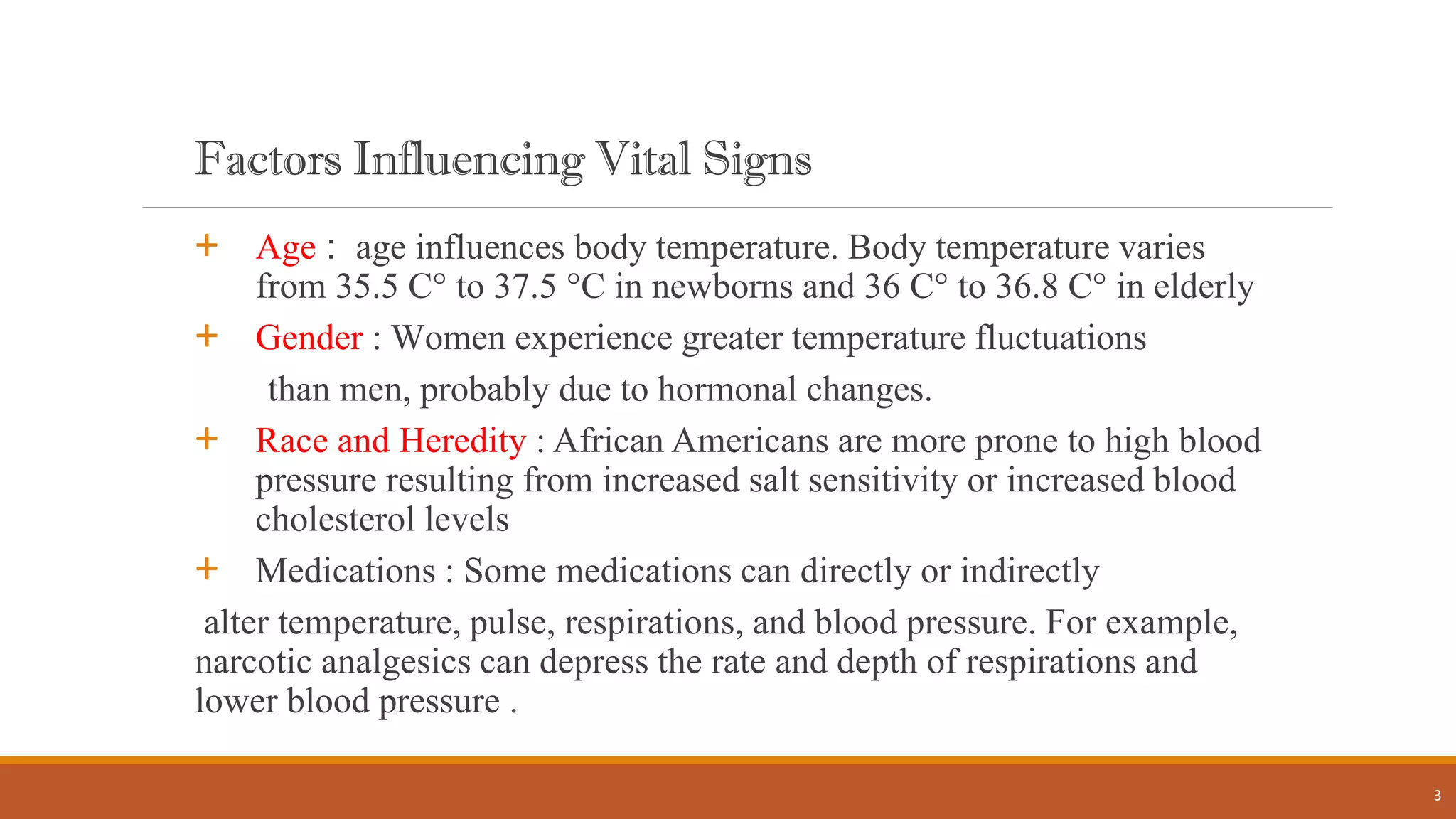
+ Age : age influences body temperature. Body temperature varies
from 35.5 C° to 37.5 °C in newborns and 36 C° to 36.8 C° in elderly
+ Gender : Women experience greater temperature fluctuations
than men, probably due to hormonal changes.
+ Race and Heredity : African Americans are more prone to high blood
pressure resulting from increased salt sensitivity or increased blood
cholesterol levels
+ Medications : Some medications can directly or indirectly
alter temperature, pulse, respirations, and blood pressure. For example,
narcotic analgesics can depress the rate and depth of respirations and
lower blood pressure .
3
+ Circadian Rhythms : (pressure is lowest in the morning and
peaks in late afternoon and evening) and temperature (highest
in the evening—8 PM to 12 midnight—and lowest in the early
morning—4 to 6 AM).
+ Pain : Acute pain leads to sympathetic stimulation, which in
turn increases the heart rate, respiratory rate, and blood
pressure.
4
Factors Influencing Vital Signs
TEMPERATURE
Temperature control of the body is a homeostatic function,
regulated by a complex mechanism involving the hypothalamus
Measuring Body Temperature :
Oral : 36° to 37.5°C
Tympanic Membrane : 0.5° C (0.9° F) lower than oral temperatures
Axilla : 0.5° C (0.9° F) lower than oral temperatures
Rectal : 0.5° C (0.9° F) higher than oral temperatures
Skin
Temporal Artery
5
6
7
Oral rout
Advantages
Easily accessible—requires no position change
Comfortable for patient
Provides accurate surface temperature reading
Limitations
Causes delay in measurement if patient recently ingested hot/cold fluids or foods,
chewed gum, or smoked
Not used with patients who have had oral surgery or facial trauma or are unable to
position in mouth, shaking chills, or history of seizures
Not used with infants; small children; or confused, unconscious, or uncooperative
patients
 Risk for body fluid exposure
8
Tympanic Membrane
Advantages
Easily accessible site
Obtained without disturbing, waking, or repositioning patient
Used for patients with tachypnea without affecting breathing
Very rapid measurement (2 to 5 seconds)
Unaffected by oral intake of food or fluids or smoking
Limitations
Requires removal of hearing aids before measurement
distorted with otitis media and cerumen impaction
Not used with patients who have had surgery of the ear or tympanic membrane
Affected by ambient temperature devices such as incubators, radiant warmers, and facial fans
9
Rectal Route
Advantages
 Argued to be reliable when oral temperature cannot be obtained
Limitations
Not used for patients with diarrhea or those who have had rectal surgery, rectal disorders,
bleeding tendencies, or neutropenia
Requires positioning and is often source of patient embarrassment and anxiety
Risk for body fluid exposure
Requires lubrication
Not used for routine vital signs in newborns
Readings influenced by impacted stool
10
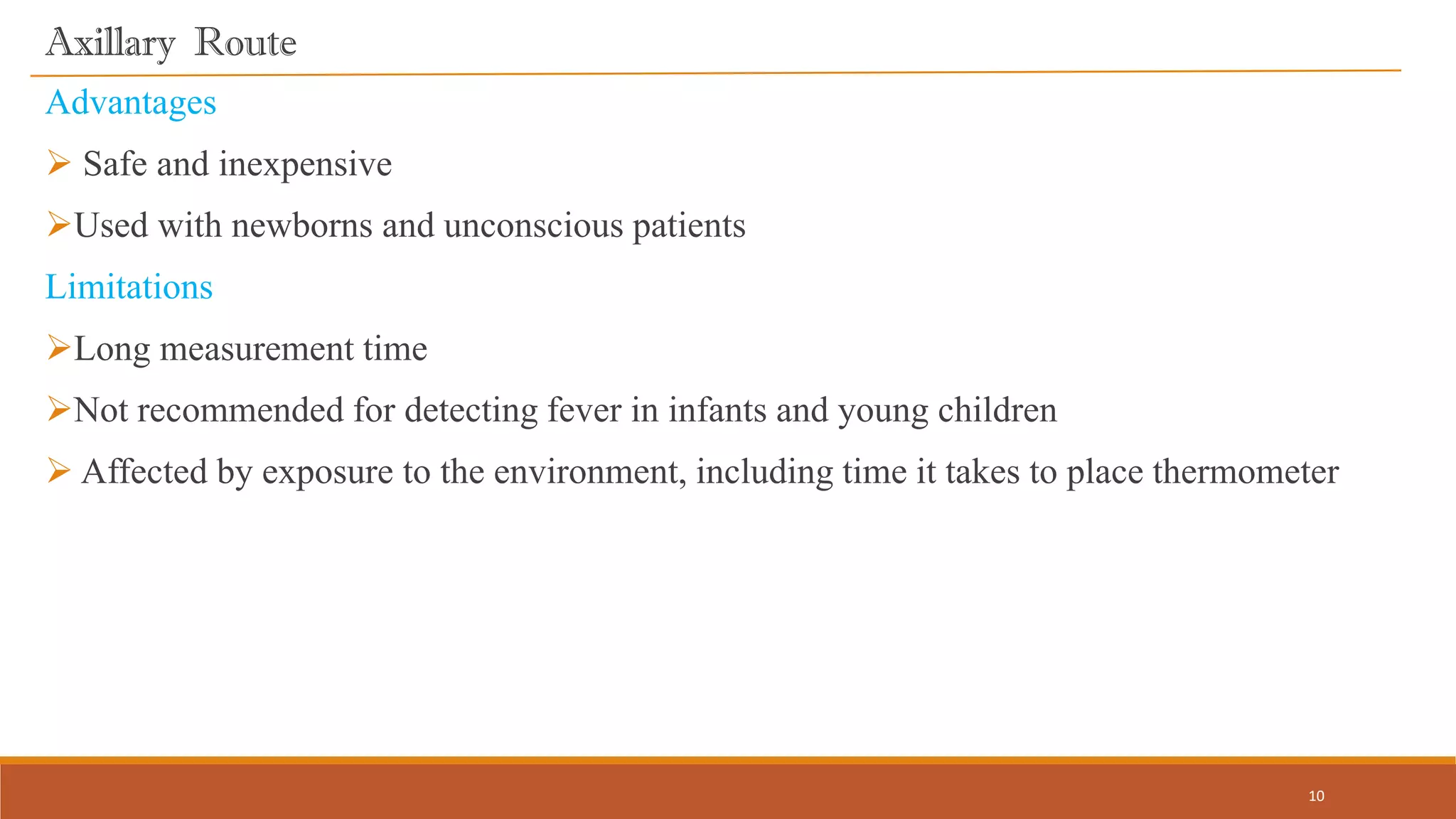
Axillary Route
Advantages
 Safe and inexpensive
Used with newborns and unconscious patients
Limitations
Long measurement time
Not recommended for detecting fever in infants and young children
 Affected by exposure to the environment, including time it takes to place thermometer
11
Skin
Advantages
 Inexpensive
Provides continuous reading (2 days)
Safe and noninvasive
Used for neonates
Limitations
Impaired adhesion from diaphoresis or sweat
Affected by environmental temperature
Cannot be used for patients with allergy to adhesive
12
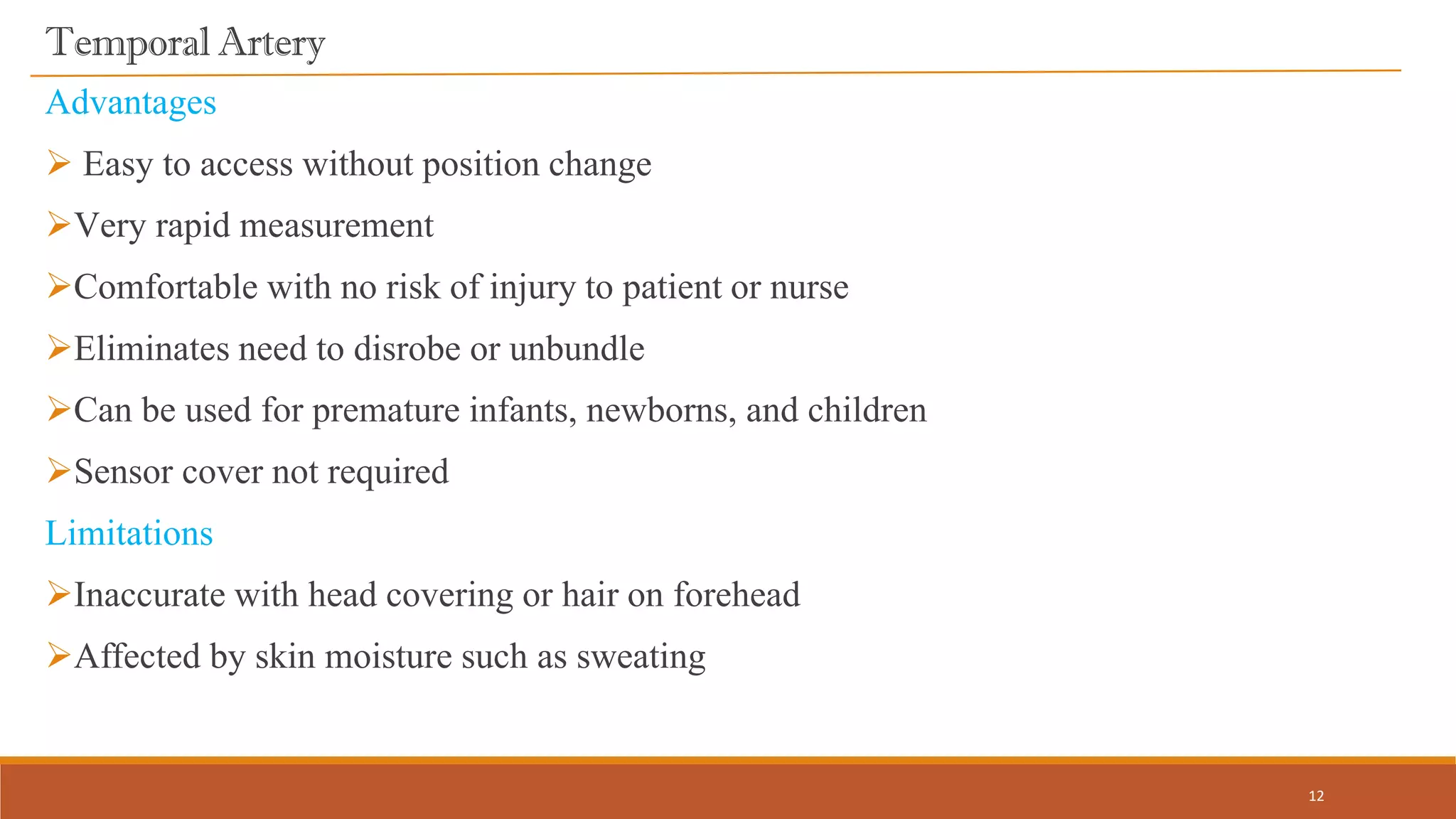
Temporal Artery
Advantages
 Easy to access without position change
Very rapid measurement
Comfortable with no risk of injury to patient or nurse
Eliminates need to disrobe or unbundle
Can be used for premature infants, newborns, and children
Sensor cover not required
Limitations
Inaccurate with head covering or hair on forehead
Affected by skin moisture such as sweating
13
Pulse
The pulse is an index of the heart’s rate and rhythm.
Measuring pulse:
A normal adult heart rate is from 60 to 100 beats/min
Rates are slightly faster in women and more rapid in children and infants (90–
140 beats/min
The arterial pulse can be felt over arteries that lie close to the body surface
and over a bone or firm surface that can support the artery when pressure is
applied. In adults and children older than age 3, the radial artery is palpated
most frequently because it is the most accessible. The femoral and carotid
arteries are used in cases of cardiac arrest to determine the adequacy of
perfusion
When peripheral pulses cannot be palpated, a ultrasound stethoscope is used
by the nurse to confirm the presence or absence of the pulse.
14
15
16
Respiration
Respiration is the process of bringing oxygen to body tissues and removing
carbon dioxide
Measuring Respiration :
Normal breathing, termed eupnea, is almost invisible, effortless, quiet,
automatic, and regular.
The normal rate for a resting adult is 12 to 18 breaths per minute. A rate of 24
or above is considered tachypnea, and a rate of 10 or less is considered
bradypnea.
The rate for infants ranges from 20 to 30 breaths per minute and is often
irregular. Older children average about 20 to 26
17
Blood Pressure
The heart generates pressure during the cardiac cycle to perfuse the organs of
the body with blood. Blood flows from the heart to the arteries, into the
capillaries and veins, and then flows back to the heart.
Measuring Blood Pressure:
The indirect method of taking a blood pressure using a recently manometer
and a stethoscope is accurate for most clients.
The direct method is A needle or catheter is inserted into the brachial, radial,
or femoral artery. An oscilloscope displays arterial pressure waveforms
Normal blood pressure in an adult varies between 100 and120 systolic and 60
and 80 diastolic
18
Pain
According to The Joint Commission, pain should be considered the fifth vital
sign. Pain must be evaluated every time vital signs are taken, and it should be
documented on the vital sign record
Measuring Blood Pressure:
The indirect method of taking a blood pressure using a recently manometer
and a stethoscope is accurate for most clients.
The direct method is A needle or catheter is inserted into the brachial, radial,
or femoral artery. An oscilloscope displays arterial pressure waveforms
Normal blood pressure in an adult varies between 100 and120 systolic and 60
and 80 diastolic
19
20
Pulse Oximetry SpO2
Arterial blood gas (ABG) analysis has been used for decades to determine a
client’s gas exchange and oxygenation transport ability. Pulse oximetry
technology allows for more cost- and time-efficient continuous monitoring of
arterial oxygen saturation (SaO2). The primary advantages of this method are:
It is cost-effective.
It is a noninvasive evaluation tool.
Minute-to-minute changes in saturation can be assessed and timely
intervention made to meet client needs.
The client’s response to treatment can be evaluated immediately and ongoing.
21
Pulse Oximetry SpO2
Normal SpO2 (oxygen saturation) levels is usually between 95–100% for
adults and children
Inaccurate oximetry readings can be found in clients with:
a. Alkalosis, acidosis
b. Fever, hypothermia
c. Poor peripheral blood flow
d. Carbon monoxide poisoning
e. Recent dye injection studies
f. Shivering or excessive movement
22
BIG CONCEPT
Bring the attention of your audience over a key concept using
icons or illustrations

vital signs.pptx

  • 1.
    1 Vital Signs Produced By MohamadA.Ghanim MSc Pediatric Nursing
  • 2.
    Vital signs Temperature, pulse,blood pressure, respirations and oxygen saturation are the most frequent measurements obtained by health care practitioners. These measurements indicate if the circulatory, pulmonary, neurological, and endocrine body systems are functioning normally. Because of their importance as indicators of the body’s physiological status and response to physical, environmental, and psychological stressors, they are referred to as vital signs Pain, a subjective symptom, is often referred to as a vital sign along with the other physiologic signs. Frequently pain is the symptom that leads patients to seek health care. For this reason assessment of a patient’s pain status is critical to understanding his or her clinical status and progress 2
  • 3.
    Factors Influencing VitalSigns + Age : age influences body temperature. Body temperature varies from 35.5 C° to 37.5 °C in newborns and 36 C° to 36.8 C° in elderly + Gender : Women experience greater temperature fluctuations than men, probably due to hormonal changes. + Race and Heredity : African Americans are more prone to high blood pressure resulting from increased salt sensitivity or increased blood cholesterol levels + Medications : Some medications can directly or indirectly alter temperature, pulse, respirations, and blood pressure. For example, narcotic analgesics can depress the rate and depth of respirations and lower blood pressure . 3
  • 4.
    + Circadian Rhythms: (pressure is lowest in the morning and peaks in late afternoon and evening) and temperature (highest in the evening—8 PM to 12 midnight—and lowest in the early morning—4 to 6 AM). + Pain : Acute pain leads to sympathetic stimulation, which in turn increases the heart rate, respiratory rate, and blood pressure. 4 Factors Influencing Vital Signs
  • 5.
    TEMPERATURE Temperature control ofthe body is a homeostatic function, regulated by a complex mechanism involving the hypothalamus Measuring Body Temperature : Oral : 36° to 37.5°C Tympanic Membrane : 0.5° C (0.9° F) lower than oral temperatures Axilla : 0.5° C (0.9° F) lower than oral temperatures Rectal : 0.5° C (0.9° F) higher than oral temperatures Skin Temporal Artery 5
  • 6.
  • 7.
    7 Oral rout Advantages Easily accessible—requiresno position change Comfortable for patient Provides accurate surface temperature reading Limitations Causes delay in measurement if patient recently ingested hot/cold fluids or foods, chewed gum, or smoked Not used with patients who have had oral surgery or facial trauma or are unable to position in mouth, shaking chills, or history of seizures Not used with infants; small children; or confused, unconscious, or uncooperative patients  Risk for body fluid exposure
  • 8.
    8 Tympanic Membrane Advantages Easily accessiblesite Obtained without disturbing, waking, or repositioning patient Used for patients with tachypnea without affecting breathing Very rapid measurement (2 to 5 seconds) Unaffected by oral intake of food or fluids or smoking Limitations Requires removal of hearing aids before measurement distorted with otitis media and cerumen impaction Not used with patients who have had surgery of the ear or tympanic membrane Affected by ambient temperature devices such as incubators, radiant warmers, and facial fans
  • 9.
    9 Rectal Route Advantages  Arguedto be reliable when oral temperature cannot be obtained Limitations Not used for patients with diarrhea or those who have had rectal surgery, rectal disorders, bleeding tendencies, or neutropenia Requires positioning and is often source of patient embarrassment and anxiety Risk for body fluid exposure Requires lubrication Not used for routine vital signs in newborns Readings influenced by impacted stool
  • 10.
    10 Axillary Route Advantages  Safeand inexpensive Used with newborns and unconscious patients Limitations Long measurement time Not recommended for detecting fever in infants and young children  Affected by exposure to the environment, including time it takes to place thermometer
  • 11.
    11 Skin Advantages  Inexpensive Provides continuousreading (2 days) Safe and noninvasive Used for neonates Limitations Impaired adhesion from diaphoresis or sweat Affected by environmental temperature Cannot be used for patients with allergy to adhesive
  • 12.
    12 Temporal Artery Advantages  Easyto access without position change Very rapid measurement Comfortable with no risk of injury to patient or nurse Eliminates need to disrobe or unbundle Can be used for premature infants, newborns, and children Sensor cover not required Limitations Inaccurate with head covering or hair on forehead Affected by skin moisture such as sweating
  • 13.
    13 Pulse The pulse isan index of the heart’s rate and rhythm. Measuring pulse: A normal adult heart rate is from 60 to 100 beats/min Rates are slightly faster in women and more rapid in children and infants (90– 140 beats/min The arterial pulse can be felt over arteries that lie close to the body surface and over a bone or firm surface that can support the artery when pressure is applied. In adults and children older than age 3, the radial artery is palpated most frequently because it is the most accessible. The femoral and carotid arteries are used in cases of cardiac arrest to determine the adequacy of perfusion When peripheral pulses cannot be palpated, a ultrasound stethoscope is used by the nurse to confirm the presence or absence of the pulse.
  • 14.
  • 15.
  • 16.
    16 Respiration Respiration is theprocess of bringing oxygen to body tissues and removing carbon dioxide Measuring Respiration : Normal breathing, termed eupnea, is almost invisible, effortless, quiet, automatic, and regular. The normal rate for a resting adult is 12 to 18 breaths per minute. A rate of 24 or above is considered tachypnea, and a rate of 10 or less is considered bradypnea. The rate for infants ranges from 20 to 30 breaths per minute and is often irregular. Older children average about 20 to 26
  • 17.
    17 Blood Pressure The heartgenerates pressure during the cardiac cycle to perfuse the organs of the body with blood. Blood flows from the heart to the arteries, into the capillaries and veins, and then flows back to the heart. Measuring Blood Pressure: The indirect method of taking a blood pressure using a recently manometer and a stethoscope is accurate for most clients. The direct method is A needle or catheter is inserted into the brachial, radial, or femoral artery. An oscilloscope displays arterial pressure waveforms Normal blood pressure in an adult varies between 100 and120 systolic and 60 and 80 diastolic
  • 18.
    18 Pain According to TheJoint Commission, pain should be considered the fifth vital sign. Pain must be evaluated every time vital signs are taken, and it should be documented on the vital sign record Measuring Blood Pressure: The indirect method of taking a blood pressure using a recently manometer and a stethoscope is accurate for most clients. The direct method is A needle or catheter is inserted into the brachial, radial, or femoral artery. An oscilloscope displays arterial pressure waveforms Normal blood pressure in an adult varies between 100 and120 systolic and 60 and 80 diastolic
  • 19.
  • 20.
    20 Pulse Oximetry SpO2 Arterialblood gas (ABG) analysis has been used for decades to determine a client’s gas exchange and oxygenation transport ability. Pulse oximetry technology allows for more cost- and time-efficient continuous monitoring of arterial oxygen saturation (SaO2). The primary advantages of this method are: It is cost-effective. It is a noninvasive evaluation tool. Minute-to-minute changes in saturation can be assessed and timely intervention made to meet client needs. The client’s response to treatment can be evaluated immediately and ongoing.
  • 21.
    21 Pulse Oximetry SpO2 NormalSpO2 (oxygen saturation) levels is usually between 95–100% for adults and children Inaccurate oximetry readings can be found in clients with: a. Alkalosis, acidosis b. Fever, hypothermia c. Poor peripheral blood flow d. Carbon monoxide poisoning e. Recent dye injection studies f. Shivering or excessive movement
  • 22.
    22 BIG CONCEPT Bring theattention of your audience over a key concept using icons or illustrations