Course: Basic Skills
Lecture One
Vital Signs
Dr. Abdiwahid MBBS
Learning Objectives:
 Describe the procedures used to assessthe vital signs:
temperature, pulse,respiration, and blood pressure.
 Identify factors that caninfluence eachvital sign.
 Identify equipment routinely usedto assessvital signs.
 Identify rationales for using different routesfor
assessingtemperature.
 Takevital signsand interpret the finding.
 Document the vitalsigns.
Vital signs (Cardinal signs)
 Vital signs reflect the body’s physiologic status and
provide information critical to evaluating
homeostatic balance.
 Vital signs are physical signs that indicate an
individual is alive.
 These signs may be observed, measured, and
monitored to assess an individual's level of physical
functioning.
 Normal vital signs change with age, sex, weight,
exercise tolerance, and condition.
Cont..
 Includes:
 Temperature,
 Pulse Rate,
 Respiratory Rate,
 Blood Pressure, and
 Recently oxygen saturation
Time to asses vital signs:
 On admission – to obtain baseline date
 When a client has a change in health status or reports
symptoms such as chest pain or fainting
 According to a nursing or medical order
 Before and after the administration of certain
medications that could affect RR or BP (Respiratory
and CVS)
 Before and after surgery or an invasive diagnostic
procedures
 Before and after any nursing intervention that could
affect the vital signs. E.g. Ambulation
 According to hospital /other health institution policy.
1. Temperature
 it is the hotness or coldness of the body.
 It is the balance b/n heat production & heat
loss of the body.
 It is usually measured in either Celcius or
Farenheit.
Two Types of Body
Temperature
o Core Temperature
 Is the temperature of internal organs and it remains
constant most of the time (37oc); with range of 36.5-
37.5oc.
 Is the Temperature of the deep tissues of the body
o Surface Temperature
 It is the temperature of the skin, subcutaneous tissue & fat
cells
 It rises & falls in response to the environment.
 (Ranges b/n 20-40oc).
 It doesn’t indicate internalphysiology.
Alterations in Body temperature
 Normal body temperature is 370 C or 98.60F
 range is 36-38 0c (96.8 – 100 0F)
 Body temperature may be abnormal due to fever
(high temperature) or hypothermia (low
temperature).
 Pyrexia, fever: a body temperature above the
normal ranges 38 0c – 410 c (100.4 – 105.8 F)
 Hyper pyrexia: a very high fever, such as 410
C
 > 42 0c leads to death.
 Hypothermia: – body temperature between 34
0c – 35 0c,
 < 34 0c leads to death
Classifications of fevers
1. Intermittent fever: the body temperature alternates at
regular intervals between periods of fever and periods of
normal or subnormal temperature.
2. Remittent fever: a wide range of temperature fluctuation
(more than 2 0c) occurs over the 24 hr period, all of which
are above normal
3. Relapsing fever: short febrile periods of a few days are
interspersed with periods of 1 or 2 days of normal
temperature.
4. Constant fever: the body temperature fluctuates minimally
but always remains above normal
Factors affecting body temperature
1.Age 4.
Hormones
2.Diurnal variations 5. Stress
3.Exercice
6.Environment
o Sites to measure body temperature
 Oral
 Rectal
 Auxiliary
 Tympanic
 Thermometer: is an instrument used to measure
body temperature.
Oral temperature:
 Obtained by putting the thermometer under the
tongue.
 Its measurement is 0.65 less than rectal To. and 0.65
greater than axillary temp.
 Leave3to5minutes in place
Rectal temperature:
 Obtained by inserting the thermometer into the rectum or
anus.
 It givesreliablemeasurement& reflectsthe core body
temperature.
 Hold the thermometer in placefor 3to 5minutes
 More accurate, most reliable, is >0.650c(10F) higherthan
the oraltemperature.
Cont..
Axillary temperature:
 A thermometer is placed under armpit
 Its 1 degree Celsius lower than oral temperature and up to 2
degree Celsius lower than rectal temperature.
 Its considered the least accurate and least reliable of all
sites because its influenced by e.g. bathing.
Tympanic temperature:
 Placedin to the
patient’s outer earcanal.
Route Normal Range ºF / ºC Sites
Oral 98.6 ºF / 37.0 ºC Mouth
Tympanic 99.6 ºF / 37.6 ºC Ear
Rectal 99.6 ºF / 37.6 ºC Rectum
Axillary 97.6 ºF / 36.6 ºC Axilla (armpit)
13
Pulse
 Pulse is a wave of blood created by the contraction of
left ventricle.
 pulse reflects the heart beat
 Pulse rate is regulated by autonomic nervous system.
 The pulse is commonly assessed by palpation (feeling) and
auscultation (hearing using a stethoscope).
 The PR is expressed in beats/ minute (BPM)
There are two types of Pulse:
 Peripheral Pulse: is a pulse located in the periphery of the
body e.g. in the foot, and or neck
 Apical Pulse (central pulse): it is located at the apex of the
heart
Method
 Themiddle 3fingertips areusedwith moderate pressurefor palpationof
allpulsesexceptapical;
 Assessthe pulsefor
 Rate(60-100bpm),
• Adult PR>100 BPM is termed Tachycardia
• Adult PR<60 BPM is termed Bradycardia
 Rhythm (regularity),
• The pattern and interval between the beats,
• Regular vs irregular
 Volume
• The force of blood with each beat that can be felt with palpation.
Factors affecting pulse rate
1. Age
2. Sex
3. Autonomic nervous system (parasympathetic vs sympathetic
nervous system)
4. Exercise
5. Temperature (high vs low temperature)
6. Fever
7. Stress (increases sympathetic activity)
8. Position changes
9. Medications
Pulse sites
 Carotid: at thesideof theneckbelowtubeof theear(wherethe
carotidarteryrunsbetween the trachea andthe sternocleidomastoid
muscle)
 Temporal:the pulseistaken at temporalbone area.
 Apical:at the apexof the heart: routinelyused for infantandchildren
<3yrs
 Inadults–Left mid-clavicularlineunderthe 4th, 5th, 6th intercostal
space
 Brachial: at theinneraspectof thebicepsmuscleof the arm or
medially in the antecubital space(elbow crease)
 Radial:onthethumb sideof theinneraspectof the wrist –readily
availableandroutinely used
 Femoral:along the inguinal ligament. Used for infants andchildren
 Popiliteal:behind the knee. Byflexing the knee slightly
 Posteriortibial: onthemedialsurfaceof theankle
 Pedal (Dorsal Pedis):palpated by feeling thedorsum (upper surface)
offoot
Pulse points
Pulse points
 if the pulse is regular, measure (count) for 30 seconds and multiply
by 2
 If it is irregular count for 1 full minute.
Auscultation of the apical heart sound:
 Each heart beat consists of two sounds
 S1 – is caused by the closure of the mitral and tricuspid valves
separating atria from the vantricles
 S2 – is caused by the closure of the Pulmonic and Aortic valves.
 The sounds are often described as muffled “Lub – Dub”
Respiration
Respirationrate(RR):-Respirationistheact of breathing andincludes
the intake of oxygenandremovalof carbon-dioxide.
Ventilationisalsoanotherword,whichrefers to movementof airinand
out of thelung.
• Hyperventilation:-isaverydeep,rapid respiration.
• Hypoventilation: -isavery shallow respiration.
• Eupnea- normal respirations
• Bradypnea- abnormally slow < 12
• Tachypnea- abnormally fast >20
• Apnea-temporarycessationofbreathing
Two types of breathing
1. Costal (thoracic)
 Observed by the movement of the chest up ward and down
ward.
 Commonly used for adults
2. Diaphragmatic (abdominal)
 Involves the contraction and relaxation of the diaphragm,
observed by the movement of abdomen.
 Commonly used for children.
Factors affecting respiratory rate
1. Age
2. Sex
3. Altitude
4. Exercise
5. Fever
6. Stress
7. Medications
Assessment of RR
o The person should be at rest
o Assessed by observing the rise and fall of the chest or abdomen
with out the person knowing. E.g. while you appear to be taking
their pulse.
 Rate:
• Isdescribedinrateperminute (RPM)
 if the RR is regular, measure (count) for 30 seconds and multiply
by 2
 If it is irregular count for 1 full minute.
 Rhythm and depth
Age Average Range/Min
New born 40-60
Early childhood 25-40
Late childhood 18-30
Adulthood-male 14-18
Female 16-20
27
Blood pressure
 It is the force exerted by the blood against thewallsof thearteries
inwhichit isflowing.
 It isexpressedintermsof millimetersof mercury (mm of
Hg).
Systolicpressureisthemaximumof the pressureagainst the
wall of the vessel following ventricularcontraction.
Diastolic pressure is the minimum pressure of the blood against the
walls of the vessels following closure of aortic valve (ventricular
relaxation).
Pulse pressure: is the difference between the systolic and diastolic
pressure
Factors affecting BP
 Age
 Fever
 Stress
 Hemorrhage
 Daily Variation
Sites for measuring BP
Upperarmusingbrachialartery (commonest)
Thigh using poplitealartery
Fore–arm using radialartery
Legusingposteriortibialordorsalpedis
 Medications
 Activity,
 Weight
 Smoking
Cont..
 Apersistentlyhigh Bp,measuredfor greaterthan three times
is called hypertension & that persistently lessthan normal
range is called hypotension.
 Becauseof manyfactorsinfluencing BPasingle
measurement is not necessarilysignificant to confirm
hypertension.
 Whenthe causeof hypertensionisknownit is called
secondaryhypertensionandwhenthe
• causeis unknown is called primary/essential
hypertension.
Equipment
Earpieces
Binaurals
Rubber or plastic tubing
Bell
Chest piece
Diaphragm
Procedure to measure BP
 Explainthe procedureto thepatient& remove anylight
cloth from patient’sarm
 Makesurethat the clienthasnot smokedor ingested
caffeine,within 30minutesprior to measurement.
 Positionthe patientonlying, sitting orstanding position, but
always ensure that the sphygmomanometer isat the levelof
the heart with the arm supported & the palm facing
upwards.
 apply cuff snugly/securelyaround the arm , 2.5cmabovethe
antecubital space/fossa,at the level of the heart (for every cm the
cuff sites aboveor below the level of the heart the BP variesby
0.8mmHg)
 Make sure the cuff is appropriate sized:
• If it is too small, the readings will be artificially
elevated.
• The opposite occurs if the cuff is too large.
 Palpatetheradialpulseandinflatethecuffuntil the radial pulse
canno longer be felt, this providesanestimationof systolic
pressure.
 Inflatecuff30mmHghigherthanestimated systolicpressure.
 palpatethe brachialartery& placethe bellof the stethoscope
over the site & the ear pieceson ear,apply enough pressure to
keep the stethoscopeinplace(the bellof the stethoscope is
designed to amplify/intensify low frequency sounds)
 Deflatethe cuff 2-4mmHg persecond.
 Thefirst pulseheardisthe systolicreading, continueto
deflateuntil thereisachangein tone to amuffled beat,
this is the diastolic reading.
 Deflate&removecuff roll neatlyandreplace.
 Recordthe systolic and diastolic pressureon vital singsheet
and compare thepresent reading withprevious reading.
 report or treat anychange
 Clearearpiecesandbellof thestethoscope with antiseptic
swaband return all equipments.
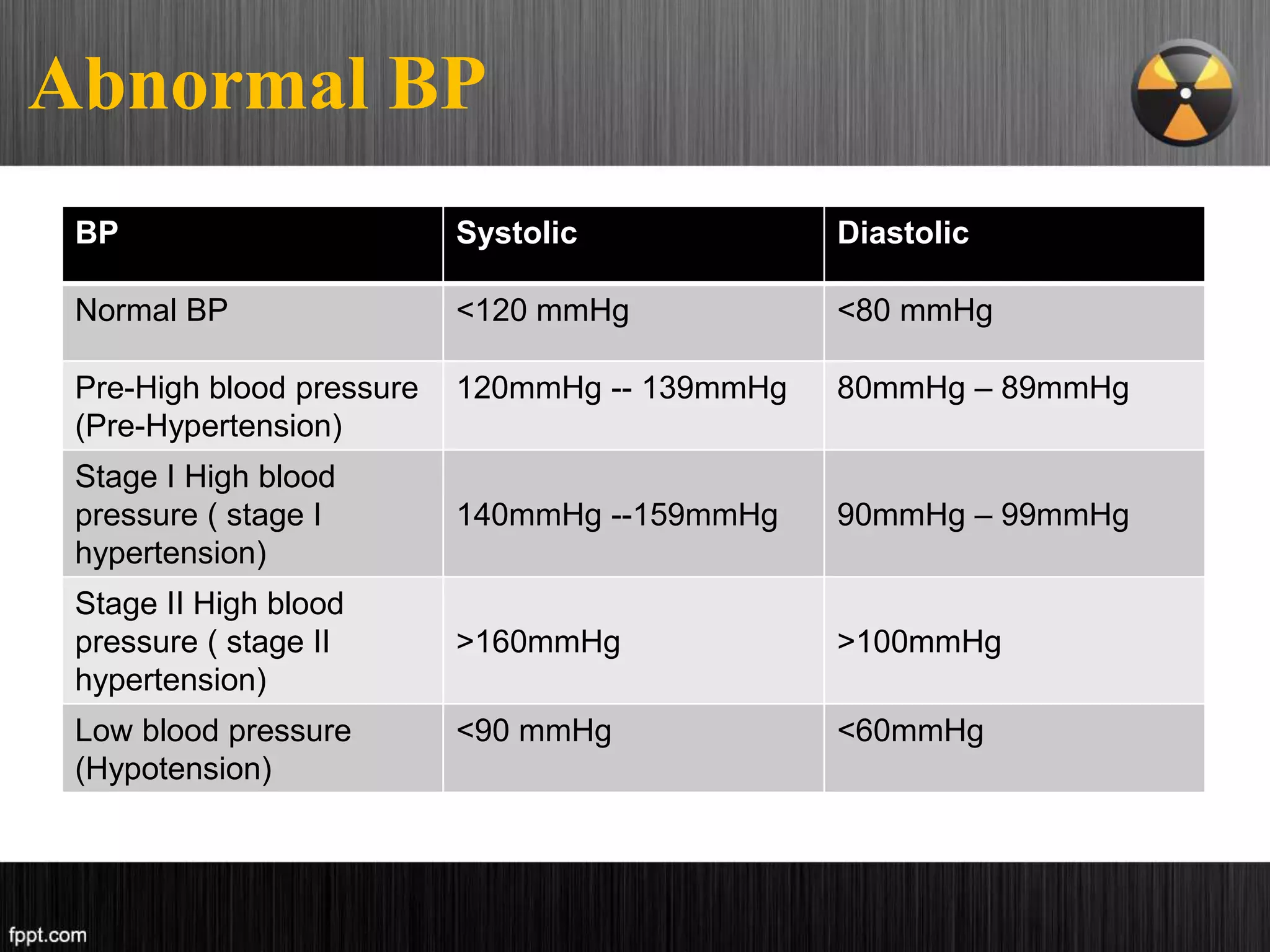
Abnormal BP
BP Systolic Diastolic
Normal BP <120 mmHg <80 mmHg
Pre-High blood pressure
(Pre-Hypertension)
120mmHg -- 139mmHg 80mmHg – 89mmHg
Stage I High blood
pressure ( stage I
hypertension)
140mmHg --159mmHg 90mmHg – 99mmHg
Stage II High blood
pressure ( stage II
hypertension)
>160mmHg >100mmHg
Low blood pressure
(Hypotension)
<90 mmHg <60mmHg
Orthostatic Hypotention
 Orthostatic (postural) is a form of low BP that happens when
standing after sitting or lying down.
 It causes dizziness, lightheadedness and possibly fainting
 First measuring BP when the patient is supine and then
repeating them after they have stood for 2 minutes, which
allows for equilibration.
 A drop of 20mmHg in systolic BP is a sign of orthostatic
hypotension.
 A drop of 10 mmHg in diastolic BP is a sign of orthostatic
hypotension.
Oxygen Saturation
 Over the past decade, Oxygen Saturation measurement of gas
exchange and red blood cell oxygen carrying capacity has become
available in all hospitals and many clinics
 Oxygen Saturation provide important information about cardio-
pulmonary dysfunction and is considered by many to be a fifth
vital sign.
 Its measured with Pulse oximeter
 Allows indirect measurement of oxygen saturation
 Measurement is affected if extremity is cold, edematous or if nail
polish is present (interference with light transmission).
Pulse oximeter
Blood oxygen levels: pulse oximeter chart
Saturation Oxygen levels
95 – 100% Normal Blood Oxygen Levels
91 – 94% Concerning Blood Oxygen Levels
86 – 90% Low Blood Oxygen Levels
80 – 85% Low Oxygen Saturation Affects Brain
<70% Cyanosis
The end
Dr Abdiwahid MBBS.

Basic Skills Vital signs.pptx

  • 1.
    Course: Basic Skills LectureOne Vital Signs Dr. Abdiwahid MBBS
  • 2.
    Learning Objectives:  Describethe procedures used to assessthe vital signs: temperature, pulse,respiration, and blood pressure.  Identify factors that caninfluence eachvital sign.  Identify equipment routinely usedto assessvital signs.  Identify rationales for using different routesfor assessingtemperature.  Takevital signsand interpret the finding.  Document the vitalsigns.
  • 3.
    Vital signs (Cardinalsigns)  Vital signs reflect the body’s physiologic status and provide information critical to evaluating homeostatic balance.  Vital signs are physical signs that indicate an individual is alive.  These signs may be observed, measured, and monitored to assess an individual's level of physical functioning.  Normal vital signs change with age, sex, weight, exercise tolerance, and condition.
  • 4.
    Cont..  Includes:  Temperature, Pulse Rate,  Respiratory Rate,  Blood Pressure, and  Recently oxygen saturation
  • 5.
    Time to assesvital signs:  On admission – to obtain baseline date  When a client has a change in health status or reports symptoms such as chest pain or fainting  According to a nursing or medical order  Before and after the administration of certain medications that could affect RR or BP (Respiratory and CVS)  Before and after surgery or an invasive diagnostic procedures  Before and after any nursing intervention that could affect the vital signs. E.g. Ambulation  According to hospital /other health institution policy.
  • 6.
    1. Temperature  itis the hotness or coldness of the body.  It is the balance b/n heat production & heat loss of the body.  It is usually measured in either Celcius or Farenheit.
  • 7.
    Two Types ofBody Temperature o Core Temperature  Is the temperature of internal organs and it remains constant most of the time (37oc); with range of 36.5- 37.5oc.  Is the Temperature of the deep tissues of the body o Surface Temperature  It is the temperature of the skin, subcutaneous tissue & fat cells  It rises & falls in response to the environment.  (Ranges b/n 20-40oc).  It doesn’t indicate internalphysiology.
  • 8.
    Alterations in Bodytemperature  Normal body temperature is 370 C or 98.60F  range is 36-38 0c (96.8 – 100 0F)  Body temperature may be abnormal due to fever (high temperature) or hypothermia (low temperature).  Pyrexia, fever: a body temperature above the normal ranges 38 0c – 410 c (100.4 – 105.8 F)  Hyper pyrexia: a very high fever, such as 410 C  > 42 0c leads to death.  Hypothermia: – body temperature between 34 0c – 35 0c,  < 34 0c leads to death
  • 9.
    Classifications of fevers 1.Intermittent fever: the body temperature alternates at regular intervals between periods of fever and periods of normal or subnormal temperature. 2. Remittent fever: a wide range of temperature fluctuation (more than 2 0c) occurs over the 24 hr period, all of which are above normal 3. Relapsing fever: short febrile periods of a few days are interspersed with periods of 1 or 2 days of normal temperature. 4. Constant fever: the body temperature fluctuates minimally but always remains above normal
  • 10.
    Factors affecting bodytemperature 1.Age 4. Hormones 2.Diurnal variations 5. Stress 3.Exercice 6.Environment o Sites to measure body temperature  Oral  Rectal  Auxiliary  Tympanic  Thermometer: is an instrument used to measure body temperature.
  • 11.
    Oral temperature:  Obtainedby putting the thermometer under the tongue.  Its measurement is 0.65 less than rectal To. and 0.65 greater than axillary temp.  Leave3to5minutes in place Rectal temperature:  Obtained by inserting the thermometer into the rectum or anus.  It givesreliablemeasurement& reflectsthe core body temperature.  Hold the thermometer in placefor 3to 5minutes  More accurate, most reliable, is >0.650c(10F) higherthan the oraltemperature.
  • 12.
    Cont.. Axillary temperature:  Athermometer is placed under armpit  Its 1 degree Celsius lower than oral temperature and up to 2 degree Celsius lower than rectal temperature.  Its considered the least accurate and least reliable of all sites because its influenced by e.g. bathing. Tympanic temperature:  Placedin to the patient’s outer earcanal.
  • 13.
    Route Normal RangeºF / ºC Sites Oral 98.6 ºF / 37.0 ºC Mouth Tympanic 99.6 ºF / 37.6 ºC Ear Rectal 99.6 ºF / 37.6 ºC Rectum Axillary 97.6 ºF / 36.6 ºC Axilla (armpit) 13
  • 14.
    Pulse  Pulse isa wave of blood created by the contraction of left ventricle.  pulse reflects the heart beat  Pulse rate is regulated by autonomic nervous system.  The pulse is commonly assessed by palpation (feeling) and auscultation (hearing using a stethoscope).  The PR is expressed in beats/ minute (BPM) There are two types of Pulse:  Peripheral Pulse: is a pulse located in the periphery of the body e.g. in the foot, and or neck  Apical Pulse (central pulse): it is located at the apex of the heart
  • 15.
    Method  Themiddle 3fingertipsareusedwith moderate pressurefor palpationof allpulsesexceptapical;  Assessthe pulsefor  Rate(60-100bpm), • Adult PR>100 BPM is termed Tachycardia • Adult PR<60 BPM is termed Bradycardia  Rhythm (regularity), • The pattern and interval between the beats, • Regular vs irregular  Volume • The force of blood with each beat that can be felt with palpation.
  • 16.
    Factors affecting pulserate 1. Age 2. Sex 3. Autonomic nervous system (parasympathetic vs sympathetic nervous system) 4. Exercise 5. Temperature (high vs low temperature) 6. Fever 7. Stress (increases sympathetic activity) 8. Position changes 9. Medications
  • 17.
    Pulse sites  Carotid:at thesideof theneckbelowtubeof theear(wherethe carotidarteryrunsbetween the trachea andthe sternocleidomastoid muscle)  Temporal:the pulseistaken at temporalbone area.  Apical:at the apexof the heart: routinelyused for infantandchildren <3yrs  Inadults–Left mid-clavicularlineunderthe 4th, 5th, 6th intercostal space
  • 18.
     Brachial: attheinneraspectof thebicepsmuscleof the arm or medially in the antecubital space(elbow crease)  Radial:onthethumb sideof theinneraspectof the wrist –readily availableandroutinely used  Femoral:along the inguinal ligament. Used for infants andchildren  Popiliteal:behind the knee. Byflexing the knee slightly  Posteriortibial: onthemedialsurfaceof theankle  Pedal (Dorsal Pedis):palpated by feeling thedorsum (upper surface) offoot
  • 19.
  • 20.
  • 22.
     if thepulse is regular, measure (count) for 30 seconds and multiply by 2  If it is irregular count for 1 full minute. Auscultation of the apical heart sound:  Each heart beat consists of two sounds  S1 – is caused by the closure of the mitral and tricuspid valves separating atria from the vantricles  S2 – is caused by the closure of the Pulmonic and Aortic valves.  The sounds are often described as muffled “Lub – Dub”
  • 23.
    Respiration Respirationrate(RR):-Respirationistheact of breathingandincludes the intake of oxygenandremovalof carbon-dioxide. Ventilationisalsoanotherword,whichrefers to movementof airinand out of thelung. • Hyperventilation:-isaverydeep,rapid respiration. • Hypoventilation: -isavery shallow respiration. • Eupnea- normal respirations • Bradypnea- abnormally slow < 12 • Tachypnea- abnormally fast >20 • Apnea-temporarycessationofbreathing
  • 24.
    Two types ofbreathing 1. Costal (thoracic)  Observed by the movement of the chest up ward and down ward.  Commonly used for adults 2. Diaphragmatic (abdominal)  Involves the contraction and relaxation of the diaphragm, observed by the movement of abdomen.  Commonly used for children.
  • 25.
    Factors affecting respiratoryrate 1. Age 2. Sex 3. Altitude 4. Exercise 5. Fever 6. Stress 7. Medications
  • 26.
    Assessment of RR oThe person should be at rest o Assessed by observing the rise and fall of the chest or abdomen with out the person knowing. E.g. while you appear to be taking their pulse.  Rate: • Isdescribedinrateperminute (RPM)  if the RR is regular, measure (count) for 30 seconds and multiply by 2  If it is irregular count for 1 full minute.  Rhythm and depth
  • 27.
    Age Average Range/Min Newborn 40-60 Early childhood 25-40 Late childhood 18-30 Adulthood-male 14-18 Female 16-20 27
  • 28.
    Blood pressure  Itis the force exerted by the blood against thewallsof thearteries inwhichit isflowing.  It isexpressedintermsof millimetersof mercury (mm of Hg). Systolicpressureisthemaximumof the pressureagainst the wall of the vessel following ventricularcontraction. Diastolic pressure is the minimum pressure of the blood against the walls of the vessels following closure of aortic valve (ventricular relaxation). Pulse pressure: is the difference between the systolic and diastolic pressure
  • 29.
    Factors affecting BP Age  Fever  Stress  Hemorrhage  Daily Variation Sites for measuring BP Upperarmusingbrachialartery (commonest) Thigh using poplitealartery Fore–arm using radialartery Legusingposteriortibialordorsalpedis  Medications  Activity,  Weight  Smoking
  • 30.
    Cont..  Apersistentlyhigh Bp,measuredforgreaterthan three times is called hypertension & that persistently lessthan normal range is called hypotension.  Becauseof manyfactorsinfluencing BPasingle measurement is not necessarilysignificant to confirm hypertension.  Whenthe causeof hypertensionisknownit is called secondaryhypertensionandwhenthe • causeis unknown is called primary/essential hypertension.
  • 31.
    Equipment Earpieces Binaurals Rubber or plastictubing Bell Chest piece Diaphragm
  • 32.
    Procedure to measureBP  Explainthe procedureto thepatient& remove anylight cloth from patient’sarm  Makesurethat the clienthasnot smokedor ingested caffeine,within 30minutesprior to measurement.  Positionthe patientonlying, sitting orstanding position, but always ensure that the sphygmomanometer isat the levelof the heart with the arm supported & the palm facing upwards.
  • 33.
     apply cuffsnugly/securelyaround the arm , 2.5cmabovethe antecubital space/fossa,at the level of the heart (for every cm the cuff sites aboveor below the level of the heart the BP variesby 0.8mmHg)  Make sure the cuff is appropriate sized: • If it is too small, the readings will be artificially elevated. • The opposite occurs if the cuff is too large.  Palpatetheradialpulseandinflatethecuffuntil the radial pulse canno longer be felt, this providesanestimationof systolic pressure.
  • 34.
     Inflatecuff30mmHghigherthanestimated systolicpressure. palpatethe brachialartery& placethe bellof the stethoscope over the site & the ear pieceson ear,apply enough pressure to keep the stethoscopeinplace(the bellof the stethoscope is designed to amplify/intensify low frequency sounds)  Deflatethe cuff 2-4mmHg persecond.  Thefirst pulseheardisthe systolicreading, continueto deflateuntil thereisachangein tone to amuffled beat, this is the diastolic reading.
  • 35.
     Deflate&removecuff rollneatlyandreplace.  Recordthe systolic and diastolic pressureon vital singsheet and compare thepresent reading withprevious reading.  report or treat anychange  Clearearpiecesandbellof thestethoscope with antiseptic swaband return all equipments.
  • 36.
    Abnormal BP BP SystolicDiastolic Normal BP <120 mmHg <80 mmHg Pre-High blood pressure (Pre-Hypertension) 120mmHg -- 139mmHg 80mmHg – 89mmHg Stage I High blood pressure ( stage I hypertension) 140mmHg --159mmHg 90mmHg – 99mmHg Stage II High blood pressure ( stage II hypertension) >160mmHg >100mmHg Low blood pressure (Hypotension) <90 mmHg <60mmHg
  • 37.
    Orthostatic Hypotention  Orthostatic(postural) is a form of low BP that happens when standing after sitting or lying down.  It causes dizziness, lightheadedness and possibly fainting  First measuring BP when the patient is supine and then repeating them after they have stood for 2 minutes, which allows for equilibration.  A drop of 20mmHg in systolic BP is a sign of orthostatic hypotension.  A drop of 10 mmHg in diastolic BP is a sign of orthostatic hypotension.
  • 38.
    Oxygen Saturation  Overthe past decade, Oxygen Saturation measurement of gas exchange and red blood cell oxygen carrying capacity has become available in all hospitals and many clinics  Oxygen Saturation provide important information about cardio- pulmonary dysfunction and is considered by many to be a fifth vital sign.  Its measured with Pulse oximeter  Allows indirect measurement of oxygen saturation  Measurement is affected if extremity is cold, edematous or if nail polish is present (interference with light transmission).
  • 39.
  • 40.
    Blood oxygen levels:pulse oximeter chart Saturation Oxygen levels 95 – 100% Normal Blood Oxygen Levels 91 – 94% Concerning Blood Oxygen Levels 86 – 90% Low Blood Oxygen Levels 80 – 85% Low Oxygen Saturation Affects Brain <70% Cyanosis
  • 41.