Elsevier items and derived items © 2014, 2010 by Mosby, an imprint of Elsevier Inc. All rights reserved.
Chapter 21
Assisting With Assessment
Elsevier items and derived items © 2014, 2010 by Mosby, an imprint of Elsevier Inc. All rights reserved.
Vital Signs
 Vital signs reflect three body processes:
 Regulation of body temperature
 Breathing
 Heart function
 A person’s vital signs:
 Vary within certain limits
 Are affected by many factors
 Show even minor changes in the person’s
condition
 Tell about responses to treatment
 Often signal life-threatening events
2
Elsevier items and derived items © 2014, 2010 by Mosby, an imprint of Elsevier Inc. All rights reserved.
Accuracy
 Accuracy is essential when you measure, record,
and report vital signs.
 If unsure of your measurements, promptly ask the
nurse to take them again.
 Unless otherwise ordered, take vital signs with the
person at rest lying or sitting.
 Report the following at once:
 Any vital sign that is changed from a prior measurement
 Vital signs above or below the normal range
3
Elsevier items and derived items © 2014, 2010 by Mosby, an imprint of Elsevier Inc. All rights reserved.
Body Temperature
 Body temperature is the amount of heat in the
body.
 It is a balance between the amount of heat produced and
the amount lost by the body.
 Thermometers are used to measure temperature.
• Fahrenheit (F) and centigrade or Celsius (C) scales are used.
 Temperature sites are the:
• Mouth
• Rectum
• Axilla (underarm)
• Tympanic membrane (ear)
• Temporal artery (forehead)
 Each temperature site has a normal range.
4
Elsevier items and derived items © 2014, 2010 by Mosby, an imprint of Elsevier Inc. All rights reserved.
Thermometers
 These types of thermometers are used:
 Glass thermometers
• Used for oral, rectal, and axillary temperatures
 Electronic thermometers
• Some have oral and rectal probes with disposable covers.
• Tympanic membrane thermometers measure temperature at the
tympanic membrane in the ear.
• Temporal artery thermometers measure temperature at the
temporal artery in the forehead.
5
Elsevier items and derived items © 2014, 2010 by Mosby, an imprint of Elsevier Inc. All rights reserved.
Pulse
 The pulse is the beat of the heart felt at an artery as
a wave of blood passes through the artery.
 A pulse is felt every time the heart beats.
 Pulse sites
• The temporal, carotid, brachial, radial, femoral, popliteal, posterior
tibial, and dorsalis pedis (pedal) pulses are on each side of the
body.
• The radial pulse is used most often.
• The apical pulse is felt over the heart.
 The apical pulse is taken with a stethoscope.
• A stethoscope is an instrument used to listen to the sounds
produced by the heart, lungs, and other body organs.
6
Elsevier items and derived items © 2014, 2010 by Mosby, an imprint of Elsevier Inc. All rights reserved.
Using a Stethoscope
 To use a stethoscope:
 Wipe the earpieces and diaphragm with antiseptic wipes
before and after use.
 Place the earpiece tips in your ears.
• The bend of the tips points forward.
• Earpieces should fit snugly.
 Tap the diaphragm gently.
• If you do not hear the tapping, turn the chest piece at the tubing.
Gently tap the diaphragm again.
• Check with the nurse if you still do not hear the tapping.
 Place the diaphragm over the artery. Hold it in place.
 Prevent noise. Do not let anything touch the tubing.
7
Elsevier items and derived items © 2014, 2010 by Mosby, an imprint of Elsevier Inc. All rights reserved.
Pulse Rate
 The pulse rate is the number of heartbeats or
pulses felt in 1 minute.
 The adult pulse rate is between 60 and 100 beats per
minute.
 Report a rate of less than 60 or more than 100 to the
nurse at once.
 The rhythm of the pulse should be regular.
 Pulses are felt in a pattern.
 The same time interval occurs between beats.
 Force relates to pulse strength.
 A forceful pulse is described as strong, full, or bounding.
 Hard-to-feel pulses are described as weak, thready, or
feeble.
8
Elsevier items and derived items © 2014, 2010 by Mosby, an imprint of Elsevier Inc. All rights reserved.
Pulse Sites
 The radial pulse is used for routine vital signs.
 Place the first 2 or 3 fingertips of one hand against the
radial artery.
 Count the pulse for 30 seconds and multiply the number
by 2.
 If the pulse is irregular, count it for 1 minute.
 The apical pulse is on the left side of the chest
slightly below the nipple.
 It is taken with a stethoscope.
 Count the apical pulse for 1 minute.
 Count each lub-dub as one beat.
9
Elsevier items and derived items © 2014, 2010 by Mosby, an imprint of Elsevier Inc. All rights reserved.
Respirations
 Respiration means breathing air into (inhalation)
and out of (exhalation) the lungs.
 Each respiration involves 1 inhalation and 1 exhalation.
 Respirations are normally quiet, effortless, and regular.
Both sides of the chest rise and fall equally.
 The healthy adult has 12 to 20 respirations per minute.
 The person should not know that you are counting
respirations.
• Count respirations right after taking a pulse.
• Count them for 30 seconds and multiply the number by 2.
• If an abnormal pattern is noted, count respirations for 1 minute.
10
Elsevier items and derived items © 2014, 2010 by Mosby, an imprint of Elsevier Inc. All rights reserved.
Blood Pressure
 Blood pressure is the amount of force exerted
against the walls of an artery by the blood.
 Systole is the period of heart muscle contraction.
 Diastole is the period of heart muscle relaxation.
 The systolic pressure is the pressure in the arteries
when the heart contracts.
 The diastolic pressure is the pressure in the arteries
when the heart is at rest.
 Blood pressure is measured in millimeters (mm) of
mercury (Hg).
 The systolic pressure is recorded over the diastolic
pressure.
11
Elsevier items and derived items © 2014, 2010 by Mosby, an imprint of Elsevier Inc. All rights reserved.
BP Normal Ranges
 Blood pressure has normal ranges:
 Systolic pressure—less than 120 mm Hg
 Diastolic pressure—less than 80 mm Hg
 Treatment is indicated for:
 Hypertension (blood pressure measurements that
remain above the normal range)
 Hypotension (when the systolic pressure and the
diastolic pressure are below the normal range)
 A stethoscope and a sphygmomanometer are
used to measure blood pressure.
 Blood pressure is normally measured in the
brachial artery.
12
Elsevier items and derived items © 2014, 2010 by Mosby, an imprint of Elsevier Inc. All rights reserved.
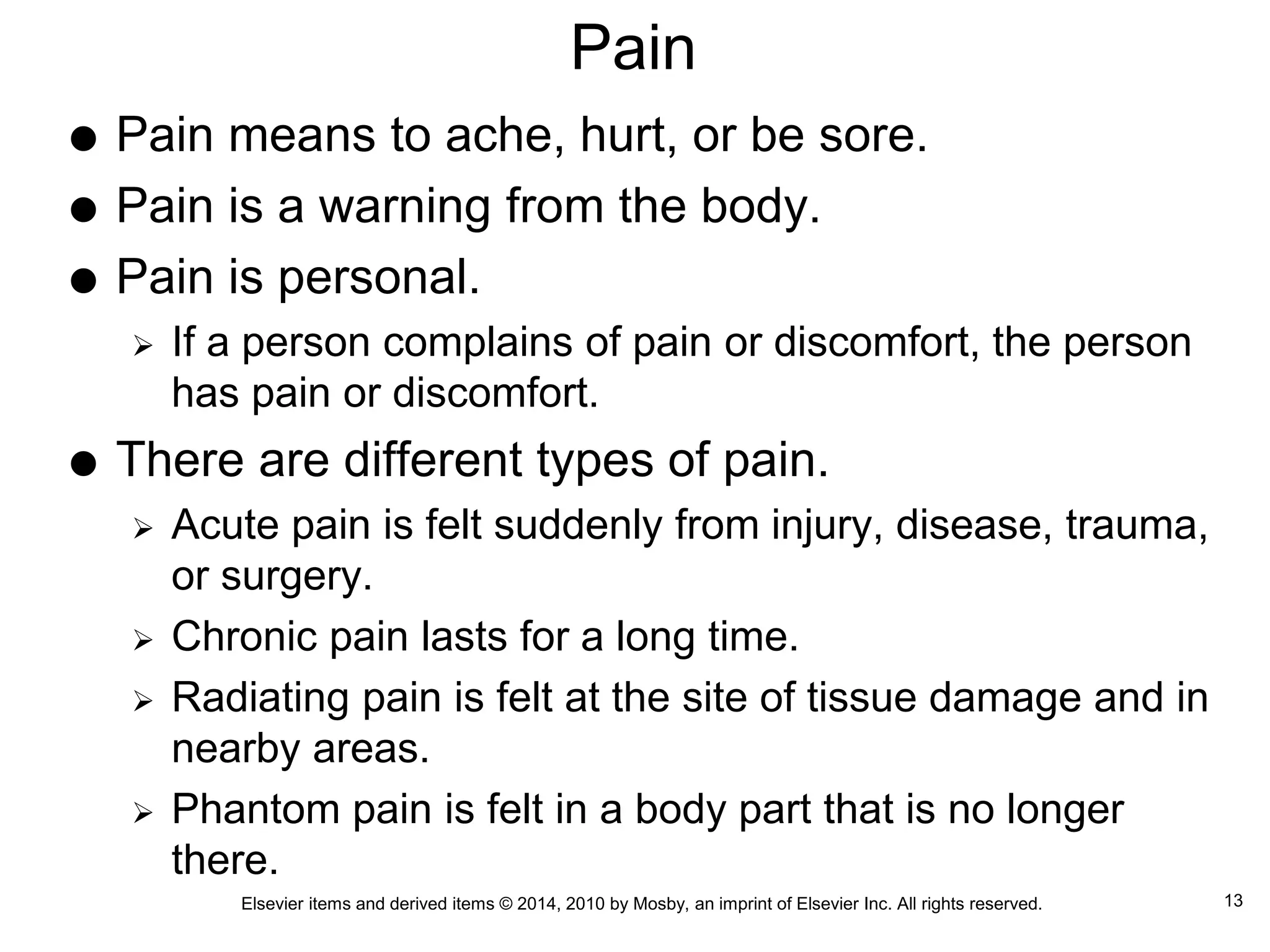
Pain
 Pain means to ache, hurt, or be sore.
 Pain is a warning from the body.
 Pain is personal.
 If a person complains of pain or discomfort, the person
has pain or discomfort.
 There are different types of pain.
 Acute pain is felt suddenly from injury, disease, trauma,
or surgery.
 Chronic pain lasts for a long time.
 Radiating pain is felt at the site of tissue damage and in
nearby areas.
 Phantom pain is felt in a body part that is no longer
there.
13
Elsevier items and derived items © 2014, 2010 by Mosby, an imprint of Elsevier Inc. All rights reserved.
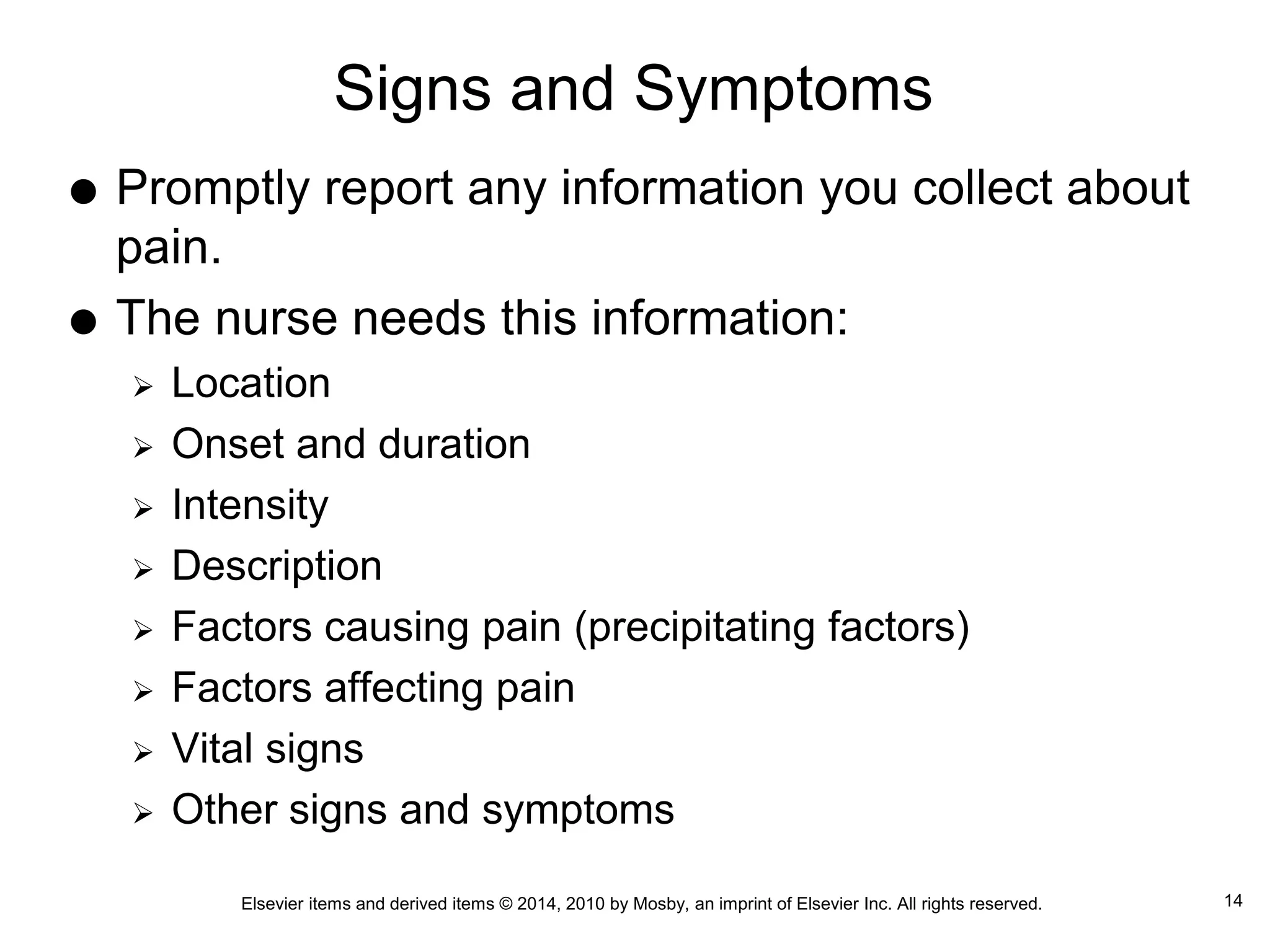
Signs and Symptoms
 Promptly report any information you collect about
pain.
 The nurse needs this information:
 Location
 Onset and duration
 Intensity
 Description
 Factors causing pain (precipitating factors)
 Factors affecting pain
 Vital signs
 Other signs and symptoms
14
Elsevier items and derived items © 2014, 2010 by Mosby, an imprint of Elsevier Inc. All rights reserved.
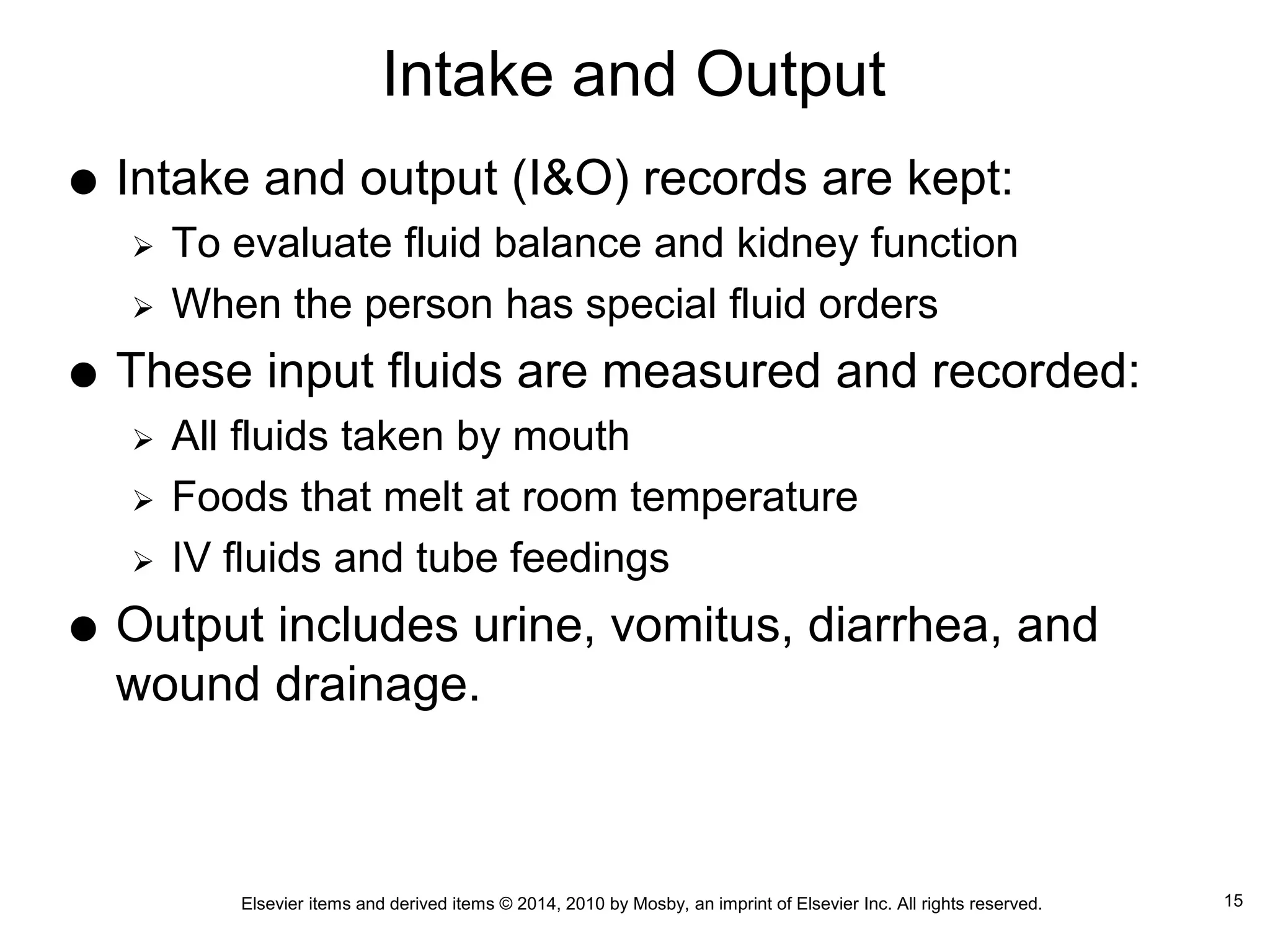
Intake and Output
 Intake and output (I&O) records are kept:
 To evaluate fluid balance and kidney function
 When the person has special fluid orders
 These input fluids are measured and recorded:
 All fluids taken by mouth
 Foods that melt at room temperature
 IV fluids and tube feedings
 Output includes urine, vomitus, diarrhea, and
wound drainage.
15
Elsevier items and derived items © 2014, 2010 by Mosby, an imprint of Elsevier Inc. All rights reserved.
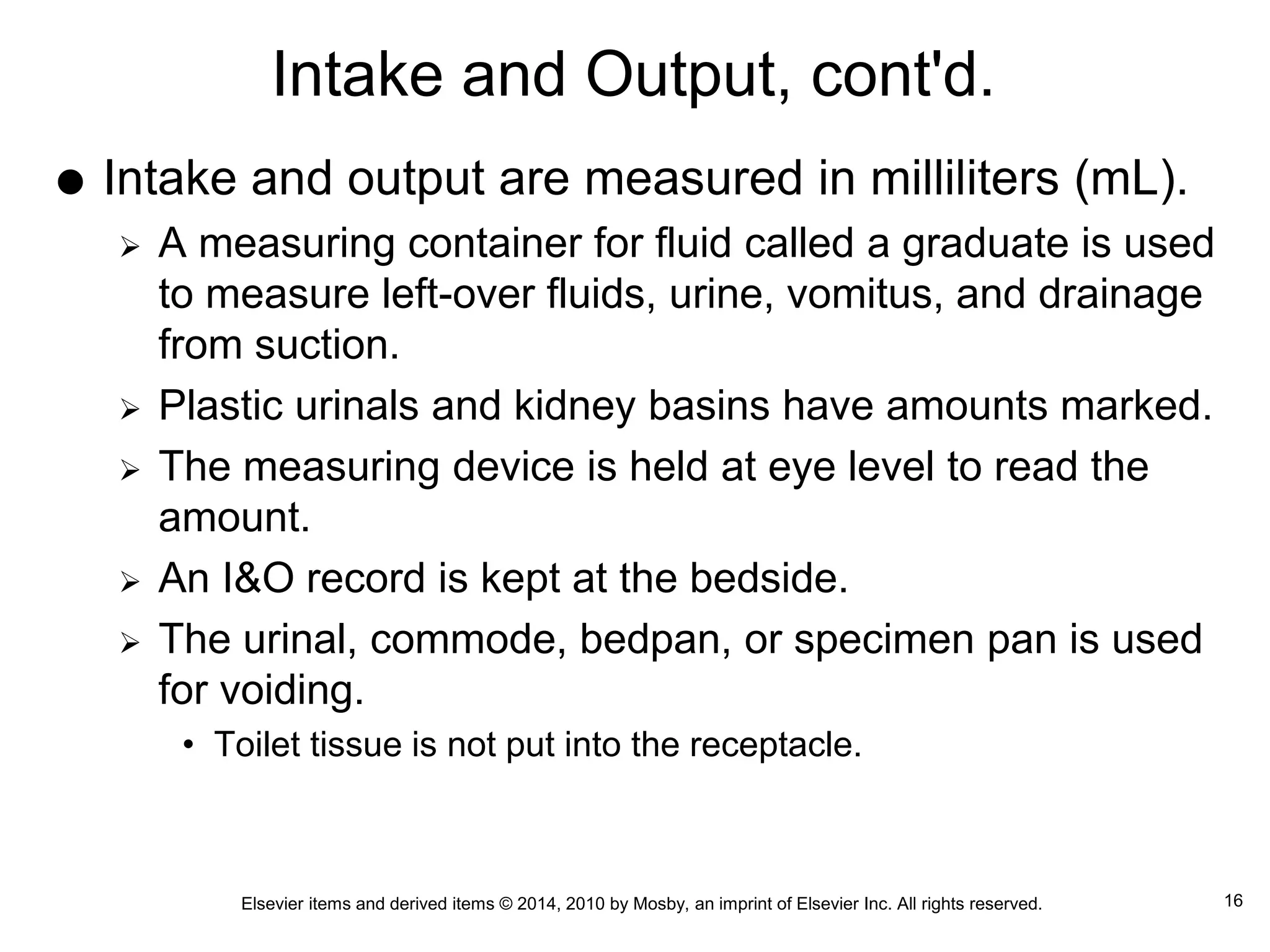
Intake and Output, cont'd.
 Intake and output are measured in milliliters (mL).
 A measuring container for fluid called a graduate is used
to measure left-over fluids, urine, vomitus, and drainage
from suction.
 Plastic urinals and kidney basins have amounts marked.
 The measuring device is held at eye level to read the
amount.
 An I&O record is kept at the bedside.
 The urinal, commode, bedpan, or specimen pan is used
for voiding.
• Toilet tissue is not put into the receptacle.
16
Elsevier items and derived items © 2014, 2010 by Mosby, an imprint of Elsevier Inc. All rights reserved.
Weight and Height
 Weight and height are measured:
 On admission to the agency
 Daily, weekly, or monthly
 Standing, chair, bed, and lift scales are used.
17
Elsevier items and derived items © 2014, 2010 by Mosby, an imprint of Elsevier Inc. All rights reserved.
Weight and Height Guidelines
 When measuring weight and height, follow these
guidelines:
 The person only wears a gown or pajamas.
• No footwear is worn.
 The person voids before being weighed.
 Weigh the person at the same time of day.
• Before breakfast is the best time.
 Use the same scale for daily, weekly, and monthly
weights.
 Balance the scale at zero (0) before weighing the
person.
18

Section 1 assisting with assessment-1

  • 1.
    Elsevier items andderived items © 2014, 2010 by Mosby, an imprint of Elsevier Inc. All rights reserved. Chapter 21 Assisting With Assessment
  • 2.
    Elsevier items andderived items © 2014, 2010 by Mosby, an imprint of Elsevier Inc. All rights reserved. Vital Signs  Vital signs reflect three body processes:  Regulation of body temperature  Breathing  Heart function  A person’s vital signs:  Vary within certain limits  Are affected by many factors  Show even minor changes in the person’s condition  Tell about responses to treatment  Often signal life-threatening events 2
  • 3.
    Elsevier items andderived items © 2014, 2010 by Mosby, an imprint of Elsevier Inc. All rights reserved. Accuracy  Accuracy is essential when you measure, record, and report vital signs.  If unsure of your measurements, promptly ask the nurse to take them again.  Unless otherwise ordered, take vital signs with the person at rest lying or sitting.  Report the following at once:  Any vital sign that is changed from a prior measurement  Vital signs above or below the normal range 3
  • 4.
    Elsevier items andderived items © 2014, 2010 by Mosby, an imprint of Elsevier Inc. All rights reserved. Body Temperature  Body temperature is the amount of heat in the body.  It is a balance between the amount of heat produced and the amount lost by the body.  Thermometers are used to measure temperature. • Fahrenheit (F) and centigrade or Celsius (C) scales are used.  Temperature sites are the: • Mouth • Rectum • Axilla (underarm) • Tympanic membrane (ear) • Temporal artery (forehead)  Each temperature site has a normal range. 4
  • 5.
    Elsevier items andderived items © 2014, 2010 by Mosby, an imprint of Elsevier Inc. All rights reserved. Thermometers  These types of thermometers are used:  Glass thermometers • Used for oral, rectal, and axillary temperatures  Electronic thermometers • Some have oral and rectal probes with disposable covers. • Tympanic membrane thermometers measure temperature at the tympanic membrane in the ear. • Temporal artery thermometers measure temperature at the temporal artery in the forehead. 5
  • 6.
    Elsevier items andderived items © 2014, 2010 by Mosby, an imprint of Elsevier Inc. All rights reserved. Pulse  The pulse is the beat of the heart felt at an artery as a wave of blood passes through the artery.  A pulse is felt every time the heart beats.  Pulse sites • The temporal, carotid, brachial, radial, femoral, popliteal, posterior tibial, and dorsalis pedis (pedal) pulses are on each side of the body. • The radial pulse is used most often. • The apical pulse is felt over the heart.  The apical pulse is taken with a stethoscope. • A stethoscope is an instrument used to listen to the sounds produced by the heart, lungs, and other body organs. 6
  • 7.
    Elsevier items andderived items © 2014, 2010 by Mosby, an imprint of Elsevier Inc. All rights reserved. Using a Stethoscope  To use a stethoscope:  Wipe the earpieces and diaphragm with antiseptic wipes before and after use.  Place the earpiece tips in your ears. • The bend of the tips points forward. • Earpieces should fit snugly.  Tap the diaphragm gently. • If you do not hear the tapping, turn the chest piece at the tubing. Gently tap the diaphragm again. • Check with the nurse if you still do not hear the tapping.  Place the diaphragm over the artery. Hold it in place.  Prevent noise. Do not let anything touch the tubing. 7
  • 8.
    Elsevier items andderived items © 2014, 2010 by Mosby, an imprint of Elsevier Inc. All rights reserved. Pulse Rate  The pulse rate is the number of heartbeats or pulses felt in 1 minute.  The adult pulse rate is between 60 and 100 beats per minute.  Report a rate of less than 60 or more than 100 to the nurse at once.  The rhythm of the pulse should be regular.  Pulses are felt in a pattern.  The same time interval occurs between beats.  Force relates to pulse strength.  A forceful pulse is described as strong, full, or bounding.  Hard-to-feel pulses are described as weak, thready, or feeble. 8
  • 9.
    Elsevier items andderived items © 2014, 2010 by Mosby, an imprint of Elsevier Inc. All rights reserved. Pulse Sites  The radial pulse is used for routine vital signs.  Place the first 2 or 3 fingertips of one hand against the radial artery.  Count the pulse for 30 seconds and multiply the number by 2.  If the pulse is irregular, count it for 1 minute.  The apical pulse is on the left side of the chest slightly below the nipple.  It is taken with a stethoscope.  Count the apical pulse for 1 minute.  Count each lub-dub as one beat. 9
  • 10.
    Elsevier items andderived items © 2014, 2010 by Mosby, an imprint of Elsevier Inc. All rights reserved. Respirations  Respiration means breathing air into (inhalation) and out of (exhalation) the lungs.  Each respiration involves 1 inhalation and 1 exhalation.  Respirations are normally quiet, effortless, and regular. Both sides of the chest rise and fall equally.  The healthy adult has 12 to 20 respirations per minute.  The person should not know that you are counting respirations. • Count respirations right after taking a pulse. • Count them for 30 seconds and multiply the number by 2. • If an abnormal pattern is noted, count respirations for 1 minute. 10
  • 11.
    Elsevier items andderived items © 2014, 2010 by Mosby, an imprint of Elsevier Inc. All rights reserved. Blood Pressure  Blood pressure is the amount of force exerted against the walls of an artery by the blood.  Systole is the period of heart muscle contraction.  Diastole is the period of heart muscle relaxation.  The systolic pressure is the pressure in the arteries when the heart contracts.  The diastolic pressure is the pressure in the arteries when the heart is at rest.  Blood pressure is measured in millimeters (mm) of mercury (Hg).  The systolic pressure is recorded over the diastolic pressure. 11
  • 12.
    Elsevier items andderived items © 2014, 2010 by Mosby, an imprint of Elsevier Inc. All rights reserved. BP Normal Ranges  Blood pressure has normal ranges:  Systolic pressure—less than 120 mm Hg  Diastolic pressure—less than 80 mm Hg  Treatment is indicated for:  Hypertension (blood pressure measurements that remain above the normal range)  Hypotension (when the systolic pressure and the diastolic pressure are below the normal range)  A stethoscope and a sphygmomanometer are used to measure blood pressure.  Blood pressure is normally measured in the brachial artery. 12
  • 13.
    Elsevier items andderived items © 2014, 2010 by Mosby, an imprint of Elsevier Inc. All rights reserved. Pain  Pain means to ache, hurt, or be sore.  Pain is a warning from the body.  Pain is personal.  If a person complains of pain or discomfort, the person has pain or discomfort.  There are different types of pain.  Acute pain is felt suddenly from injury, disease, trauma, or surgery.  Chronic pain lasts for a long time.  Radiating pain is felt at the site of tissue damage and in nearby areas.  Phantom pain is felt in a body part that is no longer there. 13
  • 14.
    Elsevier items andderived items © 2014, 2010 by Mosby, an imprint of Elsevier Inc. All rights reserved. Signs and Symptoms  Promptly report any information you collect about pain.  The nurse needs this information:  Location  Onset and duration  Intensity  Description  Factors causing pain (precipitating factors)  Factors affecting pain  Vital signs  Other signs and symptoms 14
  • 15.
    Elsevier items andderived items © 2014, 2010 by Mosby, an imprint of Elsevier Inc. All rights reserved. Intake and Output  Intake and output (I&O) records are kept:  To evaluate fluid balance and kidney function  When the person has special fluid orders  These input fluids are measured and recorded:  All fluids taken by mouth  Foods that melt at room temperature  IV fluids and tube feedings  Output includes urine, vomitus, diarrhea, and wound drainage. 15
  • 16.
    Elsevier items andderived items © 2014, 2010 by Mosby, an imprint of Elsevier Inc. All rights reserved. Intake and Output, cont'd.  Intake and output are measured in milliliters (mL).  A measuring container for fluid called a graduate is used to measure left-over fluids, urine, vomitus, and drainage from suction.  Plastic urinals and kidney basins have amounts marked.  The measuring device is held at eye level to read the amount.  An I&O record is kept at the bedside.  The urinal, commode, bedpan, or specimen pan is used for voiding. • Toilet tissue is not put into the receptacle. 16
  • 17.
    Elsevier items andderived items © 2014, 2010 by Mosby, an imprint of Elsevier Inc. All rights reserved. Weight and Height  Weight and height are measured:  On admission to the agency  Daily, weekly, or monthly  Standing, chair, bed, and lift scales are used. 17
  • 18.
    Elsevier items andderived items © 2014, 2010 by Mosby, an imprint of Elsevier Inc. All rights reserved. Weight and Height Guidelines  When measuring weight and height, follow these guidelines:  The person only wears a gown or pajamas. • No footwear is worn.  The person voids before being weighed.  Weigh the person at the same time of day. • Before breakfast is the best time.  Use the same scale for daily, weekly, and monthly weights.  Balance the scale at zero (0) before weighing the person. 18