preencoded.png
Meaning
Components
R. Dian Dia-an Muniroh
Session 04
preencoded.png
Meaning Components According
to Lobner (2013)
1 Lobner's Approach
Lobner (2013) argues that
meaning can be decomposed
into smaller units called
meaning components.These
components represent basic
semantic features that
contribute to the overall
meaning of a word.
2 Meaning Components
Examples of meaning
components include 'object,'
'action,''state,''attribute,'
'relation,' and 'quantity.'
3 Combining Components
Lobner suggests that these components can be combined in different ways
to create the meanings of complex words and phrases.
preencoded.png
Decomposition Theory
(M) Meaning. Providing models for word meanings.
What kind of entities are lexical meanings? What is their structure? How are meanings to be
represented?
(B) Basic meanings. Reducing the vast variety of lexical meanings to a smaller set of basic meanings.
Are there lexical items which are semantically basic? How can the meanings of nonbasic items be
built up from more basic ones?
(P) Precision. Providing a means of representation that allows a precise analysis of lexical items.
What exactly are the components of lexical meanings? How can they be determined and how can
they be described in a precise way?
preencoded.png
Decomposition Theory
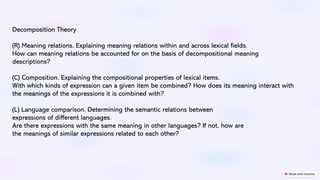
(R) Meaning relations. Explaining meaning relations within and across lexical fields.
How can meaning relations be accounted for on the basis of decompositional meaning
descriptions?
(C) Composition. Explaining the compositional properties of lexical items.
With which kinds of expression can a given item be combined? How does its meaning interact with
the meanings of the expressions it is combined with?
(L) Language comparison. Determining the semantic relations between
expressions of different languages.
Are there expressions with the same meaning in other languages? If not, how are
the meanings of similar expressions related to each other?
preencoded.png
preencoded.png
Language as a System of Signs
To Saussure, a language is an abstract complex system of relations and
rules that underlies all regularities to be observed in actual language use.
The system is formed by signs which are related in multiple ways.
A sign, e.g. a word, consists of two parts. One part is its sound form. The
other part is its meaning.
The association between form and meaning of a sign is fixed by
conventions of language use.
The association is ARBITRARY, i.e. any word could just as easily have a
different meaning, and the meaning could be associated with a different
expression – provided the conventions of the language were different.
Saussure argues that language is to be studied exclusively ‘from within’.
preencoded.png
Structuralist Approach to Meaning
Paradigmatic Relations
This refers to the relationships between words
that can substitute for one another in a given
context. For example,'dog,''cat,' and 'horse' are
all members of the same paradigm because
they can all substitute for the word 'animal' in
certain sentences.
Syntagmatic Relations
This refers to the relationships between words
that occur together in a sentence. For example,
the words 'eat' and 'apple' are syntagmatically
related because they often occur together in
sentences like 'She eats an apple.'
preencoded.png
preencoded.png
Applying the Structuralist Approach to Meaning
1
Analyzing Sentence Structure
The structuralist approach can be applied to analyze the
grammatical structure of sentences and how word
meanings combine to create meaning at the sentence
level.
2
Identifying Meaning Components
By breaking down sentences into their constituent parts,
we can identify the meaning components that contribute
to the overall meaning.
3
Understanding Word Relationships
The structuralist approach helps us understand how
words relate to each other in terms of their meanings
and how they function in language.
preencoded.png
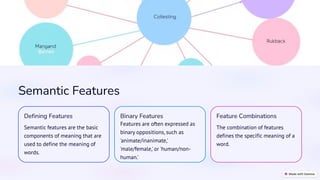
Semantic Features
Defining Features
Semantic features are the basic
components of meaning that are
used to define the meaning of
words.
Binary Features
Features are often expressed as
binary oppositions, such as
'animate/inanimate,'
'male/female,' or 'human/non-
human.'
Feature Combinations
The combination of features
defines the specific meaning of a
word.
preencoded.png
Semantic Formulae
Word Semantic Formula
Man [+HUMAN, +MALE, +ADULT]
Woman [+HUMAN,-MALE, +ADULT]
Boy [+HUMAN, +MALE,-ADULT]
preencoded.png
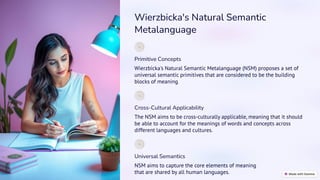
Wierzbicka's Natural Semantic
Metalanguage
Primitive Concepts
Wierzbicka's Natural Semantic Metalanguage (NSM) proposes a set of
universal semantic primitives that are considered to be the building
blocks of meaning.
Cross-Cultural Applicability
The NSM aims to be cross-culturally applicable, meaning that it should
be able to account for the meanings of words and concepts across
different languages and cultures.
Universal Semantics
NSM aims to capture the core elements of meaning
that are shared by all human languages.
preencoded.png
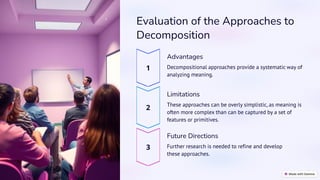
Evaluation of the Approaches to
Decomposition
Advantages
Decompositional approaches provide a systematic way of
analyzing meaning.
Limitations
These approaches can be overly simplistic, as meaning is
often more complex than can be captured by a set of
features or primitives.
Future Directions
Further research is needed to refine and develop
these approaches.
preencoded.png
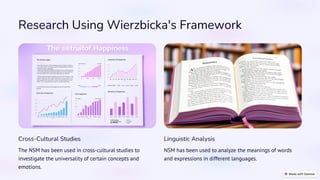
Research Using Wierzbicka's Framework
Cross-Cultural Studies
The NSM has been used in cross-cultural studies to
investigate the universality of certain concepts and
emotions.
Linguistic Analysis
NSM has been used to analyze the meanings of words
and expressions in different languages.
preencoded.png
Application of Meaning
Components
1 Lexical Semantics
Meaning components can
be used to analyze the
relationships between
words and to create
dictionaries and thesauri.
2 Natural Language
Processing
Understanding meaning
components is crucial for
developing effective
natural language
processing systems, such
as machine translation
and chatbots.
3 Cognitive Science
Research on meaning components provides insights into how
humans understand and process language.

Meaning-Components Semantics Pragmaticss

  • 1.
  • 2.
    preencoded.png Meaning Components According toLobner (2013) 1 Lobner's Approach Lobner (2013) argues that meaning can be decomposed into smaller units called meaning components.These components represent basic semantic features that contribute to the overall meaning of a word. 2 Meaning Components Examples of meaning components include 'object,' 'action,''state,''attribute,' 'relation,' and 'quantity.' 3 Combining Components Lobner suggests that these components can be combined in different ways to create the meanings of complex words and phrases.
  • 3.
    preencoded.png Decomposition Theory (M) Meaning.Providing models for word meanings. What kind of entities are lexical meanings? What is their structure? How are meanings to be represented? (B) Basic meanings. Reducing the vast variety of lexical meanings to a smaller set of basic meanings. Are there lexical items which are semantically basic? How can the meanings of nonbasic items be built up from more basic ones? (P) Precision. Providing a means of representation that allows a precise analysis of lexical items. What exactly are the components of lexical meanings? How can they be determined and how can they be described in a precise way?
  • 4.
    preencoded.png Decomposition Theory (R) Meaningrelations. Explaining meaning relations within and across lexical fields. How can meaning relations be accounted for on the basis of decompositional meaning descriptions? (C) Composition. Explaining the compositional properties of lexical items. With which kinds of expression can a given item be combined? How does its meaning interact with the meanings of the expressions it is combined with? (L) Language comparison. Determining the semantic relations between expressions of different languages. Are there expressions with the same meaning in other languages? If not, how are the meanings of similar expressions related to each other?
  • 5.
  • 6.
    preencoded.png Language as aSystem of Signs To Saussure, a language is an abstract complex system of relations and rules that underlies all regularities to be observed in actual language use. The system is formed by signs which are related in multiple ways. A sign, e.g. a word, consists of two parts. One part is its sound form. The other part is its meaning. The association between form and meaning of a sign is fixed by conventions of language use. The association is ARBITRARY, i.e. any word could just as easily have a different meaning, and the meaning could be associated with a different expression – provided the conventions of the language were different. Saussure argues that language is to be studied exclusively ‘from within’.
  • 7.
    preencoded.png Structuralist Approach toMeaning Paradigmatic Relations This refers to the relationships between words that can substitute for one another in a given context. For example,'dog,''cat,' and 'horse' are all members of the same paradigm because they can all substitute for the word 'animal' in certain sentences. Syntagmatic Relations This refers to the relationships between words that occur together in a sentence. For example, the words 'eat' and 'apple' are syntagmatically related because they often occur together in sentences like 'She eats an apple.'
  • 8.
  • 9.
    preencoded.png Applying the StructuralistApproach to Meaning 1 Analyzing Sentence Structure The structuralist approach can be applied to analyze the grammatical structure of sentences and how word meanings combine to create meaning at the sentence level. 2 Identifying Meaning Components By breaking down sentences into their constituent parts, we can identify the meaning components that contribute to the overall meaning. 3 Understanding Word Relationships The structuralist approach helps us understand how words relate to each other in terms of their meanings and how they function in language.
  • 10.
    preencoded.png Semantic Features Defining Features Semanticfeatures are the basic components of meaning that are used to define the meaning of words. Binary Features Features are often expressed as binary oppositions, such as 'animate/inanimate,' 'male/female,' or 'human/non- human.' Feature Combinations The combination of features defines the specific meaning of a word.
  • 11.
    preencoded.png Semantic Formulae Word SemanticFormula Man [+HUMAN, +MALE, +ADULT] Woman [+HUMAN,-MALE, +ADULT] Boy [+HUMAN, +MALE,-ADULT]
  • 12.
    preencoded.png Wierzbicka's Natural Semantic Metalanguage PrimitiveConcepts Wierzbicka's Natural Semantic Metalanguage (NSM) proposes a set of universal semantic primitives that are considered to be the building blocks of meaning. Cross-Cultural Applicability The NSM aims to be cross-culturally applicable, meaning that it should be able to account for the meanings of words and concepts across different languages and cultures. Universal Semantics NSM aims to capture the core elements of meaning that are shared by all human languages.
  • 13.
    preencoded.png Evaluation of theApproaches to Decomposition Advantages Decompositional approaches provide a systematic way of analyzing meaning. Limitations These approaches can be overly simplistic, as meaning is often more complex than can be captured by a set of features or primitives. Future Directions Further research is needed to refine and develop these approaches.
  • 14.
    preencoded.png Research Using Wierzbicka'sFramework Cross-Cultural Studies The NSM has been used in cross-cultural studies to investigate the universality of certain concepts and emotions. Linguistic Analysis NSM has been used to analyze the meanings of words and expressions in different languages.
  • 15.
    preencoded.png Application of Meaning Components 1Lexical Semantics Meaning components can be used to analyze the relationships between words and to create dictionaries and thesauri. 2 Natural Language Processing Understanding meaning components is crucial for developing effective natural language processing systems, such as machine translation and chatbots. 3 Cognitive Science Research on meaning components provides insights into how humans understand and process language.