LASER
Dr Ehab Hegazy
Types of Laser
Based on the mode of operation
(i) Pulsed Laser systems
(ii) Continuous wave Laser systems
Based on the mechanism in which Population
Inversion is achieved
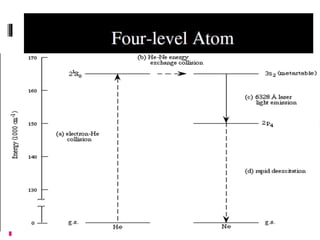
(i)Three level lasers
(ii) Four level lasers
Based on state of active medium used
(i) Gas Laser
(ii) Solid state Laser
(iii) Semiconductor Laser
(iv)Tunable dye Laser
Properties of laser light
3
 The light emitted from a laser is monochromatic, that
is, it is of one color/wavelength. In contrast, ordinary
white light is a combination of many colors (or
wavelengths) of light
Properties of laser light
4
 Lasers emit light that is highly directional, that is, laser
light is emitted as a relatively narrow beam in a specific
direction. Ordinary light, such as from a light bulb, is
emitted in many directions away from the source
Properties of laser light
5
 The light from a laser is said to be coherent, which
means that the wavelengths of the laser light are in
phase in space and time. Ordinary light can be a
mixture of many wavelengths.
These three properties of laser light are what can
make it more hazardous than ordinary light. Laser
light can deposit a lot of energy within a small area.
6
Incandescent vs. Laser Light
1. Many wavelengths
2. Multidirectional
3. Incoherent
1. Monochromatic
2. Directional
3. Coherent
Common Components of all Lasers
7
1. Active Medium
Active mediums contain atoms whose electrons may be excited to a
metastable energy level by an energy source.
solid , liquid , gas
Common Components of all Lasers
8
2. Excitation Mechanism
Excitation mechanisms pump energy into the active medium by
one or more of three basic methods; optical, electrical or
chemical.
Common Components of all Lasers
9
3. High Reflectance Mirror
A mirror which reflects essentially 100% of the laser
light.
4. Partially Transmissive Mirror
A mirror which reflects less than 100% of the laser light
and transmits the remainder.
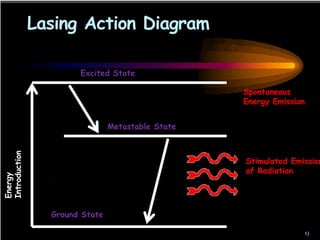
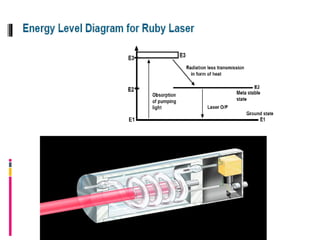
Lasing Action
1. Energy is applied to a medium raising electrons to an unstable
energy level.
2. These atoms spontaneously decay to a relatively long-lived, lower
energy, metastable state.
3. A population inversion is achieved when the majority of atoms have
reached this metastable state.
10
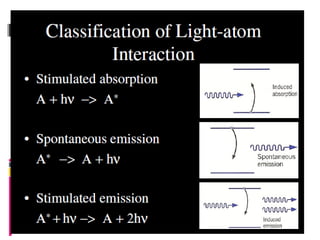
Lasing Action
1. Lasing action occurs when an electron spontaneously returns to its
ground state and produces a photon.
2. If the energy from this photon is of the precise wavelength, it will
stimulate the production of another photon of the same wavelength
and resulting in a cascading effect.
11
Lasing Action
1. The highly reflective mirror and partially reflective mirror continue
the reaction by directing photons back through the medium along
the long axis of the laser.
2. The partially reflective mirror allows the transmission of a small
amount of coherent radiation that we observe as the “beam”.
3. Laser radiation will continue as long as energy is applied to the
lasing medium.
12
Lasing Action Diagram
13
Energy
Introduction
Ground State
Excited State
Metastable State
Spontaneous
Energy Emission
Stimulated Emission
of Radiation
The Cascade of Photons
Energetic electrons accelerating from the cathode to the anode collide with He
and Ne atoms in the laser tube, producing a large number of neutral He and Ne
atoms in excited states. He and Ne atoms in excited states can deexcite and
return to their ground states by spontaneously emitting light.
This light makes up the bright pink-red glow of the plasma that is seen
even in the absence of laser action.
BASIC definitions OF LASER
PHYSICS
State of achieving more number
of atom in the excited state
compared to the ground state.
Population inversion can be
Achieved By a process called
pumping
Mechanism of exciting atoms
from the lower energy state to
a higher energy state by
supplying energy from an
external source.
Atom are excited by means of
an external optical source
This is adopted in solid state
lasers such as ruby laser and
Nd:yag laser.
The electrons are accelerated
to a high velocity by a strong
electric field.
This technique of pumping is
adopted in gas laser such as
co2 laser
Which leads to emission of
stimulated photons after
established the population
inversion is referred as
lasing.
The limited time for which a
particle or an atom remains
in the excited is know as life
time.
It is a about a nano second.
The energy levels in an
atomic system where life
time of atoms is very large.
This property helps in
achieving the population
inversion.
Population inversion is
achieved for laser action is
called active medium.
The medium can be solid,
liquid, gas and plasma.
(1) Solid state lasers
(2) Liquid lasers
(3) Gaseous lasers
(4) Dye lasers
(5) Semiconductor lasers
It is a pair of reflecting
surface of which one is a
perfect reflector and the
other is a partial reflector.

4 laser

  • 1.
  • 2.
    Types of Laser Basedon the mode of operation (i) Pulsed Laser systems (ii) Continuous wave Laser systems Based on the mechanism in which Population Inversion is achieved (i)Three level lasers (ii) Four level lasers Based on state of active medium used (i) Gas Laser (ii) Solid state Laser (iii) Semiconductor Laser (iv)Tunable dye Laser
  • 3.
    Properties of laserlight 3  The light emitted from a laser is monochromatic, that is, it is of one color/wavelength. In contrast, ordinary white light is a combination of many colors (or wavelengths) of light
  • 4.
    Properties of laserlight 4  Lasers emit light that is highly directional, that is, laser light is emitted as a relatively narrow beam in a specific direction. Ordinary light, such as from a light bulb, is emitted in many directions away from the source
  • 5.
    Properties of laserlight 5  The light from a laser is said to be coherent, which means that the wavelengths of the laser light are in phase in space and time. Ordinary light can be a mixture of many wavelengths. These three properties of laser light are what can make it more hazardous than ordinary light. Laser light can deposit a lot of energy within a small area.
  • 6.
    6 Incandescent vs. LaserLight 1. Many wavelengths 2. Multidirectional 3. Incoherent 1. Monochromatic 2. Directional 3. Coherent
  • 7.
    Common Components ofall Lasers 7 1. Active Medium Active mediums contain atoms whose electrons may be excited to a metastable energy level by an energy source. solid , liquid , gas
  • 8.
    Common Components ofall Lasers 8 2. Excitation Mechanism Excitation mechanisms pump energy into the active medium by one or more of three basic methods; optical, electrical or chemical.
  • 9.
    Common Components ofall Lasers 9 3. High Reflectance Mirror A mirror which reflects essentially 100% of the laser light. 4. Partially Transmissive Mirror A mirror which reflects less than 100% of the laser light and transmits the remainder.
  • 10.
    Lasing Action 1. Energyis applied to a medium raising electrons to an unstable energy level. 2. These atoms spontaneously decay to a relatively long-lived, lower energy, metastable state. 3. A population inversion is achieved when the majority of atoms have reached this metastable state. 10
  • 11.
    Lasing Action 1. Lasingaction occurs when an electron spontaneously returns to its ground state and produces a photon. 2. If the energy from this photon is of the precise wavelength, it will stimulate the production of another photon of the same wavelength and resulting in a cascading effect. 11
  • 12.
    Lasing Action 1. Thehighly reflective mirror and partially reflective mirror continue the reaction by directing photons back through the medium along the long axis of the laser. 2. The partially reflective mirror allows the transmission of a small amount of coherent radiation that we observe as the “beam”. 3. Laser radiation will continue as long as energy is applied to the lasing medium. 12
  • 13.
    Lasing Action Diagram 13 Energy Introduction GroundState Excited State Metastable State Spontaneous Energy Emission Stimulated Emission of Radiation
  • 15.
  • 21.
    Energetic electrons acceleratingfrom the cathode to the anode collide with He and Ne atoms in the laser tube, producing a large number of neutral He and Ne atoms in excited states. He and Ne atoms in excited states can deexcite and return to their ground states by spontaneously emitting light. This light makes up the bright pink-red glow of the plasma that is seen even in the absence of laser action.
  • 25.
    BASIC definitions OFLASER PHYSICS
  • 26.
    State of achievingmore number of atom in the excited state compared to the ground state. Population inversion can be Achieved By a process called pumping
  • 27.
    Mechanism of excitingatoms from the lower energy state to a higher energy state by supplying energy from an external source.
  • 28.
    Atom are excitedby means of an external optical source This is adopted in solid state lasers such as ruby laser and Nd:yag laser.
  • 29.
    The electrons areaccelerated to a high velocity by a strong electric field. This technique of pumping is adopted in gas laser such as co2 laser
  • 30.
    Which leads toemission of stimulated photons after established the population inversion is referred as lasing.
  • 31.
    The limited timefor which a particle or an atom remains in the excited is know as life time. It is a about a nano second.
  • 32.
    The energy levelsin an atomic system where life time of atoms is very large. This property helps in achieving the population inversion.
  • 33.
    Population inversion is achievedfor laser action is called active medium. The medium can be solid, liquid, gas and plasma.
  • 34.
    (1) Solid statelasers (2) Liquid lasers (3) Gaseous lasers (4) Dye lasers (5) Semiconductor lasers
  • 35.
    It is apair of reflecting surface of which one is a perfect reflector and the other is a partial reflector.