Plant Species Diversity Determination
by Matrix Method
UG Geography Honours CBCS Syllabus
Part of GEO-A-CC-4-010-P: Soil and Bio-Geography
Lab:
30 marks, 2 Credits
Study Material
Dr. Sarada Mandal
Associate Professor in Geography
Prabhu Jagatbandhu College
Diversity Indices:
A) A diversity index is a mathematical measure of
species diversity in a given community.
B) Based on the species richness (the number of
species present) and species abundance (the
number of individuals per species).
C) The more species you have, the more diverse the
area.
D) However, there are two types of indices,
dominance indices and information statistic
indices.
Diversity Indices (Continued)
• The Shannon - Wiener index is an
information statistic index, which means it
assumes all species are represented in a
sample and that they are randomly sampled.
• In the Shannon-Wiener index, p is the
proportion (n/N) of individuals of one
particular species found (n) divided by the
total number of individuals found (N), ln is
the natural log, Σ is the sum of the
calculations, and s is the number of species.
Diversity Indices (Continued)
• The Simpson index is a dominance index
because it gives more weight to common or
dominant species. In this case, a few rare
species with only a few representatives will
not affect the diversity.
• In the Simpson index, p is the proportion
(n/N) of individuals of one particular species
found (n) divided by the total number of
individuals found (N), Σ is still the sum of the
calculations, and s is the number of species.
Information Statistic Indices: Shannon-
Wiener Index (H’)
i. Most commonly used index in ecological studies
ii. Values range from 0 to 5, usually ranging from 1.5
to 3.5
Advantages and Disadvantages:
(1) Relatively easy to calculate
(2) Fairly sensitive to actual site differences
(3) There are several instances where H’ is similar
between sites even though sites are different.
Simpson’s Index (λ) -
• i. λ is a measure of dominance therefore, (1-D)
measures species diversity
• ii. Gives the probability that any two individuals
drawn at random from an infinitely large
community belong to different species
Advantages and Disadvantages:
(1) Less sensitive to species richness and heavily
weighted towards the most abundant species
(2) Generally less sensitive than Shannon-Weiner H’
Benefits of Diverse Range Plant
Community
a. A mixture of plants provides forage for a variety of insect and
vertibrateldspecies (biodiversity)
b. A mixture of plants will contain some plants that can survive
drought, insect plagues,and/or disease outbreaks so that the
site will have some soil protection/forage/etc. in those years
c. A mixture of plants contains a variety of genetic material that
may be useful in long-term survival.
d. The community benefits from a mixture of plants (soils
improve with nitrogen fixers. Deep rooted plants bring
nutrients up from soil layers below other plants roots, some
species work together so that both can survive -
commensalism)
e. Healthy diverse plant communities generally have all niches
filled and are theoretically less likely to be invaded by noxious
or opportunistic introduced species.
Disadvantages of Diverse Composition in
the Range Plant Community:
• It becomes more difficult to manage because
different species of plants have different grazing
tolerances and different rates of phenological
development.
• Not all plant species are desirable for all foraging
species.
• Diverse communities are often a sign of fragmented
or somewhat degraded site where much of species
richness is contributed by disturbance species.
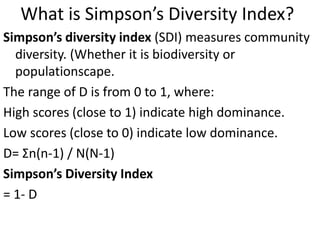
What is Simpson’s Diversity Index?
Simpson’s diversity index (SDI) measures community
diversity. (Whether it is biodiversity or
populationscape.
The range of D is from 0 to 1, where:
High scores (close to 1) indicate high dominance.
Low scores (close to 0) indicate low dominance.
D= Σn(n-1) / N(N-1)
Simpson’s Diversity Index
= 1- D
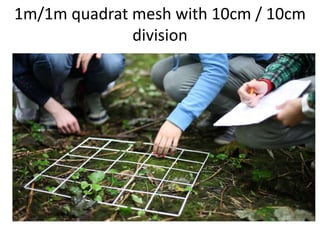
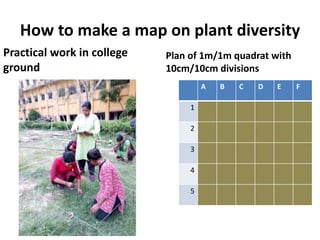
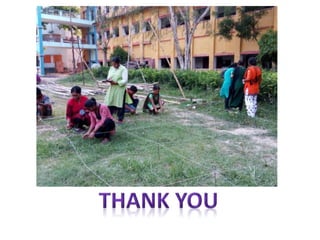
1m/1m quadrat mesh with 10cm / 10cm
division
Reference
• https://www.youtube.com/watch?v=uBYqBNyojMQ
• https://www.youtube.com/watch?v=cS4qwSK-Mqw
• https://www.youtube.com/watch?v=fjxWGZGzePk
• https://entnemdept.ifas.ufl.edu/hodges/protectus/l
p_webfolder/9_12_grade/student_handout_1a.pdf
How to make a map on plant diversity
Practical work in college
ground
Plan of 1m/1m quadrat with
10cm/10cm divisions
A B C D E F
1
2
3
4
5
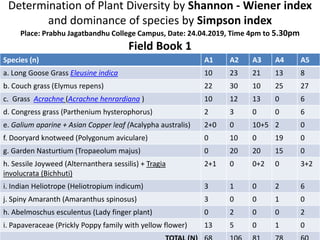
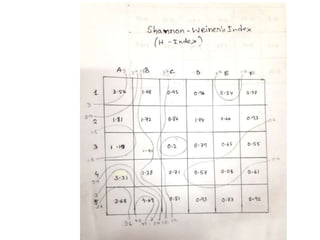
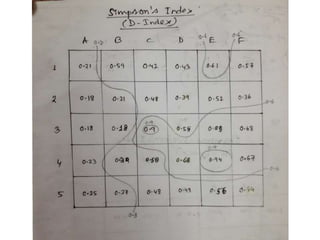
Determination of Plant Diversity by Shannon - Wiener index
and dominance of species by Simpson index
Place: Prabhu Jagatbandhu College Campus, Date: 24.04.2019, Time 4pm to 5.30pm
Field Book 1
Species (n) A1 A2 A3 A4 A5
a. Long Goose Grass Eleusine indica 10 23 21 13 8
b. Couch grass (Elymus repens) 22 30 10 25 27
c. Grass Acrachne (Acrachne henrardiana ) 10 12 13 0 6
d. Congress grass (Parthenium hysterophorus) 2 3 0 0 6
e. Galium aparine + Asian Copper leaf (Acalypha australis) 2+0 0 10+5 2 0
f. Dooryard knotweed (Polygonum aviculare) 0 10 0 19 0
g. Garden Nasturtium (Tropaeolum majus) 0 20 20 15 0
h. Sessile Joyweed (Alternanthera sessilis) + Tragia
involucrata (Bichhuti)
2+1 0 0+2 0 3+2
i. Indian Heliotrope (Heliotropium indicum) 3 1 0 2 6
j. Spiny Amaranth (Amaranthus spinosus) 3 0 0 1 0
h. Abelmoschus esculentus (Lady finger plant) 0 2 0 0 2
i. Papaveraceae (Prickly Poppy family with yellow flower) 13 5 0 1 0
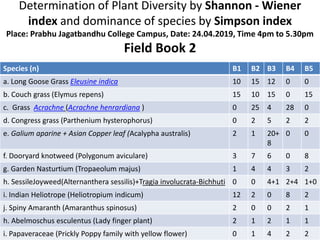
Determination of Plant Diversity by Shannon - Wiener
index and dominance of species by Simpson index
Place: Prabhu Jagatbandhu College Campus, Date: 24.04.2019, Time 4pm to 5.30pm
Field Book 2
Species (n) B1 B2 B3 B4 B5
a. Long Goose Grass Eleusine indica 10 15 12 0 0
b. Couch grass (Elymus repens) 15 10 15 0 15
c. Grass Acrachne (Acrachne henrardiana ) 0 25 4 28 0
d. Congress grass (Parthenium hysterophorus) 0 2 5 2 2
e. Galium aparine + Asian Copper leaf (Acalypha australis) 2 1 20+
8
0 0
f. Dooryard knotweed (Polygonum aviculare) 3 7 6 0 8
g. Garden Nasturtium (Tropaeolum majus) 1 4 4 3 2
h. SessileJoyweed(Alternanthera sessilis)+Tragia involucrata-Bichhuti 0 0 4+1 2+4 1+0
i. Indian Heliotrope (Heliotropium indicum) 12 2 0 8 2
j. Spiny Amaranth (Amaranthus spinosus) 2 0 0 2 1
h. Abelmoschus esculentus (Lady finger plant) 2 1 2 1 1
i. Papaveraceae (Prickly Poppy family with yellow flower) 0 1 4 2 2
Determination of Plant Diversity by Shannon - Wiener index
and dominance of species by Simpson index
Place: Prabhu Jagatbandhu College Campus, Date: 24.04.2019, Time 4pm to 5.30pm
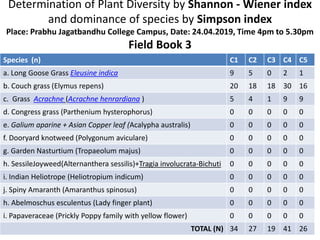
Field Book 3
Species (n) C1 C2 C3 C4 C5
a. Long Goose Grass Eleusine indica 9 5 0 2 1
b. Couch grass (Elymus repens) 20 18 18 30 16
c. Grass Acrachne (Acrachne henrardiana ) 5 4 1 9 9
d. Congress grass (Parthenium hysterophorus) 0 0 0 0 0
e. Galium aparine + Asian Copper leaf (Acalypha australis) 0 0 0 0 0
f. Dooryard knotweed (Polygonum aviculare) 0 0 0 0 0
g. Garden Nasturtium (Tropaeolum majus) 0 0 0 0 0
h. SessileJoyweed(Alternanthera sessilis)+Tragia involucrata-Bichuti 0 0 0 0 0
i. Indian Heliotrope (Heliotropium indicum) 0 0 0 0 0
j. Spiny Amaranth (Amaranthus spinosus) 0 0 0 0 0
h. Abelmoschus esculentus (Lady finger plant) 0 0 0 0 0
i. Papaveraceae (Prickly Poppy family with yellow flower) 0 0 0 0 0
TOTAL (N) 34 27 19 41 26
Determination of Plant Diversity by Shannon - Wiener index
and dominance of species by Simpson index
Place: Prabhu Jagatbandhu College Campus, Date: 24.04.2019, Time 4pm to 5.30pm
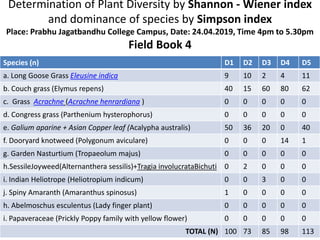
Field Book 4
Species (n) D1 D2 D3 D4 D5
a. Long Goose Grass Eleusine indica 9 10 2 4 11
b. Couch grass (Elymus repens) 40 15 60 80 62
c. Grass Acrachne (Acrachne henrardiana ) 0 0 0 0 0
d. Congress grass (Parthenium hysterophorus) 0 0 0 0 0
e. Galium aparine + Asian Copper leaf (Acalypha australis) 50 36 20 0 40
f. Dooryard knotweed (Polygonum aviculare) 0 0 0 14 1
g. Garden Nasturtium (Tropaeolum majus) 0 0 0 0 0
h.SessileJoyweed(Alternanthera sessilis)+Tragia involucrataBichuti 0 2 0 0 0
i. Indian Heliotrope (Heliotropium indicum) 0 0 3 0 0
j. Spiny Amaranth (Amaranthus spinosus) 1 0 0 0 0
h. Abelmoschus esculentus (Lady finger plant) 0 0 0 0 0
i. Papaveraceae (Prickly Poppy family with yellow flower) 0 0 0 0 0
TOTAL (N) 100 73 85 98 113
Determination of Plant Diversity by Shannon - Wiener index
and dominance of species by Simpson index
Place: Prabhu Jagatbandhu College Campus, Date: 24.04.2019, Time 4pm to 5.30pm
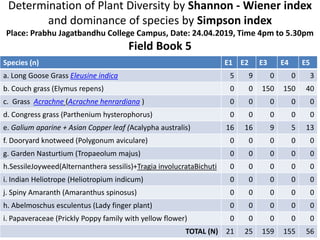
Field Book 5
Species (n) E1 E2 E3 E4 E5
a. Long Goose Grass Eleusine indica 5 9 0 0 3
b. Couch grass (Elymus repens) 0 0 150 150 40
c. Grass Acrachne (Acrachne henrardiana ) 0 0 0 0 0
d. Congress grass (Parthenium hysterophorus) 0 0 0 0 0
e. Galium aparine + Asian Copper leaf (Acalypha australis) 16 16 9 5 13
f. Dooryard knotweed (Polygonum aviculare) 0 0 0 0 0
g. Garden Nasturtium (Tropaeolum majus) 0 0 0 0 0
h.SessileJoyweed(Alternanthera sessilis)+Tragia involucrataBichuti 0 0 0 0 0
i. Indian Heliotrope (Heliotropium indicum) 0 0 0 0 0
j. Spiny Amaranth (Amaranthus spinosus) 0 0 0 0 0
h. Abelmoschus esculentus (Lady finger plant) 0 0 0 0 0
i. Papaveraceae (Prickly Poppy family with yellow flower) 0 0 0 0 0
TOTAL (N) 21 25 159 155 56
Determination of Plant Diversity by Shannon - Wiener index
and dominance of species by Simpson index
Place: Prabhu Jagatbandhu College Campus, Date: 24.04.2019, Time 4pm to 5.30pm
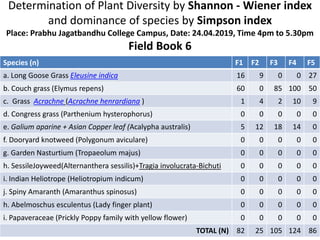
Field Book 6
Species (n) F1 F2 F3 F4 F5
a. Long Goose Grass Eleusine indica 16 9 0 0 27
b. Couch grass (Elymus repens) 60 0 85 100 50
c. Grass Acrachne (Acrachne henrardiana ) 1 4 2 10 9
d. Congress grass (Parthenium hysterophorus) 0 0 0 0 0
e. Galium aparine + Asian Copper leaf (Acalypha australis) 5 12 18 14 0
f. Dooryard knotweed (Polygonum aviculare) 0 0 0 0 0
g. Garden Nasturtium (Tropaeolum majus) 0 0 0 0 0
h. SessileJoyweed(Alternanthera sessilis)+Tragia involucrata-Bichuti 0 0 0 0 0
i. Indian Heliotrope (Heliotropium indicum) 0 0 0 0 0
j. Spiny Amaranth (Amaranthus spinosus) 0 0 0 0 0
h. Abelmoschus esculentus (Lady finger plant) 0 0 0 0 0
i. Papaveraceae (Prickly Poppy family with yellow flower) 0 0 0 0 0
TOTAL (N) 82 25 105 124 86
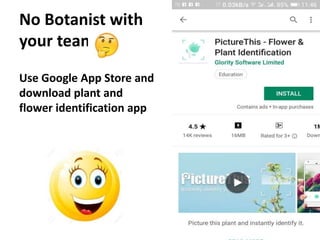
No Botanist with
your team?
Use Google App Store and
download plant and
flower identification app
What is the deference between Shannon Wiener
diversity Index and Simpson diversity Index?
Ref. Researchgate Sama S. Almaarofi
(4 years ago) Luigi Naselli-Floresadded an answer
• Simpson's index is a similarity index (the higher
the value the lower in diversity). If you want to use
it as a diversity index you can subtract it from 1
(i.e. 1-D).
• Conversely, the value of the Shannon function
increases as diversity increases.
• They are opposite to each other. In case of S-W
index, the higher is the better but in Simpson's
one the lower is the better.
Difference of two indices (contd.)
• In this sense, H has an advantage over D because it
depends more on species richness and less
abundant species, so it is very sensitive to even
small diversity changes, and thus is widely used to
assess the actual state of environment.
• On the other hand, D has the advantage over H in
counting more on dominant species and is not
affected by less abundant elements; therefore, it is
used to show the trend of ecosystem diversity
heading.
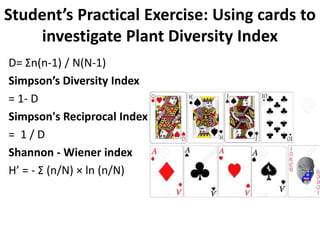
Student’s Practical Exercise: Using cards to
investigate Plant Diversity Index
D= Σn(n-1) / N(N-1)
Simpson’s Diversity Index
= 1- D
Simpson's Reciprocal Index
= 1 / D
Shannon - Wiener index
H’ = - Σ (n/N) × ln (n/N)
One pack of 52 standard playing cards The
cards represent nine possible species:
https://www.nuffieldfoundation.org/sites/default/files/19_Ecology.pdf
Species A: all
picture cards
(jacks, queens
and kings)
Species B: odd
numbered clubs
Species C: even
numbered clubs
Species D: even
numbered
diamonds
Species E: odd
numbered
diamonds
Species F: odd
numbered
hearts
Species G: even
numbered
hearts
Species H: odd
numbered
spades
Species I: even
numbered
spades
• Shuffle the
cards. Count
out 26 cards,
Now you have
two set of
samples.
• Determine
which sample
is more
diverse.
3. Plant diversity mapping

3. Plant diversity mapping

  • 1.
    Plant Species DiversityDetermination by Matrix Method UG Geography Honours CBCS Syllabus Part of GEO-A-CC-4-010-P: Soil and Bio-Geography Lab: 30 marks, 2 Credits Study Material Dr. Sarada Mandal Associate Professor in Geography Prabhu Jagatbandhu College
  • 2.
    Diversity Indices: A) Adiversity index is a mathematical measure of species diversity in a given community. B) Based on the species richness (the number of species present) and species abundance (the number of individuals per species). C) The more species you have, the more diverse the area. D) However, there are two types of indices, dominance indices and information statistic indices.
  • 3.
    Diversity Indices (Continued) •The Shannon - Wiener index is an information statistic index, which means it assumes all species are represented in a sample and that they are randomly sampled. • In the Shannon-Wiener index, p is the proportion (n/N) of individuals of one particular species found (n) divided by the total number of individuals found (N), ln is the natural log, Σ is the sum of the calculations, and s is the number of species.
  • 4.
    Diversity Indices (Continued) •The Simpson index is a dominance index because it gives more weight to common or dominant species. In this case, a few rare species with only a few representatives will not affect the diversity. • In the Simpson index, p is the proportion (n/N) of individuals of one particular species found (n) divided by the total number of individuals found (N), Σ is still the sum of the calculations, and s is the number of species.
  • 5.
    Information Statistic Indices:Shannon- Wiener Index (H’) i. Most commonly used index in ecological studies ii. Values range from 0 to 5, usually ranging from 1.5 to 3.5 Advantages and Disadvantages: (1) Relatively easy to calculate (2) Fairly sensitive to actual site differences (3) There are several instances where H’ is similar between sites even though sites are different.
  • 6.
    Simpson’s Index (λ)- • i. λ is a measure of dominance therefore, (1-D) measures species diversity • ii. Gives the probability that any two individuals drawn at random from an infinitely large community belong to different species Advantages and Disadvantages: (1) Less sensitive to species richness and heavily weighted towards the most abundant species (2) Generally less sensitive than Shannon-Weiner H’
  • 7.
    Benefits of DiverseRange Plant Community a. A mixture of plants provides forage for a variety of insect and vertibrateldspecies (biodiversity) b. A mixture of plants will contain some plants that can survive drought, insect plagues,and/or disease outbreaks so that the site will have some soil protection/forage/etc. in those years c. A mixture of plants contains a variety of genetic material that may be useful in long-term survival. d. The community benefits from a mixture of plants (soils improve with nitrogen fixers. Deep rooted plants bring nutrients up from soil layers below other plants roots, some species work together so that both can survive - commensalism) e. Healthy diverse plant communities generally have all niches filled and are theoretically less likely to be invaded by noxious or opportunistic introduced species.
  • 8.
    Disadvantages of DiverseComposition in the Range Plant Community: • It becomes more difficult to manage because different species of plants have different grazing tolerances and different rates of phenological development. • Not all plant species are desirable for all foraging species. • Diverse communities are often a sign of fragmented or somewhat degraded site where much of species richness is contributed by disturbance species.
  • 9.
    What is Simpson’sDiversity Index? Simpson’s diversity index (SDI) measures community diversity. (Whether it is biodiversity or populationscape. The range of D is from 0 to 1, where: High scores (close to 1) indicate high dominance. Low scores (close to 0) indicate low dominance. D= Σn(n-1) / N(N-1) Simpson’s Diversity Index = 1- D
  • 10.
    1m/1m quadrat meshwith 10cm / 10cm division
  • 11.
    Reference • https://www.youtube.com/watch?v=uBYqBNyojMQ • https://www.youtube.com/watch?v=cS4qwSK-Mqw •https://www.youtube.com/watch?v=fjxWGZGzePk • https://entnemdept.ifas.ufl.edu/hodges/protectus/l p_webfolder/9_12_grade/student_handout_1a.pdf
  • 12.
    How to makea map on plant diversity Practical work in college ground Plan of 1m/1m quadrat with 10cm/10cm divisions A B C D E F 1 2 3 4 5
  • 14.
    Determination of PlantDiversity by Shannon - Wiener index and dominance of species by Simpson index Place: Prabhu Jagatbandhu College Campus, Date: 24.04.2019, Time 4pm to 5.30pm Field Book 1 Species (n) A1 A2 A3 A4 A5 a. Long Goose Grass Eleusine indica 10 23 21 13 8 b. Couch grass (Elymus repens) 22 30 10 25 27 c. Grass Acrachne (Acrachne henrardiana ) 10 12 13 0 6 d. Congress grass (Parthenium hysterophorus) 2 3 0 0 6 e. Galium aparine + Asian Copper leaf (Acalypha australis) 2+0 0 10+5 2 0 f. Dooryard knotweed (Polygonum aviculare) 0 10 0 19 0 g. Garden Nasturtium (Tropaeolum majus) 0 20 20 15 0 h. Sessile Joyweed (Alternanthera sessilis) + Tragia involucrata (Bichhuti) 2+1 0 0+2 0 3+2 i. Indian Heliotrope (Heliotropium indicum) 3 1 0 2 6 j. Spiny Amaranth (Amaranthus spinosus) 3 0 0 1 0 h. Abelmoschus esculentus (Lady finger plant) 0 2 0 0 2 i. Papaveraceae (Prickly Poppy family with yellow flower) 13 5 0 1 0
  • 15.
    Determination of PlantDiversity by Shannon - Wiener index and dominance of species by Simpson index Place: Prabhu Jagatbandhu College Campus, Date: 24.04.2019, Time 4pm to 5.30pm Field Book 2 Species (n) B1 B2 B3 B4 B5 a. Long Goose Grass Eleusine indica 10 15 12 0 0 b. Couch grass (Elymus repens) 15 10 15 0 15 c. Grass Acrachne (Acrachne henrardiana ) 0 25 4 28 0 d. Congress grass (Parthenium hysterophorus) 0 2 5 2 2 e. Galium aparine + Asian Copper leaf (Acalypha australis) 2 1 20+ 8 0 0 f. Dooryard knotweed (Polygonum aviculare) 3 7 6 0 8 g. Garden Nasturtium (Tropaeolum majus) 1 4 4 3 2 h. SessileJoyweed(Alternanthera sessilis)+Tragia involucrata-Bichhuti 0 0 4+1 2+4 1+0 i. Indian Heliotrope (Heliotropium indicum) 12 2 0 8 2 j. Spiny Amaranth (Amaranthus spinosus) 2 0 0 2 1 h. Abelmoschus esculentus (Lady finger plant) 2 1 2 1 1 i. Papaveraceae (Prickly Poppy family with yellow flower) 0 1 4 2 2
  • 16.
    Determination of PlantDiversity by Shannon - Wiener index and dominance of species by Simpson index Place: Prabhu Jagatbandhu College Campus, Date: 24.04.2019, Time 4pm to 5.30pm Field Book 3 Species (n) C1 C2 C3 C4 C5 a. Long Goose Grass Eleusine indica 9 5 0 2 1 b. Couch grass (Elymus repens) 20 18 18 30 16 c. Grass Acrachne (Acrachne henrardiana ) 5 4 1 9 9 d. Congress grass (Parthenium hysterophorus) 0 0 0 0 0 e. Galium aparine + Asian Copper leaf (Acalypha australis) 0 0 0 0 0 f. Dooryard knotweed (Polygonum aviculare) 0 0 0 0 0 g. Garden Nasturtium (Tropaeolum majus) 0 0 0 0 0 h. SessileJoyweed(Alternanthera sessilis)+Tragia involucrata-Bichuti 0 0 0 0 0 i. Indian Heliotrope (Heliotropium indicum) 0 0 0 0 0 j. Spiny Amaranth (Amaranthus spinosus) 0 0 0 0 0 h. Abelmoschus esculentus (Lady finger plant) 0 0 0 0 0 i. Papaveraceae (Prickly Poppy family with yellow flower) 0 0 0 0 0 TOTAL (N) 34 27 19 41 26
  • 17.
    Determination of PlantDiversity by Shannon - Wiener index and dominance of species by Simpson index Place: Prabhu Jagatbandhu College Campus, Date: 24.04.2019, Time 4pm to 5.30pm Field Book 4 Species (n) D1 D2 D3 D4 D5 a. Long Goose Grass Eleusine indica 9 10 2 4 11 b. Couch grass (Elymus repens) 40 15 60 80 62 c. Grass Acrachne (Acrachne henrardiana ) 0 0 0 0 0 d. Congress grass (Parthenium hysterophorus) 0 0 0 0 0 e. Galium aparine + Asian Copper leaf (Acalypha australis) 50 36 20 0 40 f. Dooryard knotweed (Polygonum aviculare) 0 0 0 14 1 g. Garden Nasturtium (Tropaeolum majus) 0 0 0 0 0 h.SessileJoyweed(Alternanthera sessilis)+Tragia involucrataBichuti 0 2 0 0 0 i. Indian Heliotrope (Heliotropium indicum) 0 0 3 0 0 j. Spiny Amaranth (Amaranthus spinosus) 1 0 0 0 0 h. Abelmoschus esculentus (Lady finger plant) 0 0 0 0 0 i. Papaveraceae (Prickly Poppy family with yellow flower) 0 0 0 0 0 TOTAL (N) 100 73 85 98 113
  • 18.
    Determination of PlantDiversity by Shannon - Wiener index and dominance of species by Simpson index Place: Prabhu Jagatbandhu College Campus, Date: 24.04.2019, Time 4pm to 5.30pm Field Book 5 Species (n) E1 E2 E3 E4 E5 a. Long Goose Grass Eleusine indica 5 9 0 0 3 b. Couch grass (Elymus repens) 0 0 150 150 40 c. Grass Acrachne (Acrachne henrardiana ) 0 0 0 0 0 d. Congress grass (Parthenium hysterophorus) 0 0 0 0 0 e. Galium aparine + Asian Copper leaf (Acalypha australis) 16 16 9 5 13 f. Dooryard knotweed (Polygonum aviculare) 0 0 0 0 0 g. Garden Nasturtium (Tropaeolum majus) 0 0 0 0 0 h.SessileJoyweed(Alternanthera sessilis)+Tragia involucrataBichuti 0 0 0 0 0 i. Indian Heliotrope (Heliotropium indicum) 0 0 0 0 0 j. Spiny Amaranth (Amaranthus spinosus) 0 0 0 0 0 h. Abelmoschus esculentus (Lady finger plant) 0 0 0 0 0 i. Papaveraceae (Prickly Poppy family with yellow flower) 0 0 0 0 0 TOTAL (N) 21 25 159 155 56
  • 19.
    Determination of PlantDiversity by Shannon - Wiener index and dominance of species by Simpson index Place: Prabhu Jagatbandhu College Campus, Date: 24.04.2019, Time 4pm to 5.30pm Field Book 6 Species (n) F1 F2 F3 F4 F5 a. Long Goose Grass Eleusine indica 16 9 0 0 27 b. Couch grass (Elymus repens) 60 0 85 100 50 c. Grass Acrachne (Acrachne henrardiana ) 1 4 2 10 9 d. Congress grass (Parthenium hysterophorus) 0 0 0 0 0 e. Galium aparine + Asian Copper leaf (Acalypha australis) 5 12 18 14 0 f. Dooryard knotweed (Polygonum aviculare) 0 0 0 0 0 g. Garden Nasturtium (Tropaeolum majus) 0 0 0 0 0 h. SessileJoyweed(Alternanthera sessilis)+Tragia involucrata-Bichuti 0 0 0 0 0 i. Indian Heliotrope (Heliotropium indicum) 0 0 0 0 0 j. Spiny Amaranth (Amaranthus spinosus) 0 0 0 0 0 h. Abelmoschus esculentus (Lady finger plant) 0 0 0 0 0 i. Papaveraceae (Prickly Poppy family with yellow flower) 0 0 0 0 0 TOTAL (N) 82 25 105 124 86
  • 20.
    No Botanist with yourteam? Use Google App Store and download plant and flower identification app
  • 23.
    What is thedeference between Shannon Wiener diversity Index and Simpson diversity Index? Ref. Researchgate Sama S. Almaarofi (4 years ago) Luigi Naselli-Floresadded an answer • Simpson's index is a similarity index (the higher the value the lower in diversity). If you want to use it as a diversity index you can subtract it from 1 (i.e. 1-D). • Conversely, the value of the Shannon function increases as diversity increases. • They are opposite to each other. In case of S-W index, the higher is the better but in Simpson's one the lower is the better.
  • 24.
    Difference of twoindices (contd.) • In this sense, H has an advantage over D because it depends more on species richness and less abundant species, so it is very sensitive to even small diversity changes, and thus is widely used to assess the actual state of environment. • On the other hand, D has the advantage over H in counting more on dominant species and is not affected by less abundant elements; therefore, it is used to show the trend of ecosystem diversity heading.
  • 25.
    Student’s Practical Exercise:Using cards to investigate Plant Diversity Index D= Σn(n-1) / N(N-1) Simpson’s Diversity Index = 1- D Simpson's Reciprocal Index = 1 / D Shannon - Wiener index H’ = - Σ (n/N) × ln (n/N)
  • 26.
    One pack of52 standard playing cards The cards represent nine possible species: https://www.nuffieldfoundation.org/sites/default/files/19_Ecology.pdf Species A: all picture cards (jacks, queens and kings) Species B: odd numbered clubs Species C: even numbered clubs Species D: even numbered diamonds Species E: odd numbered diamonds Species F: odd numbered hearts Species G: even numbered hearts Species H: odd numbered spades Species I: even numbered spades • Shuffle the cards. Count out 26 cards, Now you have two set of samples. • Determine which sample is more diverse.